Works › The Book on the Sacrament of the Eucharist
Volume 38 · pp. 387–388
Chapter II, 4-8
A marker with ≈ is an approximate page boundary, placed by measure of the text; the page photographs remain the authority. In the paired views, clicking a page marker brings that page into view.
Marginal label (printed p. 387): Forma verborum qua nos utimur, usus est in sacramento.
Marginal label (printed p. 387): De singulis verbis in hac forma positis.
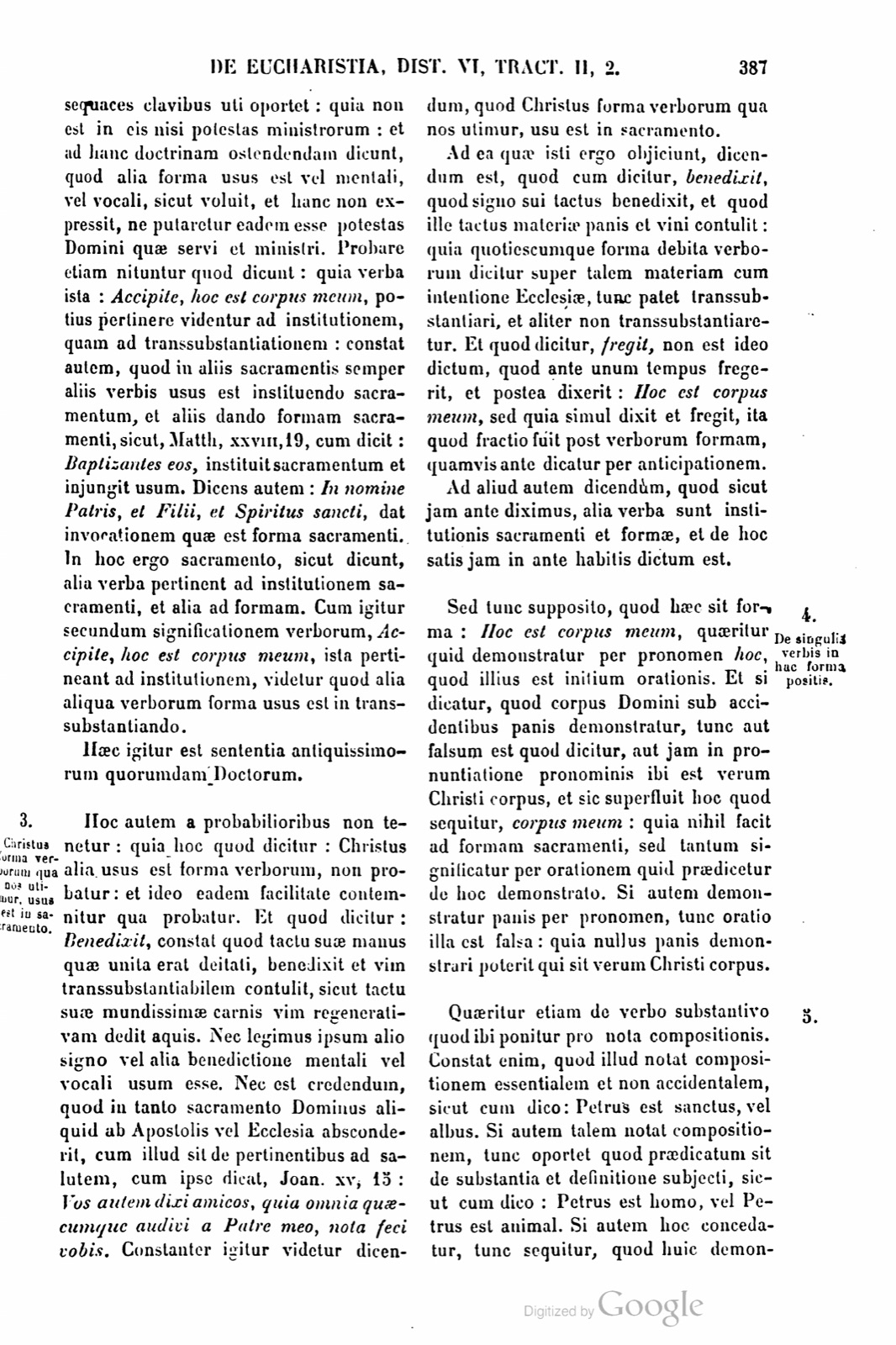
4. Sed tunc supposito, quod haec sit forma: Hoc est corpus meum, quaeritur quid demonstratur per pronomen hoc, quod illius est initium orationis. Et si dicatur, quod corpus Domini sub accidentibus panis demonstratur, tunc aut falsum est quod dicitur, aut jam in pronuntiatione pronominis ibi est verum Christi corpus, et sic superfluit hoc quod sequitur, corpus meum: quia nihil facit ad formam sacramenti, sed tantum significatur per orationem quid praedicetur de hoc demonstrato. Si autem demonstratur panis per pronomen, tunc oratio illa est falsa: quia nullus panis demonstrari poterit qui sit verum Christi corpus.
5. Quaeritur etiam de verbo substantivo quod ibi ponitur pro nota compositionis. Constat enim, quod illud notat compositionem essentialem et non accidentalem, sicut cum dico: Petrus est sanctus, vel albus. Si autem talem notat compositionem, tunc oportet quod praedicatum sit de substantia et definitione subjecti, sicut cum dico: Petrus est homo, vel Petrus est animal. Si autem hoc concedatur, tunc sequitur, quod huic demonstrato substantiale et essentiale est esse corpus Domini. Ad hoc ergo quod fiat corpus Domini, non indiget illa mutatione, quae vocatur transsubstantiatio, quod omnino falsum est: quia ad hoc forma sacramenti profertur super materiam demonstratam, quod transsubstantiatio fiat.
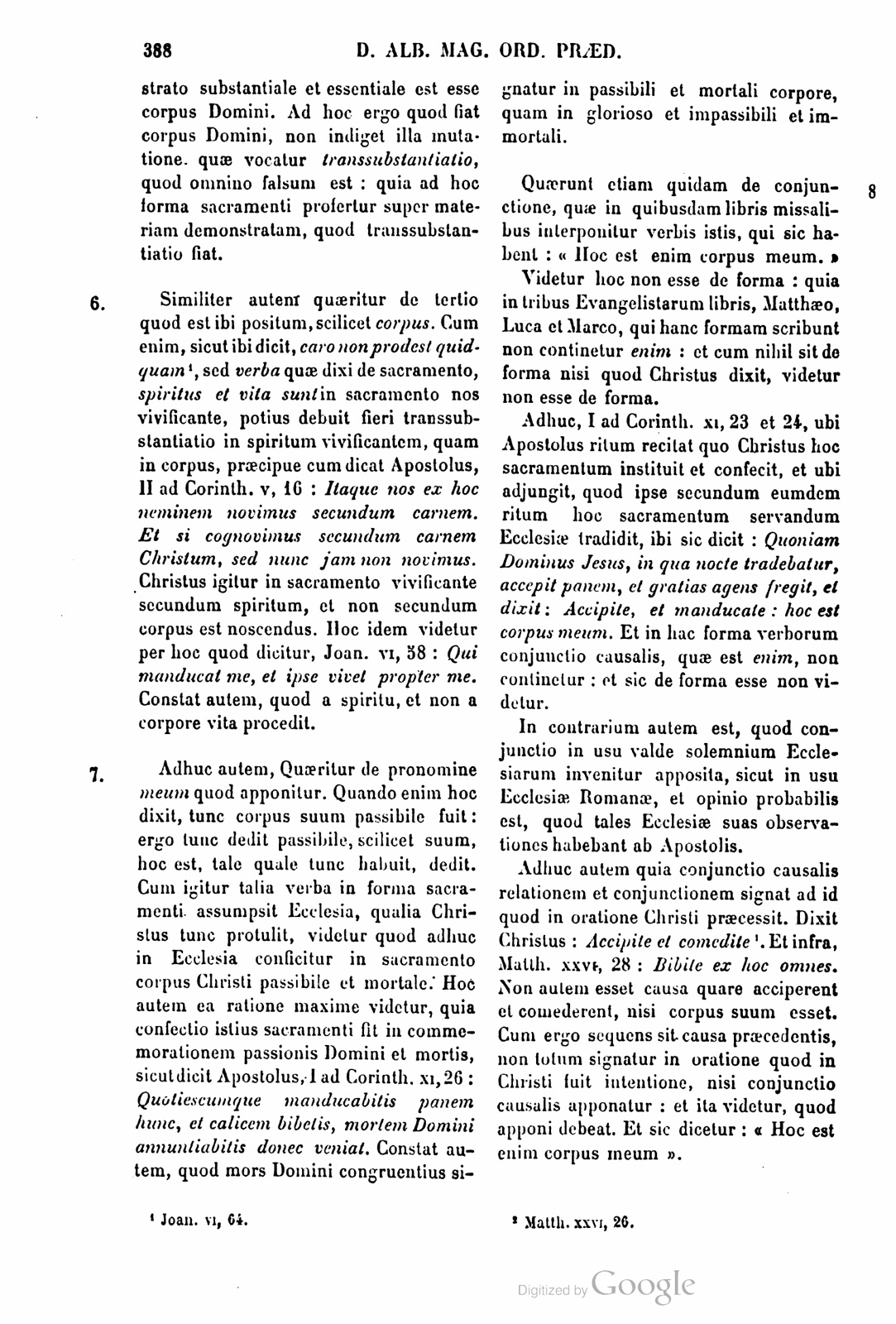
6. Similiter autem quaeritur de tertio quod est ibi positum, scilicet corpus. Cum enim, sicut ibi dicit, caro non prodest quidquam 1, sed verba quae dixi de sacramento, spiritus et vita sunt in sacramento nos vivificante, potius debuit fieri transsubstantiatio in spiritum vivificantem, quam in corpus, praecipue cum dicat Apostolus, II ad Corinth. V, 16: Itaque nos ex hoc neminem novimus secundum carnem. Et si cognovimus secundum carnem Christum, sed nunc jam non novimus. Christus igitur in sacramento vivificante secundum spiritum, et non secundum corpus est noscendus. Hoc idem videtur per hoc quod dicitur, Joan. VI, 58: Qui manducat me, et ipse vivet propter me. Constat autem, quod a spiritu, et non a corpore vita procedit.
7. Adhuc autem, Quaeritur de pronomine meum quod apponitur. Quando enim hoc dixit, tunc corpus suum passibile fuit: ergo tunc dedit passibile, scilicet suum, hoc est, tale quale tunc habuit, dedit. Cum igitur talia verba in forma sacramenti assumpsit Ecclesia, qualia Christus tunc protulit, videtur quod adhuc in Ecclesia conficitur in sacramento corpus Christi passibile et mortale. Hoc autem ea ratione maxime videtur, quia confectio istius sacramenti fit in commemorationem passionis Domini et mortis, sicut dicit Apostolus, I ad Corinth. XI, 26: Quotiescumque manducabitis panem hunc, et calicem bibetis, mortem Domini annuntiabitis donec veniat. Constat autem, quod mors Domini congruentius signatur in passibili et mortali corpore, quam in glorioso et impassibili et immortali.
Marginal label (printed p. 387): The form of words which we use, he used in the sacrament.
Marginal label (printed p. 387): On the individual words placed in this form.
4. But then, supposing that this is the form, This is my body, it is asked what is demonstrated by the pronoun this, which is the beginning of that utterance. And if it is said that the body of the Lord is demonstrated under the accidents of bread, then either what is said is false, or already in the pronouncing of the pronoun the true body of Christ is there, and thus what follows, my body, is superfluous, because it does nothing toward the form of the sacrament, but only signifies through the utterance what is predicated of this thing demonstrated. But if bread is demonstrated through the pronoun, then that utterance is false, because no bread can be demonstrated which is the true body of Christ.
5. It is also asked about the substantive verb which is placed there as the mark of composition. For it is agreed that it marks an essential and not an accidental composition, as when I say, Peter is holy, or white. But if it marks such a composition, then the predicate must be of the substance and definition of the subject, as when I say, Peter is a man, or Peter is an animal. But if this is conceded, then it follows that to this thing demonstrated it is substantial and essential to be the body of the Lord. Therefore, in order that it become the body of the Lord, it does not need that change which is called transubstantiation, which is wholly false, because the form of the sacrament is uttered over the demonstrated matter for this, that transubstantiation may occur.
6. Similarly, it is asked about the third thing placed there, namely body. For since, as he says there, the flesh profits nothing 1, but the words which I have spoken concerning the sacrament are spirit and life in the sacrament vivifying us, transubstantiation ought rather to have been made into the vivifying spirit than into the body, especially since the Apostle says, 2 Corinthians 5:16: And so we henceforth know no one according to the flesh. And if we have known Christ according to the flesh, yet now we know him no longer. Therefore Christ in the vivifying sacrament is to be known according to the spirit and not according to the body. This same thing seems from what is said in John 6:58: He who eats me, he also shall live because of me. But it is agreed that life proceeds from the spirit, and not from the body.
7. Moreover, it is asked about the pronoun my which is appended. For when he said this, then his body was passible; therefore then he gave a passible body, namely his own; that is, he gave such as he then had. Since therefore the Church took up such words in the form of the sacrament as Christ then uttered, it seems that even now in the Church the passible and mortal body of Christ is confected in the sacrament. But this seems especially by this reason, because the confecting of this sacrament is done in commemoration of the Lord's passion and death, as the Apostle says, 1 Corinthians 11:26: As often as you shall eat this bread and drink the chalice, you shall announce the death of the Lord until he comes. But it is agreed that the death of the Lord is more fittingly signified in a passible and mortal body than in a glorious and impassible and immortal body.
8. Quaerunt etiam quidam de conjunctione, quae in quibusdam libris missalibus interponitur verbis istis, qui sic habent: « Hoc est enim corpus meum. » Videtur hoc non esse de forma: quia in tribus Evangelistarum libris, Matthaeo, Luca et Marco, qui hanc formam scribunt non continetur enim: et cum nihil sit de forma nisi quod Christus dixit, videtur non esse de forma.
Adhuc, I ad Corinth. XI, 23 et 24, ubi Apostolus ritum recitat quo Christus hoc sacramentum instituit et confecit, et ubi adjungit, quod ipse secundum eumdem ritum hoc sacramentum servandum Ecclesiae tradidit, ibi sic dicit: Quoniam Dominus Jesus, in qua nocte tradebatur, accepit panem, et gratias agens fregit, et dixit: Accipite, et manducate: hoc est corpus meum. Et in hac forma verborum conjunctio causalis, quae est enim, non continetur: et sic de forma esse non videtur.
In contrarium autem est, quod conjunctio in usu valde solemnium Ecclesiarum invenitur apposita, sicut in usu Ecclesiae Romanae, et opinio probabilis est, quod tales Ecclesiae suas observationes habebant ab Apostolis.
Adhuc autem quia conjunctio causalis relationem et conjunctionem signat ad id quod in oratione Christi praecessit. Dixit Christus: Accipite et comedite 2. Et infra, Matth. XXVI, 28: Bibite ex hoc omnes. Non autem esset causa quare acciperent et comederent, nisi corpus suum esset. Cum ergo sequens sit causa praecedentis, non totum signatur in oratione quod in Christi fuit intentione, nisi conjunctio causalis apponatur: et ita videtur, quod apponi debeat. Et sic dicetur: « Hoc est enim corpus meum ».
8. Certain persons also ask about the conjunction which in certain missal books is interposed in those words, which have it thus: "For this is my body." It seems that this is not of the form, because in the books of the three Evangelists, Matthew, Luke, and Mark, who write this form, for is not contained; and since nothing is of the form except what Christ said, it seems not to be of the form.
Moreover, in 1 Corinthians 11:23 and 24, where the Apostle recounts the rite by which Christ instituted and confected this sacrament, and where he adds that he himself handed on this sacrament to the Church to be observed according to the same rite, there he says thus: For the Lord Jesus, on the night in which he was betrayed, took bread, and giving thanks broke it and said: Take and eat; this is my body. And in this form of words the causal conjunction, which is for, is not contained; and thus it does not seem to be of the form.
But to the contrary is that the conjunction is found appended in the usage of very solemn Churches, as in the usage of the Roman Church, and the probable opinion is that such Churches had their observances from the Apostles.
Moreover, because a causal conjunction signifies relation and conjunction to that which preceded in the utterance of Christ. Christ said: Take and eat 2. And below, Matthew 26:28: Drink all of this. But there would not be a cause why they should take and eat unless it were his body. Since therefore what follows is the cause of what precedes, not everything that was in Christ's intention is signified in the utterance unless the causal conjunction is appended; and so it seems that it ought to be appended. And thus it will be said: "For this is my body."
If a page does not appear, its photograph has not been uploaded yet.