Works › The Book on the Sacrament of the Eucharist
Volume 38 · pp. 383–385
Chapter I, 16-17
A marker with ≈ is an approximate page boundary, placed by measure of the text; the page photographs remain the authority. In the paired views, clicking a page marker brings that page into view.
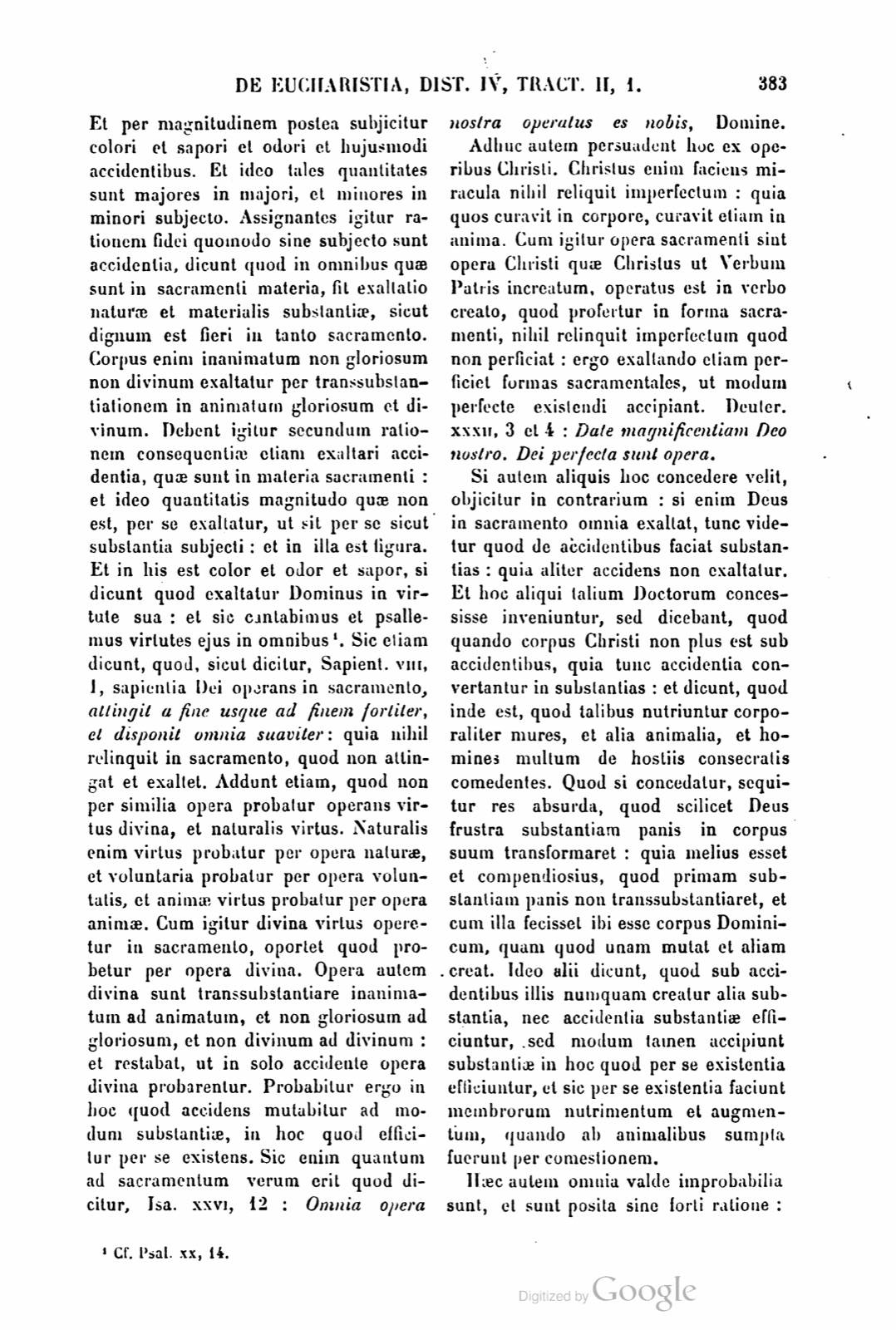
Et per magnitudinem postea subjicitur colori et sapori et odori et hujusmodi accidentibus. Et ideo tales quantitates sunt majores in majori, et minores in minori subjecto. Assignantes igitur rationem fidei quomodo sine subjecto sunt accidentia, dicunt quod in omnibus quae sunt in sacramenti materia, fit exaltatio naturae et materialis substantiae, sicut dignum est fieri in tanto sacramento. Corpus enim inanimatum non gloriosum non divinum exaltatur per transsubstantiationem in animatum gloriosum et divinum. Debent igitur secundum rationem consequentiae etiam exaltari accidentia, quae sunt in materia sacramenti: et ideo quantitatis magnitudo quae non est, per se exaltatur, ut sit per se sicut substantia subjecti: et in illa est figura. Et in his est color et odor et sapor, si dicunt quod exaltatur Dominus in virtute sua: et sic cantabimus et psallemus virtutes ejus in omnibus 1. Sic etiam dicunt, quod, sicut dicitur, Sapient. VIII, 1, sapientia Dei operans in sacramento, attingit a fine usque ad finem fortiter, et disponit omnia suaviter: quia nihil relinquit in sacramento, quod non attingat et exaltet. Addunt etiam, quod non per similia opera probatur operans virtus divina, et naturalis virtus. Naturalis enim virtus probatur per opera naturae, et voluntaria probatur per opera voluntatis, et animae virtus probatur per opera animae. Cum igitur divina virtus operetur in sacramento, oportet quod probetur per opera divina. Opera autem divina sunt transsubstantiare inanimatum ad animatum, et non gloriosum ad gloriosum, et non divinum ad divinum: et restabat, ut in solo accidente opera divina probarentur. Probabitur ergo in hoc quod accidens mutabitur ad modum substantiae, in hoc quod efficitur per se existens. Sic enim quantum ad sacramentum verum erit quod dicitur, Isa. XXVI, 12: Omnia opera nostra operatus es nobis, Domine.
Adhuc autem persuadent hoc ex operibus Christi. Christus enim faciens miracula nihil reliquit imperfectum: quia quos curavit in corpore, curavit etiam in anima. Cum igitur opera sacramenti sint opera Christi quae Christus ut Verbum Patris increatum, operatus est in verbo creato, quod profertur in forma sacramenti, nihil relinquit imperfectum quod non perficiat: ergo exaltando etiam perficiet formas sacramentales, ut modum perfecte existendi accipiant. Deuter. XXXII, 3 et 4: Date magnificentiam Deo nostro. Dei perfecta sunt opera.
Si autem aliquis hoc concedere velit, objicitur in contrarium: si enim Deus in sacramento omnia exaltat, tunc videtur quod de accidentibus faciat substantias: quia aliter accidens non exaltatur. Et hoc aliqui talium Doctorum concessisse inveniuntur, sed dicebant, quod quando corpus Christi non plus est sub accidentibus, quia tunc accidentia convertantur in substantias: et dicunt, quod inde est, quod talibus nutriuntur corporaliter mures, et alia animalia, et homines multum de hostiis consecratis comedentes. Quod si concedatur, sequitur res absurda, quod scilicet Deus frustra substantiam panis in corpus suum transformaret: quia melius esset et compendiosius, quod primam substantiam panis non transsubstantiaret, et cum illa fecisset ibi esse corpus Dominicum, quam quod unam mutat et aliam creat. Ideo alii dicunt, quod sub accidentibus illis numquam creatur alia substantia, nec accidentia substantiae efficiuntur, sed modum tamen accipiunt substantiae in hoc quod per se existentia efficiuntur, et sic per se existentia faciunt membrorum nutrimentum et augmentum, quando ab animalibus sumpta fuerunt per comestionem.
And through magnitude afterward it is subjected to color and taste and smell and accidents of this kind. And therefore such quantities are greater in a greater subject and lesser in a lesser subject. Therefore, assigning the account of faith, how accidents are without a subject, they say that in all things that are in the matter of the sacrament there occurs an exaltation of nature and of material substance, as is worthy to occur in so great a sacrament. For a body inanimate, not glorious, not divine, is exalted through transubstantiation into an animate, glorious, and divine body. Therefore, according to the account of consequence, the accidents also ought to be exalted, which are in the matter of the sacrament; and therefore the magnitude of quantity, which is not by itself, is exalted so that it may be by itself like the substance of a subject; and in that there is figure. And in these there is color and smell and taste, if they say that the Lord is exalted in his power; and thus we shall sing and sing psalms to his powers in all things 1. Thus also they say that, as is said in Wisdom 8:1, the wisdom of God, working in the sacrament, reaches from end even to end mightily and disposes all things sweetly, because it leaves nothing in the sacrament which it does not reach and exalt. They add also that the divine working power and natural power are not proved by similar works. For natural power is proved by works of nature, and voluntary power is proved by works of will, and the soul's power is proved by works of the soul. Since therefore divine power works in the sacrament, it must be proved through divine works. But divine works are to transubstantiate the inanimate to the animate, and the non-glorious to the glorious, and the non-divine to the divine; and it remained that divine works be proved in accident alone. Therefore it will be proved in this, that accident will be changed to the mode of substance, in that it is made existing by itself. Thus, indeed, with respect to the sacrament, what is said will be true: Isaiah 26:12, All our works you have worked for us, Lord.
Moreover they persuade this from the works of Christ. For Christ, doing miracles, left nothing imperfect, because those whom he cured in body he also cured in soul. Since therefore the works of the sacrament are works of Christ, which Christ as the uncreated Word of the Father worked in the created word that is uttered in the form of the sacrament, he leaves nothing imperfect which he does not perfect; therefore by exalting he will also perfect the sacramental forms, so that they may receive the mode of existing perfectly. Deuteronomy 32:3 and 4: Give magnificence to our God. The works of God are perfect.
But if someone should wish to concede this, an objection is made to the contrary: for if God exalts all things in the sacrament, then it seems that from accidents he makes substances, because otherwise an accident is not exalted. And some of such Doctors are found to have conceded this, but they said that when the body of Christ is no longer under the accidents, then the accidents are converted into substances; and they say that hence it is that by such things mice and other animals, and men eating much of consecrated hosts, are nourished bodily. But if this is conceded, an absurd thing follows, namely that God would transform the substance of bread into his body in vain, because it would be better and briefer that he not transubstantiate the first substance of bread, and with that he had made the Lord's body to be there, than that he change one and create another. Therefore others say that under those accidents another substance is never created, nor are the accidents made substances; nevertheless they receive the mode of substance in this, that they are made things existing by themselves, and thus, existing by themselves, they make nourishment and growth of the members when they have been taken by animals through eating.
Haec autem omnia valde improbabilia sunt, et sunt posita sine forti ratione: quod enim aliquid participet definitionem, et non participet nomen, non est intelligibile. Definitio autem substantiae est, quod est res per se existens. Quod igitur accidens efficiatur res per se existens, et non efficiatur substantia, non est intelligibile. Et si forte ad hanc rationem aliquis vellet dicere, quod hoc quod dico, res per se existens, non est definitio substantiae: quia substantia cum sit generalissimum, non habet definitionem: hoc valde parum valet: quia cum dicitur per se existens, dicitur hoc quo substantia substantia est, et quod est intrinsecum et essentiale substantiae. Et ideo quamvis non habeat genus extra se, tamen oportet quod habeat intra se id unde substantia est, et per quod ab accidente distinguitur: et tunc adhuc procedit objectio: quia non est intelligibile, quod aliquid sit vel efficiatur res per se existens, et non sit vel efficiatur substantia.
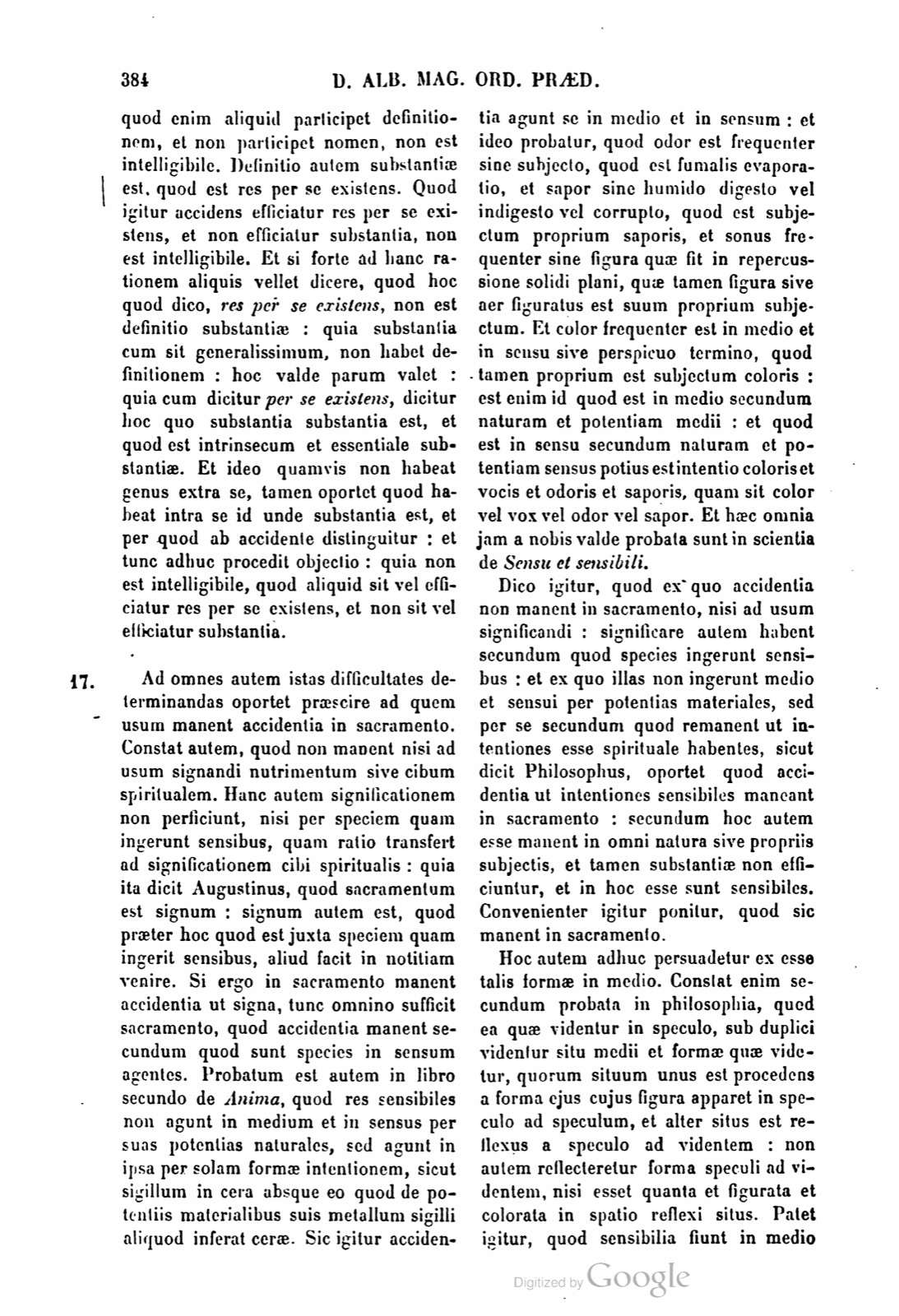
17. Ad omnes autem istas difficultates determinandas oportet praescire ad quem usum manent accidentia in sacramento. Constat autem, quod non manent nisi ad usum signandi nutrimentum sive cibum spiritualem. Hanc autem significationem non perficiunt, nisi per speciem quam ingerunt sensibus, quam ratio transfert ad significationem cibi spiritualis: quia ita dicit Augustinus, quod sacramentum est signum: signum autem est, quod praeter hoc quod est juxta speciem quam ingerit sensibus, aliud facit in notitiam venire. Si ergo in sacramento manent accidentia ut signa, tunc omnino sufficit sacramento, quod accidentia manent secundum quod sunt species in sensum agentes. Probatum est autem in libro secundo de Anima, quod res sensibiles non agunt in medium et in sensus per suas potentias naturales, sed agunt in ipsa per solam formae intentionem, sicut sigillum in cera absque eo quod de potentiis materialibus suis metallum sigilli aliquod inferat cerae. Sic igitur accidentia agunt se in medio et in sensum: et ideo probatur, quod odor est frequenter sine subjecto, quod est fumalis evaporatio, et sapor sine humido digesto vel indigesto vel corrupto, quod est subjectum proprium saporis, et sonus frequenter sine figura quae fit in repercussione solidi plani, quae tamen figura sive aer figuratus est suum proprium subjectum. Et color frequenter est in medio et in sensu sive perspicuo termino, quod tamen proprium est subjectum coloris: est enim id quod est in medio secundum naturam et potentiam medii: et quod est in sensu secundum naturam et potentiam sensus potius est intentio coloris et vocis et odoris et saporis, quam sit color vel vox vel odor vel sapor. Et haec omnia jam a nobis valde probata sunt in scientia de Sensu et sensibili.
But all these things are very improbable, and they have been set down without strong reason: for that something should share in the definition and not share in the name is not intelligible. But the definition of substance is that it is a thing existing by itself. Therefore that an accident should be made a thing existing by itself and not be made a substance is not intelligible. And if perhaps at this argument someone wanted to say that what I call a thing existing by itself is not the definition of substance, because substance, since it is the most general thing, does not have a definition, this is worth very little; because when it is called existing by itself, this is said whereby substance is substance, and what is intrinsic and essential to substance. And therefore, although it does not have a genus outside itself, nevertheless it must have within itself that whence it is substance and through which it is distinguished from accident; and then the objection still proceeds, because it is not intelligible that something is or is made a thing existing by itself and is not or is not made a substance.
17. But for determining all these difficulties, it is necessary to know beforehand for what use the accidents remain in the sacrament. It is agreed that they remain only for the use of signifying nourishment or spiritual food. But they do not perfect this signification except through the appearance which they bring to the senses, which reason transfers to the signification of spiritual food; because Augustine says in this way that a sacrament is a sign; and a sign is that which, besides that which it is according to the appearance which it brings to the senses, makes another thing come into knowledge. Therefore, if accidents remain in the sacrament as signs, then it wholly suffices for the sacrament that the accidents remain according as they are appearances acting upon sense. But it was proved in the second book On the Soul that sensible things do not act upon the medium and upon the senses through their natural powers, but they act upon them through the intention of form alone, as a seal in wax without the metal of the seal bringing any of its material powers into the wax. Thus therefore accidents conduct themselves in the medium and in sense; and therefore it is proved that smell is frequently without a subject, which is a smoky evaporation, and taste without digested or undigested or corrupted moisture, which is the proper subject of taste, and sound frequently without the figure that occurs in the repercussion of a flat solid, which figure, or figured air, is nevertheless its proper subject. And color is frequently in the medium and in sense or in the transparent as term, which nevertheless is the proper subject of color; for what is in the medium is there according to the nature and power of the medium, and what is in sense according to the nature and power of sense is rather the intention of color and of voice and of smell and of taste than color or voice or smell or taste. And all these things have already been strongly proved by us in the science On Sense and the Sensible.
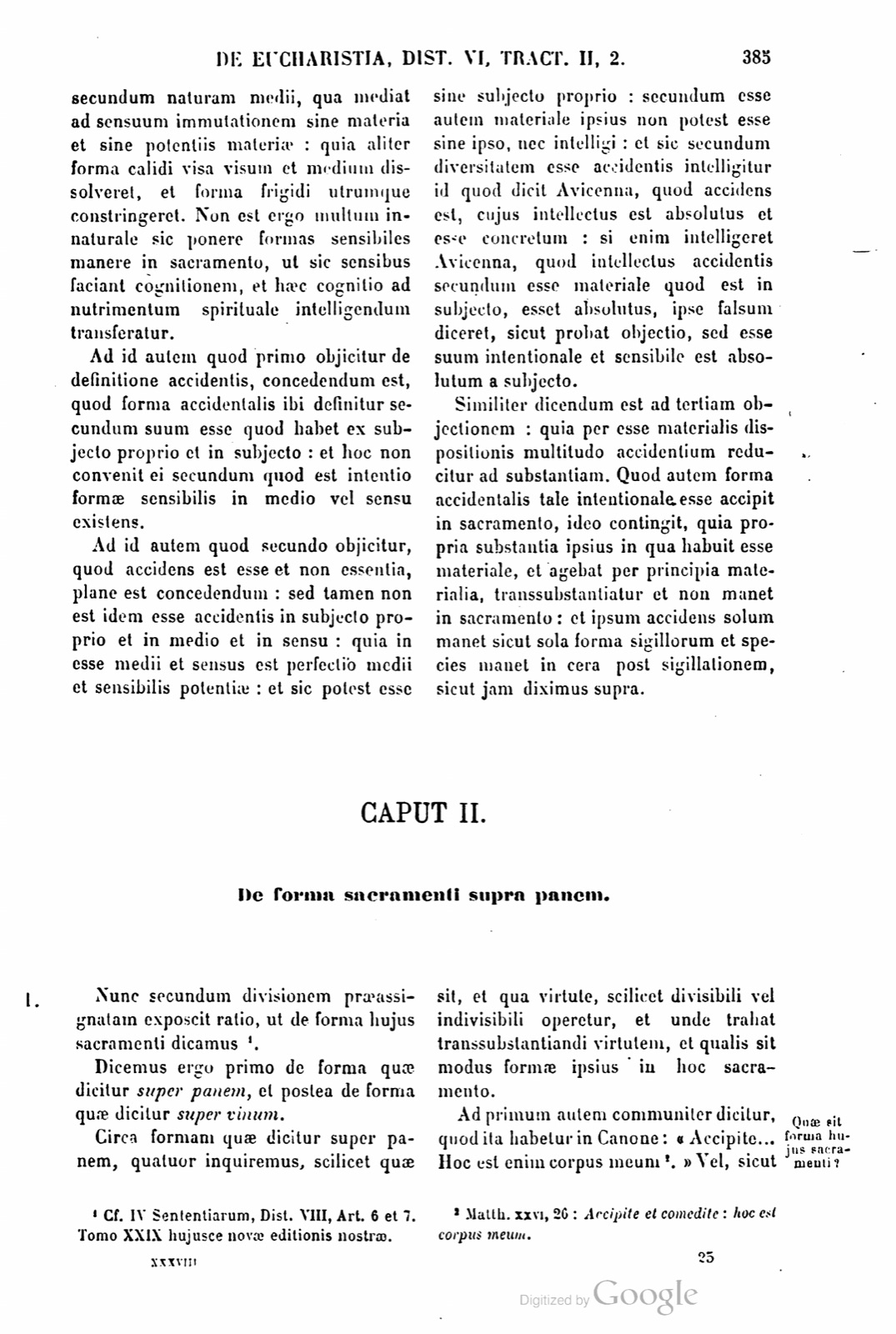
Dico igitur, quod ex quo accidentia non manent in sacramento, nisi ad usum significandi: significare autem habent secundum quod species ingerunt sensibus: et ex quo illas non ingerunt medio et sensui per potentias materiales, sed per se secundum quod remanent ut intentiones esse spirituale habentes, sicut dicit Philosophus, oportet quod accidentia ut intentiones sensibiles maneant in sacramento: secundum hoc autem esse manent in omni natura sive propriis subjectis, et tamen substantiae non efficiuntur, et in hoc esse sunt sensibiles. Convenienter igitur ponitur, quod sic manent in sacramento.
Hoc autem adhuc persuadetur ex esse talis formae in medio. Constat enim secundum probata in philosophia, quod ea quae videntur in speculo, sub duplici videntur situ medii et formae quae videtur, quorum situum unus est procedens a forma ejus cujus figura apparet in speculo ad speculum, et alter situs est reflexus a speculo ad videntem: non autem reflecteretur forma speculi ad videntem, nisi esset quanta et figurata et colorata in spatio reflexi situs. Patet igitur, quod sensibilia fiunt in medio secundum naturam medii, qua mediat ad sensuum immutationem sine materia et sine potentiis materiae: quia aliter forma calidi visa visum et medium dissolveret, et forma frigidi utrumque constringeret. Non est ergo multum innaturale sic ponere formas sensibiles manere in sacramento, ut sic sensibus faciant cognitionem, et haec cognitio ad nutrimentum spirituale intelligendum transferatur.
Ad id autem quod primo objicitur de definitione accidentis, concedendum est, quod forma accidentalis ibi definitur secundum suum esse quod habet ex subjecto proprio et in subjecto: et hoc non convenit ei secundum quod est intentio formae sensibilis in medio vel sensu existens.
Ad id autem quod secundo objicitur, quod accidens est esse et non essentia, plane est concedendum: sed tamen non est idem esse accidentis in subjecto proprio et in medio et in sensu: quia in esse medii et sensus est perfectio medii et sensibilis potentiae: et sic potest esse sine subjecto proprio: secundum esse autem materiale ipsius non potest esse sine ipso, nec intelligi: et sic secundum diversitatem esse accidentis intelligitur id quod dicit Avicenna, quod accidens est, cujus intellectus est absolutus et esse concretum: si enim intelligeret Avicenna, quod intellectus accidentis secundum esse materiale quod est in subjecto, esset absolutus, ipse falsum diceret, sicut probat objectio, sed esse suum intentionale et sensibile est absolutum a subjecto.
Similiter dicendum est ad tertiam objectionem: quia per esse materialis dispositionis multitudo accidentium reducitur ad substantiam. Quod autem forma accidentalis tale intentionale esse accipit in sacramento, ideo contingit, quia propria substantia ipsius in qua habuit esse materiale, et agebat per principia materialia, transsubstantiatur et non manet in sacramento: et ipsum accidens solum manet sicut sola forma sigillorum et species manet in cera post sigillationem, sicut jam diximus supra.
I say therefore that, since accidents remain in the sacrament only for the use of signifying, and they have signifying according as appearances bring them to the senses, and since they do not bring them to the medium and to sense through material powers but by themselves according as they remain as intentions having spiritual being, as the Philosopher says, it is necessary that accidents remain in the sacrament as sensible intentions. But according to this being they remain in every nature or in their proper subjects, and nevertheless they are not made substances, and in this being they are sensible. Therefore it is fittingly posited that they remain thus in the sacrament.
This is still further persuaded from the being of such a form in the medium. For it is agreed according to things proved in philosophy that things which are seen in a mirror are seen under a double position of the medium and of the form that is seen; of these positions, one proceeds from the form of that whose figure appears in the mirror to the mirror, and the other position is reflected from the mirror to the one seeing. But the form of the mirror would not be reflected to the one seeing unless it were quantified and figured and colored in the space of the reflected position. Therefore it is clear that sensible things come to be in the medium according to the nature of the medium, by which it mediates to the alteration of the senses without matter and without the powers of matter; because otherwise the seen form of the hot thing would dissolve sight and the medium, and the form of the cold thing would constrict both. Therefore it is not very unnatural to posit that sensible forms thus remain in the sacrament, so that thus they may cause cognition for the senses, and this cognition may be transferred to understanding spiritual nourishment.
To that which is first objected concerning the definition of accident, it must be conceded that accidental form is defined there according to its being which it has from its proper subject and in a subject; and this does not belong to it according as it is the intention of a sensible form existing in the medium or sense.
To that which is objected second, that accident is being and not essence, this plainly must be conceded; yet nevertheless the being of accident in its proper subject and in the medium and in sense is not the same, because in the being of medium and sense it is the perfection of the medium and of the sensible power, and thus it can be without its proper subject; but according to its own material being it cannot be without it, nor be understood; and thus according to the diversity of the being of accident is understood what Avicenna says, that an accident is that whose understanding is absolute and whose being is concrete. For if Avicenna understood that the understanding of accident according to material being, which is in a subject, was absolute, he would say what is false, as the objection proves; but its intentional and sensible being is absolute from a subject.
Similarly, it must be said to the third objection that through the being of material disposition the multitude of accidents is reduced to substance. But that an accidental form receives such intentional being in the sacrament happens for this reason: its proper substance, in which it had material being and acted through material principles, is transubstantiated and does not remain in the sacrament; and the accident itself alone remains, as the form alone of seals and the appearance remain in wax after sealing, as we have already said above.
Notes
- Compare Psalm 20:14. (Cf. Psal. XX, 14.) ↩
If a page does not appear, its photograph has not been uploaded yet.