Works › The Book on the Sacrament of the Eucharist
Volume 38 · pp. 385–386
Chapter II. On the Form of the Sacrament over the Bread, 1-2
A marker with ≈ is an approximate page boundary, placed by measure of the text; the page photographs remain the authority. In the paired views, clicking a page marker brings that page into view.
Marginal label (printed p. 385): Quae sit forma hujus sacramenti?
CAPUT II.
De forma sacramenti supra panem.
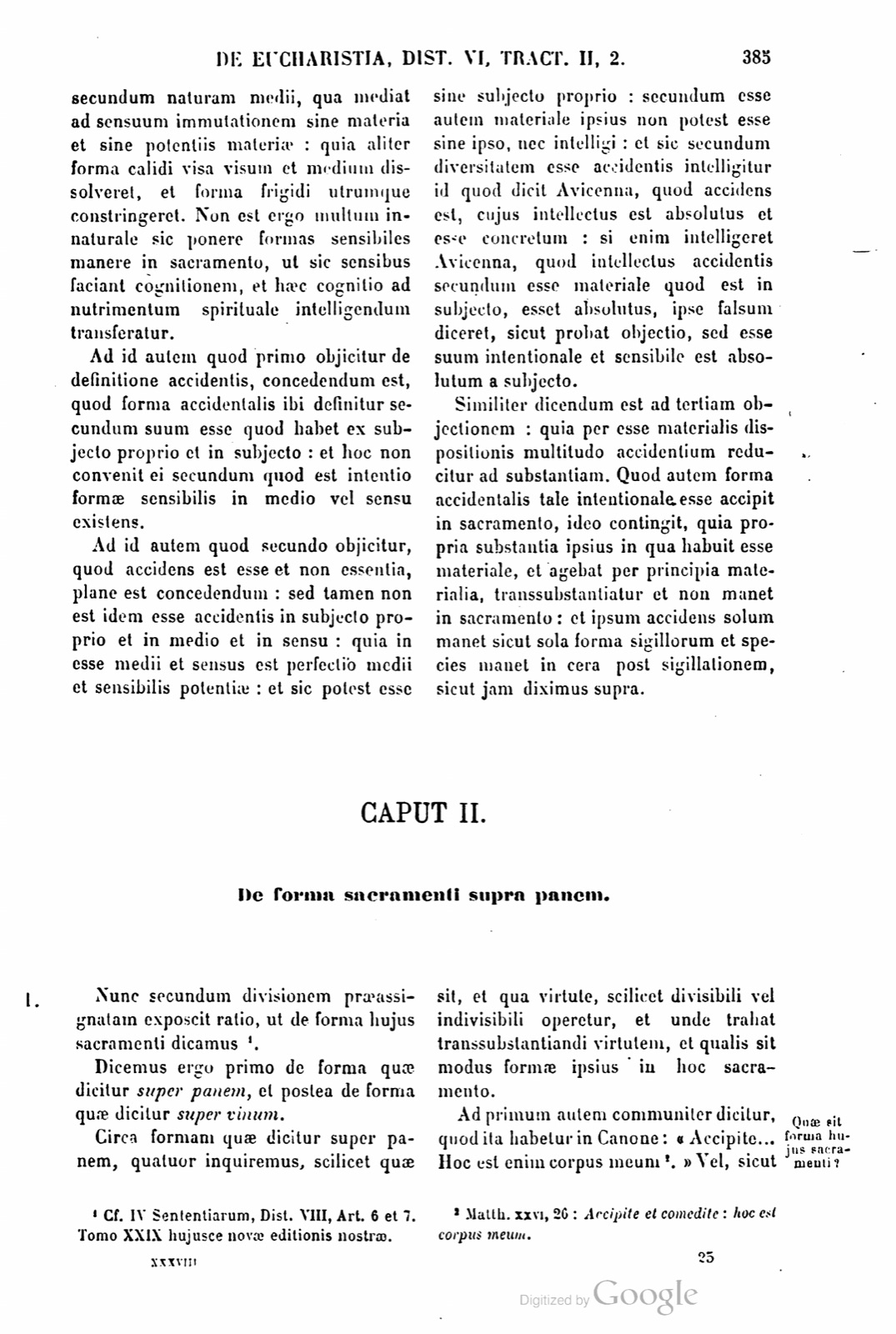
1. Nunc secundum divisionem praeassignatam exposcit ratio, ut de forma hujus sacramenti dicamus 1.
Dicemus ergo primo de forma quae dicitur super panem, et postea de forma quae dicitur super vinum.
Circa formam quae dicitur super panem, quatuor inquiremus, scilicet quae sit, et qua virtute, scilicet divisibili vel indivisibili operetur, et unde trahat transsubstantiandi virtutem, et qualis sit modus formae ipsius in hoc sacramento.
Ad primum autem communiter dicitur, quod ita habetur in Canone: « Accipite... Hoc est enim corpus meum 2. » Vel, sicut dicitur, Marc. XIV, 22: Sumite, hoc est corpus meum.
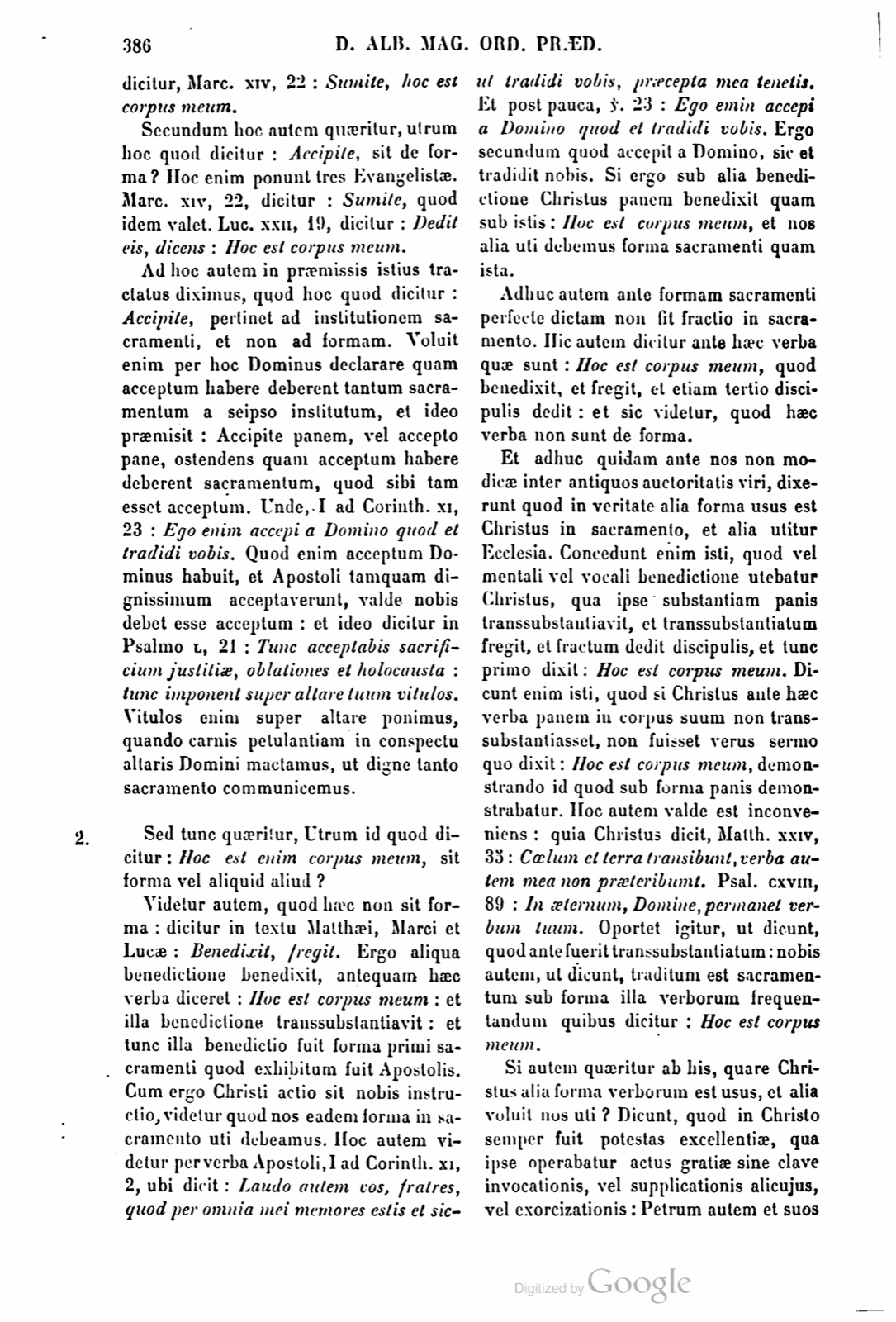
Secundum hoc autem quaeritur, utrum hoc quod dicitur: Accipite, sit de forma? Hoc enim ponunt tres Evangelistae. Marc. XIV, 22, dicitur: Sumite, quod idem valet. Luc. XXII, 19, dicitur: Dedit eis, dicens: Hoc est corpus meum.
Ad hoc autem in praemissis istius tractatus diximus, quod hoc quod dicitur: Accipite, pertinet ad institutionem sacramenti, et non ad formam. Voluit enim per hoc Dominus declarare quam acceptum habere deberent tantum sacramentum a seipso institutum, et ideo praemisit: Accipite panem, vel accepto pane, ostendens quam acceptum habere deberent sacramentum, quod sibi tam esset acceptum. Unde, I ad Corinth. XI, 23: Ego enim accepi a Domino quod et tradidi vobis. Quod enim acceptum Dominus habuit, et Apostoli tamquam dignissimum acceptaverunt, valde nobis debet esse acceptum: et ideo dicitur in Psalmo L, 21: Tunc acceptabis sacrificium justitiae, oblationes et holocausta: tunc imponent super altare tuum vitulos. Vitulos enim super altare ponimus, quando carnis petulantiam in conspectu altaris Domini mactamus, ut digne tanto sacramento communicemus.
2. Sed tunc quaeritur, Utrum id quod dicitur: Hoc est enim corpus meum, sit forma vel aliquid aliud?
Videtur autem, quod haec non sit forma: dicitur in textu Matthaei, Marci et Lucae: Benedixit, fregit. Ergo aliqua benedictione benedixit, antequam haec verba diceret: Hoc est corpus meum: et illa benedictione transsubstantiavit: et tunc illa benedictio fuit forma primi sacramenti quod exhibitum fuit Apostolis. Cum ergo Christi actio sit nobis instructio, videtur quod nos eadem forma in sacramento uti debeamus. Hoc autem videtur per verba Apostoli, I ad Corinth. XI, 2, ubi dicit: Laudo autem vos, fratres, quod per omnia mei memores estis et sicut tradidi vobis, praecepta mea tenetis. Et post pauca, v. 23: Ego enim accepi a Domino quod et tradidi vobis. Ergo secundum quod accepit a Domino, sic et tradidit nobis. Si ergo sub alia benedictione Christus panem benedixit quam sub istis: Hoc est corpus meum, et nos alia uti debemus forma sacramenti quam ista.
Marginal label (printed p. 385): What is the form of this sacrament?
CHAPTER II.
On the form of the sacrament over the bread.
1. Now, according to the division assigned beforehand, reason demands that we speak about the form of this sacrament 1.
Therefore we shall speak first about the form that is said over the bread, and afterward about the form that is said over the wine.
Concerning the form that is said over the bread, we shall inquire about four things, namely what it is, and by what power, namely divisible or indivisible, it operates, and whence it draws the power of transubstantiating, and what the mode of the form itself is in this sacrament.
But as to the first, it is commonly said that it is thus had in the Canon: "Take... For this is my body 2." Or, as is said in Mark 14:22: Take, this is my body.
According to this, however, it is asked whether this which is said, Take, is of the form. For the three Evangelists put this. In Mark 14:22 it is said, Take, which has the same force. In Luke 22:19 it is said, He gave to them, saying: This is my body.
But to this we said in the preceding parts of this tractate that this which is said, Take, pertains to the institution of the sacrament, and not to the form. For by this the Lord wished to declare how accepted they ought to hold so great a sacrament instituted by himself; and therefore he premised, Take bread, or with bread taken, showing how accepted they ought to hold the sacrament, which was so accepted by him. Hence 1 Corinthians 11:23: For I received from the Lord that which I also handed on to you. For what the Lord held as accepted, and the Apostles accepted as most worthy, ought to be very accepted by us; and therefore it is said in Psalm 50:21: Then you will accept the sacrifice of justice, oblations and holocausts; then they shall lay calves upon your altar. For we place calves upon the altar when we slay the wantonness of the flesh in the sight of the Lord's altar, so that we may communicate worthily in so great a sacrament.
2. But then it is asked whether that which is said, This is indeed my body, is the form or something else.
But it seems that this is not the form: it is said in the text of Matthew, Mark, and Luke: He blessed, he broke. Therefore he blessed by some blessing before he said these words, This is my body; and by that blessing he transubstantiated; and then that blessing was the form of the first sacrament which was shown to the Apostles. Since therefore Christ's action is instruction for us, it seems that we ought to use the same form in the sacrament. But this seems from the words of the Apostle, 1 Corinthians 11:2, where he says: I praise you, brothers, because in all things you are mindful of me and, as I handed on to you, you hold my precepts. And after a few words, verse 23: For I received from the Lord that which I also handed on to you. Therefore according as he received from the Lord, so also he handed on to us. Therefore, if Christ blessed the bread under another blessing than under these words, This is my body, we also ought to use another form of the sacrament than that one.
Adhuc autem ante formam sacramenti perfecte dictam non fit fractio in sacramento. Hic autem dicitur ante haec verba quae sunt: Hoc est corpus meum, quod benedixit, et fregit, et etiam tertio discipulis dedit: et sic videtur, quod haec verba non sunt de forma.
Et adhuc quidam ante nos non modicae inter antiquos auctoritatis viri, dixerunt quod in veritate alia forma usus est Christus in sacramento, et alia utitur Ecclesia. Concedunt enim isti, quod vel mentali vel vocali benedictione utebatur Christus, qua ipse substantiam panis transsubstantiavit, et transsubstantiatum fregit, et fractum dedit discipulis, et tunc primo dixit: Hoc est corpus meum. Dicunt enim isti, quod si Christus ante haec verba panem in corpus suum non transsubstantiasset, non fuisset verus sermo quo dixit: Hoc est corpus meum, demonstrando id quod sub forma panis demonstrabatur. Hoc autem valde est inconveniens: quia Christus dicit, Matth. XXIV, 35: Caelum et terra transibunt, verba autem mea non praeteribunt. Psal. CXVIII, 89: In aeternum, Domine, permanet verbum tuum. Oportet igitur, ut dicunt, quod antefuerit transsubstantiatum: nobis autem, ut dicunt, traditum est sacramentum sub forma illa verborum frequentandum quibus dicitur: Hoc est corpus meum.
Si autem quaeritur ab his, quare Christus alia forma verborum est usus, et alia voluit nos uti? Dicunt, quod in Christo semper fuit potestas excellentiae, qua ipse operabatur actus gratiae sine clave invocationis, vel supplicationis alicujus, vel exorcizationis: Petrum autem et suos
Moreover, before the form of the sacrament has been perfectly spoken, no breaking occurs in the sacrament. But here it is said before these words, which are, This is my body, that he blessed and broke and also, thirdly, gave to the disciples; and thus it seems that these words are not of the form.
And still some men before us, men of no slight authority among the ancients, said that in truth Christ used one form in the sacrament, and the Church uses another. For they concede that Christ used either a mental or vocal blessing, by which he himself transubstantiated the substance of bread, and broke it once transubstantiated, and gave it broken to the disciples, and then first said: This is my body. For they say that if Christ had not transubstantiated the bread into his body before these words, the speech by which he said, This is my body, would not have been true, demonstrating that which was being demonstrated under the form of bread. But this is very unfitting, because Christ says, Matthew 24:35: Heaven and earth shall pass away, but my words shall not pass away. Psalm 118:89: Forever, Lord, your word remains. Therefore it is necessary, as they say, that it had been transubstantiated beforehand; but to us, as they say, the sacrament was handed on to be repeated under that form of words by which it is said: This is my body.
But if it is asked of these why Christ used one form of words and willed us to use another, they say that in Christ there was always the power of excellence, by which he himself worked acts of grace without the key of invocation, or of some supplication, or of exorcization; but Peter and his own successors
If a page does not appear, its photograph has not been uploaded yet.