Works › The Book on the Sacrament of the Eucharist
Volume 38 · pp. 381–382
Chapter I, Beginning of 16
A marker with ≈ is an approximate page boundary, placed by measure of the text; the page photographs remain the authority. In the paired views, clicking a page marker brings that page into view.
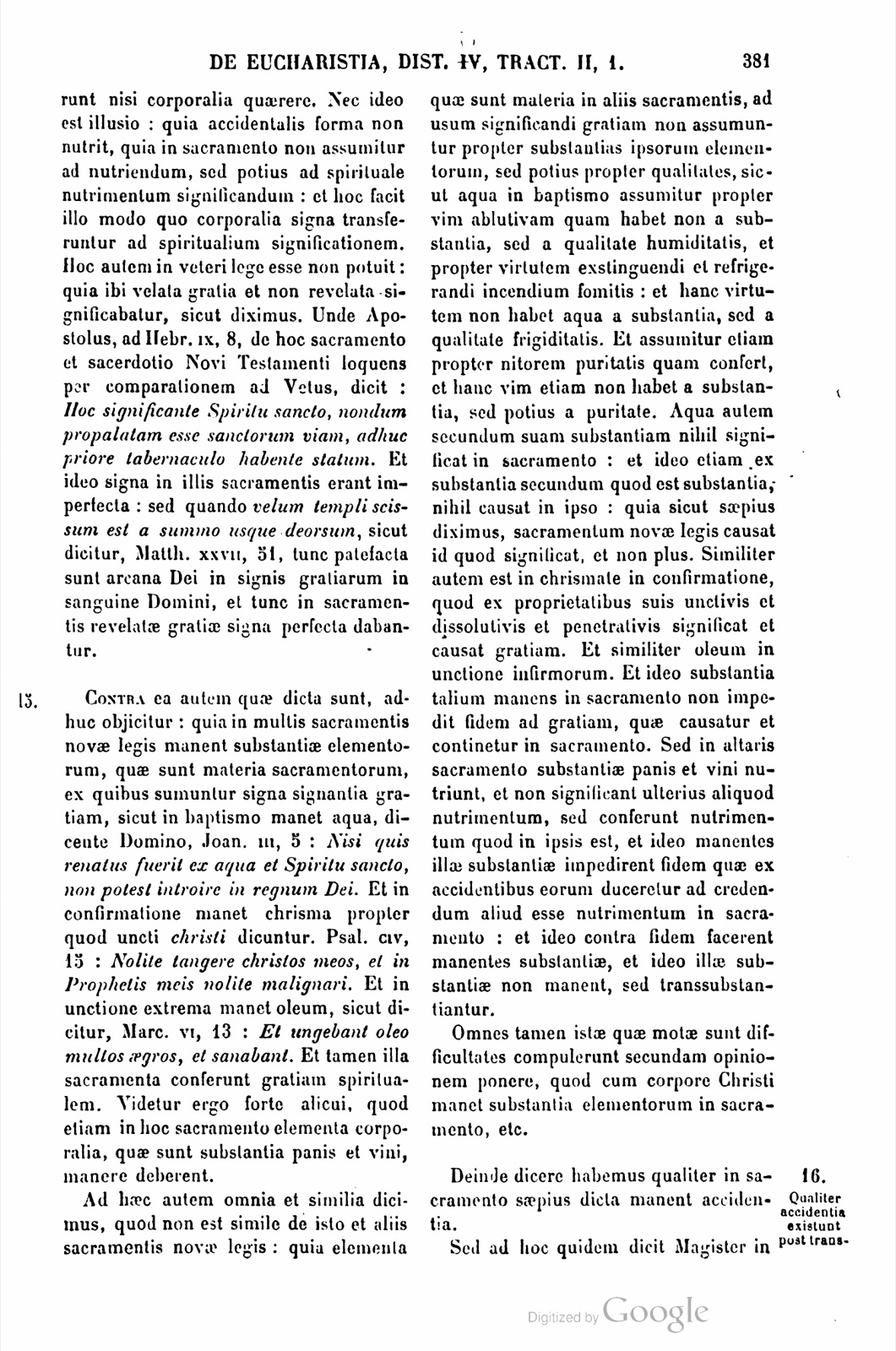
16. Deinde dicere habemus qualiter in sacramento saepius dicta manent accidentia.
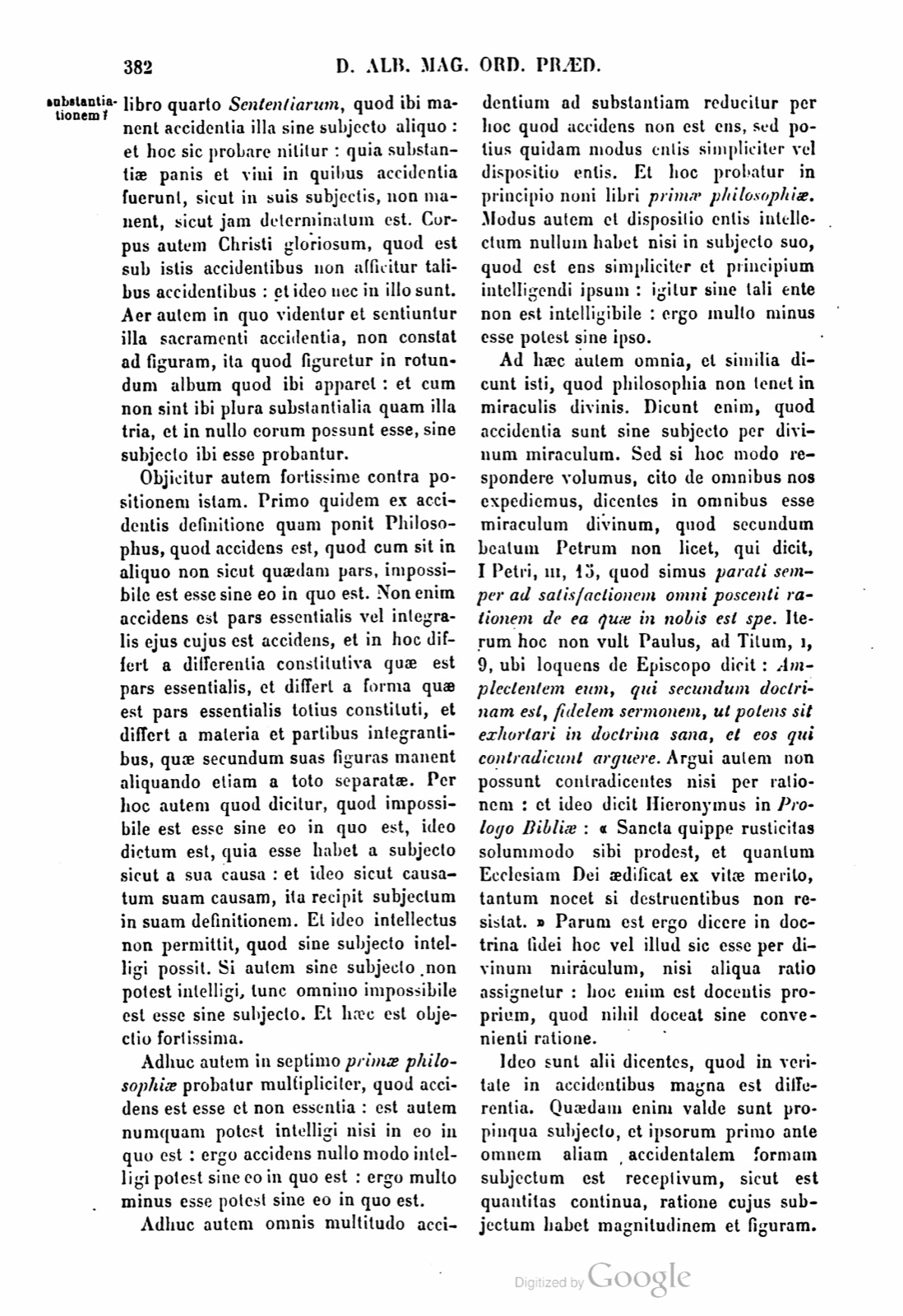
Sed ad hoc quidem dicit Magister in libro quarto Sententiarum, quod ibi manent accidentia illa sine subjecto aliquo: et hoc sic probare nititur: quia substantiae panis et vini in quibus accidentia fuerunt, sicut in suis subjectis, non manent, sicut jam determinatum est. Corpus autem Christi gloriosum, quod est sub istis accidentibus non afficitur talibus accidentibus: et ideo nec in illo sunt. Aer autem in quo videntur et sentiuntur illa sacramenti accidentia, non constat ad figuram, ita quod figuretur in rotundum album quod ibi apparet: et cum non sint ibi plura substantialia quam illa tria, et in nullo eorum possunt esse, sine subjecto ibi esse probantur.
Objicitur autem fortissime contra positionem istam. Primo quidem ex accidentis definitione quam ponit Philosophus, quod accidens est, quod cum sit in aliquo non sicut quaedam pars, impossibile est esse sine eo in quo est. Non enim accidens est pars essentialis vel integralis ejus cujus est accidens, et in hoc differt a differentia constitutiva quae est pars essentialis, et differt a forma quae est pars essentialis totius constituti, et differt a materia et partibus integrantibus, quae secundum suas figuras manent aliquando etiam a toto separatae. Per hoc autem quod dicitur, quod impossibile est esse sine eo in quo est, ideo dictum est, quia esse habet a subjecto sicut a sua causa: et ideo sicut causatum suam causam, ita recipit subjectum in suam definitionem. Et ideo intellectus non permittit, quod sine subjecto intelligi possit. Si autem sine subjecto non potest intelligi, tunc omnino impossibile est esse sine subjecto. Et haec est objectio fortissima.
Adhuc autem in septimo primae philosophiae probatur multipliciter, quod accidens est esse et non essentia: est autem numquam potest intelligi nisi in eo in quo est: ergo accidens nullo modo intelligi potest sine eo in quo est: ergo multo minus esse potest sine eo in quo est.
16. Then we have to say how the accidents often spoken of remain in the sacrament.
But to this the Master says in the fourth book of the Sentences that those accidents remain there without any subject; and he attempts to prove this thus: because the substances of bread and wine in which the accidents were, as in their subjects, do not remain, as has now been determined. But the glorious body of Christ, which is under these accidents, is not affected by such accidents, and therefore neither are they in it. But the air in which those accidents of the sacrament are seen and sensed does not stand to figure, so that it is figured into the round white thing which appears there; and since there are not there more substantial things than those three, and they cannot be in any of them, they are proved to be there without subject.
But it is objected most strongly against this position. First indeed from the definition of accident which the Philosopher posits, that an accident is that which, although it is in something not as a certain part, it is impossible for it to be without that in which it is. For an accident is not an essential or integral part of that of which it is an accident; and in this it differs from a constitutive difference, which is an essential part; and it differs from form, which is an essential part of the whole constituted; and it differs from matter and integrating parts, which according to their figures sometimes remain even separated from the whole. But through this, that it is said that it is impossible for it to be without that in which it is, it was said for this reason, because it has being from the subject as from its cause; and therefore, just as the caused receives its cause, so it receives the subject into its definition. And therefore the understanding does not permit that it can be understood without subject. But if it cannot be understood without subject, then it is altogether impossible for it to be without subject. And this is the strongest objection.
Moreover in the seventh book of first philosophy it is proved in many ways that an accident is being and not essence; but being can never be understood except in that in which it is. Therefore an accident can in no way be understood without that in which it is; therefore much less can it be without that in which it is.
Adhuc autem omnis multitudo accidentium ad substantiam reducitur per hoc quod accidens non est ens, sed potius quidam modus entis simpliciter vel dispositio entis. Et hoc probatur in principio noni libri primae philosophiae. Modus autem et dispositio entis intellectum nullum habet nisi in subjecto suo, quod est ens simpliciter et principium intelligendi ipsum: igitur sine tali ente non est intelligibile: ergo multo minus esse potest sine ipso.
Ad haec autem omnia, et similia dicunt isti, quod philosophia non tenet in miraculis divinis. Dicunt enim, quod accidentia sunt sine subjecto per divinum miraculum. Sed si hoc modo respondere volumus, cito de omnibus nos expediemus, dicentes in omnibus esse miraculum divinum, quod secundum beatum Petrum non licet, qui dicit, I Petri, III, 15, quod simus parati semper ad satisfactionem omni poscenti rationem de ea quae in nobis est spe. Iterum hoc non vult Paulus, ad Titum, I, 9, ubi loquens de Episcopo dicit: Amplectentem eum, qui secundum doctrinam est, fidelem sermonem, ut potens sit exhortari in doctrina sana, et eos qui contradicunt arguere. Argui autem non possunt contradicentes nisi per rationem: et ideo dicit Hieronymus in Prologo Bibliae: « Sancta quippe rusticitas solummodo sibi prodest, et quantum Ecclesiam Dei aedificat ex vitae merito, tantum nocet si destruentibus non resistat. » Parum est ergo dicere in doctrina fidei hoc vel illud sic esse per divinum miraculum, nisi aliqua ratio assignetur: hoc enim est docentis proprium, quod nihil doceat sine convenienti ratione.
Ideo sunt alii dicentes, quod in veritate in accidentibus magna est differentia. Quaedam enim valde sunt propinqua subjecto, et ipsorum primo ante omnem aliam accidentalem formam subjectum est receptivum, sicut est quantitas continua, ratione cujus subjectum habet magnitudinem et figuram.
Moreover every multitude of accidents is reduced to substance through this, that an accident is not a being, but rather a certain mode of being simply or a disposition of being. And this is proved at the beginning of the ninth book of first philosophy. But a mode and disposition of being has no understanding except in its subject, which is being simply and the principle of understanding it. Therefore without such a being it is not intelligible; therefore much less can it be without it.
But to all these and similar things those people say that philosophy does not hold in divine miracles. For they say that the accidents are without subject through a divine miracle. But if we wish to respond in this way, we shall quickly free ourselves from all things, saying that in all things there is a divine miracle, which according to blessed Peter is not lawful, who says, I Peter 3:15, that we should be "always ready for satisfaction to everyone asking for a reason concerning that hope which is in us." Again Paul does not will this, Titus 1:9, where, speaking of a bishop, he says: "Embracing that faithful speech which is according to doctrine, that he may be able to exhort in sound doctrine and to argue against those who contradict." But those who contradict cannot be argued against except through reason; and therefore Jerome says in the Prologue of the Bible: "Holy rusticity indeed profits only itself, and as much as it builds up the Church of God by the merit of life, so much it harms if it does not resist those destroying." Therefore it is too little in the doctrine of faith to say that this or that is so through a divine miracle, unless some reason is assigned; for this is proper to the one teaching, that he teach nothing without a fitting reason.
Therefore there are others saying that in truth there is great difference among accidents. For certain ones are very near to the subject, and the subject is receptive of them first before every other accidental form, as is continuous quantity, by reason of which the subject has magnitude and figure.
If a page does not appear, its photograph has not been uploaded yet.