Works › The Book on the Sacrament of the Eucharist
Volume 38 · pp. 379–381
Chapter I, 14-15
A marker with ≈ is an approximate page boundary, placed by measure of the text; the page photographs remain the authority. In the paired views, clicking a page marker brings that page into view.
Marginal label (printed p. 381): Qualiter accidentia existunt post transsubstantiationem?
14. Ad haec autem omnia et similia dicendum est, quod in veritate in sacramento remanent accidentia panis et vini sine omni substantia illis accidentibus subjecta, quam ipsa afficiunt accidentia: substantia enim panis et vini, quas substantias illa afficiebant accidentia, tum propter veritatem sermonis Domini, tum etiam propter sacramenti veritatem manere non poterit: quia si ibi substantiae panis et vini manerent, non esset verus sermo Domini quem dixit: Hoc est corpus meum, et, Hic est calix sanguinis mei: quia panis non est corpus Domini, et calix vini non est calix sanguinis Domini. Veritas etiam sacramenti non salvaretur: quia veritas sacramenti est in hoc quod significetur in sacramento esse verus cibus et verus potus spiritualis, sicut ipse dicit, Joan. VI, 56: Caro mea vere est cibus, et sanguis meus vere est potus. Si autem manerent in sacramento substantia panis et substantia vini, tunc accidentia illa essent in substantia panis et substantia vini, et essent illis substantiis propria. Et ideo non indicarent nisi nutrimentum, quod potest praestare substantia panis et substantia vini: et ille est cibus qui perit, sicut dicitur, Joan. VI, 27: et ille in sacramento requiri non debet. Cum autem in sacramento non manet illa substantia, non possunt accidentia illa ducere in tale corporale nutrimentum: et sic necessario ducunt in spirituale nutrimentum, quod in sacramento est requirendum.
Dicendum igitur ad primum, quod in veritate, sicut dicit Philosophus, non nutrit nisi potentia caro, et potentia os, et potentia nervus, et sic de aliis similibus partibus in homine. Sed quia tale nutrimentum corporale quo dissimilia membra in homine nutriuntur, ex hoc quod similia quae sunt in ipsis, nutriuntur in sacramento, sicut dicit Dominus, non debet requiri neque cogitari, ideo oportet quod illud corporaliter nutriens non sit in sacramento, sed totum secundum formam et materiam transsubstantietur: ideo substantia panis et vini non debent manere in sacramento, sed accidentia tantum per translationem factam ad spiritualia signantia nutrimentum spirituale. Hoc signatum est, Sapient. XVI, 26, ubi dicit quod non nativitatis fructus pascunt homines, sed sermo tuus hos qui in te crediderint conservat. Hoc enim verissimum est in sacramento altaris, in quo fructus nativitatis non manent, sed sermo Domini positus in forma sacramenti, et facit in sacramento pastum spiritualem.
Quod autem objicitur de Elia et de sacramentis veteris legis, non est simile: quia illa sunt signa imperfecta gratiam pasturae spiritualis ex seipsis non conferentia: et ideo manebat eorum substantia: quia spiritualis pastus in eis non continebatur. Unde etiam Dominus eos qui pastum corporalem in sacramentis requirebant, redarguit, dicens, Joan. VI, 26: Amen, amen dico vobis, quaeritis me, non quia vidistis signa, sed quia manducastis ex panibus, et saturati estis. Illi enim parabant in sacramento fidei dentem et ventrem, et non parabant mentem ad fidei devotionem. Et ideo etiam cum cognovisset Jesus quia venturi essent ut raperent eum, et facerent eum regem,1 sub cujus regimine cibum haberent corporalem, fugit iterum in montem ipse solus: quia non dignatur homines habere regendos, qui cibum corporalem in sacramentis requirunt: quia de illis dicitur, ad Philip. III, 19: Quorum Deus venter est, et gloria in confusione ipsorum, qui terrena sapiunt. Et hos invitans ad intellectum spiritualis nutrimenti, dixit, Joan. VI, 64: Verba quae ego locutus sum vobis, spiritus et vita sunt. Super alios autem qui cibum spiritualem quaerebant, non negavit se esse regem: quod etiam coram Pilato confitebatur, Joan. XVIII, 37: Tu dicis quia rex sum ego: sed dixerat, v. 36: Regnum meum non est de hoc mundo.
Marginal label (printed p. 381): In what manner do the accidents exist after transubstantiation?
14. But to all these and similar things it must be said that in truth in the sacrament the accidents of bread and wine remain without any substance subjected to those accidents which those accidents affect. For the substance of bread and wine, the substances which those accidents affected, will not be able to remain, both because of the truth of the Lord's speech and also because of the truth of the sacrament. For if the substances of bread and wine remained there, the speech of the Lord which he spoke would not be true: "This is my body," and, "This is the chalice of my blood," because bread is not the body of the Lord, and the chalice of wine is not the chalice of the blood of the Lord. The truth of the sacrament also would not be preserved, because the truth of the sacrament is in this, that in the sacrament there be signified true spiritual food and true spiritual drink, as he himself says, John 6:56: "My flesh is truly food, and my blood is truly drink." But if the substance of bread and the substance of wine remained in the sacrament, then those accidents would be in the substance of bread and the substance of wine, and would be proper to those substances. And therefore they would indicate nothing except the nourishment which the substance of bread and the substance of wine can furnish; and that is the food which perishes, as is said, John 6:27, and that must not be sought in the sacrament. But since that substance does not remain in the sacrament, those accidents cannot lead into such bodily nourishment, and thus necessarily they lead into spiritual nourishment, which must be sought in the sacrament.
Therefore it must be said to the first that in truth, as the Philosopher says, nothing nourishes except what is potentially flesh, and potentially bone, and potentially nerve, and so concerning the other similar parts in man. But because such bodily nourishment, by which dissimilar members in man are nourished, from the fact that like things which are in them are nourished, must neither be sought nor thought of in the sacrament, as the Lord says, therefore it is necessary that that which nourishes bodily not be in the sacrament, but be wholly transubstantiated according to form and matter. Therefore the substance of bread and wine ought not remain in the sacrament, but only the accidents signifying spiritual nourishment through transfer made to spiritual things. This was signified, Wisdom 16:26, where he says that "not the fruits of birth feed human beings, but your word preserves those who will have believed in you." For this is most true in the sacrament of the altar, in which the fruits of birth do not remain, but the word of the Lord placed in the form of the sacrament, and it makes spiritual feeding in the sacrament.
But what is objected concerning Elijah and concerning the sacraments of the old Law is not similar, because those are imperfect signs not conferring from themselves the grace of spiritual feeding; and therefore their substance remained, because spiritual feeding was not contained in them. Hence also the Lord rebuked those who sought bodily feeding in the sacraments, saying, John 6:26: "Amen, amen I say to you, you seek me not because you have seen signs, but because you ate from the breads and were filled." For they were preparing tooth and belly in the sacrament of faith, and were not preparing the mind for devotion of faith. And therefore also, when Jesus had known that they were about to come so that they might seize him and make him king,1 under whose rule they would have bodily food, he again fled by himself onto the mountain, because he does not deign to have as persons to be ruled those who seek bodily food in the sacraments, because concerning them it is said, Philippians 3:19: "Whose God is the belly, and their glory in their confusion, who taste earthly things." And inviting these persons to the understanding of spiritual nourishment, he said, John 6:64: "The words which I have spoken to you are spirit and life." But concerning others who sought spiritual food, he did not deny that he was king, which also he confessed before Pilate, John 18:37: "You say that I am a king"; but he had said, v. 36: "My kingdom is not of this world."
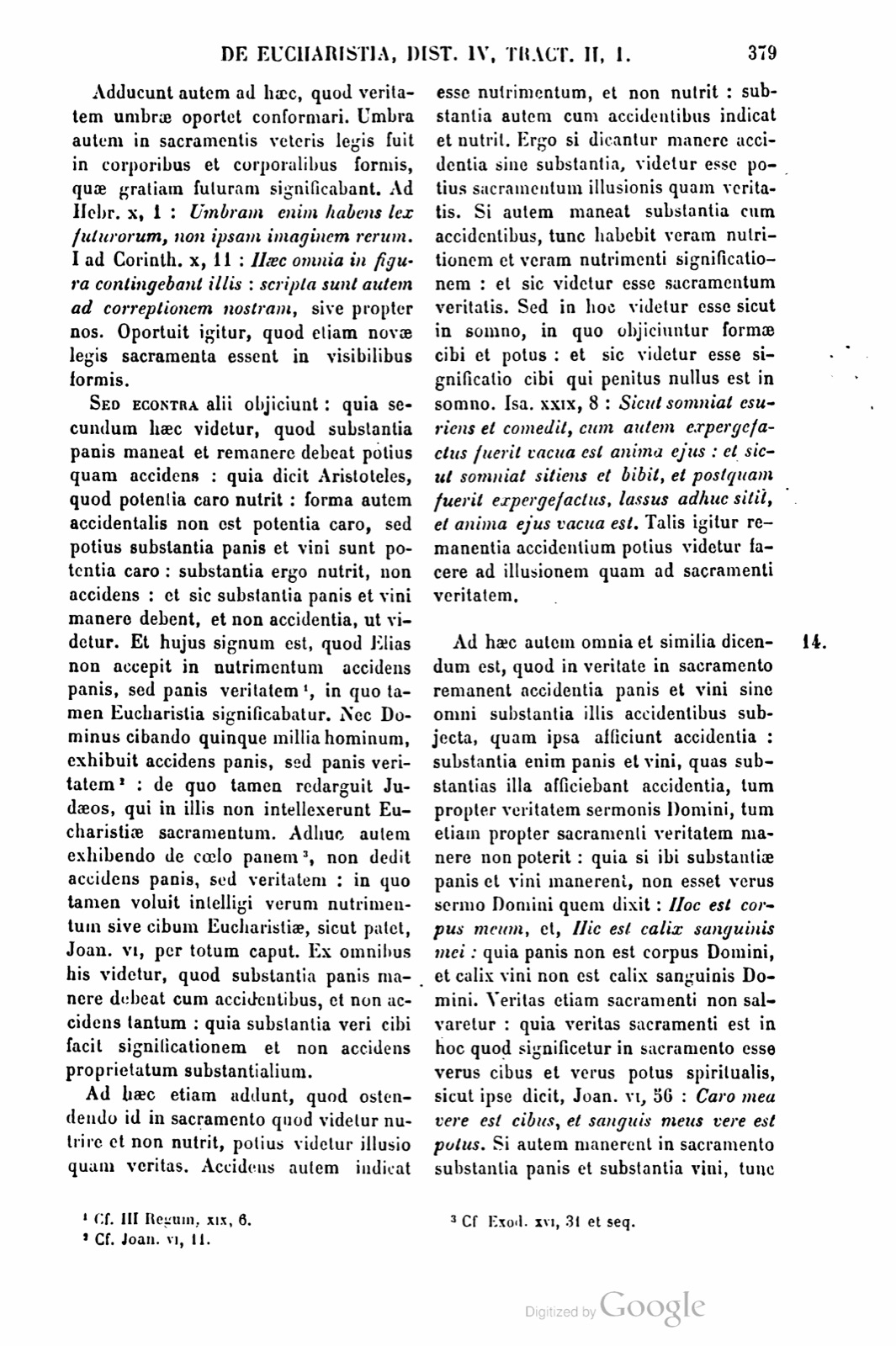
Ad illud quod objicitur, quod illusio et non veritatis sacramentum esse videretur: dicendum, quod in veritate illusio esset si substantia panis et vini manerent: quia tunc non significarent esse in sacramento nisi corporale nutrimentum, et homines ad ipsum tamquam ad corporalem caenam convenirent, quod prohibet Apostolus, I ad Corinth. XI, 20 et 21, dicens: Convenientibus vobis in unum, jam non est Dominicam caenam manducare: unusquisque enim suam caenam praesumit ad manducandum. Ac si dicat: Si in caena Domini praesumitis manducare caenam vestram corporalem, non estis digni, quod Dominicam caenam manducetis: tales enim estis, ut illi qui dixerunt, Joan. VI, 61: Durus est hic sermo. Et infra, v. 67: Ex hoc multi discipulorum ejus abierunt retro, et jam non cum illo ambulabant: quia nescierunt nisi corporalia quaerere. Nec ideo est illusio: quia accidentalis forma non nutrit, quia in sacramento non assumitur ad nutriendum, sed potius ad spirituale nutrimentum significandum: et hoc facit illo modo quo corporalia signa transferuntur ad spiritualium significationem. Hoc autem in veteri lege esse non potuit: quia ibi velata gratia et non revelata significabatur, sicut diximus. Unde Apostolus, ad Hebr. IX, 8, de hoc sacramento et sacerdotio Novi Testamenti loquens per comparationem ad Vetus, dicit: Hoc significante Spiritu sancto, nondum propalatam esse sanctorum viam, adhuc priore tabernaculo habente statum. Et ideo signa in illis sacramentis erant imperfecta: sed quando velum templi scissum est a summo usque deorsum, sicut dicitur, Matth. XXVII, 51, tunc patefacta sunt arcana Dei in signis gratiarum in sanguine Domini, et tunc in sacramentis revelatae gratiae signa perfecta dabantur.
To that which is objected, that it would seem to be illusion and not a sacrament of truth, it must be said that in truth it would be illusion if the substance of bread and wine remained, because then they would not signify that anything is in the sacrament except bodily nourishment, and human beings would come together to it as to a bodily supper, which the Apostle prohibits, I Corinthians 11:20 and 21, saying: "When you come together into one, now it is not to eat the Lord's supper; for each one presumes his own supper to eat." As if he said: If in the supper of the Lord you presume to eat your own bodily supper, you are not worthy to eat the Lordly supper; for you are such as those who said, John 6:61: "This saying is hard." And below, v. 67: "From this many of his disciples went back, and now did not walk with him," because they knew only to seek bodily things. Nor is it therefore illusion, because the accidental form does not nourish, since in the sacrament it is not assumed for nourishing, but rather for signifying spiritual nourishment; and it does this in that mode by which bodily signs are transferred to the signification of spiritual things. But this could not be in the old Law, because there veiled grace and not revealed grace was signified, as we said. Hence the Apostle, Hebrews 9:8, speaking of this sacrament and priesthood of the New Testament by comparison to the Old, says: "The Holy Spirit signifying this, that the way of the saints had not yet been made plain, while the former tabernacle still had standing." And therefore the signs in those sacraments were imperfect; but when the veil of the temple was split from top to bottom, as is said, Matthew 27:51, then the secrets of God were made open in signs of graces in the blood of the Lord, and then in the sacraments of revealed grace perfect signs were given.
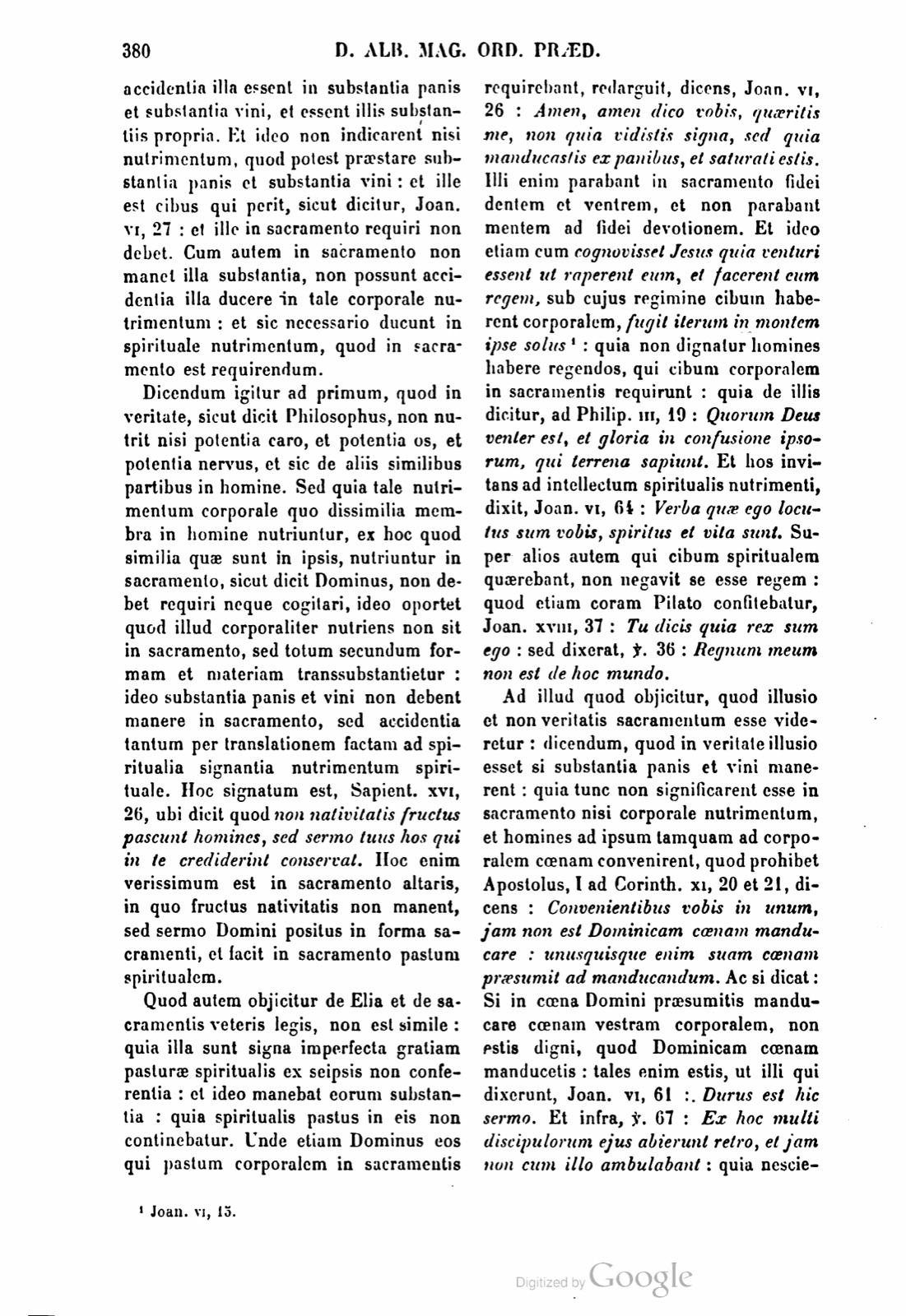
15. CONTRA ea autem quae dicta sunt, adhuc objicitur: quia in multis sacramentis novae legis manent substantiae elementorum, quae sunt materia sacramentorum, ex quibus sumuntur signa signantia gratiam, sicut in baptismo manet aqua, dicente Domino, Joan. III, 5: Nisi quis renatus fuerit ex aqua et Spiritu sancto, non potest introire in regnum Dei. Et in confirmatione manet chrisma propter quod uncti christi dicuntur. Psal. CIV, 15: Nolite tangere christos meos, et in Prophetis meis nolite malignari. Et in unctione extrema manet oleum, sicut dicitur, Marc. VI, 13: Et ungebant oleo multos aegros, et sanabant. Et tamen illa sacramenta conferunt gratiam spiritualem. Videtur ergo forte alicui, quod etiam in hoc sacramento elementa corporalia, quae sunt substantia panis et vini, manere deberent.
Ad haec autem omnia et similia dicimus, quod non est simile de isto et aliis sacramentis novae legis: quia elementa quae sunt materia in aliis sacramentis, ad usum significandi gratiam non assumuntur propter substantias ipsorum elementorum, sed potius propter qualitates, sicut aqua in baptismo assumitur propter vim ablutivam quam habet non a substantia, sed a qualitate humiditatis, et propter virtutem exstinguendi et refrigerandi incendium fomitis: et hanc virtutem non habet aqua a substantia, sed a qualitate frigiditatis. Et assumitur etiam propter nitorem puritatis quam confert, et hanc vim etiam non habet a substantia, sed potius a puritate. Aqua autem secundum suam substantiam nihil significat in sacramento: et ideo etiam ex substantia secundum quod est substantia, nihil causat in ipso: quia sicut saepius diximus, sacramentum novae legis causat id quod significat, et non plus. Similiter autem est in chrismate in confirmatione, quod ex proprietatibus suis unctivis et dissolutivis et penetrativis significat et causat gratiam. Et similiter oleum in unctione infirmorum. Et ideo substantia talium manens in sacramento non impedit fidem ad gratiam, quae causatur et continetur in sacramento. Sed in altaris sacramento substantiae panis et vini nutriunt, et non significant ulterius aliquod nutrimentum, sed conferunt nutrimentum quod in ipsis est, et ideo manentes illae substantiae impedirent fidem quae ex accidentibus eorum duceretur ad credendum aliud esse nutrimentum in sacramento: et ideo contra fidem facerent manentes substantiae, et ideo illae substantiae non manent, sed transsubstantiantur.
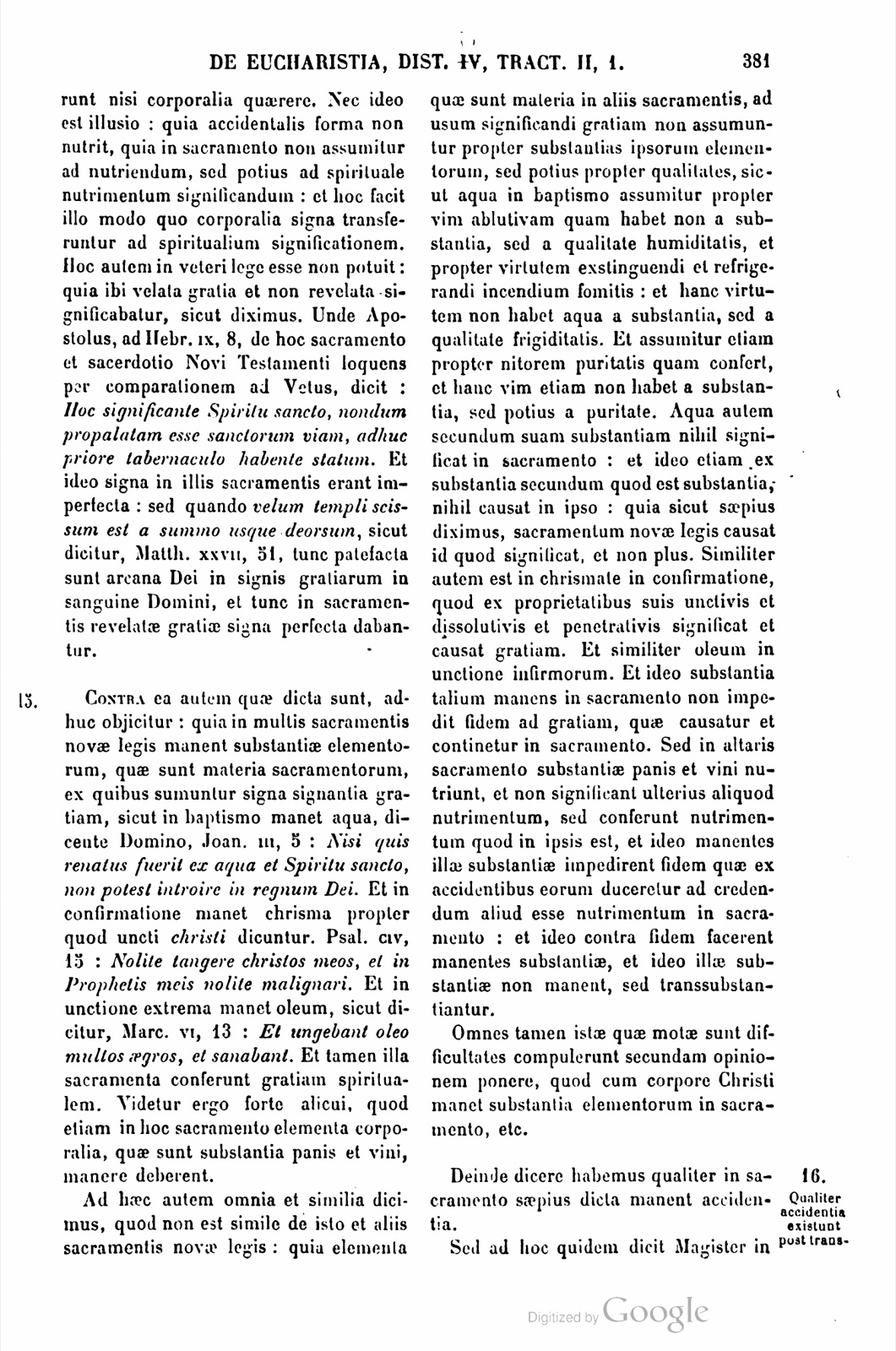
Omnes tamen istae quae motae sunt difficultates compulerunt secundam opinionem ponere, quod cum corpore Christi manet substantia elementorum in sacramento, etc.
15. AGAINST those things which have been said, it is still objected: because in many sacraments of the new Law the substances of the elements remain, which are the matter of the sacraments, from which are taken signs signifying grace, as in baptism water remains, with the Lord saying, John 3:5: "Unless one has been reborn from water and the Holy Spirit, he cannot enter into the kingdom of God." And in confirmation chrism remains, on account of which the anointed are called christs. Psalm 104:15: "Do not touch my christs, and do not act malignly against my Prophets." And in extreme unction oil remains, as is said, Mark 6:13: "And they anointed many sick persons with oil, and healed them." And nevertheless those sacraments confer spiritual grace. Therefore perhaps it seems to someone that also in this sacrament the bodily elements, which are the substance of bread and wine, ought to remain.
But to all these and similar things we say that the case is not similar concerning this sacrament and the other sacraments of the new Law, because the elements which are matter in the other sacraments are not assumed for the use of signifying grace on account of the substances of those elements themselves, but rather on account of qualities; as water in baptism is assumed on account of the abluting force which it has not from substance, but from the quality of humidity, and on account of the power of extinguishing and cooling the burning of the tinder. And water does not have this power from substance, but from the quality of coldness. And it is also assumed on account of the brightness of purity which it confers, and this force also it does not have from substance, but rather from purity. But water according to its substance signifies nothing in the sacrament; and therefore also from substance according as it is substance, it causes nothing in it, because, as we have more often said, a sacrament of the new Law causes that which it signifies, and no more. But it is similarly in chrism in confirmation, because from its anointing and dissolving and penetrating properties it signifies and causes grace. And similarly oil in the anointing of the sick. And therefore the substance of such things, remaining in the sacrament, does not impede faith toward the grace which is caused and contained in the sacrament. But in the sacrament of the altar the substances of bread and wine nourish and do not further signify some nourishment, but confer the nourishment which is in them; and therefore those substances, remaining, would impede faith which would be led from their accidents to believing that there is another nourishment in the sacrament. And therefore the substances remaining would act against faith, and therefore those substances do not remain, but are transubstantiated.
Nevertheless all those difficulties which have been moved compelled the second opinion to posit that the substance of the elements remains in the sacrament with the body of Christ, etc.
Notes
- John 6:15. (Joan. VI, 15.) ↩
If a page does not appear, its photograph has not been uploaded yet.