Works › The Book on the Sacrament of the Eucharist
Volume 38 · pp. 378–379
Chapter I, 13
A marker with ≈ is an approximate page boundary, placed by measure of the text; the page photographs remain the authority. In the paired views, clicking a page marker brings that page into view.
Marginal label (printed p. 378): Ad quid species sacramentales post transsubstantiationem remanent?
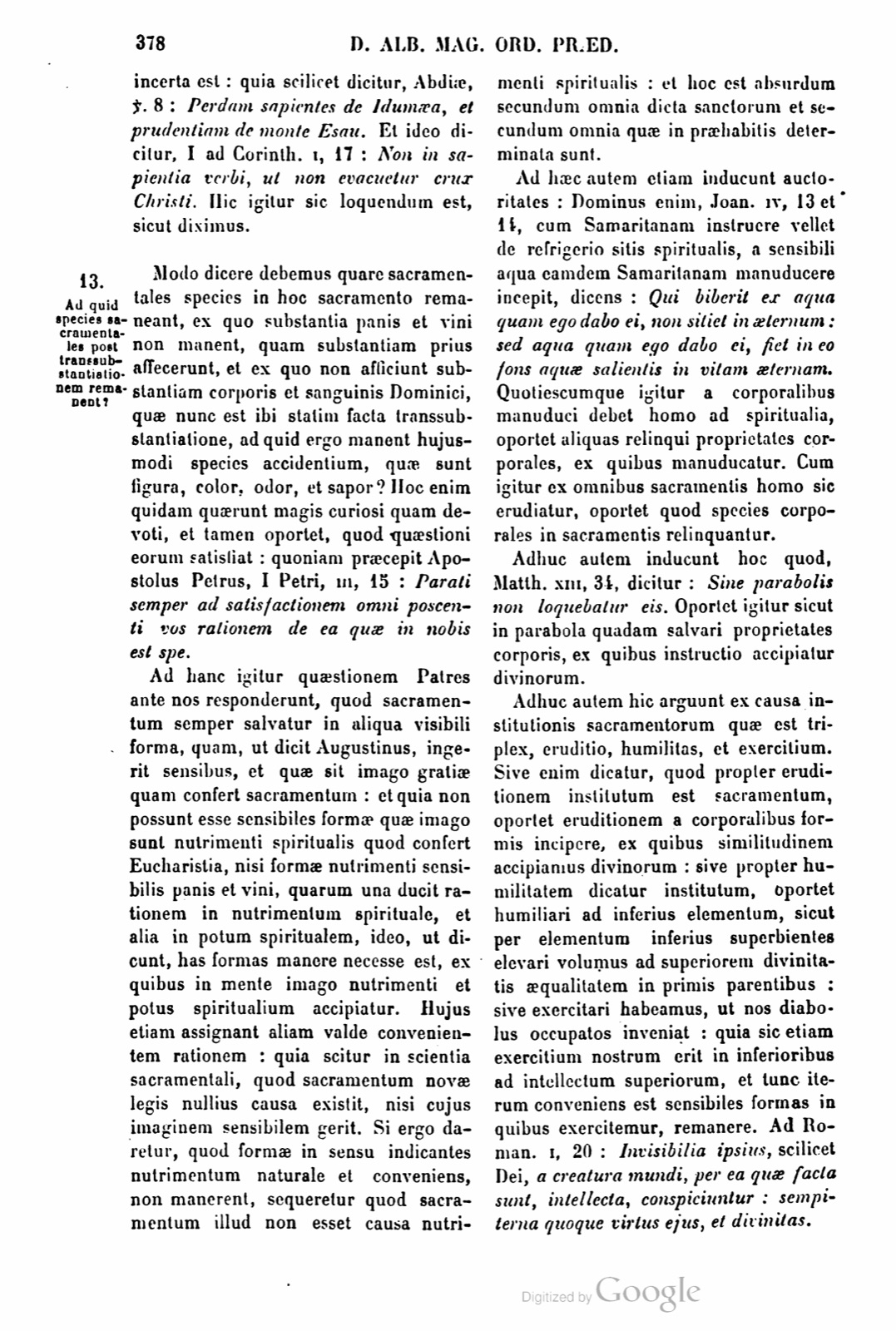
13. Modo dicere debemus quare sacramentales species in hoc sacramento remaneant, ex quo substantia panis et vini non manent, quam substantiam prius affecerunt, et ex quo non afficiunt substantiam corporis et sanguinis Dominici, quae nunc est ibi statim facta transsubstantiatione, ad quid ergo manent hujusmodi species accidentium, quae sunt figura, color, odor, et sapor? Hoc enim quidam quaerunt magis curiosi quam devoti, et tamen oportet, quod quaestioni eorum satisfiat: quoniam praecepit Apostolus Petrus, I Petri, III, 15: Parati semper ad satisfactionem omni poscenti vos rationem de ea quae in nobis est spe.
Ad hanc igitur quaestionem Patres ante nos responderunt, quod sacramentum semper salvatur in aliqua visibili forma, quam, ut dicit Augustinus, ingerit sensibus, et quae sit imago gratiae quam confert sacramentum: et quia non possunt esse sensibiles formae quae imago sunt nutrimenti spiritualis quod confert Eucharistia, nisi formae nutrimenti sensibilis panis et vini, quarum una ducit rationem in nutrimentum spirituale, et alia in potum spiritualem, ideo, ut dicunt, has formas manere necesse est, ex quibus in mente imago nutrimenti et potus spiritualium accipiatur. Hujus etiam assignant aliam valde convenientem rationem: quia scitur in scientia sacramentali, quod sacramentum novae legis nullius causa existit, nisi cujus imaginem sensibilem gerit. Si ergo daretur, quod formae in sensu indicantes nutrimentum naturale et conveniens, non manerent, sequeretur quod sacramentum illud non esset causa nutrimenti spiritualis: et hoc est absurdum secundum omnia dicta sanctorum et secundum omnia quae in prae habitis determinata sunt.
Ad haec autem etiam inducunt auctoritates: Dominus enim, Joan. IV, 13 et 14, cum Samaritanam instruere vellet de refrigerio sitis spiritualis, a sensibili aqua eamdem Samaritanam manuducere incepit, dicens: Qui biberit ex aqua quam ego dabo ei, non sitiet in aeternum: sed aqua quam ego dabo ei, fiet in eo fons aquae salientis in vitam aeternam. Quotiescumque igitur a corporalibus manuduci debet homo ad spiritualia, oportet aliquas relinqui proprietates corporales, ex quibus manuducatur. Cum igitur ex omnibus sacramentis homo sic erudiatur, oportet quod species corporales in sacramentis relinquantur.
Adhuc autem inducunt hoc quod, Matth. XIII, 34, dicitur: Sine parabolis non loquebatur eis. Oportet igitur sicut in parabola quadam salvari proprietates corporis, ex quibus instructio accipiatur divinorum.
Adhuc autem hic arguunt ex causa institutionis sacramentorum quae est triplex, eruditio, humilitas, et exercitium. Sive enim dicatur, quod propter eruditionem institutum est sacramentum, oportet eruditionem a corporalibus formis incipere, ex quibus similitudinem accipiamus divinorum: sive propter humilitatem dicatur institutum, oportet humiliari ad inferius elementum, sicut per elementum inferius superbientes elevari volumus ad superiorem divinitatis aequalitatem in primis parentibus: sive exercitari habeamus, ut nos diabolus occupatos inveniat: quia sic etiam exercitium nostrum erit in inferioribus ad intellectum superiorum, et tunc iterum conveniens est sensibiles formas in quibus exercitemur, remanere. Ad Roman. I, 20: Invisibilia ipsius, scilicet Dei, a creatura mundi, per ea quae facta sunt, intellecta, conspiciuntur: sempiterna quoque virtus ejus, et divinitas.
Marginal label (printed p. 378): For what do the sacramental species remain after transubstantiation?
13. Now we ought to say why the sacramental species remain in this sacrament, since the substance of bread and wine does not remain, which substance they previously affected, and since they do not affect the substance of the Lordly body and blood, which is now there immediately after transubstantiation has been made. Therefore why do species of accidents of this kind remain, which are figure, color, odor, and taste? For certain persons ask this more curious than devout, and nevertheless it is necessary that satisfaction be made to their question, because the Apostle Peter commanded, I Peter 3:15: "Always ready for satisfaction to everyone asking you for a reason concerning that hope which is in us."
Therefore to this question the Fathers before us responded that a sacrament is always preserved in some visible form which, as Augustine says, it puts before the senses, and which is an image of the grace which the sacrament confers. And because there cannot be sensible forms which are the image of the spiritual nourishment which the Eucharist confers except the forms of sensible nourishment of bread and wine, one of which leads the account into spiritual nourishment, and the other into spiritual drink, therefore, as they say, it is necessary that these forms remain, from which in the mind an image of spiritual nourishment and drink may be received. They also assign another very fitting reason for this: because it is known in sacramental science that a sacrament of the new Law exists as cause of nothing except that whose sensible image it bears. Therefore if it were granted that the forms indicating in sense natural and fitting nourishment did not remain, it would follow that that sacrament would not be the cause of spiritual nourishment; and this is absurd according to all the sayings of the saints and according to all things which have been determined in what was held before.
But to these things they also bring in authorities. For the Lord, John 4:13 and 14, when he wished to instruct the Samaritan woman concerning the refreshment of spiritual thirst, began to lead the same Samaritan woman by the hand from sensible water, saying: "Whoever drinks of the water which I shall give him shall not thirst forever; but the water which I shall give him will become in him a fountain of water springing up into eternal life." Therefore whenever man must be led by the hand from bodily things to spiritual things, it is necessary that some bodily properties be left, from which he may be led by the hand. Therefore since man is so instructed from all sacraments, it is necessary that bodily species be left in the sacraments.
Moreover they introduce this, that Matthew 13:34 says: "Without parables he did not speak to them." Therefore it is necessary, as in a certain parable, that the properties of the body be preserved, from which instruction concerning divine things may be received.
Moreover here they argue from the cause of the institution of the sacraments, which is threefold: instruction, humility, and exercise. For whether it is said that the sacrament was instituted because of instruction, it is necessary that instruction begin from bodily forms, from which we may receive a likeness of divine things; or whether it is said to have been instituted because of humility, it is necessary to be humbled to the lower element, just as through the lower element, being proud, we wished in the first parents to be elevated to the higher equality of deity; or whether we must be exercised, so that the devil may find us occupied, because thus also our exercise will be in lower things toward the understanding of higher things, and then again it is fitting that sensible forms in which we are exercised remain. Romans 1:20: "His invisible things," namely of God, "from the creature of the world, understood through those things which have been made, are seen; his eternal power also and divinity."
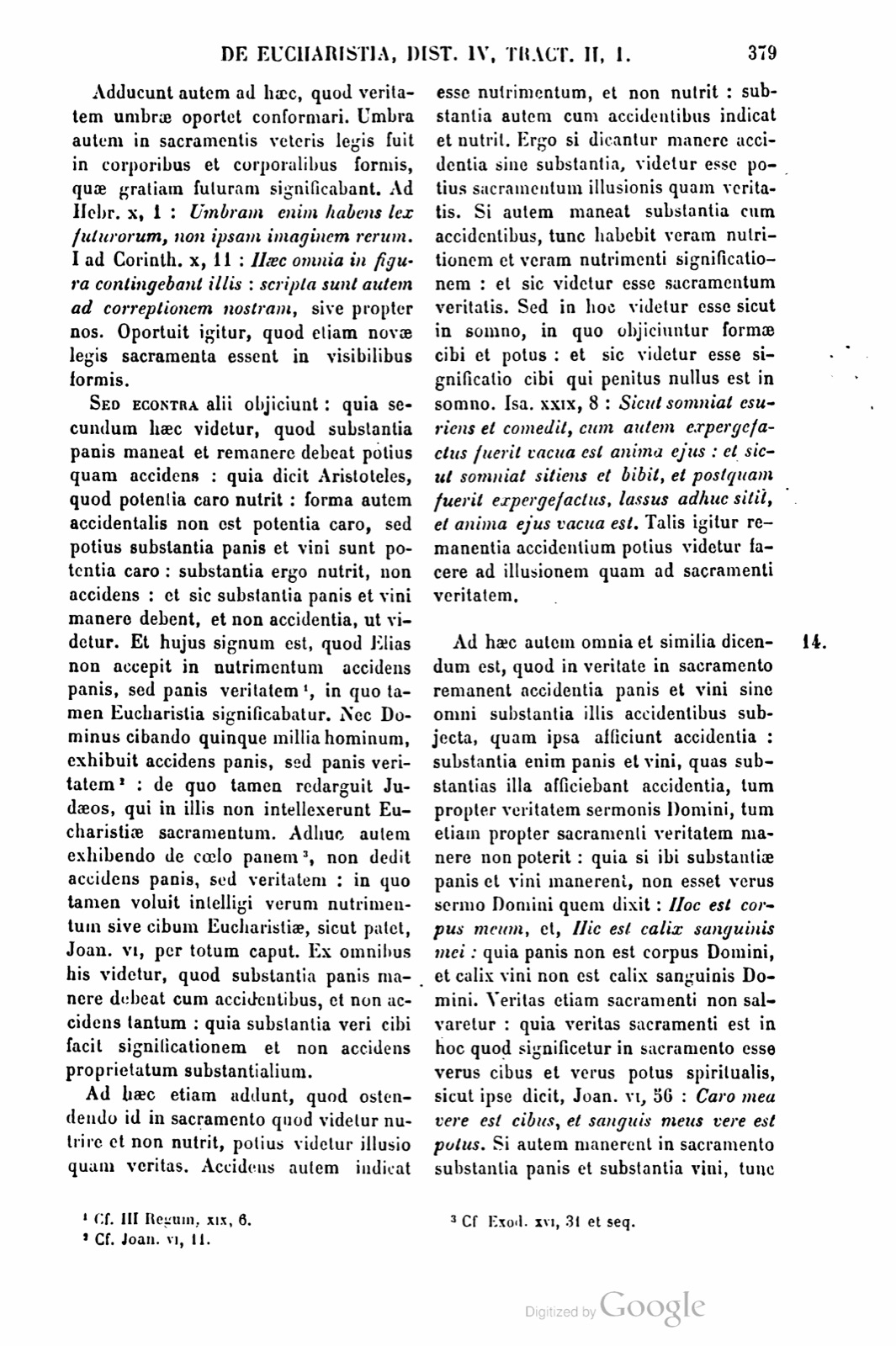
Adducunt autem ad haec, quod veritatem umbrae oportet conformari. Umbra autem in sacramentis veteris legis fuit in corporibus et corporalibus formis, quae gratiam futuram significabant. Ad Hebr. X, 1: Umbram enim habens lex futurorum, non ipsam imaginem rerum. I ad Corinth. X, 11: Haec omnia in figura contingebant illis: scripta sunt autem ad correptionem nostram, sive propter nos. Oportuit igitur, quod etiam novae legis sacramenta essent in visibilibus formis.
SED E CONTRA alii objiciunt: quia secundum haec videtur, quod substantia panis maneat et remanere debeat potius quam accidens: quia dicit Aristoteles, quod potentia caro nutrit: forma autem accidentalis non est potentia caro, sed potius substantia panis et vini sunt potentia caro: substantia ergo nutrit, non accidens: et sic substantia panis et vini manere debent, et non accidentia, ut videtur. Et hujus signum est, quod Elias non accepit in nutrimentum accidens panis, sed panis veritatem,1 in quo tamen Eucharistia significabatur. Nec Dominus cibando quinque millia hominum, exhibuit accidens panis, sed panis veritatem:2 de quo tamen redarguit Judaeos, qui in illis non intellexerunt Eucharistiae sacramentum. Adhuc autem exhibendo de caelo panem,3 non dedit accidens panis, sed veritatem: in quo tamen voluit intelligi verum nutrimentum sive cibum Eucharistiae, sicut patet, Joan. VI, per totum caput. Ex omnibus his videtur, quod substantia panis manere debeat cum accidentibus, et non accidens tantum: quia substantia veri cibi facit significationem et non accidens proprietatum substantialium.
Ad haec etiam addunt, quod ostendendo id in sacramento quod videtur nutrire et non nutrit, potius videtur illusio quam veritas. Accidens autem indicat esse nutrimentum, et non nutrit: substantia autem cum accidentibus indicat et nutrit. Ergo si dicantur manere accidentia sine substantia, videtur esse potius sacramentum illusionis quam veritatis. Si autem maneat substantia cum accidentibus, tunc habebit veram nutritionem et veram nutrimenti significationem: et sic videtur esse sacramentum veritatis. Sed in hoc videtur esse sicut in somno, in quo objiciuntur formae cibi et potus: et sic videtur esse significatio cibi qui penitus nullus est in somno. Isa. XXIX, 8: Sicut somniat esuriens et comedit, cum autem expergefactus fuerit vacua est anima ejus: et sicut somniat sitiens et bibit, et postquam fuerit expergefactus, lassus adhuc sitit, et anima ejus vacua est. Talis igitur remanentia accidentium potius videtur facere ad illusionem quam ad sacramenti veritatem.
But they bring to these things that truth must be conformed to shadow. But the shadow in the sacraments of the old Law was in bodies and bodily forms which signified future grace. Hebrews 10:1: "For the Law having a shadow of future things, not the very image of the things." I Corinthians 10:11: "All these things happened to them in figure; but they were written for our correction," or "on account of us." Therefore it was necessary that the sacraments of the new Law also be in visible forms.
BUT ON THE CONTRARY others object, because according to these things it seems that the substance of bread remains and ought to remain rather than the accident, because Aristotle says that potentially flesh nourishes. But the accidental form is not potentially flesh, but rather the substance of bread and wine are potentially flesh. Therefore substance nourishes, not accident; and thus the substance of bread and wine ought to remain, and not the accidents, as it seems. And a sign of this is that Elijah did not receive as nourishment the accident of bread, but the truth of bread,1 in which nevertheless the Eucharist was signified. Nor did the Lord, in feeding five thousand men, display the accident of bread, but the truth of bread;2 concerning which nevertheless he rebuked the Jews, who in those things did not understand the sacrament of the Eucharist. Moreover by displaying bread from heaven,3 he did not give the accident of bread, but the truth, in which nevertheless he wished the true nourishment or food of the Eucharist to be understood, as is clear, John 6, through the whole chapter. From all these things it seems that the substance of bread ought to remain with the accidents, and not the accident only, because the substance of true food makes the signification and not the accident of substantial properties.
To these things they also add that by showing in the sacrament that which seems to nourish and does not nourish, there seems to be illusion rather than truth. But the accident indicates that it is nourishment and does not nourish; but the substance with the accidents indicates and nourishes. Therefore if the accidents are said to remain without substance, it seems to be a sacrament of illusion rather than of truth. But if substance remains with the accidents, then it will have true nutrition and true signification of nourishment, and thus it seems to be a sacrament of truth. But in this it seems to be as in sleep, in which forms of food and drink are set before one; and thus there seems to be the signification of food which is utterly none in sleep. Isaiah 29:8: "As a hungry man dreams and eats, but when he has awakened his soul is empty; and as a thirsty man dreams and drinks, and after he has awakened, weary he still thirsts, and his soul is empty." Therefore such a remaining of accidents seems to make for illusion rather than for the truth of the sacrament.
If a page does not appear, its photograph has not been uploaded yet.