Works › The Book on the Sacrament of the Eucharist
Volume 38 · pp. 372–373
Chapter I, 9
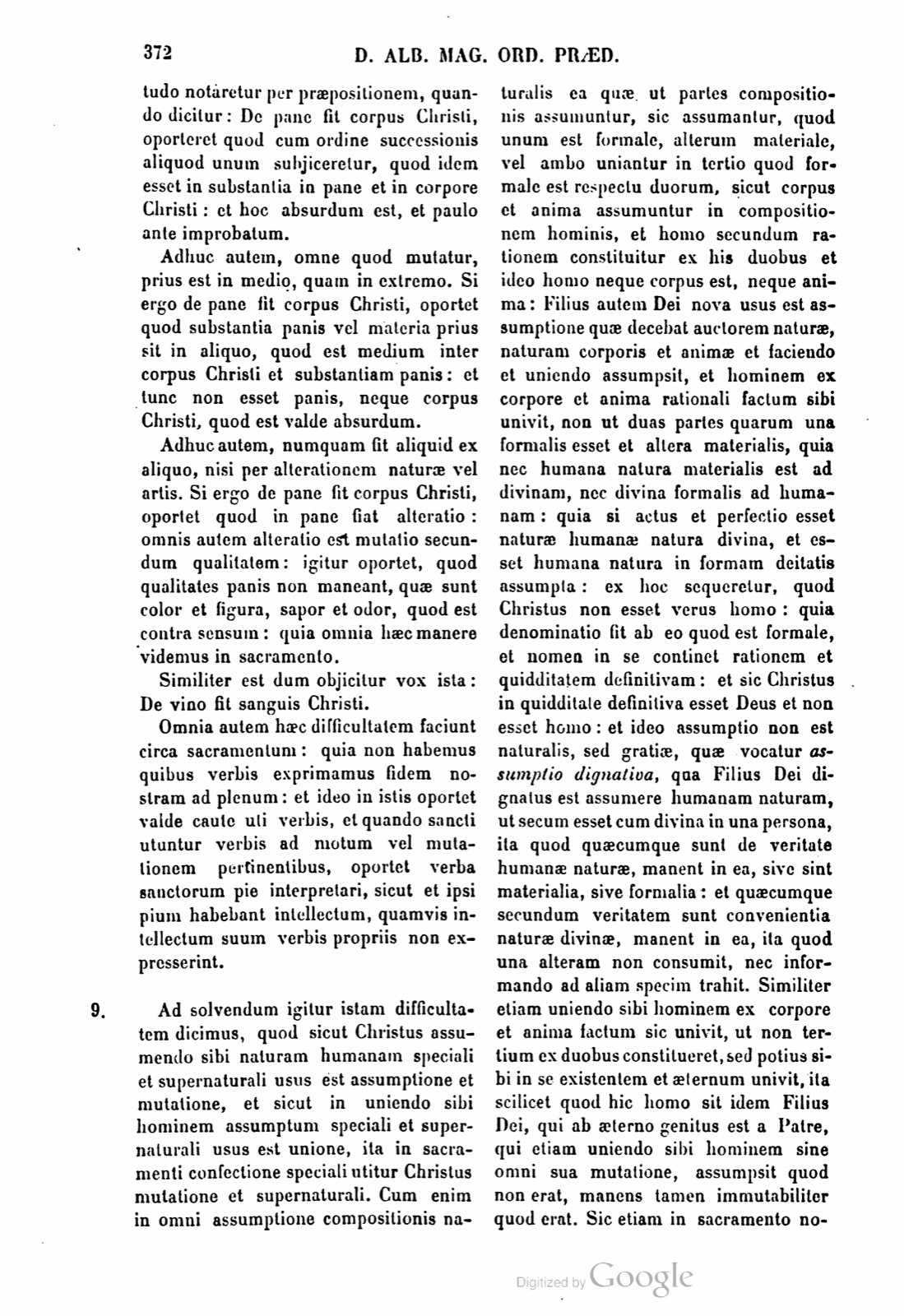
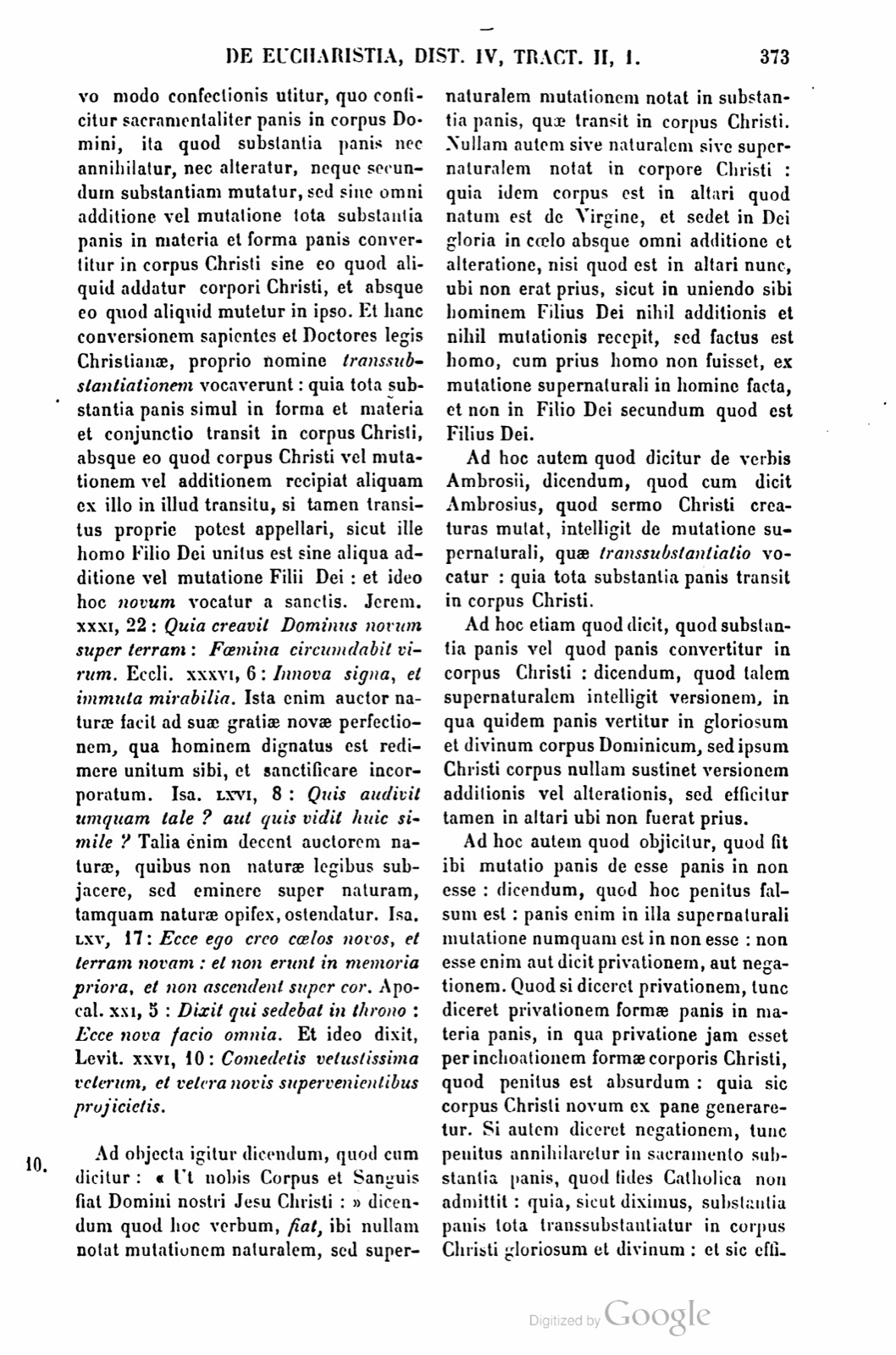
9. Ad solvendum igitur istam difficultatem dicimus, quod sicut Christus assumendo sibi naturam humanam speciali et supernaturali usus est assumptione et mutatione, et sicut in uniendo sibi hominem assumptum speciali et supernaturali usus est unione, ita in sacramenti confectione speciali utitur Christus mutatione et supernaturali. Cum enim in omni assumptione compositionis naturalis ea quae ut partes compositionis assumuntur, sic assumantur, quod unum est formale, alterum materiale, vel ambo uniantur in tertio quod formale est respectu duorum, sicut corpus et anima assumuntur in compositionem hominis, et homo secundum rationem constituitur ex his duobus et ideo homo neque corpus est, neque anima: Filius autem Dei nova usus est assumptione quae decebat auctorem naturae, naturam corporis et animae et faciendo et uniendo assumpsit, et hominem ex corpore et anima rationali factum sibi univit, non ut duas partes quarum una formalis esset et altera materialis, quia nec humana natura materialis est ad divinam, nec divina formalis ad humanam: quia si actus et perfectio esset naturae humanae natura divina, et esset humana natura in formam deitatis assumpta: ex hoc sequeretur, quod Christus non esset verus homo: quia denominatio fit ab eo quod est formale, et nomen in se continet rationem et quidditatem definitivam: et sic Christus in quidditate definitiva esset Deus et non esset homo: et ideo assumptio non est naturalis, sed gratiae, quae vocatur assumptio dignativa, qua Filius Dei dignatus est assumere humanam naturam, ut secum esset cum divina in una persona, ita quod quaecumque sunt de veritate humanae naturae, manent in ea, sive sint materialia, sive formalia: et quaecumque secundum veritatem sunt convenientia naturae divinae, manent in ea, ita quod una alteram non consumit, nec informando ad aliam speciem trahit. Similiter etiam uniendo sibi hominem ex corpore et anima factum sic univit, ut non tertium ex duobus constitueret, sed potius sibi in se existentem et aeternum univit, ita scilicet quod hic homo sit idem Filius Dei, qui ab aeterno genitus est a Patre, qui etiam uniendo sibi hominem sine omni sua mutatione, assumpsit quod non erat, manens tamen immutabiliter quod erat. Sic etiam in sacramento novo modo confectionis utitur, quo conficitur sacramentaliter panis in corpus Domini, ita quod substantia panis nec annihilatur, nec alteratur, neque secundum substantiam mutatur, sed sine omni additione vel mutatione tota substantia panis in materia et forma panis convertitur in corpus Christi sine eo quod aliquid addatur corpori Christi, et absque eo quod aliquid mutetur in ipso. Et hanc conversionem sapientes et Doctores legis Christianae, proprio nomine transsubstantiationem vocaverunt: quia tota substantia panis simul in forma et materia et conjunctio transit in corpus Christi, absque eo quod corpus Christi vel mutationem vel additionem recipiat aliquam ex illo in illud transitu, si tamen transitus proprie potest appellari, sicut ille homo Filio Dei unitus est sine aliqua additione vel mutatione Filii Dei: et ideo hoc novum vocatur a sanctis. Jerem. XXXI, 22: Quia creavit Dominus novum super terram: Femina circumdabit virum. Eccli. XXXVI, 6: Innova signa, et immuta mirabilia. Ista enim auctor naturae facit ad suae gratiae novae perfectionem, qua hominem dignatus est redimere unitum sibi, et sanctificare incorporatum. Isa. LXVI, 8: Quis audivit umquam tale? aut quis vidit huic simile? Talia enim decent auctorem naturae, quibus non naturae legibus subjacere, sed eminere super naturam, tamquam naturae opifex, ostendatur. Isa. LXV, 17: Ecce ego creo caelos novos, et terram novam: et non erunt in memoria priora, et non ascendent super cor. Apocal. XXI, 5: Dixit qui sedebat in throno: Ecce nova facio omnia. Et ideo dixit, Levit. XXVI, 10: Comedetis vetustissima veterum, et vetera novis supervenientibus projicietis.
9. Therefore, to solve this difficulty we say that just as Christ, in assuming human nature to himself, used a special and supernatural assumption and change, and just as, in uniting the assumed man to himself, he used a special and supernatural union, so in the confection of the sacrament Christ uses a special and supernatural change. For since in every assumption of natural composition those things which are assumed as parts of composition are so assumed that one is formal and the other material, or both are united in a third which is formal with respect to the two, as body and soul are assumed into the composition of man, and man according to account is constituted from these two and therefore man is neither body nor soul; but the Son of God used a new assumption which befitted the author of nature. He assumed the nature of body and soul both by making and by uniting, and he united to himself man made from body and rational soul, not as two parts, one of which would be formal and the other material, because neither is human nature material with respect to divine nature, nor divine nature formal with respect to human nature. For if divine nature were the act and perfection of human nature, and human nature were assumed into the form of deity, from this it would follow that Christ would not be true man, because denomination is made from that which is formal, and a name contains in itself the account and definitive quiddity. And thus Christ in definitive quiddity would be God and would not be man. And therefore the assumption is not natural, but of grace, which is called dignifying assumption, by which the Son of God deigned to assume human nature, so that it might be with himself, with divine nature, in one person, in such a way that whatever things belong to the truth of human nature remain in it, whether they are material or formal; and whatever things according to truth are fitting to divine nature remain in it, in such a way that one does not consume the other, nor by informing draw it to another species. Similarly also by uniting to himself the man made from body and soul, he so united him that he did not constitute a third thing from the two, but rather united to himself, existing in himself and eternal, in such a way, namely, that this man is the same Son of God who from eternity is begotten by the Father, who also by uniting man to himself, without any change of himself, assumed what he was not, nevertheless remaining immutably what he was. Thus also in the sacrament he uses a new mode of confection, by which bread is sacramentally confected into the body of the Lord, in such a way that the substance of bread is neither annihilated, nor altered, nor changed according to substance, but without any addition or change the whole substance of bread in the matter and form of bread is converted into the body of Christ, without anything being added to the body of Christ, and without anything being changed in it. And this conversion the wise and Doctors of the Christian law have called by the proper name transubstantiation, because the whole substance of bread, at once in form and matter and conjunction, passes into the body of Christ, without the body of Christ receiving either any change or addition from that passing from that into it, if nevertheless passing can properly be named, just as that man was united to the Son of God without any addition or change of the Son of God. And therefore this is called new by the saints. Jeremiah 31:22: "Because the Lord has created a new thing upon the earth: a woman shall encompass a man." Ecclesiasticus 36:6: "Renew signs, and change wonders." For the author of nature does these things for the perfection of his new grace, by which he deigned to redeem man united to himself and to sanctify man incorporated. Isaiah 66:8: "Who ever heard such a thing? or who saw anything like this?" For such things befit the author of nature, by which he is shown not to be subject to the laws of nature, but to rise above nature, as maker of nature. Isaiah 65:17: "Behold, I create new heavens and a new earth; and the former things shall not be in memory, and shall not ascend upon the heart." Apocalypse 21:5: "He who sat on the throne said: Behold, I make all things new." And therefore he said, Leviticus 26:10: "You shall eat the oldest of old things, and you shall cast away old things when new things come upon them."
If a page does not appear, its photograph has not been uploaded yet.