Works › The Book on the Sacrament of the Eucharist
Volume 38 · pp. 371–372
Chapter I, 7-8
A marker with ≈ is an approximate page boundary, placed by measure of the text; the page photographs remain the authority. In the paired views, clicking a page marker brings that page into view.
Marginal label (printed p. 371): Utrum istae propositiones sint concedendae: De pane, vel, ex pane fit corpus Christi?
Adhuc idem Ambrosius dicit, quod Christus convertit panem in corpus suum, et vinum convertit in sanguinem: convertere autem idem est quod mutare.
Fortius autem objiciunt quidam dicentes, quod mutatio est panis in non panem: post confectionem enim non est panis, sed corpus Domini: omnis autem mutatio de esse in non esse est corruptio: videtur ergo, quod in sacramento est mutatio corruptionis. Eodem modo probatur, quod ibi est mutatio generationis: quia de pane qui est non corpus Domini, fit corpus Domini: ergo fit hic mutatio de non esse corporis Domini in esse: talis autem mutatio est generatio: videtur ergo, quod corpus Christi ibi generetur ex pane: quod valde absurdum est, non tantum secundum fidem, sed etiam secundum philosophiam: quia secundum hoc corpus Christi extra Virginem saepe generaretur: et secundum hoc id quod est et manet, generaretur: et secundum hoc immutabile et incorruptibile et gloriosum generaretur: quae omnia sunt valde absurda.
Adhuc autem in omni mutatione substantiali idem subjectum quod est materia, subjicitur utrique terminorum mutationis: si ergo talis est mutatio panis in corpus Domini, tunc eadem materia subjicitur formae panis et formae Dominici corporis: et sic panis corporis Christi efficitur materia. Constat autem, quod purissimae guttae beatae Virginis operatione sancti Spiritus formatae sunt vera materia Dominici corporis. Ergo Dominicum corpus efficitur de duabus materiis. Quod autem de duabus in se diversis materiis generatur, non est idem: quia dicit Philosophus, quod individua numerantur per suas materias: ergo non est idem corpus quod efficitur in altari, et quod natum est de Virgine, quod Christiana fides penitus abhorret, sicut falsum est et impossibile et haereticum.
Adhuc autem mutata substantia panis in corpus Domini, aut manet materia panis quanta est cum materia corporis Dominici, aut annihilatur. Si dicatur, quod manet, tunc ab initio institutionis hujus sacramenti et frequentationis in Ecclesia, magnam valde corpus Christi accepit adjectionem. Si autem dicatur, quod annihilatur, tunc frustra ponitur ut annihiletur, et melius esset non ponere, quam sermone Domini creaturas annihilare.
8. Adhuc autem oportet hic determinare habitudines praepositionum quid denotent, quando dicitur: De pane fit corpus, vel, Ex pane fit corpus Christi. Quia sicut jam patuit, praepositiones istae non possunt denotare habitudines materiae, nec possunt notare habitudines ordinis terminorum mutationis, sicut quando dicitur: Ex mane fit meridies: quia secundum hoc sensus esset: Ex pane fit corpus Domini. Ac si diceretur: Post panem fit corpus Domini. Et tunc quaereretur, quid factum esset de pane, utrum maneret materia ejus, vel esset annihilata? et redirent eadem inconvenientia quae prius inducta sunt. Sic patet, quod magna est difficultas in verbis denotantibus mutationem circa corpus Christi.
Marginal label (printed p. 371): Whether these propositions are to be conceded: "From bread," or, "from bread the body of Christ is made"?
Moreover the same Ambrose says that Christ converts bread into his body and converts wine into blood; but to convert is the same as to change.
But certain persons object more strongly, saying that change is of bread into non-bread; for after the confection it is not bread, but the body of the Lord. But every change from being into non-being is corruption. Therefore it seems that in the sacrament there is a change of corruption. In the same way it is proved that there is there a change of generation, because from bread which is not the body of the Lord, the body of the Lord is made. Therefore here a change is made from non-being of the body of the Lord into being; but such a change is generation. Therefore it seems that the body of Christ is there generated from bread. This is very absurd, not only according to faith, but also according to philosophy, because according to this the body of Christ would often be generated outside the Virgin; and according to this that which is and remains would be generated; and according to this the immutable and incorruptible and glorious would be generated. All these things are very absurd.
Moreover in every substantial change the same subject which is matter is subjected to both terms of the change. Therefore if such is the change of bread into the body of the Lord, then the same matter is subjected to the form of bread and the form of the Lordly body; and thus bread is made the matter of the body of Christ. But it is clear that the most pure drops of the blessed Virgin, formed by the operation of the Holy Spirit, are the true matter of the Lordly body. Therefore the Lordly body is made from two matters. But what is generated from two matters diverse in themselves is not the same thing, because the Philosopher says that individuals are numbered by their matters. Therefore the body which is made on the altar and the body which was born from the Virgin are not the same, which Christian faith utterly abhors, as it is false and impossible and heretical.
Moreover, when the substance of bread has been changed into the body of the Lord, either the matter of bread, as much as it is, remains with the matter of the Lordly body, or it is annihilated. If it is said that it remains, then from the beginning of the institution of this sacrament and of its frequentation in the Church, the body of Christ has received a very great addition. But if it is said that it is annihilated, then it is posited in vain so that it may be annihilated, and it would be better not to posit it than to annihilate creatures by the speech of the Lord.
8. Moreover here it is necessary to determine what relations the prepositions denote when it is said: From bread the body is made, or, Out of bread the body of Christ is made. Because, as has now appeared, these prepositions cannot denote relations of matter, nor can they mark relations of order of the terms of change, as when it is said: From morning comes midday; because according to this the sense would be: From bread the body of the Lord is made, as if it were said: After bread the body of the Lord is made. And then it would be asked what had been done with the bread, whether its matter remained or was annihilated, and the same unfitting consequences which were introduced before would return. Thus it is clear that there is great difficulty in words denoting change concerning the body of Christ.
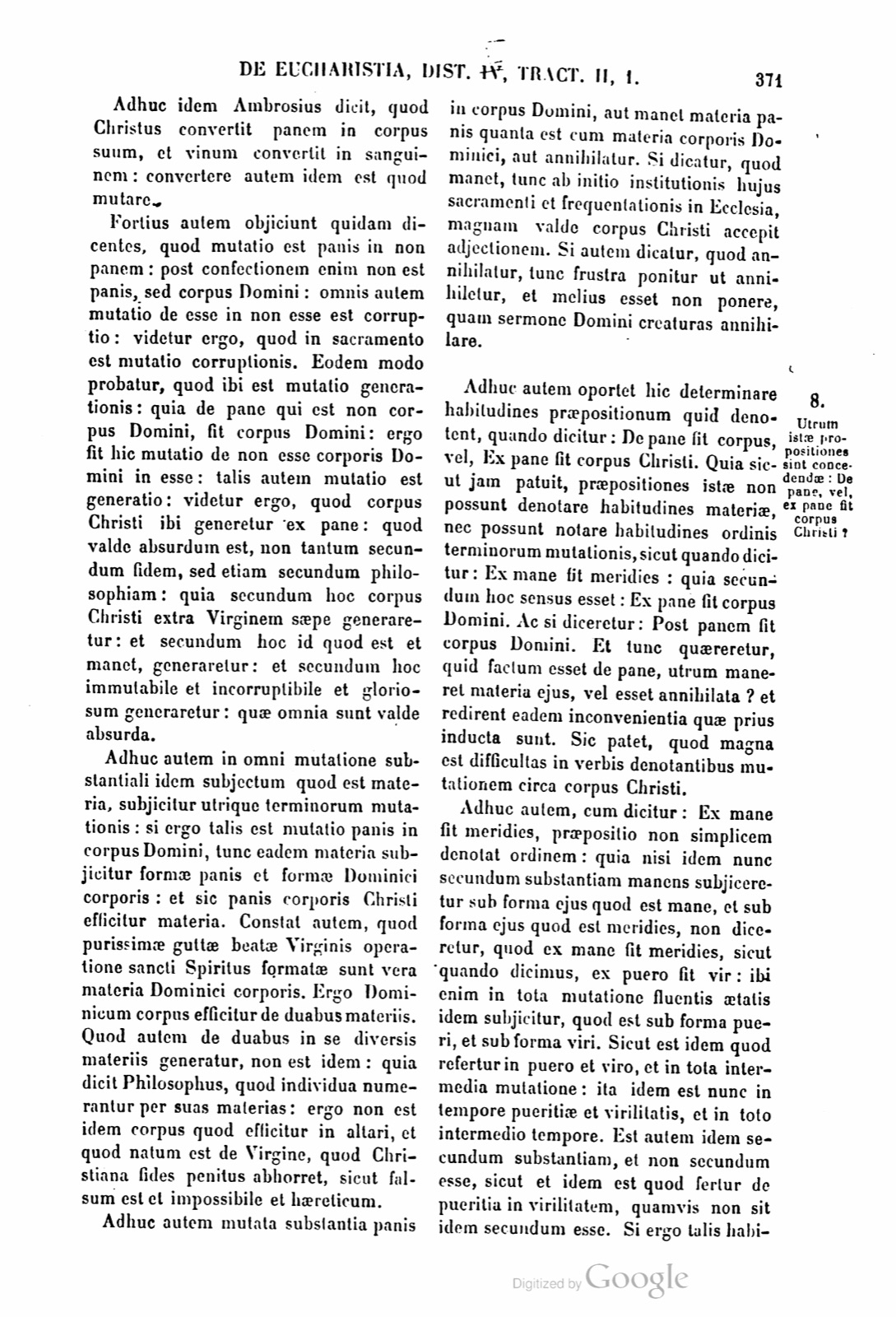
Adhuc autem, cum dicitur: Ex mane fit meridies, praepositio non simplicem denotat ordinem: quia nisi idem nunc secundum substantiam manens subjiceretur sub forma ejus quod est mane, et sub forma ejus quod est meridies, non diceretur, quod ex mane fit meridies, sicut quando dicimus, ex puero fit vir: ibi enim in tota mutatione fluentis aetatis idem subjicitur, quod est sub forma pueri, et sub forma viri. Sicut est idem quod refertur in puero et viro, et in tota intermedia mutatione: ita idem est nunc in tempore pueritiae et virilitatis, et in toto intermedio tempore. Est autem idem secundum substantiam, et non secundum esse, sicut et idem est quod fertur de pueritia in virilitatem, quamvis non sit idem secundum esse. Si ergo talis habitudo notaretur per praepositionem, quando dicitur: De pane fit corpus Christi, oporteret quod cum ordine successionis aliquod unum subjiceretur, quod idem esset in substantia in pane et in corpore Christi: et hoc absurdum est, et paulo ante improbatum.
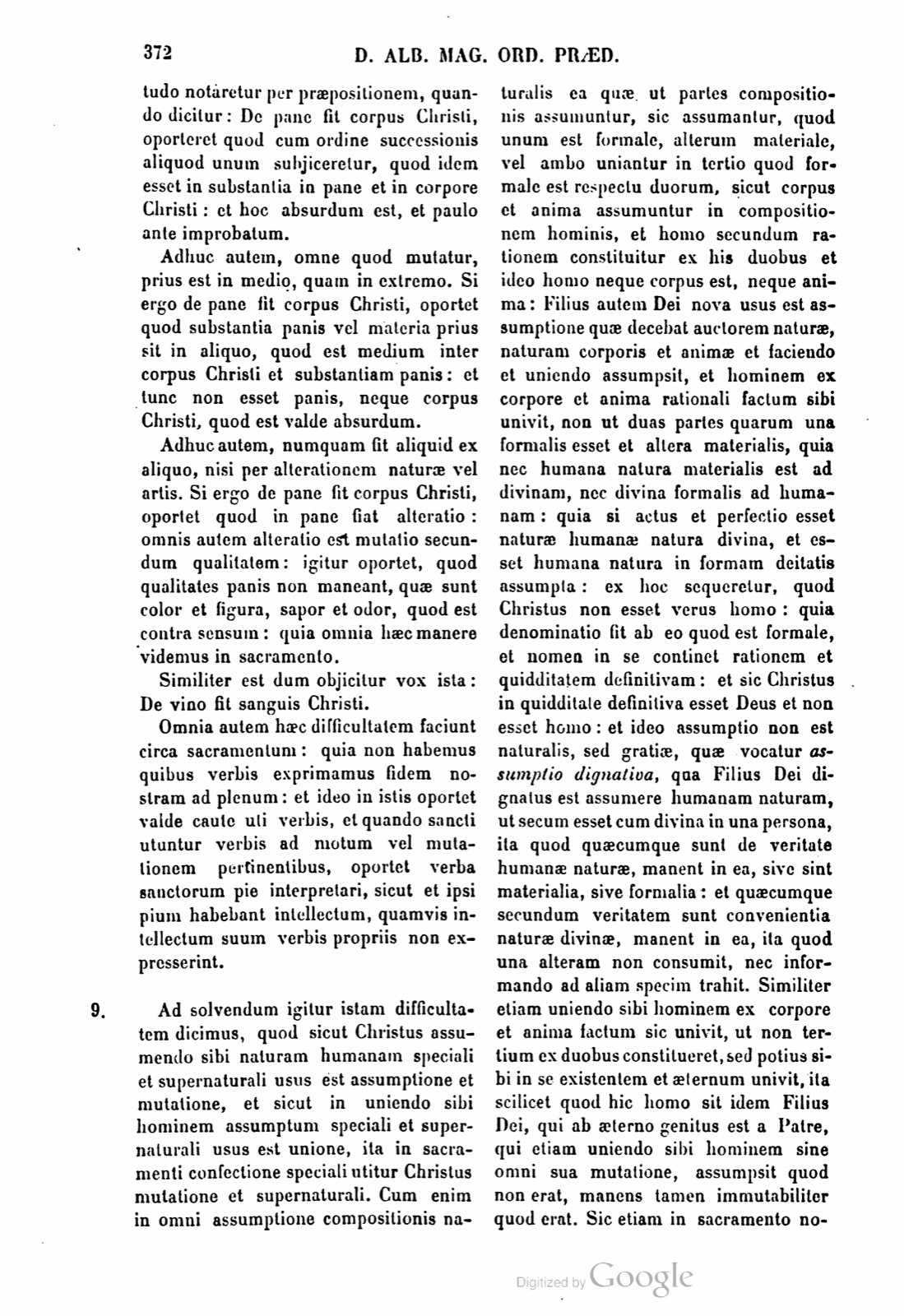
Adhuc autem, omne quod mutatur, prius est in medio, quam in extremo. Si ergo de pane fit corpus Christi, oportet quod substantia panis vel materia prius sit in aliquo, quod est medium inter corpus Christi et substantiam panis: et tunc non esset panis, neque corpus Christi, quod est valde absurdum.
Adhuc autem, numquam fit aliquid ex aliquo, nisi per alterationem naturae vel artis. Si ergo de pane fit corpus Christi, oportet quod in pane fiat alteratio: omnis autem alteratio est mutatio secundum qualitatem: igitur oportet, quod qualitates panis non maneant, quae sunt color et figura, sapor et odor, quod est contra sensum: quia omnia haec manere videmus in sacramento.
Similiter est dum objicitur vox ista: De vino fit sanguis Christi.
Omnia autem haec difficultatem faciunt circa sacramentum: quia non habemus quibus verbis exprimamus fidem nostram ad plenum: et ideo in istis oportet valde caute uti verbis, et quando sancti utuntur verbis ad motum vel mutationem pertinentibus, oportet verba sanctorum pie interpretari, sicut et ipsi pium habebant intellectum, quamvis intellectum suum verbis propriis non expresserint.
Moreover, when it is said, From morning comes midday, the preposition does not denote simple order, because unless the same now, remaining according to substance, were subjected under the form of that which is morning and under the form of that which is midday, it would not be said that from morning midday is made, just as when we say, from boy a man is made. For there in the whole change of flowing age the same thing is subjected which is under the form of boy and under the form of man. Just as it is the same thing which is referred in boy and man and in the whole intermediate change, so the now is the same in the time of boyhood and manhood and in the whole intermediate time. But it is the same according to substance and not according to being, just as it is also the same thing which is borne from boyhood into manhood, although it is not the same according to being. Therefore if such a relation were marked by the preposition when it is said, From bread the body of Christ is made, it would be necessary that, with an order of succession, some one thing be subjected which would be the same in substance in bread and in the body of Christ. And this is absurd and was disproved a little before.
Moreover, everything that is changed is first in the middle before it is in the extreme. Therefore if the body of Christ is made from bread, it is necessary that the substance or matter of bread first be in something which is a middle between the body of Christ and the substance of bread; and then it would be neither bread nor the body of Christ, which is very absurd.
Moreover, something is never made from something except through alteration of nature or of art. Therefore if the body of Christ is made from bread, it is necessary that alteration be made in the bread. But every alteration is change according to quality. Therefore it is necessary that the qualities of bread not remain, which are color and figure, taste and odor; this is contrary to sense, because we see all these things remain in the sacrament.
It is similar when this expression is objected: From wine the blood of Christ is made.
But all these things make difficulty concerning the sacrament, because we do not have words by which we may express our faith fully. And therefore in these things it is necessary to use words very cautiously; and when the saints use words pertaining to motion or change, it is necessary to interpret the words of the saints piously, just as they themselves had a pious understanding, although they did not express their understanding in proper words.
If a page does not appear, its photograph has not been uploaded yet.