Works › The Book on the Sacrament of the Eucharist
Volume 38 · pp. 373–375
Chapter I, 10
A marker with ≈ is an approximate page boundary, placed by measure of the text; the page photographs remain the authority. In the paired views, clicking a page marker brings that page into view.
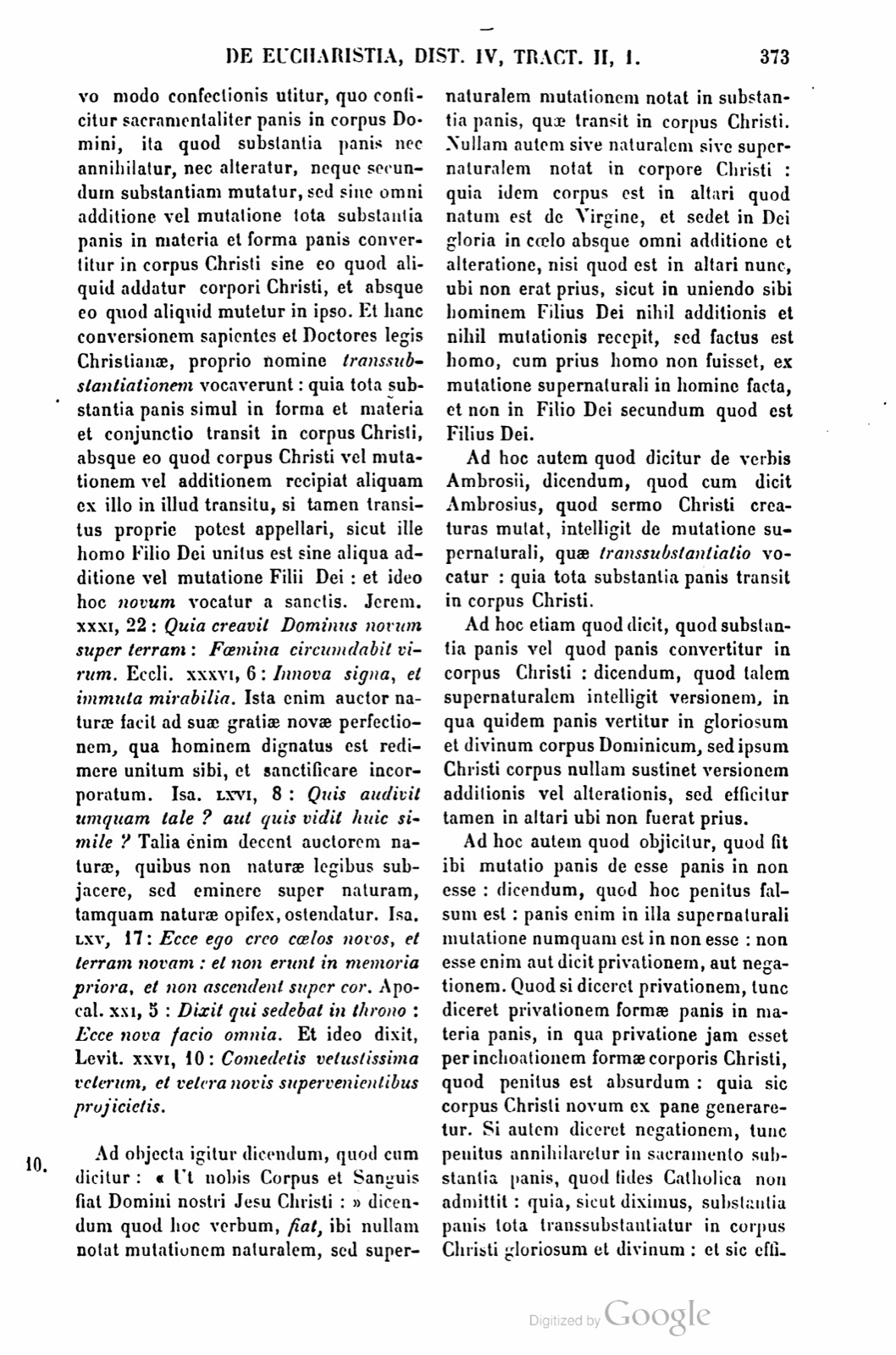
10. Ad objecta igitur dicendum, quod cum dicitur: « Ut nobis Corpus et Sanguis fiat Domini nostri Jesu Christi: » dicendum quod hoc verbum, fiat, ibi nullam naturalem mutationem notat, sed supernaturalem mutationem notat in substantia panis, quae transit in corpus Christi. Nullam autem sive naturalem sive supernaturalem notat in corpore Christi: quia idem corpus est in altari quod natum est de Virgine, et sedet in Dei gloria in caelo absque omni additione et alteratione, nisi quod est in altari nunc, ubi non erat prius, sicut in uniendo sibi hominem Filius Dei nihil additionis et nihil mutationis recepit, sed factus est homo, cum prius homo non fuisset, ex mutatione supernaturali in homine facta, et non in Filio Dei secundum quod est Filius Dei.
Ad hoc autem quod dicitur de verbis Ambrosii, dicendum, quod cum dicit Ambrosius, quod sermo Christi creaturas mutat, intelligit de mutatione supernaturali, quae transsubstantiatio vocatur: quia tota substantia panis transit in corpus Christi.
Ad hoc etiam quod dicit, quod substantia panis vel quod panis convertitur in corpus Christi: dicendum, quod talem supernaturalem intelligit versionem, in qua quidem panis vertitur in gloriosum et divinum corpus Dominicum, sed ipsum Christi corpus nullam sustinet versionem additionis vel alterationis, sed efficitur tamen in altari ubi non fuerat prius.
Ad hoc autem quod objicitur, quod fit ibi mutatio panis de esse panis in non esse: dicendum, quod hoc penitus falsum est: panis enim in illa supernaturali mutatione numquam est in non esse: non esse enim aut dicit privationem, aut negationem. Quod si diceret privationem, tunc diceret privationem formae panis in materia panis, in qua privatione jam esset per inchoationem formae corporis Christi, quod penitus est absurdum: quia sic corpus Christi novum ex pane generaretur. Si autem diceret negationem, tunc penitus annihilaretur in sacramento substantia panis, quod fides Catholica non admittit: quia, sicut diximus, substantia panis tota transsubstantiatur in corpus Christi gloriosum et divinum: et sic efficitur substantia panis, quod non erat prius: et hoc est aliquid effici, et non annihilari.
10. Therefore to the objections it must be said that when it is said, "That it may become for us the Body and Blood of our Lord Jesus Christ," it must be said that this word "may become" there marks no natural change, but marks a supernatural change in the substance of bread, which passes into the body of Christ. But it marks no change, whether natural or supernatural, in the body of Christ, because the same body is on the altar which was born from the Virgin and sits in the glory of God in heaven, without any addition or alteration, except that it is now on the altar where it was not before; just as in uniting man to himself the Son of God received no addition and no change, but was made man, although before he had not been man, from a supernatural change made in man, and not in the Son of God according as he is Son of God.
But to what is said concerning the words of Ambrose, it must be said that when Ambrose says that the speech of Christ changes creatures, he understands this of supernatural change, which is called transubstantiation, because the whole substance of bread passes into the body of Christ.
To this also, that he says that the substance of bread, or that bread, is converted into the body of Christ, it must be said that he understands such a supernatural turning, in which indeed bread is turned into the glorious and divine Lordly body, but the very body of Christ sustains no turning of addition or alteration, although it is made on the altar where it had not been before.
But to this which is objected, that there is made there a change of bread from the being of bread into non-being, it must be said that this is wholly false. For bread in that supernatural change is never in non-being; for non-being says either privation or negation. But if it said privation, then it would say privation of the form of bread in the matter of bread, in which privation the form of the body of Christ would already be through beginning, which is wholly absurd, because thus a new body of Christ would be generated from bread. But if it said negation, then the substance of bread would be wholly annihilated in the sacrament, which Catholic faith does not admit, because, as we said, the whole substance of bread is transubstantiated into the glorious and divine body of Christ; and thus the substance of bread is made what it was not before. And this is to be made something, and not to be annihilated.
Eodem modo solvendum est id quod objicitur de corporis Christi generatione: quia nulla penitus est ibi generatio, cum corpus Christi maneat ante et post secundum eumdem statum in esse naturali et divino, nisi quod efficitur in altari in quo non erat prius, etc.
Ad id autem quod probatur panis non esse materia corporis Dominici, est concedendum, sicut de necessitate ad inconveniens ducit objectio. Sed dicendum, quod panis et vinum secundum suas naturales substantias sunt materia sacramenti ex quibus sacramentum constituitur, sicut ex corporali elemento, sicut in ante habitis dictum est, et patet per ante dicta, quod supernaturali transsubstantiatione transit in corpus Christi: et ideo non annihilatur, et tamen in Christi corpore fit nulla mutatio, vel additio: et ideo illa objectio non procedit. Et quamvis hoc in naturalibus non habeat simile, tamen exemplum habet in divinis, quae decet in se habere totius naturae auctorem, sicut diximus nuper.
Ad hoc autem quod quaeritur, quid habitudinis notent istae praepositiones cum dicitur: De pane, vel, Ex pane fit corpus Christi, satis bene probatum est, quod nec materiam notare possunt nec ordinem simplicem. Sed dicendum, quod supernaturalis transsubstantiationis notant principium et ordinem: quia illa supernaturalis mutatio tota est in pane, et nullum habet terminum in corpore Dominico: quia hoc non incipit esse, cum ante hoc fuerit: nec incipit esse panis quia numquam fuit panis, neque est, neque erit: nec forma Dominici corporis incipit esse in materia panis, quia nihil in corpus per additionem recipitur. Sed si aliquid notat in corpore Domini, hoc non est, nisi quia sub formis sacramentalibus panis et vini in altari incepit esse corpus Domini, et sanguis, sub quibus non fuit prius. Aliud enim in ista materia Catholice dici non potest. Et hoc notant habitudines praepositionum. Nec hoc est inconveniens: tales enim partes indeclinabiles potius consignificant, quam significent aliquid per seipsas: et ideo a conjunctis sibi contrahunt modum et habitudines consignandi: et ideo aliquando notant habitudinem principii materialis in mutatione: aliquando autem notant ordinem mutationis in eodem quod secundum esse diversificatur: aliquando autem notant habitudinem terminorum transsubstantiationis supernaturalis, secundum quod diversis adjunguntur. Necessarium enim est, ut dicit Hilarius, quod sicut res creatae ministrant et obsequuntur ad obsequium et operationem Creatoris, ita et sermo de rebus talibus significationibus obsequatur quas admittunt operationes Creatoris: quia non sermoni res, sed rei sermo subjectus est.
In the same mode that which is objected concerning the generation of the body of Christ must be solved, because there is wholly no generation there, since the body of Christ remains before and after according to the same state in natural and divine being, except that it is made on the altar on which it was not before, etc.
But to that by which it is proved that bread is not the matter of the Lordly body, this must be conceded, as the objection leads of necessity to an unfitting consequence. But it must be said that bread and wine according to their natural substances are the matter of the sacrament from which the sacrament is constituted, as from a bodily element, as was said in what was held before; and it is clear through the things said before that by supernatural transubstantiation it passes into the body of Christ. And therefore it is not annihilated, and yet in Christ's body no change or addition is made; and therefore that objection does not proceed. And although this has no likeness in natural things, nevertheless it has an example in divine things, which it befits the author of all nature to have in himself, as we said just now.
But to this which is asked, what relation those prepositions mark when it is said, From bread, or, Out of bread the body of Christ is made, it has been proved sufficiently well that they can mark neither matter nor simple order. But it must be said that they mark the principle and order of supernatural transubstantiation, because that supernatural change is wholly in bread, and has no term in the Lordly body, because this does not begin to be, since before this it was; nor does bread begin to be, because it never was bread, nor is, nor will be; nor does the form of the Lordly body begin to be in the matter of bread, because nothing is received into the body by addition. But if it marks anything in the body of the Lord, this is only that under the sacramental forms of bread and wine, on the altar, the body and blood of the Lord began to be, under which they were not before. Nothing else can be said Catholically in this matter. And this is what the relations of the prepositions mark. Nor is this unfitting, for such indeclinable parts of speech rather co-signify than signify anything through themselves; and therefore from the things joined to them they contract the mode and relations of co-signifying. And therefore sometimes they mark the relation of a material principle in change; but sometimes they mark the order of change in the same thing which is diversified according to being; but sometimes they mark the relation of the terms of supernatural transubstantiation, according as they are joined to diverse things. For it is necessary, as Hilary says, that just as created things minister and serve for the service and operation of the Creator, so also speech about such things serve the significations which the operations of the Creator admit, because the thing is not subject to speech, but speech to the thing.
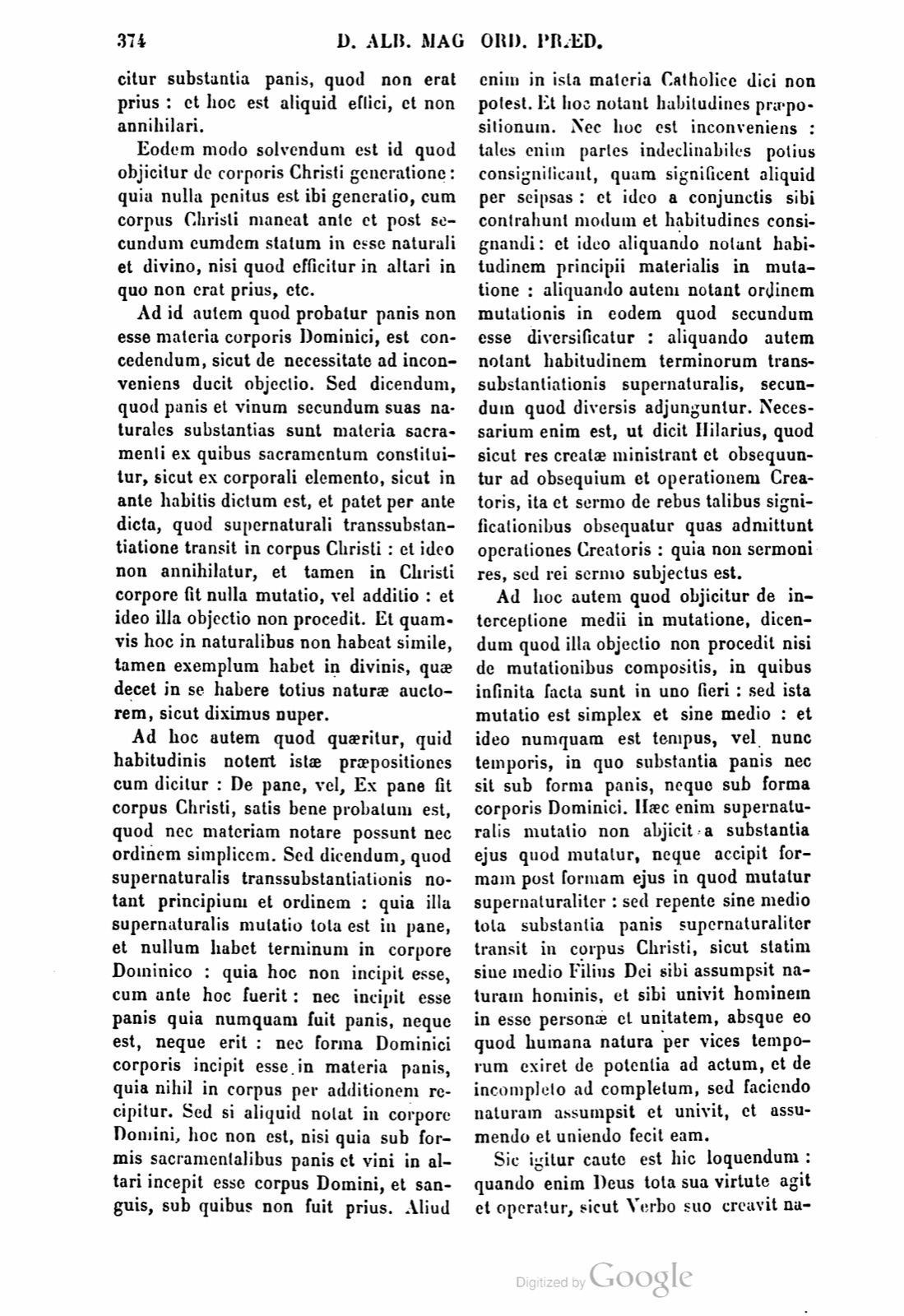
Ad hoc autem quod objicitur de interceptione medii in mutatione, dicendum quod illa objectio non procedit nisi de mutationibus compositis, in quibus infinita facta sunt in uno fieri: sed ista mutatio est simplex et sine medio: et ideo numquam est tempus, vel nunc temporis, in quo substantia panis nec sit sub forma panis, neque sub forma corporis Dominici. Haec enim supernaturalis mutatio non abjicit a substantia ejus quod mutatur, neque accipit formam post formam ejus in quod mutatur supernaturaliter: sed repente sine medio tota substantia panis supernaturaliter transit in corpus Christi, sicut statim sine medio Filius Dei sibi assumpsit naturam hominis, et sibi univit hominem in esse personae et unitatem, absque eo quod humana natura per vices temporum exiret de potentia ad actum, et de incompleto ad completum, sed faciendo naturam assumpsit et univit, et assumendo et uniendo fecit eam.
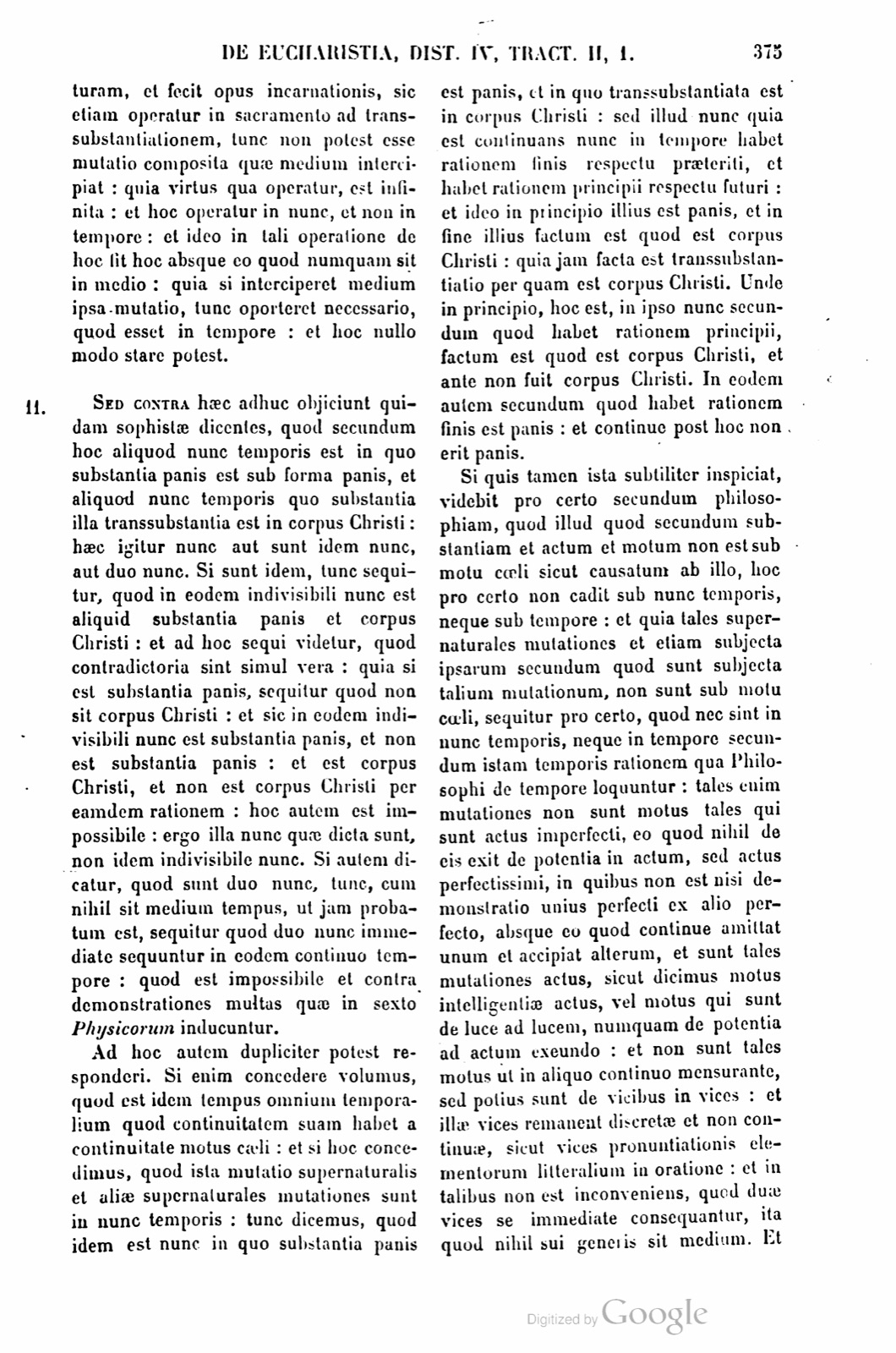
Sic igitur caute est hic loquendum: quando enim Deus tota sua virtute agit et operatur, sicut Verbo suo creavit naturam, et fecit opus incarnationis, sic etiam operatur in sacramento ad transsubstantiationem, tunc non potest esse mutatio composita quae medium intercipiat: quia virtus qua operatur, est infinita: et hoc operatur in nunc, et non in tempore: et ideo in tali operatione de hoc fit hoc absque eo quod numquam sit in medio: quia si interciperet medium ipsa mutatio, tunc oporteret necessario, quod esset in tempore: et hoc nullo modo stare potest.
But to this which is objected concerning the interception of a middle in change, it must be said that that objection proceeds only concerning composite changes, in which infinite things have been made in one becoming; but this change is simple and without a middle, and therefore there is never a time or now of time in which the substance of bread is neither under the form of bread nor under the form of the Lordly body. For this supernatural change does not cast away from the substance of that which is changed, nor does it receive form after the form of that into which it is supernaturally changed; but suddenly, without a middle, the whole substance of bread supernaturally passes into the body of Christ, just as immediately and without a middle the Son of God assumed to himself the nature of man and united man to himself in the being and unity of person, without human nature by turns of times going out from potency to act and from incomplete to complete, but by making the nature he assumed and united it, and by assuming and uniting he made it.
Thus therefore one must speak cautiously here. For when God acts and works by his whole power, just as by his Word he created nature and made the work of incarnation, so also he works in the sacrament toward transubstantiation; then there cannot be a composite change which intercepts a middle, because the power by which he works is infinite, and he works this in the now and not in time. And therefore in such an operation this becomes this without ever being in the middle, because if the change itself intercepted a middle, then it would necessarily have to be in time; and this can in no way stand.
If a page does not appear, its photograph has not been uploaded yet.