Works › The Book on the Sacrament of the Eucharist
Volume 38 · pp. 347–349
Chapter III. On the Acceptability of This Sacrifice
A marker with ≈ is an approximate page boundary, placed by measure of the text; the page photographs remain the authority. In the paired views, clicking a page marker brings that page into view.
CAPUT III. De hujus sacrificii acceptabilitate.
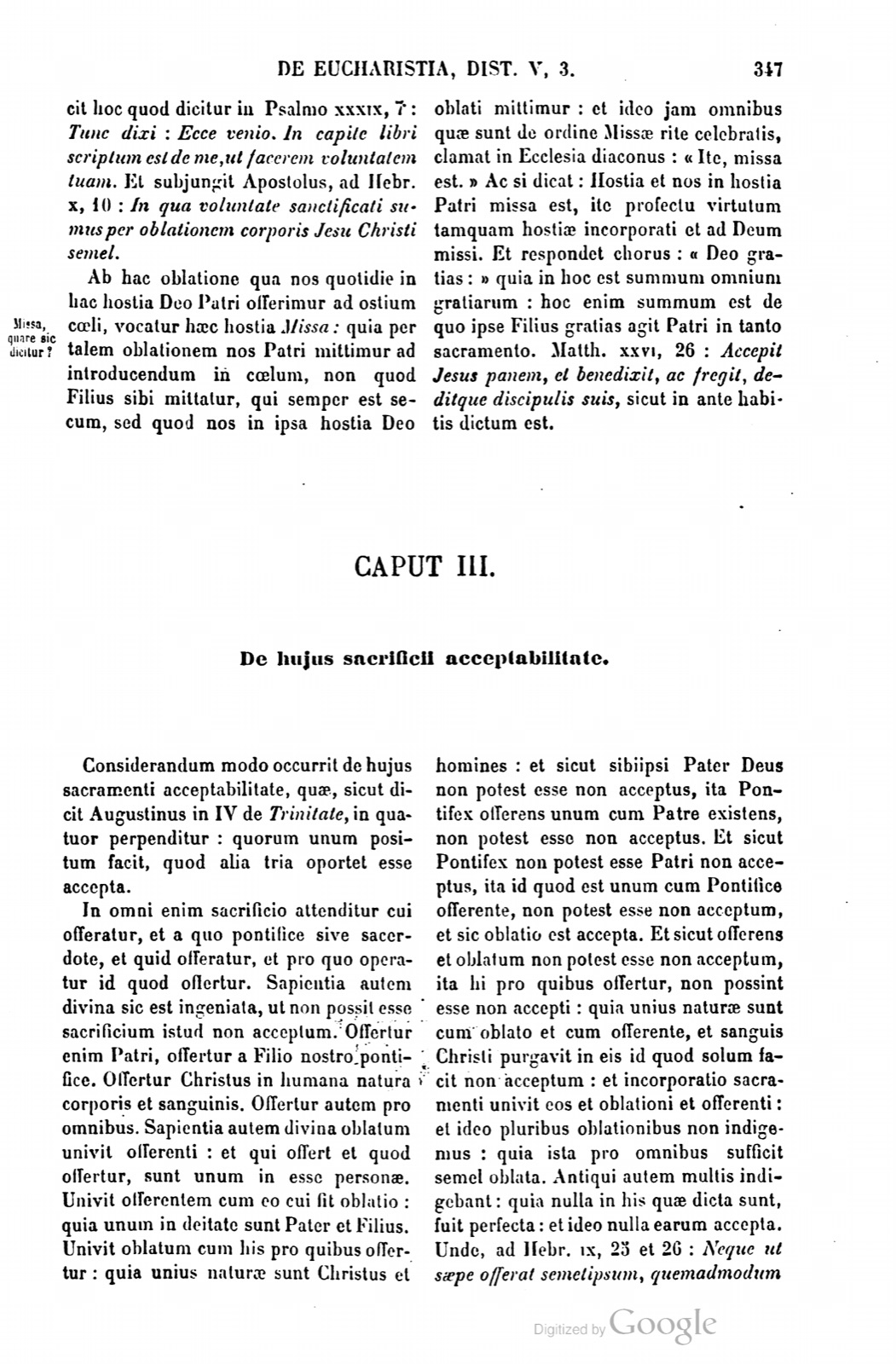
Considerandum modo occurrit de hujus sacramenti acceptabilitate, quae, sicut dicit Augustinus in IV de Trinitate, in quatuor perpenditur: quorum unum positum facit, quod alia tria oportet esse accepta.
In omni enim sacrificio attenditur cui offeratur, et a quo pontifice sive sacerdote, et quid offeratur, et pro quo operatur id quod offertur. Sapientia autem divina sic est ingeniata, ut non possit esse sacrificium istud non acceptum. Offertur enim Patri, offertur a Filio nostro pontifice. Offertur Christus in humana natura corporis et sanguinis. Offertur autem pro omnibus. Sapientia autem divina oblatum univit offerenti: et qui offert et quod offertur, sunt unum in esse personae. Univit offerentem cum eo cui fit oblatio: quia unum in deitate sunt Pater et Filius. Univit oblatum cum his pro quibus offertur: quia unius naturae sunt Christus et homines: et sicut sibi ipsi Pater Deus non potest esse non acceptus, ita Pontifex offerens unum cum Patre existens, non potest esse non acceptus. Et sicut Pontifex non potest esse Patri non acceptus, ita id quod est unum cum Pontifice offerente, non potest esse non acceptum, et sic oblatio est accepta. Et sicut offerens et oblatum non potest esse non acceptum, ita hi pro quibus offertur, non possint esse non accepti: quia unius naturae sunt cum oblato et cum offerente, et sanguis Christi purgavit in eis id quod solum facit non acceptum: et incorporatio sacramenti univit eos et oblationi et offerenti: et ideo pluribus oblationibus non indigemus: quia ista pro omnibus sufficit semel oblata. Antiqui autem multis indigebant: quia nulla in his quae dicta sunt, fuit perfecta: et ideo nulla earum accepta. Unde, ad Hebr. IX, 23 et 26: Neque ut saepe offerat semetipsum, quemadmodum pontifex intrat in sancta per singulos annos in sanguine alieno: alioquin oportebat eum frequenter pati ab origine mundi: nunc autem semel in consummatione saeculorum, ad destructionem peccati, per hostiam suam apparuit. Et sequitur, v. 27 et 28: Et quemadmodum statutum est hominibus semel mori, post hoc autem judicium, sic et Christus semel oblatus est ad multorum exhaurienda peccata: secundo sine peccato apparebit exspectantibus se, in salutem. Sic igitur perfectissima et acceptabilissima oblatio est: quia Patri offertur, cui soli est offerendum. Sic dicitur, Exod. XX, 5: Non habebis deos alienos coram me. Psal. LXXX, 10 et 11: Non erit in te deus recens, neque adorabis deum alienum. Ego enim sum Dominus Deus tuus. Solus Filius est sacerdos hujus hostiae et oblationis, ad oblationem hanc solus dignus. Ad Hebr. VII, 26: Talis enim decebat ut nobis esset pontifex, sanctus, innocens, impollutus, segregatus a peccatoribus, et excelsior caelis factus. Ad Hebr. VIII, 1 et 2: Talem habemus pontificem, qui consedit in dextera sedis magnitudinis in caelis, sanctorum minister, et tabernaculi veri, quod fixit Dominus et non homo. Sequentes autem pontifices et sacerdotes et vicarii hujus sunt, in quorum verbis pronuntiatis Verbum increatum operatur oblationem. Isa. LXI, 6: Vos autem sacerdotes Domini vocabimini: Ministri Dei nostri, dicetur vobis. Habemus sufficientissimam etiam oblationem, de qua dicitur, ad Hebr. VII, 25, quod salvare in perpetuum potest accedentes per semetipsum ad Deum, semper vivens ad interpellandum pro nobis. Non ergo restat nisi ut purificati offeramur in ipsa, et Patri erimus accepti. Ad Hebr. IV, 16: Adeamus ergo cum fiducia ad thronum gratiae, ut misericordiam consequamur, et gratiam inveniamus in auxilio opportuno. Unum enim cum Patre est pontifex: et ideo non spernit offerentem. Joan. X, 30: Ego et Pater unum sumus. Et ideo non rapiet quisquam de manu sua, sicut nec de manu Patris aliquid rapi potest. Sic sancti oblati in manu Dei sunt. Sapient. III, 1: Justorum autem animae in manu Dei sunt. Oblati a Dei Filio, et recepti a Deo Patre. Offerens et oblatum est idem: quia, Joan. XVII, 19, dicit: Pro eis ego sanctifico meipsum. Ad Hebr. VII, 27: Hoc fecit semel, seipsum offerendo. Oblatum cum his pro quibus offertur, unum est: et ideo mediator unum est nobiscum, et unum cum Patre. I ad Timoth. II, 5: Mediator Dei et hominum, homo Christus Jesus. Unde, ad Hebr. IX, 11: Christus assistens pontifex futurorum bonorum. Et dicit Glossa: « Assistens Patri, et assistens nobis. »
CHAPTER III. On the acceptability of this sacrifice.
Now consideration occurs concerning the acceptability of this sacrament, which, as Augustine says in book IV On the Trinity, is weighed in four things; and one of these, when posited, makes it necessary that the other three be accepted.
For in every sacrifice it is considered to whom it is offered, and by what pontiff or priest, and what is offered, and for whom that which is offered works. But divine wisdom has been so contrived that this sacrifice cannot be not accepted. For it is offered to the Father; it is offered by the Son, our pontiff. Christ is offered in the human nature of body and blood. And it is offered for all. But divine wisdom united the thing offered to the offerer; and he who offers and that which is offered are one in the being of person. It united the offerer with him to whom the oblation is made, because the Father and the Son are one in deity. It united the thing offered with those for whom it is offered, because Christ and human beings are of one nature. And just as God the Father cannot be not acceptable to himself, so the Pontiff offering, existing as one with the Father, cannot be not acceptable. And just as the Pontiff cannot be not acceptable to the Father, so that which is one with the Pontiff offering cannot be not acceptable; and thus the oblation is accepted. And just as the offerer and the offered thing cannot be not acceptable, so those for whom it is offered cannot be not acceptable, because they are of one nature with the offered thing and with the offerer, and the blood of Christ has cleansed in them that which alone makes one not acceptable; and the incorporation of the sacrament has united them both to the oblation and to the offerer. And therefore we do not need many oblations, because this one, once offered, suffices for all. But the ancients needed many, because none was perfect in those things which have been said; and therefore none of them was accepted. Hence, Hebrews 9:23 and 26: "Nor that he should often offer himself, as the pontiff enters into the holy places each year with alien blood; otherwise it would have been necessary for him to suffer frequently from the origin of the world. But now once, in the consummation of the ages, he has appeared for the destruction of sin through his own host." And there follows, vv. 27 and 28: "And as it is appointed for human beings once to die, and after this judgment, so also Christ was offered once to exhaust the sins of many; the second time without sin he will appear to those expecting him, unto salvation." Thus therefore the oblation is most perfect and most acceptable, because it is offered to the Father, to whom alone offering is to be made. Thus it is said, Exodus 20:5: "You shall not have strange gods before me." Psalm 80:10 and 11: "There shall not be in you a recent god, nor shall you adore an alien god. For I am the Lord your God." The Son alone is the priest of this host and oblation, alone worthy for this oblation. Hebrews 7:26: "For it was fitting that such a pontiff should be for us, holy, innocent, undefiled, separated from sinners, and made higher than the heavens." Hebrews 8:1 and 2: "We have such a pontiff, who has sat down at the right hand of the seat of majesty in the heavens, minister of the holy things and of the true tabernacle, which the Lord fixed and not man." But the pontiffs and priests following are his vicars, in whose spoken words the uncreated Word works the oblation. Isaiah 61:6: "But you shall be called priests of the Lord; ministers of our God, it shall be said to you." We also have a most sufficient oblation, concerning which it is said, Hebrews 7:25, that "he is able to save forever those approaching God through himself, always living to intercede for us." Therefore nothing remains except that, purified, we be offered in it, and we shall be accepted by the Father. Hebrews 4:16: "Therefore let us approach with confidence to the throne of grace, that we may obtain mercy and find grace in timely help." For the pontiff is one with the Father, and therefore he does not spurn the one offering. John 10:30: "I and the Father are one." And therefore no one will snatch anything from his hand, just as neither can anything be snatched from the hand of the Father. Thus the saints offered are in the hand of God. Wisdom 3:1: "But the souls of the just are in the hand of God." Offered by the Son of God, and received by God the Father. The one offering and the thing offered are the same, because, John 17:19, he says: "For them I sanctify myself." Hebrews 7:27: "This he did once, offering himself." The offered thing is one with those for whom it is offered, and therefore the mediator is one with us and one with the Father. I Timothy 2:5: "Mediator of God and human beings, the man Christ Jesus." Hence, Hebrews 9:11: "Christ, appearing as pontiff of future goods." And the Gloss says: "Appearing before the Father, and appearing before us."
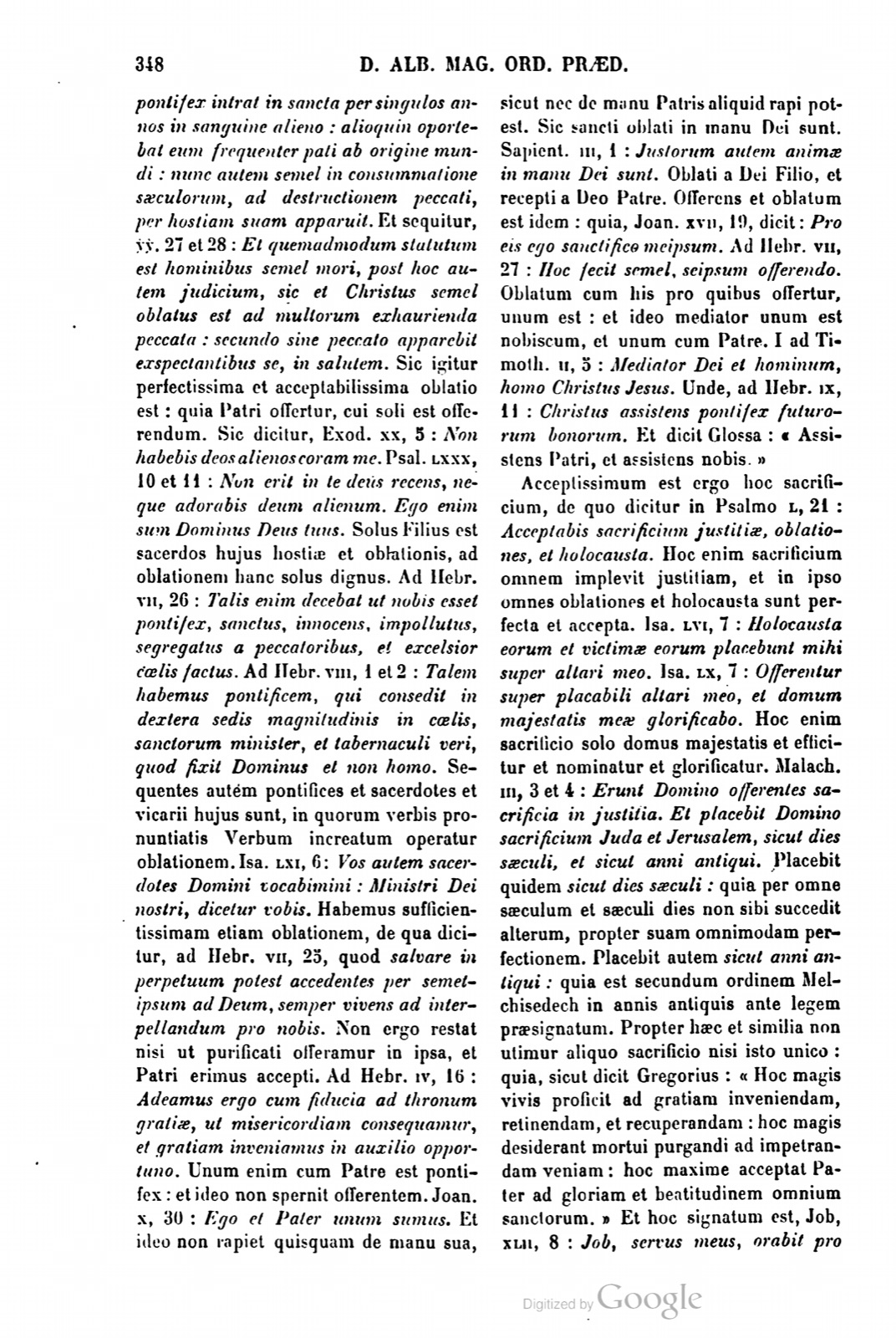
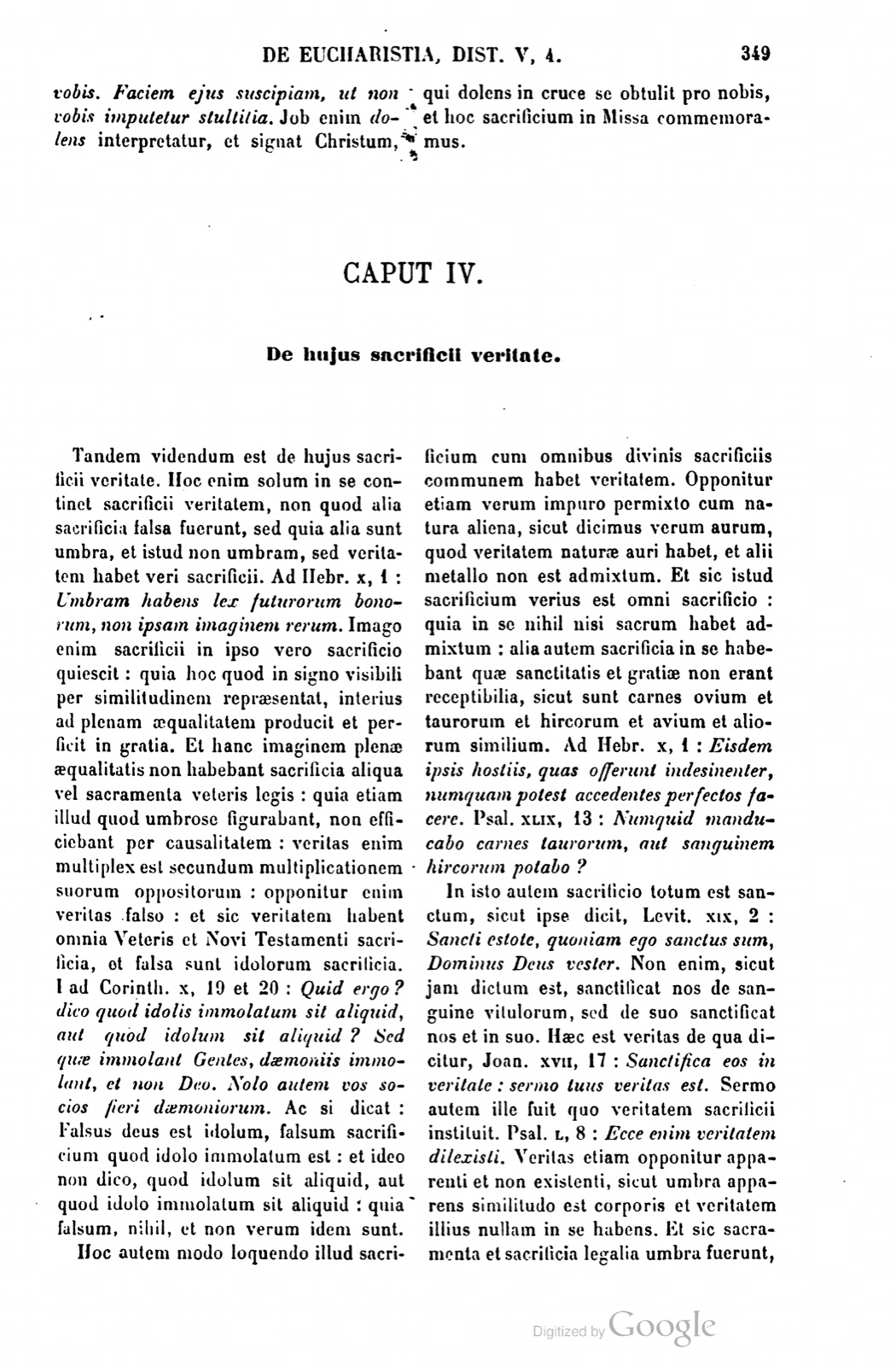
Acceptissimum est ergo hoc sacrificium, de quo dicitur in Psalmo L, 21: Acceptabis sacrificium justitiae, oblationes, et holocausta. Hoc enim sacrificium omnem implevit justitiam, et in ipso omnes oblationes et holocausta sunt perfecta et accepta. Isa. LVI, 7: Holocausta eorum et victimae eorum placebunt mihi super altari meo. Isa. LX, 7: Offerentur super placabili altari meo, et domum majestatis meae glorificabo. Hoc enim sacrificio solo domus majestatis et efficitur et nominatur et glorificatur. Malach. III, 3 et 4: Erunt Domino offerentes sacrificia in justitia. Et placebit Domino sacrificium Juda et Jerusalem, sicut dies saeculi, et sicut anni antiqui. Placebit quidem sicut dies saeculi: quia per omne saeculum et saeculi dies non sibi succedit alterum, propter suam omnimodam perfectionem. Placebit autem sicut anni antiqui: quia est secundum ordinem Melchisedech in annis antiquis ante legem praesignatum. Propter haec et similia non utimur aliquo sacrificio nisi isto unico: quia, sicut dicit Gregorius: « Hoc magis vivis proficit ad gratiam inveniendam, retinendam, et recuperandam: hoc magis desiderant mortui purgandi ad impetrandam veniam: hoc maxime acceptat Pater ad gloriam et beatitudinem omnium sanctorum. » Et hoc signatum est, Job, XLII, 8: Job, servus meus, orabit pro vobis. Faciem ejus suscipiam, ut non vobis imputetur stultitia. Job enim dolens interpretatur, et signat Christum, qui dolens in cruce se obtulit pro nobis, et hoc sacrificium in Missa commemoramus.
Therefore this sacrifice is most acceptable, concerning which it is said in Psalm 50:21: "You will accept the sacrifice of justice, oblations, and holocausts." For this sacrifice fulfilled every justice, and in it all oblations and holocausts are perfected and accepted. Isaiah 56:7: "Their holocausts and their victims will please me upon my altar." Isaiah 60:7: "They will be offered upon my placable altar, and I will glorify the house of my majesty." For by this sacrifice alone the house of majesty both is made and is named and is glorified. Malachi 3:3 and 4: "They shall be offering sacrifices to the Lord in justice. And the sacrifice of Judah and Jerusalem shall please the Lord, as the days of the age and as the ancient years." It will please indeed as the days of the age, because through every age and the days of the age another does not succeed it, on account of its every-mode perfection. But it will please as the ancient years, because according to the order of Melchizedek it was pre-signified in the ancient years before the Law. On account of these and similar things we use no sacrifice except this single one, because, as Gregory says: "This profits the living more for finding, retaining, and recovering grace; this the dead to be purged desire more for obtaining pardon; this the Father accepts most for the glory and beatitude of all the saints." And this was signified, Job 42:8: "Job, my servant, will pray for you. I will receive his face, that folly may not be imputed to you." For Job is interpreted "grieving," and signifies Christ, who, grieving on the cross, offered himself for us, and we commemorate this sacrifice in the Mass.
If a page does not appear, its photograph has not been uploaded yet.