Works › The Book on the Sacrament of the Eucharist
Volume 38 · pp. 328–329
Chapter V. That this food must be received in the delights of eternal enjoyment.
A marker with ≈ is an approximate page boundary, placed by measure of the text; the page photographs remain the authority. In the paired views, clicking a page marker brings that page into view.
CAPUT V. Quod sumendus sit hic cibus in deliciis aeternae fruitionis.
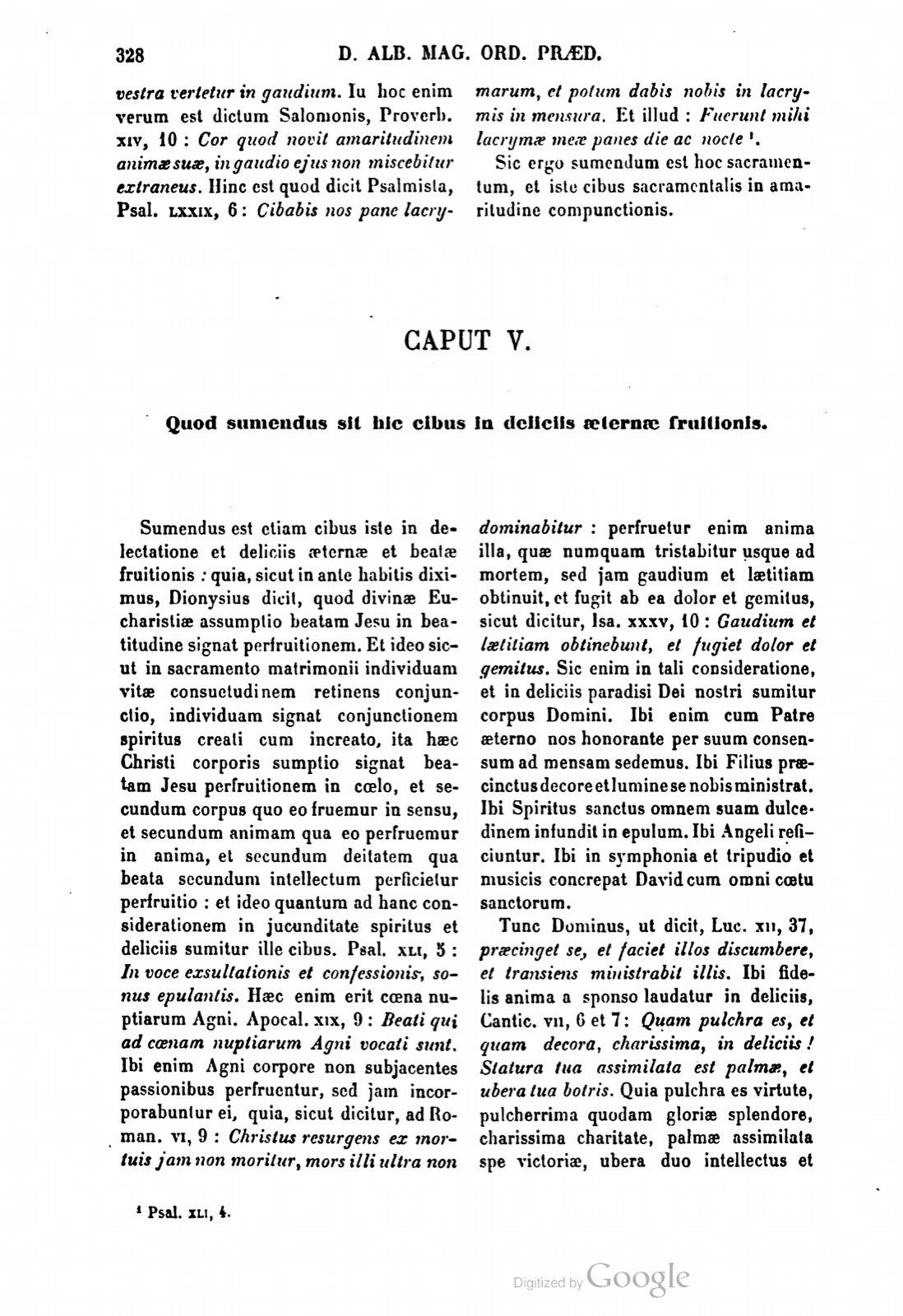
Sumendus est etiam cibus iste in delectatione et deliciis aeternae et beatae fruitionis: quia, sicut in ante habitis diximus, Dionysius dicit, quod divinae Eucharistiae assumptio beatam Jesu in beatitudine signat perfruitionem. Et ideo sicut in sacramento matrimonii individuam vitae consuetudinem retinens conjunctio, individuam signat conjunctionem spiritus creati cum increato, ita haec Christi corporis sumptio signat beatam Jesu perfruitionem in coelo, et secundum corpus quo eo fruemur in sensu, et secundum animam qua eo perfruemur in anima, et secundum deitatem qua beata secundum intellectum perficietur perfruitio: et ideo quantum ad hanc considerationem in jucunditate spiritus et deliciis sumitur ille cibus. Psal. XL, 5: In voce exsultationis et confessionis, sonus epulantis. Haec enim erit coena nuptiarum Agni. Apocal. XIX, 9: Beati qui ad coenam nuptiarum Agni vocati sunt. Ibi enim Agni corpore non subjacentes passionibus perfruentur, sed jam incorporabuntur ei, quia, sicut dicitur, ad Roman. VI, 9: Christus resurgens ex mortuis jam non moritur, mors illi ultra non dominabitur: perfruetur enim anima illa, quae numquam tristabitur usque ad mortem, sed jam gaudium et laetitiam obtinuit, et fugit ab ea dolor et gemitus, sicut dicitur, Isa. XXXV, 10: Gaudium et laetitiam obtinebunt, et fugiet dolor et gemitus. Sic enim in tali consideratione, et in deliciis paradisi Dei nostri sumitur corpus Domini. Ibi enim cum Patre aeterno nos honorante per suum consensum ad mensam sedemus. Ibi Filius praecinctus decore et lumine se nobis ministrat. Ibi Spiritus sanctus omnem suam dulcedinem infundit in epulum. Ibi Angeli reficiuntur. Ibi in symphonia et tripudio et musicis concrepat David cum omni coetu sanctorum.
Tunc Dominus, ut dicit, Luc. XI, 37, praecinget se, et faciet illos discumbere, et transiens ministrabit illis. Ibi fidelis anima a sponso laudatur in deliciis, Cantic. VII, 6 et 7: Quam pulchra es, et quam decora, charissima, in deliciis! Statura tua assimilata est palmae, et ubera tua botris. Quia pulchra es virtute, pulcherrima quodam gloriae splendore, charissima charitate, palmae assimilata spe victoriae, ubera duo intellectus et affectus tam ubertim fundentia vinum coelestis gaudii et aeternae jucunditatis. Joan. XII, 26: Si quis mihi ministraverit, honorificabit eum Pater meus, procul dubio per talem suae mensae consessionem seu consessum. O quanto affectu tunc Deo dicent illud Psalmi LXIV, 10: Parasti cibum illorum, quoniam ita est praeparatio ejus. Quam praeparationem non valuit facere nisi majestas ubertatis Dei, nec scivit nisi summa sapientia Filii, nec condire potuit nisi bonitas et dulcedo Spiritus sancti.
CHAPTER V. That this food must be received in the delights of eternal enjoyment.
This food must also be received in the delight and delights of eternal and blessed enjoyment, because, as we said in what was held before, Dionysius says that the taking up of the divine Eucharist signifies the blessed enjoyment of Jesus in blessedness. And therefore just as in the sacrament of marriage the union retaining the indivisible custom of life signifies the indivisible union of the created spirit with the uncreated, so this reception of Christ's body signifies the blessed enjoyment of Jesus in heaven, both according to the body by which we will enjoy him in sense, and according to the soul by which we will enjoy him in the soul, and according to deity by which blessed enjoyment will be perfected according to intellect. And therefore, with respect to this consideration, that food is received in joyfulness of spirit and in delights. Psalm 40:5: "With the voice of exultation and confession, the sound of one feasting." For this will be the supper of the wedding of the Lamb. Apocalypse 19:9: "Blessed are those who have been called to the supper of the wedding of the Lamb." For there they will enjoy the body of the Lamb, not subject to passions, but now they will be incorporated into him, because, as is said, Romans 6:9: "Christ rising from the dead now does not die; death will no longer have dominion over him." For that soul will enjoy him, which will never be saddened unto death, but now has obtained joy and gladness, and sorrow and groaning have fled from it, as is said, Isaiah 35:10: "They will obtain joy and gladness, and sorrow and groaning will flee." For thus in such consideration and in the delights of the paradise of our God the body of the Lord is received. For there we sit at table with the eternal Father honoring us through his consent. There the Son, girded with beauty and light, ministers himself to us. There the Holy Spirit pours all his sweetness into the feast. There Angels are refreshed. There in symphony and dance and music David resounds with the whole company of the saints.
Then the Lord, as he says, Luke 11:37, will gird himself, and will make them recline, and passing by will minister to them. There the faithful soul is praised by the bridegroom in delights, Canticles 7:6 and 7: "How beautiful you are, and how comely, dearest, in delights! Your stature is likened to a palm, and your breasts to clusters." Because you are beautiful by virtue, most beautiful by a certain splendor of glory, dearest by charity, likened to the palm by hope of victory, the two breasts of intellect and affection pouring out so richly the wine of heavenly joy and eternal joyfulness. John 12:26: "If anyone has ministered to me, my Father will honor him," without doubt through such sitting together or session at his table. O with how great affection then they will say to God that of Psalm 64:10: "You prepared their food, because so is its preparation." Only the majesty of God's richness could make that preparation, only the highest wisdom of the Son knew it, and only the goodness and sweetness of the Holy Spirit could season it.
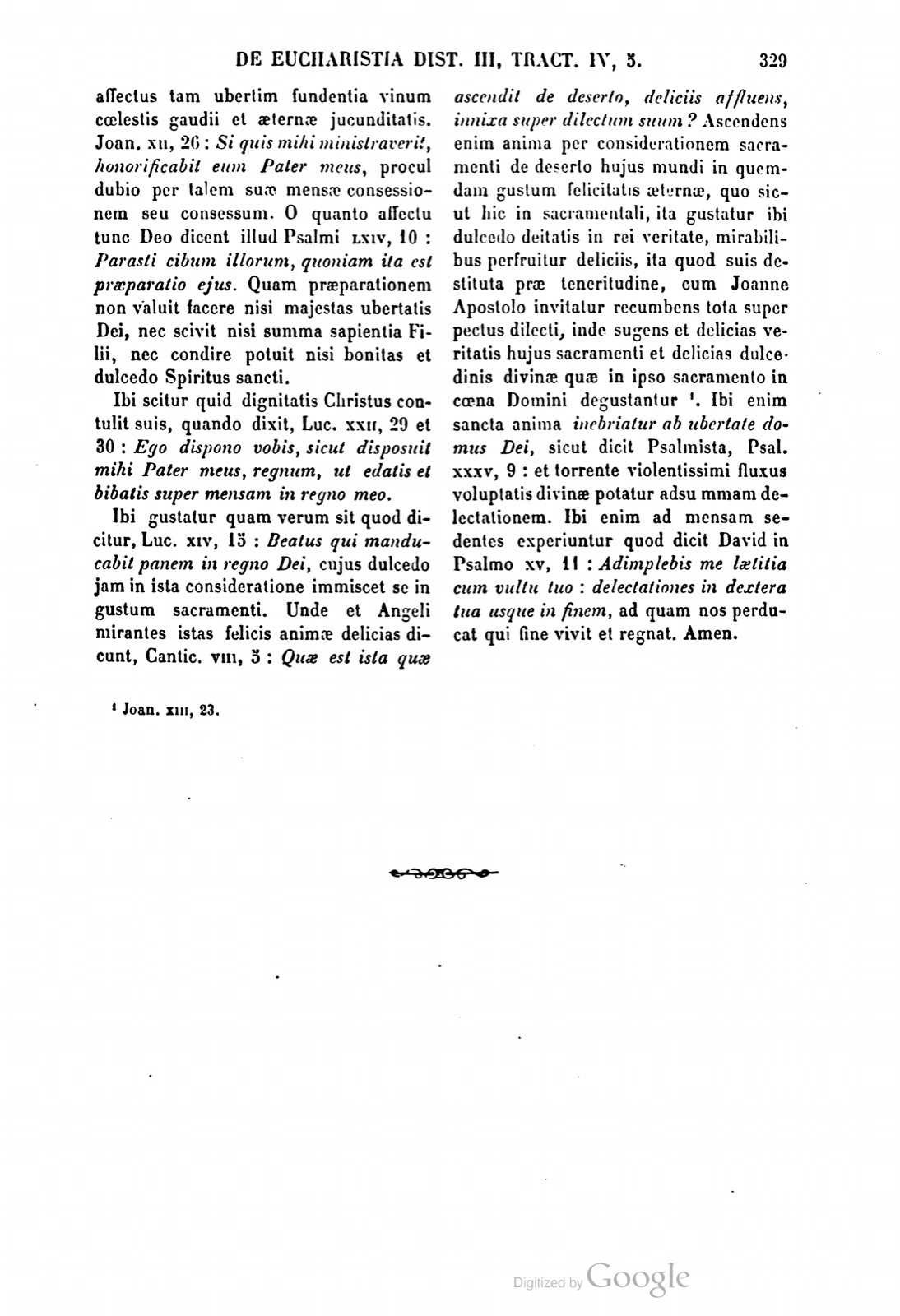
Ibi scitur quid dignitatis Christus contulit suis, quando dixit, Luc. XXII, 29 et 30: Ego dispono vobis, sicut disposuit mihi Pater meus, regnum, ut edatis et bibatis super mensam in regno meo.
Ibi gustatur quam verum sit quod dicitur, Luc. XIV, 15: Beatus qui manducabit panem in regno Dei, cujus dulcedo jam in ista consideratione immiscet se in gustum sacramenti. Unde et Angeli mirantes istas felicis animae delicias dicunt, Cantic. VIII, 5: Quae est ista quae ascendit de deserto, deliciis affluens, innixa super dilectum suum? Ascendens enim anima per considerationem sacramenti de deserto hujus mundi in quemdam gustum felicitatis aeternae, quo sicut hic in sacramentali, ita gustatur ibi dulcedo deitatis in rei veritate, mirabilibus perfruitur deliciis, ita quod suis destituta prae teneritudine, cum Joanne Apostolo invitatur recumbens tota super pectus dilecti, inde sugens et delicias veritatis hujus sacramenti et delicias dulcedinis divinae quae in ipso sacramento in coena Domini degustantur.1 Ibi enim sancta anima inebriatur ab ubertate domus Dei, sicut dicit Psalmista, Psal. XXXV, 9: et torrente violentissimi fluxus voluptatis divinae potatur ad summam delectationem. Ibi enim ad mensam sedentes experiuntur quod dicit David in Psalmo XV, 11: Adimplebis me laetitia cum vultu tuo: delectationes in dextera tua usque in finem, ad quam nos perducat qui fine vivit et regnat. Amen.
There it is known what dignity Christ conferred on his own, when he said, Luke 22:29 and 30: "I dispose to you, as my Father disposed to me, a kingdom, that you may eat and drink upon my table in my kingdom."
There is tasted how true is what is said, Luke 14:15: "Blessed is he who will eat bread in the kingdom of God," whose sweetness already in this consideration mixes itself into the taste of the sacrament. Hence also the Angels, wondering at those delights of the happy soul, say, Canticles 8:5: "Who is this who ascends from the desert, flowing with delights, leaning upon her beloved?" For the soul ascending through consideration of the sacrament from the desert of this world into a certain taste of eternal felicity, by which, as here in the sacramental, so there the sweetness of deity is tasted in the truth of the reality, enjoys marvelous delights, so that, deprived of her own things because of tenderness, with John the Apostle she is invited, reclining wholly upon the breast of the beloved, thence sucking both the delights of the truth of this sacrament and the delights of divine sweetness which are tasted in the sacrament itself in the supper of the Lord.1 For there the holy soul is made drunk from the richness of the house of God, as the Psalmist says, Psalm 35:9, and is given to drink from the torrent of the most violent flow of divine pleasure unto the highest delight. For there those sitting at table experience what David says in Psalm 15:11: "You will fill me with joy with your countenance; delights are at your right hand unto the end," to which may he lead us who lives and reigns without end. Amen.
Notes
- John 13:23. (Joan. XIII, 23.) ↩
If a page does not appear, its photograph has not been uploaded yet.