Works › The Book on the Sacrament of the Eucharist
Volume 38 · pp. 327–328
Chapter IV. That this food must be received in bitterness.
A marker with ≈ is an approximate page boundary, placed by measure of the text; the page photographs remain the authority. In the paired views, clicking a page marker brings that page into view.
CAPUT IV. Quod sumendus sit hic cibus in amaritudine.
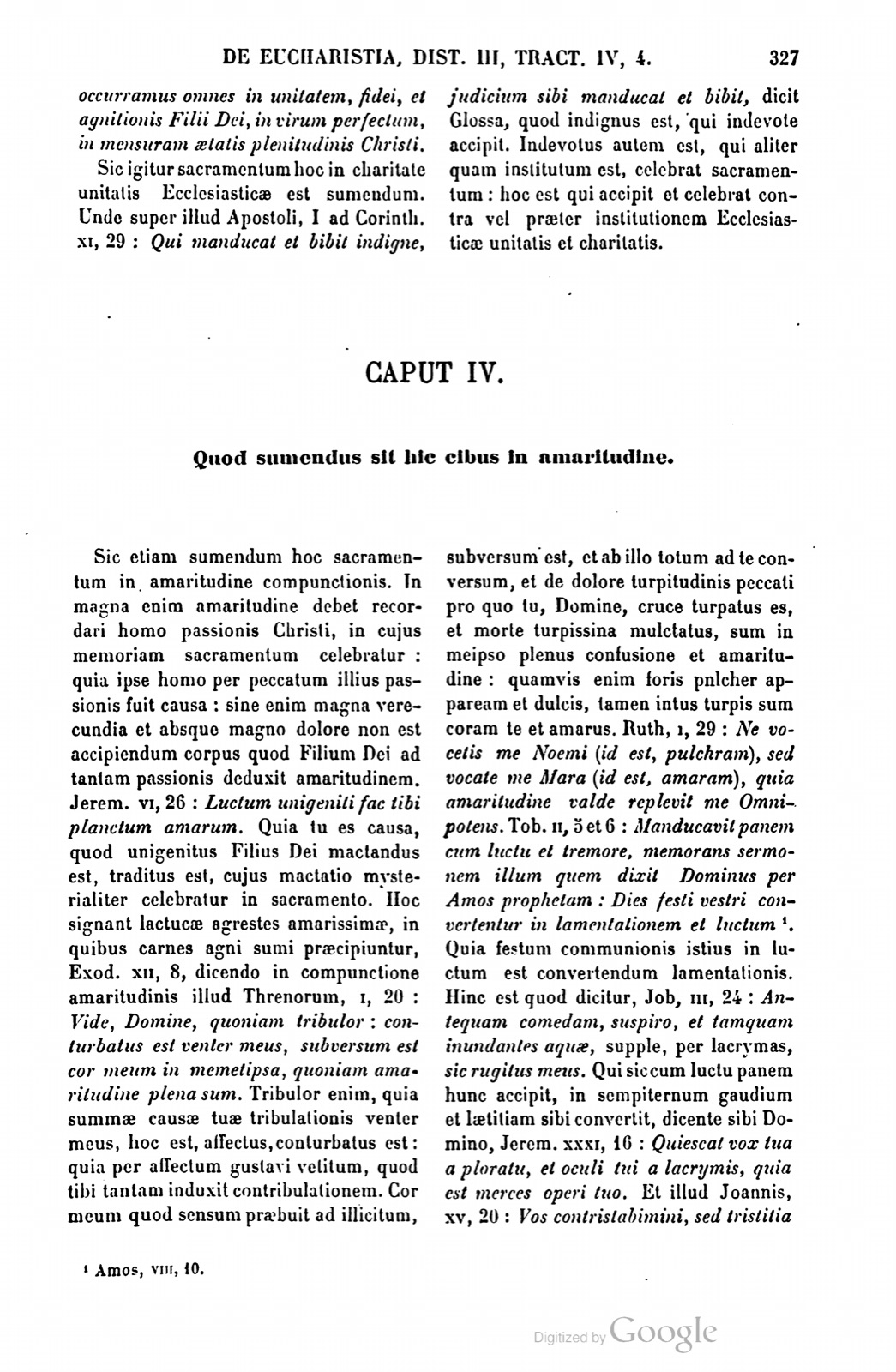
Sic etiam sumendum hoc sacramentum in amaritudine compunctionis. In magna enim amaritudine debet recordari homo passionis Christi, in cujus memoriam sacramentum celebratur: quia ipse homo per peccatum illius passionis fuit causa: sine enim magna verecundia et absque magno dolore non est accipiendum corpus quod Filium Dei ad tantam passionis deduxit amaritudinem. Jerem. VI, 26: Luctum unigeniti fac tibi planctum amarum. Quia tu es causa, quod unigenitus Filius Dei mactandus est, traditus est, cujus mactatio mysterialiter celebratur in sacramento. Hoc signant lactucae agrestes amarissimae, in quibus carnes agni sumi praecipiuntur, Exod. XII, 8, dicendo in compunctione amaritudinis illud Threnorum, I, 20: Vide, Domine, quoniam tribulor: conturbatus est venter meus, subversum est cor meum in memetipsa, quoniam amaritudine plena sum. Tribulor enim, quia summae causae tuae tribulationis venter meus, hoc est, affectus, conturbatus est: quia per affectum gustavi vetitum, quod tibi tantam induxit contribulationem. Cor meum quod sensum praebuit ad illicitum, subversum est, et ab illo totum ad te conversum, et de dolore turpitudinis peccati pro quo tu, Domine, cruce turpatus es, et morte turpissima mulctatus, sum in meipso plenus confusione et amaritudine: quamvis enim foris pulcher appaream et dulcis, tamen intus turpis sum coram te et amarus. Ruth, I, 29: Ne vocetis me Noemi, id est, pulchram, sed vocate me Mara, id est, amaram, quia amaritudine valde replevit me Omnipotens. Tob. II, 5 et 6: Manducavit panem cum luctu et tremore, memorans sermonem illum quem dixit Dominus per Amos prophetam: Dies festi vestri convertentur in lamentationem et luctum.1 Quia festum communionis istius in luctum est convertendum lamentationis. Hinc est quod dicitur, Job, III, 24: Antequam comedam, suspiro, et tamquam inundantes aquae, supple, per lacrymas, sic rugitus meus. Qui siccum luctu panem hunc accipit, in sempiternum gaudium et laetitiam sibi convertit, dicente sibi Domino, Jerem. XXXI, 16: Quiescat vox tua a ploratu, et oculi tui a lacrymis, quia est merces operi tuo. Et illud Joannis, XVI, 20: Vos contristabimini, sed tristitia vestra vertetur in gaudium. In hoc enim verum est dictum Salomonis, Proverb. XIV, 10: Cor quod novit amaritudinem animae suae, in gaudio ejus non miscebitur extraneus. Hinc est quod dicit Psalmista, Psal. LXXIX, 6: Cibabis nos pane lacrymarum, et potum dabis nobis in lacrymis in mensura. Et illud: Fuerunt mihi lacrymae meae panes die ac nocte.2
CHAPTER IV. That this food must be received in bitterness.
Thus also this sacrament must be received in the bitterness of compunction. For in great bitterness man ought to remember the Passion of Christ, in whose memory the sacrament is celebrated, because man himself through sin was the cause of that Passion; for without great shame and without great sorrow the body which led the Son of God to such bitterness of Passion is not to be received. Jeremiah 6:26: "Make for yourself the mourning of an only-begotten, a bitter lamentation." Because you are the cause that the only-begotten Son of God was handed over to be slaughtered, whose slaughter is mystically celebrated in the sacrament. This is signified by the very bitter wild lettuces in which the flesh of the lamb is commanded to be received, Exodus 12:8, saying in the compunction of bitterness that of Lamentations 1:20: "See, Lord, because I am troubled; my stomach has been disturbed, my heart has been overturned within myself, because I am full of bitterness." For I am troubled because my stomach, that is, my affection, the chief cause of your tribulation, has been disturbed, because through affection I tasted the forbidden thing which brought upon you so great a co-tribulation. My heart, which offered sense toward what was unlawful, has been overturned, and from that turned wholly to you; and from sorrow over the foulness of sin for which you, Lord, were fouled on the cross and punished by a most shameful death, I am in myself full of confusion and bitterness. For although outside I appear beautiful and sweet, nevertheless within I am foul before you and bitter. Ruth 1:29: "Do not call me Noemi," that is, beautiful, "but call me Mara," that is, bitter, "because the Almighty has filled me greatly with bitterness." Tobit 2:5 and 6: "He ate bread with mourning and trembling, remembering that word which the Lord spoke through Amos the prophet: Your feast days will be turned into lamentation and mourning."1 Because the feast of this communion must be turned into mourning of lamentation. Hence it is said, Job 3:24: "Before I eat, I sigh, and like overflowing waters," supply, through tears, "so is my roaring." He who receives this bread dry with mourning converts it for himself into everlasting joy and gladness, the Lord saying to him, Jeremiah 31:16: "Let your voice cease from weeping, and your eyes from tears, because there is a reward for your work." And that of John 16:20: "You will be saddened, but your sadness will be turned into joy." For in this the saying of Solomon is true, Proverbs 14:10: "The heart which knows the bitterness of its soul, in its joy no stranger will be mixed." Hence the Psalmist says, Psalm 79:6: "You will feed us with the bread of tears, and you will give us drink in tears by measure." And that: "My tears have been breads for me day and night."2
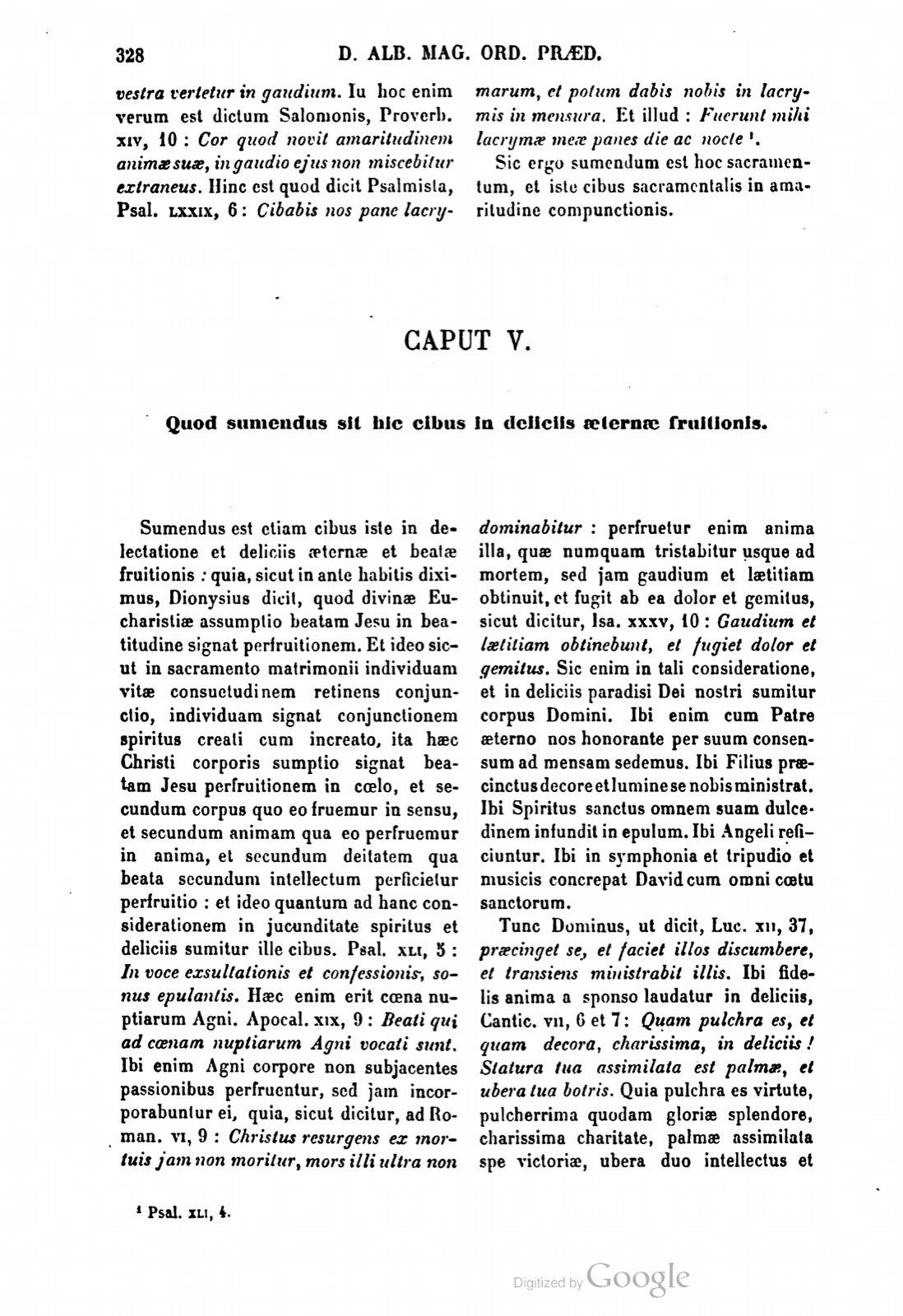
Sic ergo sumendum est hoc sacramentum, et iste cibus sacramentalis in amaritudine compunctionis.
Thus therefore this sacrament and this sacramental food must be received in the bitterness of compunction.
If a page does not appear, its photograph has not been uploaded yet.