Works › The Book on the Sacrament of the Eucharist
Volume 38 · pp. 259–262
Chapter VI. On the Fittingness of This Food for the One Fed from Likeness, nos. 1-through the opening of 5.
A marker with ≈ is an approximate page boundary, placed by measure of the text; the page photographs remain the authority. In the paired views, clicking a page marker brings that page into view.
Marginal label (printed p. 259): Congruitas nostri ad cibum ex digestione.
Marginal label (printed p. 260): In imagine sive similitudine.
Marginal label (printed p. 261): In naturae conformitate.
Marginal label (printed p. 261): In conversationis pulchritudine.
Marginal label (printed p. 262): In nostrae miseriae secundum poenas indetractabiles assumptione.
Caput VI. De cibi hujus ad cibatum congruitate ex similitudine.
1. Nunc restat dicere secundum ordinem superius digestae divisionis, quae sit cibi hujus ad cibatum congruitas ex similitudine. Dicunt enim Philosophi, quod nihil nutrit nisi simile: et ideo cum cibus iste maxime nutriat, oportet quod maxime sit similis: quia si etiam dissimilis est a proprio principio cibus, tamen antequam nutriat corpus, per digestionem oportet quod efficiatur similis. Haec autem digestio in cibo fit in eo quod convertitur ad alterum: et ideo quia cibus materialis convertitur ad corpus cibatum, oportet quod digestio fiat in cibo et potu. I Regum, i, 14: Digere paulisper vinum quo mades. In cibo isto spirituali, quia non convertitur ad nos, sed nos convertimur ad ipsum, oportet quod digestio fiat in nobis ad illius cibi salutaris similitudinem: et tunc in quinque consistit congruitas cibi ad cibatum, ex similitudine scilicet in nostri ad cibum digestione, in imaginis similitudine, in naturae conformitate, et conversationis pulchritudine, et in nostrae miseriae secundum poenas indetractabiles susceptione.
Per digestionem autem nostri ad cibum fit similitudo compunctione peccati et devotione ferventis desiderii. De compunctione quidem peccati dicitur, I ad Corinth. xi, 28 et 29: Probet autem seipsum homo: et sic de pane illo edat et de calice bibat: qui enim manducat et bibit indigne, judicium sibi manducat et bibit, non dijudicans corpus Domini. Probet autem seipsum homo, quando probando judicat quod facit, et de factis et perpetratis peccatis compungitur, ut per poenitentiam munditiae cibi assimiletur: et sic dijudicat corpus Domini, quando ipsius cibi munditiae assimilatur, sic per quamdam spiritualem digestionem calore compunctionis praeparatus. Hoc significatur per lactucas agrestes amaras, in quibus carnes agni comedi praecipiuntur.1 Hinc est quod etiam, Genes. xxvii, 14, haedi a Rebecca cocti et praeparati ad delectationem, patriarcha oblati sunt, per quos filius benedictionem patris meruit accipere. Haedi peccatores significant, qui igne compunctionis decocti et sapore satisfactionis conditi, oblati summo Patri, impetrant benedictionem in venia et gratia sacramenti ad plenitudinem omnis boni. Hoc est quod dicitur, Isa. xlv, 4: Assimilavi te, et non cognovisti me. Primo enim non cognoscimus Dominum cognitione approbationis et beneplaciti: sed tunc quasi digerendo nos sibi assimilat, ut cibo ejus digni simus, et ut nobis proficiat, quando compunctione et satisfactione ad se nos transmutat. Psal. ci, 27: Mutabis eos, et mutabuntur: tu autem idem ipse es, et anni tui non deficient.
De assimilatione autem devotionis intelligitur id quod dicit Psalmista, Psal. xxxviii, 4: Concaluit cor meum intra me: et in meditatione mea exardescet ignis. Quando enim cogitamus charitatem Christi in hoc quod pro nobis se in sacrificium obtulit, cogitamus mansuetudinem patientis, et advertimus devotionem se pro nobis offerentis, largitatem se pro nobis exhibentis, benignitatem nos ad mensam hanc rapientis, dulcescit cor nostrum ad cibum hunc, et in tota cordis devotione accenditur, et fervet in amore, et sic ad similitudinem istius cibi digeritur per ignem qui exardescit in meditatione. Et ideo dicit, Eccli. xxxi, 12: Supra mensam magnam sedisti, non aperias super illam faucem tuam prior. Hoc est dicere: Mensa magna Dei in sacramento tibi praeponitur, vide quod et qualiter et quantum tibi praeponatur: quia talia in munditia cordis et devotionis, et hoc ipsum in natura puritatis, et tantum in affectu charitatis te praeparare oportet, si vis quod cibus ille tibi congruat. Aliter similitudinem nullam habentibus ad cibum digestione et devotione dicitur: Fiat mensa eorum coram ipsis in laqueum, et in retributionem, et in scandalum.2 Talis enim sumit in corpore Domini quod Judas accepit, hoc est, suspensionis laqueum, in quo per peccatum a diabolo strangulatur, et retribuitur ei poena damnationis pro peccato temeritatis, et scandalum casus, quia impingit in lapidem offensionis, sicut dicitur, Isa. viii, 14. Et hoc est quod dicit Apostolus, I ad Corinth. xi, 29: Qui manducat et bibit indigne, reus erit corporis et sanguinis Domini. Quia sicut Judas tradidit eum membris diaboli, ita iste quantum in ipso est, tradidit corpus Dominicum in vas diaboli, quod est corpus suum. Joan. xiii, 27: Post buccellam, introivit in eum Satanas.
Marginal label (printed p. 259): Our congruity to the food from digestion.
Marginal label (printed p. 260): In image or likeness.
Marginal label (printed p. 261): In conformity of nature.
Marginal label (printed p. 261): In beauty of conduct.
Marginal label (printed p. 262): In the assumption of our misery according to unavoidable penalties.
Chapter VI. On the Fittingness of This Food for the One Fed from Likeness.
1. It now remains to speak, according to the order of the division arranged above, what is the fittingness of this food to the one fed from likeness. For the Philosophers say that nothing nourishes except what is like; and therefore, since this food nourishes most greatly, it must be most like. For even if food is unlike from its own principle, nevertheless before it nourishes the body it must be made like through digestion. But this digestion occurs in food in that it is converted to another; and therefore, because material food is converted to the body fed, digestion must occur in the food and drink. 1 Kings 1:14: Digest for a little while the wine with which you are drenched. In this spiritual food, because it is not converted to us, but we are converted to it, digestion must occur in us to the likeness of that saving food; and then the fittingness of the food to the one fed consists in five things: from likeness, namely, in the digestion of us to the food, in the likeness of image, in conformity of nature, and in beauty of conversation, and in the assumption of our misery according to unavoidable penalties.
But through the digestion of us to the food a likeness occurs by compunction for sin and by devotion of fervent desire. Concerning compunction for sin, indeed, it is said in 1 Corinthians 11:28 and 29: But let a man prove himself, and so let him eat of that bread and drink from the chalice; for he who eats and drinks unworthily eats and drinks judgment to himself, not discerning the body of the Lord. A man proves himself when by proving he judges what he does and is pierced with compunction over sins done and perpetrated, so that through penance he may be assimilated to the cleanness of the food; and thus he discerns the body of the Lord when he is assimilated to the cleanness of that food, prepared thus by a certain spiritual digestion through the heat of compunction. This is signified by the bitter wild lettuces in which the flesh of the lamb is commanded to be eaten.1 Hence also in Genesis 27:14 the kids cooked by Rebecca and prepared for delight were offered to the patriarch, through which the son deserved to receive the father's blessing. The kids signify sinners, who, cooked by the fire of compunction and seasoned by the taste of satisfaction, offered to the highest Father, obtain blessing in pardon and the grace of the sacrament unto the fullness of every good. This is what is said in Isaiah 45:4: I assimilated you, and you did not know me. For first we do not know the Lord by a knowledge of approval and good pleasure; but then, as though by digesting us, he assimilates us to himself so that we may be worthy of his food and so that it may profit us, when by compunction and satisfaction he changes us to himself. Psalm 101:27: You will change them, and they will be changed; but you are the selfsame, and your years will not fail.
But concerning assimilation of devotion, that is understood which the Psalmist says, Psalm 38:4: My heart grew hot within me, and in my meditation a fire will blaze up. For when we think of the charity of Christ in this, that for us he offered himself in sacrifice, we think of the meekness of the one suffering, and we observe the devotion of the one offering himself for us, the generosity of the one presenting himself to us, and the kindness of the one carrying us off to this table; our heart grows sweet toward this food, and in the whole devotion of the heart it is kindled and burns in love, and thus it is digested to the likeness of this food by the fire which blazes up in meditation. And therefore he says, Ecclesiasticus 31:12: You have sat above a great table; do not open your throat over it first. This is to say: The great table of God in the sacrament is set before you; see what, and of what sort, and how much is set before you, because you must prepare yourself with such things in cleanness of heart and devotion, and this very thing in nature of purity, and so much in the affection of charity, if you wish that that food be fitting for you. Otherwise, to those having no likeness to the food by digestion and devotion it is said: Let their table before them become a snare, and a retribution, and a scandal.2 For such a person receives in the body of the Lord what Judas received, that is, the snare of hanging, in which through sin he is strangled by the devil, and the penalty of damnation is repaid to him for the sin of rashness, and the scandal of falling, because he strikes against the stone of offense, as is said in Isaiah 8:14. And this is what the Apostle says, 1 Corinthians 11:29: He who eats and drinks unworthily will be guilty of the body and blood of the Lord. Because just as Judas handed him over to the members of the devil, so this person, as much as lies in him, has handed over the Lord's body into the vessel of the devil, which is his own body. John 13:27: After the morsel, Satan entered into him.
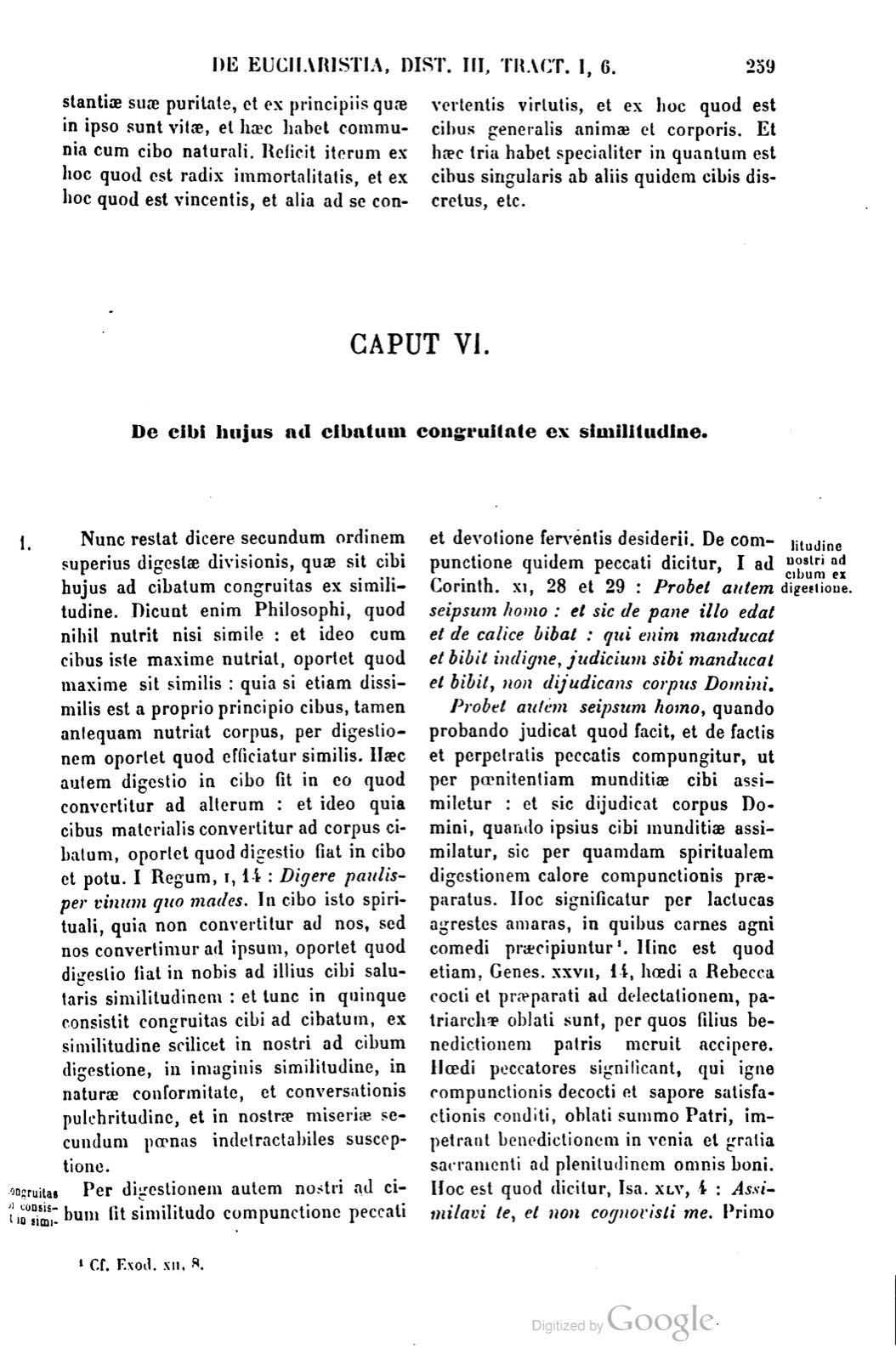
Digerendi ergo sumus et praeparandi ad similitudinem cibi compunctione et devotione, tamquam per duos ignes decocti. Exod. xii, 9: Non comedetis ex eo crudum quid, nec coctum aqua, sed tantum assum igni. Merito indignatur Dominus filiis Heli,3 qui voluerunt offerre carnem crudam indigestam in sacrificio Domini: quia crudum et indigestum cor non habet potestatem hunc cibum comedendi. Sed faciendum est sicut ibidem, I Regum, ii, 16, dicunt devoti: Incendatur primum juxta morem hodie adeps, et tolle tibi quantumcumque desiderat anima tua. Adipem vero incendi est pinguedinem bonitatis et benignitatis cordis in igne compunctionis et devotionis inflammari. Psal. lxii, 6: Sicut adipe et pinguedine repleatur anima mea, et labiis exsultationis laudabit os meum.
Hoc igitur est primum.
2. Est autem secunda assimilatio nostri ad Christum qui cibus noster est in sacramento, in imagine. Filius enim Dei est imago invisibilis Patris, et nos ad imaginem sumus facti Filii Dei, qui est Verbum Patris imitatione: nec potest esse imago quae non imitatur, quia imago ab imitando derivatur. Unde Hilarius in libro de Synodis: "Imago est rei ad rem imitandam et coaequandam species indifferens." Unde, Genes. i, 26: Faciamus hominem ad imaginem et similitudinem nostram, hoc est, qui in cognitionis veritate et affectionis dilectione imitetur formam Filii Dei, ad quam factus esse dignoscitur. Sic enim, ut dicit Augustinus, ad eamdem imaginem facti sumus, et reformamur, et sic reformati assimilamur Filio Dei, qui est cibus noster in sacramento. Ad Roman. viii, 29 et 30: Quos praescivit, et praedestinavit conformes fieri imaginis Filii sui, ut sit ipse primogenitus in multis fratribus. Quos autem praedestinavit, hos et vocavit: et quos vocavit, hos et justificavit: et quos justificavit, illos et glorificavit. Ad Coloss. i, 15 et 16: Qui est imago Dei invisibilis, primogenitus omnis creaturae: quoniam in ipso condita sunt universa in coelis et in terra, visibilia et invisibilia, etc.
Therefore we must be digested and prepared to the likeness of the food by compunction and devotion, as though cooked by two fires. Exodus 12:9: You shall not eat anything of it raw, nor cooked with water, but only roasted with fire. Deservedly the Lord is indignant with the sons of Eli,3 who wished to offer raw undigested flesh in the sacrifice of the Lord, because a raw and undigested heart does not have the power of eating this food. But it must be done as, in the same place, 1 Kings 2:16, the devout say: Let the fat first be burned today according to custom, and take for yourself whatever your soul desires. But for the fat to be burned is for the fatness of the goodness and kindness of the heart to be inflamed in the fire of compunction and devotion. Psalm 62:6: Let my soul be filled as with fat and fatness, and my mouth will praise with lips of exultation.
This, therefore, is the first.
2. But the second assimilation of us to Christ, who is our food in the sacrament, is in image. For the Son of God is the image of the invisible Father, and we have been made to the image of the Son of God, who is the Word of the Father, by imitation; nor can there be an image which does not imitate, because image is derived from imitating. Hence Hilary in the book On Synods: "Image is the indifferent appearance of a thing toward a thing to be imitated and equaled." Hence Genesis 1:26: Let us make man to our image and likeness, that is, one who, in the truth of knowledge and the love of affection, may imitate the form of the Son of God, to which he is known to have been made. For thus, as Augustine says, to the same image we have been made and are reformed, and thus, reformed, we are assimilated to the Son of God, who is our food in the sacrament. Romans 8:29 and 30: Those whom he foreknew, he also predestined to be made conformable to the image of his Son, that he himself may be the firstborn among many brothers. But those whom he predestined, these he also called; and those whom he called, these he also justified; and those whom he justified, those he also glorified. Colossians 1:15 and 16: Who is the image of the invisible God, the firstborn of every creature, because in him all things were created in the heavens and on earth, visible and invisible, and so forth.
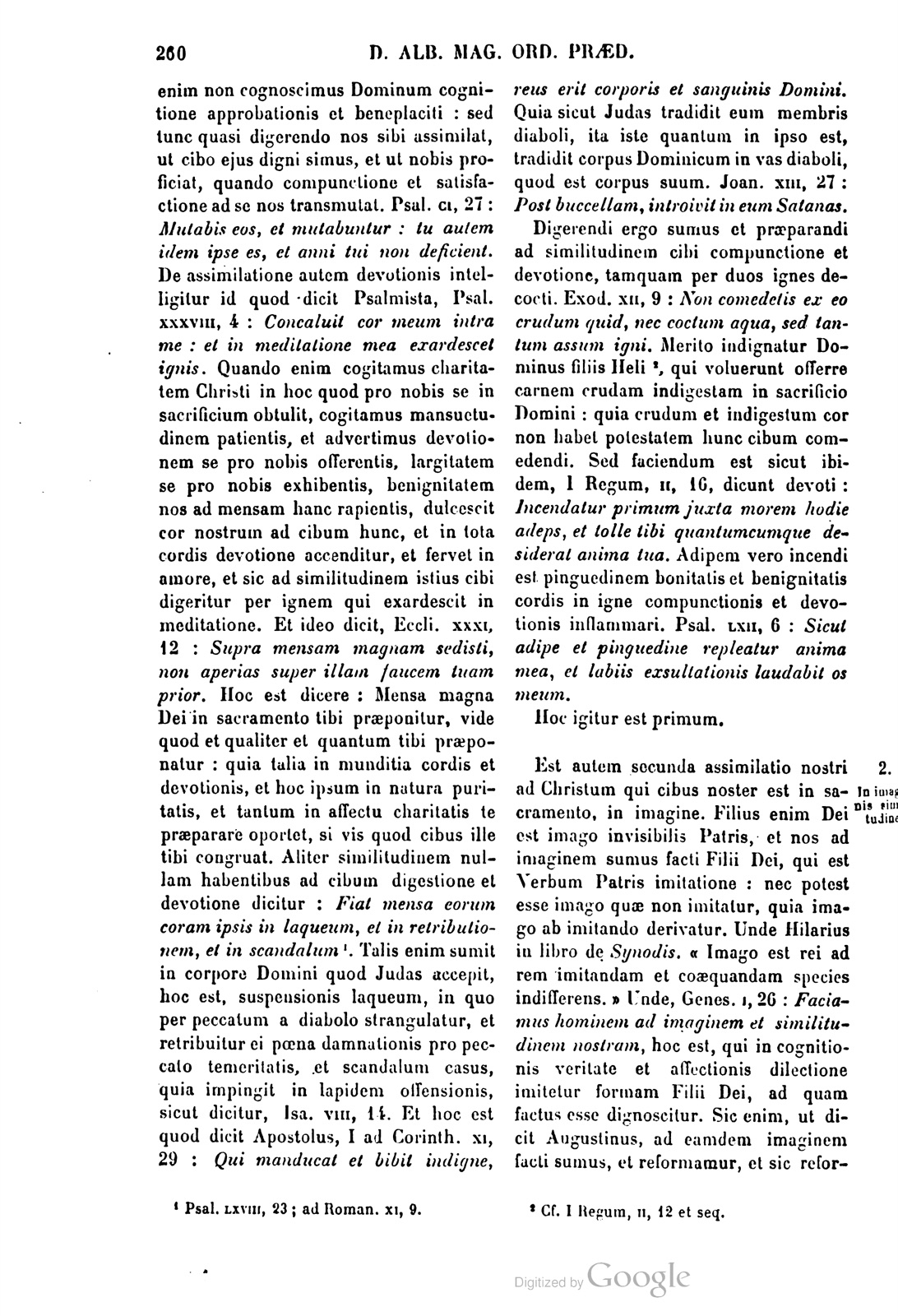
Sic igitur imitando Filium Dei, ad similitudinem illius efficitur, et dignus efficitur ut corpore ejus cibetur. Eccli. xvii, 1 et 2: Deus creavit de terra hominem, et secundum imaginem suam fecit illum... Et secundum se vestivit illum virtute, hoc est, in virtute assimilavit sibi eum: et ideo simul sibi potest incorporari. Est enim regula in natura, quoniam habentium symbolum facilior est transmutatio: et ideo symbolum, hoc est, similitudinem habentes ad Dominum nostrum Jesum Christum, facile transmutantur in ipsius corpus, et in ipsius membra. Sicut enim dicitur, Matth. xxii, 20 et 21: Cujus est imago haec et superscriptio? Dicunt ei: Caesaris. Tunc ait illis, scilicet Jesus: Reddite igitur quae sunt Caesaris Caesari, et quae sunt Dei Deo. Quae enim sunt similia Deo, sunt reddenda Deo: quia per similitudinem sibi incorporantur: imago enim ab imitando dicitur et superscriptio designat similitudinem.
Sic ergo assimilamur in imagine.
3. Est etiam similitudo cibi istius ad cibatum et congruitas in naturae conformitate. Sicut enim dicitur, ad Hebr. ii, 16: Nusquam Angelos apprehendit, sed semen Abrahae apprehendit. Et ibidem, v. 18: Unde debuit per omnia fratribus assimilari. In omnibus enim naturalibus nobis est assimilatus. Ad Philipp. ii, 7: In similitudinem hominum factus, et habitu inventus ut homo. Propter quod dicit magister Hugo de sancto Victore: "Clamat Dominus in dolore cordis quo tangitur intrinsecus: Ecce Adam quasi unus ex nobis factus est,4 ironice loquens: quia multum destitit ab honore in quo creatus fuit. Et hic dolor tantum in corde Dei profundatus fuit, ut quem ordine justitiae non potuit reducere in similitudinem Dei unde exciderat, ordine misericordiae ipse descenderet, et similis homini fieret. Et ideo vere dicamus: Ecce Adam secundus similis nobis, etiam quasi unus ex nobis factus est, sciens per experientiam bonum et malum, qui ante per experimentum non novit nisi bonum." Propter hanc similitudinem dicitur, Baruch, iii, 38: In terris visus est, et cum hominibus conversatus est. Quod autem dicit, cum hominibus, id est, ac si dicat: Ad similitudinem hominum factus in humanis. Concorporavit enim nos sibi nostra assumens, ut facilius in ipsum transeamus. Genes. xxxvii, 27: Frater enim et caro nostra est. Sic igitur facillime incorporamur huic cibo similitudinem naturalem habentes ad ipsum. Propter hoc, ad Romanos, viii, 29, dicitur: Ipse primogenitus in multis fratribus. Quia ipse principalis et naturalis Filius Dei conformat sibi filios gratiae, qui per adoptionem fiunt filii Dei, et fratres sui, et incorporat eos sibi in sacramento, ut omnes eodem spiritu vivant et eadem haereditate gaudeant. Ad Roman. viii, 15 et seq.: Sed accepistis spiritum adoptionis filiorum, in quo clamamus: Abba (Pater)... Si autem filii, et haeredes: haeredes quidem Dei, cohaeredes autem Christi.
Hoc igitur modo etiam conformes transmutamur in cibum sacramenti, qui est corpus Filii Dei.
4. Sumus autem conformes congruitatem habentes ex conversationis pulchritudine: quia conformantur sibi in virtutis pulchritudine: et ex hac congruitate maxime conveniemus cum cibo divino. Istud notatur per vestem nuptialem, sicut dicitur, Matth. xxii, 12, de eo qui ingressus est coenam Domini non habens vestem nuptialem. Dicit enim: Amice, quomodo huc intrasti, non habens vestem nuptialem? In veste enim nuptiali similes sunt sponso filii nuptiarum: eo quod omnes induti sunt vestibus gaudiorum. Isa. lxi, 10: Induit me Dominus vestimentis salutis, et indumento justitiae circumdedit me, quasi sponsum decoratum corona, etc. Hi sunt enim qui flore omnis honestatis in conversatione vestiuntur, et his vestibus similes Filio Dei regi summo offeruntur. Genes. xli, 14: Ad regis imperium eductum de carcere Joseph totonderunt, ac veste mutata, obtulerunt ei, scilicet regi. Joseph enim crescens in virtute de carcere educitur, quando de conclusione peccatorum liberatur. Tondetur autem, quando ab eo cura saecularis abscinditur. Vestis saecularis mutatur, quando saecularis conversatio in similitudinem conversationis Filii Dei mutatur: et sic regi offertur: quia tunc hostiae nostrae immolationis incorporatur: et sic Christo incorporatus, summo Patri offertur. Hoc voluit dicere, Joan. xii, 26: Si quis mihi ministrat, me sequatur: et ubi ego sum, illic et minister meus erit. Quia vult Christus, in quantum Christus floret et vestitur virtutum conversatione, quod nos sibi assimilati et incorporati floreamus: quia sic congruunt capiti, et totum corpus una gloriae stola gloriatur. Eccli. xv, 5 et 6: Stola gloriae vestiet illum. Jucunditatem et exsultationem thesaurizabit super illum, et nomine aeterno haereditabit illum. Sic dixit Apostolus, I ad Corinth. xi, 1: Imitatores mei estote, sicut et ego Christi.
Thus, therefore, by imitating the Son of God one is made to his likeness and is made worthy to be fed with his body. Ecclesiasticus 17:1 and 2: God created man from the earth and made him according to his image... And he clothed him with virtue according to himself, that is, in virtue he assimilated him to himself; and therefore he can be incorporated together with him. For there is a rule in nature that the transmutation of things having a symbol is easier; and therefore those having a symbol, that is, a likeness, to our Lord Jesus Christ are easily transmuted into his body and into his members. For as is said in Matthew 22:20 and 21: Whose image and inscription is this? They say to him: Caesar's. Then he, namely Jesus, says to them: Render therefore the things that are Caesar's to Caesar, and the things that are God's to God. For things that are like God must be rendered to God, because through likeness they are incorporated into him; for image is spoken from imitating, and inscription designates likeness.
Thus therefore we are assimilated in image.
3. There is also a likeness of this food to the one fed and a fittingness in conformity of nature. For as is said in Hebrews 2:16: Nowhere does he take hold of angels, but he takes hold of the seed of Abraham. And in the same place, verse 18: Hence he had to be assimilated to his brothers through all things. For in all natural things he was assimilated to us. Philippians 2:7: Made in the likeness of men and found in habit as a man. On account of which Master Hugh of Saint Victor says: "The Lord cries out in the pain of heart by which he is touched inwardly: Behold, Adam has been made as one of us,4 speaking ironically, because he had fallen far away from the honor in which he was created. And this pain was so deeply founded in God's heart that the one whom he could not reduce by the order of justice into the likeness of God from which he had fallen, by the order of mercy he himself would descend and become like man. And therefore let us say truly: Behold, the second Adam, like us, has even been made as one of us, knowing good and evil by experience, who before, through experience, knew only good." On account of this likeness it is said in Baruch 3:38: He was seen on earth and conversed with men. But when he says, with men, that is as if he were saying: made in human things according to the likeness of men. For he joined us to his body by assuming our things, so that we may more easily pass into him. Genesis 37:27: For he is our brother and our flesh. Thus, therefore, we are incorporated most easily into this food, having natural likeness to it. On account of this, in Romans 8:29 it is said: He is the firstborn among many brothers. Because he himself, the principal and natural Son of God, conforms to himself the sons of grace, who through adoption become sons of God and his brothers, and he incorporates them into himself in the sacrament, so that all may live by the same spirit and rejoice in the same inheritance. Romans 8:15 and following: But you have received the spirit of adoption of sons, in which we cry: Abba, Father... But if sons, also heirs: heirs indeed of God, and coheirs of Christ.
Therefore also in this way, made conformable, we are transmuted into the food of the sacrament, which is the body of the Son of God.
4. But we are conformable, having fittingness from the beauty of conversation, because they are conformed to him in the beauty of virtue; and from this fittingness we shall most greatly come together with the divine food. This is noted through the wedding garment, as is said in Matthew 22:12 concerning the one who entered the Lord's supper not having a wedding garment. For he says: Friend, how have you come in here, not having a wedding garment? For in the wedding garment the children of the wedding are like the bridegroom, in that all have been clothed with garments of joys. Isaiah 61:10: The Lord clothed me with garments of salvation, and with a garment of justice he surrounded me, as a bridegroom adorned with a crown, and so forth. For these are those who are clothed with the flower of every nobility in conversation, and with these garments they are offered, like the Son of God, to the highest king. Genesis 41:14: At the king's command Joseph, brought out of prison, was shaved, and with his garment changed, they offered him to him, namely to the king. For Joseph growing in virtue is brought out of prison when he is freed from the enclosure of sins. But he is shaved when secular care is cut away from him. Secular clothing is changed when secular conversation is changed into the likeness of the conversation of the Son of God; and thus he is offered to the king, because then he is incorporated into the victim of our immolation; and thus, incorporated into Christ, he is offered to the highest Father. This is what John 12:26 meant to say: If anyone ministers to me, let him follow me, and where I am, there also will my minister be. Because Christ wills, insofar as Christ flourishes and is clothed with the conversation of virtues, that we, assimilated and incorporated into him, may flourish, because thus they fit the head, and the whole body is gloried in one robe of glory. Ecclesiasticus 15:5 and 6: He will clothe him with a robe of glory. He will store up joy and exultation over him, and by an eternal name he will inherit him. Thus the Apostle said, 1 Corinthians 11:1: Be imitators of me, as I also am of Christ.
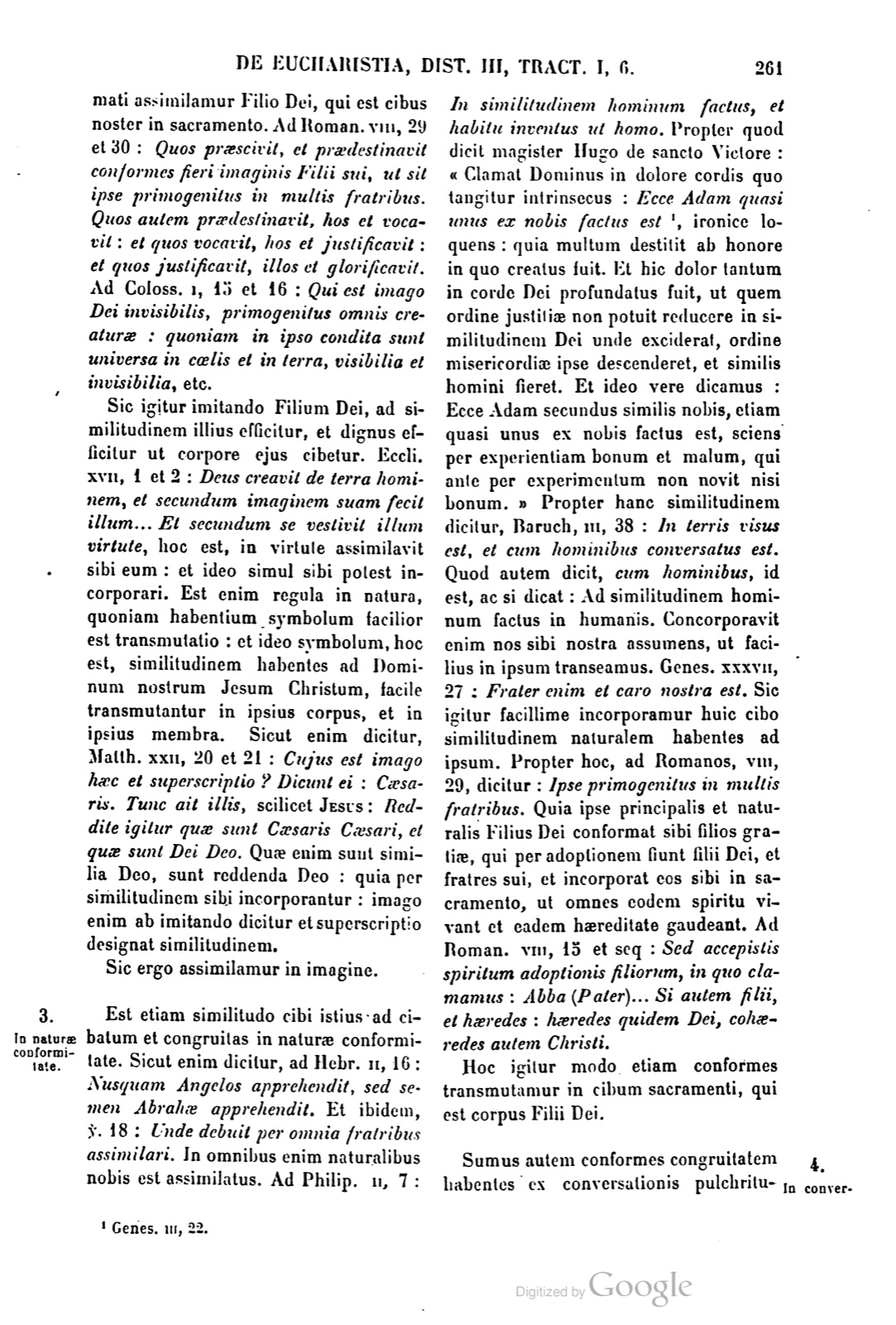
Sic ergo etiam conversationis pulchritudine Christo conformamur.
5. Conformamur etiam in nostrae miseriae secundum poenas indetractabiles assumptione. Nullam enim assumpsit culpam, sed nec poenam omnem assumpsit: quia sunt quaedam poenae, quas si assumpsisset, honestati nostrae redemptionis detraheretur: quia illae poenae non sunt honestae.
Et harum poenarum quaedam sunt in anima, quaedam autem in corpore. In anima autem sunt quae non ex natura, sed ex culpa procedunt, sicut ex ignorantia agendorum et concupiscentia noxiorum, elatio mentis ad fastuosa, et pronitas malitiae in perniciosa. Quamcumque enim harum poenarum Christus assumpsisset, nostrae redemptioni factae per Christum detraheretur. In corpore autem sunt, ut foemineus sexus, sicut lepra, sicut jugis scabies, in collo vel in suris debilitas continua, et hujusmodi. Quia sexus foemineus impediret a praedicatione, lepra autem ab hominum conversatione, jugis scabies abominalis esset intuentibus, debilitas autem impediret officium evangelizationis regni Dei: et ideo has et hujusmodi non assumpsit: quia illae nostrae impedirent opus redemptionis.
Alias autem nostras omnes assumpsit poenalitates, et pro hac assimilatione, ad maximas sibi tenemur gratiarum actiones: quia ex hac poenarum assumptione, et nobis compati scit, et similis non tantum nobis, sed et peccatoribus factus est, et pro nobis passibilis est effectus, et minor Angelis est effectus, et omnia taedia humanae vitae sustinuit.
De primo horum dicitur, II ad Corinth. v, 21: Eum qui non noverat peccatum, pro nobis peccatum fecit, hoc est, similem peccatoribus, ut nos efficeremus justitia Dei pro ipso.
De secundo dicitur in Psalmo viii, 6, et ad Hebr. ii, 7: Minuisti eum paulo minus ab Angelis. Quod exponens Apostolus, ad Hebr. ii, 9, dicit: Eum, qui modico quam Angeli minoratus est, videmus Jesum propter passionem mortis, gloria et honore coronatum.
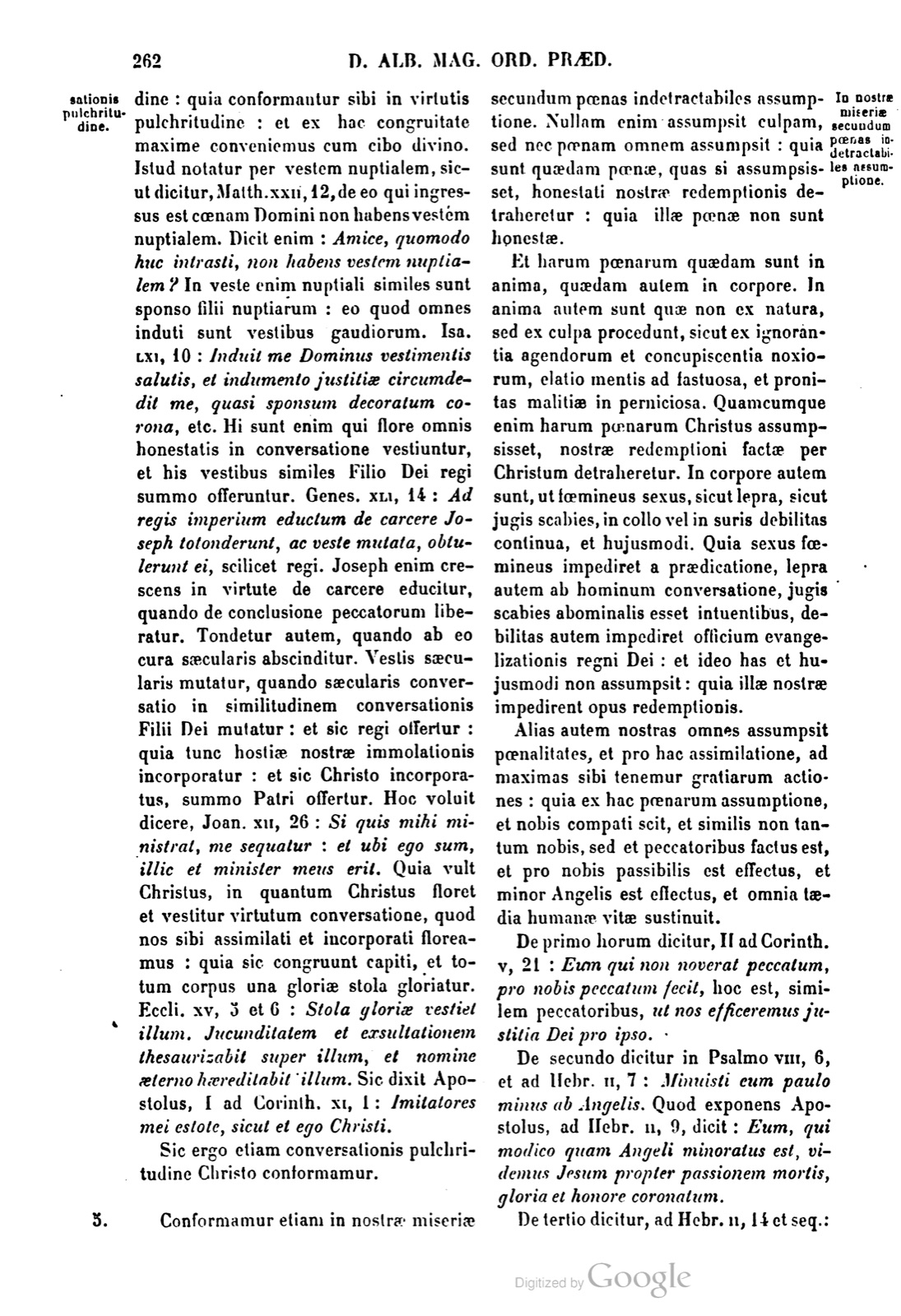
De tertio dicitur, ad Hebr. ii, 14 et seq.:
Thus therefore also by the beauty of conversation we are conformed to Christ.
5. We are also conformed in the assumption of our misery according to unavoidable penalties. For he assumed no guilt, but neither did he assume every penalty, because there are certain penalties which, if he had assumed them, would have detracted from the dignity of our redemption, because those penalties are not honorable.
And of these penalties some are in the soul, but some in the body. In the soul, however, are those which proceed not from nature but from guilt, such as from ignorance of things to be done and concupiscence of harmful things, elevation of mind toward boastful things, and proneness of malice toward pernicious things. For whichever of these penalties Christ had assumed, it would have detracted from our redemption made through Christ. But in the body there are such as the female sex, as leprosy, as continual chronic scabies, continual weakness in the neck or in the calves, and things of this sort. Because the female sex would hinder from preaching, leprosy from the conversation of human beings, chronic scabies would be abominable to those looking on, and weakness would hinder the office of evangelization of the kingdom of God; and therefore he did not assume these and things of this sort, because those penalties of ours would hinder the work of redemption.
But he assumed all our other penalities, and for this assimilation we are bound to the greatest thanksgivings to him, because from this assumption of penalties he both knows how to suffer with us, and he was made like not only to us but also to sinners, and for us was made passible, and was made less than the angels, and sustained all the wearinesses of human life.
Concerning the first of these it is said, 2 Corinthians 5:21: Him who had not known sin, he made sin for us, that is, like sinners, so that we might be made the justice of God for him.
Concerning the second it is said in Psalm 8:6 and Hebrews 2:7: You made him a little less than the angels. The Apostle, explaining this in Hebrews 2:9, says: We see Jesus, who was made lower than the angels for a little while because of the passion of death, crowned with glory and honor.
Concerning the third it is said in Hebrews 2:14 and following:
If a page does not appear, its photograph has not been uploaded yet.