Works › The Book on the Sacrament of the Eucharist
Volume 38 · pp. 264–268
Chapter VII. On the Penetrability of This Food to the One Fed from Subtlety, nos. 1-4.
A marker with ≈ is an approximate page boundary, placed by measure of the text; the page photographs remain the authority. In the paired views, clicking a page marker brings that page into view.
Marginal label (printed p. 265): Quare forma sacramentalis dividitur in tres partes?
Marginal label (printed p. 265): In quascumque partes forma sacramentalis dividatur, totus et integer Christus manet.
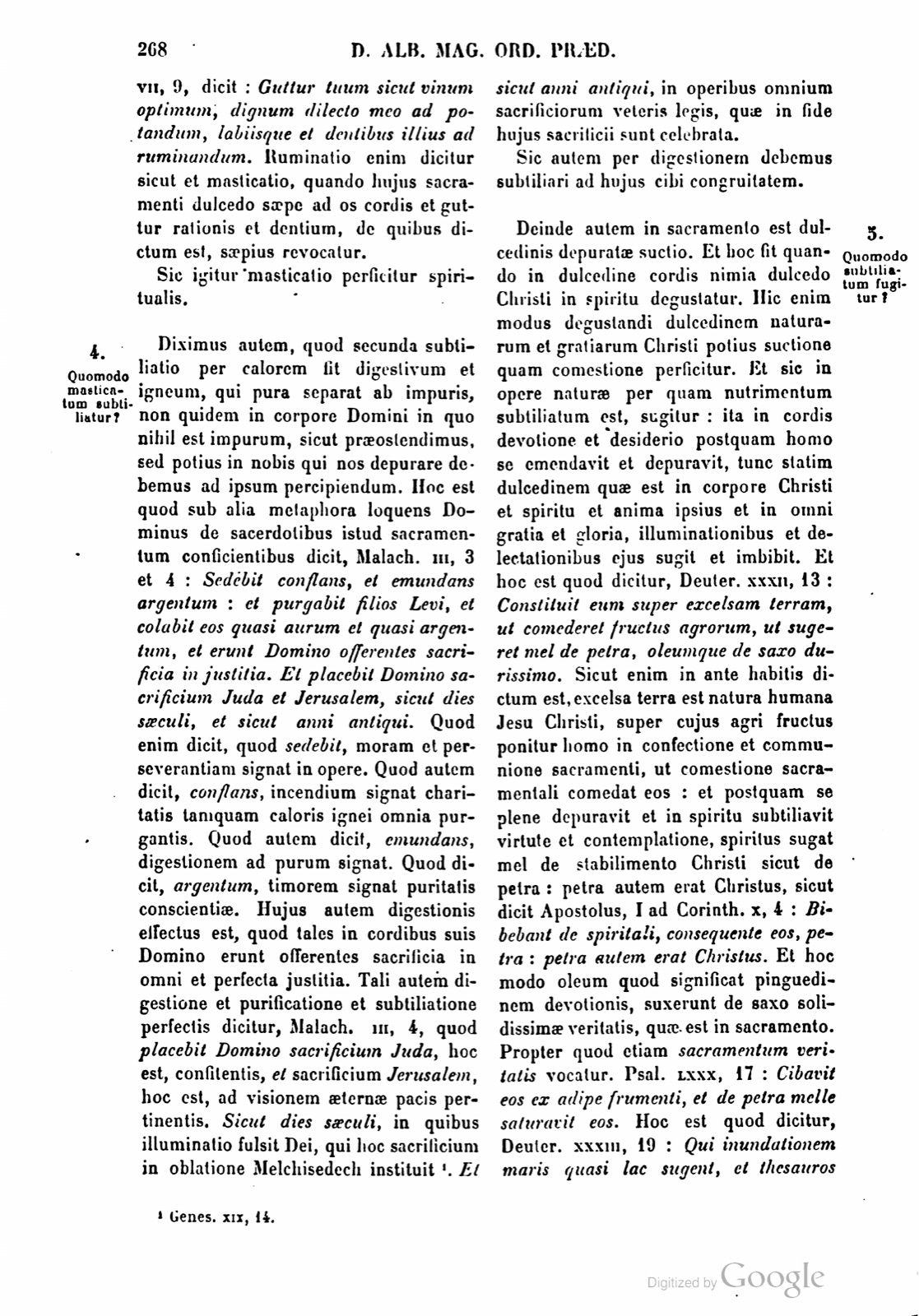
Marginal label (printed p. 268): Quomodo masticatum subtiliatur?
Marginal label (printed p. 268): Quomodo subtiliatum sugitur?
Caput VII. De cibi hujus ad cibatum penetrabilitate ex subtilitate.
1. Nunc dicemus de cibi ad cibatum penetrabilitate quam habet ex subtilitate. Cibus enim naturalis non nutrit membra, nisi membris infundatur: non infunditur autem porositati et spongiositati membrorum, nisi subtilis sit ad penetrandum: quia, sicut dicit Philosophus, subtile est penetrativum, et partium partibus penetrativum: et ideo in ore hominis natura posuit dentes, qui cibum dividerent: posuit et molares, qui ad minimum contererent: posuit in stomacho calorem igneum, qui subtile penetrativum a grosso non penetrativo separaret: posuit venas mesaraicas, quae subtile quod penetrare potest, sugerent: posuit venas, quae ut viae ab hepate derivatae, in totum corpus nutritivum succum et subtiliatum ad membra portarent: posuit colatoria panniculorum, quae ulterius foetulentum ex subtilissimo colando auferrent: posuit subtiles poros et spongiositatem corporis, quae id subtile subtiliter sugerent, et membris infunderent, ut in subtilissimum corporis nutrimentum perficeretur.
Hoc igitur modo perficitur etiam nutrimentum animae in sacramento, ut scilicet spiritualiter masticetur, tam dividendo, quam conterendo, ut calore igneo subtilietur, ut subtilibus venis subtiliter spiritualibus sugatur, et subtilibus viis membris spiritualibus deferatur, ut colatoriis spiritualibus coletur, et subtiliter id quod est tam subtile membris proportionaliter infundatur: quae sunt sex modi in universo.
Omnibus tamen his praenotandum, de primo, scilicet masticatione, dicturus, praemittit de fractione quod est de fidei veritate in hoc sacramento, quod fractio quae fit in sacramento sive per manus sacerdotis in altari, sive etiam per dentes fidelium in ore, quando sacramentaliter sumitur sacramentum, non est in corpore Christi: quia illud non frangitur, sed manet integrum et sanum et illibatum in qualibet parte formae sacramenti fractae, sicut dicitur, Exod. xii, 46: Os non comminuetis ex eo. Quia etiam milites licet essent malitiosi, corpus Domini frangere non potuerunt. Joan. xix, 33 et 34: Ad Jesum cum venissent, ut viderunt eum jam mortuum, non fregerunt ejus crura: sed unus militum lancea latus ejus aperuit, et continuo exivit sanguis et aqua. Sed ipsa fractio est in forma et figura panis, quae duabus de causis frangitur. Quarum una est significationis, et altera necessitatis. Illa quae est significationis, est: quia manibus sacerdotum forma sacramentalis frangitur, diversitas corporis Christi mystici signatur.
Marginal label (printed p. 265): Why is the sacramental form divided into three parts?
Marginal label (printed p. 265): Into whatever parts the sacramental form is divided, Christ remains whole and entire.
Marginal label (printed p. 268): How is what has been chewed subtiliated?
Marginal label (printed p. 268): How is what has been subtiliated sucked?
Chapter VII. On the Penetrability of This Food to the One Fed from Subtlety.
1. Now we shall speak about the penetrability of the food to the one fed, which it has from subtlety. For natural food does not nourish the members unless it is poured into the members; but it is not poured into the porosity and sponginess of the members unless it is subtle for penetrating, because, as the Philosopher says, the subtle is penetrative and penetrative of parts by parts. And therefore in the mouth of man nature placed teeth, which would divide food; it also placed molars, which would grind it down to the least; it placed in the stomach fiery heat, which would separate the subtle penetrative part from the coarse non-penetrative part; it placed mesaraic veins, which would suck up the subtle thing which can penetrate; it placed veins which, as ways derived from the liver, would carry the nutritive and subtilized juice to the members in the whole body; it placed strainers of membranes, which by straining would further remove the foul thing from the most subtle; it placed subtle pores and sponginess of the body, which would subtly suck up that subtle thing and pour it into the members, so that it might be perfected into the most subtle nourishment of the body.
Therefore in this way the nourishment of the soul also is perfected in the sacrament, namely so that it may be spiritually chewed, both by dividing and by grinding, so that it may be subtilized by fiery heat, so that it may be subtly sucked by subtle spiritual veins and carried by subtle ways to the spiritual members, so that it may be strained by spiritual strainers, and that which is so subtle may be subtly poured proportionally into the members. These are the six modes in the whole.
Nevertheless, before all these things, when he is about to speak of the first, namely mastication, he premises concerning breaking what belongs to the truth of faith in this sacrament: that the breaking which occurs in the sacrament, whether by the hands of the priest on the altar or also by the teeth of the faithful in the mouth when the sacrament is received sacramentally, is not in the body of Christ, because that body is not broken, but remains whole and healthy and uninjured in any part of the broken form of the sacrament, as is said in Exodus 12:46: You shall not break a bone from it. For even the soldiers, although they were malicious, could not break the body of the Lord. John 19:33 and 34: When they had come to Jesus and saw him already dead, they did not break his legs; but one of the soldiers opened his side with a lance, and immediately there came out blood and water. But the breaking itself is in the form and figure of bread, which is broken for two causes. One of these is of signification, and the other of necessity. The one which is of signification is this: because when the sacramental form is broken by the hands of priests, the diversity of the mystical body of Christ is signified.
Unde usus Ecclesiae habet, quod in tria frangatur: quia pars corporis Christi mystici in coelo triumphat, et pro illa parte sacramentum offertur ad laudem et ad gratiarum actionem: quia illi jam beati sunt. Alia autem pars corporis mystici in labore adhuc vivit, in fide conversans et merito in terris, et pro illa sacramentum offertur in pignus redemptionis. Tertia pars in purgatorio afflicta purgatur, et pro illa parte sacramentum offertur in supplicationem pro afflictis. Isti sunt tres panes,1 quos nobis accommodat amicus noster Christus, ut ponamus ante illum unum qui de via venit ad amicum, proximum scilicet nostrum, quando venit vel ad laudandum, vel ut pro redemptione sua offerat sacrificium, vel venit de via ad supplicandum pro captivis et afflictis: de via enim venit, quando de negotio occupationis terrenorum ad cultum se convertit.
Necessitatis autem causa frangitur in ore fidelium: quia integrum propter gutturis arctitudinem a multis cum periculo gluttiretur. Exod. xii, 9 et 10: Caput cum pedibus et intestinis vorabitis... Si quid residuum fuerit, igne comburetis.
2. In omnibus tamen his notandum est, quod in quascumque partes forma frangatur, totus et integer Christus vivus et sanus in corpore, spiritu et anima, deitas plena remanet sub qualibet parte: et antequam frangatur, non est nisi unicus et indivisus sub tota forma integra.
Et hujus quidem exemplum antiqui posuerunt duplex: sed unum illorum exemplorum non est usquequaque verum. Et unum illorum est de forma, quae apparet ad speculi reflexionem, quae una est in reflexione speculi unius ad unum: et cum speculum frangitur in partes, eadem una integra forma apparet in omnibus partibus, propter plures reflexiones quae fiunt ex pluribus partibus fracti speculi ad unum et idem. Sic enim Christus unicus est in toto totus: quia non nisi unum signum significans et continens est in toto: et quando frangitur forma panis, in qualibet fractura est totus Christus: ideo quia plura tunc sunt signa significantia et continentia. Hujus autem causa est vera: quia res sacramenti est semper causata et contenta in signo sacramenti in nova gratia et nova lege: et ideo cum signum non habeat usum significandi ex hoc quod est totum vel pars, sed potius ex hoc quod est forma cibi cor confortantis: et cum hanc formam aequaliter habeat in toto et in parte, ideo oportet quod aequaliter corpus Christi quod est res sacramenti contenta et significata, sit in toto et in parte: tantum enim significationis ad refectionem habet pars formae panis et pars partis formae panis, quantum habet totus panis quantumcumque magnus. Ex quo pars quaelibet igitur minima significare habet, oportet quod quaelibet minima pars totum contineat: quia sacramentum novae legis quantum est de se totum continet quod significat: quia aliter significatio esset mendax. Quod absit credere de sacramento veritatis.
Hence the use of the Church has it that it is broken into three parts, because one part of the mystical body of Christ triumphs in heaven, and for that part the sacrament is offered for praise and thanksgiving, because those are already blessed. But another part of the mystical body still lives in labor, conversing in faith and merit on earth, and for that part the sacrament is offered as a pledge of redemption. The third part, afflicted in purgatory, is purified, and for that part the sacrament is offered in supplication for the afflicted. These are the three loaves1 which our friend Christ lends to us, so that we may set them before that one who comes from the way to his friend, namely our neighbor, when he comes either to praise, or so that he may offer sacrifice for his redemption, or comes from the way to supplicate for captives and the afflicted; for he comes from the way when he turns himself from the business of occupation with earthly things to worship.
But for the cause of necessity it is broken in the mouth of the faithful, because the whole would be swallowed by many with danger because of the narrowness of the throat. Exodus 12:9 and 10: You shall devour the head with the feet and entrails... If anything remains, you shall burn it with fire.
2. Nevertheless, in all these things it must be noted that into whatever parts the form is broken, the whole and entire Christ, living and healthy in body, spirit, and soul, full deity, remains under each part; and before it is broken, he is only one and undivided under the whole entire form.
And concerning this the ancients indeed posited a double example, but one of those examples is not true in every respect. And one of them is about a form which appears by the reflection of a mirror, which is one in the reflection of one mirror toward one thing; and when the mirror is broken into parts, the same one entire form appears in all the parts, because of the several reflections which occur from the several parts of the broken mirror toward one and the same thing. For thus the one Christ is whole in the whole, because in the whole there is only one sign signifying and containing; and when the form of bread is broken, in any breaking Christ is whole, for the reason that there are then several signs signifying and containing. But the cause of this is true, because the reality of the sacrament is always caused and contained in the sign of the sacrament in the new grace and new law. And therefore, since the sign does not have the use of signifying from the fact that it is a whole or a part, but rather from the fact that it is the form of food strengthening the heart, and since it has this form equally in the whole and in the part, therefore it is necessary that the body of Christ, which is the contained and signified reality of the sacrament, be equally in the whole and in the part. For a part of the form of bread and a part of a part of the form of bread have as much signification for refreshment as the whole bread has, however large it may be. From this, therefore, since any smallest part has the capacity to signify, any smallest part must contain the whole, because the sacrament of the new law, as far as concerns itself, contains the whole of what it signifies; otherwise the signification would be false. Far be it to believe this concerning the sacrament of truth.
Ex isto jam patet, quod in corpore sumentis hunc cibum non sacramentaliter manet corpus Christi, nisi quamdiu formae sacramentales in stomacho vel in vomitu possunt videri vel discerni: quamdiu enim formae illae discernuntur, tamdiu est contentum ibi corpus Christi et signatum: quando autem liquefactae sunt formae illae, ulterius non significatur esse per aliquod. Et ideo ibi etiam non continetur per aliud: quia continentia non se extendit ultra significationem. In hac forma panis et vini Christus est opertus quasi pallio quodam quo totus involvitur. Isa. lix, 17: Opertus est quasi pallio zeli. Quia scilicet zelans nostrum profectum, sic operatur ad nostram refectionem et salutem.
Alia similitudo ab antiquis posita est de anguilla, vel serpente, vel alio animali, quod habet corpus aequalis compositionis et annulosum. In hoc enim tota est una et integra et sola anima sensibilis per sensum et motum: et si dividatur in paucas vel multas partes, dicunt, quod eadem una et indivisa anima sensibilis et tota per sensum et motum remanet in qualibet parte. Sed hoc exemplum pro secunda parte non est verum: quia jam probatum est in praehabitis, quod diviso corpore talium animalium, dividitur anima per accidens, et non est una eadem in qualibet parte divisa: sed tamen hoc est verum, quod est integra anima in qualibet parte. Et quod non quaelibet pars convalescit in anima, non est propter hoc quod non tota anima sit in qualibet parte, sed potius ideo quia membra sine quibus convalescere non potest, non habet in qualibet parte, sicut membra accipiendi et digerendi cibum, quae sunt os, stomachus, hepar, cor, anus in posterioribus: quia sine his non potest cibum capere, vel digerere, vel emittere: et in his consistit vita convalescens in omni sensibili.
Non autem possunt in natura vel arte exempla sufficientia inveniri, quae tantae per omnia respondeant excellentiae. Isa. xl, 18: Cui ergo similem fecistis Deum? aut quam imaginem ponetis ei?
Haec autem sunt quae de fractura hic sunt dicenda et attendenda.
Hanc autem et hujusmodi fracturam in sacramento fore faciendam significavit Christus, Matth. xxvi, 26, ubi dicitur: Coenantibus autem eis, accepit Jesus panem, et benedixit, ac fregit, deditque discipulis suis, et ait: Accipite et comedite: hoc est corpus meum. In hoc enim quod dicit, fregit, discipulis etiam frangendum dereliquit. In hoc autem quod dicit, comedite, significavit etiam dentibus esse confringendum. Marc. xiv, 22: Et manducantibus illis, accepit panem, et benedicens fregit. Et ex hoc accipitur idem quod prius. Luc. xxii, 17, plus dicit sic: Accipite, et dividite inter vos. Voluit enim corpus suum per fracturam formarum dividi inter partes Ecclesiae, ut unicuique parti Ecclesiae prodesset secundum utilitatem congruam cuilibet parti. Similiter autem in quacumque refectione signatur istud sacramentum, semper panis frangitur. Matth. xxvi, 26: Accepit Jesus panem, et benedixit, ac fregit.2 Et in tantum hoc semper ostendit, ut et ipse Dominus in hoc modo fractionis cognosceretur. Luc. xxiv, 35: Cognoverunt eum in fractione panis. Hoc etiam Apostoli servandum ab eo sanxerunt per totam Ecclesiam. Act. ii, 42: Erant perseverantes in doctrina Apostolorum, et communione fractionis panis, et orationibus.
From this it is now clear that in the body of one receiving this food the body of Christ does not remain sacramentally except as long as the sacramental forms can be seen or discerned in the stomach or in vomit. For as long as those forms are discerned, so long the body of Christ, and what is signified, is contained there; but when those forms have been liquefied, it is no longer signified to be there through anything. And therefore there also it is not contained through another thing, because containment does not extend beyond signification. In this form of bread and wine Christ is covered as though with a certain mantle by which he is wholly wrapped. Isaiah 59:17: He was covered as with a mantle of zeal. Because, namely, zealous for our progress, he so works for our refreshment and salvation.
Another likeness was posited by the ancients concerning an eel, or a serpent, or another animal which has a body of equal composition and ringed. For in this there is a whole, one, entire, and sole sensitive soul through sense and motion; and if it is divided into few or many parts, they say that the same one and undivided sensitive soul, whole through sense and motion, remains in any part. But this example is not true for the second part, because it has already been proved in what went before that when the body of such animals is divided, the soul is divided accidentally and is not one and the same in any divided part. Yet this is true, that the whole soul is in any part. And the fact that not every part grows strong in soul is not because the whole soul is not in any part, but rather because it does not have in any part the members without which it cannot grow strong, such as the members for taking and digesting food, which are the mouth, stomach, liver, heart, and anus in the posterior parts; because without these it cannot take food, or digest, or emit it; and in these consists life growing strong in every sensible thing.
But sufficient examples cannot be found in nature or art which in all respects correspond to so great an excellence. Isaiah 40:18: To whom, therefore, have you made God like? Or what image will you set for him?
But these are the things which must be said and considered here concerning breaking.
But Christ signified that this and such breaking would have to be done in the sacrament, Matthew 26:26, where it is said: While they were supping, Jesus took bread, and blessed, and broke it, and gave it to his disciples, and said: Take and eat; this is my body. For in this, that he says he broke, he left it also to the disciples to be broken. But in this, that he says eat, he signified that it was also to be broken with the teeth. Mark 14:22: And while they were eating, he took bread, and blessing, broke it. And from this the same thing is taken as before. Luke 22:17 says more in this way: Take and divide among yourselves. For he willed his body to be divided among the parts of the Church through the breaking of the forms, so that it might profit each part of the Church according to the usefulness fitting to each part. Similarly, in whatever refreshment this sacrament is signified, bread is always broken. Matthew 26:26: Jesus took bread, and blessed, and broke it.2 And he always showed this to such an extent that the Lord himself was recognized in this mode of breaking. Luke 24:35: They knew him in the breaking of bread. The Apostles also sanctioned that this was to be observed from him throughout the whole Church. Acts 2:42: They were persevering in the doctrine of the Apostles, and in the communion of the breaking of bread, and in prayers.
Talis igitur fractio est in hoc sacramento, et propter ea quae dicta sunt.
3. Divisio autem harum formarum et fractio et masticatio quae fit per dentes, ut undique sugi possit quod comeditur. Sicut ipsa masticatio est frequens reditus dentium super idem dividendum et atterendum, ita signat meditationem istius cibi spiritualis: quia meditatio nihil aliud est quam frequens reditus mentis super idem cogitatione et devotione et affectu mentis dividendum et atterendum in omnes differentias bonitatis, charitatis et virtutis, ut undique sugatur ex ipso dulcedo in qua praeparavit hoc sacramentum homini Deus, tamquam dentibus divisoribus et molaribus conteratur, qui sunt dentes rationis per cogitationem veritatis, et affectus per devotionem virtutis et bonitatis, et conscientiae optimae per albedinem sinceritatis, et intentionis bonae per directionem optimi finis. Isti sunt dentes de quibus dicitur, Cantic. iv, 2 et 3: Dentes tui sicut greges tonsarum quae ascenderunt de lavacro: omnes gemellis foetibus, et sterilis non est inter eas. Sicut vitta coccinea labia tua, et eloquium tuum dulce. Dentes enim divisores sunt rationis, quibus hoc sacramentum in omnes differentias pietatis et bonitatis dividunt, ut singula meditentur. Dentes autem masticatores sive molares, sunt dentes affectus, quibus in devotione singula bonitatis Dei judicia comprimuntur et conteruntur, ut succus dulcedinis qui in ipsis est, degustetur. Isti sunt in numero intellectus et affectus, qui ovibus in omni mansuetudine et pietate significantur: quia sicut quidam greges in cordibus nostris ad pastum Dominici corporis egrediuntur. Hae ascenderunt de lavacro mundissimae confessionis et satisfactionis. Et sunt omnes gemellis foetibus: quia quaelibet fert foetum veritatis in contemplatione, et foetum virtutis in operatione. Et non potest esse sterilis quae fructum aeternorum gaudiorum non ferat inter eas.
Isti sunt dentes de quibus conqueritur in persona Ecclesiae Jeremias, Thren. i, 16: Fregit ad numerum dentes meos, cibavit me cinere. Ad omnem enim numerum intellectus et affectus diabolus dentes confringit: quia ad cognitionem veritatis et conscientiam serenitatis et affectum virtutis a corde in hoc sacramento tollit: et tunc desipiente cibo spirituali, hominem cinere, id est, amore incenso cupiditatis hujus mundi cibat, et sic omnino destruit. Econtra laudans sponsam in Canticis, vi, 5, dicit: Dentes tui sicut grex ovium quae ascenderunt de lavacro. Quia dente veritatis conterit ea quae pertinent ad cognitionem veritatis, et dente virtutis conterit ea quae pertinent ad opus virtutis: et omnia haec loca sunt lavacra mundissimae confessionis et conscientiae. Unde etiam de hujus sacramenti dulcedine loquens, Cantic. vii, 9, dicit: Guttur tuum sicut vinum optimum, dignum dilecto meo ad potandum, labiisque et dentibus illius ad ruminandum. Ruminatio enim dicitur sicut et masticatio, quando hujus sacramenti dulcedo saepe ad os cordis et guttur rationis et dentium, de quibus dictum est, saepius revocatur.
Therefore such is the breaking in this sacrament, and for the things which have been said.
3. But the division of these forms, and the breaking and mastication which occurs through the teeth, is so that what is eaten may be sucked from every side. Just as mastication itself is the frequent return of the teeth upon the same thing to be divided and worn down, so it signifies meditation on this spiritual food, because meditation is nothing other than the frequent return of the mind upon the same thing, by thought and devotion and affection of the mind, to be divided and worn down into all the differences of goodness, charity, and virtue, so that from every side the sweetness in which God prepared this sacrament for man may be sucked from it, and so that it may be ground as by dividing teeth and molars. These are the teeth of reason through the thought of truth, and of affection through the devotion of virtue and goodness, and of the best conscience through the whiteness of sincerity, and of good intention through the direction of the best end. These are the teeth of which it is said in Canticles 4:2 and 3: Your teeth are like flocks of shorn sheep which have come up from the washing; all with twin offspring, and there is no barren one among them. Your lips are like a scarlet ribbon, and your speech is sweet. For the dividing teeth are of reason, by which they divide this sacrament into all the differences of piety and goodness, so that they may meditate on each thing. But the masticating teeth or molars are the teeth of affection, by which in devotion the several judgments of God's goodness are pressed and ground, so that the juice of sweetness which is in them may be tasted. These are in the number of intellect and affection, which are signified by sheep in all meekness and piety, because they go forth like certain flocks in our hearts to the pasture of the Lord's body. These have come up from the washing of most clean confession and satisfaction. And all have twin offspring, because each bears the offspring of truth in contemplation and the offspring of virtue in operation. And she who bears the fruit of eternal joys among them cannot be barren.
These are the teeth concerning which Jeremiah complains in the person of the Church, Lamentations 1:16: He has broken my teeth by number; he has fed me with ashes. For the devil breaks the teeth at every number of intellect and affection, because in this sacrament he removes from the heart the knowledge of truth, the serenity of conscience, and the affection of virtue. And then, when spiritual food is tasteless, he feeds man with ash, that is, with the burned-up love of covetousness of this world, and thus utterly destroys him. On the other hand, praising the bride in Canticles 6:5, he says: Your teeth are like a flock of sheep which have come up from the washing. Because with the tooth of truth she grinds the things that pertain to the knowledge of truth, and with the tooth of virtue she grinds the things that pertain to the work of virtue; and all these places are washings of most clean confession and conscience. Hence also, speaking of the sweetness of this sacrament, Canticles 7:9 says: Your throat is like the best wine, worthy for my beloved to drink, and for his lips and teeth to ruminate. For rumination is spoken of just as mastication is, when the sweetness of this sacrament is often recalled again and again to the mouth of the heart and the throat of reason and of the teeth of which we have spoken.
Sic igitur masticatio perficitur spiritualis.
4. Diximus autem, quod secunda subtiliatio per calorem fit digestivum et igneum, qui pura separat ab impuris, non quidem in corpore Domini in quo nihil est impurum, sicut praeostendimus, sed potius in nobis qui nos depurare debemus ad ipsum percipiendum. Hoc est quod sub alia metaphora loquens Dominus de sacerdotibus istud sacramentum conficientibus dicit, Malach. iii, 3 et 4: Sedebit conflans, et emundans argentum: et purgabit filios Levi, et colabit eos quasi aurum et quasi argentum, et erunt Domino offerentes sacrificia in justitia. Et placebit Domino sacrificium Juda et Jerusalem, sicut dies saeculi, et sicut anni antiqui. Quod enim dicit, quod sedebit, moram et perseverantiam signat in opere. Quod autem dicit, conflans, incendium signat charitatis tamquam caloris ignei omnia purgantis. Quod autem dicit, emundans, digestionem ad purum signat. Quod dicit, argentum, timorem signat puritatis conscientiae. Hujus autem digestionis effectus est, quod tales in cordibus suis Domino erunt offerentes sacrificia in omni et perfecta justitia. Tali autem digestione et purificatione et subtiliatione perfectis dicitur, Malach. iii, 4, quod placebit Domino sacrificium Juda, hoc est, confitentis, et sacrificium Jerusalem, hoc est, ad visionem aeternae pacis pertinentis. Sicut dies saeculi, in quibus illuminatio fulsit Dei, qui hoc sacrificium in oblatione Melchisedech instituit.3 Et sicut anni antiqui, in operibus omnium sacrificiorum veteris legis, quae in fide hujus sacrificii sunt celebrata.
Sic autem per digestionem debemus subtiliari ad hujus cibi congruitatem.
Thus, therefore, spiritual mastication is perfected.
4. But we have said that the second subtilization occurs through digestive and fiery heat, which separates pure things from impure things, not indeed in the body of the Lord, in which nothing is impure, as we have shown before, but rather in us, who must purify ourselves for receiving him. This is what the Lord, speaking under another metaphor about the priests confecting this sacrament, says in Malachi 3:3 and 4: He will sit refining and cleansing silver; and he will purge the sons of Levi, and he will strain them like gold and like silver, and they will be offering sacrifices to the Lord in justice. And the sacrifice of Judah and Jerusalem will please the Lord, as the days of the age and as the ancient years. For when he says that he will sit, he signifies delay and perseverance in the work. But when he says refining, he signifies the burning of charity as of a fiery heat purging all things. But when he says cleansing, he signifies digestion to purity. When he says silver, he signifies the fear of purity of conscience. But the effect of this digestion is that such persons in their hearts will be offering sacrifices to the Lord in all and perfect justice. When such digestion and purification and subtilization have been perfected, Malachi 3:4 says that the sacrifice of Judah will please the Lord, that is, of the one confessing, and the sacrifice of Jerusalem, that is, of the one pertaining to the vision of eternal peace. As the days of the age, in which the illumination of God shone forth, who instituted this sacrifice in the offering of Melchizedek.3 And as the ancient years, in the works of all the sacrifices of the old law, which were celebrated in faith of this sacrifice.
Thus by digestion we must be subtilized to the fittingness of this food.
If a page does not appear, its photograph has not been uploaded yet.