Works › The Book on the Sacrament of the Eucharist
Volume 38 · pp. 256–259
Chapter V, nos. 5-6.
A marker with ≈ is an approximate page boundary, placed by measure of the text; the page photographs remain the authority. In the paired views, clicking a page marker brings that page into view.
Marginal label (printed p. 258): Pascit universali virtute.
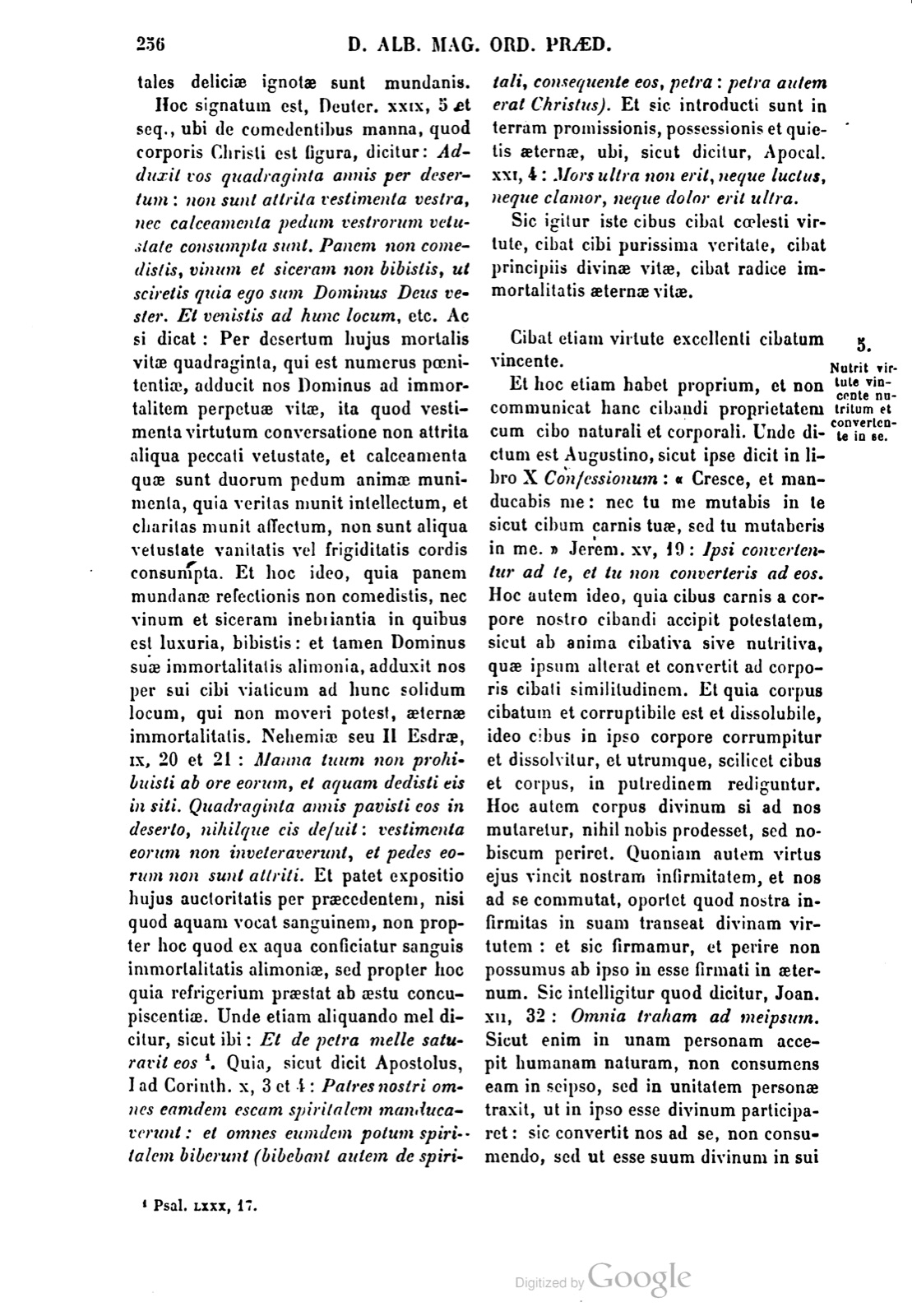
5. Cibat etiam virtute excellenti cibatum vincente. Et hoc etiam habet proprium, et non communicat hanc cibandi proprietatem cum cibo naturali et corporali. Unde dictum est Augustino, sicut ipse dicit in libro X Confessionum: "Cresce, et manducabis me: nec tu me mutabis in te sicut cibum carnis tuae, sed tu mutaberis in me." Jerem. xv, 19: Ipsi convertentur ad te, et tu non converteris ad eos. Hoc autem ideo, quia cibus carnis a corpore nostro cibandi accipit potestatem, sicut ab anima cibativa sive nutritiva, quae ipsum alterat et convertit ad corporis cibati similitudinem. Et quia corpus cibatum et corruptibile est et dissolubile, ideo cibus in ipso corpore corrumpitur et dissolvitur, et utrumque, scilicet cibus et corpus, in putredinem rediguntur. Hoc autem corpus divinum si ad nos mutaretur, nihil nobis prodesset, sed nobiscum periret. Quoniam autem virtus ejus vincit nostram infirmitatem, et nos ad se commutat, oportet quod nostra infirmitas in suam transeat divinam virtutem: et sic firmamur, et perire non possumus ab ipso in esse firmati in aeternum. Sic intelligitur quod dicitur, Joan. xii, 32: Omnia traham ad meipsum. Sicut enim in unam personam accepit humanam naturam, non consumens eam in seipso, sed in unitatem personae traxit, ut in ipso esse divinum participaret: sic convertit nos ad se, non consumendo, sed ut esse suum divinum in sui sumptione participemus. Sic taedium sui ipsius habens sponsa, Cantic. i, 3, et desiderans intrare in participationem sponsi, in desiderio animae clamat et dicit: Trahe me post te, ut in esse tuo et virtute feliciter sim, quae mihi displiceo in meipsa. Sic orat Jeremias, Thren. v, 21, dicens: Converte nos, Domine, ad te, et convertemur: innova dies nostros, sicut a principio. In principio enim creationis non in nobis, sed ad te tracti sumus, et tunc conversi fuimus in te tamquam tibi incorporati. Modo autem mali sumus et perversi in nobis ipsis: et ideo virtute tua propria nos ad te, et a nobis converte: et sic incorporatis nobis tibi, innovabis dies nostros sicut a principio. Sic Ecclesia dicitur esse corpus Christi, sicut dicitur, I ad Corinth. xii, 27: Vos estis corpus Christi, et membra de membro. Haec spiritualia membra Christi de membro capite, quod nobis influit hanc virtutem, quae nos in ipsum convertit, ut membra ejus et corpus efficiamur. Hoc expresse dicitur, ad Ephes. iv, 13 et 16: Veritatem facientes in charitate, crescamus in illo per omnia, qui est caput Christus: ex quo totum corpus compactum, et connexum per omnem juncturam subministrationis, secundum operationem in mensuram uniuscujusque membri, augmentum corporis facit in aedificationem sui in charitate. Non enim ratio potest assignari quare Ecclesia dicatur et sit corpus Christi, nisi hoc modo quo dictum est, dando illi corpus suum, et convertit eam ad se, ut corpus ejus efficiatur, et singuli sint membra ejus. Constat enim, quod Ecclesia mystice vel metaphorice corpus Christi dicitur. Omnis autem translatio mystica habet fieri per appropriationem ad aliud. Quod vero eodem nomine dicitur et eadem ratione. Haec autem non est nisi communio corporis et sanguinis Christi naturalis et veri, quod cum influit Ecclesiae, totam Ecclesiam ad se convertit, et a sui natura non avertitur, et sibi eam sic assimilando in spiritu vitae et calore veritatis vivifico, et operatione virtutum, tamquam quadam operatione membrorum Ecclesiam facit esse corpus suum spirituale et mysticum. Et hoc est quod dicitur, ad Ephes. iv, 11 et seq., quod scilicet diversas gratias dando, in diversis officiis constituit, sicut in corpore in diversis officiis et operationibus constituuntur membra. Et haec sunt verba Apostoli: Ipse dedit quosdam quidem Apostolos, quosdam autem Prophetas, alios vero Evangelistas, alios autem pastores, et doctores: ad consummationem sanctorum in opus ministerii, in aedificationem corporis Christi, donec occurramus omnes in unitatem fidei, et agnitionis Filii Dei, in virum perfectum, in mensuram aetatis plenitudinis Christi. Sic Christus dicit ad Ecclesiam, Genes. ii, 23, sub figura Adam et Hevae loquens: Hoc nunc os ex ossibus meis, et caro de carne mea. Quia et fortiora et firmiora membra apud ipsum sic mutantur. Sic translatis ad se fratribus de terra Chanaan, loquitur magnus ille Joseph in membris per continuum augmentum accrescens, Genes. l, 21: Nolite timere, ego pascam vos et parvulos vestros, quos non pavit quando ad ipsum non fuerunt translati. Hoc est significatum, II Regum, v, 1 et 2, ubi sub typo filiorum Israel ad David Ecclesia loquitur, scilicet ad Christum: Ecce nos os tuum et caro tua sumus. Sed et heri et nudiustertius, cum esset Saul rex super nos, tu eras educens et reducens Israel: dixit autem Dominus ad te: Tu pasces populum meum, etc. Quia quod modo facit Christus in Ecclesia, heri fecit in lege Moysi, cujus regnum per Saul figuratur: et nudiustertius fecit in lege naturali. Per fidem autem tunc fecit, quod modo facit in sacramento et in ipsa veritate praesentiae corporis Christi.
Marginal label (printed p. 258): It feeds by universal virtue.
5. It also feeds by an excellent virtue conquering the one fed. And it also has this as proper to itself, and it does not communicate this property of feeding with natural and bodily food. Hence it was said to Augustine, as he himself says in book 10 of the Confessions: "Grow, and you will eat me; nor will you change me into yourself as the food of your flesh, but you will be changed into me." Jeremiah 15:19: They will be converted to you, and you will not be converted to them. But this is so because the food of the flesh receives the power of feeding from our body, as from the feeding or nutritive soul, which alters it and converts it to the likeness of the body fed. And because the body fed is corruptible and dissoluble, therefore food is corrupted and dissolved in the body itself, and both, namely food and body, are reduced to putrefaction. But if this divine body were changed into us, it would profit us nothing, but would perish with us. But since its virtue conquers our weakness and changes us to itself, our weakness must pass into its divine virtue; and thus we are made firm and cannot perish, made firm by it in being forever. Thus is understood what is said in John 12:32: I shall draw all things to myself. For just as he received human nature into one person, not consuming it in himself, but drawing it into the unity of person so that it might participate in divine being in him, so he converts us to himself, not by consuming us, but so that in receiving him we may participate in his divine being. Thus the bride, having weariness of herself and desiring to enter into participation of the bridegroom, in the desire of the soul cries out and says in Canticles 1:3: Draw me after you, so that I, who displease myself in myself, may be blessedly in your being and virtue. Thus Jeremiah prays, Lamentations 5:21, saying: Convert us, Lord, to you, and we shall be converted; renew our days as from the beginning. For in the beginning of creation we were drawn not into ourselves, but to you, and then we were converted into you as incorporated into you. But now we are evil and perverse in ourselves; and therefore by your own proper virtue convert us to you and away from ourselves; and thus, when we have been incorporated into you, you will renew our days as from the beginning. Thus the Church is said to be the body of Christ, as is said in 1 Corinthians 12:27: You are the body of Christ and members from a member. These are the spiritual members of Christ from the member, the head, which pours into us this virtue which converts us into him, so that we may become his members and body. This is said expressly in Ephesians 4:13 and 16: Doing the truth in charity, let us grow in all things in him who is the head, Christ; from whom the whole body, compacted and joined through every joint of supply, according to operation in the measure of each member, makes the increase of the body for the edification of itself in charity. For no reason can be assigned why the Church is called and is the body of Christ except in this way which has been stated: by giving to it his body, he converts it to himself so that it may be made his body and each person may be his members. For it is established that the Church is called the body of Christ mystically or metaphorically. But every mystical transference must occur through appropriation to another. But what is said by the same name is said by the same reason. And this is nothing other than the communion of the natural and true body and blood of Christ; when it flows into the Church, it converts the whole Church to itself and is not turned away from its nature, and by thus assimilating the Church to itself in the life-giving spirit of life and heat of truth, and by the operation of virtues, as by a certain operation of members, it makes the Church be his spiritual and mystical body. And this is what is said in Ephesians 4:11 and following, namely that by giving diverse graces he established persons in diverse offices, just as in a body the members are established in diverse offices and operations. And these are the Apostle's words: He gave some indeed as Apostles, some as Prophets, others as Evangelists, and others as pastors and teachers, for the consummation of the saints unto the work of ministry, unto the building up of the body of Christ, until we all meet in the unity of faith and of the knowledge of the Son of God, into a perfect man, into the measure of the age of the fullness of Christ. Thus Christ says to the Church in Genesis 2:23, speaking under the figure of Adam and Eve: This now is bone from my bones and flesh from my flesh. Because even the stronger and firmer members are changed in this way with him. Thus, when his brothers had been transferred to him from the land of Canaan, that great Joseph, growing in his members through continual increase, speaks in Genesis 50:21: Do not fear; I shall feed you and your little ones, whom he did not feed when they had not been transferred to him. This is signified in 2 Kings 5:1 and 2, where under the type of the children of Israel the Church speaks to David, namely to Christ: Behold, we are your bone and your flesh. But yesterday also and the day before yesterday, when Saul was king over us, you were leading out and leading back Israel; but the Lord said to you: You shall feed my people, and so forth. Because what Christ now does in the Church, yesterday he did in the law of Moses, whose kingdom is figured by Saul, and the day before yesterday he did in the natural law. But then he did through faith what now he does in the sacrament and in the very truth of the presence of the body of Christ.
Iste igitur nobilissimus modus pasturae est, quo sua indeficiente virtute hoc sacramentum nos convertit in corpus Christi, ut simus os ex ossibus, et caro ex carne, et membra de membro ejus, et ex omnibus nobis corpus Christi connectatur.
Therefore this is the most noble mode of feeding, by which through its unfailing virtue this sacrament converts us into the body of Christ, so that we may be bone from his bones and flesh from his flesh, and members from his member, and from all of us the body of Christ may be joined together.
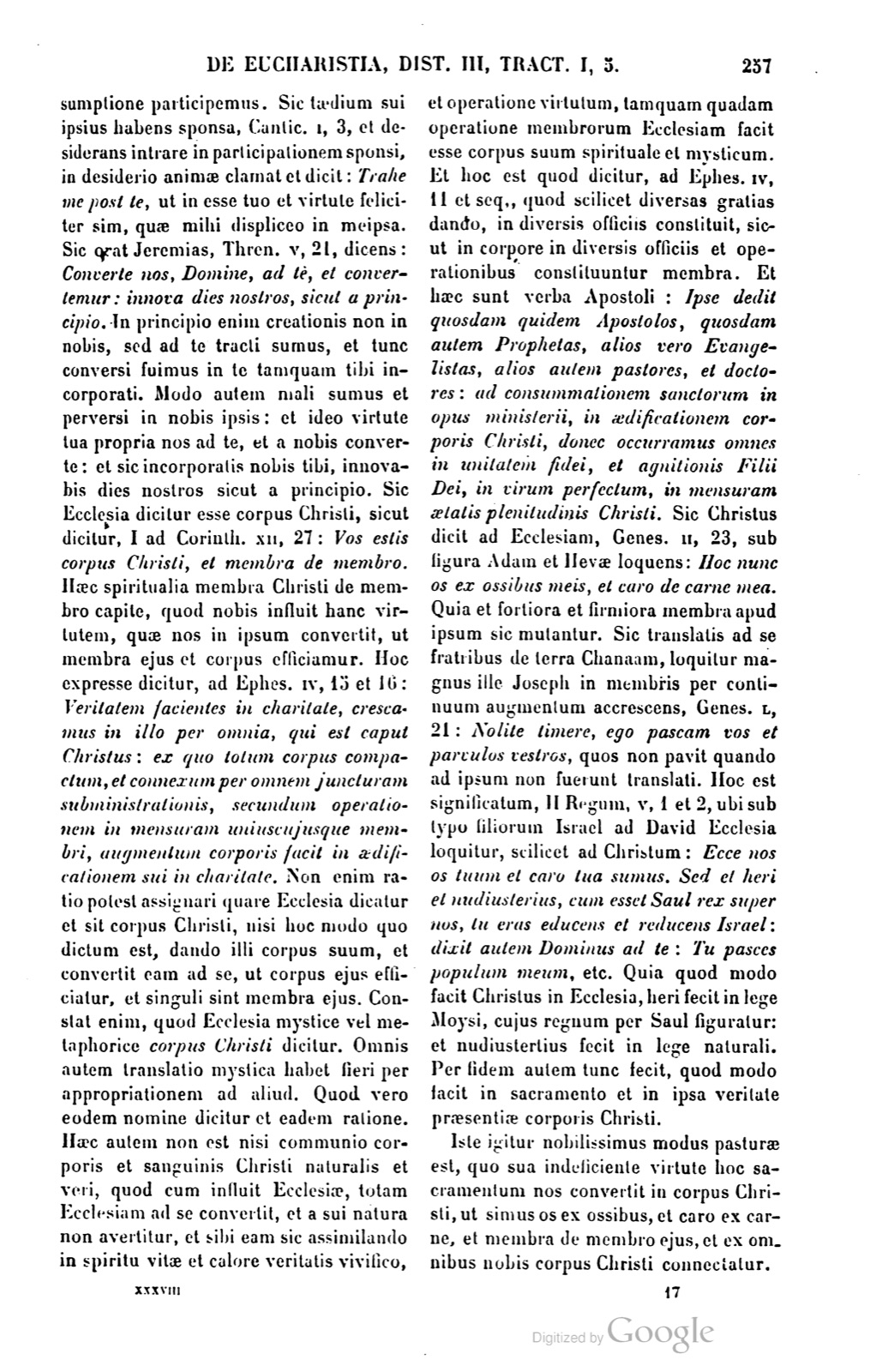
6. Pascit etiam hic cibus universali virtute, et corpus nutriens et animam: in quo etiam excedit cibi corporalis virtutem, quod tantum deperdita in corpore restaurat. Unde beatus Gregorius in quadam Collecta quae post communionem dicitur, orat dicens: "Praesta, quaesumus, omnipotens Deus, ut quod in sacramento percepimus, ad nostrarum vegetationem transeat animarum." Et beatus Ambrosius dicit, quod sicut homo ex duobus componitur, corpore scilicet et anima, sic etiam Christus cibum corporis sui ex duobus composuit, visibili scilicet sacramento, et invisibili corpore suo pleno gratia, ut uterque homo, scilicet interior et exterior, in corpore Christi inveniat refectionem. Et hoc est quod dicitur, Joan. x, 9: Ingredietur, et egredietur, et pascua inveniet. Foris enim inveniet ad sensum in manducatione sacramentali: intus autem invenit in manducatione spirituali, ita ut nihil nobis desit in hoc sacramento. Et hoc est quod dicitur in Psalmo xxi, 1 et 2: Dominus regit me, et nihil mihi deerit: in loco pascuae ibi me collocavit. In hoc enim cibo utramque perficit sumptionem: et nihil potest deesse. Unde sequitur, v. 3: Super aquam refectionis educavit me, animam meam convertit. Quia in refrigerio sanguinis sui intus reficit, et animam spirituali manducatione ad se convertit: et ideo iterum dicit, v. 5: Parasti in conspectu meo mensam, adversus eos qui tribulant me. Tantam enim pasturam confert mensa illa, quod tribulantes, scilicet mundus, caro, daemonia, nihil possunt adversus nos: statim enim ut hujus sacramenti in nobis sentiunt spiritum et odorem et virtutem, confusi abscedunt a nobis inimici, et omnis potestas inimicorum. Quia, sicut dicit Chrysostomus: "Ut leones ignem spirantes, ita a mensa secedimus." Cui aliquid simile est in naturalibus. Narrat enim Avicenna in suo libro de Animalibus,1 quod cum avis parva confligere vult cum serpente, ne venenum noceat aviculae, accipit per cibum lactucam agrestem. Et in succo lactucae agrestis praecipitur sumi sacrificium agni paschalis, sicut patet, Exod. xii, 8: quia cum in memoriam passionis Dominicae sumimus corpus Christi, flagrans de ore nostro virtus sacramenti fugat et ab anima et a corpore omne venenum inimici: et est utriusque hominis ex sua generali virtute refectio propter deitatem quae tam animae quam corpori in Christo est unita.
6. This food also feeds by universal virtue, nourishing both body and soul; in this also it exceeds the virtue of bodily food, because bodily food restores only things lost in the body. Hence blessed Gregory, in a certain Collect which is said after communion, prays, saying: "Grant, we ask, almighty God, that what we have received in the sacrament may pass over to the vegetation of our souls." And blessed Ambrose says that just as man is composed from two things, namely body and soul, so also Christ composed the food of his body from two things, namely the visible sacrament and his invisible body full of grace, so that each man, namely the interior and the exterior, may find refreshment in the body of Christ. And this is what is said in John 10:9: He will enter and go out, and he will find pastures. For outside he will find it according to sense in sacramental eating; but inside he finds it in spiritual eating, so that nothing may be lacking to us in this sacrament. And this is what is said in Psalm 21:1 and 2: The Lord rules me, and nothing will be lacking to me; in a place of pasture there he has placed me. For in this food he perfects both receptions, and nothing can be lacking. Hence it follows, verse 3: He led me out over the water of refreshment; he converted my soul. Because in the refreshment of his blood he restores inwardly, and by spiritual eating he converts the soul to himself; and therefore again he says, verse 5: You have prepared a table in my sight, against those who trouble me. For that table confers so great a feeding that those who trouble us, namely the world, the flesh, and demons, can do nothing against us. For as soon as the enemies and every power of enemies sense in us the spirit and odor and virtue of this sacrament, they depart from us in confusion. Because, as Chrysostom says: "As lions breathing fire, so we depart from the table." Something similar to this exists in natural things. For Avicenna narrates in his book On Animals1 that when a little bird wants to fight with a serpent, lest the venom harm the little bird, it receives wild lettuce as food. And the sacrifice of the paschal lamb is commanded to be taken in the juice of wild lettuce, as is clear in Exodus 12:8, because when, in memory of the Lord's passion, we receive the body of Christ, the blazing virtue of the sacrament from our mouth drives away from both soul and body every poison of the enemy; and it is, from its general virtue, the refreshment of each man because of the deity which is united in Christ both to soul and to body.
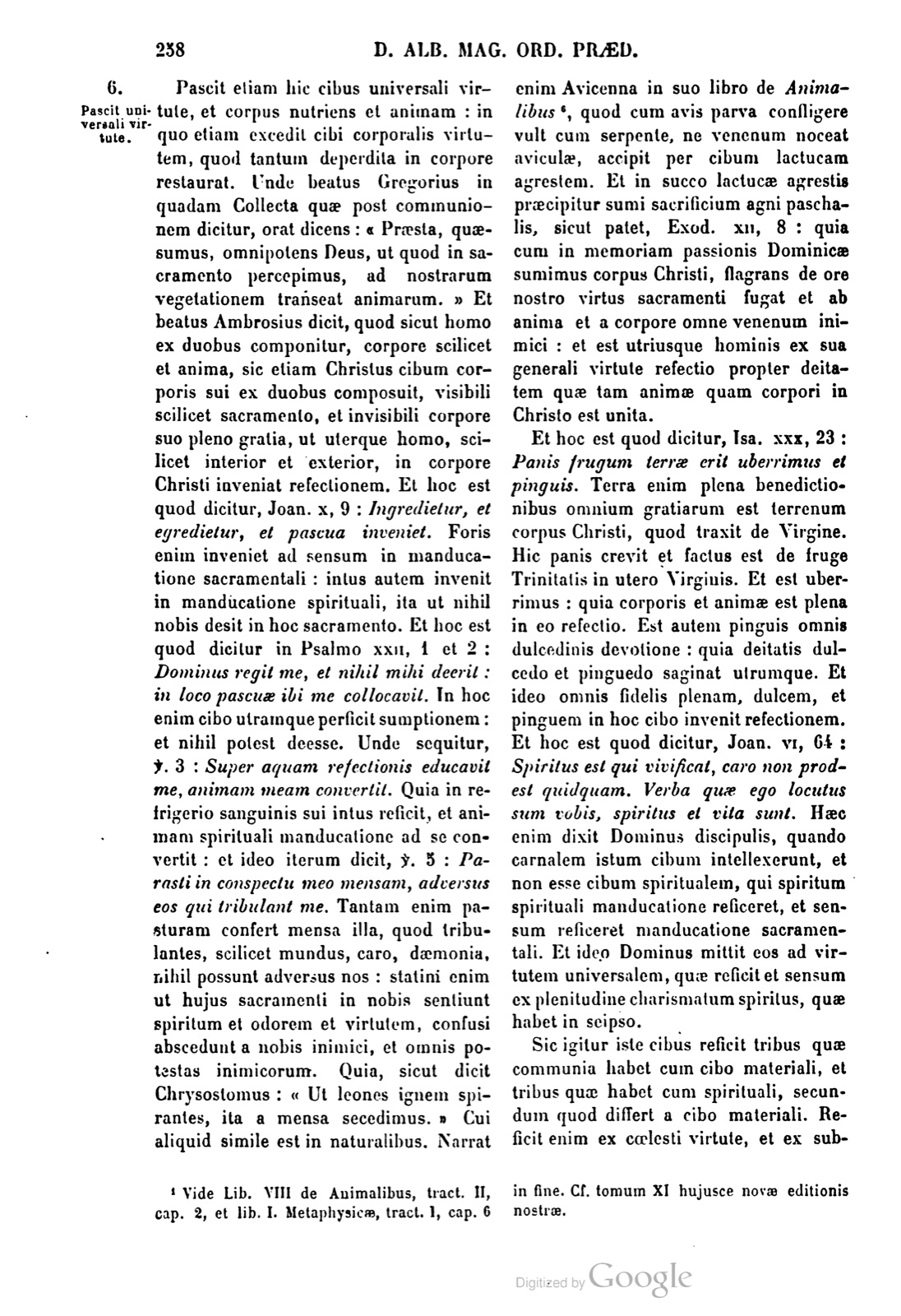
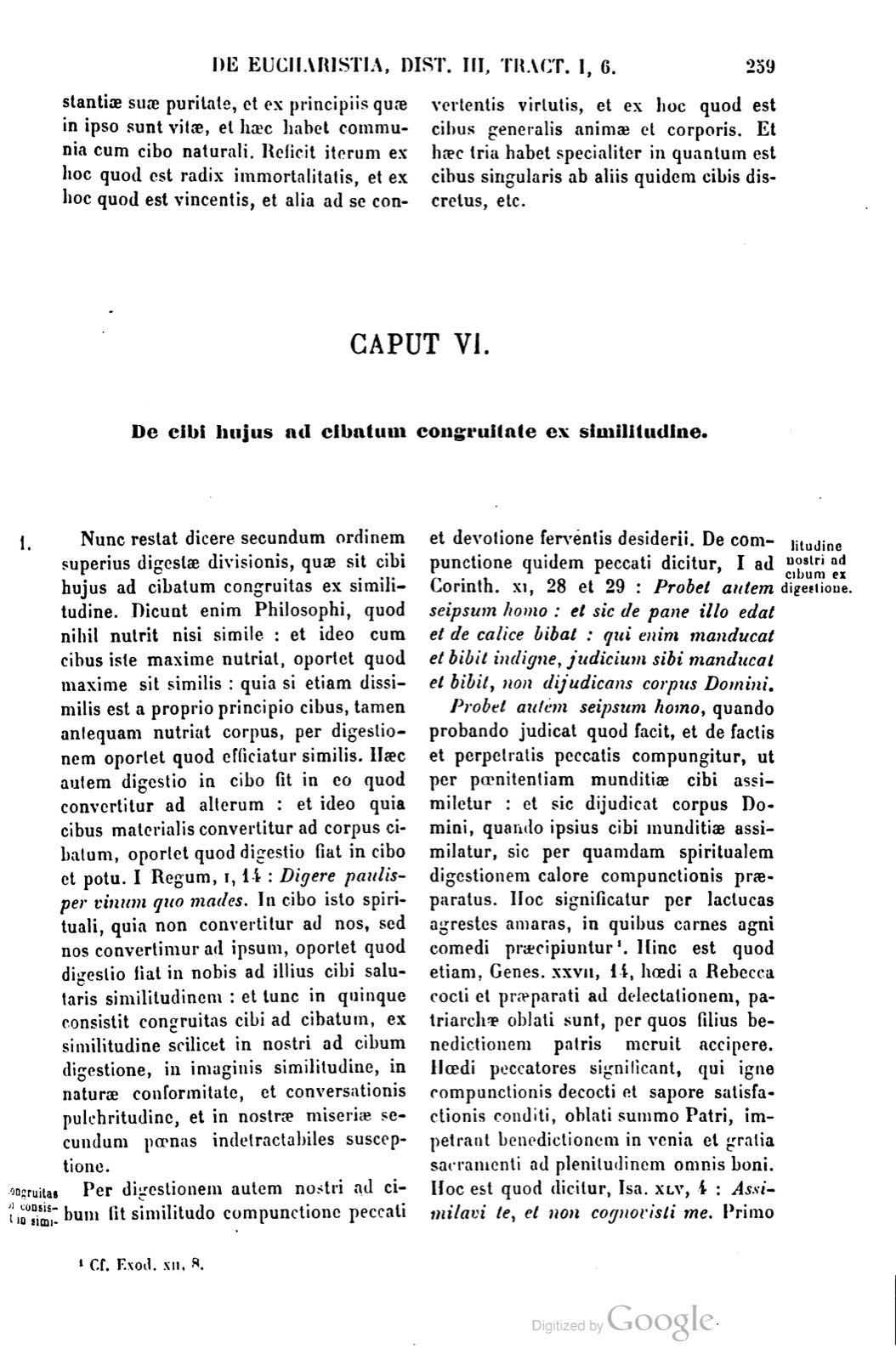
Et hoc est quod dicitur, Isa. xxx, 23: Panis frugum terrae erit uberrimus et pinguis. Terra enim plena benedictionibus omnium gratiarum est terrenum corpus Christi, quod traxit de Virgine. Hic panis crevit et factus est de fruge Trinitatis in utero Virginis. Et est uberrimus: quia corporis et animae est plena in eo refectio. Est autem pinguis omnis dulcedinis devotione: quia deitatis dulcedo et pinguedo saginat utrumque. Et ideo omnis fidelis plenam, dulcem, et pinguem in hoc cibo invenit refectionem. Et hoc est quod dicitur, Joan. vi, 64: Spiritus est qui vivificat, caro non prodest quidquam. Verba quae ego locutus sum vobis, spiritus et vita sunt. Haec enim dixit Dominus discipulis, quando carnalem istum cibum intellexerunt, et non esse cibum spiritualem, qui spiritum spirituali manducatione reficeret, et sensum reficeret manducatione sacramentali. Et ideo Dominus mittit eos ad virtutem universalem, quae reficit et sensum ex plenitudine charismatum spiritus, quae habet in seipso.
Sic igitur iste cibus reficit tribus quae communia habet cum cibo materiali, et tribus quae habet cum spirituali, secundum quod differt a cibo materiali. Reficit enim ex coelesti virtute, et ex substantiae suae puritate, et ex principiis quae in ipso sunt vitae, et haec habet communia cum cibo naturali. Reficit iterum ex hoc quod est radix immortalitatis, et ex hoc quod est vincentis, et alia ad se convertentis virtutis, et ex hoc quod est cibus generalis animae et corporis. Et haec tria habet specialiter in quantum est cibus singularis ab aliis quidem cibis discretus, etc.
And this is what is said in Isaiah 30:23: The bread of the fruits of the earth will be most abundant and fat. For the earth full of the blessings of all graces is the earthly body of Christ, which he drew from the Virgin. This bread grew and was made from the fruit of the Trinity in the womb of the Virgin. And it is most abundant, because in it there is full refreshment of body and soul. It is fat with the devotion of every sweetness, because the sweetness and fatness of deity fattens both. And therefore every faithful person finds full, sweet, and fat refreshment in this food. And this is what is said in John 6:64: The spirit is what gives life; the flesh profits nothing. The words which I have spoken to you are spirit and life. For the Lord said these things to the disciples when they understood this food carnally and did not understand it to be spiritual food, which would refresh the spirit by spiritual eating and would refresh sense by sacramental eating. And therefore the Lord sends them to the universal virtue, which refreshes even sense from the fullness of the charisms of the spirit which it has in itself.
Thus, therefore, this food refreshes by three things which it has in common with material food, and by three things which it has with spiritual food, according as it differs from material food. For it refreshes from heavenly virtue, and from the purity of its substance, and from the principles of life which are in it, and it has these in common with natural food. Again it refreshes from the fact that it is the root of immortality, and from the fact that it is of a virtue conquering and converting other things to itself, and from the fact that it is the general food of soul and body. And it has these three specially insofar as it is a singular food distinct indeed from other foods, and so forth.
Notes
- See book 8 On Animals, tractate 2, chapter 2, and book 1 of the Metaphysics, tractate 1, chapter 6 at the end. Compare volume 11 of this new edition of ours. (Vide Lib. VIII de Animalibus, tract. II, cap. 2, et lib. I. Metaphysicae, tract. 1, cap. 6 in fine. Cf. tomum XI hujusce novae editionis nostrae.) ↩
If a page does not appear, its photograph has not been uploaded yet.