Works › The Book on the Sacrament of the Eucharist
Volume 38 · pp. 254–256
Chapter V, nos. 3-4.
A marker with ≈ is an approximate page boundary, placed by measure of the text; the page photographs remain the authority. In the paired views, clicking a page marker brings that page into view.
Marginal label (printed p. 254): Nutrit ad vitam.
Marginal label (printed p. 255): Hic cibus confert immortalitatem.
Marginal label (printed p. 256): Nutrit virtute vincente nutritum et convertente in se.
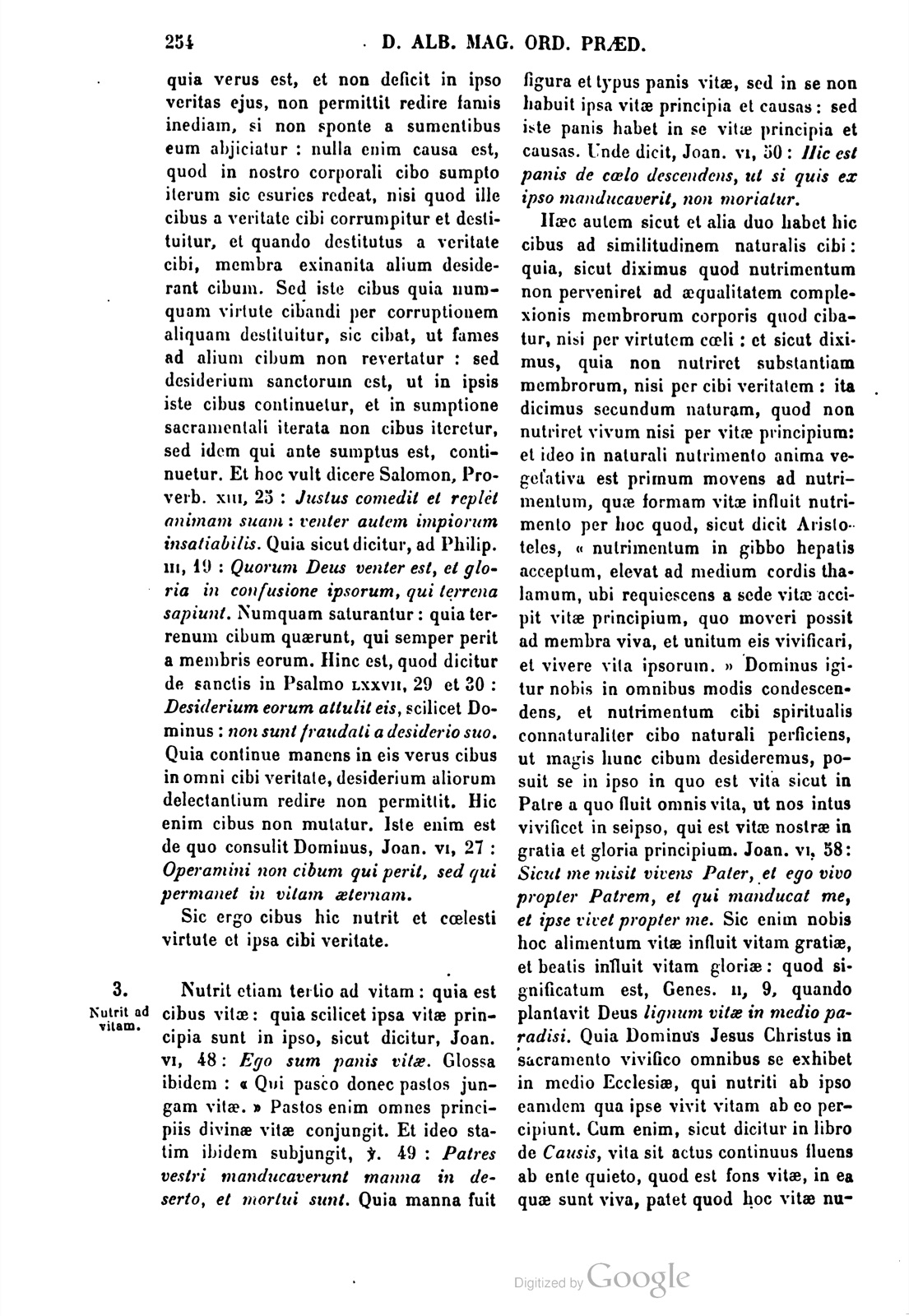
3. Nutrit etiam tertio ad vitam: quia est cibus vitae: quia scilicet ipsa vitae principia sunt in ipso, sicut dicitur, Joan. vi, 48: Ego sum panis vitae. Glossa ibidem: "Qui pasco donec pastos jungam vitae." Pastos enim omnes principiis divinae vitae conjungit. Et ideo statim ibidem subjungit, v. 49: Patres vestri manducaverunt manna in deserto, et mortui sunt. Quia manna fuit figura et typus panis vitae, sed in se non habuit ipsa vitae principia et causas: sed iste panis habet in se vitae principia et causas. Unde dicit, Joan. vi, 50: Hic est panis de coelo descendens, ut si quis ex ipso manducaverit, non moriatur.
Haec autem sicut et alia duo habet hic cibus ad similitudinem naturalis cibi: quia, sicut diximus quod nutrimentum non perveniret ad aequalitatem complexionis membrorum corporis quod cibatur, nisi per virtutem coeli: et sicut diximus, quia non nutriret substantiam membrorum, nisi per cibi veritatem: ita dicimus secundum naturam, quod non nutriret vivum nisi per vitae principium: et ideo in naturali nutrimento anima vegetativa est primum movens ad nutrimentum, quae formam vitae influit nutrimento per hoc quod, sicut dicit Aristoteles, "nutrimentum in gibbo hepatis acceptum, elevat ad medium cordis thalamum, ubi requiescens a sede vitae accipit vitae principium, quo moveri possit ad membra viva, et unitum eis vivificari, et vivere vita ipsorum." Dominus igitur nobis in omnibus modis condescendens, et nutrimentum cibi spiritualis connaturaliter cibo naturali perficiens, ut magis hunc cibum desideremus, posuit se in ipso in quo est vita sicut in Patre a quo fluit omnis vita, ut nos intus vivificet in seipso, qui est vitae nostrae in gratia et gloria principium. Joan. vi, 58: Sicut me misit vivens Pater, et ego vivo propter Patrem, et qui manducat me, et ipse vivet propter me. Sic enim nobis hoc alimentum vitae influit vitam gratiae, et beatis influit vitam gloriae: quod significatum est, Genes. ii, 9, quando plantavit Deus lignum vitae in medio paradisi. Quia Dominus Jesus Christus in sacramento vivifico omnibus se exhibet in medio Ecclesiae, qui nutriti ab ipso eamdem qua ipse vivit vitam ab eo percipiunt. Cum enim, sicut dicitur in libro de Causis, vita sit actus continuus fluens ab ente quieto, quod est fons vitae, in ea quae sunt viva, patet quod hoc vitae nutrimentum cibus est, in quo Pater fluit vitam in Filium: et Filius habens vitam in semetipso, fluit vitam in sacramentum, sacramentum autem fluit vitam in nos. Eccli. xv, 3: Cibavit illum Dominus pane vitae et intellectus. Dat enim vitam intellectualem, quae est pars vitae beatae: omnis enim beata vita est secundum vitam intellectualem. Unde, Joan. vi, 52: Panis quem ego dabo, caro mea est pro mundi vita. Quia ex illa hauritur vita indeficiens.
Marginal label (printed p. 254): It nourishes unto life.
Marginal label (printed p. 255): This food confers immortality.
Marginal label (printed p. 256): It nourishes by a virtue conquering the one nourished and converting him into itself.
3. It also nourishes, thirdly, unto life, because it is the food of life, because namely the very principles of life are in it, as is said in John 6:48: I am the bread of life. The Gloss there: "I who feed until I join those fed to life." For it joins all those who have been fed to the principles of divine life. And therefore immediately in the same place it adds, verse 49: Your fathers ate manna in the desert and died. For manna was a figure and type of the bread of life, but in itself it did not have the very principles and causes of life. But this bread has in itself the principles and causes of life. Hence he says, John 6:50: This is the bread descending from heaven, so that if anyone eats from it, he may not die.
But this food has these things, just as also the other two, according to the likeness of natural food. For as we have said that nourishment would not come to the equality of the complexion of the members of the body that is fed except through the virtue of heaven, and as we have said that it would not nourish the substance of the members except through the truth of food, so we say according to nature that it would not nourish a living thing except through a principle of life. And therefore in natural nourishment the vegetative soul is the first mover toward nourishment, which pours the form of life into the nourishment through this, that, as Aristotle says, "nourishment received in the swelling of the liver raises it to the middle chamber of the heart, where, resting from the seat of life, it receives the principle of life by which it can be moved to the living members, and, united to them, be vivified and live by their life." Therefore the Lord, condescending to us in all ways, and perfecting the nourishment of spiritual food connaturally to natural food, so that we may desire this food more, placed himself in it, in whom life is as in the Father from whom all life flows, so that inwardly he may vivify us in himself, who is the principle of our life in grace and glory. John 6:58: As the living Father sent me, and I live because of the Father, so he who eats me, he too will live because of me. For thus this nourishment of life pours into us the life of grace, and into the blessed it pours the life of glory. This was signified in Genesis 2:9, when God planted the tree of life in the midst of paradise. For the Lord Jesus Christ in the life-giving sacrament offers himself to all in the midst of the Church; those nourished by him receive from him the same life by which he himself lives. For since, as is said in the book On Causes, life is a continuous act flowing from a quiet being, which is the fountain of life, into those things that are living, it is clear that this nourishment of life is the food in which the Father flows life into the Son, and the Son, having life in himself, flows life into the sacrament, but the sacrament flows life into us. Ecclesiasticus 15:3: The Lord fed him with the bread of life and understanding. For he gives intellectual life, which is part of blessed life; for every blessed life is according to intellectual life. Hence John 6:52: The bread which I shall give is my flesh for the life of the world. For unfailing life is drawn from that flesh.
Sic ergo iste cibus nutrit ex principiis vitae in vitam aeternam et divinam.
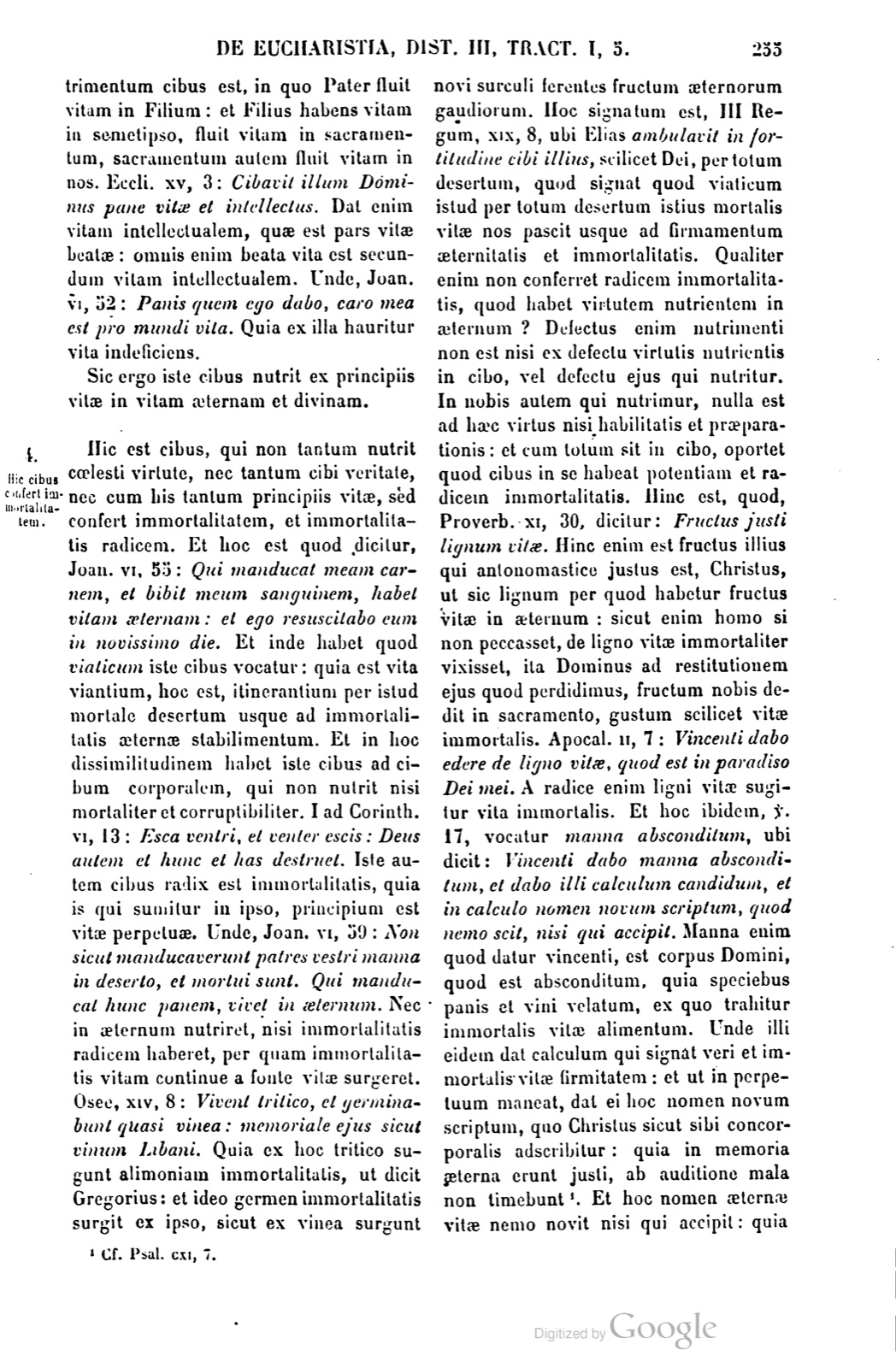
4. Hic est cibus, qui non tantum nutrit coelesti virtute, nec tantum cibi veritate, nec cum his tantum principiis vitae, sed confert immortalitatem, et immortalitatis radicem. Et hoc est quod dicitur, Joan. vi, 55: Qui manducat meam carnem, et bibit meum sanguinem, habet vitam aeternam: et ego resuscitabo eum in novissimo die. Et inde habet quod viaticum iste cibus vocatur: quia est vita viantium, hoc est, itinerantium per istud mortale desertum usque ad immortalitatis aeternae stabilimentum. Et in hoc dissimilitudinem habet iste cibus ad cibum corporalem, qui non nutrit nisi mortaliter et corruptibiliter. I ad Corinth. vi, 13: Esca ventri, et venter escis: Deus autem et hunc et has destruet. Iste autem cibus radix est immortalitatis, quia is qui sumitur in ipso, principium est vitae perpetuae. Unde, Joan. vi, 59: Non sicut manducaverunt patres vestri manna in deserto, et mortui sunt. Qui manducat hunc panem, vivet in aeternum. Nec in aeternum nutriret, nisi immortalitatis radicem haberet, per quam immortalitatis vitam continue a fonte vitae surgeret. Osee, xiv, 8: Vivent tritico, et germinabunt quasi vinea: memoriale ejus sicut vinum Libani. Quia ex hoc tritico sugunt alimoniam immortalitatis, ut dicit Gregorius: et ideo germen immortalitatis surgit ex ipso, sicut ex vinea surgunt novi surculi ferentes fructum aeternorum gaudiorum. Hoc signatum est, III Regum, xix, 8, ubi Elias ambulavit in fortitudine cibi illius, scilicet Dei, per totum desertum, quod signat quod viaticum istud per totum desertum istius mortalis vitae nos pascit usque ad firmamentum aeternitatis et immortalitatis. Qualiter enim non conferret radicem immortalitatis, quod habet virtutem nutrientem in aeternum? Defectus enim nutrimenti non est nisi ex defectu virtutis nutrientis in cibo, vel defectu ejus qui nutritur. In nobis autem qui nutrimur, nulla est ad haec virtus nisi habilitatis et praeparationis: et cum totum sit in cibo, oportet quod cibus in se habeat potentiam et radicem immortalitatis. Hinc est, quod, Proverb. xi, 30, dicitur: Fructus justi lignum vitae. Hinc enim est fructus illius qui antonomastice justus est, Christus, ut sic lignum per quod habetur fructus vitae in aeternum: sicut enim homo si non peccasset, de ligno vitae immortaliter vixisset, ita Dominus ad restitutionem ejus quod perdidimus, fructum nobis dedit in sacramento, gustum scilicet vitae immortalis. Apocal. ii, 7: Vincenti dabo edere de ligno vitae, quod est in paradiso Dei mei. A radice enim ligni vitae sugitur vita immortalis. Et hoc ibidem, v. 17, vocatur manna absconditum, ubi dicit: Vincenti dabo manna absconditum, et dabo illi calculum candidum, et in calculo nomen novum scriptum, quod nemo scit, nisi qui accipit. Manna enim quod datur vincenti, est corpus Domini, quod est absconditum, quia speciebus panis et vini velatum, ex quo trahitur immortalis vitae alimentum. Unde illi eidem dat calculum qui signat veri et immortalis vitae firmitatem: et ut in perpetuum maneat, dat ei hoc nomen novum scriptum, quo Christus sicut sibi concorporalis adscribitur: quia in memoria aeterna erunt justi, ab auditione mala non timebunt.1 Et hoc nomen aeternae vitae nemo novit nisi qui accipit: quia tales deliciae ignotae sunt mundanis.
Thus, therefore, this food nourishes from the principles of life into eternal and divine life.
4. This is the food which does not only nourish by heavenly virtue, nor only by the truth of food, nor only with these principles of life, but confers immortality and the root of immortality. And this is what is said in John 6:55: He who eats my flesh and drinks my blood has eternal life, and I shall raise him up on the last day. And from this it has that this food is called viaticum, because it is the life of those on the way, that is, of those journeying through this mortal desert unto the establishment of eternal immortality. And in this this food has unlikeness to bodily food, which nourishes only mortally and corruptibly. 1 Corinthians 6:13: Food for the belly, and the belly for foods; but God will destroy both this and those. But this food is the root of immortality, because he who is received in it is the principle of perpetual life. Hence John 6:59: Not as your fathers ate manna in the desert and died. He who eats this bread will live forever. Nor would it nourish forever unless it had the root of immortality, through which the life of immortality would continually rise from the fountain of life. Hosea 14:8: They will live on wheat and will germinate like a vine; its memorial is like the wine of Lebanon. Because from this wheat they suck the nourishment of immortality, as Gregory says; and therefore a shoot of immortality rises from it, just as from a vine new shoots arise bearing the fruit of eternal joys. This was signified in 3 Kings 19:8, where Elijah walked in the strength of that food, namely of God, through the whole desert, which signifies that this viaticum feeds us through the whole desert of this mortal life unto the firmament of eternity and immortality. For how would that which has nourishing virtue forever not confer the root of immortality? For defect of nourishment is only from a defect of nourishing virtue in the food, or from a defect of the one who is nourished. But in us who are nourished there is no virtue for these things except of aptitude and preparation; and since the whole is in the food, it is necessary that the food have in itself the power and root of immortality. Hence Proverbs 11:30 says: The fruit of the just is a tree of life. For hence is the fruit of him who by antonomasia is just, Christ, so that it is the tree through which the fruit of life is had forever. For just as, if man had not sinned, he would have lived immortally from the tree of life, so the Lord, for the restoration of what we lost, gave us fruit in the sacrament, namely the taste of immortal life. Apocalypse 2:7: To the one who conquers I shall give to eat of the tree of life, which is in the paradise of my God. For immortal life is sucked from the root of the tree of life. And this, in the same place, verse 17, is called hidden manna, where he says: To the one who conquers I shall give hidden manna, and I shall give him a white stone, and on the stone a new name written, which no one knows except the one who receives it. For the manna which is given to the conqueror is the body of the Lord, which is hidden because veiled by the species of bread and wine, from which the nourishment of immortal life is drawn. Hence to that same one he gives a stone which signifies the firmness of true and immortal life; and so that he may remain forever, he gives him this new name written, by which Christ is assigned to him as one sharing the same body, because the just will be in eternal memory; they will not fear from an evil hearing.1 And no one knows this name of eternal life except the one who receives it, because such delights are unknown to worldly people.
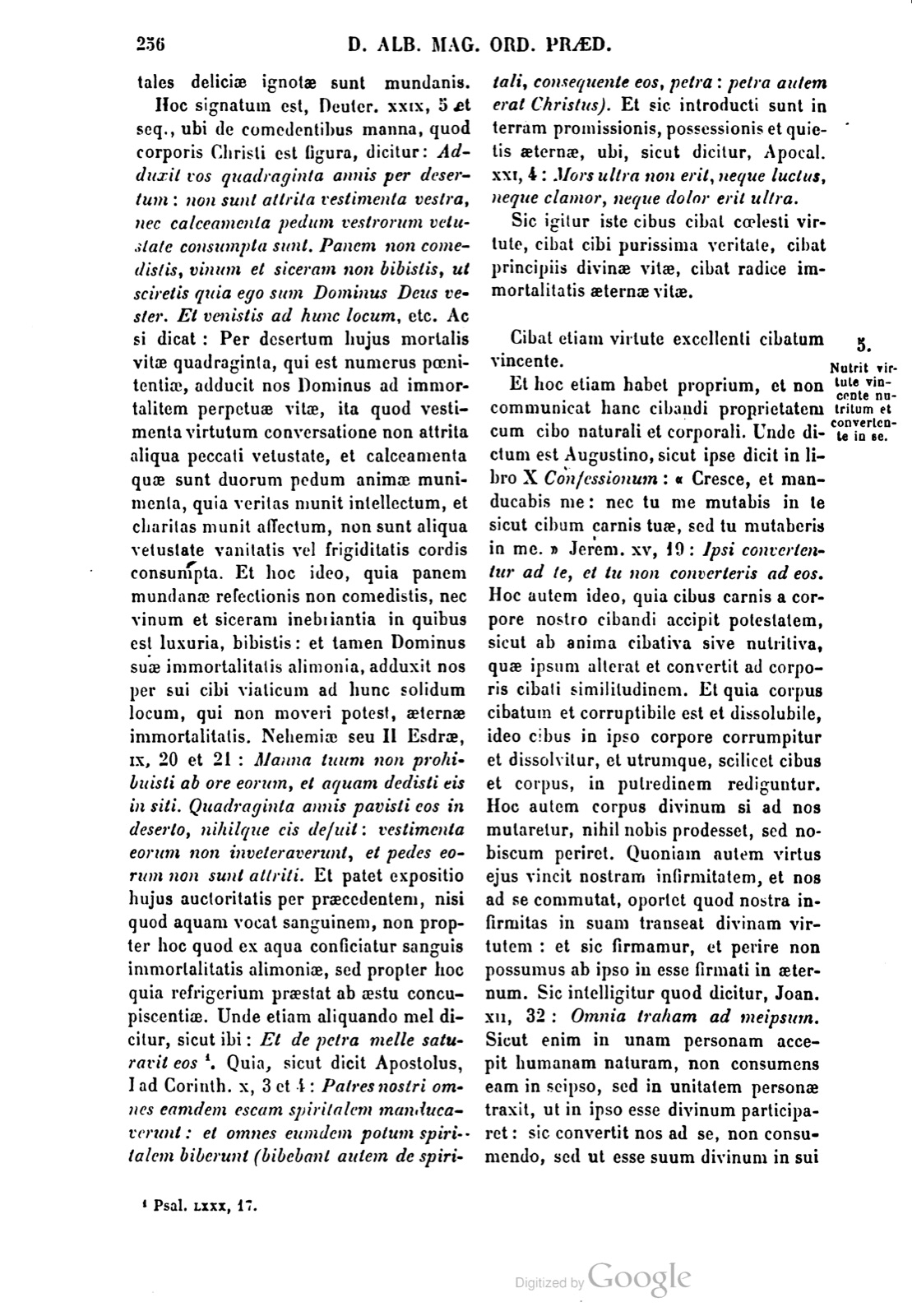
Hoc signatum est, Deuter. xxix, 5 et seq., ubi de comedentibus manna, quod corporis Christi est figura, dicitur: Adduxit vos quadraginta annis per desertum: non sunt attrita vestimenta vestra, nec calceamenta pedum vestrorum vetustate consumpta sunt. Panem non comedistis, vinum et siceram non bibistis, ut sciretis quia ego sum Dominus Deus vester. Et venistis ad hunc locum, etc. Ac si dicat: Per desertum hujus mortalis vitae quadraginta, qui est numerus poenitentiae, adducit nos Dominus ad immortalitatem perpetuae vitae, ita quod vestimenta virtutum conversatione non attrita aliqua peccati vetustate, et calceamenta quae sunt duorum pedum animae munimenta, quia veritas munit intellectum, et charitas munit affectum, non sunt aliqua vetustate vanitatis vel frigiditatis cordis consumpta. Et hoc ideo, quia panem mundanae refectionis non comedistis, nec vinum et siceram inebriantia in quibus est luxuria, bibistis: et tamen Dominus suae immortalitatis alimonia, adduxit nos per sui cibi viaticum ad hunc solidum locum, qui non moveri potest, aeternae immortalitatis. Nehemiae seu II Esdrae, ix, 20 et 21: Manna tuum non prohibuisti ab ore eorum, et aquam dedisti eis in siti. Quadraginta annis pavisti eos in deserto, nihilque eis defuit: vestimenta eorum non inveteraverunt, et pedes eorum non sunt attriti. Et patet expositio hujus auctoritatis per praecedentem, nisi quod aquam vocat sanguinem, non propter hoc quod ex aqua conficiatur sanguis immortalitatis alimoniae, sed propter hoc quia refrigerium praestat ab aestu concupiscentiae. Unde etiam aliquando mel dicitur, sicut ibi: Et de petra melle saturavit eos.2 Quia, sicut dicit Apostolus, I ad Corinth. x, 3 et 4: Patres nostri omnes eamdem escam spiritalem manducaverunt: et omnes eumdem potum spiritalem biberunt (bibebant autem de spiritali, consequente eos, petra: petra autem erat Christus). Et sic introducti sunt in terram promissionis, possessionis et quietis aeternae, ubi, sicut dicitur, Apocal. xxi, 4: Mors ultra non erit, neque luctus, neque clamor, neque dolor erit ultra.
Sic igitur iste cibus cibat coelesti virtute, cibat cibi purissima veritate, cibat principiis divinae vitae, cibat radice immortalitatis aeternae vitae.
This was signified in Deuteronomy 29:5 and following, where concerning those eating manna, which is a figure of the body of Christ, it is said: He led you for forty years through the desert; your garments were not worn away, nor were the shoes of your feet consumed by age. You did not eat bread, you did not drink wine and strong drink, so that you might know that I am the Lord your God. And you came to this place, and so forth. As if he were saying: Through the desert of this mortal life, forty, which is the number of penance, the Lord leads us to the immortality of perpetual life, so that the garments of the virtues have not been worn away in conversation by any age of sin, and the shoes which are the protections of the two feet of the soul, because truth protects the intellect and charity protects the affection, have not been consumed by any age of vanity or coldness of heart. And this is so because you did not eat the bread of worldly refreshment, nor did you drink intoxicating wine and strong drink, in which there is luxury. And nevertheless the Lord, by the nourishment of his immortality, led us through the viaticum of his food to this solid place, which cannot be moved, of eternal immortality. Nehemiah or 2 Esdras 9:20 and 21: You did not withhold your manna from their mouth, and you gave them water in thirst. For forty years you fed them in the desert, and nothing was lacking to them; their garments did not grow old, and their feet were not worn. And the exposition of this authority is clear through the preceding one, except that he calls the water blood, not because the blood of the nourishment of immortality is made from water, but because it furnishes refreshment from the heat of concupiscence. Hence also it is sometimes called honey, as there: And he satisfied them with honey from the rock.2 Because, as the Apostle says in 1 Corinthians 10:3 and 4: All our fathers ate the same spiritual food, and all drank the same spiritual drink; for they drank from the spiritual rock following them, and the rock was Christ. And so they were introduced into the land of promise, possession, and eternal rest, where, as is said in Apocalypse 21:4: Death will be no more, nor mourning, nor crying, nor will there be pain any more.
Thus therefore this food feeds by heavenly virtue, feeds by the most pure truth of food, feeds by the principles of divine life, feeds by the root of immortality of eternal life.
If a page does not appear, its photograph has not been uploaded yet.