Works › The Book on the Sacrament of the Eucharist
Volume 38 · pp. 247–250
Chapter IV. On the Sweetness of This Food from Operation.
A marker with ≈ is an approximate page boundary, placed by measure of the text; the page photographs remain the authority. In the paired views, clicking a page marker brings that page into view.
Marginal label (printed p. 247): Cibus sanus: quia ab infirmitate praeservat.
Caput IV. De cibi hujus suavitate ex operatione.
1. Sic cibus sanus est ex operatione: quia operatur suavitatem in homine ipsum in communionem sumente.
Est autem sanus quadrupliciter, scilicet ab infirmitate praeservando, causam infirmitatis expurgando, sanitatem perditam reparando, et sanitatem reparatam conservando.
De praeservatione quidem ab infirmitate dicitur, Eccli. xxxviii, 4: Altissimus creavit de terra medicamenta, et vir prudens non abhorrebit illa. De terra enim illa benedicta Dominici corporis et sanguinis, de qua scriptum est: Domini est terra, etc.1, creavit nobis Deus medicinam gratiae praeservantem nos ab omni peccati infirmitate. Vir ergo prudens, qui de futuris habet providentiam, quod scilicet sine hac medicina non praeservatur homo ab infirmitate, et ideo non abhorret eam: quia licet sit apud imperitos horribile sumere humanam carnem, vel humanum sanguinem, tamen in hoc sacramento medicina est supra modum amplectenda. Et hoc est quod dicitur, Eccli. xlii, 24: Medicina omnium in festinatione nebulae. Quia forma panis intra quam corpus Domini continetur, nebula vocatur, quae medicina est praeservans ab omni infirmitate. Hoc est quod dicitur, Job, v, 19: In sex tribulationibus liberabit te, et in septima non tanget te malum. Tot enim sunt infirmitates quas timemus. Sunt enim sex quae causantur ab infirmitate corporis et mentis. A corpore quidem tres, luxuria, gula, avaritia. Ab anima tres secundum quod est in corpore corrupto, scilicet ira ex sanguinis accensione, acedia ex corporis ponderositate, invidia ex cordis pravitate, quia scilicet timet ne alterius prosperitate ipse impediatur. Haec est quae ducit hominem in desperationem. Superbia autem causatur ex sola spiritus altitudine, et haec est septima. In quibus nos non tangit malum, a quibus nos corpus Christi praeservat. Si enim cogitamus patientis humilitatem, quando in memoriam passionis Christi corpus Domini sumimus, non tangit nos malum superbiae. Si autem cogitamus Christi charitatem in qua nobis se in corpore et sanguine communicavit, non tangit nos malum invidiae. Si autem cogitamus, quod impiger fuerit ut omnia faceret quae ad nostram salutem requirebantur in offerendo se pro nobis, liberamur a malo acediae. Et si advertimus quam liberaliter sua et se nobis impendit, liberamur a malo avaritiae. Si autem ad cor reducimus patientiam ipsius et mansuetudinem cum se pro nobis obtulit, liberamur a malo irae. Si autem subvenit nobis de sobrietate illius coenae, liberamur a malo gulae. Et si cogitamus amaritudinem in lactucis agrestibus, quae amaritudinem et acerbitatem signant passionis, liberamur a malo luxuriae.
Hoc signatum est, Tob. vi, 8 et 9: Cordis ejus particulam si super carbones ponas, fumus ejus extricat omne genus daemoniorum. Quia omne genus daemoniorum consistit in his septem: haec enim est illa optima particula inter omnia sacramenta quae nobis Salvator exhibuit, et ideo illa posita super carbones devotionis igniti cordis, statim fumat in effectu ad Deum, et omnem vim inimici expellit a nobis. Et fel valet ad ungendos oculos in quibus fuerit albugo, et sanabuntur. Fel enim est fellea amaritudo exprobrationum Christi patientis, quae extergit albuginem spissam, quam nobis ante oculos vanitas mundi posuit, ut non videamus lumen caeli: quia Christi amaritudo reducit nos, ita ut nos cognoscamus et ad lumen coeli oculos attollamus, et vanitatem mundi non curemus quae nobis oculos obtexit.
Marginal label (printed p. 247): Healthful food: because it preserves from infirmity.
Chapter IV. On the sweetness of this food from operation.
1. Thus the food is healthy from its operation, because it works sweetness in the man who receives it in communion.
But it is healthy in four ways, namely by preserving from infirmity, by purging the cause of infirmity, by repairing lost health, and by preserving repaired health.
Concerning preservation from infirmity Ecclesiasticus 38:4 says: The Most High created medicines from the earth, and a prudent man will not abhor them. For from that blessed earth of the Lord's body and blood, about which it is written: The earth is the Lord's, and so forth1, God created for us the medicine of grace preserving us from every infirmity of sin. Therefore the prudent man, who has providence concerning future things, knows that without this medicine a man is not preserved from infirmity, and therefore he does not abhor it; for although among the unskilled it is horrible to take human flesh or human blood, nevertheless in this sacrament the medicine is to be embraced beyond measure. And this is what is said in Ecclesiasticus 42:24: The medicine of all things is in the hastening of the cloud. Because the form of bread within which the body of the Lord is contained is called a cloud, which is a medicine preserving from every infirmity. This is what is said in Job 5:19: In six tribulations he will free you, and in the seventh evil will not touch you. For there are so many infirmities which we fear. There are six which are caused by infirmity of body and mind. From the body there are three: lust, gluttony, avarice. From the soul, insofar as it is in a corrupt body, there are three: anger from the kindling of blood, sloth from the heaviness of the body, envy from the depravity of the heart, because it fears lest by another's prosperity it itself be hindered. This is what leads a man into desperation. But pride is caused from the height of the spirit alone, and this is the seventh. In these evil does not touch us, from which the body of Christ preserves us. For if we think upon the humility of the one suffering, when we receive the body of the Lord in memory of Christ's passion, the evil of pride does not touch us. But if we think upon the charity of Christ in which he communicated himself to us in body and blood, the evil of envy does not touch us. But if we think that he was diligent to do all things which were required for our salvation in offering himself for us, we are freed from the evil of sloth. And if we note how liberally he spent his own things and himself for us, we are freed from the evil of avarice. But if we bring back to heart his patience and meekness when he offered himself for us, we are freed from the evil of anger. But if the sobriety of that supper comes to our aid, we are freed from the evil of gluttony. And if we think upon the bitterness in the wild lettuces, which signify the bitterness and harshness of the passion, we are freed from the evil of lust.
This was signified in Tobit 6:8 and 9: If you place a little piece of its heart upon coals, its smoke drives out every kind of demons. Because every kind of demons consists in these seven; for this is that best little piece among all the sacraments which the Savior offered to us, and therefore when it is placed upon the coals of devotion of a fiery heart, it immediately smokes in effect toward God and drives all force of the enemy away from us. And the gall is strong for anointing eyes in which there has been whiteness, and they will be healed. For the gall is the bilious bitterness of the reproaches of the suffering Christ, which wipes away the thick whiteness which the vanity of the world placed before our eyes so that we might not see the light of heaven, because Christ's bitterness leads us back so that we may know ourselves and lift our eyes to the light of heaven and not care for the vanity of the world which has covered our eyes.
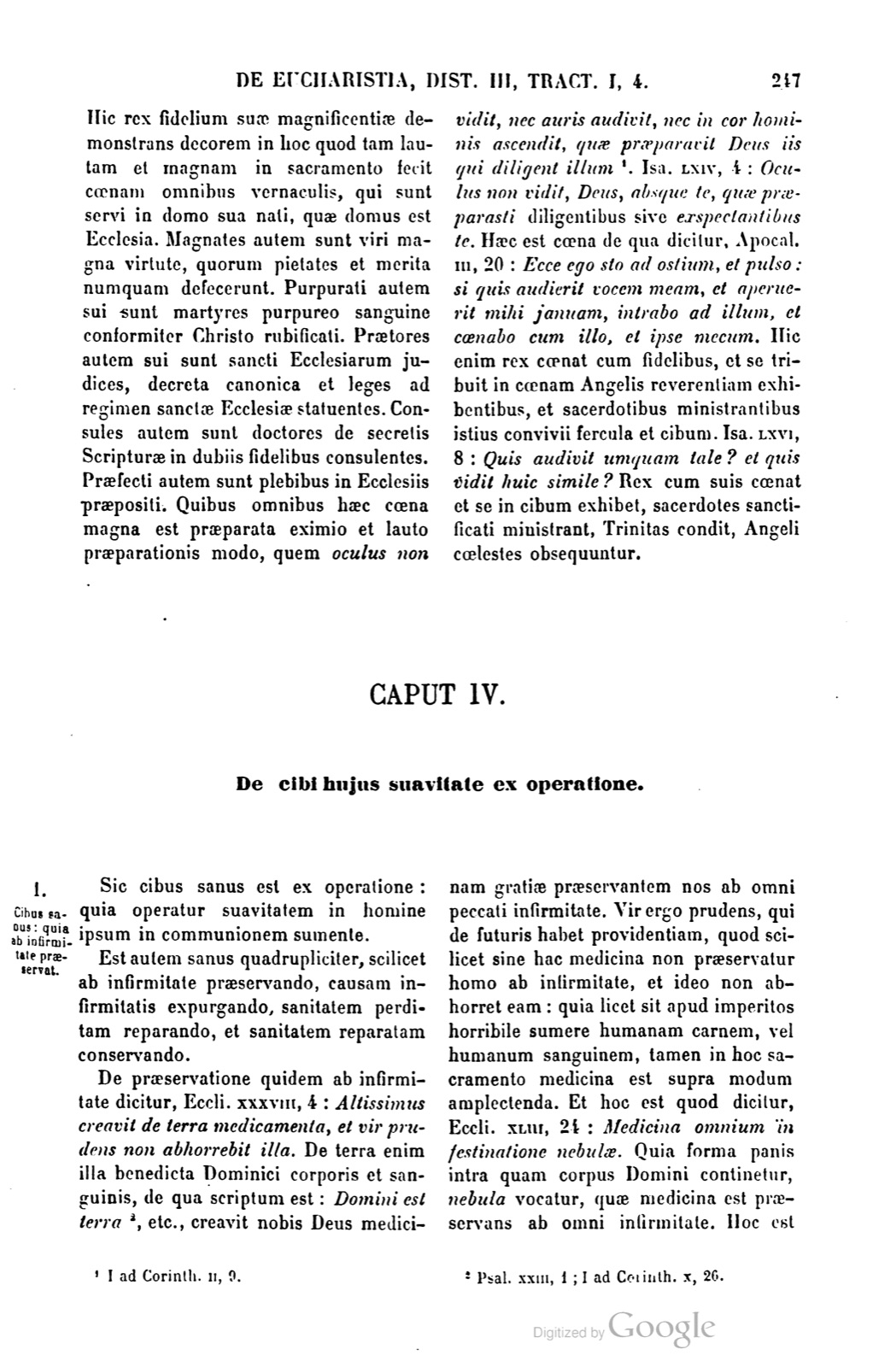
Sic igitur est cibus iste operans sanitatem, praeservando nos ab omnibus malis, quae septem sunt in mortalibus, et unum octavum in caecitate veritatis.
2. Est etiam iste cibus sanus causam infirmitatis expellendo. Omnis enim causa nostrae infirmitatis est quintuplex. Quod enim ad infirmitatem movet, extra nos est, secundum id quod dicitur, I Joannis, ii, 16: Omne quod est in mundo, concupiscentia carnis est, et concupiscentia oculorum, et superbia vitae. Et quod in nobis inducit, aut est timor humanus vel mundanus, vel amor improbus, in quo superflue nos ipsos amamus. Et hoc totum curat cibus iste. Si enim cogitamus Christi in patiendo dolorem, expurgatur concupiscentia mollitiei carnalis. Si advertimus patientis nudam paupertatem, concupiscentiam expurgamus oculorum. Si autem advertimus illusi et exprobrati et derisi etiam a crucifixis latronibus vilitatem, totum expurgatur quod in nobis est de vitae superbia. Thren. iii, 19: Recordare paupertatis et transgressionis meae, absynthii et fellis. Paupertatis, inquam, ne concupiscentia oculorum in mundi spectaculis divitiarum te inficiat. Transgressionis in sensu doloris, ne dulcedo te concupiscentiae carnalis alliciat. Absynthii et fellis in exprobratione derisionis et illusionis, ne superbia vitae decipiat.
Contra timorem valet recordatio gaudii, qua pro nobis audacter crucem sustinuit. Et recordatio mortis, quam pro nobis sustinuit, valet contra amorem superfluum, ne nos tantum amemus, quod pro ipso nihil sustinere velimus. De timore dicitur, Matth. x, 28: Nolite timere eos qui occidunt corpus, animam autem non possunt occidere. Ad Hebr. xii, 3: Recogitate eum qui talem sustinuit a peccatoribus adversum semetipsum contradictionem, ut ne fatigemini, animis vestris deficientes. De amore autem dicitur, Joan. xii, 25: Qui amat animam suam, perdet eam: et qui odit animam suam in hoc mundo, in vitam aeternam custodit eam. De utrisque similiter dicitur, ad Hebr. xii, 2: Adspicientes in auctorem fidei et consummatorem, Jesum, qui proposito sibi gaudio sustinuit crucem, confusione contempta. Sic enim fit quod dicit Apostolus, I ad Corinth. xi, 26: Quotiescumque manducabitis panem hunc, et calicem Domini bibetis, mortem Domini annuntiabitis, donec veniat.
Sic enim memoria passionis expurgat ab omni causa infirmitatis.
3. Est item medicina sanitatis, sanitatem deperditam restaurando. Sicut enim perditur sanitas et vires corporis, ita perditur sanitas mentis. Sanitas autem corporis et vires perduntur per longam abstinentiae inediam, ita quod consumuntur substantiae membrorum et vires: et sic per longam abstinentiae inediam deperditur substantia spiritus et vires et substantia boni naturalis in spiritu. Thren. iv, 9: Melius fuit occisis gladio quam interfectis fame, quoniam isti extabuerunt consumpti a sterilitate terrae. Occisi enim gladio sunt percussi rumphea diaboli, quae est peccatum actuale et mortale, in quo satiatur libido concupiscentiae. Fame autem per abstinentiam istius cibi laborantes, interius destituuntur, et contabescit bonum spiritus naturale ex longa inedia famis, et omne bonum nutrimentum interius convertitur in tabem. Unde, Psal. xxxviii, 12: Propter iniquitatem corripuisti hominem, et tabescere fecisti sicut araneam animam ejus. Quia propter iniquitatem operis corrumpitur homo, et corruptus a sumptione istius cibi spirituali manducatione suspenditur, et tunc inedia consumptus, spiritualia sua in tabem convertuntur et destituuntur in seipso. Per hunc autem cibum fit deperditi in substantia spiritualis boni restauratio, et revertuntur vires, et homo redit ad statum et vigorem debitum. Sapient. xvi, 26: Quoniam non nativitatis fructus pascunt homines, sed sermo tuus hos qui in te crediderint conservat. Nativitatis enim fructus pascunt corpus, sed non animas: sed sermo Dei, hoc est, Verbum Dei, formam et figuram cibi et potus assumens in sacramento pascit eos qui in te confidunt ad restaurationem substantiae boni spiritualis et naturalis, et virium spiritualium restaurationem: quia per abstinentiam cibi istius sacramenti tabescit anima, hoc est, in tabem corruptam convertitur, sicut aranea quae labore venationis muscarum, in quibus vana hujus mundi gaudia signantur, pro quibus homo laborat, contabescit eviscerans se in suiipsius labore: livida enim tabes efficitur in interioribus omnis hominis qui hoc cibo diu privatur.
Thus therefore this food works health by preserving us from all evils, which are seven among mortal things, and one eighth in the blindness of truth.
2. This food is also healthy by expelling the cause of infirmity. For every cause of our infirmity is fivefold. For what moves toward infirmity is outside us, according to what is said in 1 John 2:16: All that is in the world is the concupiscence of the flesh, and the concupiscence of the eyes, and the pride of life. And what induces it in us is either human or worldly fear, or improper love, in which we love ourselves excessively. And this food cures all this. For if we think upon Christ's pain in suffering, the concupiscence of carnal softness is purged. If we note the naked poverty of the one suffering, we purge the concupiscence of the eyes. But if we note the baseness of the one mocked and reproached and derided even by the crucified thieves, all that is in us of the pride of life is purged. Lamentations 3:19: Remember my poverty and transgression, the wormwood and the gall. Poverty, I say, lest the concupiscence of the eyes infect you in the worldly spectacles of riches. Transgression in the sense of pain, lest sweetness draw you into carnal concupiscence. Wormwood and gall in the reproach of derision and mockery, lest the pride of life deceive you.
Against fear the recollection of the joy with which he boldly bore the cross for us is strong. And the recollection of the death which he sustained for us is strong against excessive love, lest we love ourselves so much that we are unwilling to endure anything for him. Concerning fear Matthew 10:28 says: Do not fear those who kill the body but cannot kill the soul. Hebrews 12:3: Think again upon him who endured such contradiction from sinners against himself, lest you be wearied, failing in your souls. But concerning love John 12:25 says: He who loves his soul will lose it; and he who hates his soul in this world keeps it unto eternal life. Concerning both similarly Hebrews 12:2 says: Looking toward Jesus, the author and consummator of faith, who, with joy set before him, endured the cross, despising shame. For thus what the Apostle says in 1 Corinthians 11:26 happens: As often as you eat this bread and drink the chalice of the Lord, you will announce the death of the Lord until he comes.
Thus the memory of the passion purges from every cause of infirmity.
3. It is likewise a medicine of health by restoring lost health. For just as health and strength of body are lost, so health of mind is lost. But bodily health and strength are lost through the long hunger of abstinence, so that the substance and powers of the members are consumed; and thus through the long hunger of abstinence the substance of the spirit and the powers and substance of natural good in the spirit are lost. Lamentations 4:9: It was better for those killed by the sword than for those killed by famine, because these wasted away, consumed by the barrenness of the earth. For those killed by the sword are those struck by the sword of the devil, which is actual and mortal sin, in which the desire of concupiscence is satisfied. But those laboring by hunger through abstinence from this food are inwardly destitute, and the natural good of the spirit wastes away from the long hunger of famine, and every good nourishment inwardly is turned into decay. Hence Psalm 38:12: Because of iniquity you rebuked man, and you made his soul waste away like a spider. Because because of the iniquity of the work a man is corrupted, and once corrupted he is suspended from receiving this food by spiritual eating, and then, consumed by hunger, his spiritual things are turned into decay and are destitute in himself. But through this food there is made a restoration of what was lost in the substance of spiritual good, and the powers return, and the man returns to the due state and vigor. Wisdom 16:26: Because the fruits of birth do not feed men, but your word preserves those who have believed in you. For the fruits of birth feed the body, but not souls; but the speech of God, that is, the Word of God, assuming the form and figure of food and drink in the sacrament, feeds those who trust in you for the restoration of the substance of spiritual and natural good and the restoration of spiritual powers, because by abstinence from the food of this sacrament the soul wastes away, that is, is turned into corrupt decay, like a spider which, by the labor of hunting flies, in which the empty joys of this world are signified, for which man labors, wastes away, disemboweling itself in its own labor. For a livid decay is produced in the inner parts of every man who is deprived of this food for a long time.
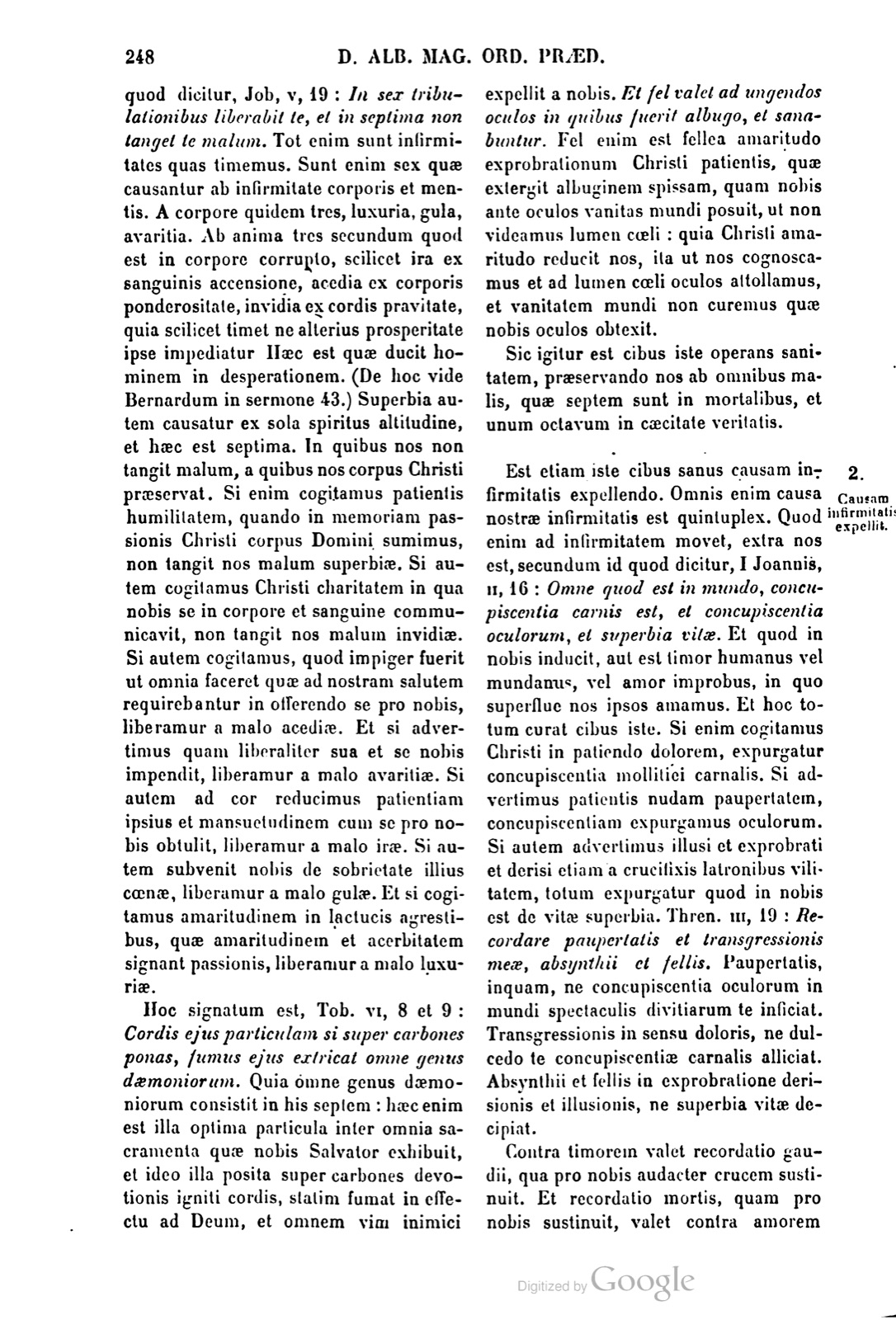
Hoc optime signatum est in Psalmo cvi, 36 et 37: Collocavit illic, hoc est, in terra fructifera, esurientes, et constituerunt civitatem habitationis: et seminaverunt agros, et plantaverunt vineas, et fecerunt fructum nativitatis. Esurientes enim sunt cibum corporis Christi desiderantes, et sitientes sunt qui desiderant sanguinem Christi. Hi constituerunt se per Dei gratiam in hoc loco, ubi est habitatio civitatis Dei, hoc est, in Ecclesia, et ibi semine justitiae seminaverunt agros ab augendo seu agendo dictos, in quibus crescit frumentum panis corporis Christi, et plantaverunt vineas in quibus crescit potus sanguinis Christi: et in his fecerunt fructum dulcissimum gratiae sacramenti quo cibamur, qui dicitur fructus nativitatis, quia ex eisdem et corporaliter et spiritualiter nascimur et nutrimur: gratia enim Christi nascimur, et gratia Christi in sacramento nutrimur. Psal. xxii, 1: Dominus regit me, et nihil mihi deerit, in loco pascuae ibi me collocavit. Ibi enim et substantia spiritualium restituitur, et vigor virtutum perficitur, et revertitur spiritus omnium bonorum. Act. ix, 19: Cum accepisset cibum, confortatus est, ita quod sicut dicitur, III Regum, xix, 8, Elias recreatus est in fortitudine cibi Angelorum panis, totum desertum transiit, et ambulavit usque ad montem in quo Deo est conjunctus. Hinc est quod patriarcha dixit, Genes. xviii, 5: Ponam buccellam panis, et confortate cor vestrum, quod scilicet prius per inediam longae famis erat tabefactum. Genes. xlii, 2: Descendite, et emite nobis cibaria necessaria, ut possimus vivere, et non consumamur inopia. Triticum enim quod ad imperium Joseph venditur in Aegypto, omnes salvat a sterilitate famis. Hoc est triticum corporis Domini, quod a Domino, qui per Joseph significatur, venditur commutatione animae et corporis, et in mundo salvat omnes a famis spiritualis consumptione. Sic igitur restituendo deperditum in substantia et vigore spiritus sanitatem restituit deperditam et reparat vigorem. Genes. xlvii, 12: Et alebat eos, omnemque domum patris sui, praebens cibaria singulis. Sic alit nos Christus, et omnem domum, hoc est, Ecclesiam quae est domus Patris, praebens cibaria singulis in sacramento cibi spiritualis, in quo est medicina perfectae sanitatis, quo omnia restituuntur deperdita per inediam antiquae famis.
This was very well signified in Psalm 106:36 and 37: He placed the hungry there, that is, in the fruitful land, and they established a city of habitation, and they sowed fields and planted vineyards and made the fruit of birth. For the hungry are those desiring the food of Christ's body, and the thirsty are those who desire Christ's blood. These established themselves by the grace of God in this place where the habitation of the city of God is, that is, in the Church, and there by the seed of justice they sowed fields, so called from increasing or acting, in which the wheat of the bread of Christ's body grows, and they planted vineyards in which the drink of Christ's blood grows; and in these they made the sweetest fruit of the grace of the sacrament by which we are fed, which is called the fruit of birth, because from these same things both bodily and spiritually we are born and nourished. For by the grace of Christ we are born, and by the grace of Christ in the sacrament we are nourished. Psalm 22:1: The Lord rules me, and nothing will be lacking to me; in a place of pasture there he has placed me. For there both the substance of spiritual things is restored, and the vigor of virtues is perfected, and the spirit of all goods returns. Acts 9:19: When he had received food, he was strengthened, so that, as is said in 3 Kings 19:8, Elijah, restored in the strength of the food of the bread of angels, passed through the whole desert and walked as far as the mountain where he is joined to God. Hence the patriarch said in Genesis 18:5: I shall set a morsel of bread, and strengthen your heart, which before had wasted away through the hunger of long famine. Genesis 42:2: Go down and buy for us necessary foods, so that we may be able to live and not be consumed by want. For the wheat which is sold in Egypt at the command of Joseph saves all from the barrenness of famine. This is the wheat of the Lord's body, which is sold by the Lord, who is signified through Joseph, in exchange for soul and body, and in the world saves all from the consumption of spiritual famine. Thus therefore by restoring what was lost in the substance and vigor of spirit, it restores lost health and repairs vigor. Genesis 47:12: And he fed them and all the house of his father, providing foods to each. Thus Christ feeds us and the whole house, that is, the Church which is the house of the Father, providing foods to each in the sacrament of spiritual food, in which there is the medicine of perfect health, by which all things lost through the hunger of ancient famine are restored.
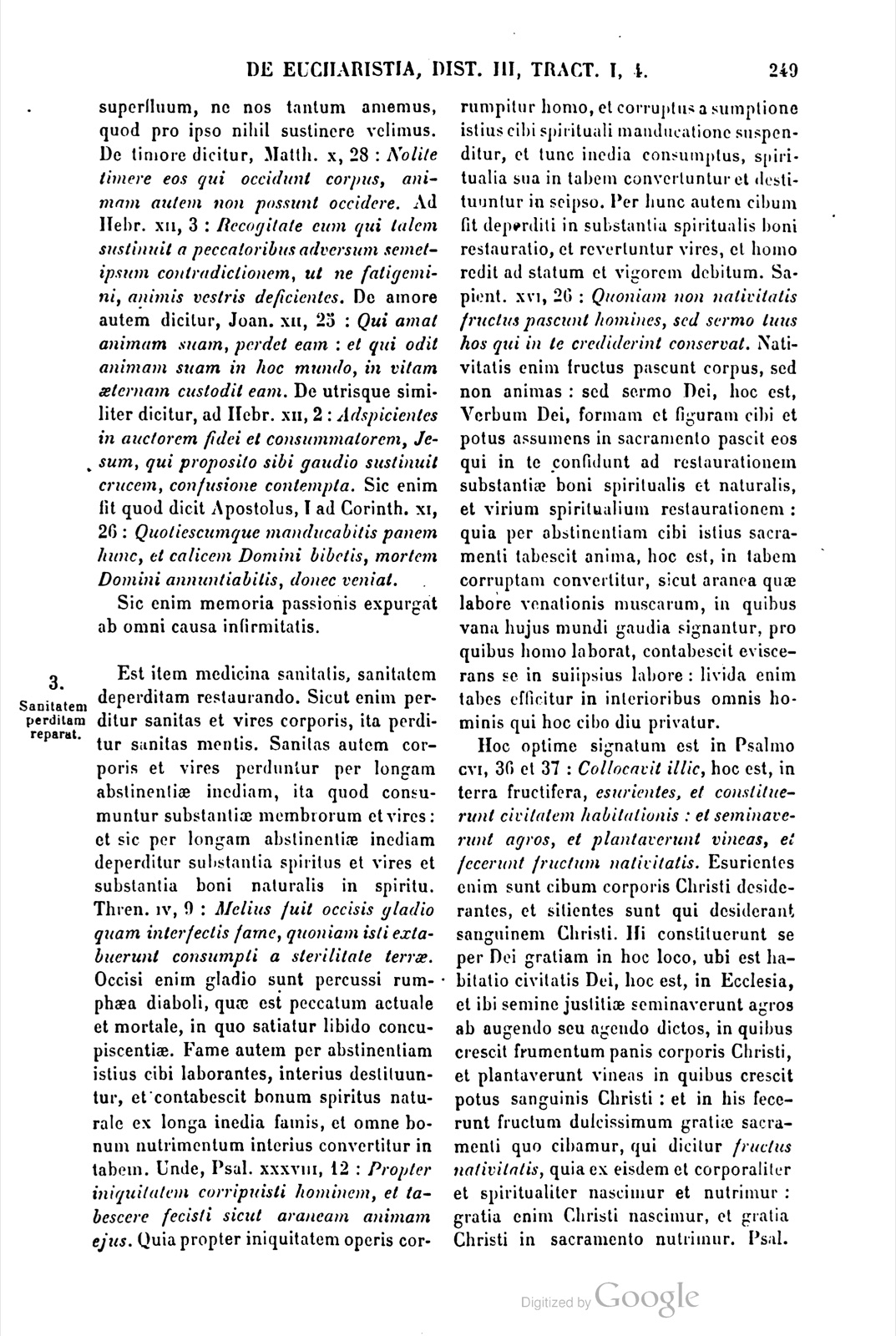
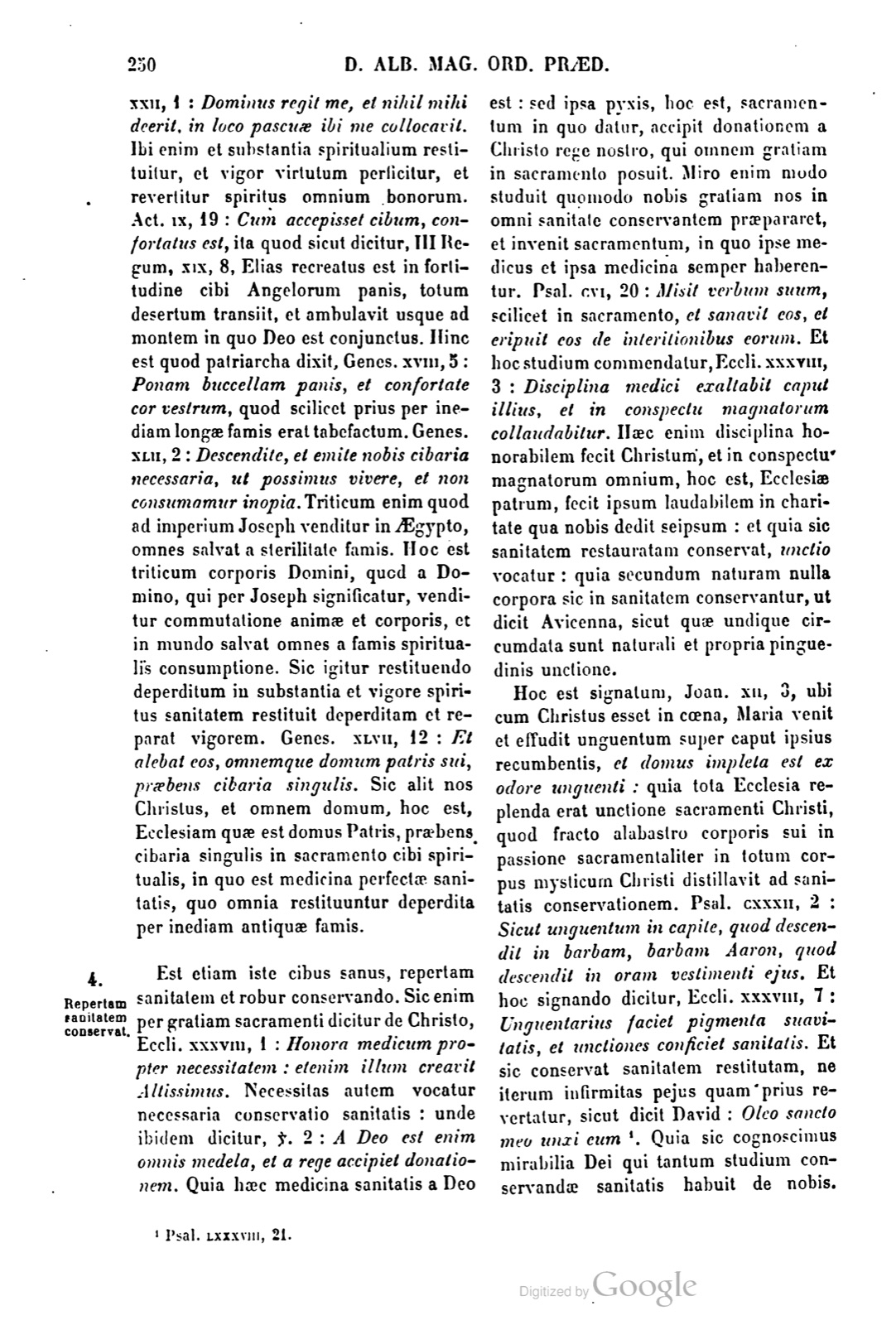
4. Est etiam iste cibus sanus, repertam sanitatem et robur conservando. Sic enim per gratiam sacramenti dicitur de Christo, Eccli. xxxviii, 1: Honora medicum propter necessitatem: etenim illum creavit Altissimus. Necessitas autem vocatur necessaria conservatio sanitatis: unde ibidem dicitur, v. 2: A Deo est enim omnis medela, et a rege accipiet donationem. Quia haec medicina sanitatis a Deo est: sed ipsa pyxis, hoc est, sacramentum in quo datur, accipit donationem a Christo rege nostro, qui omnem gratiam in sacramento posuit. Miro enim modo studuit quomodo nobis gratiam nos in omni sanitate conservantem praepararet, et invenit sacramentum, in quo ipse medicus et ipsa medicina semper haberentur. Psal. cvi, 20: Misit verbum suum, scilicet in sacramento, et sanavit eos, et eripuit eos de interitionibus eorum. Et hoc studium commendatur, Eccli. xxxviii, 3: Disciplina medici exaltabit caput illius, et in conspectu magnatorum collaudabitur. Haec enim disciplina honorabilem fecit Christum, et in conspectu magnatorum omnium, hoc est, Ecclesiae patrum, fecit ipsum laudabilem in charitate qua nobis dedit seipsum: et quia sic sanitatem restauratam conservat, unctio vocatur: quia secundum naturam nulla corpora sic in sanitatem conservantur, ut dicit Avicenna, sicut quae undique circumdata sunt naturali et propria pinguedinis unctione.
Hoc est signatum, Joan. xii, 3, ubi cum Christus esset in coena, Maria venit et effudit unguentum super caput ipsius recumbentis, et domus impleta est ex odore unguenti: quia tota Ecclesia replenda erat unctione sacramenti Christi, quod fracto alabastro corporis sui in passione sacramentaliter in totum corpus mysticum Christi distillavit ad sanitatis conservationem. Psal. cxxxii, 2: Sicut unguentum in capite, quod descendit in barbam, barbam Aaron, quod descendit in oram vestimenti ejus. Et hoc signando dicitur, Eccli. xxxvii, 7: Unguentarius faciet pigmenta suavitatis, et unctiones conficiet sanitatis. Et sic conservat sanitatem restitutam, ne iterum infirmitas pejus quam prius revertatur, sicut dicit David: Oleo sancto meo unxi eum2. Quia sic cognoscimus mirabilia Dei qui tantum studium conservandae sanitatis habuit de nobis.
4. This food is also healthy by preserving the health and strength that have been found again. Thus through the grace of the sacrament it is said of Christ in Ecclesiasticus 38:1: Honor the physician because of necessity, for the Most High created him. But necessity is called the necessary preservation of health; hence in the same place, verse 2, it is said: For every healing is from God, and from the king he will receive a gift. Because this medicine of health is from God, but the pyx itself, that is, the sacrament in which it is given, receives the gift from Christ our king, who placed every grace in the sacrament. In a wonderful way he studied how he might prepare for us the grace preserving us in every health, and he invented the sacrament in which he himself as physician and the medicine itself would always be had. Psalm 106:20: He sent his word, namely in the sacrament, and healed them, and rescued them from their destructions. And this study is commended in Ecclesiasticus 38:3: The discipline of the physician will exalt his head, and in the sight of the great he will be praised. For this discipline made Christ honorable, and in the sight of all the great, that is, of the Church of the fathers, it made him praiseworthy in the charity by which he gave himself to us. And because thus he preserves restored health, it is called anointing, because according to nature no bodies are preserved in health so well, as Avicenna says, as those which on every side are surrounded with the natural and proper anointing of fatness.
This was signified in John 12:3, where, when Christ was at supper, Mary came and poured ointment upon his head as he reclined, and the house was filled from the odor of the ointment, because the whole Church was to be filled by the anointing of the sacrament of Christ, which, when the alabaster of his body was broken in the passion, sacramentally dripped into the whole mystical body of Christ for the preservation of health. Psalm 132:2: Like ointment on the head, which descends into the beard, the beard of Aaron, which descends onto the hem of his garment. And in signifying this Ecclesiasticus 37:7 says: The perfumer will make pigments of sweetness and will compose anointings of health. And thus he preserves restored health, lest infirmity return again worse than before, as David says: With my holy oil I have anointed him2. Because thus we know the wonderful works of God, who had so great a study concerning us for preserving health.
If a page does not appear, its photograph has not been uploaded yet.