Works › The Book on the Sacrament of the Eucharist
Volume 38 · pp. 240–243
Chapter II. On the Sweetness and Taste of This Food.
A marker with ≈ is an approximate page boundary, placed by measure of the text; the page photographs remain the authority. In the paired views, clicking a page marker brings that page into view.
Marginal label (printed p. 240): Sapor dulcedinis valde amabilis ex sanguine.
Marginal label (printed p. 240): Sapor aromaticus omni virtute fragrans ex anima.
Marginal label (printed p. 241): Saporem subtilitatis ex spiritu humano.
Marginal label (printed p. 241): Saporem omnis gratiae ex deitate.
Marginal label (printed p. 241): Saporem coelestem ex unione humanorum suorum cum deitate.
Marginal label (printed p. 242): Eucharistia duos habet sapores in significando, scilicet saporem panis et vini.
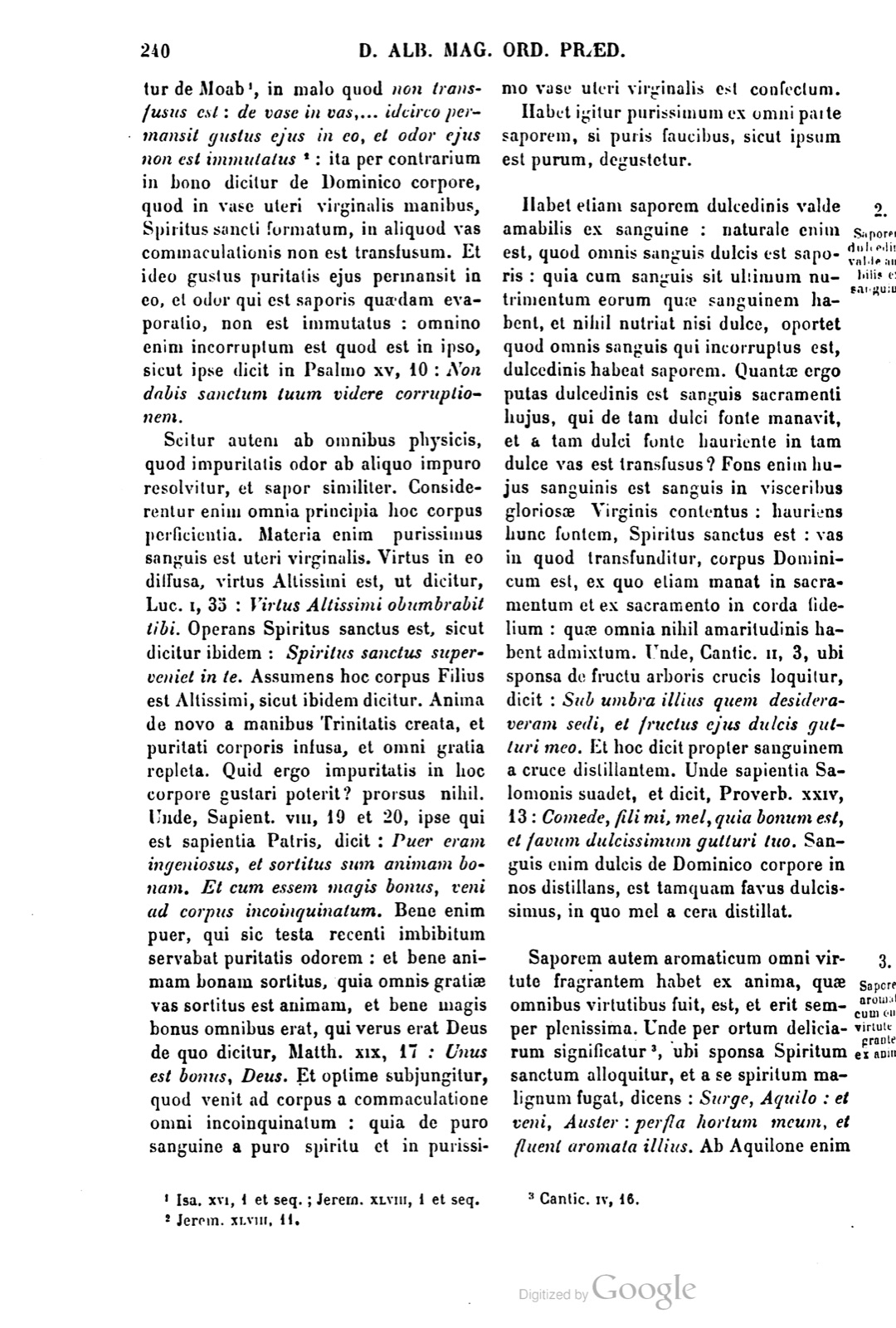
et sicut dicitur de Moab1, in malo quod non transfusus est: de vase in vas, ... idcirco permansit gustus ejus in eo, et odor ejus non est immutatus2: ita per contrarium in bono dicitur de Dominico corpore, quod in vase uteri virginalis manibus Spiritus sancti formatum, in aliquod vas commaculationis non est transfusum. Et ideo gustus puritatis ejus permansit in eo, et odor qui est saporis quaedam evaporatio, non est immutatus: omnino enim incorruptum est quod est in ipso, sicut ipse dicit in Psalmo xv, 10: Non dabis sanctum tuum videre corruptionem.
Scitur autem ab omnibus physicis, quod impuritatis odor ab aliquo impuro resolvitur, et sapor similiter. Considerentur enim omnia principia hoc corpus perficientia. Materia enim purissimus sanguis est uteri virginalis. Virtus in eo diffusa, virtus Altissimi est, ut dicitur, Luc. i, 35: Virtus Altissimi obumbrabit tibi. Operans Spiritus sanctus est, sicut dicitur ibidem: Spiritus sanctus superveniet in te. Assumens hoc corpus Filius est Altissimi, sicut ibidem dicitur. Anima de novo a manibus Trinitatis creata, et puritati corporis infusa, et omni gratia repleta. Quid ergo impuritatis in hoc corpore gustari poterit? prorsus nihil. Unde, Sapient. viii, 19 et 20, ipse qui est sapientia Patris, dicit: Puer eram ingeniosus, et sortitus sum animam bonam. Et cum essem magis bonus, veni ad corpus incoinquinatum. Bene enim puer, qui sic testa recenti imbibitum servabat puritatis odorem: et bene animam bonam sortitus, quia omnis gratiae vas sortitus est animam, et bene magis bonus omnibus erat, qui verus erat Deus de quo dicitur, Matth. xix, 17: Unus est bonus, Deus. Et optime subjungitur, quod venit ad corpus a commaculatione omni incoinquinatum: quia de puro sanguine a puro spiritu et in purissimo vase uteri virginalis est confectum. Habet igitur purissimum ex omni parte saporem, si puris faucibus, sicut ipsum est purum, degustetur.
2. Habet etiam saporem dulcedinis valde amabilis ex sanguine: naturale enim est, quod omnis sanguis dulcis est saporis: quia cum sanguis sit ultimum nutrimentum eorum quae sanguinem habent, et nihil nutriat nisi dulce, oportet quod omnis sanguis qui incorruptus est, dulcedinis habeat saporem. Quantae ergo putas dulcedinis est sanguis sacramenti hujus, qui de tam dulci fonte manavit, et a tam dulci fonte hauriente in tam dulce vas est transfusus? Fons enim hujus sanguinis est sanguis in visceribus gloriosae Virginis contentus: hauriens hunc fontem, Spiritus sanctus est: vas in quod transfunditur, corpus Dominicum est, ex quo etiam manat in sacramentum et ex sacramento in corda fidelium: quae omnia nihil amaritudinis habent admixtum. Unde, Cantic. ii, 3, ubi sponsa de fructu arboris crucis loquitur, dicit: Sub umbra illius quem desideraveram sedi, et fructus ejus dulcis gutturi meo. Et hoc dicit propter sanguinem a cruce distillantem. Unde sapientia Salomonis suadet, et dicit, Proverb. xxiv, 13: Comede, fili mi, mel, quia bonum est, et favum dulcissimum gutturi tuo. Sanguis enim dulcis de Dominico corpore in nos distillans, est tamquam favus dulcissimus, in quo mel a cera distillat.
3. Saporem autem aromaticum omni virtute fragrantem habet ex anima, quae omnibus virtutibus fuit, est, et erit semper plenissima. Unde per ortum deliciarum significatur, ubi sponsa Spiritum sanctum alloquitur, et a se spiritum malignum fugat, dicens: Surge, Aquilo: et veni, Auster: perfla hortum meum, et fluent aromata illius3. Ab Aquilone enim pandetur omne malum, qui est ventus frigidus diabolicae suggestionis, constringens aromata, ne saporem et odorem virtutum effundant. De hoc igitur dicit, quod surgat, hoc est, recedat, et de medio tollatur: quia ille vere omnino repulsus est ab horto verarum deliciarum, quae est anima Christi. Sed, veni, Auster, qui est ventus calidus et humidus, ex calore aperiens, et ex humiditate laxans aromata, et significat Spiritus sancti aspirationem calidam charitate, et devotione humidam, pietatis consolatione resolvens et laxans et spirare faciens hortum istum: ut aromaticus ejus sapor et odor in omnem fluant Ecclesiam, ut omnes hi inebrientur sapore. Unde, ibidem, v. 10, dicitur: Odor unguentorum tuorum super omnia aromata. Sicut autem in antehabitis diximus, odor est indicium saporis, et respiratio quaedam ex sapore facta.
Marginal label (printed p. 240): The flavor of very lovable sweetness from the blood.
Marginal label (printed p. 240): The aromatic flavor, fragrant with every virtue, from the soul.
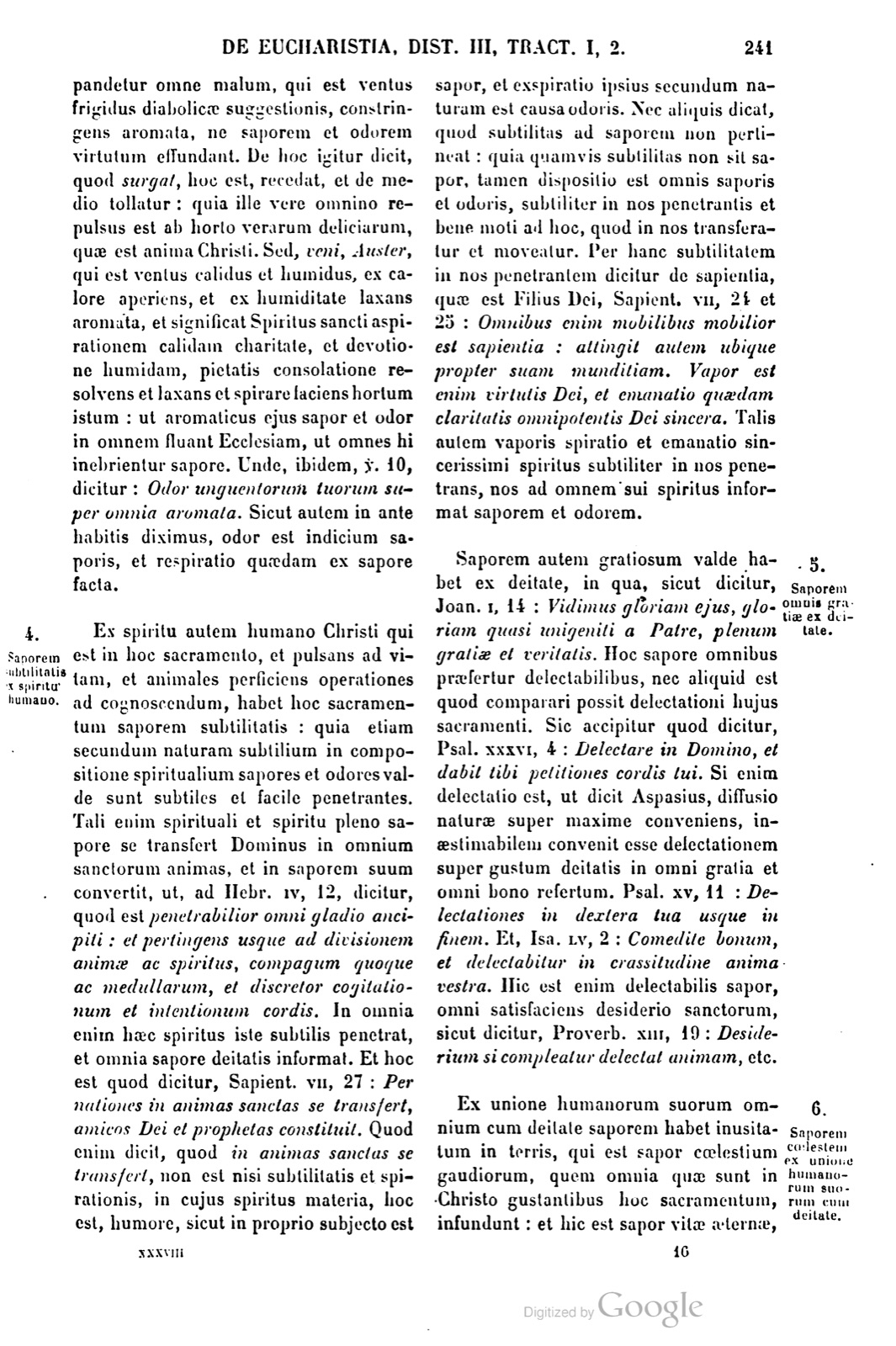
Marginal label (printed p. 241): The flavor of subtlety from the human spirit.
Marginal label (printed p. 241): The flavor of every grace from the deity.
Marginal label (printed p. 241): The heavenly flavor from the union of his human things with deity.
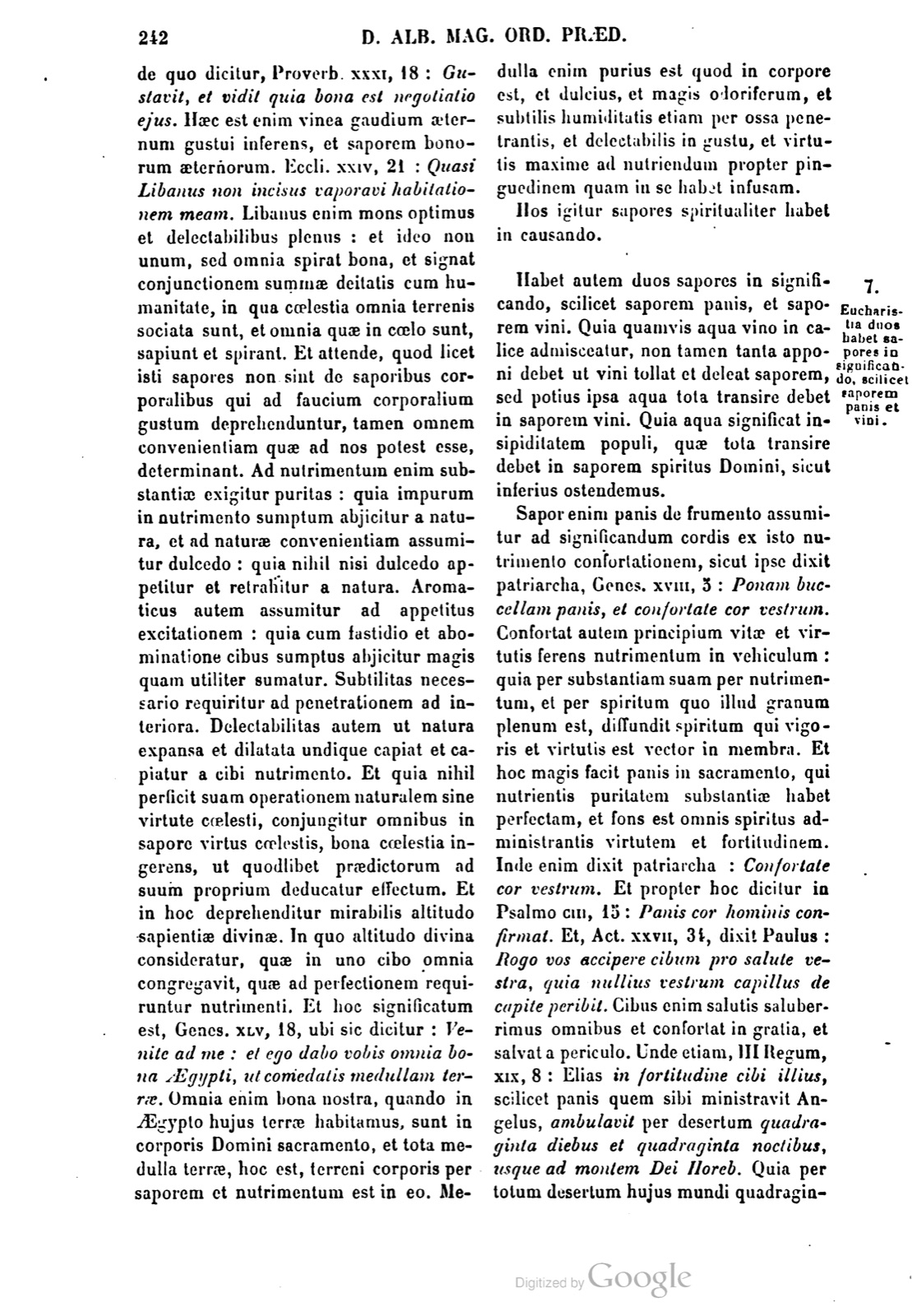
Marginal label (printed p. 242): The Eucharist has two flavors in signifying, namely the flavor of bread and of wine.
and as is said of Moab1, in an evil sense, because he was not poured out from vessel to vessel, therefore his taste remained in him, and his odor was not changed2; so, by contrast in the good sense, it is said of the Lord's body that, formed in the vessel of the virginal womb by the hands of the Holy Spirit, it was not poured out into any vessel of defilement. And therefore the taste of its purity remained in it, and the odor, which is a certain evaporation of taste, was not changed; for what is in him is wholly incorrupt, as he himself says in Psalm 15:10: You will not give your holy one to see corruption.
But it is known by all natural philosophers that the odor of impurity is released from something impure, and taste similarly. For let all the principles perfecting this body be considered. The matter is the most pure blood of the virginal womb. The virtue diffused in it is the virtue of the Most High, as is said in Luke 1:35: The virtue of the Most High will overshadow you. The one working is the Holy Spirit, as is said in the same place: The Holy Spirit will come upon you. The one assuming this body is the Son of the Most High, as is said there. The soul was created anew by the hands of the Trinity, poured into the purity of the body, and filled with every grace. What impurity, therefore, could be tasted in this body? Absolutely none. Hence in Wisdom 8:19 and 20, he who is the wisdom of the Father says: I was an ingenious boy, and I received a good soul. And when I was more good, I came to an undefiled body. For he was well called a boy, who, imbued as with fresh clay, preserved the odor of purity; and he well received a good soul, because he received a soul as the vessel of every grace; and he was well more good than all, who was true God, concerning whom Matthew 19:17 says: One is good, God. And it is most fittingly added that he came to a body undefiled from every defilement, because it was fashioned from pure blood, by a pure spirit, and in the most pure vessel of the virginal womb. Therefore it has a most pure taste on every side, if it is tasted with pure mouths, just as it itself is pure.
2. It also has the taste of very lovable sweetness from the blood. For it is natural that all blood is of sweet taste, because, since blood is the final nourishment of those things which have blood, and nothing nourishes except what is sweet, every blood which is incorrupt must have a taste of sweetness. Therefore of what sweetness do you think is the blood of this sacrament, which flowed from so sweet a fountain and was poured by one drawing from so sweet a fountain into so sweet a vessel? For the fountain of this blood is the blood contained in the inward parts of the glorious Virgin; the one drawing this fountain is the Holy Spirit; the vessel into which it is poured is the Lord's body, from which it also flows into the sacrament and from the sacrament into the hearts of the faithful; all these things have nothing of bitterness mixed in. Hence in Canticles 2:3, where the bride speaks of the fruit of the tree of the cross, she says: Under the shadow of him whom I had desired I sat, and his fruit was sweet to my throat. And she says this because of the blood dripping from the cross. Hence the wisdom of Solomon persuades and says in Proverbs 24:13: Eat honey, my son, because it is good, and the honeycomb most sweet to your throat. For the sweet blood dripping into us from the Lord's body is like a most sweet honeycomb, in which honey drips from the wax.
3. But it has from the soul an aromatic taste fragrant with every virtue, because the soul was, is, and will always be most full of all virtues. Hence it is signified through the garden of delights, where the bride addresses the Holy Spirit and drives the malignant spirit away from herself, saying: Arise, North wind, and come, South wind; blow through my garden, and its spices will flow3. For every evil will be spread from the North, which is the cold wind of diabolical suggestion, binding the spices so that they do not pour forth the taste and odor of virtues. Therefore concerning this she says that it should arise, that is, depart and be taken out of the midst, because that spirit truly has been wholly driven away from the garden of true delights, which is the soul of Christ. But, come, South wind, which is a warm and moist wind, opening by warmth and loosening spices by moisture, and it signifies the breathing of the Holy Spirit, warm with charity and moist with devotion, loosening and relaxing by the consolation of piety and making that garden breathe, so that its aromatic taste and odor may flow into the whole Church, so that all these may be drunk with the taste. Hence, in the same place, verse 10, it is said: The odor of your ointments is above all spices. But as we said in what went before, odor is an indication of taste and a certain breathing made from taste.
4. Ex spiritu autem humano Christi qui est in hoc sacramento, et pulsans ad vitam, et animales perficiens operationes ad cognoscendum, habet hoc sacramentum saporem subtilitatis: quia etiam secundum naturam subtilium in compositione spiritualium sapores et odores valde sunt subtiles et facile penetrantes. Tali enim spirituali et spiritu pleno sapore se transfert Dominus in omnium sanctorum animas, et in saporem suum convertit, ut, ad Hebr. iv, 12, dicitur, quod est penetrabilior omni gladio ancipiti: et pertingens usque ad divisionem animae ac spiritus, compagum quoque ac medullarum, et discretor cogitationum et intentionum cordis. In omnia enim haec spiritus iste subtilis penetrat, et omnia sapore deitatis informat. Et hoc est quod dicitur, Sapient. vii, 27: Per nationes in animas sanctas se transfert, amicos Dei et prophetas constituit. Quod enim dicit, quod in animas sanctas se transfert, non est nisi subtilitatis et spirationis, in cujus spiritus materia, hoc est, humore, sicut in proprio subjecto est sapor, et exspiratio ipsius secundum naturam est causa odoris. Nec aliquis dicat, quod subtilitas ad saporem non pertineat: quia quamvis subtilitas non sit sapor, tamen dispositio est omnis saporis et odoris, subtiliter in nos penetrantis et bene moti ad hoc, quod in nos transferatur et moveatur. Per hanc subtilitatem in nos penetrantem dicitur de sapientia, quae est Filius Dei, Sapient. vii, 24 et 25: Omnibus enim mobilibus mobilior est sapientia: attingit autem ubique propter suam munditiam. Vapor est enim virtutis Dei, et emanatio quaedam claritatis omnipotentis Dei sincera. Talis autem vaporis spiratio et emanatio sincerissimi spiritus subtiliter in nos penetrans, nos ad omnem sui spiritus informat saporem et odorem.
5. Saporem autem gratiosum valde habet ex deitate, in qua, sicut dicitur, Joan. i, 14: Vidimus gloriam ejus, gloriam quasi unigeniti a Patre, plenum gratiae et veritatis. Hoc sapore omnibus praefertur delectabilibus, nec aliquid est quod comparari possit delectationi hujus sacramenti. Sic accipitur quod dicitur, Psal. xxxvi, 4: Delectare in Domino, et dabit tibi petitiones cordis tui. Si enim delectatio est, ut dicit Aspasius, diffusio naturae super maxime conveniens, inaestimabilem convenit esse delectationem super gustum deitatis in omni gratia et omni bono refertum. Psal. xv, 11: Delectationes in dextera tua usque in finem. Et, Isa. lv, 2: Comedite bonum, et delectabitur in crassitudine anima vestra. Hic est enim delectabilis sapor, omni satisfaciens desiderio sanctorum, sicut dicitur, Proverb. xiii, 19: Desiderium si compleatur delectat animam, etc.
4. But from the human spirit of Christ which is in this sacrament, both throbbing toward life and perfecting animal operations for knowing, this sacrament has the taste of subtlety, because even according to the nature of subtle things, in the composition of spiritual things, tastes and odors are very subtle and easily penetrating. For by such a spiritual taste, full of spirit, the Lord transfers himself into the souls of all the saints and converts them into his taste, as Hebrews 4:12 says, that it is more penetrating than every two-edged sword, reaching even to the division of soul and spirit, of joints also and marrow, and discerning thoughts and intentions of the heart. For this subtle spirit penetrates into all these things and forms all things with the taste of deity. And this is what is said in Wisdom 7:27: Through nations she transfers herself into holy souls, she establishes friends of God and prophets. For the statement that she transfers herself into holy souls belongs only to subtlety and breathing; in the matter of this spirit, that is, in its moisture, taste is as in its proper subject, and its exhalation according to nature is the cause of odor. Nor should anyone say that subtlety does not belong to taste, because although subtlety is not taste, nevertheless it is the disposition of every taste and odor penetrating subtly into us and well moved for this, that it may be transferred and moved into us. Through this subtlety penetrating into us it is said concerning wisdom, which is the Son of God, in Wisdom 7:24 and 25: For wisdom is more mobile than all mobile things; she reaches everywhere because of her cleanness. For she is the vapor of the virtue of God and a certain sincere emanation of the brightness of almighty God. But the breathing of such vapor and the emanation of the most sincere spirit, penetrating subtly into us, forms us according to every taste and odor of its own spirit.
5. But it has a very gracious taste from deity, in which, as John 1:14 says: We saw his glory, glory as of the only-begotten from the Father, full of grace and truth. By this taste it is preferred to all delightful things, nor is there anything that can be compared to the delight of this sacrament. Thus what is said in Psalm 36:4 is received: Delight in the Lord, and he will give you the petitions of your heart. For if delight is, as Aspasius says, the diffusion of nature over what is most fitting, the delight over the taste of deity, filled with every grace and every good, must be inestimable. Psalm 15:11: Delights are at your right hand unto the end. And Isaiah 55:2: Eat the good, and your soul will be delighted in fatness. For this is the delightful taste satisfying every desire of the saints, as Proverbs 13:19 says: Desire, if it is fulfilled, delights the soul, and so forth.
6. Ex unione humanorum suorum omnium cum deitate saporem habet inusitatum in terris, qui est sapor coelestium gaudiorum, quem omnia quae sunt in Christo gustantibus hoc sacramentum, infundunt: et hic est sapor vitae aeternae, de quo dicitur, Proverb. xxxi, 18: Gustavit, et vidit quia bona est negotiatio ejus. Haec est enim vinea gaudium aeternum gustui inferens, et saporem bonorum aeternorum. Eccli. xxiv, 21: Quasi Libanus non incisus vaporavi habitationem meam. Libanus enim mons optimus et delectabilibus plenus: et ideo non unum, sed omnia spirat bona, et signat conjunctionem summae deitatis cum humanitate, in qua coelestia omnia terrenis sociata sunt, et omnia quae in caelo sunt, sapiunt et spirant. Et attende, quod licet isti sapores non sint de saporibus corporalibus qui ad faucium corporalium gustum deprehenduntur, tamen omnem convenientiam quae ad nos potest esse, determinant. Ad nutrimentum enim substantiae exigitur puritas: quia impurum in nutrimento sumptum abjicitur a natura, et ad naturae convenientiam assumitur dulcedo: quia nihil nisi dulcedo appetitur et retrahitur a natura. Aromaticus autem assumitur ad appetitus excitationem: quia cum fastidio et abominatione cibus sumptus abjicitur magis quam utiliter sumatur. Subtilitas necessario requiritur ad penetrationem ad interiora. Delectabilitas autem ut natura expansa et dilatata undique capiat et capiatur a cibi nutrimento. Et quia nihil perficit suam operationem naturalem sine virtute coelesti, conjungitur omnibus in sapore virtus coelestis, bona coelestia ingerens, ut quodlibet praedictorum ad suum proprium deducatur effectum. Et in hoc deprehenditur mirabilis altitudo sapientiae divinae. In quo altitudo divina consideratur, quae in uno cibo omnia congregavit, quae ad perfectionem requiruntur nutrimenti. Et hoc significatum est, Genes. xlv, 18, ubi sic dicitur: Venite ad me: et ego dabo vobis omnia bona Aegypti, ut comedatis medullam terrae. Omnia enim bona nostra, quando in Aegypto hujus terrae habitamus, sunt in corporis Domini sacramento, et tota medulla terrae, hoc est, terreni corporis per saporem et nutrimentum est in eo. Medulla enim purius est quod in corpore est, et dulcius, et magis odoriferum, et subtilis humiditatis etiam per ossa penetrantis, et delectabilis in gustu, et virtutis maximae ad nutriendum propter pinguedinem quam in se habet infusam.
Hos igitur sapores spiritualiter habet in causando.
7. Habet autem duos sapores in significando, scilicet saporem panis, et saporem vini. Quia quamvis aqua vino in calice admisceatur, non tamen tanta apponi debet ut vini tollat et deleat saporem, sed potius ipsa aqua tota transire debet in saporem vini. Quia aqua significat insipiditatem populi, quae tota transire debet in saporem spiritus Domini, sicut inferius ostendemus.
Sapor enim panis de frumento assumitur ad significandum cordis ex isto nutrimento confortationem, sicut ipse dixit patriarcha, Genes. xviii, 5: Ponam buccellam panis, et confortate cor vestrum. Confortat autem principium vitae et virtutis ferens nutrimentum in vehiculum: quia per substantiam suam per nutrimentum, et per spiritum quo illud granum plenum est, diffundit spiritum qui vigoris et virtutis est vector in membra. Et hoc magis facit panis in sacramento, qui nutrientis puritatem substantiae habet perfectam, et fons est omnis spiritus administrantis virtutem et fortitudinem. Inde enim dixit patriarcha: Confortate cor vestrum. Et propter hoc dicitur in Psalmo ciii, 15: Panis cor hominis confirmat. Et, Act. xxvii, 34, dixit Paulus: Rogo vos accipere cibum pro salute vestra, quia nullius vestrum capillus de capite peribit. Cibus enim salutis saluberrimus omnibus et confortat in gratia, et salvata periculo. Unde etiam, III Regum, xix, 8: Elias in fortitudine cibi illius, scilicet panis quem sibi ministravit Angelus, ambulavit per desertum quadraginta diebus et quadraginta noctibus, usque ad montem Dei Horeb. Quia per totum desertum hujus mundi quadraginta diebus et quadraginta noctibus poenitentialibus ambulamus, donec ad montem divinae visitationis et visionis veniamus.
6. From the union of all his human things with deity, it has a taste unused on earth, which is the taste of heavenly joys, which all the things that are in Christ pour into those tasting this sacrament; and this is the taste of eternal life, of which Proverbs 31:18 says: She tasted and saw that her commerce is good. For this is the vineyard bringing eternal joy to the taste and the taste of eternal goods. Ecclesiasticus 24:21: Like Lebanon not cut down, I have breathed out my dwelling. For Lebanon is the best mountain and full of delightful things; and therefore it breathes not one good but all goods, and it signifies the conjunction of highest deity with humanity, in which all heavenly things have been joined to earthly things, and all things which are in heaven taste and breathe. And note that although these tastes are not bodily tastes, which are detected by the taste of bodily mouths, nevertheless they determine every fittingness that can belong to us. For purity is required for the nourishment of substance, because what is impure, when taken in nourishment, is rejected by nature; and sweetness is taken for the fittingness of nature, because nothing except sweetness is sought and drawn back by nature. But the aromatic is taken for the excitation of appetite, because food taken with disgust and loathing is rejected rather than usefully received. Subtlety is necessarily required for penetration to the inner things. But delightfulness is required so that nature, expanded and widened, may receive on every side and be received by the nourishment of food. And because nothing perfects its natural operation without heavenly virtue, heavenly virtue is joined to all things in taste, bringing in heavenly goods, so that each of the aforesaid things may be led to its proper effect. And in this the wonderful height of divine wisdom is detected. In this the divine height is considered, which gathered in one food all things required for the perfection of nourishment. And this was signified in Genesis 45:18, where it is said thus: Come to me, and I shall give you all the goods of Egypt, so that you may eat the marrow of the earth. For all our goods, while we dwell in the Egypt of this earth, are in the sacrament of the Lord's body, and the whole marrow of the earth, that is, of the earthly body through taste and nourishment, is in it. For marrow is what is purer in the body, sweeter, more fragrant, and of subtle moisture penetrating even through the bones, delightful in taste, and of greatest virtue for nourishing because of the fatness which it has infused in itself.
Therefore it spiritually has these tastes in causing.
7. But it has two tastes in signifying, namely the taste of bread and the taste of wine. For although water is mixed with wine in the chalice, nevertheless so much should not be added that it removes and destroys the taste of wine, but rather the water itself ought wholly to pass into the taste of wine, because water signifies the tastelessness of the people, which ought wholly to pass into the taste of the spirit of the Lord, as we shall show below.
For the taste of bread from wheat is taken to signify the strengthening of the heart from that nourishment, as the patriarch himself said in Genesis 18:5: I shall set a morsel of bread, and strengthen your heart. But it strengthens the principle of life and virtue, carrying nourishment as into a vehicle, because through its substance by nourishment, and through the spirit with which that grain is full, it diffuses the spirit which is the bearer of vigor and virtue into the members. And bread does this more in the sacrament, which has the perfect purity of the substance of the one nourishing, and is the fountain of every spirit administering virtue and fortitude. For thence the patriarch said: Strengthen your heart. And because of this it is said in Psalm 103:15: Bread strengthens the heart of man. And in Acts 27:34 Paul said: I ask you to take food for your safety, because not a hair of your head will perish. For the food of salvation, most health-giving for all, both strengthens in grace and, being saved, from danger. Hence also in 3 Kings 19:8: Elijah, in the strength of that food, namely the bread which the angel ministered to him, walked through the desert forty days and forty nights, as far as the mountain of God, Horeb. Because through the whole desert of this world we walk with forty penitential days and forty nights until we come to the mountain of divine visitation and vision.
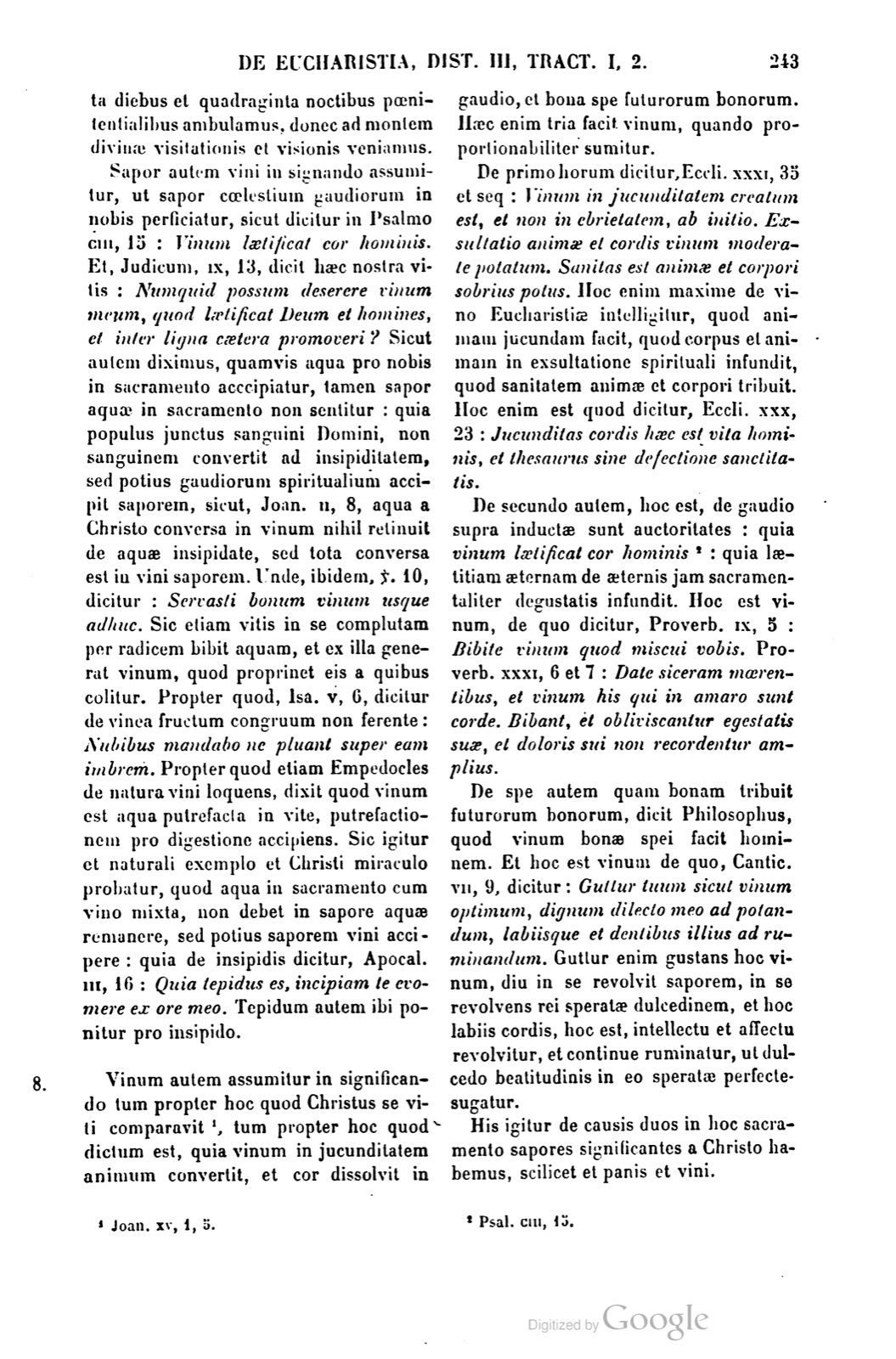
Sapor autem vini in signando assumitur, ut sapor coelestium gaudiorum in nobis perficiatur, sicut dicitur in Psalmo ciii, 15: Vinum laetificat cor hominis4. Et, Judicum, ix, 13, dicit haec nostra vitis: Numquid possum deserere vinum meum, quod laetificat Deum et homines, et inter ligna caetera promoveri? Sicut autem diximus, quamvis aqua pro nobis in sacramento accipiatur, tamen sapor aquae in sacramento non sentitur: quia populus junctus sanguini Domini, non sanguinem convertit ad insipiditatem, sed potius gaudiorum spiritualium accipit saporem, sicut, Joan. ii, 8, aqua a Christo conversa in vinum nihil retinuit de aquae insipidate, sed tota conversa est in vini saporem. Unde, ibidem, v. 10, dicitur: Servasti bonum vinum usque adhuc. Sic etiam vitis in se complutam per radicem bibit aquam, et ex illa generat vinum, quod propinat eis a quibus colitur. Propter quod, Isa. v, 6, dicitur de vinea fructum congruum non ferente: Nubibus mandabo ne pluant super eam imbrem. Propter quod etiam Empedocles de natura vini loquens, dixit quod vinum est aqua putrefacta in vite, putrefactionem pro digestione accipiens. Sic igitur et naturali exemplo et Christi miraculo probatur, quod aqua in sacramento cum vino mixta, non debet in sapore aquae remanere, sed potius saporem vini accipere: quia de insipidis dicitur, Apocal. iii, 16: Quia tepidus es, incipiam te evomere ex ore meo. Tepidum autem ibi ponitur pro insipido.
8. Vinum autem assumitur in significando tum propter hoc quod Christus se viti comparavit5, tum propter hoc quod dictum est, quia vinum in jucunditatem animum convertit, et cor dissolvit in gaudio, et bona spe futurorum bonorum. Haec enim tria facit vinum, quando proportionabiliter sumitur.
De primo horum dicitur, Eccli. xxxi, 35 et seq.: Vinum in jucunditatem creatum est, et non in ebrietatem, ab initio. Exsultatio animae et cordis vinum moderatum sobrie potatum. Sanitas est animae et corpori sobrius potus. Hoc enim maxime de vino Eucharistiae intelligitur, quod animam jucundam facit, quod corpus et animam in exsultatione spirituali infundit, quod sanitatem animae et corpori tribuit. Hoc enim est quod dicitur, Eccli. xxx, 23: Jucunditas cordis haec est vita hominis, et thesaurus sine defectione sanctitatis.
De secundo autem, hoc est, de gaudio supra inductae sunt auctoritates: quia vinum laetificat cor hominis: quia laetitiam aeternam de aeternis jam sacramentaliter degustatis infundit. Hoc est vinum, de quo dicitur, Proverb. ix, 5: Bibite vinum quod miscui vobis. Proverb. xxxi, 6 et 7: Date siceram moerentibus, et vinum his qui in amaro sunt corde. Bibant, et obliviscantur egestatis suae, et doloris sui non recordentur amplius.
De spe autem quam bonam tribuit futurorum bonorum, dicit Philosophus, quod vinum bonae spei facit hominem. Et hoc est vinum de quo, Cantic. vii, 9, dicitur: Guttur tuum sicut vinum optimum, dignum dilecto meo ad potandum, labiisque et dentibus illius ad ruminandum. Guttur enim gustans hoc vinum, diu in se revolvit saporem, in se revolvens rei speratae dulcedinem, et hoc labiis cordis, hoc est, intellectu et affectu revolvitur, et continue ruminatur, ut dulcedo beatitudinis in eo speratae perfecte sugatur.
His igitur de causis duos in hoc sacramento sapores significantes a Christo habemus, scilicet et panis et vini.
But the taste of wine is taken in signifying so that the taste of heavenly joys may be perfected in us, as is said in Psalm 103:15: Wine gladdens the heart of man4. And in Judges 9:13 this vine of ours says: Can I abandon my wine, which gladdens God and men, and be promoted among the other trees? But as we said, although water is received in the sacrament for us, nevertheless the taste of water is not felt in the sacrament, because the people joined to the blood of the Lord does not convert the blood to tastelessness, but rather receives the taste of spiritual joys, just as in John 2:8 the water converted by Christ into wine retained nothing of the tastelessness of water, but was wholly converted into the taste of wine. Hence, in the same place, verse 10, it is said: You have kept the good wine until now. So also the vine drinks into itself through the root the water rained upon it, and from it generates wine, which it pours out for those by whom it is cultivated. On account of this, in Isaiah 5:6 it is said concerning the vineyard not bearing suitable fruit: I shall command the clouds not to rain rain upon it. On account of this also Empedocles, speaking about the nature of wine, said that wine is water putrefied in the vine, taking putrefaction for digestion. Thus therefore both by natural example and by Christ's miracle it is proved that water mixed with wine in the sacrament ought not to remain in the taste of water, but rather to receive the taste of wine, because concerning the tasteless it is said in Apocalypse 3:16: Because you are lukewarm, I shall begin to vomit you from my mouth. But lukewarm is there put for tasteless.
8. But wine is taken in signifying both because Christ compared himself to the vine5, and because of what was said, because wine turns the soul into joy, dissolves the heart in gladness, and gives good hope of future goods. For wine does these three things when it is taken proportionately.
Concerning the first of these Ecclesiasticus 31:35 and following says: Wine was created for joy and not for drunkenness from the beginning. Wine moderately drunk is the exultation of soul and heart. Sober drink is health for soul and body. For this is most of all understood concerning the wine of the Eucharist, which makes the soul joyful, which pours body and soul into spiritual exultation, which bestows health on soul and body. For this is what is said in Ecclesiasticus 30:23: This joyfulness of heart is the life of man and a treasure without defect of holiness.
Concerning the second, that is, concerning gladness, authorities have been introduced above, because wine gladdens the heart of man, because it pours in eternal gladness from eternal things already tasted sacramentally. This is the wine of which Proverbs 9:5 says: Drink the wine which I have mixed for you. Proverbs 31:6 and 7: Give strong drink to the mourning and wine to those who are bitter in heart. Let them drink and forget their want, and let them remember their sorrow no more.
But concerning the hope of future goods which it bestows as good, the Philosopher says that wine makes a man of good hope. And this is the wine of which Canticles 7:9 says: Your throat is like the best wine, worthy for my beloved to drink and for his lips and teeth to ruminate. For the throat tasting this wine rolls the taste within itself for a long time, rolling within itself the sweetness of the hoped-for reality, and this is rolled by the lips of the heart, that is, by intellect and affection, and is continually ruminated, so that the sweetness of the blessedness hoped for in it may be perfectly sucked.
Therefore for these causes we have from Christ two signifying tastes in this sacrament, namely both of bread and of wine.
If a page does not appear, its photograph has not been uploaded yet.