Works › The Book on the Sacrament of the Eucharist
Volume 38 · pp. 235–238
Chapter I. On Manna and Wheat.
A marker with ≈ is an approximate page boundary, placed by measure of the text; the page photographs remain the authority. In the paired views, clicking a page marker brings that page into view.
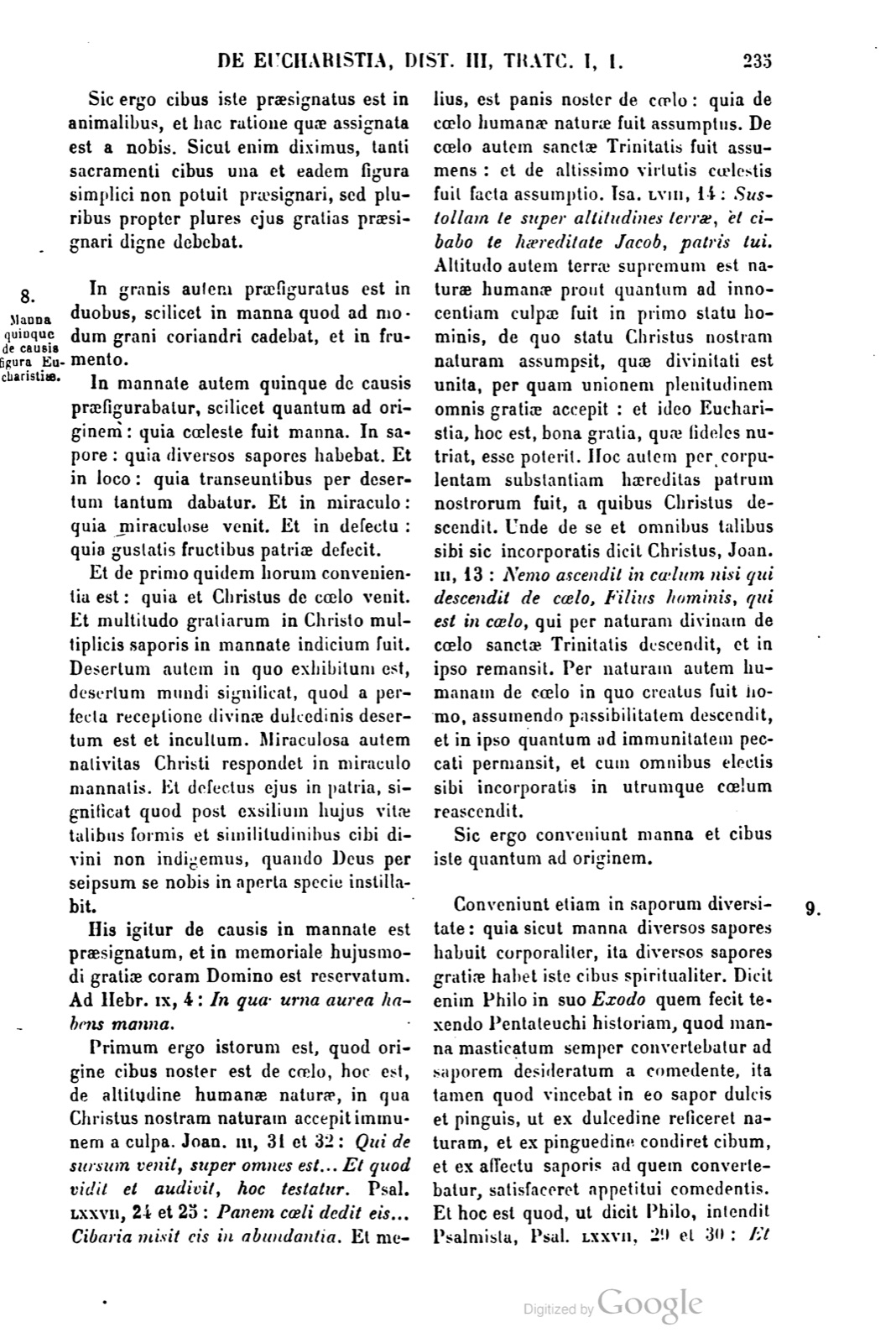
7. In granis autem praefiguratus est in duobus, scilicet in manna quod ad modum grani coriandri cadebat, et in frumento.
8. In mannate autem quinque de causis praefigurabatur, scilicet quantum ad originem: quia coeleste fuit manna. In sapore: quia diversos sapores habebat. Et in loco: quia transeuntibus per desertum tantum dabatur. Et in miraculo: quia miraculose venit. Et in defectu: quia gustatis fructibus patriae defecit.
Et de primo quidem horum convenientia est: quia et Christus de coelo venit. Et multitudo gratiarum in Christo multiplicis saporis in mannate indicium fuit. Desertum autem in quo exhibitum est, desertum mundi significat, quod a perfecta receptione divinae dulcedinis desertum est et incultum. Miraculosa autem nativitas Christi respondet in miraculo mannatis. Et defectus ejus in patria, significat quod post exsilium hujus vitae talibus formis et similitudinibus cibi divini non indigemus, quando Deus per seipsum se nobis in aperta specie instillabit.
His igitur de causis in mannate est praesignatum, et in memoriale hujusmodi gratiae coram Domino est reservatum. Ad Hebr. ix, 4: In qua urna aurea habens manna.
9. Primum ergo istorum est, quod origine cibus noster est de coelo, hoc est, de altitudine humanae naturae, in qua Christus nostram naturam accepit immunem a culpa. Joan. iii, 31 et 32: Qui de sursum venit, super omnes est... Et quod vidit et audivit, hoc testatur. Psal. lxxvii, 24 et 25: Panem caeli dedit eis... Cibaria misit eis in abundantia. Et melius, est panis noster de coelo: quia de coelo humanae naturae fuit assumptus. De coelo autem sanctae Trinitatis fuit assumens: et de altissimo virtutis coelestis fuit facta assumptio. Isa. lviii, 14: Sustollam te super altitudines terrae, et cibabo te haereditate Jacob, patris tui. Altitudo autem terrae supremum est naturae humanae prout quantum ad innocentiam culpae fuit in primo statu hominis, de quo statu Christus nostram naturam assumpsit, quae divinitati est unita, per quam unionem plenitudinem omnis gratiae accepit: et ideo Eucharistia, hoc est, bona gratia, quae fideles nutriat, esse poterit. Hoc autem per corpulentam substantiam haereditas patrum nostrorum fuit, a quibus Christus descendit. Unde de se et omnibus talibus sibi sic incorporatis dicit Christus, Joan. iii, 13: Nemo ascendit in caelum nisi qui descendit de caelo, Filius hominis, qui est in caelo, qui per naturam divinam de coelo sanctae Trinitatis descendit, et in ipso remansit. Per naturam autem humanam de coelo in quo creatus fuit homo, assumendo passibilitatem descendit, et in ipso quantum ad immunitatem peccati permansit, et cum omnibus electis sibi incorporatis in utrumque coelum reascendit.
Sic ergo conveniunt manna et cibus iste quantum ad originem.
Conveniunt etiam in saporum diversitate: quia sicut manna diversos sapores habuit corporaliter, ita diversos sapores gratiae habet iste cibus spiritualiter. Dicit enim Philo in suo Exodo quem fecit texendo Pentateuchi historiam, quod manna masticatum semper convertebatur ad saporem desideratum a comedente, ita tamen quod vincebat in eo sapor dulcis et pinguis, ut ex dulcedine reficeret naturam, et ex pinguedine condiret cibum, et ex affectu saporis ad quem convertebatur, satisfaceret appetitui comedentis. Et hoc est quod, ut dicit Philo, intendit Psalmista, Psal. lxxvii, 29 et 30: Et manducaverunt, et saturati sunt nimis: et desiderium eorum attulit eis, scilicet Dominus. Non sunt fraudati a desiderio suo: quia ex dulcedine attulit saturitatem, ex pinguedine demulsit gustum, et ex desiderato sapore attulit desiderium. Sapient. xvi, 20: Paratum panem de coelo praestitisti eis sine labore, omne delectamentum in se habentem, et omnis saporis suavitatem. Et paulo post, v. 21: Et deserviens uniuscujusque voluntati, ad quod quisque volebat convertebatur. Ita etiam spiritualiter panis noster quem ad aram devotamus, omnium vas est gratiarum, omnem saporem gratiae exhibens, et praeter haec dulcedinem divinae naturae et pinguedinem devotionis ad nos gustu exhibet spirituali. Et sicut aures diversorum verba Dei audientium diversas in verbo inveniunt pro uniuscujusque facultate illuminationes, ita fauces diversorum hunc cibum gustantium, diversas gratiarum inveniunt refectiones. Job, xii, 11: Nonne auris verba dijudicat, et fauces comedentis saporem? Quasi diceret: Dummodo fauces aliena amaritudine non sint infecti. Infirmis enim omnia amara videntur, sicut dicit Philosophus: quia cholerica et fellea amaritudo palatum inficit febricitantium. Et sic infirmi ex amaritudine peccati non dijudicant verum saporem hujus cibi. Act. viii, 23: In felle amaritudinis, et obligatione iniquitatis, video te esse. Hoc significatum est, Exod. xxix, 41 et 42, ubi de agno offerendo Domino in vespera Dominus dicit sic, quod juxta ea quae diximus, in odorem suavitatis sacrificium est, Domino oblatione perpetua. Dicunt autem hi qui eruditi sunt in naturalibus, quod odor sequela est saporis, nec potest esse odor suavissimus nisi saporis suavissimi: nec hoc esset in oblatione perpetua in omnes generationes, nisi unusquisque saporem spiritus quem quaerit, in agno isto inveniret. Hinc est quod dicitur, Cantic. iv, 10: Odor unguentorum tuorum super omnia aromata. Quia omnis unctionis et pinguedinis gratia est in Eucharistia contra omnem infirmitatem et omnem refectionem sapor omnia vincens aromata.
7. But in grains it was prefigured in two, namely in manna, which fell in the manner of coriander seed, and in wheat.
8. But in manna it was prefigured for five causes, namely with respect to origin, because the manna was heavenly; in taste, because it had diverse tastes; and in place, because it was given only to those passing through the desert; and in miracle, because it came miraculously; and in defect, because, when the fruits of the fatherland had been tasted, it failed.
And concerning the first of these there is fittingness because Christ also came from heaven. And the multitude of graces in Christ was an indication in the manna of manifold taste. But the desert in which it was offered signifies the desert of the world, which is deserted and uncultivated from the perfect reception of divine sweetness. But the miraculous nativity of Christ answers to the miracle of the manna. And its failing in the fatherland signifies that after the exile of this life we do not need such forms and likenesses of divine food, when God through himself will instill himself into us in open species.
Therefore for these causes he is prefigured in manna, and for a memorial of grace of this sort the manna was reserved before the Lord. Hebrews 9:4: In which was the golden urn having manna.
9. Therefore the first of these is that by origin our food is from heaven, that is, from the height of human nature, in which Christ received our nature immune from fault. John 3:31 and 32: He who comes from above is above all... And what he has seen and heard, this he testifies. Psalm 77:24 and 25: He gave them the bread of heaven... He sent them foods in abundance. And better, our bread is from heaven, because he was taken from the heaven of human nature. But he was the one assuming from the heaven of the holy Trinity, and the assumption was made from the highest point of heavenly virtue. Isaiah 58:14: I shall lift you above the heights of the earth, and I shall feed you with the inheritance of Jacob your father. But the height of the earth is the summit of human nature insofar as, with respect to innocence from fault, it was in the first state of man; from that state Christ assumed our nature, which is united to deity; through that union it received the fullness of every grace, and therefore it could be Eucharist, that is, good grace, which nourishes the faithful. But this, through corpulent substance, was the inheritance of our fathers, from whom Christ descended. Hence concerning himself and all such persons thus incorporated into him, Christ says in John 3:13: No one ascends into heaven except he who descended from heaven, the Son of man, who is in heaven; through the divine nature he descended from the heaven of the holy Trinity and remained in it. But through the human nature he descended from the heaven in which man was created, by assuming passibility, and remained in it with respect to immunity from sin, and with all the elect incorporated into himself he reascended into each heaven.
Thus therefore manna and this food agree with respect to origin.
They also agree in diversity of tastes, because just as manna had diverse tastes bodily, so this food has diverse tastes of grace spiritually. For Philo says in his Exodus which he made by weaving together the history of the Pentateuch, that manna when chewed was always converted to the taste desired by the one eating, in such a way however that a sweet and fat taste prevailed in it, so that from sweetness it refreshed nature, and from fatness it seasoned the food, and from the affection for the taste into which it was converted it satisfied the appetite of the one eating. And this is what, as Philo says, the Psalmist intends in Psalm 77:29 and 30: And they ate, and were greatly filled; and he brought them their desire, namely the Lord did. They were not defrauded of their desire, because from sweetness he brought fullness, from fatness he soothed the taste, and from the desired taste he brought desire. Wisdom 16:20: You furnished them prepared bread from heaven without labor, having every delight in itself and the sweetness of every taste. And a little after, verse 21: And serving the will of each one, it was turned to what each one wished. So also spiritually our bread which we devote at the altar is the vessel of all graces, offering every taste of grace, and besides these things it offers to us, by spiritual taste, the sweetness of the divine nature and the fatness of devotion. And just as the ears of different persons hearing the words of God find in the word different illuminations according to the capacity of each, so the mouths of different persons tasting this food find different refreshments of graces. Job 12:11: Does not the ear judge words, and the mouth of the one eating judge taste? As if he were saying: Provided that the mouths are not infected by alien bitterness. For all things seem bitter to the sick, as the Philosopher says, because choleric and bilious bitterness infects the palate of those fevering. And thus those sick from the bitterness of sin do not judge the true taste of this food. Acts 8:23: I see that you are in the gall of bitterness and the bond of iniquity. This was signified in Exodus 29:41 and 42, where concerning the lamb to be offered to the Lord in the evening the Lord says thus, that according to those things which we have said, it is a sacrifice for an odor of sweetness, a perpetual oblation to the Lord. But those who are learned in natural things say that odor is the consequence of taste, nor can there be a most sweet odor except from a most sweet taste; nor would this be in a perpetual oblation for all generations unless each one found in that lamb the taste of the spirit which he seeks. Hence Canticles 4:10 says: The odor of your ointments is above all spices. Because the grace of every anointing and fatness is in the Eucharist against every infirmity, and the taste that overcomes all spices is for every refreshment.
Sic igitur convenientia est eucharistialis cibi et mannatis in diversitate saporis.
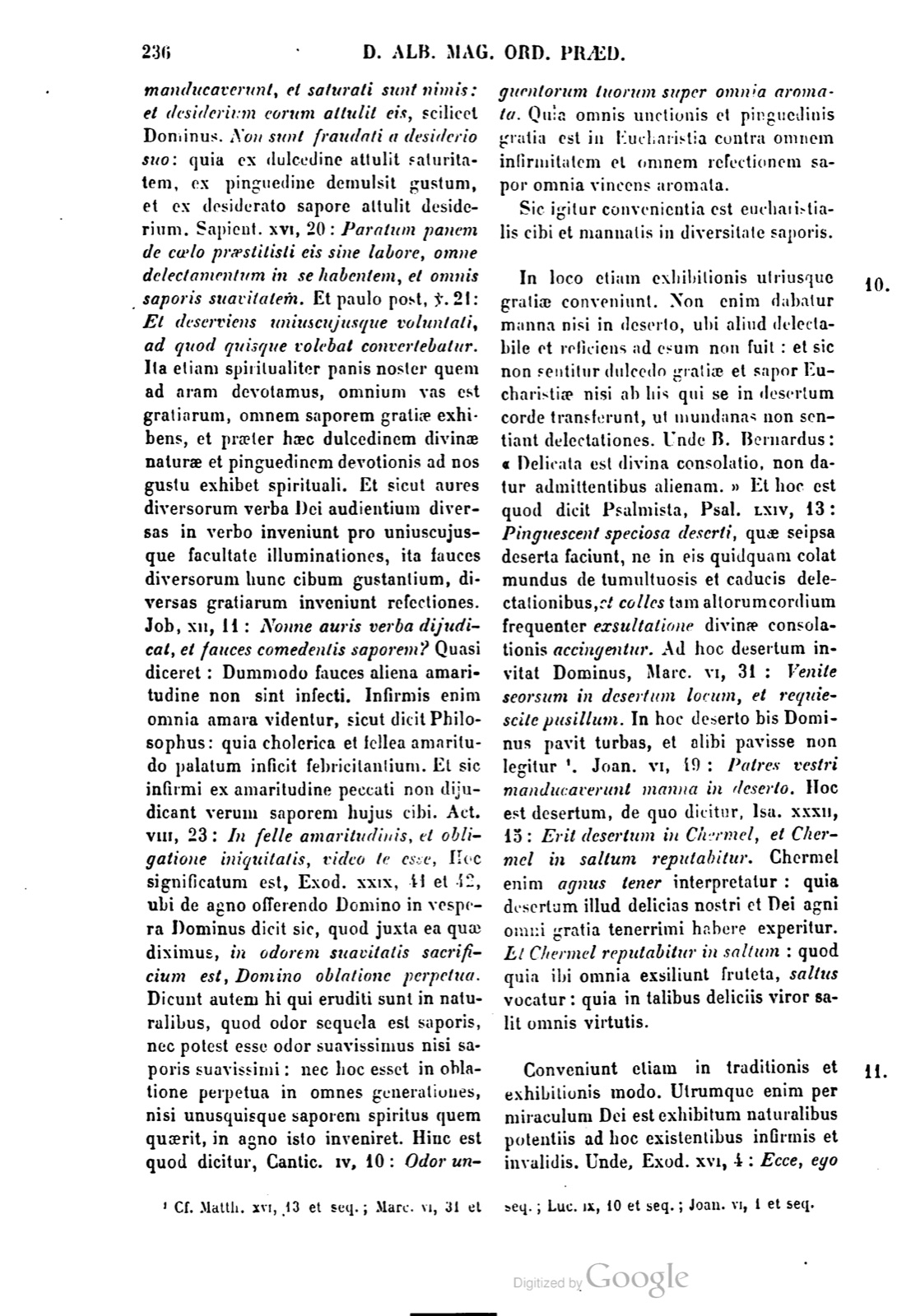
10. In loco etiam exhibitionis utriusque gratiae conveniunt. Non enim dabatur manna nisi in deserto, ubi aliud delectabile et reficiens ad esum non fuit: et sic non sentitur dulcedo gratiae et sapor Eucharistiae nisi ab his qui se in desertum corde transferunt, ut mundanas non sentiant delectationes. Unde B. Bernardus: Delicata est divina consolatio, non datur admittentibus alienam. Et hoc est quod dicit Psalmista, Psal. lxiv, 13: Pinguescent speciosa deserti, quae seipsa deserta faciunt, ne in eis quidquam colat mundus de tumultuosis et caducis delectationibus, et colles tam altorum cordium frequenter exsultatione divinae consolationis accingentur. Ad hoc desertum invitat Dominus, Marc. vi, 31: Venite seorsum in desertum locum, et requiescite pusillum. In hoc deserto bis Dominus pavit turbas, et alibi pavisse non legitur1. Joan. vi, 49: Patres vestri manducaverunt manna in deserto. Hoc est desertum, de quo dicitur, Isa. xxxii, 15: Erit desertum in Chermel, et Chermel in saltum reputabitur. Chermel enim agnus tener interpretatur: quia desertum illud delicias nostri et Dei agni omni gratia tenerrimi habere experitur. Et Chermel reputabitur in saltum: quod quia ibi omnia exsiliunt fruteta, saltus vocatur: quia in talibus deliciis viror salit omnis virtutis.
11. Conveniunt etiam in traditionis et exhibitionis modo. Utrumque enim per miraculum Dei est exhibitum naturalibus potentiis ad hoc existentibus infirmis et invalidis. Unde, Exod. xvi, 4: Ecce, ego pluam vobis panes de caelo: egrediatur populus, et colligat quae sufficiunt per singulos dies. Psal. lxxvii, 23 et 24: Januas caeli aperuit, scilicet Dominus: et pluit illis manna ad manducandum. Sic etiam Filius Dei sua voluntate et verbo cibum nobis Eucharisticae ministravit. Joan. vi, 52: Panis quem ego dabo, caro mea est. Ac si dicat: Ego dabo et non alius: quia non nisi Deus hunc cibum mannatis gloriosum saporem in se contentae divinitatis habentem poterit dare. Unde Christus hunc cibum praeferens mannati, et ostendens quod nec illum nec istum dare potuit nisi solus Deus, dicit, Joan. vi, 32 et 33: Amen, amen dico vobis, non Moyses dedit vobis panem de caelo, sed Pater meus dat vobis panem de caelo verum. Panis enim Dei est, qui de caelo descendit, et dat vitam mundo. Ille enim panis quem Moyses a Deo oratione impetravit, et non de thesauris suis dedit, sed Dominus non ad vitam aeternam sumentes eum vegetavit, quamvis de coelo descenderit: sed iste panis qui sicut ille descendit, quem sicut illum non de thesauris humanis, sed de divinis suis promptuariis Pater coelestis protulit, in hoc verus est, quia refectos ad se vegetat ad vitam aeternam, et ita uterque miraculo bonitatis Dei est exhibitus. Et in hoc verum est quod dicit Psalmista novum miraculum veteri conformans, Psal. cx, 4 et 5: Memoriam fecit mirabilium suorum, misericors et miserator Dominus. Escam dedit timentibus se. Quia ne inferiores reputaremur antiquis patribus, qui Angelorum esca nutriti sunt, quinimo ut superiores in infinitum reputaremur, Dominum Angelorum nobis paravit in escam. Joan. vi, 27: Operamini non cibum qui perit, sed qui permanet in vitam aeternam, quem Filius hominis dabit vobis. De quo pane post pauca, v. 34, quidam ignorantes verum, dixerunt: Domine, semper da nobis panem hunc. De quo etiam Dominus exponens subdit, v. 35: Ego sum panis vitae: qui venit ad me non esuriet. Patet igitur, quod uterque ab ipsa Dei dulcedine per miraculum est administratus. Dicit enim Joannes Chrysostomus, quod id per miraculum fit, quod sola fit Dei voluntate, nulla potentia naturae cooperante.
Thus therefore there is a fittingness of the eucharistic food and of manna in diversity of taste.
10. They also agree in the place of the offering of each grace. For manna was not given except in the desert, where there was no other delightful and refreshing thing for eating; and so the sweetness of grace and the taste of the Eucharist is not felt except by those who transfer themselves in heart into the desert, so that they do not feel worldly delights. Hence Blessed Bernard says: Divine consolation is delicate; it is not given to those admitting an alien one. And this is what the Psalmist says in Psalm 64:13: The beautiful places of the desert will grow fat, namely those which make themselves deserted, lest the world cultivate anything in them from tumultuous and falling delights, and the hills of such high hearts will frequently be girded with the exultation of divine consolation. The Lord invites to this desert in Mark 6:31: Come apart into a desert place and rest a little. In this desert the Lord twice fed the crowds, and he is not read to have fed them elsewhere1. John 6:49: Your fathers ate manna in the desert. This is the desert concerning which Isaiah 32:15 says: The desert will be in Carmel, and Carmel will be reputed as a forest. For Carmel is interpreted tender lamb, because that desert is experienced as having the delights of our and God's lamb, most tender with every grace. And Carmel will be reputed as a forest, because since there all thickets leap up, it is called a forest, because in such delights the greenness of every virtue leaps.
11. They also agree in the mode of handing over and offering. For each was offered through the miracle of God, with natural powers existing weak and invalid for this. Hence Exodus 16:4: Behold, I shall rain breads from heaven for you; let the people go out and gather what suffices for each day. Psalm 77:23 and 24: He opened the gates of heaven, namely the Lord did, and rained manna upon them to eat. So also the Son of God by his will and word ministered eucharistic food to us. John 6:52: The bread which I shall give is my flesh. As if he were saying: I shall give, and no other, because no one except God will be able to give this food, having in itself the glorious taste of the deity contained in the manna. Hence Christ, preferring this food to the manna and showing that neither that one nor this one could be given except by God alone, says in John 6:32 and 33: Amen, amen I say to you, Moses did not give you bread from heaven, but my Father gives you the true bread from heaven. For the bread of God is he who descends from heaven and gives life to the world. For that bread which Moses obtained from God by prayer and did not give from his own treasures, but the Lord, did not enliven those taking it unto eternal life, although it descended from heaven; but this bread, which descended like that one, which the heavenly Father brought forth, like that one, not from human treasures but from his divine storerooms, is true in this, because it enlivens those refreshed unto himself for eternal life. And thus each was offered by the miracle of the goodness of God. And in this what the Psalmist says is true, conforming the new miracle to the old, Psalm 110:4 and 5: The merciful and compassionate Lord has made a memorial of his wonderful works. He has given food to those who fear him. Because, lest we be considered lower than the ancient fathers who were nourished by the food of angels, indeed rather so that we might be considered infinitely higher, he prepared the Lord of angels for us as food. John 6:27: Work not for the food which perishes, but for that which remains unto eternal life, which the Son of man will give you. Concerning this bread a little later, verse 34, certain men ignorant of the truth said: Lord, always give us this bread. Concerning this also the Lord, explaining, adds, verse 35: I am the bread of life; he who comes to me will not hunger. Therefore it is clear that each was administered by the very sweetness of God through a miracle. For John Chrysostom says that that is done through a miracle which is done by the will of God alone, with no power of nature cooperating.
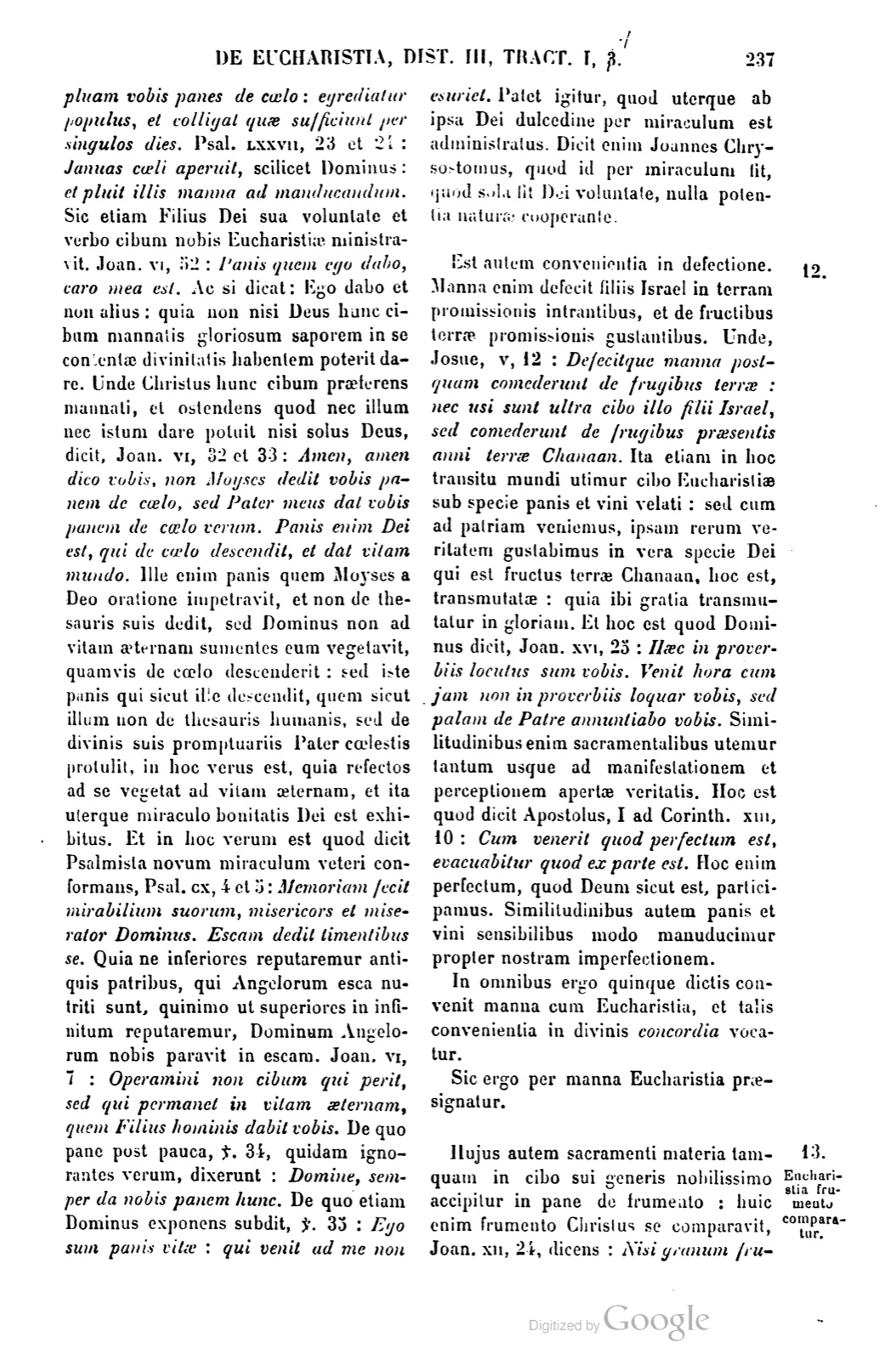
12. Est autem convenientia in defectione. Manna enim defecit filiis Israel in terram promissionis intrantibus, et de fructibus terrae promissionis gustantibus. Unde, Josue, v, 12: Defecitque manna postquam comederunt de frugibus terrae: nec usi sunt ultra cibo illo filii Israel, sed comederunt de frugibus praesentis anni terrae Chanaan. Ita etiam in hoc transitu mundi utimur cibo Eucharistiae sub specie panis et vini velati: sed cum ad patriam veniemus, ipsam rerum veritatem gustabimus in vera specie Dei qui est fructus terrae Chanaan, hoc est, transmutatae: quia ibi gratia transmutatur in gloriam. Et hoc est quod Dominus dicit, Joan. xvi, 25: Haec in proverbiis locutus sum vobis. Venit hora cum jam non in proverbiis loquar vobis, sed palam de Patre annuntiabo vobis. Similitudinibus enim sacramentalibus utemur tantum usque ad manifestationem et perceptionem apertae veritatis. Hoc est quod dicit Apostolus, I ad Corinth. xiii, 10: Cum venerit quod perfectum est, evacuabitur quod ex parte est. Hoc enim perfectum, quod Deum sicut est, participamus. Similitudinibus autem panis et vini sensibilibus modo manuducimur propter nostram imperfectionem.
In omnibus ergo quinque dictis convenit manna cum Eucharistia, et talis convenientia in divinis concordia vocatur.
Sic ergo per manna Eucharistia praesignatur.
13. Hujus autem sacramenti materia tamquam in cibo sui generis nobilissimo accipitur in pane de frumento: huic enim frumento Christus se comparavit, Joan. xii, 24, dicens: Nisi granum frumenti cadens in terram mortuum fuerit, ipsum solum manet.
In granis enim quatuor considerantur, scilicet color, figura, quantitas, et puritas substantiae, si debeant esse nobilia. Haec autem omnia in grano frumenti inveniuntur.
12. But there is fittingness in the failing. For the manna failed for the sons of Israel as they entered the land of promise and tasted the fruits of the land of promise. Hence Joshua 5:12: And the manna failed after they ate of the fruits of the land; nor did the sons of Israel use that food any longer, but they ate of the fruits of the present year of the land of Canaan. So also in this passage of the world we use the food of the Eucharist under the veiled species of bread and wine; but when we come to the fatherland, we shall taste the very truth of things in the true species of God, who is the fruit of the land of Canaan, that is, of the transmuted land, because there grace is transmuted into glory. And this is what the Lord says in John 16:25: These things I have spoken to you in proverbs. The hour comes when I shall no longer speak to you in proverbs, but I shall announce openly to you concerning the Father. For we shall use sacramental likenesses only until the manifestation and perception of open truth. This is what the Apostle says in 1 Corinthians 13:10: When that which is perfect has come, that which is in part will be emptied out. For this is perfect, that we participate in God as he is. But now we are led by the hand by sensible likenesses of bread and wine because of our imperfection.
Therefore in all the five things said, manna agrees with the Eucharist, and such fittingness in divine things is called concord.
Thus therefore the Eucharist is prefigured through manna.
13. But the matter of this sacrament, as in the noblest food of its genus, is taken in bread from wheat; for Christ compared himself to this wheat, saying in John 12:24: Unless the grain of wheat falling into the earth has died, it remains alone.
For in grains four things are considered, namely color, figure, quantity, and purity of substance, if they ought to be noble. But all these things are found in the grain of wheat.
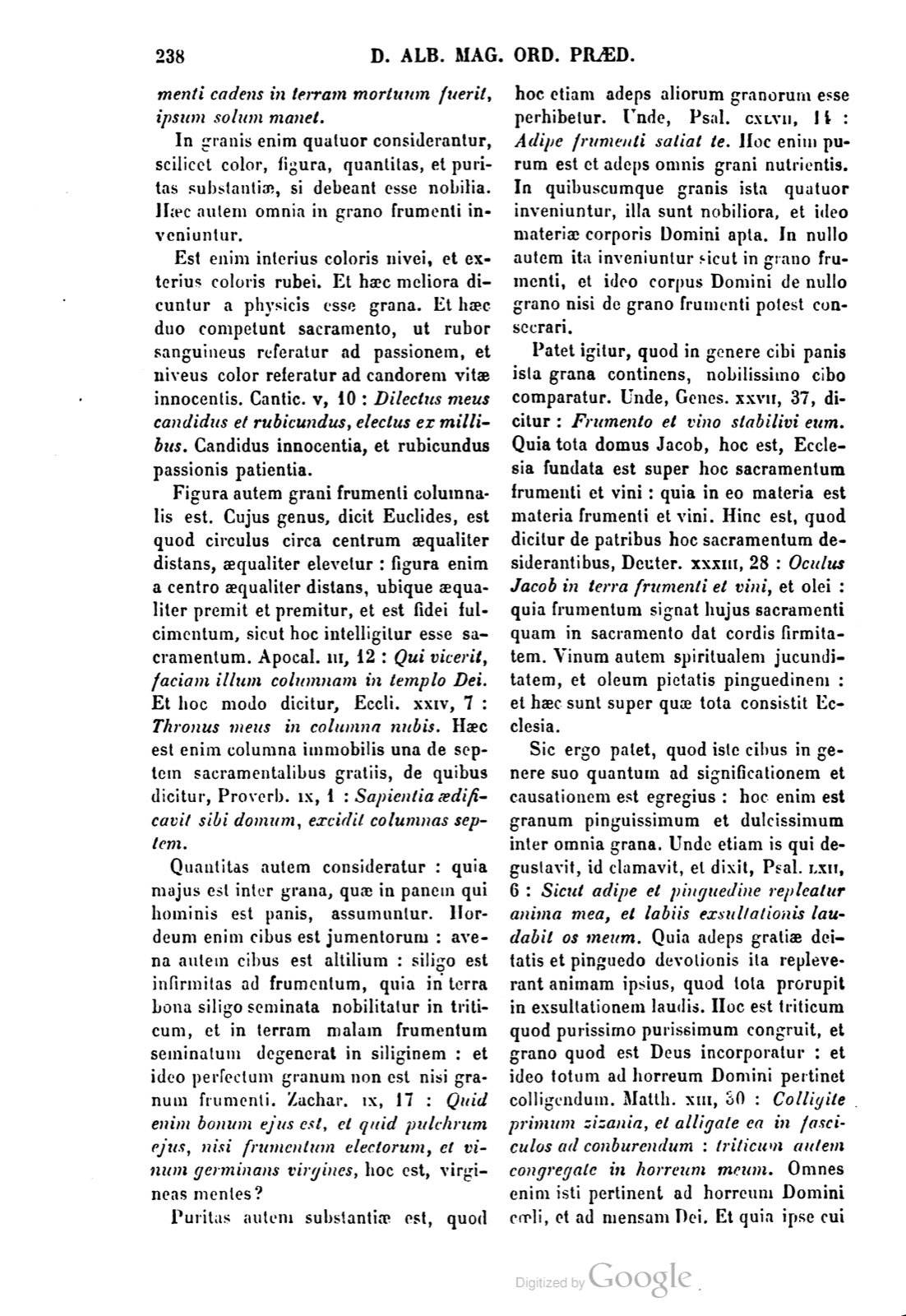
Est enim interius coloris nivei, et exterius coloris rubei. Et haec meliora dicuntur a physicis esse grana. Et haec duo competunt sacramento, ut rubor sanguineus referatur ad passionem, et niveus color referatur ad candorem vitae innocentis. Cantic. v, 10: Dilectus meus candidus et rubicundus, electus ex millibus. Candidus innocentia, et rubicundus passionis patientia.
Figura autem grani frumenti columnalis est. Cujus genus, dicit Euclides, est quod circulus circa centrum aequaliter distans, aequaliter elevetur: figura enim a centro aequaliter distans, ubique aequaliter premit et premitur, et est fidei fulcimentum, sicut hoc intelligitur esse sacramentum. Apocal. iii, 12: Qui vicerit, faciam illum columnam in templo Dei. Et hoc modo dicitur, Eccli. xxiv, 7: Thronus meus in columna nubis. Haec est enim columna immobilis una de septem sacramentalibus gratiis, de quibus dicitur, Proverb. ix, 1: Sapientia aedificavit sibi domum, excidit columnas septem.
Quantitas autem consideratur: quia majus est inter grana, quae in panem qui hominis est panis, assumuntur. Hordeum enim cibus est jumentorum: avena autem cibus est altilium: siligo est infirmitas ad frumentum, quia in terra bona siligo seminata nobilitatur in triticum, et in terram malam frumentum seminatum degenerat in siliginem: et ideo perfectum granum non est nisi granum frumenti. Zachar. ix, 17: Quid enim bonum ejus est, et quid pulchrum ejus, nisi frumentum electorum, et vinum germinans virgines, hoc est, virgineas mentes?
Puritas autem substantiae est, quod hoc etiam adeps aliorum granorum esse perhibetur. Unde, Psal. cxlvii, 14: Adipe frumenti satiat te. Hoc enim purum est et adeps omnis grani nutrientis. In quibuscumque granis ista quatuor inveniuntur, illa sunt nobiliora, et ideo materiae corporis Domini apta. In nullo autem ita inveniuntur sicut in grano frumenti, et ideo corpus Domini de nullo grano nisi de grano frumenti potest consecrari.
Patet igitur, quod in genere cibi panis ista grana continens, nobilissimo cibo comparatur. Unde, Genes. xxvii, 37, dicitur: Frumento et vino stabilivi eum. Quia tota domus Jacob, hoc est, Ecclesia fundata est super hoc sacramentum frumenti et vini: quia in eo materia est materia frumenti et vini. Hinc est, quod dicitur de patribus hoc sacramentum desiderantibus, Deuter. xxxiii, 28: Oculus Jacob in terra frumenti et vini, et olei: quia frumentum signat hujus sacramenti quam in sacramento dat cordis firmitatem. Vinum autem spiritualem jucunditatem, et oleum pietatis pinguedinem: et haec sunt super quae tota consistit Ecclesia.
Sic ergo patet, quod iste cibus in genere suo quantum ad significationem et causationem est egregius: hoc enim est granum pinguissimum et dulcissimum inter omnia grana. Unde etiam is qui degustavit, id clamavit, et dixit, Psal. lxii, 6: Sicut adipe et pinguedine repleatur anima mea, et labiis exsultationis laudabit os meum. Quia adeps gratiae deitatis et pinguedo devotionis ita repleverant animam ipsius, quod tota prorupit in exsultationem laudis. Hoc est triticum quod purissimo purissimum congruit, et grano quod est Deus incorporatur: et ideo totum ad horreum Domini pertinet colligendum. Matth. xiii, 30: Colligite primum zizania, et alligate ea in fasciculos ad conburendum: triticum autem congregate in horreum meum. Omnes enim isti pertinent ad horreum Domini coeli, et ad mensam Dei. Et quia ipse cui
For it is snowy in color within and red in color without. And these are said by the natural philosophers to be the better grains. And these two things belong to the sacrament, so that the blood-red color may be referred to the passion, and the snowy color may be referred to the whiteness of innocent life. Canticles 5:10: My beloved is white and ruddy, chosen from thousands. White in innocence, and ruddy in the patience of passion.
But the figure of a grain of wheat is columnar. Its genus, Euclid says, is that a circle equally distant around a center is equally raised; for a figure equally distant from the center presses and is pressed equally everywhere, and it is a support of faith, as this sacrament is understood to be. Apocalypse 3:12: He who conquers, I shall make him a pillar in the temple of God. And in this way Ecclesiasticus 24:7 says: My throne is in a pillar of cloud. For this is one immovable pillar of the seven sacramental graces, concerning which Proverbs 9:1 says: Wisdom has built herself a house; she has cut out seven pillars.
But quantity is considered because it is greater among the grains which are taken for bread that is the bread of man. For barley is the food of beasts of burden; oats are the food of fattened birds; rye is weakness in relation to wheat, because rye sown in good earth is ennobled into wheat, and wheat sown into bad earth degenerates into rye. And therefore there is no perfect grain except the grain of wheat. Zechariah 9:17: For what is his good, and what is his beautiful thing, except the wheat of the elect and wine germinating virgins, that is, virginal minds?
But the purity of substance is that this is also said to be the fat of the other grains. Hence Psalm 147:14: He satisfies you with the fat of wheat. For this is pure and the fat of every nourishing grain. In whatever grains those four things are found, those are more noble and therefore fit for the matter of the body of the Lord. But they are not found thus in any grain as in the grain of wheat, and therefore the body of the Lord can be consecrated from no grain except from the grain of wheat.
Therefore it is clear that in the genus of food bread containing these grains is compared to the noblest food. Hence Genesis 27:37 says: I have established him with wheat and wine. Because the whole house of Jacob, that is, the Church, is founded upon this sacrament of wheat and wine, because in it the matter is the matter of wheat and wine. Hence it is said concerning the fathers desiring this sacrament, Deuteronomy 33:28: The eye of Jacob is in a land of wheat and wine and oil, because wheat signifies the firmness of heart of this sacrament which it gives in the sacrament. But wine signifies spiritual joy, and oil the fatness of piety; and these are the things upon which the whole Church stands.
Thus therefore it is clear that this food in its genus, with respect to signification and causation, is outstanding, for this is the fattest and sweetest grain among all grains. Hence also he who tasted it cried out this and said in Psalm 62:6: Let my soul be filled as with fat and fatness, and my mouth will praise with lips of exultation. Because the fat of the grace of deity and the fatness of devotion had so filled his soul that the whole of it broke forth into the exultation of praise. This is the wheat which, most pure, agrees with the most pure, and is incorporated with the grain which is God; and therefore all of it belongs to be gathered into the barn of the Lord. Matthew 13:30: Gather first the darnel, and bind it in bundles for burning; but gather the wheat into my barn. For all these belong to the barn of the Lord of heaven and to the table of God. And because he himself to whom
Notes
- Compare Matthew 14:13 and following; Mark 6:31 and following; Luke 9:10 and following; John 6:1 and following. (Cf. Matth. xiv, 13 et seq.; Marc. vi, 31 et seq.; Luc. ix, 10 et seq.; Joan. vi, 1 et seq.) ↩
If a page does not appear, its photograph has not been uploaded yet.