Works › The Book on the Sacrament of the Eucharist
Volume 38 · pp. 220–222
Tractate II. On the Property of the Gift. Chapters I-II.
A marker with ≈ is an approximate page boundary, placed by measure of the text; the page photographs remain the authority. In the paired views, clicking a page marker brings that page into view.
Tractatus II. De proprietate doni.
Caput I. De doni nobilitate.
In ipso autem dono sacramenti hujus quatuor notanda esse occurrunt, scilicet doni nobilitas, doni sufficientissima copiositas, et doni utilitas, et quarto, doni hujus ad donantem conformitas.
Propter quod semper etiam memoria habetur in dono, et de nobilitate est pretiositas et electio doni: quia nobile pretiosum est et electum. Hoc est enim illud donum de quo dicitur, Sapient. iii, 14: Dabitur enim illi fidei donum electum, et sors in templo Domini acceptissima. Quamvis enim multa sint fidei dona, tamen hoc donum prae omnibus fidei donum est, in quo tanta sunt fidei fundamenta: quia in hoc dono et fides Christi fundatur, et fideles sanctificantur: et ideo ex omnibus est donum electum, et magnum fidei sacramentum, quo donatum est fidelibus. Et est istud donum tota sors fidelium acceptissima, in qua omnes acceptantur in templo Domini, in quo donum offertur, et ad cujus oblationem totum Ecclesiae templum sanctificatur, dicente Patre ad Filium, Isa. lvi, 7: Holocausta eorum et victimae eorum placebunt mihi super altari meo1: quia in hoc dono omnia alia munera fiunt accepta, in quo Filius offertur Patri, et in Filio nobis sic dato omnes nos ipsi dono communicantes acceptantur, dicente, Isa. lx, 7: Offerentur super placabili altari meo, et donum majestatis meae glorificabo. Hoc enim bono nobili pretioso et electo tota domus divinae majestatis et exaltatur et glorificatur. Propter quod, Aggai, ii, 10, dicitur: Magna erit gloria domus hujus novissimae plusquam primae. Quia nullum tale donum in aurato templo synagogae fuit, quantum est istud donum in domo templi Dei fidelibus donatum. Unde, I Petri, i, 18 et 19, dicitur: Non corruptibilibus auro vel argento redempti estis de vana vestra conversatione paternae traditionis, sed pretioso sanguine quasi agni immaculati Christi, et incontaminati. Quod tractans Joannes Chrysostomus in Originali super Joannem, xii, dicit: Sicut homo auro servos emit, et servos quos honorare vult, mundat et ornat: ita Dominus noster nos et sanguine mundavit et ornavit. Et Ambrosius in libro de Virginitate loquens de sancta Agnete, dixit: Ab alio amatore praeventa sum: quia mihi satis meliora te obtulit ornamenta: jam corpus ejus corpori meo sociatum est, et sanguis ejus ornavit genas meas. Hic est enim de quo dicitur, Cantic. v, 10, quod est candidus et rubicundus, electus ex millibus. Est donum istud in candore cibi immaculati confecti ex adipe candidissimi frumenti, et rubore pretiosi sanguinis ex uva sui corporis expressum. Unde, Genes. xlix, 11, secundum translationem Septuaginta, legitur: Lavit vino stolam suam, et in sanguine uvae et olivae pallium suum2. Hoc ergo est donum, quod nobilitate suae pretiositatis est ex omnibus electum.
Tractate II. On the property of the gift.
Chapter I. On the nobility of the gift.
In the gift itself of this sacrament four things occur as needing to be noted, namely the nobility of the gift, the most sufficient copiousness of the gift, the usefulness of the gift, and fourth, the conformity of this gift to the giver.
On account of this, memory also is always had in the gift; and from nobility come the preciousness and election of the gift, because what is noble is precious and chosen. For this is that gift concerning which Wisdom 3:14 says: For to him shall be given the chosen gift of faith, and a most acceptable lot in the temple of the Lord. For although there are many gifts of faith, nevertheless this gift before all others is the gift of faith, in which there are so many foundations of faith, because in this gift both the faith of Christ is founded and the faithful are sanctified. And therefore from all gifts it is the chosen gift, and the great sacrament of faith by which it has been given to the faithful. And that gift is the whole most acceptable lot of the faithful, in which all are accepted in the temple of the Lord, in which the gift is offered, and at whose oblation the whole temple of the Church is sanctified, the Father saying to the Son in Isaiah 56:7: Their holocausts and their victims will please me upon my altar1, because in this gift all other presents are made acceptable, in which the Son is offered to the Father, and in the Son thus given to us all of us communicating in the gift itself are accepted, as Isaiah 60:7 says: They shall be offered upon my placable altar, and I shall glorify the gift of my majesty. For by this noble, precious, and chosen good the whole house of divine majesty is both exalted and glorified. On account of this Haggai 2:10 says: Great will be the glory of this last house more than of the first. Because no such gift was in the gilded temple of the synagogue as is this gift given to the faithful in the house of the temple of God. Hence 1 Peter 1:18 and 19 says: You have been redeemed not by corruptible gold or silver from the vain conversation of your paternal tradition, but by the precious blood, as of an immaculate and undefiled lamb, Christ. Treating this, John Chrysostom says in the Original on John 12: Just as a man buys slaves with gold and cleanses and adorns the slaves whom he wishes to honor, so our Lord cleansed and adorned us also with blood. And Ambrose, in the book On Virginity, speaking of Saint Agnes, said: I have been anticipated by another lover, because he offered me ornaments much better than you; already his body has been joined to my body, and his blood has adorned my cheeks. For this is he concerning whom Canticles 5:10 says that he is white and ruddy, chosen from thousands. That gift is in the whiteness of immaculate food made from the fat of the whitest grain, and in the redness of the precious blood pressed from the grape of his body. Hence in Genesis 49:11, according to the translation of the Septuagint, it is read: He washed his robe with wine, and his cloak in the blood of the grape and olive2. This therefore is the gift which by the nobility of its preciousness has been chosen from all.
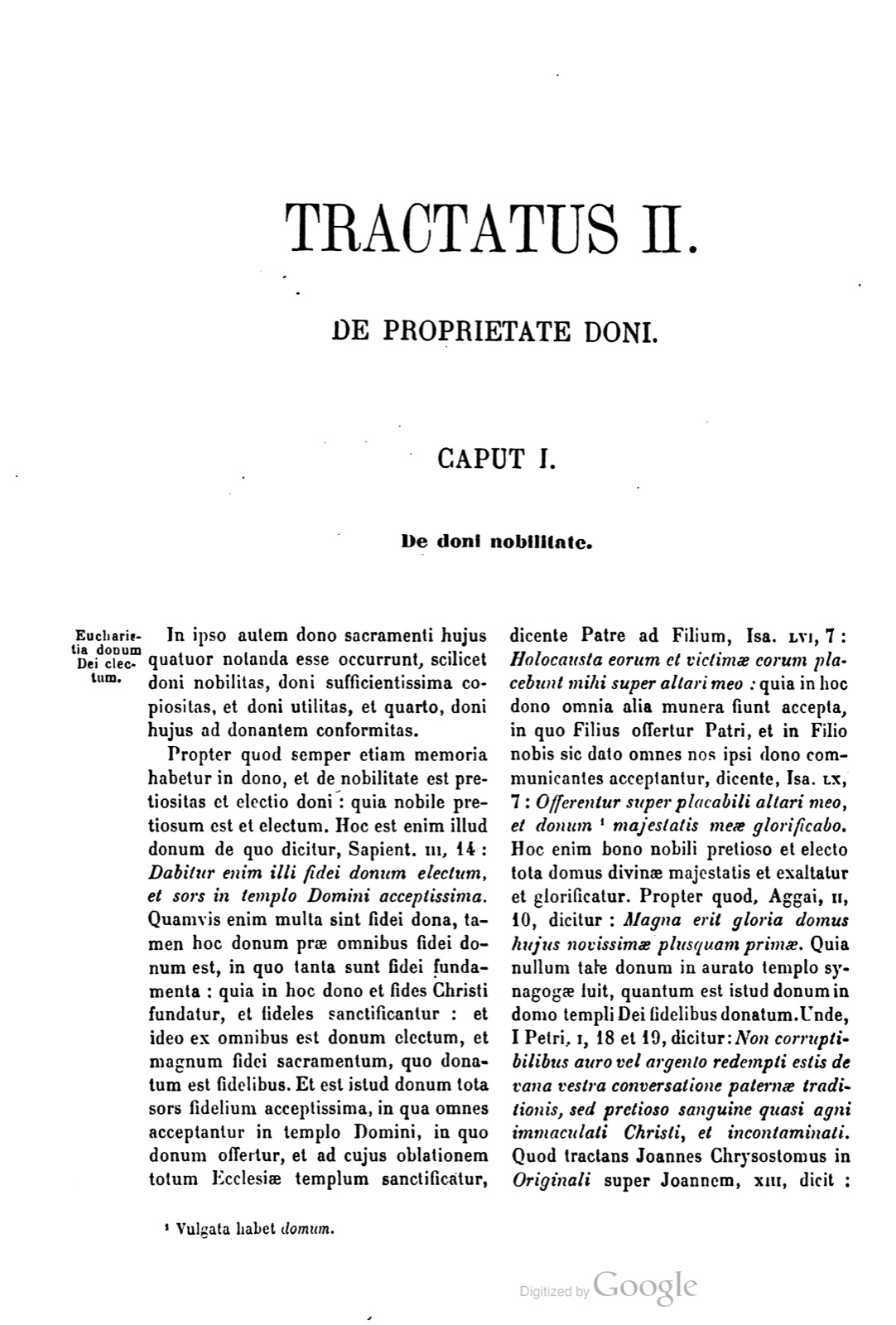
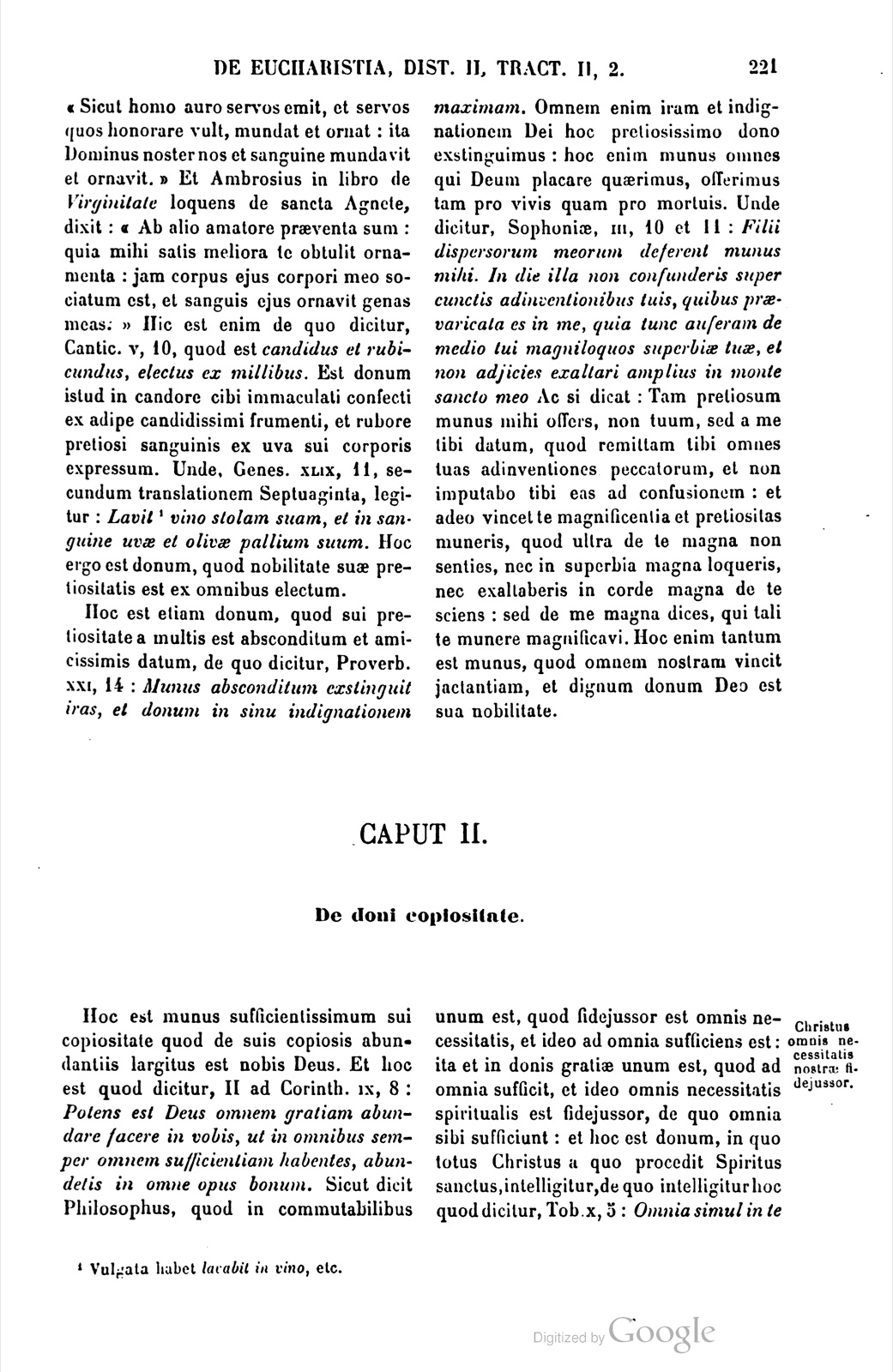
Hoc est etiam donum, quod sui pretiositate a multis est absconditum et amicissimis datum, de quo dicitur, Proverb. xxi, 14: Munus absconditum exstinguit iras, et donum in sinu indignationem maximam. Omnem enim iram et indignationem Dei hoc pretiosissimo dono exstinguimus: hoc enim munus omnes qui Deum placare quaerimus, offerimus tam pro vivis quam pro mortuis. Unde dicitur, Sophoniae, iii, 10 et 11: Filii dispersorum meorum deferent munus mihi. In die illa non confunderis super cunctis adinventionibus tuis, quibus praevaricata es in me, quia tunc auferam de medio tui magniloquos superbiae tuae, et non adjicies exaltari amplius in monte sancto meo. Ac si dicat: Tam pretiosum munus mihi offers, non tuum, sed a me tibi datum, quod remittam tibi omnes tuas adinventiones peccatorum, et non imputabo tibi eas ad confusionem: et adeo vincet te magnificentia et pretiositas muneris, quod ultra de te magna non senties, nec in superbia magna loqueris, nec exaltaberis in corde magna de te sciens: sed de me magna dices, qui tali te munere magnificavi. Hoc enim tantum est munus, quod omnem nostram vincit jactantiam, et dignum donum Deo est sua nobilitate.
Caput II. De doni copiositate.
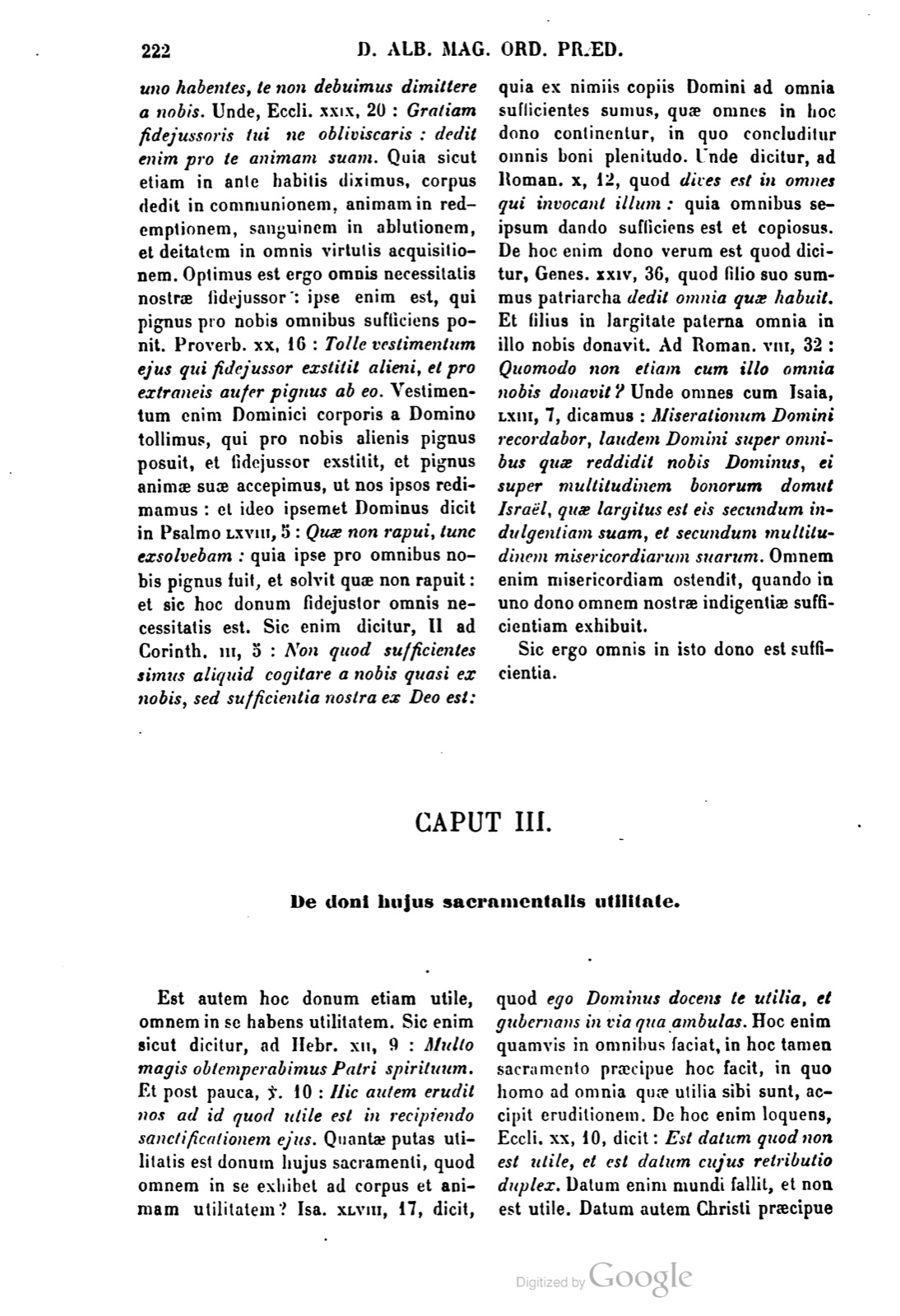
Hoc est munus sufficientissimum sui copiositate quod de suis copiosis abundantiis largitus est nobis Deus. Et hoc est quod dicitur, II ad Corinth. ix, 8: Potens est Deus omnem gratiam abundare facere in vobis, ut in omnibus semper omnem sufficientiam habentes, abundetis in omne opus bonum. Sicut dicit Philosophus, quod in commutabilibus unum est, quod fidejussor est omnis necessitatis, et ideo ad omnia sufficiens est: ita et in donis gratiae unum est, quod ad omnia sufficit, et ideo omnis necessitatis spiritualis est fidejussor, de quo omnia sibi sufficiunt: et hoc est donum, in quo totus Christus a quo procedit Spiritus sanctus, intelligitur, de quo intelligitur hoc quod dicitur, Tob. x, 5: Omnia simul in te uno habentes, te non debuimus dimittere a nobis. Unde, Eccli. xxx, 20: Gratiam fidejussoris tui ne obliviscaris: dedit enim pro te animam suam. Quia sicut etiam in ante habitis diximus, corpus dedit in communionem, animam in redemptionem, sanguinem in ablutionem, et deitatem in omnis virtutis acquisitionem. Optimus est ergo omnis necessitatis nostrae fidejussor: ipse enim est, qui pignus pro nobis omnibus sufficiens ponit. Proverb. xx, 16: Tolle vestimentum ejus qui fidejussor exstitit alieni, et pro extraneis aufer pignus ab eo. Vestimentum enim Dominici corporis a Domino tollimus, qui pro nobis alienis pignus posuit, et fidejussor exstitit, et pignus animae suae accepimus, ut nos ipsos redimamus: et ideo ipsemet Dominus dicit in Psalmo lxviii, 5: Quae non rapui, tunc exsolvebam: quia ipse pro omnibus nobis pignus fuit, et solvit quae non rapuit: et sic hoc donum fidejussor omnis necessitatis est. Sic enim dicitur, II ad Corinth. iii, 5: Non quod sufficientes simus aliquid cogitare a nobis quasi ex nobis, sed sufficientia nostra ex Deo est: quia ex nimiis copiis Domini ad omnia sufficientes sumus, quae omnes in hoc dono continentur, in quo concluditur omnis boni plenitudo. Unde dicitur, ad Roman. x, 12, quod dives est in omnes qui invocant illum: quia omnibus seipsum dando sufficiens est et copiosus. De hoc enim dono verum est quod dicitur, Genes. xxiv, 36, quod filio suo summus patriarcha dedit omnia quae habuit. Et filius in largitate paterna omnia in illo nobis donavit. Ad Roman. viii, 32: Quomodo non etiam cum illo omnia nobis donavit? Unde omnes cum Isaia, lxiii, 7, dicamus: Miserationum Domini recordabor, laudem Domini super omnibus quae reddidit nobis Dominus, et super multitudinem bonorum domui Israel, quae largitus est eis secundum indulgentiam suam, et secundum multitudinem misericordiarum suarum. Omnem enim misericordiam ostendit, quando in uno dono omnem nostrae indigentiae sufficientiam exhibuit.
This is also the gift which by its preciousness is hidden from many and given to the dearest friends, concerning which Proverbs 21:14 says: A hidden present extinguishes angers, and a gift in the bosom the greatest indignation. For by this most precious gift we extinguish every anger and indignation of God; for all of us who seek to placate God offer this present both for the living and for the dead. Hence Zephaniah 3:10 and 11 says: The sons of my dispersed ones will bring a present to me. On that day you will not be confounded over all your inventions by which you have transgressed against me, because then I shall take away from your midst the great speakers of your pride, and you shall no longer add to be exalted on my holy mountain. As if he were saying: You offer me so precious a present, not yours but given to you by me, that I shall remit to you all your inventions of sins, and I shall not impute them to you for confusion; and the magnificence and preciousness of the present will so conquer you that henceforth you will not think great things about yourself, nor speak great things in pride, nor be exalted in heart knowing great things about yourself, but you will say great things about me, who have magnified you with such a present. For this present is so great that it conquers all our boasting, and by its nobility it is a gift worthy of God.
Chapter II. On the copiousness of the gift.
This is the most sufficient present by its copiousness, which God bestowed upon us from his copious abundances. And this is what is said in 2 Corinthians 9:8: God is able to make every grace abound in you, so that in all things, always having all sufficiency, you may abound unto every good work. As the Philosopher says that among exchangeable things there is one thing which is guarantor of every necessity and therefore sufficient for all things, so also among the gifts of grace there is one which suffices for all things, and therefore is guarantor of every spiritual necessity, from which all things suffice for themselves; and this is the gift in which the whole Christ, from whom the Holy Spirit proceeds, is understood. Concerning it is understood what is said in Tobit 10:5: Having all things together in you alone, we ought not to have let you go from us. Hence Ecclesiasticus 30:20: Do not forget the grace of your guarantor, for he gave his soul for you. Because, as we also said in what came before, he gave his body for communion, his soul for redemption, his blood for washing, and deity for the acquisition of every virtue. Therefore he is the best guarantor of every necessity of ours, for he is the one who places a sufficient pledge for all of us. Proverbs 20:16: Take away the garment of him who has become guarantor for a stranger, and take the pledge from him for foreigners. For we take from the Lord the garment of the Lord's body, who for us strangers placed a pledge and became guarantor, and we received the pledge of his soul, that we might redeem ourselves. And therefore the Lord himself says in Psalm 68:5: What I did not seize, then I paid back; because he himself was the pledge for all of us and paid what he did not seize. And thus this gift is the guarantor of every necessity. For thus it is said in 2 Corinthians 3:5: Not that we are sufficient to think anything from ourselves as from ourselves, but our sufficiency is from God; because from the excessive copiousness of the Lord we are sufficient for all things, all of which are contained in this gift, in which the fullness of every good is enclosed. Hence it is said in Romans 10:12 that he is rich toward all who invoke him, because by giving himself to all he is sufficient and copious. For concerning this gift it is true what is said in Genesis 24:36, that the highest patriarch gave to his son all things that he had. And the Son, in paternal largesse, gave us all things in him. Romans 8:32: How has he not also with him given us all things? Hence let us all say with Isaiah 63:7: I will remember the mercies of the Lord, the praise of the Lord for all the things which the Lord has returned to us, and for the multitude of goods to the house of Israel, which he bestowed on them according to his indulgence and according to the multitude of his mercies. For he showed every mercy when in one gift he offered all sufficiency for our need.
Sic ergo omnis in isto dono est sufficientia.
Thus therefore every sufficiency is in that gift.
If a page does not appear, its photograph has not been uploaded yet.