Works › The Book on the Sacrament of the Eucharist
Volume 38 · p. 215
Distinction I, Chapter VI Conclusion.
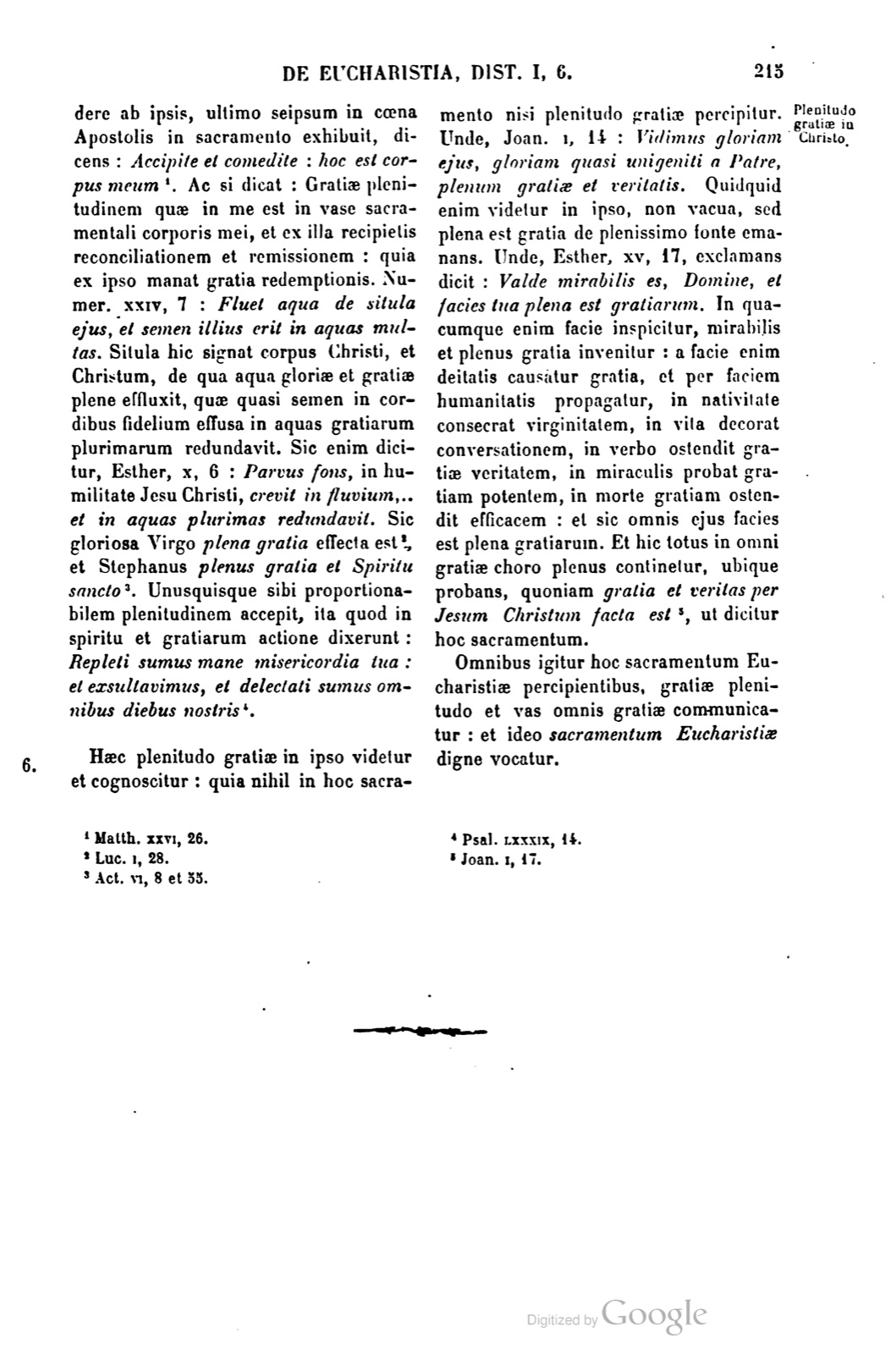
dere ab ipsis, ultimo seipsum in cena Apostolis in sacramento exhibuit, dicens: Accipite et comedite: hoc est corpus meum1. Ac si dicat: Gratiae plenitudinem quae in me est in vase sacramentali corporis mei, et ex illa recipietis reconciliationem et remissionem: quia ex ipso manat gratia redemptionis. Numer. xxiv, 7: Fluet aqua de situla ejus, et semen illius erit in aquas multas. Situla hic signat corpus Christi, et Christum, de qua aqua gloriae et gratiae plene effluxit, quae quasi semen in cordibus fidelium effusa in aquas gratiarum plurimarum redundavit. Sic enim dicitur, Esther, x, 6: Parvus fons, in humilitate Jesu Christi, crevit in fluvium... et in aquas plurimas redundavit. Sic gloriosa Virgo plena gratia effecta est2, et Stephanus plenus gratia et Spiritu sancto3. Unusquisque sibi proportionabilem plenitudinem accepit, ita quod in spiritu et gratiarum actione dixerunt: Repleti sumus mane misericordia tua: et exsultavimus, et delectati sumus omnibus diebus nostris4.
6. Haec plenitudo gratiae in ipso videtur et cognoscitur: quia nihil in hoc sacramento nisi plenitudo gratiae percipitur. Unde, Joan. i, 14: Vidimus gloriam ejus, gloriam quasi unigeniti a Patre, plenum gratiae et veritatis. Quidquid enim videtur in ipso, non vacua, sed plena est gratia de plenissimo fonte emanans. Unde, Esther, xv, 17, exclamans dicit: Valde mirabilis es, Domine, et facies tua plena est gratiarum. In quaecumque enim facie inspicitur, mirabilis et plenus gratia invenitur: a facie enim deitatis causatur gratia, et per faciem humanitatis propagatur, in nativitate consecrat virginitatem, in vita decorat conversationem, in verbo ostendit gratiae veritatem, in miraculis probat gratiam potentem, in morte gratiam ostendit efficacem: et sic omnis ejus facies est plena gratiarum. Et hic totus in omni gratiae choro plenus continetur, ubique probans, quoniam gratia et veritas per Jesum Christum facta est, ut dicitur hoc sacramentum5.
Omnibus igitur hoc sacramentum Eucharistiae percipientibus, gratiae plenitudo et vas omnis gratiae communicatur: et ideo sacramentum Eucharistiae digne vocatur.
from them, at the end he offered himself in the sacrament at supper to the Apostles, saying: Take and eat: this is my body1. As if he were saying: The fullness of grace which is in me is in the sacramental vessel of my body, and from it you will receive reconciliation and remission, because from it flows the grace of redemption. Numbers 24:7: Water will flow from his bucket, and his seed will be in many waters. Here the bucket signifies the body of Christ, and Christ, from whom the water of glory and grace flowed out fully; poured forth like seed in the hearts of the faithful, it overflowed into the waters of very many graces. For thus it is said in Esther 10:6: A little fountain, in the humility of Jesus Christ, grew into a river... and overflowed into many waters. Thus the glorious Virgin was made full of grace2, and Stephen full of grace and the Holy Spirit3. Each one received a fullness proportioned to himself, so that in spirit and thanksgiving they said: We have been filled in the morning with your mercy, and we have exulted and been delighted all our days4.
6. This fullness of grace is seen and known in him, because nothing is perceived in this sacrament except the fullness of grace. Hence John 1:14: We saw his glory, glory as of the only-begotten from the Father, full of grace and truth. For whatever is seen in him is not empty grace, but full grace flowing from the fullest fountain. Hence Esther 15:17, crying out, says: You are very wonderful, Lord, and your face is full of graces. For in whatever face he is beheld, he is found wonderful and full of grace: for grace is caused by the face of deity and is propagated through the face of humanity; in birth it consecrates virginity, in life it adorns conduct, in the word it shows the truth of grace, in miracles it proves grace powerful, in death it shows grace efficacious; and thus every face of his is full of graces. And here this whole one, full in every choir of grace, is contained, proving everywhere that grace and truth was made through Jesus Christ, as this sacrament is called5.
Therefore to all who receive this sacrament of the Eucharist, the fullness of grace and the vessel of every grace is communicated; and therefore it is fittingly called the sacrament of the Eucharist.
If a page does not appear, its photograph has not been uploaded yet.