Works › The Book on the Sacrament of the Eucharist
Volume 38 · pp. 208–212
Chapter V. This Sacrament Is Grace upon Grace.
A marker with ≈ is an approximate page boundary, placed by measure of the text; the page photographs remain the authority. In the paired views, clicking a page marker brings that page into view.
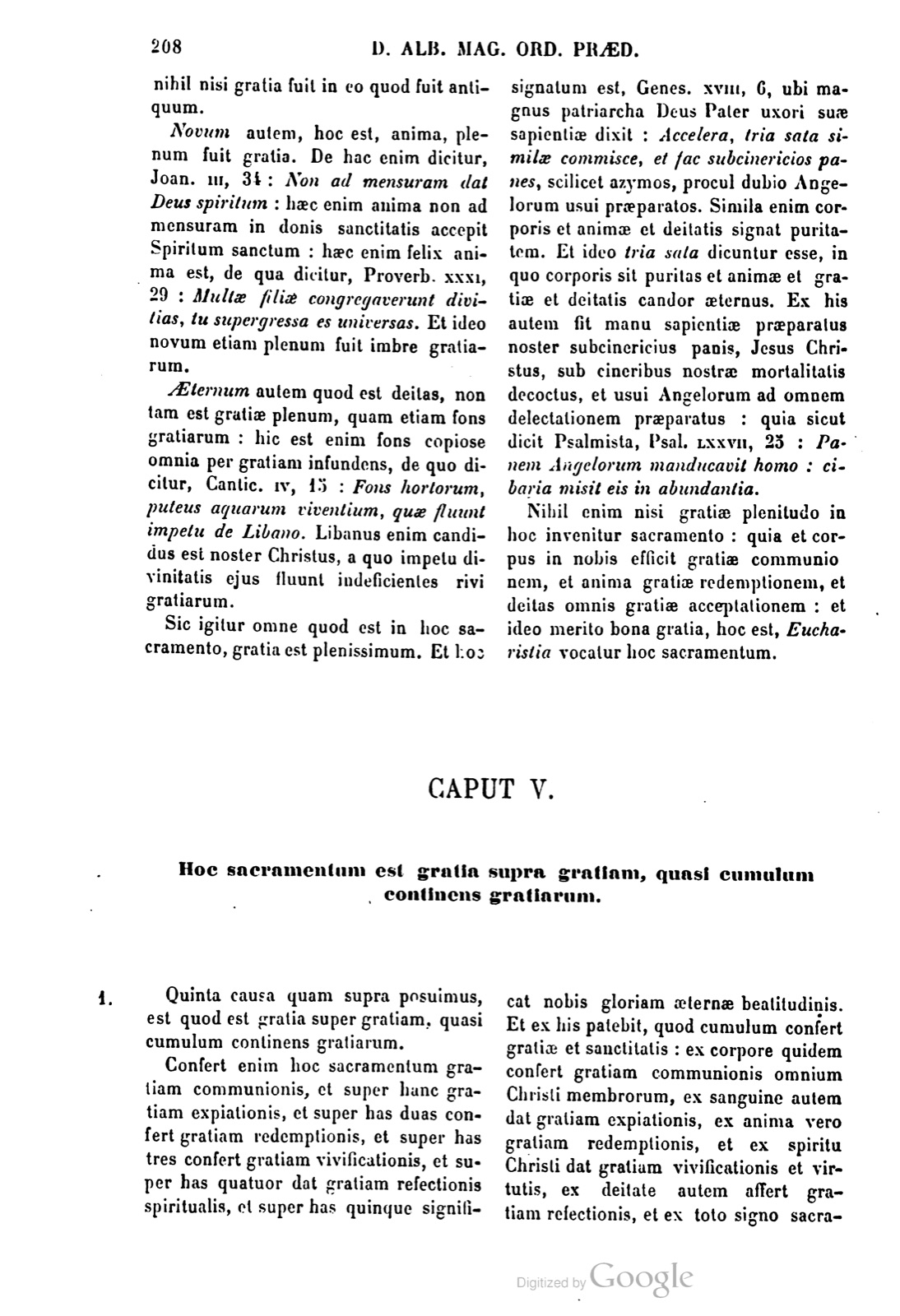
Caput V. Hoc sacramentum est gratia supra gratiam, quasi cumulum continens gratiarum.
1. Quinta causa quam supra posuimus, est quod est gratia super gratiam, quasi cumulum continens gratiarum.
Confert enim hoc sacramentum gratiam communionis, et super hanc gratiam expiationis, et super has duas confert gratiam redemptionis, et super has tres confert gratiam vivificationis, et super has quatuor dat gratiam refectionis spiritualis, et super has quinque significat nobis gloriam aeternae beatitudinis. Et ex his patebit, quod cumulum confert gratiae et sanctitatis: ex corpore quidem confert gratiam communionis omnium Christi membrorum, ex sanguine autem dat gratiam expiationis, ex anima vero gratiam redemptionis, et ex spiritu Christi dat gratiam vivificationis et virtutis, ex deitate autem affert gratiam refectionis, et ex toto signo sacramenti dat gratiam aeternae beatitudinis.
Et de communione quidem corporis dicit Apostolus, I ad Corinth. x, 16: Panis, quem frangimus, nonne communicatio corporis Christi est? Quasi diceret: Sic est: quia sicut dicit Apostolus, ad Roman. xii, 4 et 5: Sicut in uno corpore multa membra habemus, omnia autem membra non eumdem actum habent, ita multi unum corpus sumus in Christo1. Sicut enim in uno corpore Christi naturali et vero omnium membrorum fuit una in corpore Christi omnis boni et omnis gratiae communicatio, ita in corpore mystico per corpus Christi verum omnes in omnibus gratiis Christi et omnium fidelium communicamus. Psal. cxviii, 63: Particeps ego sum omnium timentium te, et custodientium mandata tua, Domine. Unde vere dicitur de fidelibus, Act. iv, 32: Et erant illis omnia communia. Et sequitur statim, quod non erat quisquam egens inter illos, sed vere fiebat in illis quod dicit Apostolus, II ad Corinth. viii, 14 et 15, aequalitas, sicut scriptum est, scilicet de manna: Qui multum habuit, non abundavit: et qui modicum, non minoravit2. Omnibus enim in hac communione corporis Christi omnia quae sunt corporis, sunt communia, sicut et membra corporis Christi veri omnia bona corporis communicaverunt.
Haec est sanctorum communio, quam in symbolo nos credere profitemur, dicentes: Credo in sanctorum communionem. Quia in communione corporis Christi omnia quae sunt Christi et fidelium propria, nobis omnibus efficiuntur communia, sicut dicitur, II ad Corinth. viii, 14: Vestra abundantia illorum inopiam suppleat, ut et illorum abundantia vestrae inopiae sit supplementum. Haec enim sunt promptuaria hujus sacramenti, de quibus dicitur, Psal. cxlii, 13: Promptuaria eorum plena, eructantia ex hoc in illud. Et hoc est quod in consonanti jucunditate sanctorum de plenitudine ista accipientium in gratiarum actione dicit Psalmista, Psal. cxliv, 7: Memoriam abundantiae suavitatis tuae eructabunt, et justitia tua exsultabunt. Habentes enim illam memoriam abundantiae istius communionis Christi et omnis sanctitatis, de plenitudine illa eructant suavitatem, et exsultant in justitia abundantissima ad omnem plenitudinem gratiarum.
Chapter V. This sacrament is grace upon grace, containing as it were a heap of graces.
1. The fifth cause which we set down above is that it is grace upon grace, containing as it were a heap of graces.
For this sacrament confers the grace of communion, and above this the grace of expiation; and above these two it confers the grace of redemption; and above these three it confers the grace of vivification; and above these four it gives the grace of spiritual refreshment; and above these five it signifies to us the glory of eternal beatitude. From these it will be clear that it confers a heap of grace and holiness: from the body it confers the grace of communion of all Christ's members; from the blood it gives the grace of expiation; from the soul, truly, the grace of redemption; from Christ's spirit it gives the grace of vivification and virtue; from deity it brings the grace of refreshment; and from the whole sign of the sacrament it gives the grace of eternal beatitude.
Concerning the communion of the body the Apostle says in 1 Corinthians 10:16: The bread which we break, is it not the communication of the body of Christ? As if he were saying: It is so, because as the Apostle says in Romans 12:4 and 5, as in one body we have many members, but all the members do not have the same act, so we, being many, are one body in Christ1. For just as in the natural and true body of Christ there was in Christ's body one communication of every good and every grace of all the members, so in the mystical body through the true body of Christ we all communicate in all the graces of Christ and of all the faithful. Psalm 118:63: I am a partaker of all who fear you and keep your commandments, O Lord. Hence it is truly said of the faithful in Acts 4:32: And all things were common to them. And immediately it follows that there was no needy one among them, but equality was truly made in them, as the Apostle says in 2 Corinthians 8:14 and 15, as it is written, namely concerning the manna: He who had much did not abound, and he who had little had no less2. For to all in this communion of the body of Christ all things that belong to the body are common, just as the members of Christ's true body communicated all the goods of the body.
This is the communion of saints which in the Creed we profess that we believe, saying: I believe in the communion of saints. Because in the communion of the body of Christ all things which are proper to Christ and to the faithful are made common to all of us, as is said in 2 Corinthians 8:14: Let your abundance supply their want, so that their abundance also may be a supplement to your want. For these are the storehouses of this sacrament, concerning which Psalm 142:13 says: Their storehouses are full, pouring forth from this into that. And this is what the Psalmist says in thanksgiving in Psalm 144:7, in the concordant joy of the saints receiving from that fullness: They shall pour forth the memory of the abundance of your sweetness, and they shall exult in your justice. For having that memory of the abundance of this communion of Christ and of every holiness, they pour forth sweetness from that fullness and exult in most abundant justice unto every fullness of graces.
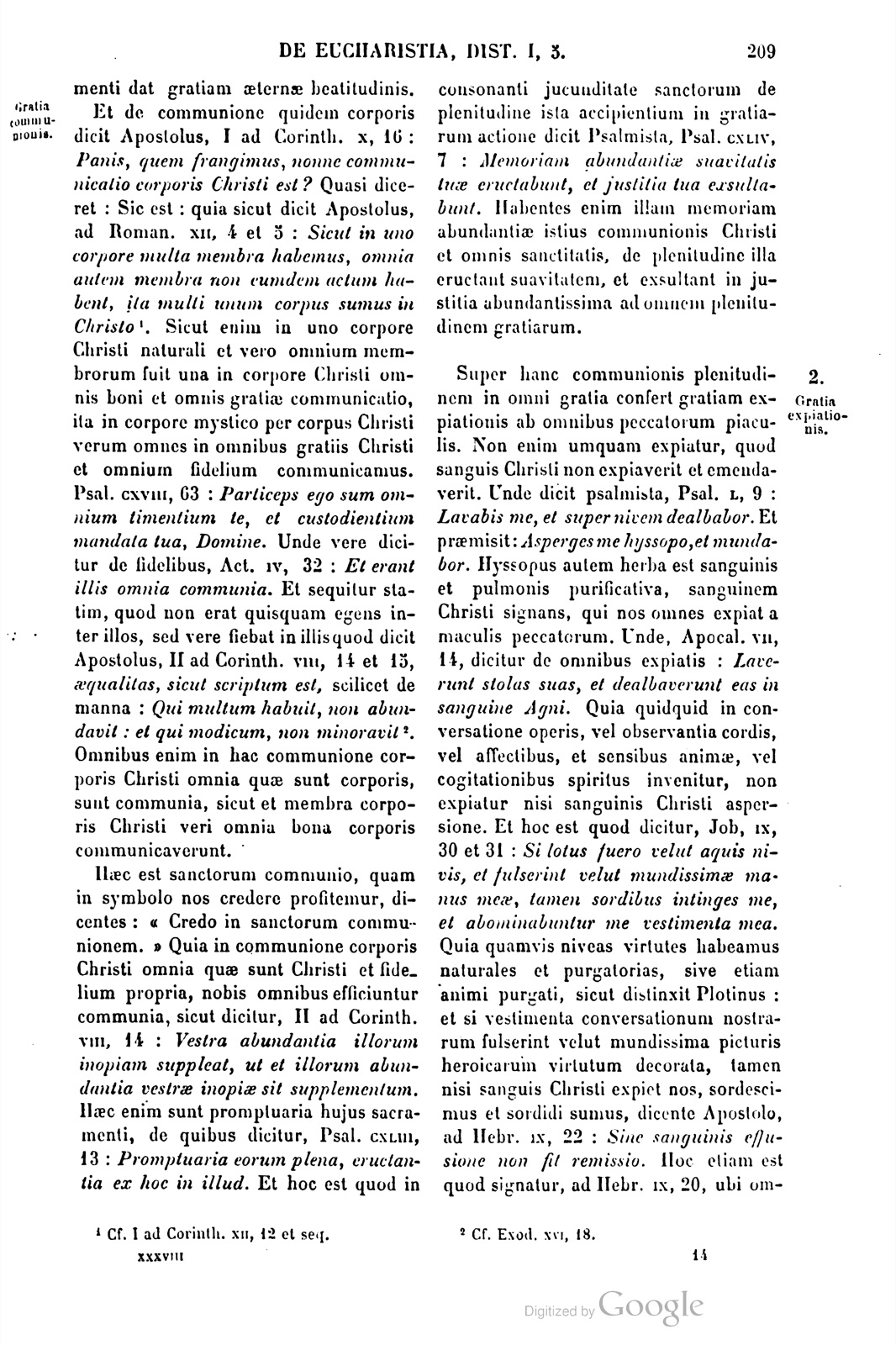
2. Super hanc communionis plenitudinem in omni gratia confert gratiam expiationis ab omnibus peccatorum piaculis. Non enim umquam expiatur, quod sanguis Christi non expiaverit et emendaverit. Unde dicit psalmista, Psal. l, 9: Lavabis me, et super nivem dealbabor. Et praemisit: Asperges me hyssopo, et mundabor. Hyssopus autem herba est sanguinis et pulmonis purificativa, sanguinem Christi signans, qui nos omnes expiat a maculis peccatorum. Unde, Apocal. vii, 14, dicitur de omnibus expiatis: Laverunt stolas suas, et dealbaverunt eas in sanguine Agni. Quia quidquid in conversatione operis, vel observantia cordis, vel affectibus, et sensibus animae, vel cogitationibus spiritus invenitur, non expiatur nisi sanguinis Christi aspersione. Et hoc est quod dicitur, Job, ix, 30 et 31: Si lotus fuero velut aquis nivis, et fulserint velut mundissimae manus meae, tamen sordibus intinges me, et abominabuntur me vestimenta mea. Quia quamvis niveas virtutes habeamus naturales et purgatorias, sive etiam animi purgati, sicut distinxit Plotinus: et si vestimenta conversationum nostrarum fulserint velut mundissima picturis heroicarum virtutum decorata, tamen nisi sanguis Christi expiet nos, sordescimus et sordidi sumus, dicente Apostolo, ad Hebr. ix, 22: Sine sanguinis effusione non fit remissio. Hoc etiam est quod signatur, ad Hebr. ix, 20, ubi omnia praecipiuntur mundari in sanguine, dicente Aaron: Hic sanguis testamenti quod mandavit ad vos Deus. Testamenti enim sanguis, sanguis est expiationis, in quo omnia mundantur, dicente Apostolo, ad Hebr. ix, 14: Sanguis Christi emundabit conscientiam nostram ab operibus mortuis, ad serviendum Deo viventi.
Haec igitur gratia expiationis est super gratiam communionis in hoc sacramento.
2. Above this fullness of communion in every grace, it confers the grace of expiation from all guilts of sins. For nothing is ever expiated which the blood of Christ has not expiated and amended. Hence the Psalmist says in Psalm 50:9: You will wash me, and I shall be made whiter than snow. And he premised: You will sprinkle me with hyssop, and I shall be cleansed. Hyssop, however, is an herb purifying blood and lung, signifying the blood of Christ, which expiates all of us from the stains of sins. Hence in Apocalypse 7:14 it is said of all the expiated: They have washed their robes and made them white in the blood of the Lamb. Because whatever is found in the conduct of work, or observance of heart, or affections and senses of the soul, or thoughts of the spirit, is expiated only by the sprinkling of Christ's blood. And this is what is said in Job 9:30 and 31: If I have been washed as with waters of snow, and my hands have shone as most clean, nevertheless you will dip me in filth, and my garments will abhor me. Because although we may have snow-white virtues, natural and purgative, or even of the purged soul, as Plotinus distinguished, and if the garments of our conduct should shine as most clean, adorned with pictures of heroic virtues, nevertheless unless the blood of Christ expiates us, we grow filthy and are filthy, as the Apostle says in Hebrews 9:22: Without shedding of blood there is no remission. This also is what is signified in Hebrews 9:20, where all things are commanded to be cleansed in blood, as Aaron says: This is the blood of the testament which God commanded for you. For the blood of the testament is the blood of expiation, in which all things are cleansed, as the Apostle says in Hebrews 9:14: The blood of Christ will cleanse our conscience from dead works, to serve the living God.
Therefore this grace of expiation is above the grace of communion in this sacrament.
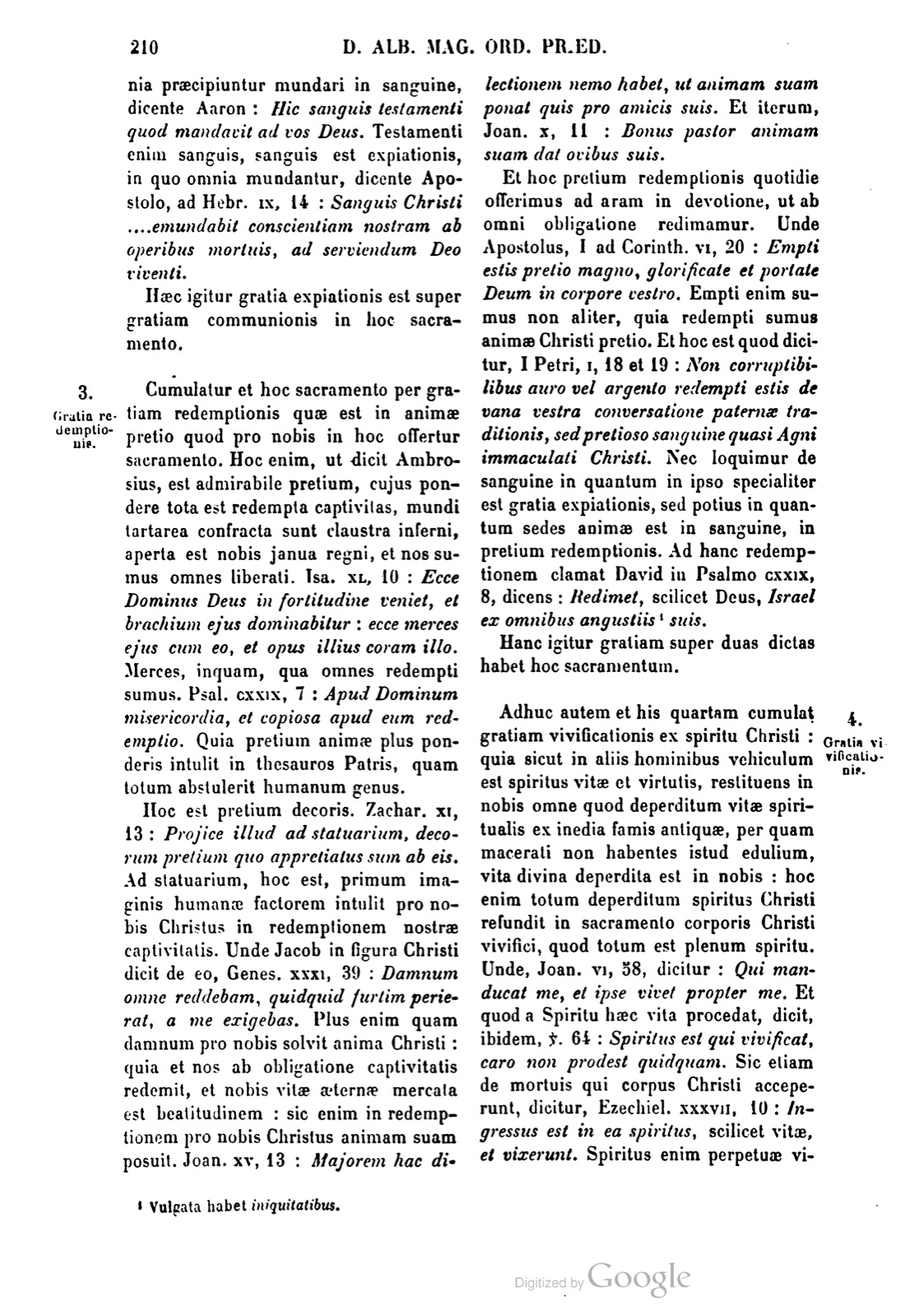
3. Cumulatur et hoc sacramento per gratiam redemptionis quae est in animae pretio quod pro nobis in hoc offertur sacramento. Hoc enim, ut dicit Ambrosius, est admirabile pretium, cujus pondere tota est redempta captivitas, mundi tartarea confracta sunt claustra inferni, aperta est nobis janua regni, et nos sumus omnes liberati. Isa. xl, 10: Ecce Dominus Deus in fortitudine veniet, et brachium ejus dominabitur: ecce merces ejus cum eo, et opus illius coram illo. Merces, inquam, qua omnes redempti sumus. Psal. cxxix, 7: Apud Dominum misericordia, et copiosa apud eum redemptio. Quia pretium animae plus ponderis intulit in thesauros Patris, quam totum abstulerit humanum genus. Hoc est pretium decoris. Zachar. xi, 13: Projice illud ad statuarium, decorum pretium quo appretiatus sum ab eis. Ad statuarium, hoc est, primum imaginis humanae factorem intulit pro nobis Christus in redemptionem nostrae captivitatis. Unde Jacob in figura Christi dicit de eo, Genes. xxxi, 39: Damnum omne reddebam, quidquid furtim perierat, a me exigebas. Plus enim quam damnum pro nobis solvit anima Christi: quia et nos ab obligatione captivitatis redemit, et nobis vitae aeternae mercata est beatitudinem: sic enim in redemptionem pro nobis Christus animam suam posuit. Joan. xv, 13: Majorem hac dilectionem nemo habet, ut animam suam ponat quis pro amicis suis. Et iterum, Joan. x, 11: Bonus pastor animam suam dat ovibus suis. Et hoc pretium redemptionis quotidie offerimus ad aram in devotione, ut ab omni obligatione redimamur. Unde Apostolus, I ad Corinth. vi, 20: Empti estis pretio magno, glorificate et portate Deum in corpore vestro. Empti enim sumus non aliter, quia redempti sumus animae Christi pretio. Et hoc est quod dicitur, I Petri, i, 18 et 19: Non corruptibilibus auro vel argento redempti estis de vana vestra conversatione paternae traditionis, sed pretioso sanguine quasi Agni immaculati Christi. Nec loquimur de sanguine in quantum in ipso specialiter est gratia expiationis, sed potius in quantum sedes animae est in sanguine, in pretium redemptionis. Ad hanc redemptionem clamat David in Psalmo cxxix, 8, dicens: Redimet, scilicet Deus, Israel ex omnibus angustiis suis3. Hanc igitur gratiam super duas dictas habet hoc sacramentum.
4. Adhuc autem et his quartam cumulat gratiam vivificationis ex spiritu Christi: quia sicut in aliis hominibus vehiculum est spiritus vitae et virtutis, restituens in nobis omne quod deperditum vitae spiritualis ex inedia famis antiquae, per quam macerati non habentes istud edulium, vita divina deperdita est in nobis: hoc enim totum deperditum spiritus Christi refundit in sacramento corporis Christi vivifici, quod totum est plenum spiritu. Unde, Joan. vi, 58, dicitur: Qui manducat me, et ipse vivet propter me. Et quod a Spiritu haec vita procedat, dicit, ibidem, v. 64: Spiritus est qui vivificat, caro non prodest quidquam. Sic etiam de mortuis qui corpus Christi acceperunt, dicitur, Ezechiel. xxxvi, 10: Ingressus est in ea spiritus, scilicet vitae, et vixerunt. Spiritus enim perpetuae vitae, spiritus Dei est: quoniam abundanter nostrum spirat sacramentum. Unde, Apostolus dicit, ad Roman, viii, 11: Qui suscitavit Jesum a mortuis vivificabit et mortalia corpora vestra, propter inhabitantem Spiritum ejus in vobis. Mortalia enim corpora sunt, quae continue deperditionem habent in vitae principiis, quae deperditio continue reparatur per vivificationis et vegetationis aeternae sacramentum. Sic de Christo summa sapientia Patris, qui hunc vivificationis modum excogitare potuit, dicitur, Eccli. iv, 12: Sapientia filiis suis vitam inspirat. Inspiravit enim omnibus filiis suis vitam in pane filiorum vivifico, in quo Christus sumitur, a quo vitae spiritus procedit. Sic enim ut, Eccli. xv, 3, dicitur: Cibabit illum pane vitae et intellectus, et aqua sapientiae salutaris potabit illum: sicut dicitur, Joan. x, 28: Ego vitam aeternam do eis, et non peribunt. Per cibum enim conjungit eis Spiritum qui aeternam vitam spirat in eis: et ideo perire non possunt. Et haec est quarta gratia quam cumulat super tres anteriores.
3. And it is heaped up in this sacrament through the grace of redemption, which is in the price of the soul that is offered for us in this sacrament. For this, as Ambrose says, is the wonderful price, by whose weight the whole captivity was redeemed, the Tartarean bars of hell were broken, the gate of the kingdom was opened to us, and we were all set free. Isaiah 40:10: Behold, the Lord God will come in strength, and his arm will rule; behold, his reward is with him, and his work before him. The reward, I say, by which we have all been redeemed. Psalm 129:7: With the Lord there is mercy, and with him plentiful redemption. Because the price of the soul brought more weight into the treasures of the Father than the whole human race had taken away. This is the price of beauty. Zechariah 11:13: Cast it to the statuary, the beautiful price at which I was appraised by them. Christ brought it for us to the statuary, that is, to the first maker of the human image, for the redemption of our captivity. Hence Jacob in figure of Christ says concerning it in Genesis 31:39: I restored every loss; whatever had perished by theft, you demanded from me. For the soul of Christ paid more than the loss for us, because it both redeemed us from the obligation of captivity and purchased for us the beatitude of eternal life. Thus Christ laid down his soul for us in redemption. John 15:13: No one has a greater love than this, that one lay down his soul for his friends. And again, John 10:11: The good shepherd gives his soul for his sheep. And this price of redemption we offer daily at the altar in devotion, so that we may be redeemed from every obligation. Hence the Apostle in 1 Corinthians 6:20: You have been bought with a great price; glorify and bear God in your body. For we have not been bought otherwise, because we have been redeemed by the price of Christ's soul. And this is what is said in 1 Peter 1:18 and 19: You have been redeemed not with corruptible gold or silver from your vain conversation of paternal tradition, but with the precious blood of Christ as of an immaculate Lamb. Nor are we speaking of the blood insofar as in it there is specially the grace of expiation, but rather insofar as the seat of the soul is in the blood, for the price of redemption. David cries out for this redemption in Psalm 129:8, saying: God will redeem Israel from all his distresses3. Therefore this sacrament has this grace above the two already mentioned.
4. Still further, above these it heaps up a fourth grace, the grace of vivification from the spirit of Christ, because, as in other men, the spirit is the vehicle of life and virtue, restoring in us everything that has been lost of spiritual life from the want of the ancient famine, through which, being wasted away and not having that food, divine life was lost in us. For the spirit of Christ pours back all this loss in the sacrament of the vivifying body of Christ, which is wholly full of spirit. Hence in John 6:58 it is said: He who eats me, he also shall live because of me. And that this life proceeds from the Spirit he says in the same place, verse 64: It is the Spirit who vivifies; the flesh profits nothing. Thus also concerning the dead who received the body of Christ, it is said in Ezekiel 36:10: The spirit, namely of life, entered into them, and they lived. For the spirit of perpetual life is the Spirit of God, since our sacrament breathes abundantly. Hence the Apostle says in Romans 8:11: He who raised Jesus from the dead will also vivify your mortal bodies because of his Spirit dwelling in you. For mortal bodies are those which continually have loss in the principles of life, and this loss is continually repaired through the sacrament of eternal vivification and nourishment. Thus concerning Christ, the highest wisdom of the Father, who was able to think out this mode of vivification, Ecclesiasticus 4:12 says: Wisdom breathes life into her sons. For she breathed life into all her sons in the vivifying bread of sons, in which Christ is received, from whom the spirit of life proceeds. Thus, as Ecclesiasticus 15:3 says: She will feed him with the bread of life and understanding, and will give him to drink with the water of saving wisdom; as it is said in John 10:28: I give them eternal life, and they shall not perish. For through food he joins to them the Spirit who breathes eternal life in them; and therefore they cannot perish. And this is the fourth grace which it heaps above the three previous ones.
5. Habet autem et quintam ex refectione deitatis. Haec enim est quae vere reficit et verum confert homini nutrimentum refectionis. Unde, I ad Corinth. iii, 7: Neque qui plantat est aliquid, neque qui rigat: sed qui incrementum dat, Deus. Haec est pascua intimae refectionis, de qua dicitur, Genes. l, 21: Nolite timere: ego pascam vos et parvulos vestros. Nihil enim interius mentem reficit, nisi sumpta in corpore Domini divinitas, de qua dicit Psalmista, Psal. xxii, 2: In loco pascuae ibi me collocavit. Alibi enim pascua non inveniuntur. Unde Christus haec pascua suis exhibens tam in nuda divinitate in qua cum Patre communicat, quam etiam in humanitate quae deitati est unita, dicit, Joan. x, 9: Et ingredietur, et egredietur, et pascua inveniet. Intus enim inveniet in deitate, et extra ad sensum in humanitate, quae deitati est unita. Ezechiel. xxxiv, 14: In pascuis uberrimis pascam eas. Uberrima pascua sunt refectiones sacramenti, saporem divinitatis habentes. Hoc est quod dicit, Isa. lviii, 14: Sustollam te super altitudinem terrae, et cibabo te haereditate Jacob, patris tui. Altitudo enim terrae est excellentia corporis Christi, in qua cibus est et refectio per hoc quod corpus deitati est unitum, et hoc est haereditas Jacob et omnium ab initio patriarcharum: quia omnes in fide vegetati et refecti. Hoc est quod omnes invitans Dominus dicit, Matth. xi, 28: Venite ad me, omnes qui laboratis et onerati estis, et ego reficiam vos. Reficitur enim quod deperditum est gratiae hujus edulium: quia comedentes ipsum semper sunt in desiderio refectionis hujus. Unde, Eccli. xxiv, 29, dicitur: Qui edunt me adhuc esurient, et qui bibunt me adhuc sitient.
5. It also has the fifth grace from the refreshment of deity. For this truly refreshes and confers on man the true nourishment of refreshment. Hence 1 Corinthians 3:7: Neither he who plants is anything, nor he who waters, but God who gives the increase. This is the pasture of inward refreshment, concerning which Genesis 50:21 says: Do not fear; I will feed you and your little ones. For nothing inwardly refreshes the mind except deity received in the body of the Lord, concerning which the Psalmist says in Psalm 22:2: In a place of pasture there he has placed me. Pastures are not found elsewhere. Hence Christ, offering these pastures to his own both in bare deity, in which he communicates with the Father, and also in humanity united to deity, says in John 10:9: He shall enter and go out, and shall find pastures. Within he will find them in deity, and outside, for sense, in humanity united to deity. Ezekiel 34:14: I will feed them in most abundant pastures. The most abundant pastures are the refreshments of the sacrament, having the savor of divinity. This is what Isaiah 58:14 says: I will lift you above the height of the earth, and I will feed you with the inheritance of Jacob your father. The height of the earth is the excellence of the body of Christ, in which there is food and refreshment because the body is united to deity; and this is the inheritance of Jacob and of all the patriarchs from the beginning, because all were nourished and refreshed in faith. This is what the Lord says inviting all in Matthew 11:28: Come to me, all who labor and are burdened, and I will refresh you. For that which has been lost is refreshed by the food of this grace, because those eating it are always in desire of this refreshment. Hence Ecclesiasticus 24:29 says: Those who eat me will still hunger, and those who drink me will still thirst.
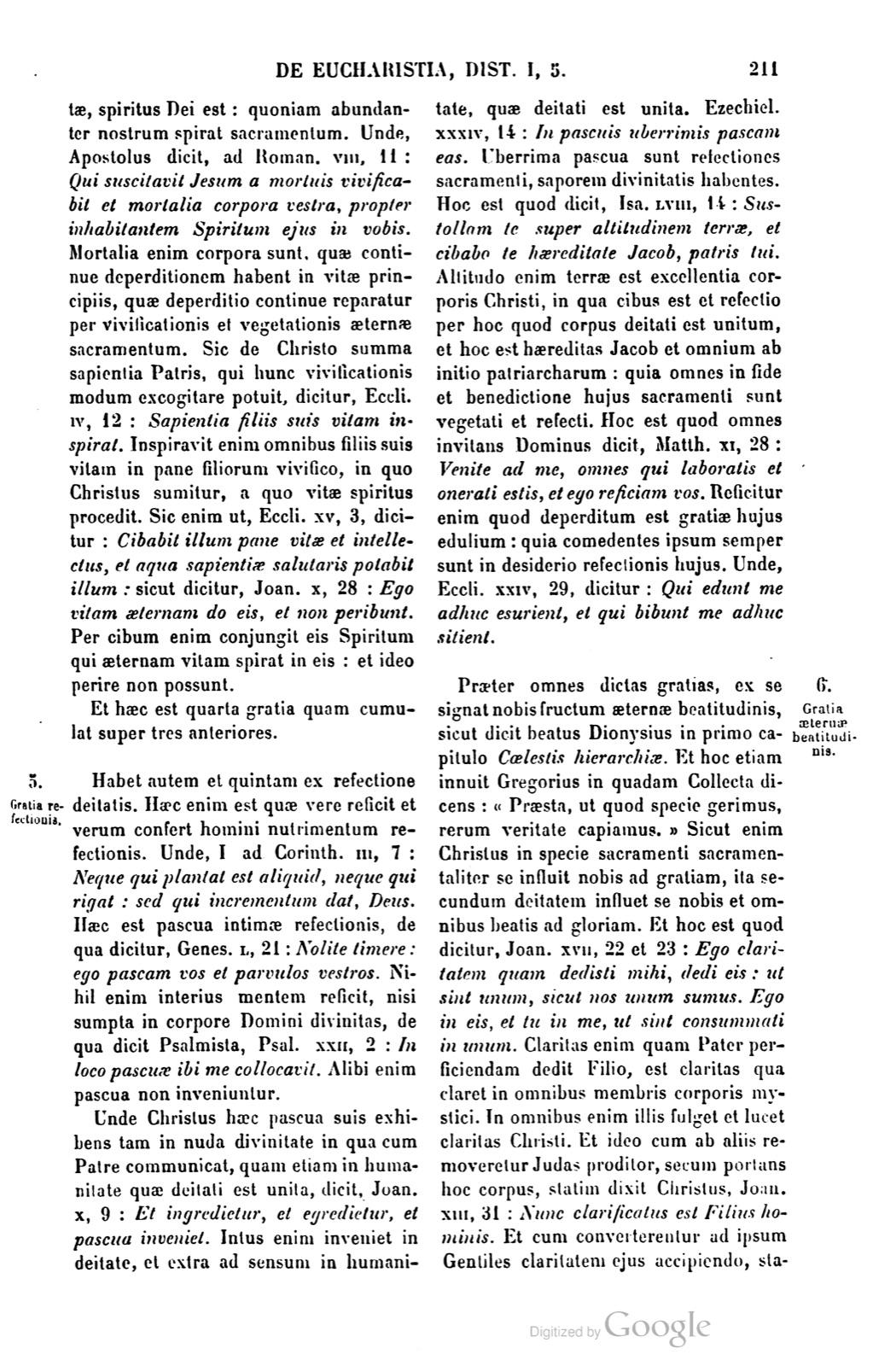
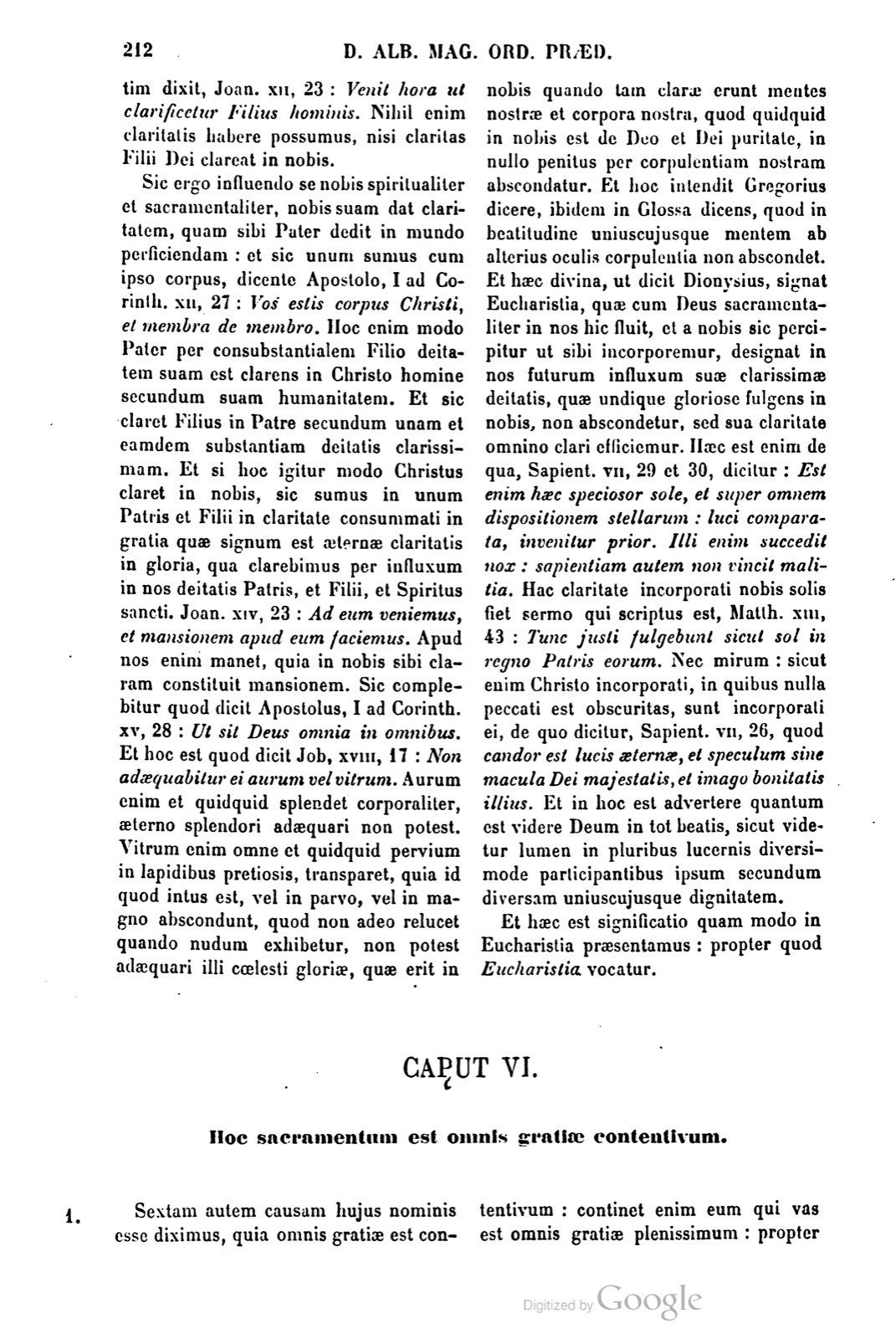
6. Praeter omnes dictas gratias, ex se et benedictione hujus sacramenti sunt adhuc signat nobis fructum aeternae beatitudinis, sicut dicit beatus Dionysius in primo capitulo Caelestis hierarchiae. Et hoc etiam innuit Gregorius in quadam Collecta dicens: Praesta, ut quod specie gerimus, rerum veritate capiamus. Sicut enim Christus in specie sacramenti sacramentaliter se influit nobis ad gratiam, ita secundum deitatem influet se nobis et omnibus beatis ad gloriam. Et hoc est quod dicitur, Joan. xvii, 22 et 23: Ego claritatem quam dedisti mihi, dedi eis: ut sint unum, sicut nos unum sumus. Ego in eis, et tu in me, ut sint consummati in unum. Claritas enim quam Pater perficiendam dedit Filio, est claritas qua claret in omnibus membris corporis mystici. In omnibus enim illis fulget et lucet claritas Christi. Et ideo cum ab aliis removeretur Judas proditor, secum portans hoc corpus, statim dixit Christus, Joan. xiii, 31: Nunc clarificatus est Filius hominis. Et cum converterentur ad ipsum Gentiles claritatem ejus accipiendo, statim dixit, Joan. xii, 23: Venit hora ut clarificetur Filius hominis. Nihil enim claritatis habere possumus, nisi claritas Filii Dei clareat in nobis.
6. Beyond all the graces mentioned, from itself and the blessing of this sacrament it still signifies to us the fruit of eternal beatitude, as blessed Dionysius says in the first chapter of The Celestial Hierarchy. Gregory also hints at this in a certain collect, saying: Grant that what we bear in species, we may receive in the truth of things. For just as Christ under the species of the sacrament flows sacramentally into us for grace, so according to deity he will flow into us and into all the blessed for glory. And this is what is said in John 17:22 and 23: The brightness which you have given me I have given them, that they may be one as we are one. I in them, and you in me, that they may be consummated into one. For the brightness which the Father gave to the Son to be perfected is the brightness by which he shines in all the members of the mystical body. For the brightness of Christ gleams and shines in all of them. And therefore when Judas the traitor, carrying this body with him, was removed from the others, immediately Christ said in John 13:31: Now the Son of Man has been glorified. And when the Gentiles were converted to him by receiving his brightness, immediately he said in John 12:23: The hour has come that the Son of Man be glorified. For we can have nothing of brightness unless the brightness of the Son of God shines in us.
If a page does not appear, its photograph has not been uploaded yet.