Works › The Book on the Sacrament of the Eucharist
Volume 38 · pp. 196–197
Chapter II. Goodness, Kindliness, Piety.
A marker with ≈ is an approximate page boundary, placed by measure of the text; the page photographs remain the authority. In the paired views, clicking a page marker brings that page into view.
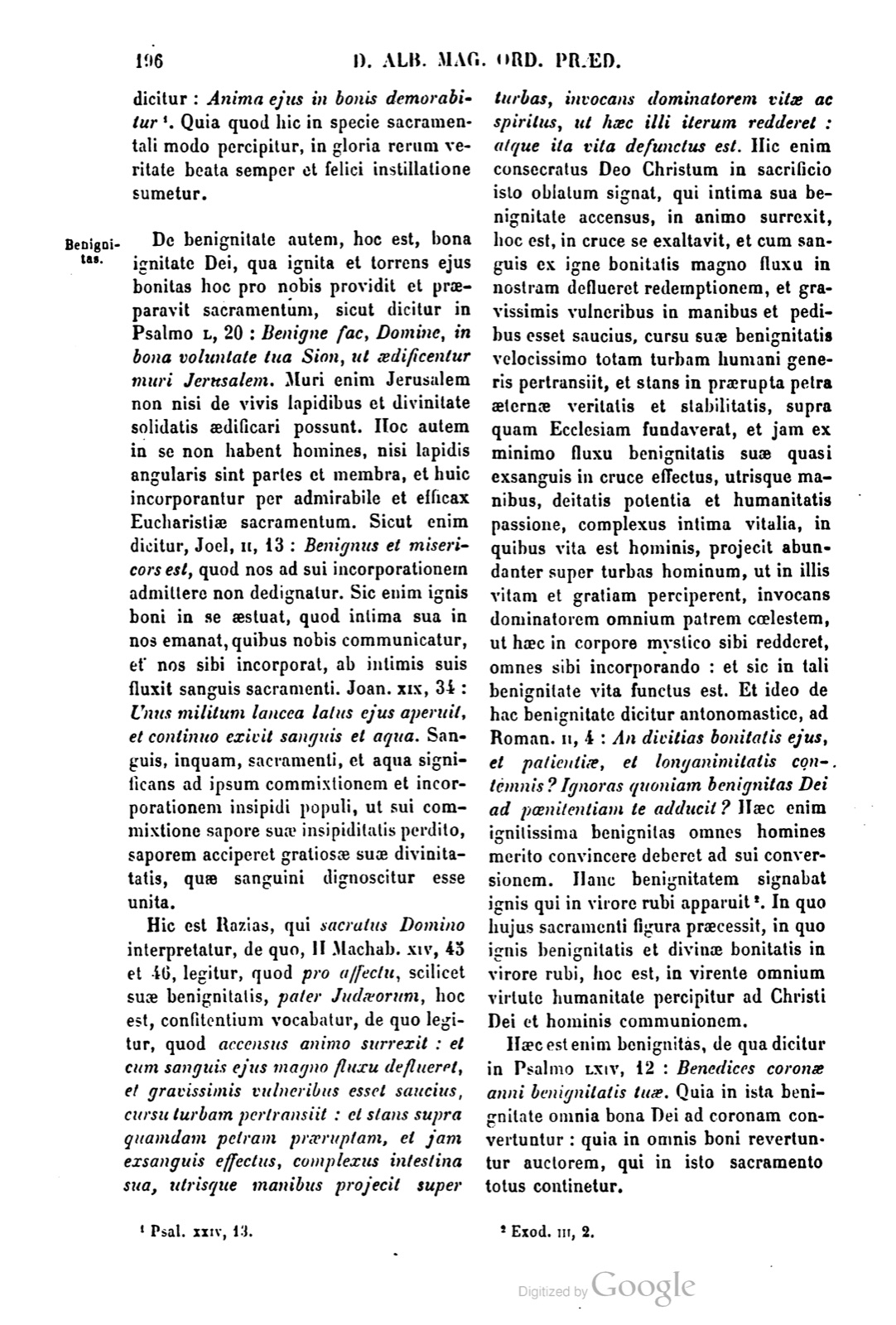
Hoc est, de quo dicitur: Anima ejus in bonis demorabitur1. Quia quod hic in specie sacramentali modo percipitur, in gloria rerum veritate beata semper et felici instillatione sumetur.
De benignitate autem, hoc est, bona ignitate Dei, qua ignita et torrens ejus bonitas hoc pro nobis providit et praeparavit sacramentum, sicut dicitur in Psalmo l, 20: Benigne fac, Domine, in bona voluntate tua Sion, ut aedificentur muri Jerusalem. Muri enim Jerusalem non nisi de vivis lapidibus et divinitate solidatis aedificari possunt. Hoc autem in se non habent homines, nisi lapidis angularis sint partes et membra, et huic incorporantur per admirabile et efficax Eucharistiae sacramentum. Sicut enim dicitur, Joel, ii, 13: Benignus et misericors est, quod nos ad sui incorporationem admittere non dedignatur. Sic enim ignis boni in se aestuat, quod intima sua in nos emanat, quibus nobis communicatur, et nos sibi incorporat, ab intimis suis fluxit sanguis sacramenti. Joan. xix, 34: Unus militum lancea latus ejus aperuit, et continuo exivit sanguis et aqua. Sanguis, inquam, sacramenti, et aqua significans ad ipsum commixtionem et incorporationem insipidi populi, ut sui commixtione sapore suae insipiditatis perdito, saporem acciperet gratiosae suae divinitatis, quae sanguini dignoscitur esse unita.
Hic est Razias, qui sacratus Domino interpretatur, de quo, II Machab. xiv, 45 et 46, legitur, quod pro affectu, scilicet suae benignitatis, pater Judaeorum, hoc est, confitentium vocabatur, de quo legitur, quod accensus animo surrexit: et cum sanguis ejus magno fluxu deflueret, et gravissimis vulneribus esset saucius, cursu turbam pertransiit: et stans supra quamdam petram praeruptam, et jam exsanguis effectus, complexus intestina sua, utrisque manibus projecit super turbas, invocans dominatorem vitae ac spiritus, ut haec illi iterum redderet: atque ita vita defunctus est. Hic enim consecratus Deo Christum in sacrificio isto oblatum signat, qui intima sua benignitate accensus, in animo surrexit, hoc est, in cruce se exaltavit, et cum sanguis ex igne bonitatis magno fluxu in nostram deflueret redemptionem, et gravissimis vulneribus in manibus et pedibus esset saucius, cursu suae benignitatis velocissimo totam turbam humani generis pertransiit, et stans in praerupta petra aeternae veritatis et stabilitatis, supra quam Ecclesiam fundaverat, et jam ex minimo fluxu benignitatis suae quasi exsanguis in cruce effectus, utrisque manibus, deitatis potentia et humanitatis passione, complexus intima vitalia, in quibus vita est hominis, projecit abundanter super turbas hominum, ut in illis vitam et gratiam perciperent, invocans dominatorem omnium patrem caelestem, ut haec in corpore mystico sibi redderet, omnes sibi incorporando: et sic in tali benignitate vita functus est. Et ideo de hac benignitate dicitur antonomastice, ad Roman. ii, 4: An divitias bonitatis ejus, et patientiae, et longanimitatis contemnis? Ignoras quoniam benignitas Dei ad paenitentiam te adducit? Haec enim ignitissima benignitas omnes homines merito convincere deberet ad sui conversionem. Hanc benignitatem signabat ignis qui in virore rubi apparuit2. In quo hujus sacramenti figura praecessit, in quo ignis benignitatis et divinae bonitatis in virore rubi, hoc est, in virente omnium virtute humanitate percipitur ad Christi Dei et hominis communionem.
Haec est enim benignitas, de qua dicitur in Psalmo lxiv, 12: Benedices coronae anni benignitatis tuae. Quia in ista benignitate omnia bona Dei ad coronam convertuntur: quia in omnis boni revertuntur auctorem, qui in isto sacramento totus continetur.
This is that concerning which it is said: His soul shall dwell in good things1. Because what is here now received under the sacramental species will be taken in glory in the truth of things, blessed and always with a happy instillation.
Concerning kindliness, however, that is, the good enkindling of God, by which his enkindled and torrenting goodness provided and prepared this sacrament for us, it is said in Psalm 50:20: Deal kindly, O Lord, in your good will with Sion, that the walls of Jerusalem may be built up. For the walls of Jerusalem can be built only from living stones and stones made firm by deity. But men do not have this in themselves unless they are parts and members of the cornerstone, and they are incorporated into this stone through the wonderful and efficacious sacrament of the Eucharist. For as it is said in Joel 2:13, He is kind and merciful, because he does not disdain to admit us to incorporation with himself. For the fire of the good so burns within itself that his inner things flow forth into us, by which he is communicated to us and incorporates us to himself; from his inner parts flowed the blood of the sacrament. John 19:34: One of the soldiers opened his side with a lance, and immediately there came out blood and water. Blood, I say, of the sacrament, and water signifying the mixture and incorporation into it of the tasteless people, so that by mixture with him, after the taste of its tastelessness had been lost, it might receive the taste of his gracious divinity, which is known to be united to the blood.
This is Razias, which is interpreted consecrated to the Lord, concerning whom in 2 Maccabees 14:45 and 46 it is read that, because of affection, namely of his kindliness, he was called father of the Jews, that is, of those confessing; concerning him it is read that, enkindled in soul, he rose up, and when his blood was flowing down in a great stream and he was wounded with very grave wounds, he ran through the crowd, and standing upon a certain steep rock, and now made bloodless, embracing his intestines, he threw them with both hands upon the crowds, invoking the ruler of life and spirit that he would return these to him again; and thus he departed life. For this man consecrated to God signifies Christ offered in that sacrifice, who, enkindled by his inward kindliness, rose up in soul, that is, exalted himself on the cross, and when blood from the fire of goodness flowed down in a great stream for our redemption, and he was wounded with very grave wounds in hands and feet, by the most swift course of his kindliness he passed through the whole crowd of the human race, and standing on the steep rock of eternal truth and stability, upon which he had founded the Church, and now made as it were bloodless on the cross from the smallest flow of his kindliness, with both hands, the power of deity and the passion of humanity, embracing the inward vital parts in which the life of man is, he cast them abundantly upon the crowds of men so that in them they might receive life and grace, invoking the ruler of all things, the heavenly Father, that he would return these things to himself in the mystical body by incorporating all to himself; and thus in such kindliness he fulfilled life. And therefore concerning this kindliness it is said by antonomasia, Romans 2:4: Do you despise the riches of his goodness, patience, and longanimity? Do you not know that the kindliness of God leads you to repentance? For this most enkindled kindliness ought deservedly to convict all men unto conversion to him. The fire which appeared in the greenness of the bush signified this kindliness2. In this the figure of this sacrament went before, in which the fire of kindliness and divine goodness is received in the greenness of the bush, that is, in humanity green with the virtue of all things, unto the communion of Christ God and man.
For this is the kindliness concerning which it is said in Psalm 64:12: You will bless the crown of the year of your kindliness. Because in that kindliness all the good things of God are turned into a crown, since they are returned into the author of every good, who is wholly contained in this sacrament.
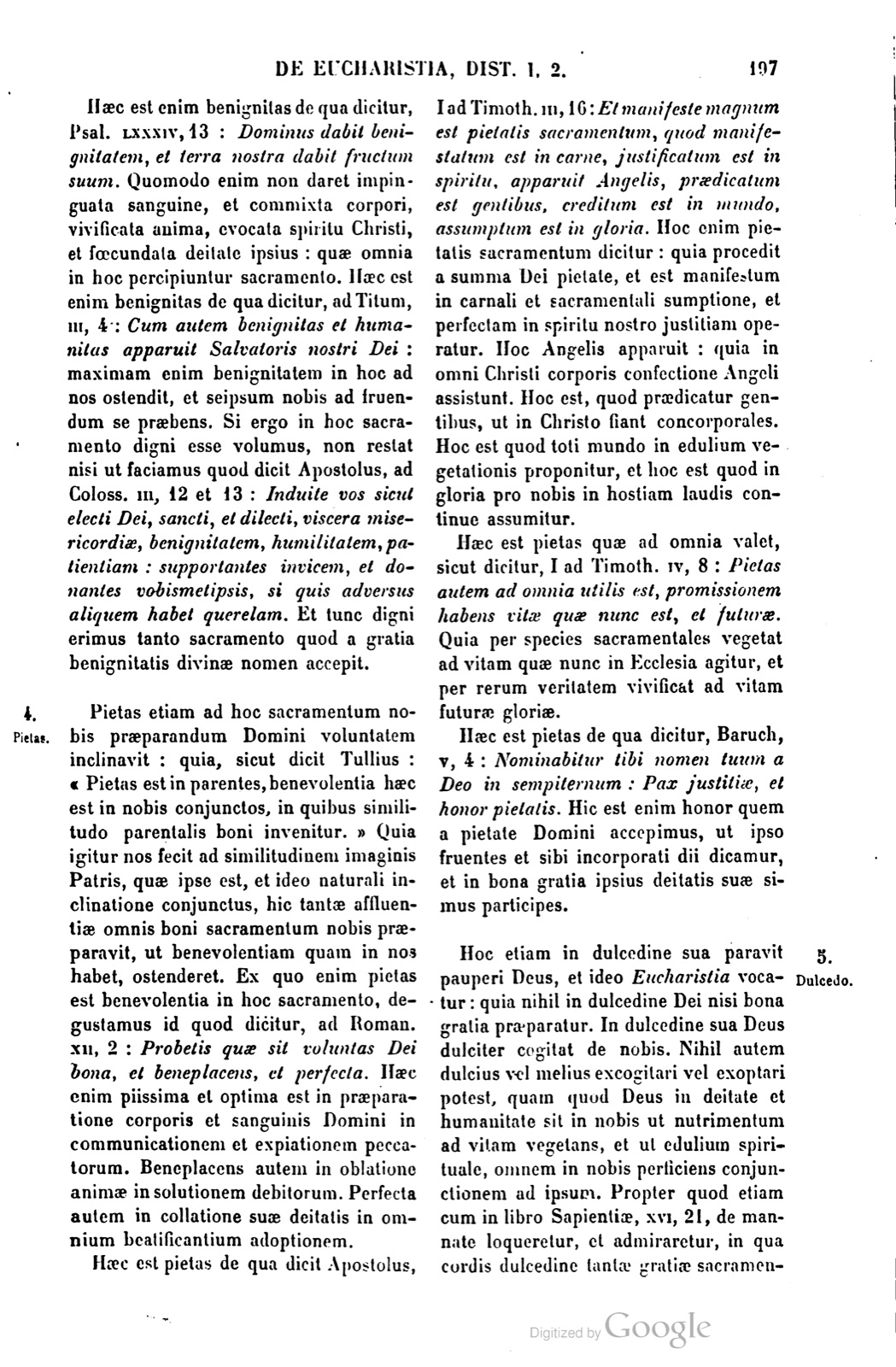
Haec est enim benignitas de qua dicitur, Psal. lxxxiv, 13: Dominus dabit benignitatem, et terra nostra dabit fructum suum. Quomodo enim non daret impinguata sanguine, et commixta corpori, vivificata anima, evocata spiritu Christi, et foecundata deitate ipsius: quae omnia in hoc percipiuntur sacramento. Haec est enim benignitas de qua dicitur, ad Titum, iii, 4: Cum autem benignitas et humanitas apparuit Salvatoris nostri Dei: maximam enim benignitatem in hoc ad nos ostendit, et seipsum nobis ad fruendum se praebens. Si ergo in hoc sacramento digni esse volumus, non restat nisi ut faciamus quod dicit Apostolus, ad Coloss. iii, 12 et 13: Induite vos sicut electi Dei, sancti, et dilecti, viscera misericordiae, benignitatem, humilitatem, patientiam: supportantes invicem, et donantes vobismetipsis, si quis adversus aliquem habet querelam. Et tunc digni erimus tanto sacramento quod a gratia benignitatis divinae nomen accepit.
Pietas etiam ad hoc sacramentum nobis praeparandum Domini voluntatem inclinavit: quia, sicut dicit Tullius: Pietas est in parentes benevolentia, haec est in nobis conjunctos, in quibus similitudo parentalis boni invenitur. Quia igitur nos fecit ad similitudinem imaginis Patris, quae ipse est, et ideo naturali inclinatione conjunctus, hic tantae affluentiae omnis boni sacramentum nobis praeparavit, ut benevolentiam quam in nos habet, ostenderet. Ex quo enim pietas est benevolentia in hoc sacramento, degustamus id quod dicitur, ad Roman. xii, 2: Probetis quae sit voluntas Dei bona, et beneplacens, et perfecta. Haec enim piissima et optima est in praeparatione corporis et sanguinis Domini in communicationem et expiationem peccatorum. Beneplacens autem in oblatione animae in solutionem debitorum. Perfecta autem in collatione suae deitatis in omnium beatificantium adoptionem.
Haec est pietas de qua dicit Apostolus, I ad Timoth. iii, 16: Et manifeste magnum est pietatis sacramentum, quod manifestatum est in carne, justificatum est in spiritu, apparuit Angelis, praedicatum est gentibus, creditum est in mundo, assumptum est in gloria. Hoc enim pietatis sacramentum dicitur: quia procedit a summa Dei pietate, et est manifestum in carnali et sacramentali sumptione, et perfectam in spiritu nostro justitiam operatur. Hoc Angelis apparuit: quia in omni Christi corporis confectione Angeli assistunt. Hoc est, quod praedicatur gentibus, ut in Christo fiant concorporales. Hoc est quod toti mundo in edulium vegetationis proponitur, et hoc est quod in gloria pro nobis in hostiam laudis continue assumitur.
Haec est pietas quae ad omnia valet, sicut dicitur, I ad Timoth. iv, 8: Pietas autem ad omnia utilis est, promissionem habens vitae quae nunc est, et futurae. Quia per species sacramentales vegetat ad vitam quae nunc in Ecclesia agitur, et per rerum veritatem vivificat ad vitam futurae gloriae.
Haec est pietas de qua dicitur, Baruch, v, 4: Nominabitur tibi nomen tuum a Deo in sempiternum: Pax justitiae, et honor pietatis. Hic est enim honor quem a pietate Domini accepimus, ut ipso fruentes et sibi incorporati dii dicamur, et in bona gratia ipsius deitatis suae simus participes.
For this is the kindliness concerning which it is said in Psalm 84:13: The Lord will give kindliness, and our earth will give its fruit. For how would it not give fruit, made fat with blood, mixed with body, vivified by soul, called forth by the spirit of Christ, and made fruitful by his deity, all of which are received in this sacrament? For this is the kindliness concerning which it is said in Titus 3:4: But when the kindliness and humanity of God our Savior appeared. For in this he showed the greatest kindliness toward us, also giving himself to us for the enjoyment of himself. Therefore if we wish to be worthy in this sacrament, nothing remains except that we do what the Apostle says in Colossians 3:12 and 13: Put on, as the elect of God, holy and beloved, the bowels of mercy, kindliness, humility, patience, bearing with one another and forgiving one another, if anyone has a complaint against another. And then we shall be worthy of so great a sacrament, which received its name from the grace of divine kindliness.
Piety also inclined the will of the Lord to prepare this sacrament for us, because, as Tullius says: Piety is benevolence toward parents; this benevolence is toward those joined to us, in whom a likeness of parental good is found. Therefore, because he made us according to the likeness of the image of the Father, which he himself is, and for that reason, joined by natural inclination, he prepared for us here the sacrament of so great an abundance of every good, so that he might show the benevolence which he has toward us. For since piety is benevolence, in this sacrament we taste that which is said in Romans 12:2: That you may prove what is the good, pleasing, and perfect will of God. For this will is most pious and best in the preparation of the body and blood of the Lord for the communication and expiation of sins. It is pleasing, however, in the offering of the soul for the payment of debts. It is perfect, however, in the bestowal of his deity for the adoption of all beatifying things.
This is the piety concerning which the Apostle says in 1 Timothy 3:16: And manifestly great is the sacrament of piety, which was manifested in the flesh, justified in the spirit, appeared to angels, was preached to the nations, was believed in the world, was assumed in glory. For this is called the sacrament of piety because it proceeds from the highest piety of God, and is manifest in fleshly and sacramental taking, and works perfect justice in our spirit. This appeared to angels because in every confection of Christ's body angels stand by. This is what is preached to the nations, that in Christ they may become members of the same body. This is what is proposed to the whole world as food of nourishment, and this is what in glory is continually taken up for us as a host of praise.
This is the piety which has force for all things, as is said in 1 Timothy 4:8: Piety is useful for all things, having the promise of the life which now is and of the life to come. Because through the sacramental species it nourishes unto the life which is now carried on in the Church, and through the truth of the things it vivifies unto the life of future glory.
This is the piety concerning which it is said in Baruch 5:4: Your name shall be named to you by God forever: Peace of justice and honor of piety. For this is the honor that we have received from the piety of the Lord, that, enjoying him and incorporated into him, we may be called gods, and in the good grace of his deity may be participants.
If a page does not appear, its photograph has not been uploaded yet.