Works › Commentary on the Apocalypse of Blessed John
Volume 38 · pp. 786–790
Exposition on Chapter XXII of the Apocalypse, verses 6-18 opening
A marker with ≈ is an approximate page boundary, placed by measure of the text; the page photographs remain the authority. In the paired views, clicking a page marker brings that page into view.
6. "Et dixit mihi: Haec verba fidelissima sunt et vera: et Dominus Deus spirituum Prophetarum misit Angelum suum ostendere servis suis quae oportet fieri cito. 7. Et ecce venio velociter. Beatus qui custodit verba prophetiae libri hujus."
Supra posuit Joannes libri exordium et narrationem, hic ponit hujus conclusionem.
Et dividitur in tres partes. In prima ponitur totius operis commendatio. Secundo, ne quid addatur vel subtrahatur, ponitur comminatio, ibi, v. 18: "Contestor enim, etc." Tertio, optat gratiam omnibus Sanctis, ibi, v. 21: "Gratia Domini nostri, etc."
Item, opus commendatur a quinque. Primo, ab auctoritate Angeli. Secundo, ab auctoritate Joannis, ibi, v. 8: "Et ego Joannes." Tertio, ab auctoritate Christi, ibi, v. 16: "Ego Jesus." Quarto, ab auctoritate Ecclesiae, et totius Trinitatis, ibi, v. 17: "Et spiritus et sponsa." Quinto, ab auctoritate legentis et intelligentis, ibidem, "Et qui audit."
In prima dicuntur tria. Primo, testimonium Angeli: secundo, manifestatio necessitatis, ibi, v. 7: "Oportet fieri cito." Tertio, utilitatis, ibi, v. 8: "Beatus qui custodit."
Dicit ergo: "Et dixit mihi," scilicet Angelus qui caetera ostenderat: "Haec verba," scilicet quae a principio libri tibi sunt ostensa, "fidelissima sunt," id est, fide dignissima: "et vera," quia a Deo vero prolata, secundum Haymonem. Vel, "Fidelissima," quia solvunt quod promittunt: "et vera," quia nullum fallunt.
"Dominus Deus spirituum," id est, qui habet in potestate sua donum Spiritus sancti. "Prophetarum," id est, per quem locuti sunt Prophetae. II Petri, I, 21: Non enim voluntate humana allata est aliquando, etc.
"Misit Angelum suum," id est, quem creavit ad hoc ut esset nuntius suus, "ostendere," id est, ut ostenderet, "servis suis," id est, humilibus non superbis. Glossa, non regibus, vel philosophis.
"Quae oportet fieri cito," propter Dei praeordinationem, et propter bonorum et malorum remunerationem.
"Et ecce venio velociter."
"Et ecce venio," ad bonos glorificandum, et malos puniendum. Joel. III, 4: Cito velociter reddam vicissitudinem, etc. [Marginal label: Cito.] NOTA: Secundum Haymonem, dicit "cito," vel "velociter," quia omne tempus praesentis vitae aeternitati comparatum, sicut momentaneum habetur.
"Beatus qui audit," intelligendo, obediendo, opere implendo, etc., "verba prophetiae libri hujus," id est, ea quae in libro hoc continentur. Luc. XI, 28: Beati qui audiunt verbum Dei, etc. Gregorius: "Si vis custodire verbum, manus necesse est ut adhibeas."
8. "Et ego Joannes, qui audivi, et vidi haec."
Hic ponitur commendatio operis ab auctoritate Joannis.
Primo, testatur Joannes, quod haec vidit, et audivit. Secundo manifestat, qualiter his visis se habuit, ibi, "Et postquam audissem."
Dicit ergo: "Et ego Joannes." Glossa, qui nihil falsum soleo dicere. "Qui audivi" verba, "et vidi haec," scilicet has figuras, supple, sum perhibens testimonium de praedictis.
6. "And he said to me: These words are most faithful and true; and the Lord God of the spirits of the Prophets sent his Angel to show his servants the things which must happen soon. 7. And behold, I come quickly. Blessed is he who keeps the words of the prophecy of this book."
Above John set down the beginning and narration of the book; here he sets down its conclusion.
And it is divided into three parts. In the first, a commendation of the whole work is set down. Secondly, lest anything be added or subtracted, a threat is set down, there at verse 18: "For I testify, etc." Thirdly, he wishes grace to all Saints, there at verse 21: "The grace of our Lord, etc."
Likewise, the work is commended from five things. First, from the authority of the Angel. Secondly, from the authority of John, there at verse 8: "And I John." Thirdly, from the authority of Christ, there at verse 16: "I Jesus." Fourthly, from the authority of the Church and of the whole Trinity, there at verse 17: "And the spirit and the bride." Fifthly, from the authority of the one reading and understanding, in the same place, "And he who hears."
In the first three things are said. First, the testimony of the Angel; secondly, the manifestation of necessity, there at verse 7: "It must happen soon." Thirdly, of usefulness, there at verse 8: "Blessed is he who keeps."
Therefore he says: "And he said to me," namely the Angel who had shown the other things, "These words," namely which from the beginning of the book have been shown to you, "are most faithful," that is, most worthy of faith, "and true," because spoken by the true God, according to Haymo. Or, "Most faithful," because they pay what they promise; "and true," because they deceive no one.
"The Lord God of the spirits," that is, he who has in his power the gift of the Holy Spirit. "Of the Prophets," that is, through whom the Prophets spoke. 2 Peter 1:21: For at no time was it brought by human will, etc.
"Sent his Angel," that is, whom he created for this, that he might be his messenger, "to show," that is, so that he might show, "his servants," that is, the humble, not the proud. The Gloss says, not kings or philosophers.
"The things which must happen soon," because of God's preordination, and because of the remuneration of the good and the evil.
"And behold, I come quickly."
"And behold, I come," to glorify the good and punish the evil. Joel 3:4: Soon and quickly I will repay recompense, etc. [Marginal label: Soon.] NOTE: According to Haymo, he says "soon," or "quickly," because every time of the present life, compared to eternity, is held as momentary.
"Blessed is he who hears," by understanding, by obeying, by fulfilling in work, etc., "the words of the prophecy of this book," that is, the things which are contained in this book. Luke 11:28: Blessed are those who hear the word of God, etc. Gregory says: "If you wish to keep the word, it is necessary that you apply your hand."
8. "And I John, who heard and saw these things."
Here the commendation of the work is set down from the authority of John.
First, John testifies that he saw and heard these things. Secondly, he makes clear how he conducted himself when these things had been seen, there, "And after I had heard."
Therefore he says: "And I John." The Gloss says, who am accustomed to say nothing false. "Who heard" the words, "and saw these things," namely these figures, supply, am bearing testimony concerning the aforesaid things.
8. "Et postquam audissem et vidissem, cecidi ut adorarem ante pedes Angeli qui mihi haec ostendebat: 9. Et dixit mihi: Vide ne feceris: conservus enim tuus sum, et fratrum tuorum prophetarum, et eorum qui servant verba prophetiae libri hujus. Deum adora. 10. Et dixit mihi: Ne signaveris verba prophetiae libri hujus: tempus enim prope est."
Hic dicit, qualiter his visis se habuerit.
Et dicuntur tria. Primo, quod Angelum adoravit. Secundo, quod ab Angelo prohibitus fuit, ibi, v. 9: "Et dixit mihi." Tertio, prohibet, ne occultet mysteria hujus, ibi, v. 10: "Ne signaveris."
Unde dicit: "Et postquam vidissem et audissem," scilicet omnia praedicta, "cecidi," corde et corpore me humiliando, "ut adorarem," id est, exhiberem honorem reverentiae quae est dulia, "ante pedes Angeli qui mihi haec ostendebat." Quasi dicat: Pro hac causa volui adorare.
"Et dixit mihi,"
Scilicet Angelus quem volebam adorare: "Vide," id est, cave "ne feceris." Quasi diceret: Attende diligenter dignitatem humanae naturae, et noli me adorare.
"Conservus enim tuus sum," id est, ego et tu sumus unius Dei servi: "et fratrum tuorum prophetarum." Glossa, id est, praedicantium: "et eorum qui servant verba prophetiae libri hujus." Glossa, id est, Praedicatoribus obedientium.
"Deum adora," scilicet qui solus supra naturam humanam est exaltandus. Matth. IV, 10: Dominum Deum tuum adorabis.
"Et dixit mihi,"
Scilicet Angelus qui mecum loquebatur: "Ne signaveris," id est, sigillaveris, vel clauseris, "verba prophetiae libri hujus." Simile, Habacuc, II, 2: Scribe visum, et explana eum super tabulas, etc.
Et subdit causam: "Tempus enim prope est," scilicet quo haec debent impleri: et ideo unusquisque debet esse sollicitus bona facere. Eccle. IX, 10: Quodcumque facere potest manus tua, instanter operare, etc.
11. "Qui nocet, noceat adhuc: et qui in sordibus est, sordescat adhuc: et qui justus, justificetur adhuc: et qui sanctus, sanctificetur adhuc. 12. Ecce venio cito."
Hic est alia causa quare manifestanda sunt verba libri, scilicet ut justa appareat malorum damnatio, et bonorum salvatio.
Unde dicit: "Qui nocet," mala operando, "noceat adhuc," scilicet ea quae scripta sunt in libro contemnendo.
"Et qui in sordibus est," id est, in vitiis conversatur, "sordescat adhuc," id est, in deteriora labatur.
"Et qui justus est." Haymo, per fidem, "justificetur adhuc," per operationem bonam. Psal. LXXXIII, 8: Ibunt de virtute in virtutem.
"Et sanctus," scilicet in se, "sanctificetur adhuc," amplius proficiendo.
"Ecce venio cito,"
Scilicet ad judicandum bonos et malos. Joel. III, 14: Juxta est dies Domini in valle concisionis. Et cum dicit: "Ecce," notatur evidentia: "venio," praesentia: "cito," velocitas.
"Et merces mea mecum est, reddere unicuique secundum opera sua."
8. "And after I had heard and seen, I fell down to adore before the feet of the Angel who was showing me these things. 9. And he said to me: See that you do not do it; for I am your fellow-servant, and of your brothers the prophets, and of those who keep the words of the prophecy of this book. Adore God. 10. And he said to me: Do not seal the words of the prophecy of this book; for the time is near."
Here he says how he conducted himself when these things had been seen.
And three things are said. First, that he adored the Angel. Secondly, that he was forbidden by the Angel, there at verse 9: "And he said to me." Thirdly, he forbids him to hide the mysteries of this, there at verse 10: "Do not seal."
Hence he says: "And after I had seen and heard," namely all the aforesaid things, "I fell down," humbling myself in heart and body, "that I might adore," that is, show the honor of reverence which is dulia, "before the feet of the Angel who was showing me these things." As if he said: For this reason I wished to adore.
"And he said to me,"
Namely the Angel whom I wished to adore: "See," that is, take care, "that you do not do it." As if he said: Attend carefully to the dignity of human nature, and do not adore me.
"For I am your fellow-servant," that is, I and you are servants of one God, "and of your brothers the prophets." The Gloss says, that is, of those preaching, "and of those who keep the words of the prophecy of this book." The Gloss says, that is, of those obeying the Preachers.
"Adore God," namely him who alone is to be exalted above human nature. Matthew 4:10: You shall adore the Lord your God.
"And he said to me,"
Namely the Angel who was speaking with me: "Do not seal," that is, do not seal up or close, "the words of the prophecy of this book." A like passage, Habakkuk 2:2: Write the vision, and explain it upon tablets, etc.
And he adds the cause: "For the time is near," namely in which these things must be fulfilled; and therefore each one ought to be solicitous to do good things. Ecclesiastes 9:10: Whatever your hand is able to do, work earnestly, etc.
11. "He who harms, let him harm still; and he who is in filth, let him be filthy still; and he who is just, let him be justified still; and he who is holy, let him be sanctified still. 12. Behold, I come soon."
Here is another cause why the words of the book must be manifested, namely so that the damnation of the evil and the salvation of the good may appear just.
Hence he says: "He who harms," by doing evil things, "let him harm still," namely by despising the things which have been written in the book.
"And he who is in filth," that is, dwells in vices, "let him be filthy still," that is, let him slide into worse things.
"And he who is just." Haymo says, through faith, "let him be justified still," through good operation. Psalm 83:8: They will go from virtue into virtue.
"And he who is holy," namely in himself, "let him be sanctified still," by advancing more.
"Behold, I come soon,"
Namely to judge the good and evil. Joel 3:14: Near is the day of the Lord in the valley of cutting. And when he says, "Behold," evidence is noted; "I come," presence; "soon," swiftness.
"And my reward is with me, to render to each one according to his works."
Hic ostendit, quod justa erit impiorum damnatio, et justorum salvatio.
Et dicuntur tria. Primo dicit, quod unicuique reddetur secundum exigentiam sui meriti. Secundo ostendit, quod hoc facere poterit, ibi, v. 13: "Ego sum Alpha." Tertio, quod reddet bonis et malis, ibi, v. 14: "Beati qui lavant."
Dicit ergo: "Et merces mea mecum est," id est, quae dabitur a me. Isa. XL, 10: Ecce merces ejus cum eo.
"Reddere unicuique," id est, ad reddendum, "secundum opera sua," scilicet alii plus, alii minus. Eccli. XXXV, 24: Reddet Dominus hominibus secundum actus suos.
13. "Ego sum Alpha et Omega, primus et novissimus, principium et finis."
Hic ostendit quoniam hoc poterit facere: quia ipse est finis, et principium omnium.
Unde dicit: [Marginal label: Alpha.] "Ego sum Alpha et Omega." Beda: "In Alpha Verbi divinitatem, in Omega susceptam humanitatem designat." Item, Haymo: "Alpha, id est, principium manens cum Patre: Omega, id est, finis natus temporaliter de matre." De Alpha dicitur, Joan. I, 1: In principio erat Verbum. De Omega dicitur, ibidem, v. 14: Et Verbum caro factum est.
"Primus et novissimus," id est, ante quem nullus. Isa. XLI, 10: Ante me non est formatus Deus, et post me non erit.
"Principium." Glossa, a quo coeperunt omnia: "et finis," in quo consummabuntur omnia.
14. "Beati qui lavant stolas suas in sanguine Agni, ut sit potestas eorum in ligno vitae, et per portas intrent in civitatem."
Hic dicit, quibus Deus redditurus est praemia, quoniam bonis paradisum, ibi, v. 14: "Beati qui lavant:" malis aeternum supplicium, ibi, v. 15: "Foris canes."
Unde dicit: "Beati qui lavant stolas suas." Haymo: "Qui lavant corda sua et vitam suam fonte baptismatis, et aqua poenitentiae." Psal. VI, 7: Lavabo per singulas noctes, etc.
"Ut sit potestas eorum in ligno vitae." Glossa, id est, ut possint edere de ligno vitae. Supra, II, 7: Vincenti dabo edere de ligno vitae.
Vel sic: "In ligno vitae," id est, in Domino Jesu Christo, quem habentes, utique in capite suo omnia possidebunt. Hujus autem est refectio in visione Dei delectatio. Matth. V, 8: Beati mundo corde, etc.
"Et per portas," id est, per fidem et doctrinam bonorum, vel per observantiam mandatorum. Matth. XIX, 17: Si vis ad vitam ingredi, serva mandata.
Vel, "Per portas," id est, virtutes, et dona, "intrent in civitatem," id est, Ecclesiam triumphantem.
15. "Foris canes, et venefici, et impudici, et homicidae, et idolis servientes, et omnis qui amat et facit mendacium."
Hic Joannes ostendit qui sunt illi qui foras ejicientur.
Unde dicit: [Marginal label: Multi foras ejicientur.] "Foris," id est, extra civitatem, scilicet manebunt, expositi ventis et tempestatibus et procellis, et in perpetuum exclusi, "canes," id est, ad peccata redeuntes, sicut canes ad vomitum: de quibus, II Petri, II, 22: Contigit eis illud veri proverbii: Canis reversus ad suum vomitum. Vel, canes dicuntur invidi et detractores. Ad Philip. III, 2: Videte, canes..., videte concisionem.
Here he shows that the damnation of the impious and the salvation of the just will be just.
And three things are said. First he says that to each one it will be rendered according to the requirement of his merit. Secondly he shows that he will be able to do this, there at verse 13: "I am Alpha." Thirdly, that he will render to the good and to the evil, there at verse 14: "Blessed are those who wash."
Therefore he says: "And my reward is with me," that is, which will be given by me. Isaiah 40:10: Behold, his reward is with him.
"To render to each one," that is, for rendering, "according to his works," namely to one more, to another less. Ecclesiasticus 35:24: The Lord will render to men according to their acts.
13. "I am Alpha and Omega, the first and the last, the beginning and the end."
Here he shows that he will be able to do this, because he himself is the end and beginning of all things.
Hence he says: [Marginal label: Alpha.] "I am Alpha and Omega." Bede says: "In Alpha he designates the divinity of the Word; in Omega, the assumed humanity." Likewise, Haymo says: "Alpha, that is, the beginning remaining with the Father; Omega, that is, the end born temporally from the mother." Concerning Alpha it is said, John 1:1: In the beginning was the Word. Concerning Omega it is said in the same place, verse 14: And the Word was made flesh.
"The first and the last," that is, before whom there is no one. Isaiah 41:10: Before me God was not formed, and after me there will not be.
"The beginning." The Gloss says, from whom all things began, "and the end," in whom all things will be consummated.
14. "Blessed are those who wash their robes in the blood of the Lamb, so that their power may be in the tree of life, and they may enter into the city through the gates."
Here he says to whom God is going to render rewards, since to the good he will render paradise, there at verse 14: "Blessed are those who wash;" to the evil eternal punishment, there at verse 15: "Outside are dogs."
Hence he says: "Blessed are those who wash their robes." Haymo says: "Those who wash their hearts and their life in the fountain of baptism and the water of penitence." Psalm 6:7: I shall wash through individual nights, etc.
"So that their power may be in the tree of life." The Gloss says, that is, so that they may be able to eat of the tree of life. Above, 2:7: To the one conquering I will give to eat of the tree of life.
Or thus: "In the tree of life," that is, in the Lord Jesus Christ, whom, when they have him, they will certainly possess all things in their head. Now his refreshment is delight in the vision of God. Matthew 5:8: Blessed are the clean of heart, etc.
"And through the gates," that is, through the faith and doctrine of the good, or through observance of the commandments. Matthew 19:17: If you wish to enter into life, keep the commandments.
Or, "Through the gates," that is, virtues and gifts, "they may enter into the city," that is, the Church triumphant.
15. "Outside are dogs, and poisoners, and the shameless, and murderers, and those serving idols, and everyone who loves and makes a lie."
Here John shows who are those who will be cast outside.
Hence he says: [Marginal label: Many will be cast outside.] "Outside," that is, outside the city, namely they will remain, exposed to winds and storms and tempests, and excluded forever, "dogs," that is, those returning to sins, just as dogs to vomit; concerning these, 2 Peter 2:22: That of the true proverb has happened to them: A dog returned to his vomit. Or, the envious and detractors are called dogs. Philippians 3:2: Beware of dogs..., beware of the cutting.
"Et venefici," ad litteram, qui venena propinant aliis. Habacuc, II, 15: Vae qui potum dat amico suo, mittens fel.
"Et impudici," id est, inverecundi. Jerem. III, 3: Frons mulieris meretricis facta est tibi, etc.
"Et homicidae," qui interficiunt materiali gladio, vel voluntate, vel verbo, vel victum subtrahendo necessarium. Augustinus: "Non pavisti, occidisti."
"Et idolis servientes," ut Pagani. Vel spiritualiter, ut avari. Ad Ephes. V, 3: Omnis avarus, quod est idolorum servitus, non habet haereditatem, etc.
"Et omnis qui amat," id est, qui libenter audit, "et facit," id est, invenit, "mendacium." Haymo: "Ille dicitur amare mendacium et facere, qui studio et amore peccandi mentitur."
16. "Ego Jesus misi Angelum meum, testificari vobis haec in Ecclesiis."
Hic commendatur opus ab auctoritate Christi.
Et dicuntur duo. Primo, introducitur Christus dicens se Angelum misisse ad revelationem divinorum mysteriorum. Secundo, describit seipsum, ibi, "Ego sum radix David."
Dicit ergo: "Ego Jesus," supple, sum, a quo est omnis salus: et ideo mihi credendum. "Misi," ut Dominus, "Angelum meum," id est, quem creavi ad meum servitium, "testificari vobis," id est, ad testificandum, "haec in Ecclesiis," scilicet per Joannem, cui haec sunt revelata. Supra, I, 1: Mittens per Angelum suum servo suo Joanni. Et sequitur, v. 4: Joannes septem Ecclesiis quae sunt in Asia.
"Ego sum radix et genus David, stella splendida et matutina."
Hic describit Christus seipsum. Et primo, a natura divina. Secundo, ab humana, ibi, "Et genus David." Tertio, ab effectu potissimo quem fecit in natura humana, ibi, "Stella splendida."
Dicit ergo: [Marginal label: Radix David.] "Ego sum radix David," id est, origo et sustentamentum David per divinitatem, sicut radix est sustentamentum arboris et origo, et eam nutrit. "Et genus David," quia ab eo genitus secundum humanitatem. Ad Roman. I, 3: Qui factus est ex semine David secundum carnem.
"Stella," quia noctem hujus mundi illuminavit. Item, "Splendida," quia splendorem omnium Sanctorum excellit. "Et matutina," quia diem gratiae annuntiavit, et fecit.
Item, "Stella," alios illuminans doctrina et praedicatione: "splendida," in miraculorum operatione: "matutina," in resurrectione. Eccli. L, 6: Quasi stella matutina in medio nebulae.
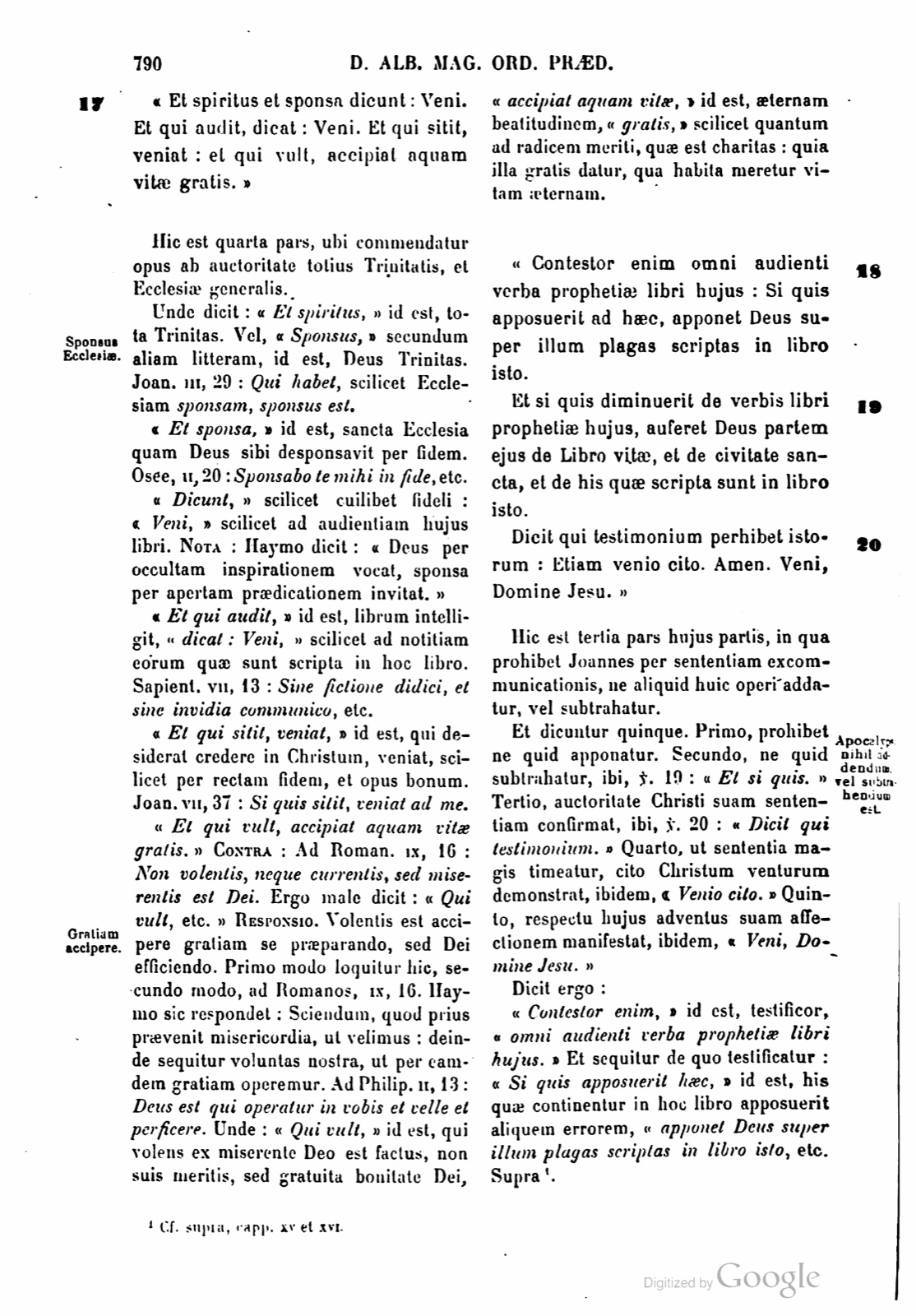
17. "Et spiritus et sponsa dicunt: Veni. Et qui audit, dicat: Veni. Et qui sitit, veniat: et qui vult, accipiat aquam vitae gratis."
Hic est quarta pars, ubi commendatur opus ab auctoritate totius Trinitatis, et Ecclesiae generalis.
Unde dicit: "Et spiritus," id est, tota Trinitas. Vel, [Marginal label: Sponsus Ecclesiae.] "Sponsus," secundum aliam litteram, id est, Deus Trinitas. Joan. III, 29: Qui habet, scilicet Ecclesiam sponsam, sponsus est.
"And poisoners," literally, those who serve poisons as drink to others. Habakkuk 2:15: Woe to him who gives drink to his friend, sending gall.
"And the shameless," that is, the immodest. Jeremiah 3:3: The forehead of a prostitute woman has been made yours, etc.
"And murderers," those who kill with material sword, or with will, or with word, or by withdrawing necessary sustenance. Augustine says: "You did not feed; you killed."
"And those serving idols," as Pagans. Or spiritually, as the greedy. Ephesians 5:3: Every greedy person, which is the service of idols, does not have inheritance, etc.
"And everyone who loves," that is, who willingly hears, "and makes," that is, invents, "a lie." Haymo says: "He is said to love and make a lie who lies with zeal and love of sinning."
16. "I Jesus sent my Angel to testify these things to you in the Churches."
Here the work is commended from the authority of Christ.
And two things are said. First, Christ is introduced, saying that he sent the Angel for the revelation of divine mysteries. Secondly, he describes himself, there, "I am the root of David."
Therefore he says: "I Jesus," supply, am, from whom is all salvation, and therefore one must believe me. "I sent," as Lord, "my Angel," that is, whom I created for my service, "to testify to you," that is, for testifying, "these things in the Churches," namely through John, to whom these things were revealed. Above, 1:1: Sending through his Angel to his servant John. And there follows, verse 4: John to the seven Churches which are in Asia.
"I am the root and stock of David, the splendid and morning star."
Here Christ describes himself. And first, from the divine nature; secondly, from the human, there, "And stock of David;" thirdly, from the most powerful effect which he made in human nature, there, "The splendid star."
Therefore he says: [Marginal label: Root of David.] "I am the root of David," that is, the origin and support of David through divinity, just as the root is the support and origin of a tree, and nourishes it. "And stock of David," because generated from him according to humanity. Romans 1:3: Who was made from the seed of David according to the flesh.
"Star," because he illuminated the night of this world. Likewise, "Splendid," because he excels the splendor of all the Saints. "And morning," because he announced and made the day of grace.
Likewise, "Star," illuminating others by doctrine and preaching; "splendid," in the working of miracles; "morning," in the resurrection. Ecclesiasticus 50:6: Like the morning star in the midst of a cloud.
17. "And the spirit and the bride say: Come. And he who hears, let him say: Come. And he who thirsts, let him come; and he who wills, let him receive the water of life freely."
Here is the fourth part, where the work is commended from the authority of the whole Trinity and of the general Church.
Hence he says: "And the spirit," that is, the whole Trinity. Or, [Marginal label: Bridegroom of the Church.] "Bridegroom," according to another letter, that is, God the Trinity. John 3:29: He who has, namely, the Church as bride, is the bridegroom.
"Et sponsa," id est, sancta Ecclesia quam Deus sibi desponsavit per fidem. Osee, II, 20: Sponsabo te mihi in fide, etc.
"Dicunt," scilicet cuilibet fideli: "Veni," scilicet ad audientiam hujus libri. Nota: Haymo dicit: "Deus per occultam inspirationem vocat, sponsa per apertam praedicationem invitat."
"Et qui audit," id est, librum intelligit, "dicat: Veni," scilicet ad notitiam eorum quae sunt scripta in hoc libro. Sapient. VII, 13: Sine fictione didici, et sine invidia communico, etc.
"Et qui sitit, veniat," id est, qui desiderat credere in Christum, veniat, scilicet per rectam fidem, et opus bonum. Joan. VII, 37: Si quis sitit, veniat ad me.
"Et qui vult, accipiat aquam vitae gratis." CONTRA: Ad Roman. IX, 16: Non volentis, neque currentis, sed miserentis est Dei. Ergo male dicit: "Qui vult, etc." RESPONSIO. [Marginal label: Gratiam accipere.] Volentis est accipere gratiam se praeparando, sed Dei efficiendo. Primo modo loquitur hic, secundo modo, ad Romanos, IX, 16. Haymo sic respondet: Sciendum, quod prius praevenit misericordia, ut velimus: deinde sequitur voluntas nostra, ut per eamdem gratiam operemur. Ad Philip. II, 13: Deus est qui operatur in vobis et velle et perficere. Unde: "Qui vult," id est, qui volens ex miserente Deo est factus, non suis meritis, sed gratuita bonitate Dei, "accipiat aquam vitae," id est, aeternam beatitudinem, "gratis," scilicet quantum ad radicem meriti, quae est charitas: quia illa gratis datur, qua habita meretur vitam aeternam.
18. "Contestor enim omni audienti verba prophetiae libri hujus: Si quis apposuerit ad haec, apponet Deus super illum plagas scriptas in libro isto. 19. Et si quis diminuerit de verbis libri prophetiae hujus, auferet Deus partem ejus de Libro vitae, et de civitate sancta, et de his quae scripta sunt in libro isto. 20. Dicit qui testimonium perhibet istorum: Etiam venio cito. Amen. Veni, Domine Jesu."
Hic est tertia pars hujus partis, in qua prohibet Joannes per sententiam excommunicationis, ne aliquid huic operi addatur, vel subtrahatur.
Et dicuntur quinque. Primo, prohibet ne quid apponatur. Secundo, ne quid subtrahatur, ibi, v. 19: "Et si quis." Tertio, auctoritate Christi suam sententiam confirmat, ibi, v. 20: "Dicit qui testimonium." Quarto, ut sententia magis timeatur, cito Christum venturum demonstrat, ibidem, "Venio cito." Quinto, respectu hujus adventus suam affectionem manifestat, ibidem, "Veni, Domine Jesu."
Dicit ergo: [Marginal label: Apocalypsi nihil addendum, vel subtrahendum est.] "Contestor enim," id est, testificor, "omni audienti verba prophetiae libri hujus." Et sequitur de quo testificatur: "Si quis apposuerit ad haec," id est, his quae continentur in hoc libro apposuerit aliquem errorem, "apponet Deus super illum plagas scriptas in libro isto, etc." Supra 1.
"And the bride," that is, holy Church, whom God betrothed to himself through faith. Hosea 2:20: I will betroth you to me in faith, etc.
"They say," namely to any faithful person, "Come," namely to the hearing of this book. Note: Haymo says: "God calls through hidden inspiration; the bride invites through open preaching."
"And he who hears," that is, understands the book, "let him say: Come," namely to knowledge of those things which are written in this book. Wisdom 7:13: Without fiction I learned, and without envy I communicate, etc.
"And he who thirsts, let him come," that is, he who desires to believe in Christ, let him come, namely through right faith and good work. John 7:37: If anyone thirsts, let him come to me.
"And he who wills, let him receive the water of life freely." TO THE CONTRARY: Romans 9:16: It is not of the one willing, nor of the one running, but of God showing mercy. Therefore he says badly: "He who wills, etc." RESPONSE. [Marginal label: To receive grace.] It belongs to the one willing to receive grace by preparing himself, but it belongs to God by effecting it. He speaks here in the first way, but in the second way, in Romans 9:16. Haymo responds thus: It must be known that mercy first anticipates, so that we may will; then our will follows, so that through the same grace we may work. Philippians 2:13: God is the one who works in you both to will and to accomplish. Hence: "He who wills," that is, he who has been made willing from God showing mercy, not by his own merits, but by the freely given goodness of God, "let him receive the water of life," that is, eternal beatitude, "freely," namely with respect to the root of merit, which is charity; because that is given freely, and when it has been had, eternal life is merited.
18. "For I testify to everyone hearing the words of the prophecy of this book: If anyone adds to these things, God will add upon him the plagues written in this book. 19. And if anyone takes away from the words of the book of this prophecy, God will take away his part from the Book of life, and from the holy city, and from these things which are written in this book. 20. He who gives testimony of these things says: Indeed I come soon. Amen. Come, Lord Jesus."
Here is the third part of this part, in which John forbids through a sentence of excommunication that anything be added to this work or subtracted from it.
And five things are said. First, he forbids that anything be added. Secondly, that anything be subtracted, there at verse 19: "And if anyone." Thirdly, by the authority of Christ he confirms his sentence, there at verse 20: "He who gives testimony." Fourthly, so that the sentence may be more feared, he shows that Christ will come soon, in the same place, "I come soon." Fifthly, with respect to this coming, he manifests his affection, in the same place, "Come, Lord Jesus."
Therefore he says: [Marginal label: Nothing is to be added to, or subtracted from, the Apocalypse.] "For I testify," that is, I bear witness, "to everyone hearing the words of the prophecy of this book." And there follows concerning what he testifies: "If anyone adds to these things," that is, adds some error to the things which are contained in this book, "God will add upon him the plagues written in this book, etc." Above 1.
Notes
- Cf. above, chapters 15 and 16. (Cf. supra, capp. XV et XVI.) ↩
If a page does not appear, its photograph has not been uploaded yet.