Works › Commentary on the Apocalypse of Blessed John
Volume 38 · pp. 791–792
Exposition on Chapter XXII of the Apocalypse, ending and doubtful points
A marker with ≈ is an approximate page boundary, placed by measure of the text; the page photographs remain the authority. In the paired views, clicking a page marker brings that page into view.
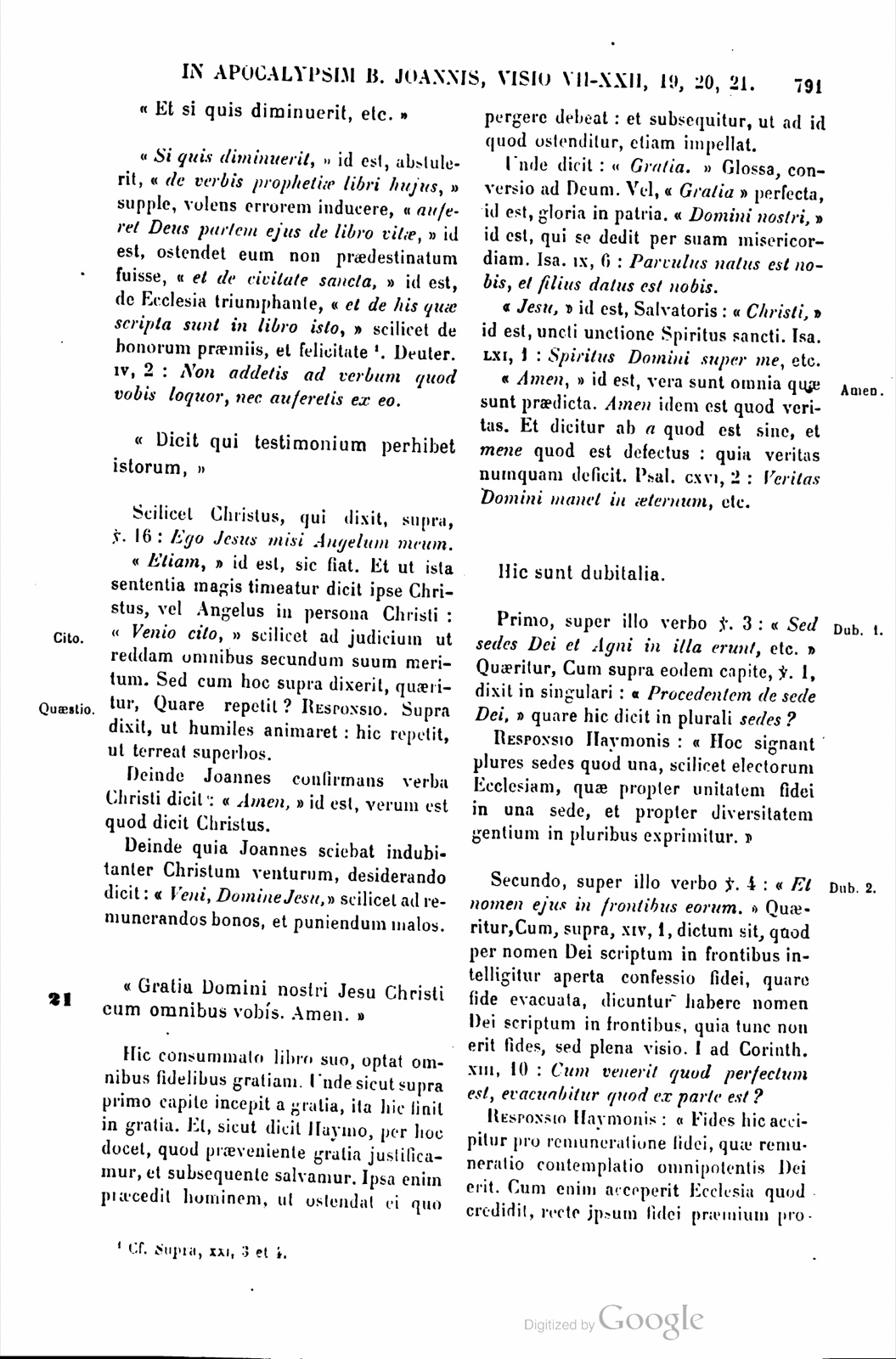
"Et si quis diminuerit, etc."
"Si quis diminuerit," id est, abstulerit, "de verbis prophetiae libri hujus," supple, volens errorem inducere, "auferet Deus partem ejus de libro vitae," id est, ostendet eum non praedestinatum fuisse, "et de civitate sancta," id est, de Ecclesia triumphante, "et de his quae scripta sunt in libro isto," scilicet de bonorum praemiis, et felicitate 1. Deuter. IV, 2: Non addetis ad verbum quod vobis loquor, nec auferetis ex eo.
"Dicit qui testimonium perhibet istorum,"
Scilicet Christus, qui dixit, supra, v. 16: Ego Jesus misi Angelum meum.
"Etiam," id est, sic fiat. Et ut ista sententia magis timeatur dicit ipse Christus, vel Angelus in persona Christi: [Marginal label: Cito.] "Venio cito," scilicet ad judicium ut reddam omnibus secundum suum meritum. Sed cum hoc supra dixerit, quaeritur, Quare repetit? RESPONSIO. [Marginal label: Quaestio.] Supra dixit, ut humiles animaret: hic repetit, ut terreat superbos.
Deinde Joannes confirmans verba Christi dicit: "Amen," id est, verum est quod dicit Christus.
Deinde quia Joannes sciebat indubitanter Christum venturum, desiderando dicit: "Veni, Domine Jesu," scilicet ad remunerandos bonos, et puniendum malos.
21. "Gratia Domini nostri Jesu Christi cum omnibus vobis. Amen."
Hic consummato libro suo, optat omnibus fidelibus gratiam. Unde sicut supra primo capite incepit a gratia, ita hic finit in gratia. Et, sicut dicit Haymo, per hoc docet, quod praeveniente gratia justificamur, et subsequente salvamur. Ipsa enim praecedit hominem, ut ostendat ei quo pergere debeat: et subsequitur, ut ad id quod ostenditur, etiam impellat.
Unde dicit: "Gratia." Glossa, conversio ad Deum. Vel, "Gratia" perfecta, id est, gloria in patria. "Domini nostri," id est, qui se dedit per suam misericordiam. Isa. IX, 6: Parvulus natus est nobis, et filius datus est nobis.
"Jesu," id est, Salvatoris: "Christi," id est, uncti unctione Spiritus sancti. Isa. LXI, 1: Spiritus Domini super me, etc.
"Amen," id est, vera sunt omnia quae sunt praedicta. [Marginal label: Amen.] Amen idem est quod veritas. Et dicitur ab a quod est sine, et mene quod est defectus: quia veritas numquam deficit. Psal. CXVI, 2: Veritas Domini manet in aeternum, etc.
Hic sunt dubitabilia.
Primo, super illo verbo v. 3: "Sed sedes Dei et Agni in illa erunt, etc." [Marginal label: Dub. 1.] Quaeritur, Cum supra eodem capite, v. 1, dixit in singulari: "Procedentem de sede Dei," quare hic dicit in plurali sedes?
RESPONSIO Haymonis: "Hoc signant plures sedes quod una, scilicet electorum Ecclesiam, quae propter unitatem fidei in una sede, et propter diversitatem gentium in pluribus exprimitur."
Secundo, super illo verbo v. 4: "Et nomen ejus in frontibus eorum." [Marginal label: Dub. 2.] Quaeritur, Cum, supra, XIV, 1, dictum sit, quod per nomen Dei scriptum in frontibus intelligitur aperta confessio fidei, quare fide evacuata, dicuntur habere nomen Dei scriptum in frontibus, quia tunc non erit fides, sed plena visio. I ad Corinth. XIII, 10: Cum venerit quod perfectum est, evacuabitur quod ex parte est?
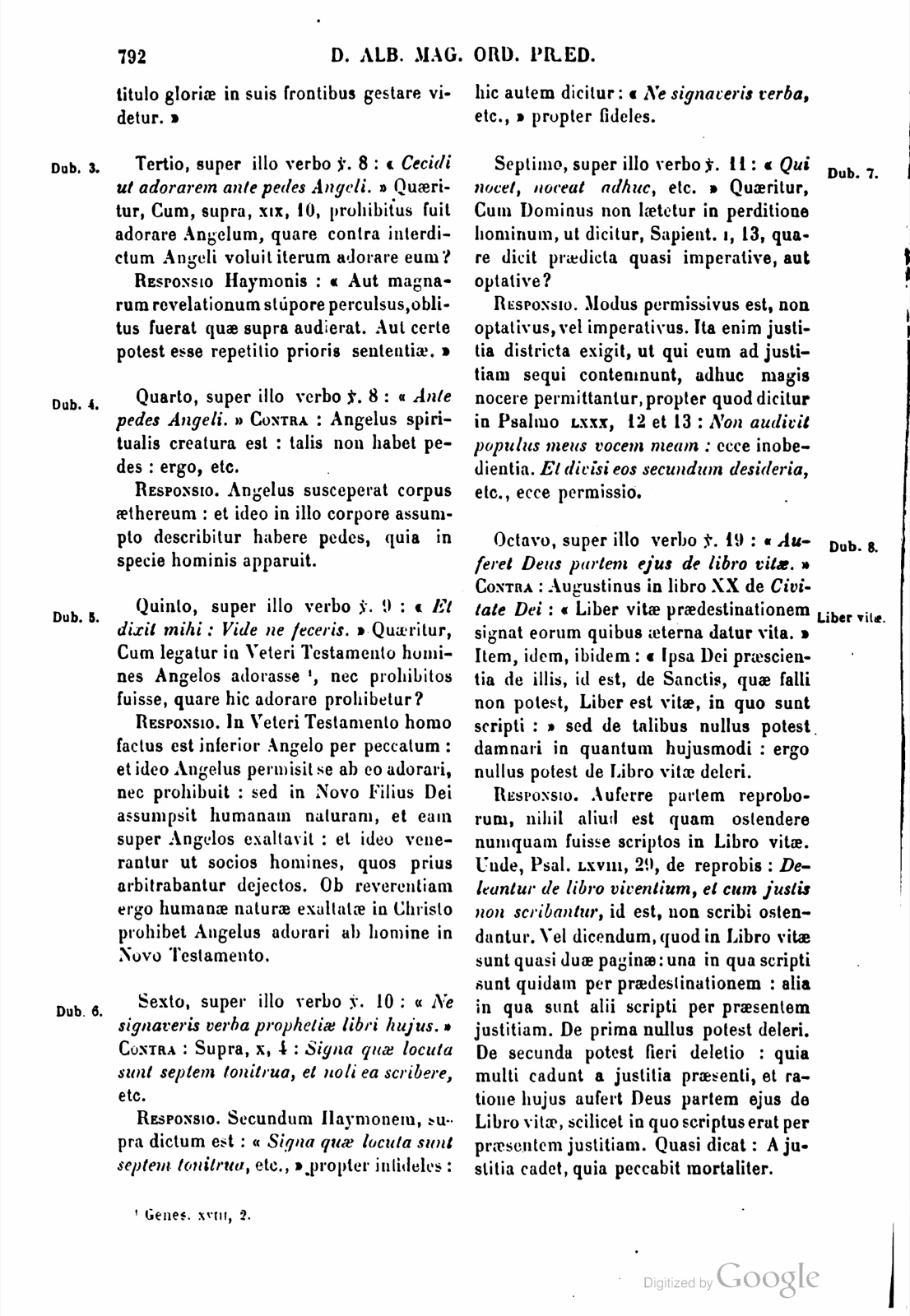
RESPONSIO Haymonis: "Fides hic accipitur pro remuneratione fidei, quae remuneratio contemplatio omnipotentis Dei erit. Cum enim acceperit Ecclesia quod credidit, recte ipsum fidei praemium pro titulo gloriae in suis frontibus gestare videtur."
Tertio, super illo verbo v. 8: "Cecidi ut adorarem ante pedes Angeli." [Marginal label: Dub. 3.] Quaeritur, Cum, supra, XIX, 10, prohibitus fuit adorare Angelum, quare contra interdictum Angeli voluit iterum adorare eum?
"And if anyone takes away, etc."
"If anyone takes away," that is, removes, "from the words of the prophecy of this book," supply, wishing to introduce error, "God will take away his part from the book of life," that is, he will show that he was not predestined, "and from the holy city," that is, from the Church triumphant, "and from these things which are written in this book," namely from the rewards and happiness of the good 1. Deuteronomy 4:2: You shall not add to the word which I speak to you, nor shall you take away from it.
"He who gives testimony of these things says,"
Namely Christ, who said above, verse 16: I Jesus sent my Angel.
"Indeed," that is, so let it be. And so that this sentence may be more feared, Christ himself says, or the Angel in the person of Christ: [Marginal label: Soon.] "I come soon," namely to judgment, so that I may render to all according to their merit. But since he said this above, it is asked, Why does he repeat it? RESPONSE. [Marginal label: Question.] Above he said it so that he might encourage the humble; here he repeats it so that he may terrify the proud.
Then John, confirming the words of Christ, says: "Amen," that is, what Christ says is true.
Then because John knew without doubting that Christ would come, by desiring he says: "Come, Lord Jesus," namely for rewarding the good and punishing the evil.
21. "The grace of our Lord Jesus Christ be with all of you. Amen."
Here, when his book has been consummated, he wishes grace to all the faithful. Hence just as above in the first chapter he began from grace, so here he ends in grace. And, as Haymo says, through this he teaches that by grace going before we are justified, and by grace following after we are saved. For grace precedes man, so that it may show him where he ought to go; and it follows after, so that it may also impel him toward that which is shown.
Hence he says: "Grace." The Gloss says, conversion to God. Or, perfect "grace," that is, glory in the homeland. "Of our Lord," that is, who gave himself through his mercy. Isaiah 9:6: A little child has been born to us, and a son has been given to us.
"Jesus," that is, Savior; "Christ," that is, anointed with the anointing of the Holy Spirit. Isaiah 61:1: The Spirit of the Lord is upon me, etc.
"Amen," that is, all things which have been said before are true. [Marginal label: Amen.] Amen is the same as truth. And it is said from a, which is without, and mene, which is defect, because truth never fails. Psalm 116:2: The truth of the Lord remains forever, etc.
Here are the doubtful points.
First, concerning that word in verse 3: "But the seats of God and of the Lamb will be in it, etc." [Marginal label: Dub. 1.] It is asked, Since above in the same chapter, verse 1, he said in the singular, "Proceeding from the seat of God," why here does he say seats in the plural?
RESPONSE of Haymo: "The many seats signify this same thing as one, namely the Church of the elect, which because of the unity of faith is expressed in one seat, and because of the diversity of nations in many."
Secondly, concerning that word in verse 4: "And his name on their foreheads." [Marginal label: Dub. 2.] It is asked, Since above, 14:1, it was said that by the name of God written on the foreheads open confession of faith is understood, why, when faith has been emptied out, are they said to have the name of God written on their foreheads, since then there will not be faith, but full vision? 1 Corinthians 13:10: When that which is perfect has come, that which is partial will be emptied out?
RESPONSE of Haymo: "Faith is here taken for the remuneration of faith, which remuneration will be the contemplation of almighty God. For when the Church has received what it believed, rightly it seems to bear the very reward of faith as a title of glory on its foreheads."
Thirdly, concerning that word in verse 8: "I fell down to adore before the feet of the Angel." [Marginal label: Dub. 3.] It is asked, Since above, 19:10, he was forbidden to adore the Angel, why, contrary to the Angel's prohibition, did he wish again to adore him?
RESPONSIO Haymonis: "Aut magnarum revelationum stupore perculsus, oblitus fuerat quae supra audierat. Aut certe potest esse repetitio prioris sententiae."
Quarto, super illo verbo v. 8: "Ante pedes Angeli." [Marginal label: Dub. 4.] CONTRA: Angelus spiritualis creatura est: talis non habet pedes: ergo, etc.
RESPONSIO. Angelus susceperat corpus aethereum: et ideo in illo corpore assumpto describitur habere pedes, quia in specie hominis apparuit.
Quinto, super illo verbo v. 9: "Et dixit mihi: Vide ne feceris." [Marginal label: Dub. 5.] Quaeritur, Cum legatur in Veteri Testamento homines Angelos adorasse 2, nec prohibitos fuisse, quare hic adorare prohibetur?
RESPONSIO. In Veteri Testamento homo factus est inferior Angelo per peccatum: et ideo Angelus permisit se ab eo adorari, nec prohibuit: sed in Novo Filius Dei assumpsit humanam naturam, et eam super Angelos exaltavit: et ideo venerantur ut socios homines, quos prius arbitrabantur dejectos. Ob reverentiam ergo humanae naturae exaltatae in Christo prohibet Angelus adorari ab homine in Novo Testamento.
Sexto, super illo verbo v. 10: "Ne signaveris verba prophetiae libri hujus." [Marginal label: Dub. 6.] CONTRA: Supra, X, 4: Signa quae locuta sunt septem tonitrua, et noli ea scribere, etc.
RESPONSIO. Secundum Haymonem, supra dictum est: "Signa quae locuta sunt septem tonitrua, etc.," propter infideles: hic autem dicitur: "Ne signaveris verba, etc.," propter fideles.
Septimo, super illo verbo v. 11: "Qui nocet, noceat adhuc, etc." [Marginal label: Dub. 7.] Quaeritur, Cum Dominus non laetetur in perditione hominum, ut dicitur, Sapient. I, 13, quare dicit praedicta quasi imperative, aut optative?
RESPONSIO. Modus permissivus est, non optativus, vel imperativus. Ita enim justitia districta exigit, ut qui eum ad justitiam sequi contemnunt, adhuc magis nocere permittantur, propter quod dicitur in Psalmo LXXX, 12 et 13: Non audivit populus meus vocem meam: ecce inobedientia. Et dimisi eos secundum desideria, etc., ecce permissio.
Octavo, super illo verbo v. 19: "Auferet Deus partem ejus de libro vitae." [Marginal label: Dub. 8.] CONTRA: Augustinus in libro XX de Civitate Dei: "Liber vitae praedestinationem signat eorum quibus aeterna datur vita." [Marginal label: Liber vitae.] Item, idem, ibidem: "Ipsa Dei praescientia de illis, id est, de Sanctis, quae falli non potest, Liber est vitae, in quo sunt scripti:" sed de talibus nullus potest damnari in quantum hujusmodi: ergo nullus potest de Libro vitae deleri.
RESPONSIO. Auferre partem reproborum, nihil aliud est quam ostendere numquam fuisse scriptos in Libro vitae. Unde, Psal. LXVIII, 29, de reprobis: Deleantur de libro viventium, et cum justis non scribantur, id est, non scribi ostendantur. Vel dicendum, quod in Libro vitae sunt quasi duae paginae: una in qua scripti sunt quidam per praedestinationem: alia in qua sunt alii scripti per praesentem justitiam. De prima nullus potest deleri. De secunda potest fieri deletio: quia multi cadunt a justitia praesenti, et ratione hujus aufert Deus partem ejus de Libro vitae, scilicet in quo scriptus erat per praesentem justitiam. Quasi dicat: A justitia cadet, quia peccabit mortaliter.
RESPONSE of Haymo: "Either, struck by the stupor of great revelations, he had forgotten what he had heard above. Or certainly it can be a repetition of the former sentence."
Fourthly, concerning that word in verse 8: "Before the feet of the Angel." [Marginal label: Dub. 4.] TO THE CONTRARY: An Angel is a spiritual creature; such a creature does not have feet; therefore, etc.
RESPONSE. The Angel had taken on an ethereal body; and therefore in that assumed body he is described as having feet, because he appeared in the appearance of a man.
Fifthly, concerning that word in verse 9: "And he said to me: See that you do not do it." [Marginal label: Dub. 5.] It is asked, Since in the Old Testament men are read to have adored Angels 2, and not to have been forbidden, why is adoring forbidden here?
RESPONSE. In the Old Testament man was made lower than an Angel through sin; and therefore the Angel permitted himself to be adored by him, and did not forbid it. But in the New, the Son of God assumed human nature and exalted it above the Angels; and therefore Angels venerate as companions the men whom they formerly judged cast down. Therefore out of reverence for human nature exalted in Christ, the Angel forbids himself to be adored by a man in the New Testament.
Sixthly, concerning that word in verse 10: "Do not seal the words of the prophecy of this book." [Marginal label: Dub. 6.] TO THE CONTRARY: Above, 10:4: Seal the things which the seven thunders spoke, and do not write them, etc.
RESPONSE. According to Haymo, above it was said, "Seal the things which the seven thunders spoke, etc.," because of unbelievers; but here it is said, "Do not seal the words, etc.," because of the faithful.
Seventhly, concerning that word in verse 11: "He who harms, let him harm still, etc." [Marginal label: Dub. 7.] It is asked, Since the Lord does not rejoice in the destruction of men, as is said in Wisdom 1:13, why does he say the aforesaid things as if imperatively or optatively?
RESPONSE. The mode is permissive, not optative or imperative. For strict justice so requires that those who despise following him toward justice are permitted to harm still more; because of this it is said in Psalm 80:12 and 13: My people did not hear my voice: behold disobedience. And I dismissed them according to their desires, etc.; behold permission.
Eighthly, concerning that word in verse 19: "God will take away his part from the book of life." [Marginal label: Dub. 8.] TO THE CONTRARY: Augustine in book 20 On the City of God says: "The book of life signifies the predestination of those to whom eternal life is given." [Marginal label: The book of life.] Likewise, the same author in the same place says: "The very foreknowledge of God concerning them, that is, concerning the Saints, which cannot be deceived, is the Book of life, in which they are written." But no one from such persons can be damned insofar as he is of this sort; therefore no one can be blotted out from the Book of life.
RESPONSE. To take away the part of the reprobate is nothing other than to show that they were never written in the Book of life. Hence Psalm 68:29, concerning the reprobate: Let them be blotted out from the book of the living, and not be written with the just, that is, let them be shown not to be written. Or it must be said that in the Book of life there are as it were two pages: one in which certain persons are written through predestination; another in which others are written through present justice. From the first no one can be blotted out. From the second, blotting out can happen, because many fall from present justice, and by reason of this God takes away his part from the Book of life, namely in which he had been written through present justice. As if he said: He will fall from justice, because he will sin mortally.
If a page does not appear, its photograph has not been uploaded yet.