Works › Commentary on the Apocalypse of Blessed John
Volume 38 · pp. 784–786
Exposition on Chapter XXII of the Apocalypse, verses 1-5
A marker with ≈ is an approximate page boundary, placed by measure of the text; the page photographs remain the authority. In the paired views, clicking a page marker brings that page into view.
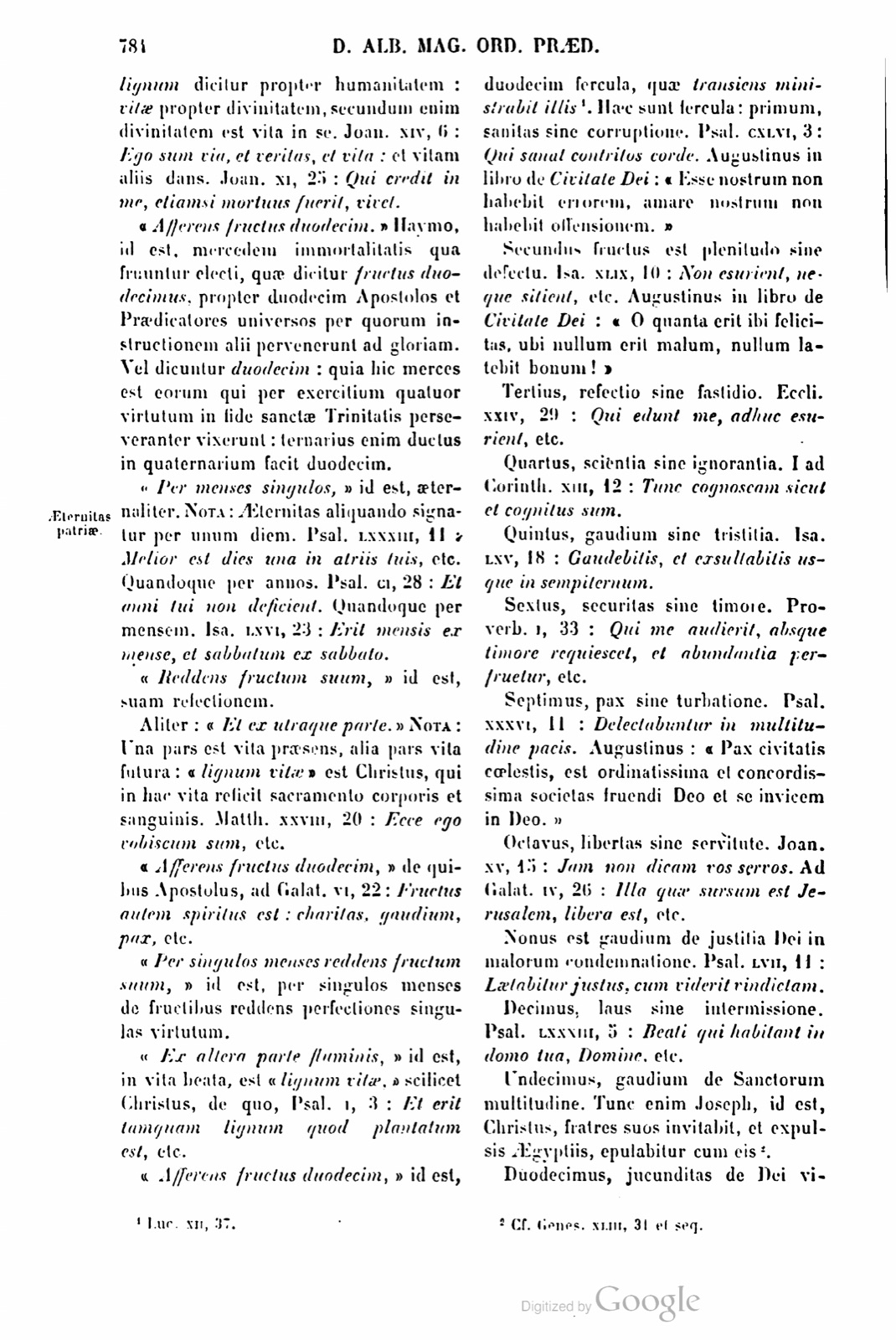
lignum dicitur propter humanitatem: vitae propter divinitatem, secundum enim divinitatem est vita in se. Joan. XIV, 6: Ego sum via, et veritas, et vita: et vitam aliis dans. Joan. XI, 25: Qui credit in me, etiamsi mortuus fuerit, vivet.
"Afferens fructus duodecim." Haymo, id est, mercedem immortalitatis qua fruuntur electi, quae dicitur fructus duodecimus, propter duodecim Apostolos et Praedicatores universos per quorum instructionem alii pervenerunt ad gloriam. Vel dicuntur duodecim: quia haec merces est eorum qui per exercitium quatuor virtutum in fide sanctae Trinitatis perseveranter vixerunt: ternarius enim ductus in quaternarium facit duodecim.
"Per menses singulos," id est, aeternaliter. [Marginal label: Aeternitas patriae.] NOTA: Aeternitas aliquando signatur per unum diem. Psal. LXXXIII, 11: Melior est dies una in atriis tuis, etc. Quandoque per annos. Psal. CI, 28: Et anni tui non deficient. Quandoque per mensem. Isa. LXVI, 23: Erit mensis ex mense, et sabbatum ex sabbato.
"Reddens fructum suum," id est, suam refectionem.
Aliter: "Et ex utraque parte." NOTA: Una pars est vita praesens, alia pars vita futura: "lignum vitae" est Christus, qui in hac vita reficit sacramento corporis et sanguinis. Matth. XXVIII, 20: Ecce ego vobiscum sum, etc.
"Afferens fructus duodecim," de quibus Apostolus, ad Galat. V, 22: Fructus autem spiritus est: charitas, gaudium, pax, etc.
"Per singulos menses reddens fructum suum," id est, per singulos menses de fructibus reddens perfectiones singulas virtutum.
"Ex altera parte fluminis," id est, in vita beata, est "lignum vitae," scilicet Christus, de quo, Psal. I, 3: Et erit tamquam lignum quod plantatum est, etc.
"Afferens fructus duodecim," id est, duodecim fercula, quae transiens ministrabit illis 1. Haec sunt fercula: primum, sanitas sine corruptione. Psal. CXLVI, 3: Qui sanat contritos corde. Augustinus in libro de Civitate Dei: "Esse nostrum non habebit errorem, amare nostrum non habebit offensionem."
Secundus fructus est plenitudo sine defectu. Isa. XLIX, 10: Non esurient, neque sitient, etc. Augustinus in libro de Civitate Dei: "O quanta erit ibi felicitas, ubi nullum erit malum, nullum latebit bonum!"
Tertius, refectio sine fastidio. Eccli. XXIV, 29: Qui edunt me, adhuc esurient, etc.
Quartus, scientia sine ignorantia. I ad Corinth. XIII, 12: Tunc cognoscam sicut et cognitus sum.
Quintus, gaudium sine tristitia. Isa. LXV, 18: Gaudebitis, et exsultabitis usque in sempiternum.
Sextus, securitas sine timore. Proverb. I, 33: Qui me audierit, absque timore requiescet, et abundantia perfruetur, etc.
Septimus, pax sine turbatione. Psal. XXXVI, 11: Delectabuntur in multitudine pacis. Augustinus: "Pax civitatis coelestis, est ordinatissima et concordissima societas fruendi Deo et se invicem in Deo."
it is called a tree because of the humanity; of life because of the divinity, for according to divinity he is life in himself. John 14:6: I am the way, and the truth, and the life; and giving life to others. John 11:25: He who believes in me, even if he has died, will live.
"Bearing twelve fruits." Haymo says, that is, the reward of immortality which the elect enjoy, which is called the twelfth fruit because of the twelve Apostles and all Preachers, through whose instruction others came through to glory. Or they are called twelve because this reward belongs to those who through the exercise of the four virtues lived perseveringly in the faith of the holy Trinity; for three led into four makes twelve.
"Through individual months," that is, eternally. [Marginal label: The eternity of the homeland.] NOTE: Eternity is sometimes signified by one day. Psalm 83:11: Better is one day in your courts, etc. Sometimes by years. Psalm 101:28: And your years will not fail. Sometimes by a month. Isaiah 66:23: There will be month from month, and sabbath from sabbath.
"Rendering its fruit," that is, its refreshment.
Otherwise: "And on each side." NOTE: One side is the present life, the other side the future life; "the tree of life" is Christ, who in this life refreshes by the sacrament of his body and blood. Matthew 28:20: Behold, I am with you, etc.
"Bearing twelve fruits," concerning which the Apostle says, Galatians 5:22: But the fruit of the spirit is charity, joy, peace, etc.
"Rendering its fruit through individual months," that is, through individual months rendering, from the fruits, individual perfections of virtues.
"On the other side of the river," that is, in blessed life, there is "the tree of life," namely Christ, concerning whom, Psalm 1:3: And he will be like a tree that has been planted, etc.
"Bearing twelve fruits," that is, twelve courses, which, passing by, he will minister to them 1. These are the courses: first, health without corruption. Psalm 146:3: He who heals the contrite in heart. Augustine in the book On the City of God: "Our being will not have error, our loving will not have offense."
The second fruit is fullness without defect. Isaiah 49:10: They will not hunger, nor thirst, etc. Augustine in the book On the City of God: "O how great will be the happiness there, where there will be no evil, no good will lie hidden!"
The third, refreshment without satiety. Ecclesiasticus 24:29: Those who eat me will still hunger, etc.
The fourth, knowledge without ignorance. 1 Corinthians 13:12: Then I shall know as also I am known.
The fifth, joy without sadness. Isaiah 65:18: You will rejoice and exult even forever.
The sixth, security without fear. Proverbs 1:33: He who has heard me will rest without fear, and will enjoy abundance, etc.
The seventh, peace without disturbance. Psalm 36:11: They will delight in the multitude of peace. Augustine says: "The peace of the heavenly city is the most ordered and most harmonious fellowship of enjoying God and one another in God."
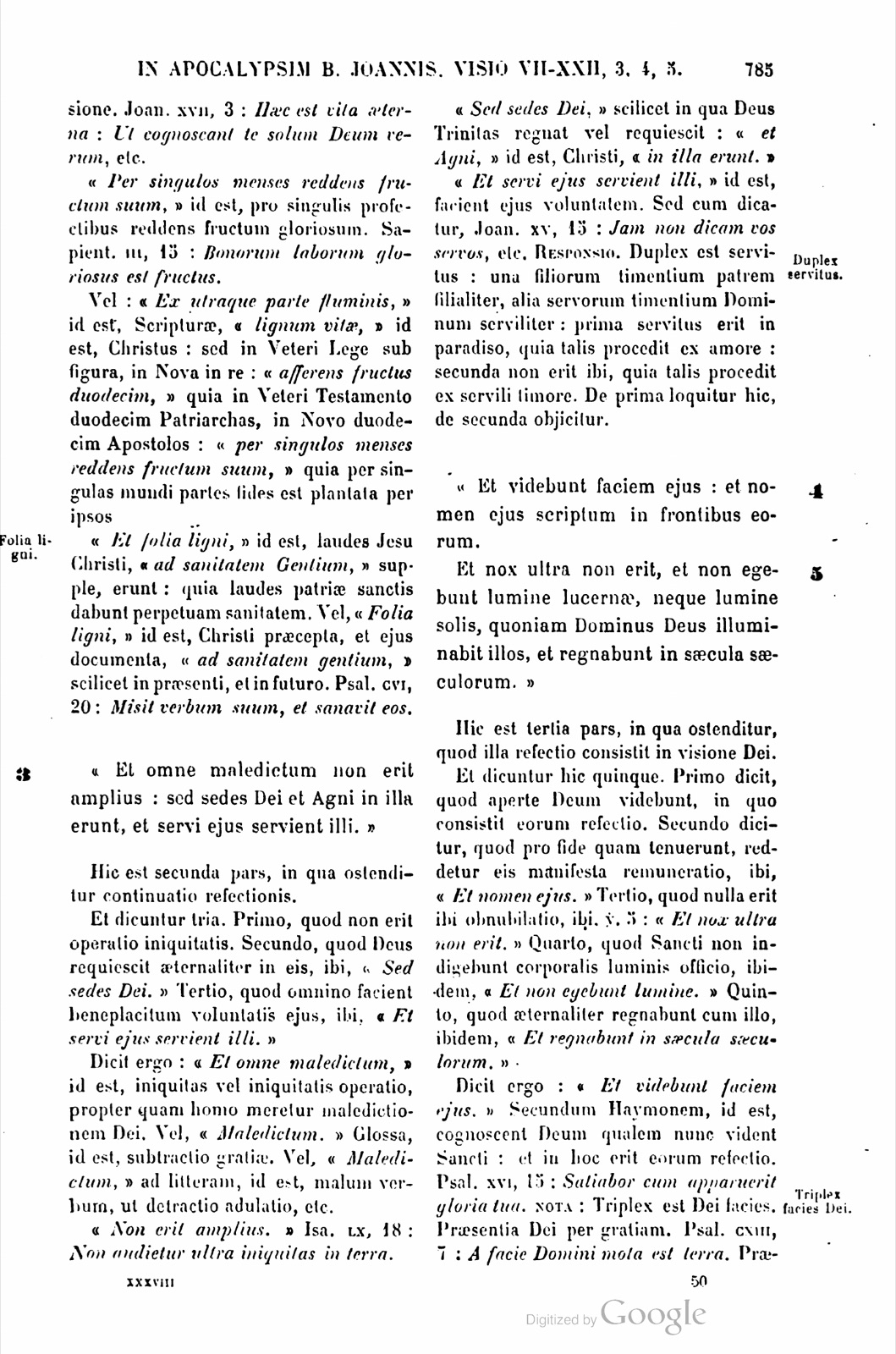
Octavus, libertas sine servitute. Joan. XV, 15: Jam non dicam vos servos. Ad Galat. IV, 26: Illa quae sursum est Jerusalem, libera est, etc.
Nonus est gaudium de justitia Dei in malorum condemnatione. Psal. LVII, 11: Laetabitur justus, cum viderit vindictam.
Decimus, laus sine intermissione. Psal. LXXXIII, 5: Beati qui habitant in domo tua, Domine, etc.
Undecimus, gaudium de Sanctorum multitudine. Tunc enim Joseph, id est, Christus, fratres suos invitabit, et expulsis Aegyptiis, epulabitur cum eis 2.
Duodecimus, jucunditas de Dei visione. Joan. XVII, 3: Haec est vita aeterna: Ut cognoscant te solum Deum verum, etc.
"Per singulos menses reddens fructum suum," id est, pro singulis profectibus reddens fructum gloriosum. Sapient. III, 15: Bonorum laborum gloriosus est fructus.
Vel: "Ex utraque parte fluminis," id est, Scripturae, "lignum vitae," id est, Christus: sed in Veteri Lege sub figura, in Nova in re: "afferens fructus duodecim," quia in Veteri Testamento duodecim Patriarchas, in Novo duodecim Apostolos: "per singulos menses reddens fructum suum," quia per singulas mundi partes fides est plantata per ipsos.
[Marginal label: Folia ligni.] "Et folia ligni," id est, laudes Jesu Christi, "ad sanitatem Gentium," supple, erunt: quia laudes patriae sanctis dabunt perpetuam sanitatem. Vel, "Folia ligni," id est, Christi praecepta, et ejus documenta, "ad sanitatem gentium," scilicet in praesenti, et in futuro. Psal. CVI, 20: Misit verbum suum, et sanavit eos.
3. "Et omne maledictum non erit amplius: sed sedes Dei et Agni in illa erunt, et servi ejus servient illi."
Hic est secunda pars, in qua ostenditur continuatio refectionis.
Et dicuntur tria. Primo, quod non erit ibi operatio iniquitatis. Secundo, quod Deus requiescit aeternaliter in eis, ibi, "Sed sedes Dei." Tertio, quod omnino facient beneplacitum voluntatis ejus, ibi, "Et servi ejus servient illi."
Dicit ergo: "Et omne maledictum," id est, iniquitas vel iniquitatis operatio, propter quam homo meretur maledictionem Dei. Vel, "Maledictum." Glossa, id est, subtractio gratiae. Vel, "Maledictum," ad litteram, id est, malum verbum, ut detractio, adulatio, etc.
"Non erit amplius." Isa. LX, 18: Non audietur ultra iniquitas in terra.
"Sed sedes Dei," scilicet in qua Deus Trinitas regnat vel requiescit: "et Agni," id est, Christi, "in illa erunt."
"Et servi ejus servient illi," id est, facient ejus voluntatem. Sed cum dicatur, Joan. XV, 15: Jam non dicam vos servos, etc. RESPONSIO. [Marginal label: Duplex servitus.] Duplex est servitus: una filiorum timentium patrem filialiter, alia servorum timentium Dominum serviliter: prima servitus erit in paradiso, quia talis procedit ex amore: secunda non erit ibi, quia talis procedit ex servili timore. De prima loquitur hic, de secunda objicitur.
The eighth, liberty without servitude. John 15:15: Now I will not call you servants. Galatians 4:26: That Jerusalem which is above is free, etc.
The ninth is joy concerning the justice of God in the condemnation of the evil. Psalm 57:11: The just one will rejoice when he has seen vengeance.
The tenth, praise without interruption. Psalm 83:5: Blessed are those who dwell in your house, Lord, etc.
The eleventh, joy concerning the multitude of Saints. For then Joseph, that is, Christ, will invite his brothers, and when the Egyptians have been sent out, will feast with them 2.
The twelfth, pleasantness from the vision of God. John 17:3: This is eternal life: That they may know you, the only true God, etc.
"Rendering its fruit through individual months," that is, rendering a glorious fruit for individual advancements. Wisdom 3:15: The fruit of good labors is glorious.
Or: "On each side of the river," that is, of Scripture, "the tree of life," that is, Christ: but in the Old Law under a figure, in the New in reality; "bearing twelve fruits," because in the Old Testament the twelve Patriarchs, in the New the twelve Apostles; "rendering its fruit through individual months," because faith was planted through the individual parts of the world by them.
[Marginal label: The leaves of the tree.] "And the leaves of the tree," that is, the praises of Jesus Christ, "for the health of the nations," supply, will be, because the praises of the homeland will give perpetual health to the Saints. Or, "The leaves of the tree," that is, the precepts of Christ and his teachings, "for the health of the nations," namely in the present and in the future. Psalm 106:20: He sent his word, and healed them.
3. "And every curse will be no more; but the seats of God and of the Lamb will be in it, and his servants will serve him."
Here is the second part, in which the continuation of refreshment is shown.
And three things are said. First, that there will not be the operation of iniquity there. Secondly, that God rests eternally in them, there, "But the seats of God." Thirdly, that they will do altogether the good pleasure of his will, there, "And his servants will serve him."
Therefore he says: "And every curse," that is, iniquity or the operation of iniquity, because of which a man merits the curse of God. Or, "Curse." The Gloss says, that is, the withdrawal of grace. Or, "Curse," literally, that is, an evil word, as detraction, flattery, etc.
"Will be no more." Isaiah 60:18: Iniquity will no longer be heard in the land.
"But the seats of God," namely in which God the Trinity reigns or rests, "and of the Lamb," that is, of Christ, "will be in it."
"And his servants will serve him," that is, they will do his will. But since it is said, John 15:15: Now I will not call you servants, etc. RESPONSE. [Marginal label: A twofold servitude.] Servitude is twofold: one of sons fearing their father filially, another of servants fearing the Lord servilely. The first servitude will be in paradise, because such servitude proceeds from love; the second will not be there, because such servitude proceeds from servile fear. He is speaking here about the first; the objection is made concerning the second.
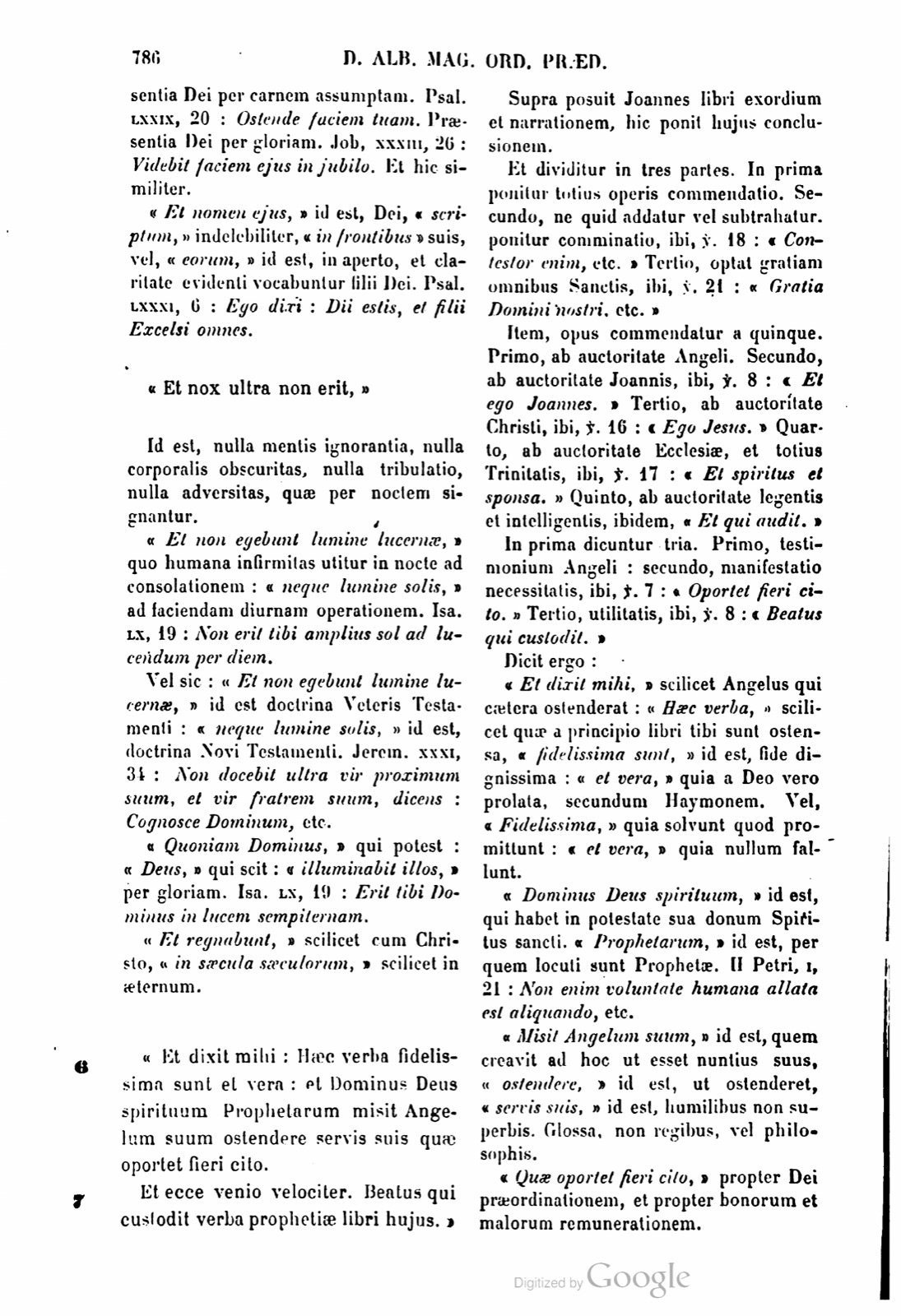
4. "Et videbunt faciem ejus: et nomen ejus scriptum in frontibus eorum. 5. Et nox ultra non erit, et non egebunt lumine lucernae, neque lumine solis, quoniam Dominus Deus illuminabit illos, et regnabunt in saecula saeculorum."
Hic est tertia pars, in qua ostenditur, quod illa refectio consistit in visione Dei.
Et dicuntur hic quinque. Primo dicit, quod aperte Deum videbunt, in quo consistit eorum refectio. Secundo dicitur, quod pro fide quam tenuerunt, reddetur eis manifesta remuneratio, ibi, "Et nomen ejus." Tertio, quod nulla erit ibi obnubilatio, ibi, v. 5: "Et nox ultra non erit." Quarto, quod Sancti non indigebunt corporalis luminis officio, ibidem, "Et non egebunt lumine." Quinto, quod aeternaliter regnabunt cum illo, ibidem, "Et regnabunt in saecula saeculorum."
Dicit ergo: "Et videbunt faciem ejus." Secundum Haymonem, id est, cognoscent Deum qualem nunc vident Sancti: et in hoc erit eorum refectio. Psal. XVI, 15: Satiabor cum apparuerit gloria tua. [Marginal label: Triplex facies Dei.] NOTA: Triplex est Dei facies. Praesentia Dei per gratiam. Psal. CXIII, 7: A facie Domini mota est terra. Praesentia Dei per carnem assumptam. Psal. LXXIX, 20: Ostende faciem tuam. Praesentia Dei per gloriam. Job. XXX, 26: Videbit faciem ejus in jubilo. Et hic similiter.
"Et nomen ejus," id est, Dei, "scriptum," indelebiliter, "in frontibus suis," vel, "eorum," id est, in aperto, et claritate evidenti vocabuntur filii Dei. Psal. LXXXI, 6: Ego dixi: Dii estis, et filii Excelsi omnes.
"Et nox ultra non erit,"
Id est, nulla mentis ignorantia, nulla corporalis obscuritas, nulla tribulatio, nulla adversitas, quae per noctem signantur.
"Et non egebunt lumine lucernae," quo humana infirmitas utitur in nocte ad consolationem: "neque lumine solis," ad faciendam diurnam operationem. Isa. LX, 19: Non erit tibi amplius sol ad lucendum per diem.
Vel sic: "Et non egebunt lumine lucernae," id est, doctrina Veteris Testamenti: "neque lumine solis," id est, doctrina Novi Testamenti. Jerem. XXXI, 34: Non docebit ultra vir proximum suum, et vir fratrem suum, dicens: Cognosce Dominum, etc.
"Quoniam Dominus," qui potest: "Deus," qui scit: "illuminabit illos," per gloriam. Isa. LX, 19: Erit tibi Dominus in lucem sempiternam.
"Et regnabunt," scilicet cum Christo, "in saecula saeculorum," scilicet in aeternum.
4. "And they will see his face; and his name written on their foreheads. 5. And night will be no more, and they will not need the light of a lamp, nor the light of the sun, because the Lord God will illuminate them, and they will reign forever and ever."
Here is the third part, in which it is shown that that refreshment consists in the vision of God.
And five things are said here. First, he says that they will see God openly, in which their refreshment consists. Secondly, that for the faith which they held, manifest remuneration will be rendered to them, there, "And his name." Thirdly, that there will be no clouding there, there at verse 5: "And night will be no more." Fourthly, that the Saints will not need the service of bodily light, in the same place, "And they will not need light." Fifthly, that they will reign eternally with him, in the same place, "And they will reign forever and ever."
Therefore he says: "And they will see his face." According to Haymo, that is, they will know God as the Saints now see him; and in this will be their refreshment. Psalm 16:15: I shall be satisfied when your glory has appeared. [Marginal label: The threefold face of God.] NOTE: The face of God is threefold. The presence of God through grace. Psalm 113:7: At the face of the Lord the earth was moved. The presence of God through flesh assumed. Psalm 79:20: Show your face. The presence of God through glory. Job 30:26: He will see his face in jubilation. And similarly here.
"And his name," that is, God's, "written," indelibly, "on their foreheads," or, "on theirs," that is, openly, and with evident brightness they will be called sons of God. Psalm 81:6: I said: You are gods, and all sons of the Most High.
"And night will be no more,"
That is, no ignorance of mind, no bodily obscurity, no tribulation, no adversity, which are signified by night.
"And they will not need the light of a lamp," which human weakness uses in the night for consolation, "nor the light of the sun," for carrying out daytime work. Isaiah 60:19: The sun will no longer be for you to give light by day.
Or thus: "And they will not need the light of a lamp," that is, the doctrine of the Old Testament, "nor the light of the sun," that is, the doctrine of the New Testament. Jeremiah 31:34: A man will no longer teach his neighbor, and a man his brother, saying: Know the Lord, etc.
"Because the Lord," who is able, "God," who knows, "will illuminate them," through glory. Isaiah 60:19: The Lord will be for you as eternal light.
"And they will reign," namely with Christ, "forever and ever," namely eternally.
If a page does not appear, its photograph has not been uploaded yet.