Works › Commentary on the Apocalypse of Blessed John
Volume 38 · p. 783
Exposition on Chapter XXII of the Apocalypse, beginning
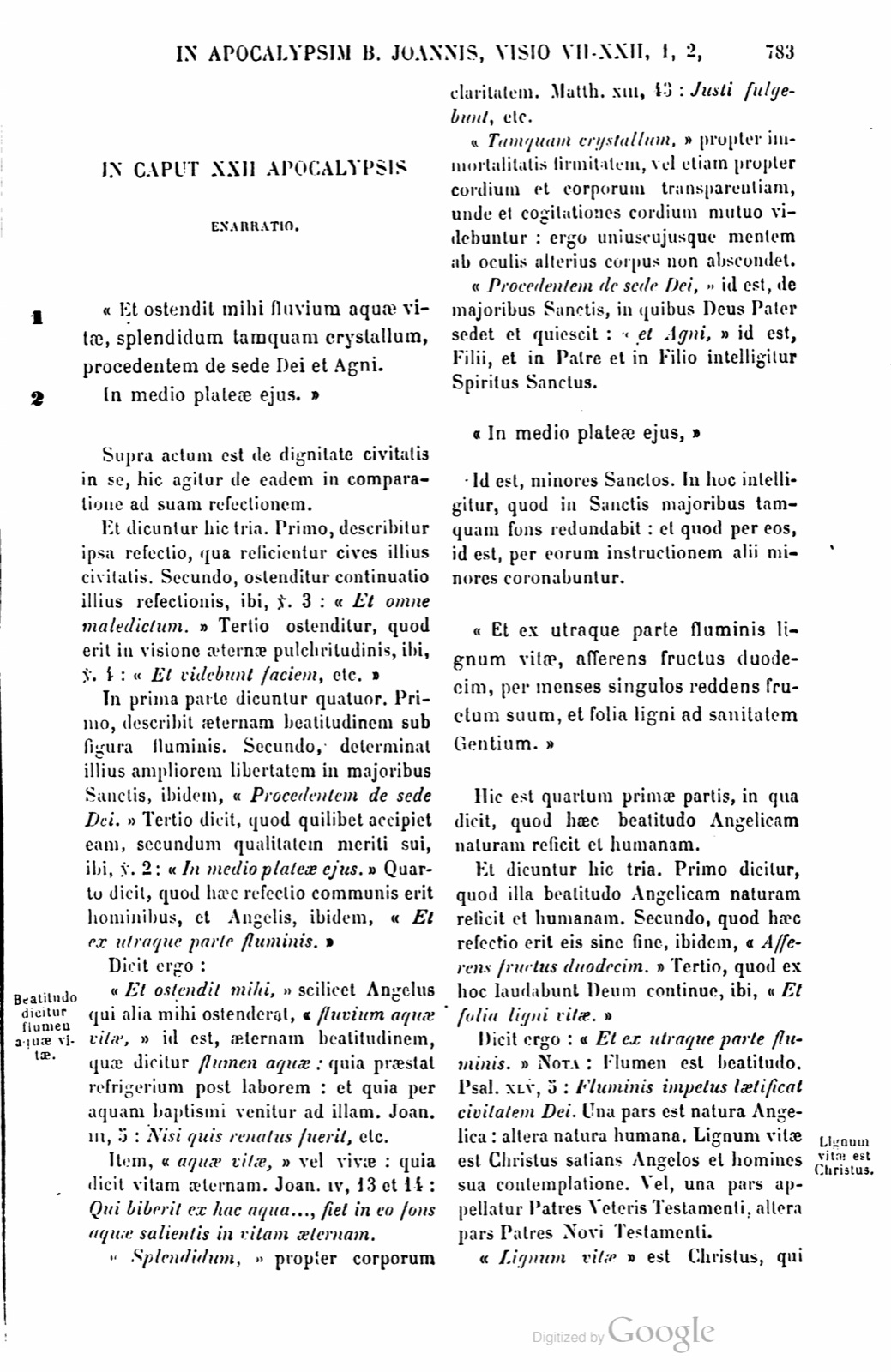
IN CAPUT XXII APOCALYPSIS ENARRATIO.
1. "Et ostendit mihi fluvium aquae vitae, splendidum tamquam crystallum, procedentem de sede Dei et Agni. 2. In medio plateae ejus."
Supra actum est de dignitate civitatis in se, hic agitur de eadem in comparatione ad suam refectionem.
Et dicuntur hic tria. Primo, describitur ipsa refectio, qua reficientur cives illius civitatis. Secundo, ostenditur continuatio illius refectionis, ibi, v. 3: "Et omne maledictum." Tertio ostenditur, quod erit in visione aeternae pulchritudinis, ibi, v. 4: "Et videbunt faciem, etc."
In prima parte dicuntur quatuor. Primo, describit aeternam beatitudinem sub figura fluminis. Secundo, determinat illius ampliorem libertatem in majoribus Sanctis, ibidem, "Procedentem de sede Dei." Tertio dicit, quod quilibet accipiet eam, secundum qualitatem meriti sui, ibi, v. 2: "In medio plateae ejus." Quarto dicit, quod haec refectio communis erit hominibus, et Angelis, ibidem, "Et ex utraque parte fluminis."
Dicit ergo: [Marginal label: Beatitudo dicitur flumen aquae vitae.] "Et ostendit mihi," scilicet Angelus qui alia mihi ostenderat, "fluvium aquae vitae," id est, aeternam beatitudinem, quae dicitur flumen aquae: quia praestat refrigerium post laborem: et quia per aquam baptismi venitur ad illam. Joan. III, 5: Nisi quis renatus fuerit, etc.
Item, "aquae vitae," vel vivae: quia dicit vitam aeternam. Joan. IV, 13 et 14: Qui biberit ex hac aqua..., fiet in eo fons aquae salientis in vitam aeternam.
"Splendidum," propter corporum claritatem. Matth. XIII, 43: Justi fulgebunt, etc.
"Tamquam crystallum," propter immortalitatis firmitatem, vel etiam propter cordium et corporum transparentiam, unde et cogitationes cordium mutuo videbuntur: ergo uniuscujusque mentem ab oculis alterius corpus non abscondet.
"Procedentem de sede Dei," id est, de majoribus Sanctis, in quibus Deus Pater sedet et quiescit: "et Agni," id est, Filii, et in Patre et in Filio intelligitur Spiritus Sanctus.
"In medio plateae ejus,"
Id est, minores Sanctos. In hoc intelligitur, quod in Sanctis majoribus tamquam fons redundabit: et quod per eos, id est, per eorum instructionem alii minores coronabuntur.
"Et ex utraque parte fluminis lignum vitae, afferens fructus duodecim, per menses singulos reddens fructum suum, et folia ligni ad sanitatem Gentium."
Hic est quartum primae partis, in qua dicit, quod haec beatitudo Angelicam naturam reficit et humanam.
Et dicuntur hic tria. Primo dicitur, quod illa beatitudo Angelicam naturam reficit et humanam. Secundo, quod haec refectio erit eis sine fine, ibidem, "Afferens fructus duodecim." Tertio, quod ex hoc laudabunt Deum continue, ibi, "Et folia ligni vitae."
Dicit ergo: "Et ex utraque parte fluminis." NOTA: Flumen est beatitudo. Psal. XLV, 5: Fluminis impetus laetificat civitatem Dei. Una pars est natura Angelica: altera natura humana. [Marginal label: Lignum vitae est Christus.] Lignum vitae est Christus satians Angelos et homines sua contemplatione. Vel, una pars appellatur Patres Veteris Testamenti, altera pars Patres Novi Testamenti.
"Lignum vitae" est Christus, qui
EXPOSITION ON CHAPTER XXII OF THE APOCALYPSE.
1. "And he showed me a river of the water of life, splendid as crystal, proceeding from the seat of God and of the Lamb. 2. In the middle of its street."
Above the dignity of the city in itself was treated; here the same is treated in comparison to its refreshment.
And three things are said here. First, the refreshment itself, by which the citizens of that city will be refreshed, is described. Secondly, the continuation of that refreshment is shown, there at verse 3: "And every curse." Thirdly, that it will be in the vision of eternal beauty is shown, there at verse 4: "And they will see the face, etc."
In the first part four things are said. First, he describes eternal beatitude under the figure of a river. Secondly, he determines its more ample freedom in the greater Saints, in the same place, "Proceeding from the seat of God." Thirdly, he says that anyone will receive it according to the quality of his merit, there at verse 2: "In the middle of its street." Fourthly, he says that this refreshment will be common to men and Angels, in the same place, "And on each side of the river."
Therefore he says: [Marginal label: Beatitude is called a river of the water of life.] "And he showed me," namely the Angel who had shown me other things, "a river of the water of life," that is, eternal beatitude, which is called a river of water because it provides cooling after labor, and because through the water of baptism one comes to it. John 3:5: Unless someone has been born again, etc.
Likewise, "of the water of life," or of living water, because it declares eternal life. John 4:13 and 14: Whoever drinks from this water..., it will become in him a fountain of water springing up into eternal life.
"Splendid," because of the brightness of bodies. Matthew 13:43: The just will shine, etc.
"As crystal," because of the firmness of immortality, or also because of the transparency of hearts and bodies; hence also the thoughts of hearts will be seen mutually. Therefore the body will not hide the mind of each one from the eyes of another.
"Proceeding from the seat of God," that is, from the greater Saints, in whom God the Father sits and rests; "and of the Lamb," that is, of the Son; and in the Father and in the Son the Holy Spirit is understood.
"In the middle of its street,"
That is, the lesser Saints. In this it is understood that in the greater Saints it will overflow as a fountain, and that through them, that is, through their instruction, other lesser ones will be crowned.
"And on each side of the river the tree of life, bearing twelve fruits, rendering its fruit through individual months, and the leaves of the tree for the health of the nations."
Here is the fourth of the first part, in which he says that this beatitude refreshes the Angelic nature and the human nature.
And three things are said here. First it is said that that beatitude refreshes the Angelic nature and the human. Secondly, that this refreshment will be for them without end, in the same place, "Bearing twelve fruits." Thirdly, that from this they will praise God continually, there, "And the leaves of the tree of life."
Therefore he says: "And on each side of the river." NOTE: The river is beatitude. Psalm 45:5: The impulse of the river makes glad the city of God. One side is the Angelic nature; the other is the human nature. [Marginal label: The tree of life is Christ.] The tree of life is Christ satisfying Angels and men with his contemplation. Or, one side is called the Fathers of the Old Testament, the other side the Fathers of the New Testament.
"The tree of life" is Christ, who
If a page does not appear, its photograph has not been uploaded yet.