Works › Commentary on the Apocalypse of Blessed John
Volume 38 · pp. 775–778
Chapter XXI, Foundations, Gates, and Street of the City
A marker with ≈ is an approximate page boundary, placed by measure of the text; the page photographs remain the authority. In the paired views, clicking a page marker brings that page into view.
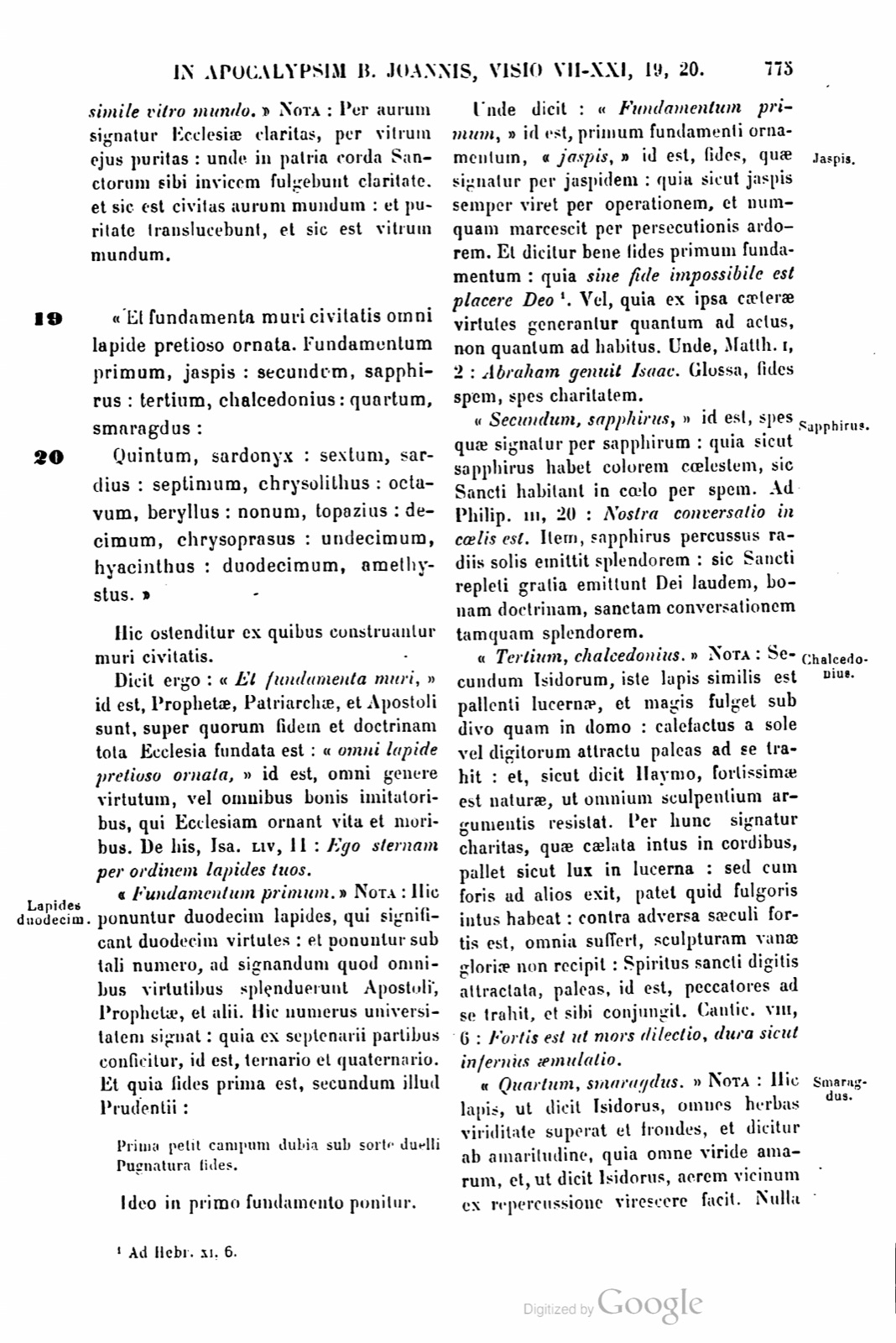
19. "Et fundamenta muri civitatis omni lapide pretioso ornata. Fundamentum primum, jaspis: secundum, sapphirus: tertium, chalcedonius: quartum, smaragdus: 20. Quintum, sardonyx: sextum, sardius: septimum, chrysolithus: octavum, beryllus: nonum, topazius: decimum, chrysoprasus: undecimum, hyacinthus: duodecimum, amethystus."
Hic ostenditur ex quibus construantur muri civitatis.
Dicit ergo: "Et fundamenta muri," id est, Prophetae, Patriarchae, et Apostoli sunt, super quorum fidem et doctrinam tota Ecclesia fundata est: "omni lapide pretioso ornata," id est, omni genere virtutum, vel omnibus bonis imitatoribus, qui Ecclesiam ornant vita et moribus. De his, Isa. LIV, 11: Ego sternam per ordinem lapides tuos.
"Fundamentum primum." [Marginal label: Lapides duodecim.] NOTA: Hic ponuntur duodecim lapides, qui significant duodecim virtutes: et ponuntur sub tali numero, ad signandum quod omnibus virtutibus splenduerunt Apostoli, Prophetae, et alii. Hic numerus universitatem signat: quia ex septenarii partibus conficitur, id est, ternario et quaternario. Et quia fides prima est, secundum illud Prudentii:
Prima petit campum dubia sub sorte duelli Pugnatura fides.
Ideo in primo fundamento ponitur.
Unde dicit: "Fundamentum primum," id est, primum fundamenti ornamentum, "jaspis," [Marginal label: Jaspis.] id est, fides, quae signatur per jaspidem: quia sicut jaspis semper viret per operationem, et numquam marcescit per persecutionis ardorem. Et dicitur bene fides primum fundamentum: quia sine fide impossibile est placere Deo 1. Vel, quia ex ipsa caeterae virtutes generantur quantum ad actus, non quantum ad habitus. Unde, Matth. I, 2: Abraham genuit Isaac. Glossa, fides spem, spes charitatem.
"Secundum, sapphirus," [Marginal label: Sapphirus.] id est, spes quae signatur per sapphirum: quia sicut sapphirus habet colorem coelestem, sic Sancti habitant in coelo per spem. Ad Philip. III, 20: Nostra conversatio in coelis est. Item, sapphirus percussus radiis solis emittit splendorem: sic Sancti repleti gratia emittunt Dei laudem, bonam doctrinam, sanctam conversationem tamquam splendorem.
"Tertium, chalcedonius." [Marginal label: Chalcedonius.] NOTA: Secundum Isidorum, iste lapis similis est pallenti lucernae, et magis fulget sub divo quam in domo: calefactus a sole vel digitorum attractu paleas ad se trahit: et, sicut dicit Haymo, fortissimae est naturae, ut omnium sculpentium argumentis resistat. Per hunc signatur charitas, quae caelata intus in cordibus, pallet sicut lux in lucerna: sed cum foris ad alios exit, patet quid fulgoris intus habeat: contra adversa saeculi fortis est, omnia suffert, sculpturam vanae gloriae non recipit: Spiritus sancti digitis attractata, paleas, id est, peccatores ad se trahit, et sibi conjungit. Cantic. VIII, 6: Fortis est ut mors dilectio, dura sicut infernus aemulatio.
"Quartum, smaragdus." [Marginal label: Smaragdus.] NOTA: Hic lapis, ut dicit Isidorus, omnes herbas viriditate superat et frondes, et dicitur ab amaritudine, quia omne viride amarum, et, ut dicit Isidorus, aerem vicinum ex repercussione virescere facit. Nulla gemma gratior oculis: cujus corpus extersum sicut speculum imagines reddit. Hinc Gryphes hominibus auferunt: sed populus quidam, qui habet unum oculum solum, pugnans contra eos, aufert eis. Per hunc lapidem signatur castitas vel virginitas, quae virorem carnis integre servat, et in amaritudine poenitentiae malos motus castigat. Haec est gratiosa oculis Angelorum et Christi. Item, in se portat imaginem Christi et Angelorum: quia, sicut dicit Hieronymus, cognata est Angelis virginitas, etc. Hanc daemones nituntur auferre hominibus: sed mens et intentio indivisa a Deo, quae signatur per unum oculum, resistit, et custodit eam illaesam. Et bene dicitur quartus lapis: quia in quatuor Evangeliis praecipue commendatur.
19. "And the foundations of the wall of the city were adorned with every precious stone. The first foundation, jasper; the second, sapphire; the third, chalcedony; the fourth, emerald; 20. the fifth, sardonyx; the sixth, sardius; the seventh, chrysolite; the eighth, beryl; the ninth, topaz; the tenth, chrysoprase; the eleventh, hyacinth; the twelfth, amethyst."
Here he shows from what the walls of the city are constructed.
Therefore he says: "And the foundations of the wall," that is, the Prophets, Patriarchs, and Apostles are, upon whose faith and doctrine the whole Church has been founded; "adorned with every precious stone," that is, with every kind of virtues, or with all good imitators, who adorn the Church in life and morals. Concerning these, Isaiah 54:11: I will lay your stones in order.
"The first foundation." [Marginal label: Twelve stones.] NOTE: Here twelve stones are set down, which signify twelve virtues; and they are set down under such a number to signify that the Apostles, Prophets, and others shone with all virtues. This number signifies universality, because it is made from the parts of seven, that is, from three and four. And because faith is first, according to that saying of Prudentius:
Faith, about to fight, first seeks the field under the doubtful lot of combat.
Therefore it is placed in the first foundation.
Hence he says: "The first foundation," that is, the first adornment of the foundation, "jasper," [Marginal label: Jasper.] that is, faith, which is signified by jasper, because as jasper is always green through operation and never withers through the heat of persecution. And faith is well called the first foundation, because without faith it is impossible to please God 1. Or, because from it the other virtues are generated with respect to acts, not with respect to habits. Hence Matthew 1:2: Abraham begot Isaac. The Gloss says, faith begets hope, hope charity.
"The second, sapphire," [Marginal label: Sapphire.] that is, hope, which is signified by sapphire, because as sapphire has a heavenly color, so the Saints dwell in heaven through hope. Philippians 3:20: Our conversation is in heaven. Likewise, sapphire struck by the rays of the sun emits splendor; so the Saints, filled with grace, emit the praise of God, good doctrine, and holy conversation like splendor.
"The third, chalcedony." [Marginal label: Chalcedony.] NOTE: According to Isidore, this stone is like a pale lamp, and shines more under the open sky than in a house; heated by the sun or by the drawing of fingers it draws straws to itself; and, as Haymo says, it is of the strongest nature, so that it resists the tools of all sculptors. By this is signified charity, which, carved within in hearts, is pale like light in a lamp; but when it goes out to others outside, what brilliance it has within is clear. It is strong against the adversities of the age, bears all things, does not receive the carving of vain glory; drawn by the fingers of the Holy Spirit, it draws straws, that is, sinners, to itself and joins them to itself. Canticles 8:6: Love is strong as death, zeal hard as hell.
"The fourth, emerald." [Marginal label: Emerald.] NOTE: This stone, as Isidore says, surpasses all herbs and leaves in greenness, and is said from bitterness, because every green thing is bitter; and, as Isidore says, it makes the neighboring air grow green by reflection. No gem is more pleasing to the eyes; its body, wiped clean, gives back images like a mirror. Hence Griffins take it away from men; but a certain people, who have only one eye, fighting against them, take it from them. By this stone chastity or virginity is signified, which keeps the greenness of the flesh whole and chastises evil motions in the bitterness of penitence. This is pleasing to the eyes of Angels and of Christ. Likewise, it bears in itself the image of Christ and of Angels, because, as Jerome says, virginity is akin to Angels, etc. Demons strive to take this away from men; but the mind and intention undivided from God, which is signified by one eye, resists and keeps it unharmed. And it is well called the fourth stone, because it is especially commended in the four Gospels.
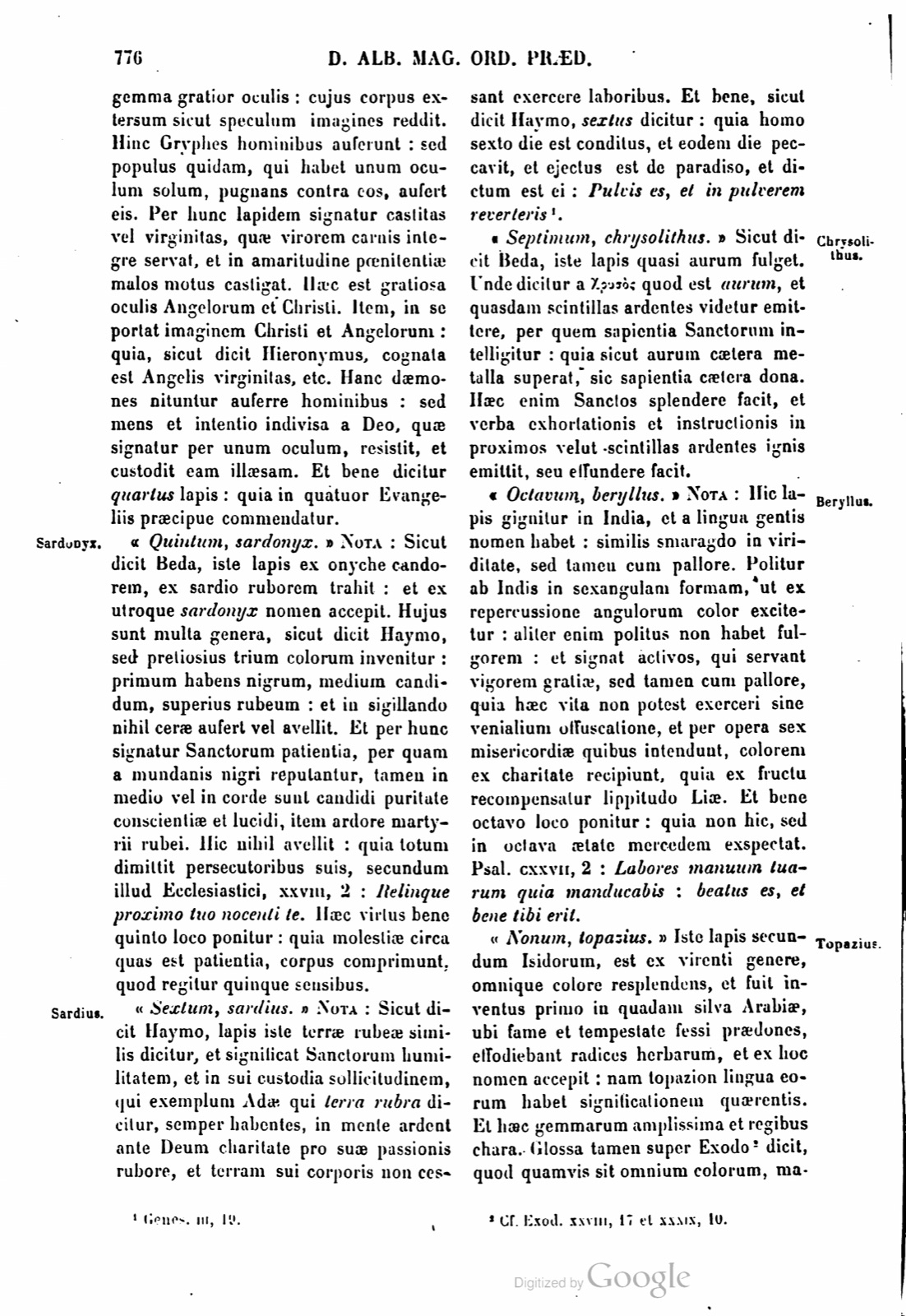
"Quintum, sardonyx." [Marginal label: Sardonyx.] NOTA: Sicut dicit Beda, iste lapis ex onyche candorem, ex sardio ruborem trahit: et ex utroque sardonyx nomen accepit. Hujus sunt multa genera, sicut dicit Haymo, sed pretiosius trium colorum invenitur: primum habens nigrum, medium candidum, superius rubeum: et in sigillando nihil cerae aufert vel avellit. Et per hunc signatur Sanctorum patientia, per quam a mundanis nigri reputantur, tamen in medio vel in corde sunt candidi puritate conscientiae et lucidi, item ardore martyrii rubei. Hic nihil avellit: quia totum dimittit persecutoribus suis, secundum illud Ecclesiastici, XXVIII, 2: Relinque proximo tuo nocenti te. Haec virtus bene quinto loco ponitur: quia molestiae circa quas est patientia, corpus comprimunt, quod regitur quinque sensibus.
"Sextum, sardius." [Marginal label: Sardius.] NOTA: Sicut dicit Haymo, lapis iste terrae rubeae similis dicitur, et significat Sanctorum humilitatem, et in sui custodia sollicitudinem, qui exemplum Adae qui terra rubra dicitur, semper habentes, in mente ardent ante Deum charitate pro suae passionis rubore, et terram sui corporis non cessant exercere laboribus. Et bene, sicut dicit Haymo, sextus dicitur: quia homo sexto die est conditus, et eodem die peccavit, et ejectus est de paradiso, et dictum est ei: Pulvis es, et in pulverem reverteris 2.
"Septimum, chrysolithus." [Marginal label: Chrysolithus.] Sicut dicit Beda, iste lapis quasi aurum fulget. Unde dicitur a chrysos quod est aurum, et quasdam scintillas ardentes videtur emittere, per quem sapientia Sanctorum intelligitur: quia sicut aurum caetera metalla superat, sic sapientia caetera dona. Haec enim Sanctos splendere facit, et verba exhortationis et instructionis in proximos velut scintillas ardentes ignis emittit, seu effundere facit.
"Octavum, beryllus." [Marginal label: Beryllus.] NOTA: Hic lapis gignitur in India, et a lingua gentis nomen habet: similis smaragdo in viriditate, sed tamen cum pallore. Politur ab Indis in sexangulam formam, ut ex repercussione angulorum color excitetur: aliter enim politus non habet fulgorem: et signat activos, qui servant vigorem gratiae, sed tamen cum pallore, quia haec vita non potest exerceri sine venialium offuscatione, et per opera sex misericordiae quibus intendunt, colorem ex charitate recipiunt, quia ex fructu recompensatur lippitudo Liae. Et bene octavo loco ponitur: quia non hic, sed in octava aetate mercedem exspectat. Psal. CXXVII, 2: Labores manuum tuarum quia manducabis: beatus es, et bene tibi erit.
"Nonum, topazius." [Marginal label: Topazius.] Iste lapis secundum Isidorum, est ex virenti genere, omnique colore resplendens, et fuit inventus primo in quadam silva Arabiae, ubi fame et tempestate fessi praedones, effodiebant radices herbarum, et ex hoc nomen accepit: nam topazion lingua eorum habet significationem quaerentis. Et haec gemmarum amplissima et regibus chara. Glossa tamen super Exodo 3 dicit, quod quamvis sit omnium colorum, maxime tamen duos habet, aureum, et aethereum. Et dicitur topazion quasi topaudion, id est, omnium colorum, a pan quod est totum. Hic cum radio solis tangitur, omnium gemmarum claritatem superat. In adspectum suum singulariter provocat inspicientes: qui si plus poliatur, obscuratur: si naturae relinquitur, clarior est: et nihil charius regibus inter divitias. Per hunc signatur vita contemplativa, quae ex charitate aurea est, et cognitione aetherea lucet, quae in aethereo colore intelligitur. In hac Deus videtur limpidius: et ad hanc homo singulariter trahitur: et qui in saeculi dignitatibus sunt ornati, obscurantur, quia turbantur erga plurima. Quod hic lapis omnium colore praefulget, signat quod qui tales sunt, omnium virtutum lucem gerunt. Haec est gemmarum amplissima: quia maxime cor dilatat. Et bene nono loco ponitur: quia qui tales sunt, Angelis (quorum novem sunt ordines) in Dei contemplatione pro suo modulo similantur. Matth. XVIII, 10: Angeli eorum in caelis semper vident faciem Patris.
"The fifth, sardonyx." [Marginal label: Sardonyx.] NOTE: As Bede says, this stone draws whiteness from onyx and redness from sardius; and from both it received the name sardonyx. There are many kinds of this, as Haymo says, but the more precious is found of three colors: first having black, middle white, upper red; and in sealing it takes or tears away nothing of the wax. And by this is signified the patience of the Saints, through which they are considered black by worldly persons, yet in the middle or in the heart they are white with purity of conscience and shining, likewise red with the ardor of martyrdom. This takes away nothing, because it leaves everything to its persecutors, according to that saying of Ecclesiasticus 28:2: Forgive your neighbor who harms you. This virtue is well placed in the fifth place because troubles, with which patience is concerned, compress the body, which is ruled by the five senses.
"The sixth, sardius." [Marginal label: Sardius.] NOTE: As Haymo says, this stone is said to be like red earth, and signifies the humility of the Saints and solicitude in guarding oneself; having always the example of Adam, who is called red earth, in mind, they burn before God with charity because of the redness of their suffering, and do not cease to exercise the earth of their body with labors. And it is well called the sixth, as Haymo says, because man was created on the sixth day, and sinned on the same day, and was cast out of paradise, and it was said to him: You are dust, and into dust you will return 2.
"The seventh, chrysolite." [Marginal label: Chrysolite.] As Bede says, this stone shines like gold. Hence it is said from chrysos, which is gold, and it seems to emit certain burning sparks, through which the wisdom of the Saints is understood, because as gold surpasses the other metals, so wisdom surpasses the other gifts. For this makes the Saints shine, and sends out words of exhortation and instruction upon neighbors like burning sparks of fire, or makes them pour them out.
"The eighth, beryl." [Marginal label: Beryl.] NOTE: This stone is generated in India, and has its name from the language of the people; it is similar to emerald in greenness, but nevertheless with paleness. It is polished by the Indians into a hexagonal form, so that color is stirred up from the reflection of the angles; otherwise, when polished, it does not have brilliance. And it signifies active persons, who preserve the vigor of grace, but nevertheless with paleness, because this life cannot be exercised without the dimming of venial sins, and through the six works of mercy to which they give attention, they receive color from charity, because the dimness of Leah is recompensed from fruit. And it is well placed in the eighth place because not here, but in the eighth age, it awaits reward. Psalm 127:2: Because you will eat the labors of your hands; blessed are you, and it will be well for you.
"The ninth, topaz." [Marginal label: Topaz.] This stone, according to Isidore, is from the green kind, shining with every color, and was first found in a certain forest of Arabia, where robbers, exhausted by hunger and storm, were digging up roots of herbs, and from this it received its name; for topazion in their tongue has the meaning of one seeking. And this is the largest of gems and dear to kings. Yet the Gloss on Exodus 3 says that although it is of all colors, it nevertheless chiefly has two, golden and ethereal. And it is called topazion as if topaudion, that is, of all colors, from pan, which is the whole. When this is touched by a ray of the sun, it surpasses the brightness of all gems. It singularly summons those who look at it to gaze upon it; if it is polished more, it is darkened; if it is left to nature, it is brighter; and nothing is dearer to kings among riches. By this is signified the contemplative life, which is golden from charity and shines with ethereal knowledge, which is understood in the ethereal color. In this God is seen more clearly; and to this man is singularly drawn; and those who are adorned in the dignities of the age are darkened, because they are troubled about many things. That this stone shines ahead with every color signifies that those who are such bear the light of all virtues. This is the largest of gems because it most greatly enlarges the heart. And it is well placed in the ninth place because those who are such are made like the Angels, whose orders are nine, in the contemplation of God according to their measure. Matthew 18:10: Their Angels in heaven always see the face of the Father.
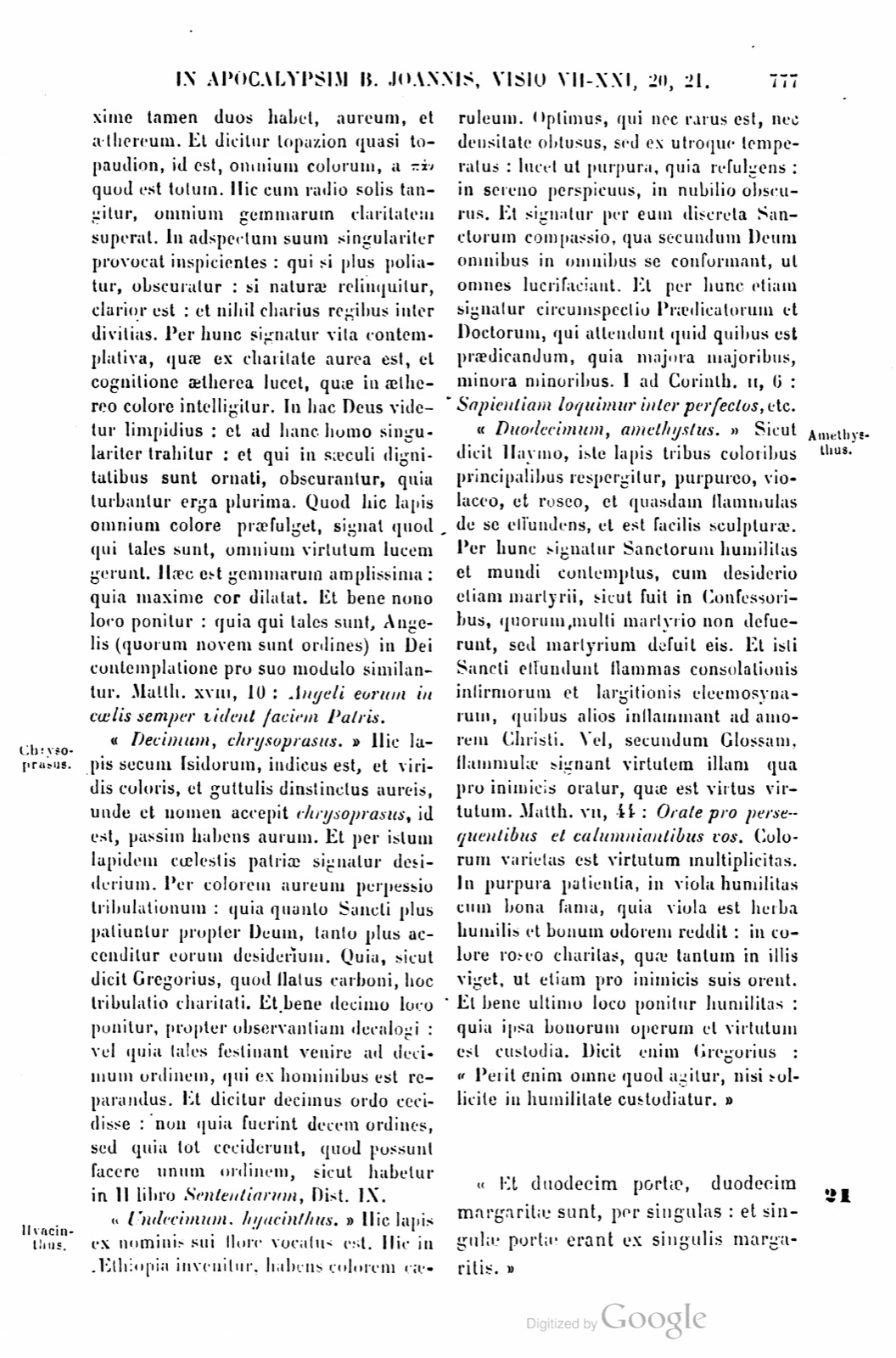
"Decimum, chrysoprasus." [Marginal label: Chrysoprasus.] Hic lapis secundum Isidorum, indicus est, et viridis coloris, et guttulis distinctus aureis, unde et nomen accepit chrysoprasus, id est, passim habens aurum. Et per istum lapidem coelestis patriae signatur desiderium. Per colorem aureum perpessio tribulationum: quia quanto Sancti plus patiuntur propter Deum, tanto plus accenditur eorum desiderium. Quia, sicut dicit Gregorius, quod flatus carboni, hoc tribulatio charitati. Et bene decimo loco ponitur, propter observantiam decalogi: vel quia tales festinant venire ad decimum ordinem, qui ex hominibus est reparandus. Et dicitur decimus ordo cecidisse: non quia fuerint decem ordines, sed quia tot ceciderunt, quod possunt facere unum ordinem, sicut habetur in II libro Sententiarum, Dist. IX.
"Undecimum, hyacinthus." [Marginal label: Hyacinthus.] Hic lapis ex nominis sui flore vocatus est. Hic in Aethiopia invenitur, habens colorem caeruleum. Optimus, qui nec rarus est, nec densitate obtusus, sed ex utroque temperatus: lucet ut purpura, quia refulgens: in sereno perspicuus, in nubilio obscurus. Et signatur per eum discreta Sanctorum compassio, qua secundum Deum omnibus in omnibus se conformant, ut omnes lucrifaciant. Et per hunc etiam signatur circumspectio Praedicatorum et Doctorum, qui attendunt quid quibus est praedicandum, quia majora majoribus, minora minoribus. I ad Corinth. II, 6: Sapientiam loquimur inter perfectos, etc.
"Duodecimum, amethystus." [Marginal label: Amethystus.] Sicut dicit Haymo, iste lapis tribus coloribus principalibus respergitur, purpureo, violaceo, et roseo, et quasdam flammulas de se effundens, et est facilis sculpturae. Per hunc signatur Sanctorum humilitas et mundi contemptus, cum desiderio etiam martyrii, sicut fuit in Confessoribus, quorum multi martyrio non defuerunt, sed martyrium defuit eis. Et isti Sancti effundunt flammas consolationis infirmorum et largitionis eleemosynarum, quibus alios inflammant ad amorem Christi. Vel, secundum Glossam, flammulae signant virtutem illam qua pro inimicis oratur, quae est virtus virtutum. Matth. V, 44: Orate pro persequentibus et calumniantibus vos. Colorum varietas est virtutum multiplicitas. In purpura patientia, in viola humilitas cum bona fama, quia viola est herba humilis et bonum odorem reddit: in colore roseo charitas, quae tantum in illis viget, ut etiam pro inimicis suis orent. Et bene ultimo loco ponitur humilitas: quia ipsa bonorum operum et virtutum est custodia. Dicit enim Gregorius: "Perit enim omne quod agitur, nisi sollicite in humilitate custodiatur."
"The tenth, chrysoprase." [Marginal label: Chrysoprase.] This stone, according to Isidore, is Indian, of green color, and marked with golden drops, whence it also received the name chrysoprase, that is, having gold here and there. And through that stone is signified desire for the heavenly homeland. Through the golden color, the enduring of tribulations, because the more the Saints suffer for God, the more their desire is kindled. For, as Gregory says, what blowing is to coal, tribulation is to charity. And it is well placed in the tenth place because of observance of the Decalogue; or because such persons hasten to come to the tenth order, which must be repaired from men. And the tenth order is said to have fallen, not because there were ten orders, but because so many fell that they can make one order, as is held in book 2 of the Sentences, distinction 9.
"The eleventh, hyacinth." [Marginal label: Hyacinth.] This stone is named from the flower of its name. It is found in Ethiopia, having a sky-blue color. The best is that which is neither rare nor dulled by density, but tempered from both; it shines like purple, because gleaming; in clear weather transparent, in cloudy weather dark. And by it is signified the discreet compassion of the Saints, by which according to God they conform themselves to all persons in all things, so that they may make gain of all. And through this is also signified the circumspection of Preachers and Doctors, who attend to what must be preached to whom, because greater things to greater persons, lesser things to lesser persons. 1 Corinthians 2:6: We speak wisdom among the perfect, etc.
"The twelfth, amethyst." [Marginal label: Amethyst.] As Haymo says, this stone is sprinkled with three principal colors, purple, violet, and rosy, and pouring out certain little flames from itself, and it is easy to carve. Through this is signified the humility of the Saints and contempt of the world, with desire also for martyrdom, as it was in Confessors, many of whom were not lacking to martyrdom, but martyrdom was lacking to them. And those Saints pour out flames of consolation of the weak and of the giving of alms, by which they inflame others to the love of Christ. Or, according to the Gloss, the little flames signify that virtue by which one prays for enemies, which is the virtue of virtues. Matthew 5:44: Pray for those persecuting and slandering you. The variety of colors is the multiplicity of virtues: in purple, patience; in violet, humility with good fame, because violet is a humble herb and gives back a good odor; in rosy color, charity, which flourishes so much in them that they even pray for their enemies. And humility is well placed in the last place, because it is itself the guardian of good works and virtues. For Gregory says: "Everything that is done perishes unless it is carefully guarded in humility."
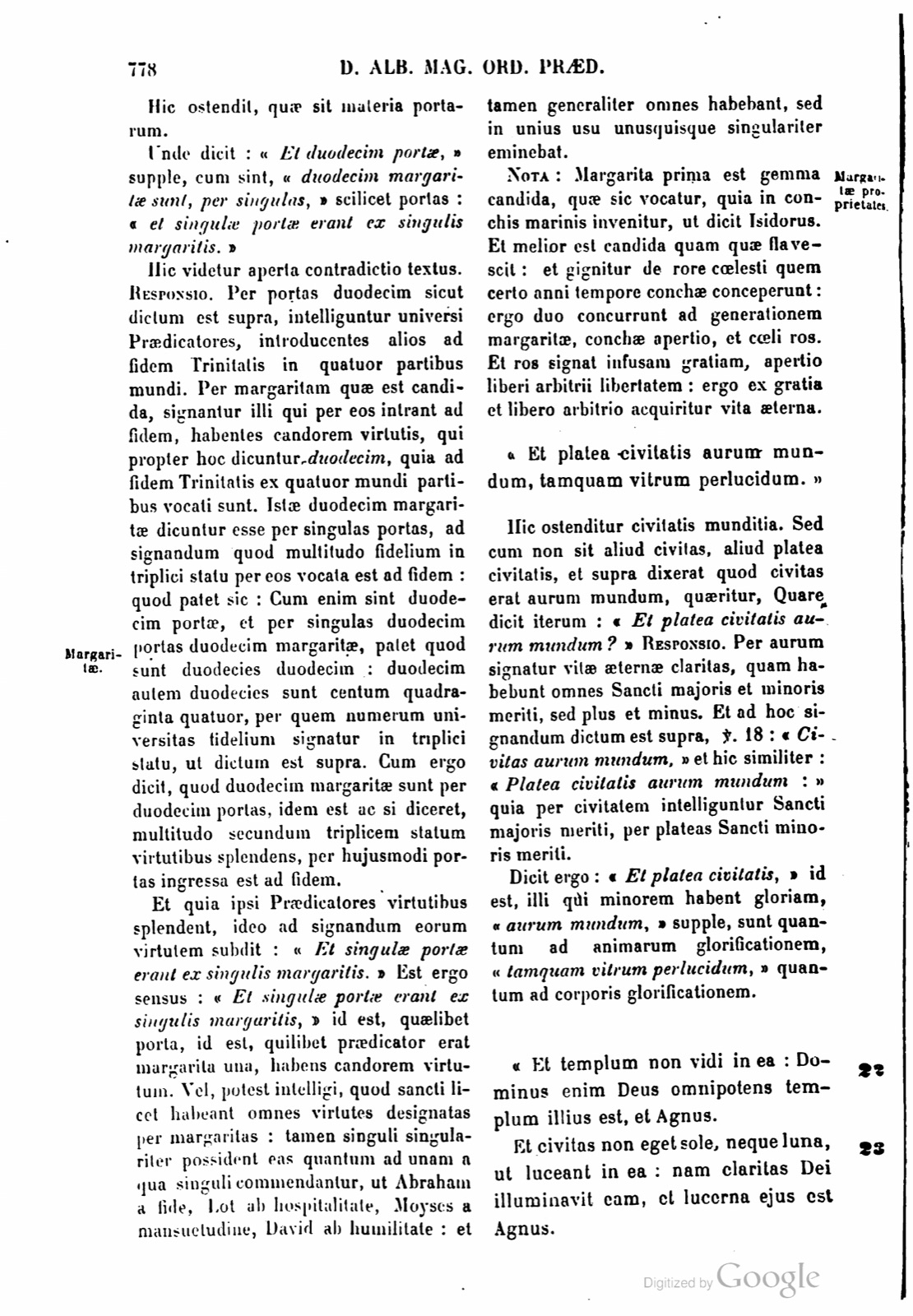
21. "Et duodecim portae, duodecim margaritae sunt, per singulas: et singulae portae erant ex singulis margaritis."
Hic ostendit, quae sit materia portarum.
Unde dicit: "Et duodecim portae," supple, cum sint, "duodecim margaritae sunt, per singulas," scilicet portas: "et singulae portae erant ex singulis margaritis."
Hic videtur aperta contradictio textus. RESPONSIO. Per portas duodecim sicut dictum est supra, intelliguntur universi Praedicatores, introducentes alios ad fidem Trinitatis in quatuor partibus mundi. Per margaritam quae est candida, signantur illi qui per eos intrant ad fidem, habentes candorem virtutis, qui propter hoc dicuntur duodecim, quia ad fidem Trinitatis ex quatuor mundi partibus vocati sunt. Istae duodecim margaritae dicuntur esse per singulas portas, ad signandum quod multitudo fidelium in triplici statu per eos vocata est ad fidem: quod patet sic: Cum enim sint duodecim portae, et per singulas duodecim portas duodecim margaritae, patet quod sunt duodecies duodecim: duodecim autem duodecies sunt centum quadraginta quatuor, per quem numerum universitas fidelium signatur in triplici statu, ut dictum est supra. Cum ergo dicit, quod duodecim margaritae sunt per duodecim portas, idem est ac si diceret, multitudo secundum triplicem statum virtutibus splendens, per hujusmodi portas ingressa est ad fidem.
Et quia ipsi Praedicatores virtutibus splendent, ideo ad signandum eorum virtutem subdit: "Et singulae portae erant ex singulis margaritis." Est ergo sensus: "Et singulae portae erant ex singulis margaritis," id est, quaelibet porta, id est, quilibet praedicator erat margarita una, habens candorem virtutum. Vel, potest intelligi, quod sancti licet habeant omnes virtutes designatas per margaritas: tamen singuli singulariter possident eas quantum ad unam a qua singuli commendantur, ut Abraham a fide, Lot ab hospitalitate, Moyses a mansuetudine, David ab humilitate: et tamen generaliter omnes habebant, sed in unius usu unusquisque singulariter eminebat.
[Marginal label: Margaritae proprietates.] NOTA: Margarita prima est gemma candida, quae sic vocatur, quia in conchis marinis invenitur, ut dicit Isidorus. Et melior est candida quam quae flavescit: et gignitur de rore coelesti quem certo anni tempore conchae conceperunt: ergo duo concurrunt ad generationem margaritae, conchae apertio, et coeli ros. Et ros signat infusam gratiam, apertio liberi arbitrii libertatem: ergo ex gratia et libero arbitrio acquiritur vita aeterna.
"Et platea civitatis aurum mundum, tamquam vitrum perlucidum."
Hic ostenditur civitatis munditia. Sed cum non sit aliud civitas, aliud platea civitatis, et supra dixerat quod civitas erat aurum mundum, quaeritur, Quare dicit iterum: "Et platea civitatis aurum mundum?" RESPONSIO. Per aurum signatur vitae aeternae claritas, quam habebunt omnes Sancti majoris et minoris meriti, sed plus et minus. Et ad hoc signandum dictum est supra, v. 18: "Civitas aurum mundum," et hic similiter: "Platea civitatis aurum mundum:" quia per civitatem intelliguntur Sancti majoris meriti, per plateas Sancti minoris meriti.
Dicit ergo: "Et platea civitatis," id est, illi qui minorem habent gloriam, "aurum mundum," supple, sunt quantum ad animarum glorificationem, "tamquam vitrum perlucidum," quantum ad corporis glorificationem.
21. "And the twelve gates are twelve pearls, individually; and each gate was from single pearls."
Here he shows what the material of the gates is.
Hence he says: "And the twelve gates," supply, since they are, "are twelve pearls, individually," namely the gates; "and each gate was from single pearls."
Here there seems to be an open contradiction of the text. RESPONSE. By the twelve gates, as was said above, all Preachers are understood, introducing others to the faith of the Trinity in the four parts of the world. By the pearl, which is white, are signified those who enter through them to faith, having the whiteness of virtue; they are for this reason called twelve, because they have been called to the faith of the Trinity from the four parts of the world. These twelve pearls are said to be individually through the gates, to signify that the multitude of the faithful in a threefold state was called through them to faith. This is clear thus: since there are twelve gates, and through the individual twelve gates twelve pearls, it is clear that there are twelve times twelve; but twelve twelve times are one hundred forty-four, by which number the universality of the faithful is signified in a threefold state, as was said above. Therefore when he says that the twelve pearls are through the twelve gates, it is the same as if he said that the multitude, shining with virtues according to the threefold state, entered through gates of this kind to faith.
And because the Preachers themselves shine with virtues, therefore to signify their virtue he adds: "And each gate was from single pearls." Therefore the sense is: "And each gate was from single pearls," that is, any gate, that is, any preacher, was one pearl, having the whiteness of virtues. Or, it can be understood that although the saints have all the virtues designated by pearls, nevertheless individual persons singularly possess them with respect to one by which the individual is commended, as Abraham by faith, Lot by hospitality, Moses by meekness, David by humility; and nevertheless they all generally had all, but each one singularly stood out in the use of one.
[Marginal label: Properties of the pearl.] NOTE: The first pearl is a white gem, which is so called because it is found in sea shells, as Isidore says. And the white is better than that which grows yellow; and it is generated from heavenly dew which the shells conceived at a certain time of year. Therefore two things concur for the generation of the pearl, the opening of the shell and the dew of heaven. And dew signifies infused grace, opening the liberty of free choice; therefore eternal life is acquired from grace and free choice.
"And the street of the city was clean gold, like transparent glass."
Here the cleanness of the city is shown. But since the city is not one thing and the street of the city another, and above he had said that the city was clean gold, it is asked why he says again: "And the street of the city was clean gold." RESPONSE. By gold is signified the brightness of eternal life, which all Saints of greater and lesser merit will have, but more and less. And to signify this it was said above, verse 18: "The city was clean gold," and here similarly: "The street of the city was clean gold," because by the city are understood the Saints of greater merit, by the streets the Saints of lesser merit.
Therefore he says: "And the street of the city," that is, those who have lesser glory, "clean gold," supply, are, with respect to the glorification of souls, "like transparent glass," with respect to the glorification of bodies.
If a page does not appear, its photograph has not been uploaded yet.