Works › Commentary on the Apocalypse of Blessed John
Volume 38 · pp. 778–781
Chapter XXI, Dignity, Security, and Doubtful Points
A marker with ≈ is an approximate page boundary, placed by measure of the text; the page photographs remain the authority. In the paired views, clicking a page marker brings that page into view.
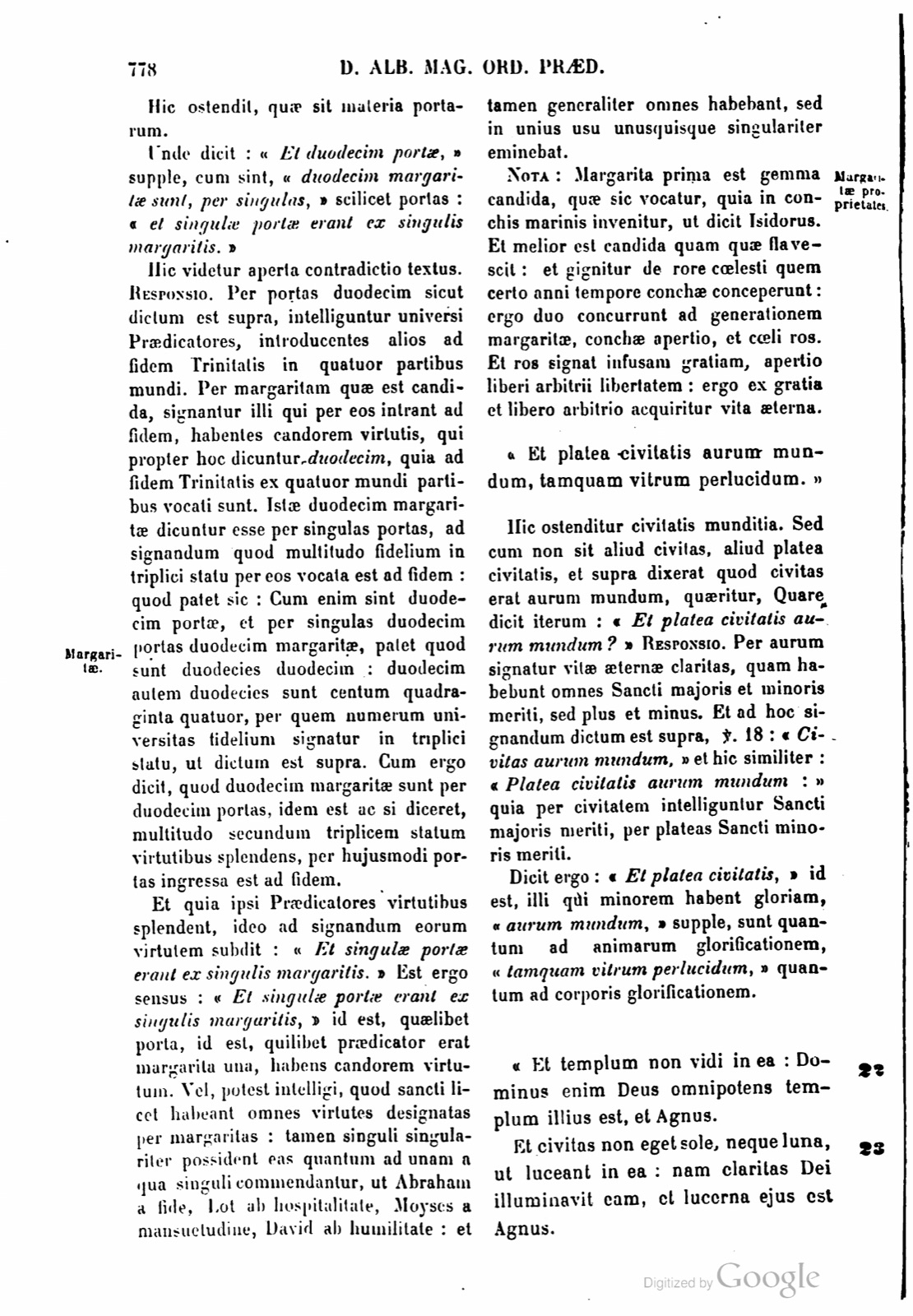
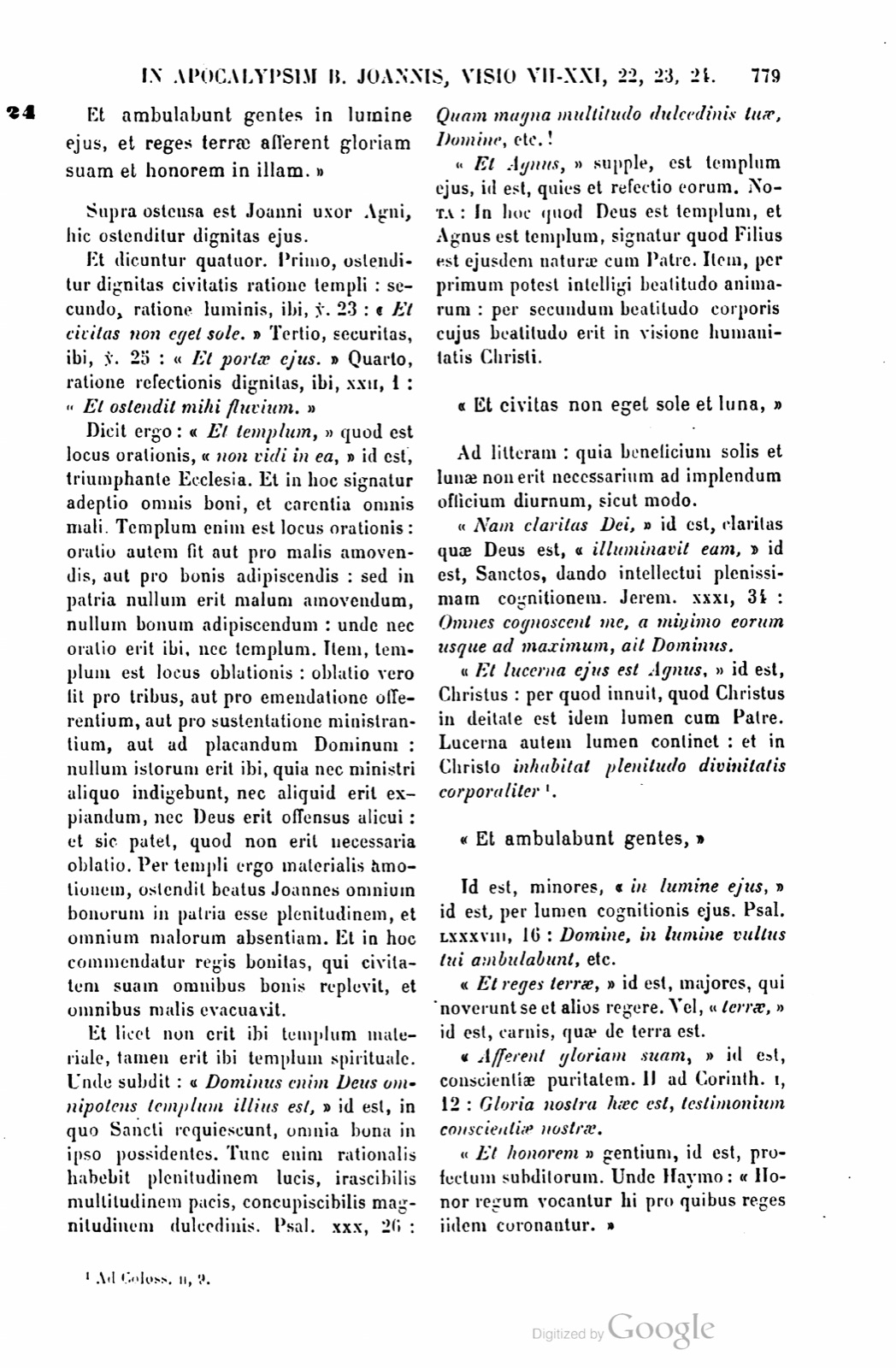
"Et templum non vidi in ea: Dominus enim Deus omnipotens templum illius est, et Agnus. 23. Et civitas non eget sole, neque luna, ut luceant in ea: nam claritas Dei illuminavit eam, et lucerna ejus est Agnus. 24. Et ambulabunt gentes in lumine ejus, et reges terrae afferent gloriam suam et honorem in illam."
Supra ostensa est Joanni uxor Agni, hic ostenditur dignitas ejus.
Et dicuntur quatuor. Primo, ostenditur dignitas civitatis ratione templi: secundo, ratione luminis, ibi, v. 23: "Et civitas non eget sole." Tertio, securitas, ibi, v. 25: "Et portae ejus." Quarto, ratione refectionis dignitas, ibi, XXII, 1: "Et ostendit mihi fluvium."
Dicit ergo: "Et templum," quod est locus orationis, "non vidi in ea," id est, triumphante Ecclesia. Et in hoc signatur adeptio omnis boni, et carentia omnis mali. Templum enim est locus orationis: oratio autem fit aut pro malis amovendis, aut pro bonis adipiscendis: sed in patria nullum erit malum amovendum, nullum bonum adipiscendum: unde nec oratio erit ibi, nec templum. Item, templum est locus oblationis: oblatio vero fit pro tribus, aut pro emendatione offerentium, aut pro sustentatione ministrantium, aut ad placandum Dominum: nullum istorum erit ibi, quia nec ministri aliquo indigebunt, nec aliquid erit expiandum, nec Deus erit offensus alicui: et sic patet, quod non erit necessaria oblatio. Per templi ergo materialis amotionem, ostendit beatus Joannes omnium bonorum in patria esse plenitudinem, et omnium malorum absentiam. Et in hoc commendatur regis bonitas, qui civitatem suam omnibus bonis replevit, et omnibus malis evacuavit.
Et licet non erit ibi templum materiale, tamen erit ibi templum spirituale. Unde subdit: "Dominus enim Deus omnipotens templum illius est," id est, in quo Sancti requiescunt, omnia bona in ipso possidentes. Tunc enim rationalis habebit plenitudinem lucis, irascibilis multitudinem pacis, concupiscibilis magnitudinem dulcedinis. Psal. XXX, 26: Quam magna multitudo dulcedinis tuae, Domine, etc.!
"Et Agnus," supple, est templum ejus, id est, quies et refectio eorum. NOTA: In hoc quod Deus est templum, et Agnus est templum, signatur quod Filius est ejusdem naturae cum Patre. Item, per primum potest intelligi beatitudo animarum: per secundum beatitudo corporis cujus beatitudo erit in visione humanitatis Christi.
"And I saw no temple in it: for the Lord God almighty is its temple, and the Lamb. 23. And the city has no need of sun, nor of moon, that they may shine in it: for the brightness of God illuminated it, and its lamp is the Lamb. 24. And the nations will walk in its light, and the kings of the earth will bring their glory and honor into it."
Above the wife of the Lamb was shown to John; here its dignity is shown.
And four things are said. First, the dignity of the city is shown by reason of the temple; secondly, by reason of light, there at verse 23: "And the city has no need of sun." Thirdly, security, there at verse 25: "And its gates." Fourthly, dignity by reason of refreshment, there, 22:1: "And he showed me a river."
Therefore he says: "And a temple," which is a place of prayer, "I did not see in it," that is, in the Church triumphant. And in this is signified the attainment of every good and the lack of every evil. For a temple is a place of prayer; but prayer is made either for evils to be removed, or for goods to be obtained; but in the homeland there will be no evil to be removed, no good to be obtained; hence there will be neither prayer there, nor temple. Likewise, a temple is a place of offering; but an offering is made for three things: either for the correction of those offering, or for the support of ministers, or for placating the Lord. None of these will be there, because neither will ministers need anything, nor will anything have to be expiated, nor will God be offended at anyone; and thus it is clear that an offering will not be necessary. Therefore through the removal of a material temple, blessed John shows that in the homeland there is fullness of all goods and the absence of all evils. And in this the goodness of the king is commended, who filled his city with all goods and emptied it of all evils.
And although there will not be a material temple there, nevertheless there will be a spiritual temple there. Hence he adds: "For the Lord God almighty is its temple," that is, in whom the Saints rest, possessing all goods in him. For then the rational power will have fullness of light, the irascible power a multitude of peace, the concupiscible power a magnitude of sweetness. Psalm 30:26: How great is the multitude of your sweetness, Lord, etc.!
"And the Lamb," supply, is its temple, that is, their rest and refreshment. NOTE: In this, that God is the temple and the Lamb is the temple, it is signified that the Son is of the same nature with the Father. Likewise, through the first the beatitude of souls can be understood; through the second, the beatitude of the body, whose beatitude will be in the vision of the humanity of Christ.
"Et civitas non eget sole et luna,"
Ad litteram: quia beneficium solis et lunae non erit necessarium ad implendum officium diurnum, sicut modo.
"Nam claritas Dei," id est, claritas quae Deus est, "illuminavit eam," id est, Sanctos, dando intellectui plenissimam cognitionem. Jerem. XXXI, 34: Omnes cognoscent me, a minimo eorum usque ad maximum, ait Dominus.
"Et lucerna ejus est Agnus," id est, Christus: per quod innuit, quod Christus in deitate est idem lumen cum Patre. Lucerna autem lumen continet: et in Christo inhabitat plenitudo divinitatis corporaliter 1.
"Et ambulabunt gentes,"
Id est, minores, "in lumine ejus," id est, per lumen cognitionis ejus. Psal. LXXXVII, 16: Domine, in lumine vultus tui ambulabunt, etc.
"Et reges terrae," id est, majores, qui noverunt se et alios regere. Vel, "terrae," id est, carnis, quae de terra est.
"Afferent gloriam suam," id est, conscientiae puritatem. II ad Corinth. I, 12: Gloria nostra haec est, testimonium conscientiae nostrae.
"Et honorem" gentium, id est, profectum subditorum. Unde Haymo: "Honor regum vocantur hi pro quibus reges iidem coronantur."
"In illam" civitatem, quia omnem remunerationem et prosperitatem et exsultationem ibi recipient. Psal. CXXV, 6: Venientes autem venient cum exsultatione, etc., sicut victores deferunt spolia in suas urbes. Isa. IX, 3: Laetabuntur coram te, sicut qui laetantur in messe, etc.
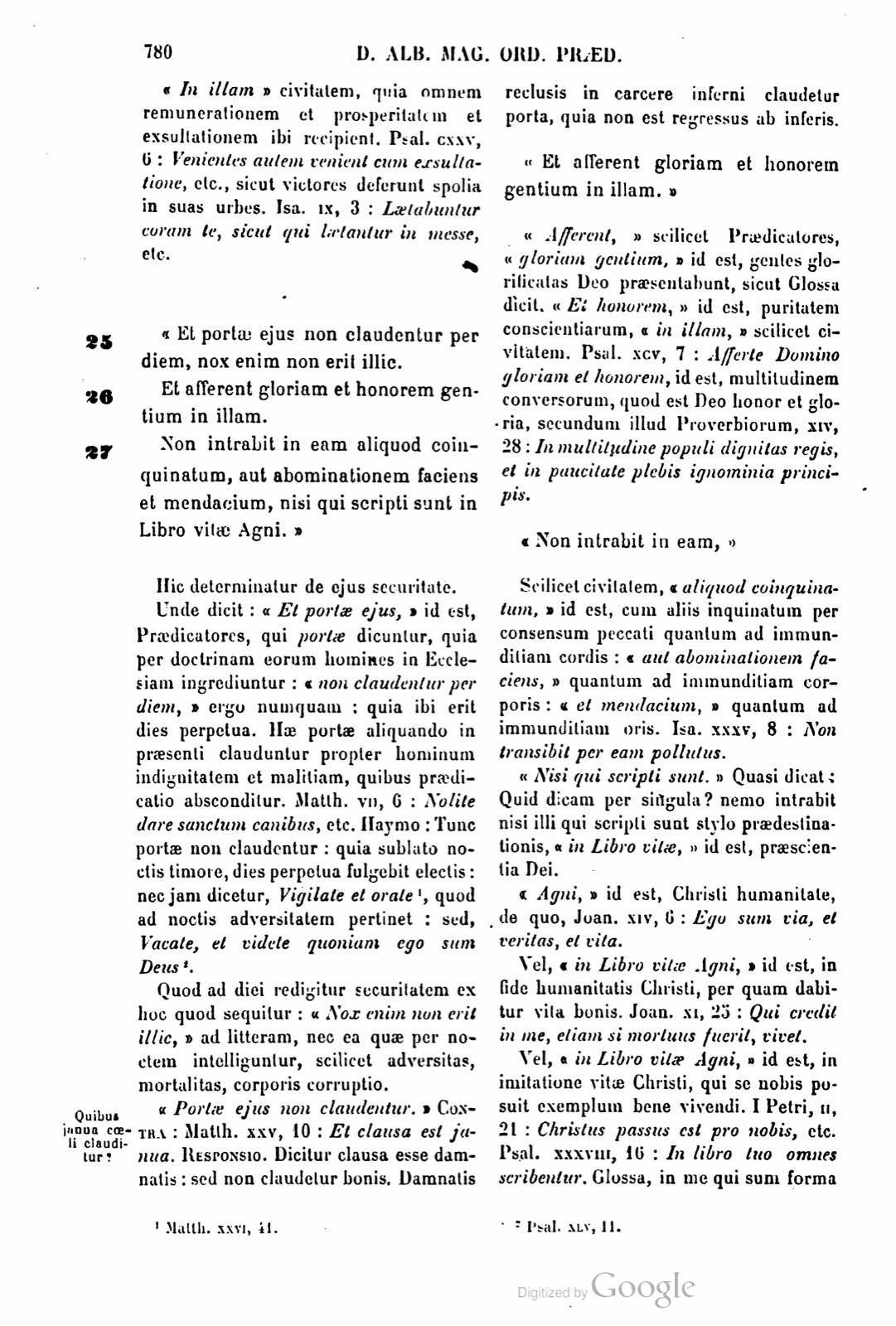
25. "Et portae ejus non claudentur per diem, nox enim non erit illic. 26. Et afferent gloriam et honorem gentium in illam. 27. Non intrabit in eam aliquid coinquinatum, aut abominationem faciens et mendacium, nisi qui scripti sunt in Libro vitae Agni."
Hic determinatur de ejus securitate.
Unde dicit: "Et portae ejus," id est, Praedicatores, qui portae dicuntur, quia per doctrinam eorum homines in Ecclesiam ingrediuntur: "non claudentur per diem," ergo numquam: quia ibi erit dies perpetua. Hae portae aliquando in praesenti clauduntur propter hominum indignitatem et malitiam, quibus praedicatio absconditur. Matth. VII, 6: Nolite dare sanctum canibus, etc. Haymo: Tunc portae non claudentur: quia sublato noctis timore, dies perpetua fulgebit electis: nec jam dicetur, Vigilate et orate 2, quod ad noctis adversitatem pertinet: sed, Vacate, et videte quoniam ego sum Deus 3.
"And the city has no need of sun and moon,"
Literally: because the service of sun and moon will not be necessary for fulfilling the daily office, as now.
"For the brightness of God," that is, the brightness which God is, "illuminated it," that is, the Saints, by giving to the intellect most full knowledge. Jeremiah 31:34: All will know me, from the least of them even to the greatest, says the Lord.
"And its lamp is the Lamb," that is, Christ; through this he suggests that Christ in deity is the same light with the Father. But a lamp contains light; and in Christ the fullness of divinity dwells bodily 1.
"And the nations will walk,"
That is, the lesser ones, "in its light," that is, through the light of its knowledge. Psalm 87:16: Lord, in the light of your countenance they will walk, etc.
"And the kings of the earth," that is, the greater ones, who know how to rule themselves and others. Or, "of the earth," that is, of the flesh, which is from earth.
"They will bring their glory," that is, purity of conscience. 2 Corinthians 1:12: This is our glory, the testimony of our conscience.
"And the honor" of the nations, that is, the advancement of subjects. Hence Haymo says: "Those for whom the same kings are crowned are called the honor of kings."
"Into that" city, because they will receive all remuneration and prosperity and exultation there. Psalm 125:6: But coming they will come with exultation, etc., just as victors carry spoils into their own cities. Isaiah 9:3: They will rejoice before you, as those who rejoice in harvest, etc.
25. "And its gates will not be closed by day, for night will not be there. 26. And they will bring the glory and honor of the nations into it. 27. Nothing defiled will enter into it, or anything making abomination and a lie, except those who are written in the Book of life of the Lamb."
Here he determines concerning its security.
Hence he says: "And its gates," that is, Preachers, who are called gates because through their doctrine men enter into the Church, "will not be closed by day," therefore never, because there will be perpetual day there. These gates are sometimes closed in the present because of the indignity and malice of men, from whom preaching is hidden. Matthew 7:6: Do not give what is holy to dogs, etc. Haymo says: Then the gates will not be closed, because, when the fear of night has been taken away, perpetual day will shine upon the elect; nor now will it be said, Watch and pray 2, which pertains to the adversity of night, but, Be still, and see that I am God 3.
Quod ad diei redigitur securitatem ex hoc quod sequitur: "Nox enim non erit illic," ad litteram, nec ea quae per noctem intelliguntur, scilicet adversitas, mortalitas, corporis corruptio.
[Marginal label: Quibus janua coeli clauditur?] "Portae ejus non claudentur." CONTRA: Matth. XXV, 10: Et clausa est janua. RESPONSIO. Dicitur clausa esse damnatis: sed non claudetur bonis. Damnatis reclusis in carcere inferni claudetur porta, quia non est regressus ab inferis.
"Et afferent gloriam et honorem gentium in illam."
"Afferent," scilicet Praedicatores, "gloriam gentium," id est, gentes glorificatas Deo praesentabunt, sicut Glossa dicit. "Et honorem," id est, puritatem conscientiarum, "in illam," scilicet civitatem. Psal. XCV, 7: Afferte Domino gloriam et honorem, id est, multitudinem conversorum, quod est Deo honor et gloria, secundum illud Proverbiorum, XIV, 28: In multitudine populi dignitas regis, et in paucitate plebis ignominia principis.
"Non intrabit in eam,"
Scilicet civitatem, "aliquid coinquinatum," id est, cum aliis inquinatum per consensum peccati quantum ad immunditiam cordis: "aut abominationem faciens," quantum ad immunditiam corporis: "et mendacium," quantum ad immunditiam oris. Isa. XXXV, 8: Non transibit per eam pollutus.
"Nisi qui scripti sunt." Quasi dicat: Quid dicam per singula? nemo intrabit nisi illi qui scripti sunt stylo praedestinationis, "in Libro vitae," id est, praescientia Dei.
"Agni," id est, Christi humanitate, de quo, Joan. XIV, 6: Ego sum via, et veritas, et vita.
Vel, "in Libro vitae Agni," id est, in fide humanitatis Christi, per quam dabitur vita bonis. Joan. XI, 25: Qui credit in me, etiam si mortuus fuerit, vivet.
Vel, "in Libro vitae Agni," id est, in imitatione vitae Christi, qui se nobis posuit exemplum bene vivendi. I Petri, II, 21: Christus passus est pro nobis, etc. Psal. XXXVIII, 16: In libro tuo omnes scribentur. Glossa, in me qui sum forma et exemplar vivendi. Joan. XIII, 15: Exemplum dedi vobis, ut quemadmodum ego feci, ita et vos faciatis.
This is brought back to the security of day from what follows: "For night will not be there," literally, nor those things which are understood by night, namely adversity, mortality, corruption of the body.
[Marginal label: To whom is the door of heaven closed?] "Its gates will not be closed." TO THE CONTRARY: Matthew 25:10: And the door was closed. RESPONSE. It is said to be closed to the damned, but it will not be closed to the good. With the damned shut up in the prison of hell, the gate will be closed, because there is no return from the lower regions.
"And they will bring the glory and honor of the nations into it."
"They will bring," namely the Preachers, "the glory of the nations," that is, they will present the glorified nations to God, as the Gloss says. "And honor," that is, purity of consciences, "into that," namely city. Psalm 95:7: Bring to the Lord glory and honor, that is, a multitude of converts, which is honor and glory to God, according to that saying of Proverbs 14:28: In a multitude of people is the dignity of the king, and in the fewness of the people the disgrace of the prince.
"There will not enter into it,"
Namely the city, "anything defiled," that is, defiled with others through consent of sin with respect to uncleanness of heart; "or anything making abomination," with respect to uncleanness of body; "and a lie," with respect to uncleanness of mouth. Isaiah 35:8: The polluted will not pass through it.
"Except those who are written." As if he said: What shall I say through individual cases? No one will enter except those who are written by the stylus of predestination, "in the Book of life," that is, the foreknowledge of God.
"Of the Lamb," that is, by the humanity of Christ, concerning whom, John 14:6: I am the way, and the truth, and the life.
Or, "in the Book of life of the Lamb," that is, in faith in the humanity of Christ, through which life will be given to the good. John 11:25: He who believes in me, even if he has died, will live.
Or, "in the Book of life of the Lamb," that is, in imitation of the life of Christ, who set himself before us as an example of living well. 1 Peter 2:21: Christ suffered for us, etc. Psalm 38:16: All will be written in your book. The Gloss says, in me who am the form and exemplar of living. John 13:15: I have given you an example, that just as I have done, so you also may do.
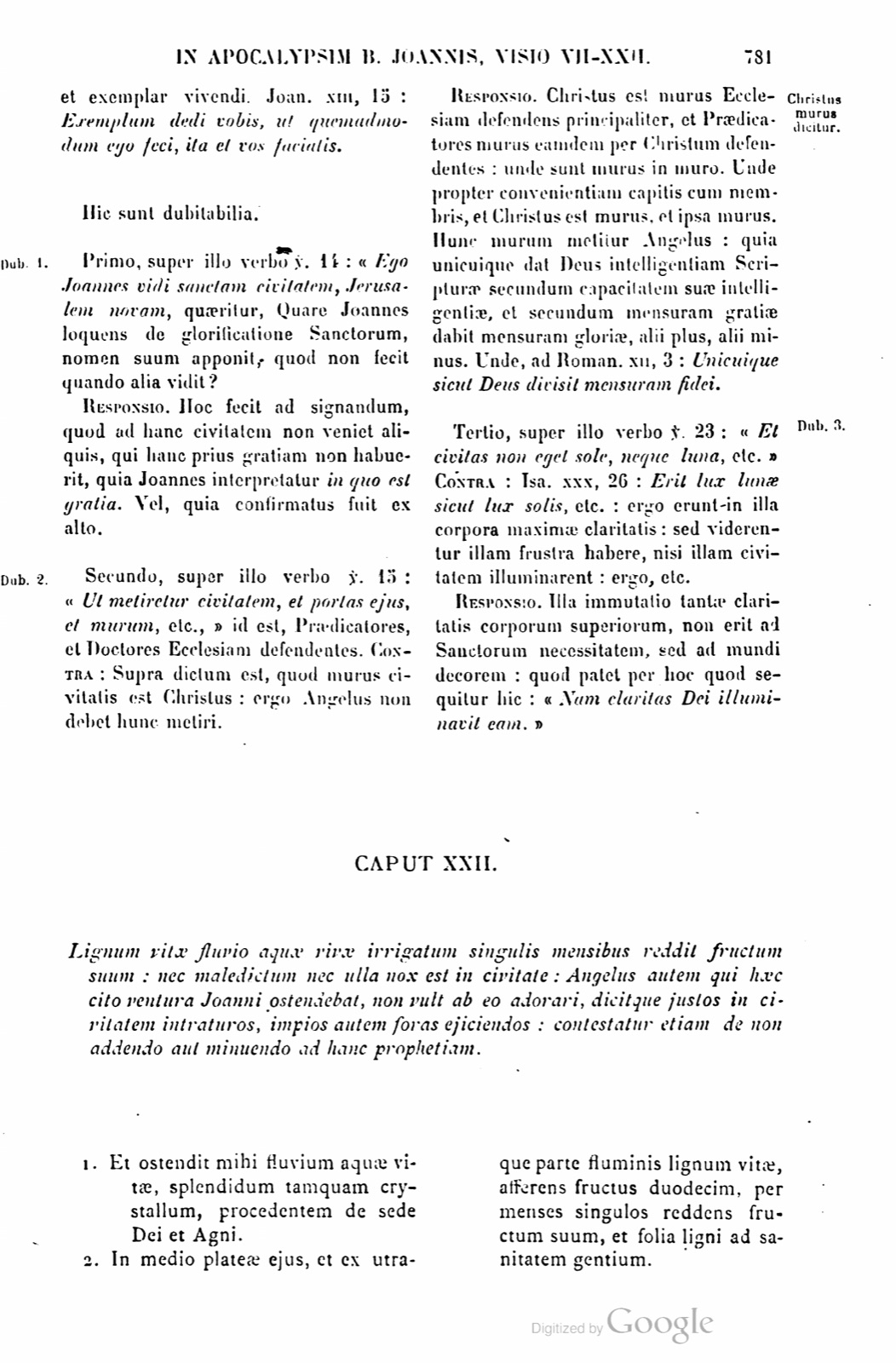
Hic sunt dubitabilia.
Primo, super illo verbo v. 14: "Ego Joannes vidi sanctam civitatem, Jerusalem novam," [Marginal label: Dub. 1.] quaeritur, Quare Joannes loquens de glorificatione Sanctorum, nomen suum apponit, quod non fecit quando alia vidit?
RESPONSIO. Hoc fecit ad signandum, quod ad hanc civitatem non veniet aliquis, qui hanc prius gratiam non habuerit, quia Joannes interpretatur in quo est gratia. Vel, quia confirmatus fuit ex alto.
Secundo, super illo verbo v. 15: "Ut metiretur civitatem, et portas ejus, et murum, etc.," [Marginal label: Dub. 2.] id est, Praedicatores, et Doctores Ecclesiam defendentes. CONTRA: Supra dictum est, quod murus civitatis est Christus: ergo Angelus non debet hunc metiri.
RESPONSIO. [Marginal label: Christus murus dicitur.] Christus est murus Ecclesiam defendens principaliter, et Praedicatores murus eamdem per Christum defendentes: unde sunt murus in muro. Unde propter convenientiam capitis cum membris, et Christus est murus, et ipsa murus. Hunc murum metitur Angelus: quia unicuique dat Deus intelligentiam Scripturae secundum capacitatem suae intelligentiae, et secundum mensuram gratiae dabit mensuram gloriae, alii plus, alii minus. Unde, ad Roman. XII, 3: Unicuique sicut Deus divisit mensuram fidei.
Tertio, super illo verbo v. 23: "Et civitas non eget sole, neque luna, etc." [Marginal label: Dub. 3.] CONTRA: Isa. XXX, 26: Erit lux lunae sicut lux solis, etc.: ergo erunt in illa corpora maximae claritatis: sed viderentur illam frustra habere, nisi illam civitatem illuminarent: ergo, etc.
RESPONSIO. Illa immutatio tantae claritatis corporum superiorum, non erit ad Sanctorum necessitatem, sed ad mundi decorem: quod patet per hoc quod sequitur hic: "Nam claritas Dei illuminavit eam."
Here are the doubtful points.
First, concerning that word in verse 14: "I John saw the holy city, the new Jerusalem," [Marginal label: Dub. 1.] it is asked why John, speaking about the glorification of the Saints, adds his own name, which he did not do when he saw other things.
RESPONSE. He did this to signify that no one will come to this city who has not first had this grace, because John is interpreted, "in whom there is grace." Or, because he was confirmed from on high.
Secondly, concerning that word in verse 15: "So that he might measure the city, and its gates, and the wall, etc.," [Marginal label: Dub. 2.] that is, Preachers and Doctors defending the Church. TO THE CONTRARY: It was said above that the wall of the city is Christ; therefore the Angel ought not to measure this wall.
RESPONSE. [Marginal label: Christ is called wall.] Christ is the wall defending the Church principally, and Preachers are the wall defending the same Church through Christ; hence they are a wall in the wall. Therefore because of the agreement of the head with the members, both Christ is the wall and it itself is the wall. The Angel measures this wall, because God gives to each one understanding of Scripture according to the capacity of his understanding, and according to the measure of grace he will give the measure of glory, to one more, to another less. Hence Romans 12:3: To each one as God has divided the measure of faith.
Thirdly, concerning that word in verse 23: "And the city has no need of sun, nor of moon, etc." [Marginal label: Dub. 3.] TO THE CONTRARY: Isaiah 30:26: The light of the moon will be like the light of the sun, etc.; therefore those bodies of the greatest brightness will be in that place. But they would seem to have that brightness in vain unless they illuminated that city; therefore, etc.
RESPONSE. That change of such great brightness of the superior bodies will not be for the necessity of the Saints, but for the adornment of the world; this is clear through what follows here: "For the brightness of God illuminated it."
If a page does not appear, its photograph has not been uploaded yet.