Works › Commentary on the Apocalypse of Blessed John
Volume 38 · pp. 470–478
Explanation of Gilbert's Prologue on the Apocalypse of Blessed John the Apostle
A marker with ≈ is an approximate page boundary, placed by measure of the text; the page photographs remain the authority. In the paired views, clicking a page marker brings that page into view.
Prologi Gilberti, in Apocalypsim B. Joannis Apostoli, Explanatio.
Omnes qui pie volunt vivere in Christo Jesu (sicut ait Apostolus 1) persecutionem patientur, juxta illud, Fili, accedens ad servitudinem Dei, sta in justitia et timore, et praepara animam tuam ad tentationem 2. Tentatio namque est vita hominis super terram. Ne autem fideles deficiant in his, consolatur eos Dominus atque confirmat, dicens: Vobiscum sum usque ad consummationem saeculi 3. Et, Nolite timere, pusillus grex 4. Propterea videns Deus Pater tribulationes quas passura erat Ecclesia ab Apostolis fundata supra petram Christum, ut minus timeatur, disposuit una cum Filio et Spiritu sancto, eas revelare.
Iste prologus dividitur in duas partes. In prima, tanguntur causae hujus libri in generali. In secunda, in speciali, ibi, "Itaque materia Joannis."
Prima pars in quatuor. In prima ponitur causa efficiens: in secunda, materialis, ibi, "Itaque materia Joannis." In tertia, causa formalis, ibi, "Ideo liber iste." In quarta, causa finalis, ibi, "Vidit autem Joannes."
In prima tangitur duplex causa efficiens: primo movens vel inducens, secundo operans et exsequens, ibi, "Revelavit autem tota Trinitas."
Prima pars in tres. In prima, primo praemittit Gilbertus tribulationem Ecclesiae exteriorem ut proficiat: secundo, interiorem Dei consolationem ne deficiat, ibi, "Ne autem fideles." Tertio, utriusque revelationem, ne timore succumbat, ibi, "Propterea videns Deus."
Dicit ergo: "Omnes qui pie volunt vivere in Christo Jesu," id est, cultum Dei tenentes, et proximis compatientes. Vel, "pie," id est, religiose. Et primo modo est pietas venerationis, quae est idem quod religiositas vel cultus Dei. Secundo modo est pietas compassionis, quae idem est quod affectus erga proximum, ut dicit Tullius. Sicut ait Apostolus, II ad Timoth. III, 12: "Persecutionem patientur," juxta illud Ecclesiastici, II, 1: "Fili, accedens ad servitudinem Dei," cui scilicet servire regnare est, "sta in justitia," id est, firmitate propositi contra tentationes immobilis, "et timore," ut nihil negligas de faciendis. Eccle. VII, 19: Qui timet Deum, nihil negligit. Vel sic: "Sta in justitia," id est, persevera in operatione boni, "et timore," id est, declinatione mali. Proverb. XIV, 27: Timor Domini fons vitae, ut declinent a ruina mortis, id est, declinare eos faciat a peccato mortali. "Et praepara animam tuam," id est, voluntatem, "ad tentationem," scilicet sustinendam. Quasi diceret: Ut sis paratus voluntarie sustinere omnia. Augustinus super Psalmum LIV: "Si non pateris ullam pro Christo persecutionem, nondum coepisti in Christo vivere pie: cum autem coeperis, ingressus es torcular, praepara te ad pressuras."
Explanation of Gilbert's Prologue on the Apocalypse of Blessed John the Apostle.
All who wish to live piously in Christ Jesus (as the Apostle says 1) will suffer persecution, according to that saying, Son, when you approach the service of God, stand in justice and fear, and prepare your soul for temptation 2. For temptation is the life of man upon the earth. But lest the faithful fail in these things, the Lord consoles them and confirms them, saying: I am with you even to the consummation of the age 3. And, Do not fear, little flock 4. Therefore God the Father, seeing the tribulations which the Church, founded by the Apostles upon the rock Christ, was going to suffer, so that they might be feared less, determined together with the Son and the Holy Spirit to reveal them.
This prologue is divided into two parts. In the first, the causes of this book are touched on in general. In the second, in particular, there: "Therefore the matter of John."
The first part is in four. In the first the efficient cause is set down; in the second, the material cause, there: "Therefore the matter of John." In the third, the formal cause, there: "Therefore this book." In the fourth, the final cause, there: "But John saw."
In the first a twofold efficient cause is touched on: first, the cause moving or inducing; second, the cause working and executing, there: "But the whole Trinity revealed."
The first part is in three. In the first, first Gilbert puts before us the outward tribulation of the Church so that it may profit; second, the inward consolation of God lest it fail, there: "But lest the faithful." Third, the revelation of both, lest it succumb through fear, there: "Therefore God seeing."
Therefore he says: "All who wish to live piously in Christ Jesus," that is, holding the worship of God and suffering together with their neighbors. Or, "piously," that is, religiously. And in the first way piety is the piety of veneration, which is the same as religiousness or the worship of God. In the second way it is the piety of compassion, which is the same as affection toward neighbor, as Tullius says. As the Apostle says, II Timothy III, 12: "They will suffer persecution," according to that saying of Ecclesiasticus II, 1: "Son, when you approach the service of God," to serve whom, namely, is to reign, "stand in justice," that is, immovable in firmness of purpose against temptations, "and in fear," so that you neglect nothing among the things to be done. Ecclesiastes VII, 19: He who fears God neglects nothing. Or thus: "Stand in justice," that is, persevere in the operation of good, "and in fear," that is, in the declining of evil. Proverbs XIV, 27: The fear of the Lord is a fountain of life, so that they may turn aside from the ruin of death, that is, so that it may make them turn aside from mortal sin. "And prepare your soul," that is, your will, "for temptation," namely to be endured. As if he were saying: So that you may be voluntarily prepared to endure all things. Augustine on Psalm LIV: "If you suffer no persecution for Christ, you have not yet begun to live piously in Christ; but when you have begun, you have entered the winepress; prepare yourself for pressures."

"Tentatio namque est vita hominis super terram." Job, VII, 1, secundum aliam litteram 5. Quasi diceret: Ad hoc est homo positus super terram, ut sicut miles strenuus fortis sit in tentationibus.
"Ne autem fideles in his," scilicet, tribulationibus, "deficiant, consolatur eos Dominus," scilicet ut hilares reddat: "atque confirmat," ut stabiles efficiat, "dicens," Matth. XXVIII, 20: "Vobiscum sum usque ad consummationem saeculi," scilicet ad tuendum et erudiendum. "Et, Nolite timere, pusillus grex." Luc. XII, 32.
"Propterea," id est, quia sic oportet pati, vel quia semper consolatur et confirmat fideles, "videns Deus Pater tribulationes quas passura erat Ecclesia ab Apostolis fundata super petram Christum." Matth. XVI, 18: Super hanc petram aedificabo Ecclesiam meam. I ad Corinth. X, 4: Petra autem erat Christus. Matth. VII, 25: Fundata enim erat super petram. "Ut minus timeatur," scilicet, tribulationes: quia, ut dicit Gregorius, jacula quae praevidentur, minus feriunt; "disposuit una cum Filio et Spiritu sancto eas revelare," scilicet Joanni, et per Joannem aliis.
"For temptation is the life of man upon the earth." Job VII, 1, according to another reading 5. As if he were saying: Man has been placed upon the earth for this, that, like a strenuous soldier, he may be strong in temptations.
"But lest the faithful in these things," namely, in tribulations, "fail, the Lord consoles them," namely so that he may render them cheerful; "and confirms them," so that he may make them stable, "saying," Matthew XXVIII, 20: "I am with you even to the consummation of the age," namely for protecting and instructing. "And, Do not fear, little flock." Luke XII, 32.
"Therefore," that is, because thus it is necessary to suffer, or because he always consoles and confirms the faithful, "God the Father seeing the tribulations which the Church, founded by the Apostles upon the rock Christ, was going to suffer." Matthew XVI, 18: Upon this rock I will build my Church. I Corinthians X, 4: But the rock was Christ. Matthew VII, 25: For it had been founded upon the rock. "So that they might be feared less," namely, the tribulations; because, as Gregory says, weapons that are foreseen wound less; "he determined together with the Son and the Holy Spirit to reveal them," namely to John, and through John to others.
Revelavit autem tota Trinitas Christo secundum humanitatem, Christus vero Joanni per Angelum, Joannes Ecclesiae.
Hic tangitur quadruplex causa efficiens hujus revelationis, scilicet, Deus Trinitas, Christus, Joannes, Angelus.
Unde dicit: "Revelavit autem tota Trinitas," scilicet, unus Deus, "Christo secundum humanitatem, Christus vero Joanni per Angelum, Joannes Ecclesiae," scilicet, Asiae specialiter: universae generaliter.
De qua revelatione hunc librum composuit. Unde et liber iste Apocalypsis dicitur, id est, revelatio: quia hic continentur quae Deus revelavit Joanni, et Joannes Ecclesiae, quanta scilicet Ecclesia passa sit in tempore primitivo, et nunc patiatur, et novissimis temporibus Antichristi passura sit: quando tanta erit tribulatio, ut si fieri potest, etiam moveantur electi. Et quae pro his, et nunc, et in futuro praemia sit susceptura: ut quos denuntiata supplicia terrent, promissa praemia laetificent.
Hic tangitur causa materialis hujus libri: et primo, secundum quod materia virtutis: secundo, secundum quod est ratio acquirendae beatitudinis, ibi, "Et quae pro his."
But the whole Trinity revealed to Christ according to humanity, Christ however to John through the Angel, John to the Church.
Here the fourfold efficient cause of this revelation is touched on, namely, God the Trinity, Christ, John, and the Angel.
Hence he says: "But the whole Trinity revealed," namely, one God, "to Christ according to humanity; Christ however to John through the Angel; John to the Church," namely, specially to Asia, generally to the universal Church.
Concerning which revelation he composed this book. Hence also this book is called Apocalypse, that is, revelation: because here are contained the things which God revealed to John, and John to the Church: how much, namely, the Church suffered in the primitive time, and now suffers, and will suffer in the last times of Antichrist; when there will be such great tribulation that, if it can be, even the elect will be moved. And what rewards for these things, both now and in the future, it is going to receive, so that those whom the announced punishments terrify may be gladdened by the promised rewards.
Here the material cause of this book is touched on: first, insofar as it is matter of virtue; second, insofar as it is a reason for acquiring beatitude, there: "And what rewards for these things."
Unde dicit: "De qua revelatione hunc librum composuit," scilicet Joannes. "Unde et liber iste Apocalypsis dicitur, id est, revelatio."
"Quia hic continentur quae Dominus revelavit Joanni, et Joannes Ecclesiae, quanta scilicet Ecclesia passa sit in tempore primitivo," id est, in principio suae fundationis, "et nunc patiatur," scilicet tempore moderno, "et novissimis temporibus Antichristi passura sit: quando tanta erit tribulatio ut si fieri potest, etiam moveantur electi 6."
"Et quae pro his." Quasi diceret: Non solum tribulationes in hoc libro continentur: imo "et quae pro his," scilicet tribulationibus, "et nunc," quantum ad dona gratiae, id est, in praesenti, "et in futuro praemia sit susceptura," quantum ad dona gloriae, scilicet Ecclesia 7. "Ut quos denuntiata supplicia terrent, promissa praemia laetificent," quia dicit Gregorius: "Consideratio praemii minuit vim flagelli."
Ideo iste liber inter reliquas scripturas Novi Testamenti, prophetiae nomine censetur, quae aliis est excellentior prophetiis. Sicut enim Novum Testamentum praestat Veteri, Evangelium legi: ita haec prophetia prophetiis Veteris Testamenti: quia de Christo et Ecclesia magna ex parte jam adimpleta sacramenta denuntiat.
Hic tangitur causa formalis. Et primo determinatur modus vel forma absolute, scilicet, prophetalis: secundo, in comparatione, ibi, "Quae aliis est excellentior." Et ibi ejus excellentia ostenditur in quatuor. Primo, in hoc quod habet aliis prophetiis modum certiorem: quia jam impleta mysteria denuntiat. Secundo, in hoc quod habet materiam universaliorem: quia de praesenti, praeterito, et futuro, ibi, "Vel etiam ideo." Tertio, quia Auctorem majorem, ibi, "Ad cujus confirmandam." Quarto, in hoc quod habet visionem nobiliorem, ibi, "Cum enim Joannes."
Dicit ergo: "Ideo iste liber inter reliquas scripturas Novi Testamenti prophetiae nomine censetur." Infra, XXI, 5. "Quae aliis excellentior prophetiis." Unde Haymo: "Tanta est distinctio inter hanc prophetiam, et eam quae ante adventum Domini revelata est: quanta est differentia inter servum, et Dominum: inter legem, et Evangelium: inter hominem, et Deum."
"Sicut enim Novum Testamentum praestat Veteri, Evangelium legi." Contra: Ezechiel. I, 16: Rota erat in medio rotae, id est, Vetus Testamentum in Novo: et e converso: ergo unum non est praestantius altero. Responsio. Vetus est in Novo per explicationem, Novum in Veteri per implicationem. Item, Vetus est in Novo materialiter, Novum in Veteri formaliter: et ideo Novum praestantius est Veteri. Sicut forma materia praestantior est, "ita haec prophetia prophetiis Veteris Testamenti: quia de Christo et Ecclesia magna ex parte jam adimpleta sacramenta demonstrat, vel denuntiat."
Contra: Si prophetia haec praestat aliis, ergo Joannes praestantior fuit omnibus Prophetis. Contra: Glossa dicit in principio Psalterii, quod David fuit eximius Prophetarum. Item, quaedam Glossa super Zachariam dicit, quod Zacharias fuit eximius Prophetarum. Item, super illud Matthaei, XVII, 3: Apparuerunt illis Moyses et Elias. Glossa: Prophetarum eximius Elias. Item, Deuter. XXXIV, 10: Non surrexit ultra Propheta in Israel sicut Moyses. Item, super principium Danielis dicit Hieronymus, quod nullus Propheta tam aperte scripsit de Christo, ut Daniel: qui et tempus adventus notat, et annos, et reges enumerat, et signa manifesta praedicit. Item, super Isaiam dicit Hieronymus, quod non tam Propheta quam Evangelista dicendus sit.
Hence he says: "Concerning which revelation he composed this book," namely John did. "Hence also this book is called Apocalypse, that is, revelation."
"Because here are contained the things which the Lord revealed to John, and John to the Church: how much, namely, the Church suffered in the primitive time," that is, in the beginning of its foundation, "and now suffers," namely in the modern time, "and will suffer in the last times of Antichrist: when there will be so great a tribulation that, if it can be, even the elect will be moved 6."
"And what rewards for these things." As if he were saying: Not only tribulations are contained in this book, but rather "also what rewards for these things," namely for tribulations, "both now," with regard to the gifts of grace, that is, in the present, "and in the future it is going to receive," with regard to the gifts of glory, namely the Church 7. "So that those whom the announced punishments terrify may be gladdened by the promised rewards," because Gregory says: "Consideration of the reward diminishes the force of the scourge."
Therefore this book, among the other Scriptures of the New Testament, is reckoned by the name of prophecy, which is more excellent than the other prophecies. For just as the New Testament surpasses the Old, and the Gospel the law, so this prophecy surpasses the prophecies of the Old Testament, because concerning Christ and the Church it announces sacraments already fulfilled for the greater part.
Here the formal cause is touched on. And first the mode or form is determined absolutely, namely as prophetic; second, in comparison, there: "Which is more excellent than the others." And there its excellence is shown in four ways. First, in this, that it has a more certain mode than the other prophecies, because it announces mysteries already fulfilled. Second, in this, that it has a more universal matter, because it is about present, past, and future, there: "Or also for this reason." Third, because it has a greater Author, there: "For confirming which." Fourth, in this, that it has a more noble vision, there: "For since John."
Therefore he says: "Therefore this book, among the other Scriptures of the New Testament, is reckoned by the name of prophecy." Below, XXI, 5. "Which is more excellent than the other prophecies." Hence Haymo says: "There is as great a distinction between this prophecy and that which was revealed before the coming of the Lord as there is a difference between servant and Lord, between law and Gospel, between man and God."
"For just as the New Testament surpasses the Old, and the Gospel the law." On the contrary: Ezekiel I, 16: A wheel was in the middle of a wheel, that is, the Old Testament in the New, and conversely; therefore one is not more excellent than the other. Response. The Old is in the New by explanation, the New in the Old by implication. Likewise, the Old is in the New materially, the New in the Old formally; and therefore the New is more excellent than the Old. Just as form is more excellent than matter, "so this prophecy is more excellent than the prophecies of the Old Testament, because concerning Christ and the Church it demonstrates, or announces, sacraments already fulfilled for the greater part."
On the contrary: If this prophecy surpasses the others, then John was more excellent than all the Prophets. On the contrary: the Gloss says at the beginning of the Psalter that David was the eminent one of the Prophets. Likewise, a certain Gloss on Zechariah says that Zechariah was the eminent one of the Prophets. Likewise, on that saying of Matthew XVII, 3: Moses and Elijah appeared to them. The Gloss says: Elijah the eminent one of the Prophets. Likewise, Deuteronomy XXXIV, 10: There has not arisen further a Prophet in Israel like Moses. Likewise, on the beginning of Daniel Jerome says that no Prophet wrote so openly about Christ as Daniel, who notes both the time of the coming, and enumerates the years and kings, and foretells manifest signs. Likewise, on Isaiah Jerome says that he should be called not so much a Prophet as an Evangelist.
Quis sit eximius Prophetarum?
Respondeo. Joannes praestantior fuit omnibus Prophetis Veteris Testamenti: quia Propheta fuit Novi Testamenti, et dictorum profunditate, et revelantis auctoritate, et ipsius dignitate, fuit enim Apostolus, et omnes Apostoli majores sunt dignitate antiquis Prophetis. Unde Hieronymus in secundo prologo Bibliae: "Confidenter illis omnibus Apostolos praefero." Notandum tamen, quod quilibet praedictorum fuit eximius aliqua ratione. Elias quoad carnis integritatem, signorum operationem, et liberam malorum correptionem: David propter sermonis facilitatem, et prophetiae apertionem, et mansuetudinem, et regiam dignitatem, et Christi de ipso nascituri promissionem: Moyses quoad Dei familiaritatem, et praeceptorum Dei promulgationem apertam: Zacharias propter strenuam populi invitationem ad templi aedificationem, et Dei fidem et cultum: Isaias propter apertam Gentium vocationem: Daniel propter determinationem temporis incarnationis et passionis Christi.
Vel etiam ideo, quia cum aliis unifaria, isti trifaria data est prophetia simul, scilicet, de praeterito, praesenti, et futuro. Ad cujus confirmandam auctoritatem occurrit jam auctoritas mittentis, deferentis, et accipientis. Mittentis, scilicet, Trinitatis: et deferentis, scilicet, Angeli: et accipientis, scilicet, Joannis.
"Vel etiam ideo." Hic tangitur secunda causa excellentiae majoris. "Quia cum aliis unifaria" id est, unica, "isti trifaria data est prophetia simul, scilicet, de praeterito, et praesenti, et futuro."
"Ad cujus," scilicet prophetiae, "confirmandam auctoritatem occurrit etiam auctoritas mittentis, deferentis, et accipientis." Deinde exponit: "Mittentis, scilicet, Trinitatis: et deferentis, scilicet, Angeli: et accipientis, scilicet, Joannis." Quasi diceret: Ex his habet auctoritatem liber iste tamquam ex tribus testibus quibus bene credendum est: quia in ore duorum vel trium testium stabit omne verbum 8.
Cum autem Joanni haec in visione fuerint revelata, et sint tria genera visionum, sub quo genere contineatur, videndum est. Visio enim alia corporalis, quando videlicet corporalibus oculis aliquid videmus. Alia spiritualis seu imaginaria, cum videlicet dormientes vel vigilantes imagines rerum cernimus, quibus aliquid significatur: sicut vidit Pharao spicas, et Moyses rubum ardere: ille dormiens, iste vigilans. Alia intellectualis, quando videlicet Spiritu sancto revelante intellectui mentis, veritatem mysteriorum sicut est, capimus: quo modo vidit Joannes quae in hoc libro referuntur. Non enim figuras tantum spiritu vidit, sed et earum significata mente intellexit.
Hic ostendit quod nobiliori genere visionis vidit caeteris: unde dicit: "Cum autem Joanni haec in visione fuerint revelata, et sint tria genera visionum, sub quo genere contineatur, videndum est. Visio enim alia corporalis, quando videlicet corporalibus oculis aliquid videmus," scilicet oculo corporali, ita quod
Who is the eminent one of the Prophets?
I respond. John was more excellent than all the Prophets of the Old Testament, because he was a Prophet of the New Testament, both in the profundity of his sayings, and in the authority of the one revealing, and in his own dignity, for he was an Apostle, and all the Apostles are greater in dignity than the ancient Prophets. Hence Jerome in the second prologue of the Bible says: "With confidence I prefer the Apostles to all of them." Nevertheless it must be noted that each of the aforesaid was eminent for some reason. Elijah with regard to the integrity of the flesh, the working of signs, and the free correction of the wicked; David because of ease of speech, and the opening of prophecy, and meekness, and royal dignity, and the promise of Christ to be born from him; Moses with regard to familiarity with God and the open promulgation of God's commandments; Zechariah because of the strenuous invitation of the people to the building of the temple, and to God's faith and worship; Isaiah because of the open calling of the Gentiles; Daniel because of the determination of the time of the incarnation and passion of Christ.
Or also for this reason: because, while prophecy was given to others in one way, to this one prophecy was given at once in three ways, namely concerning the past, present, and future. To confirm its authority there already occurs the authority of the sender, the bearer, and the receiver: of the sender, namely the Trinity; and of the bearer, namely the Angel; and of the receiver, namely John.
"Or also for this reason." Here the second cause of greater excellence is touched on. "Because while to others in one way," that is, a single way, "to this one prophecy was given in three ways at once, namely concerning the past, and present, and future."
"For confirming which," namely the prophecy, "there also occurs the authority of the sender, the bearer, and the receiver." Then he explains: "Of the sender, namely the Trinity; and of the bearer, namely the Angel; and of the receiver, namely John." As if he were saying: From these this book has authority as from three witnesses to whom one should rightly give credence, because in the mouth of two or three witnesses every word shall stand 8.
But since these things were revealed to John in a vision, and there are three kinds of visions, it must be seen under which kind it is contained. For one vision is bodily, when, namely, we see something with bodily eyes. Another is spiritual or imaginary, when, namely, whether sleeping or awake, we discern images of things, by which something is signified, as Pharaoh saw the ears of grain, and Moses the bush burning: the former sleeping, the latter awake. Another is intellectual, when, namely, with the Holy Spirit revealing, we grasp by the understanding of the mind the truth of mysteries as it is: in which way John saw the things that are reported in this book. For he did not see only the figures in spirit, but also understood their meanings in his mind.
Here he shows that he saw with a nobler kind of vision than the others. Hence he says: "But since these things were revealed to John in a vision, and there are three kinds of visions, it must be seen under which kind it is contained. For one vision is bodily, when, namely, we see something with bodily eyes," namely with the bodily eye, in such a way that
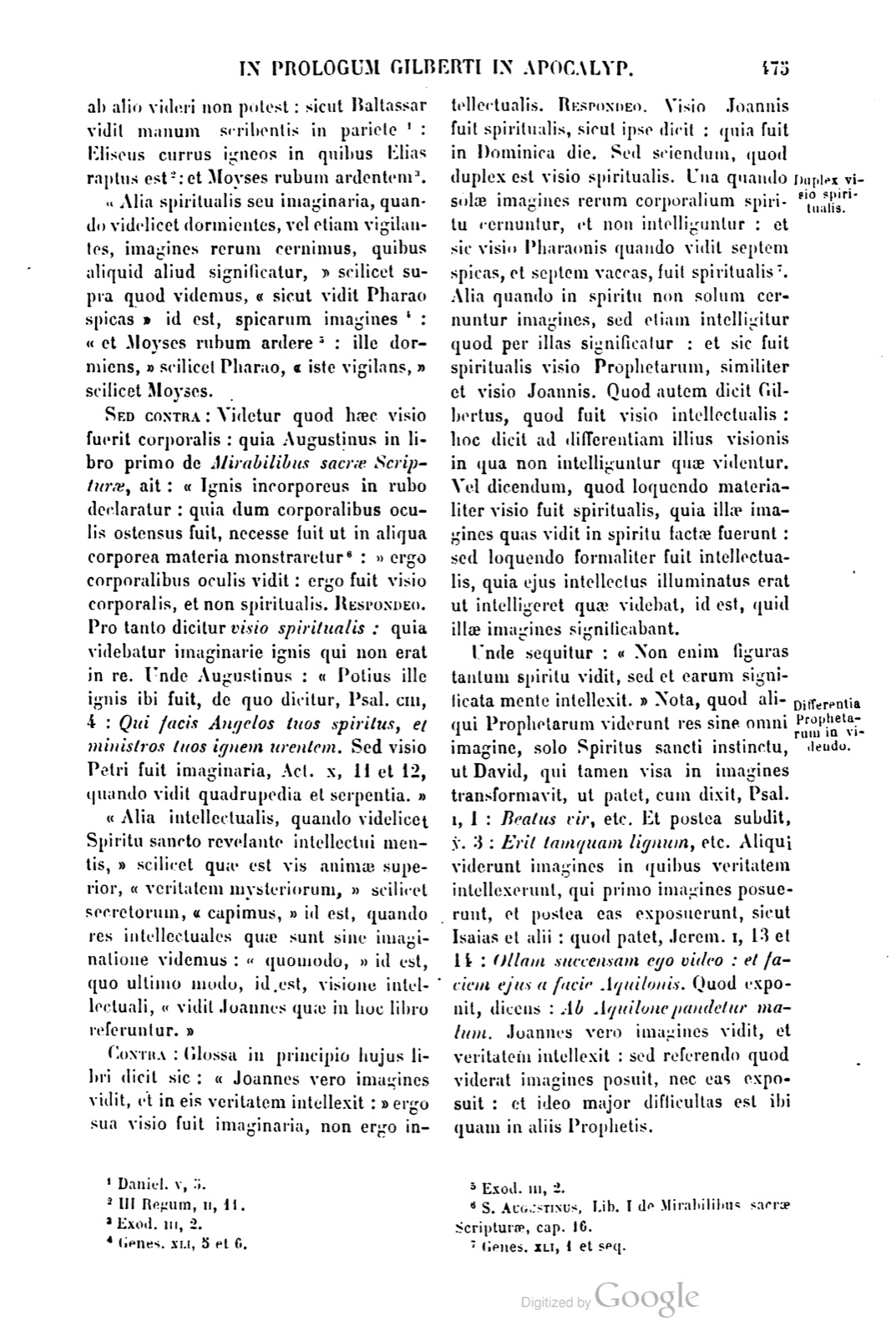
ab alio videri non potest: sicut Baltassar vidit manum scribentis in pariete 9: Eliseus currus igneos in quibus Elias raptus est 10: et Moyses rubum ardentem 11.
"Alia spiritualis seu imaginaria, quando videlicet dormientes, vel etiam vigilantes, imagines rerum cernimus, quibus aliquid aliud significatur," scilicet supra quod videmus, "sicut vidit Pharao spicas" id est, spicarum imagines 12: "et Moyses rubum ardere: ille dormiens," scilicet Pharao, "iste vigilans," scilicet Moyses.
Sed contra: Videtur quod haec visio fuerit corporalis: quia Augustinus in libro primo de Mirabilibus sacrae Scripturae, ait: "Ignis incorporeus in rubo declaratur: quia dum corporalibus oculis ostensus fuit, necesse fuit ut in aliqua corporea materia monstraretur 13:" ergo corporalibus oculis vidit: ergo fuit visio corporalis, et non spiritualis. Respondeo. Pro tanto dicitur visio spiritualis: quia videbatur imaginarie ignis qui non erat in re. Unde Augustinus: "Potius ille ignis ibi fuit, de quo dicitur, Psal. CIII, 4: Qui facis Angelos tuos spiritus, et ministros tuos ignem urentem. Sed visio Petri fuit imaginaria, Act. X, 11 et 12, quando vidit quadrupedia et serpentia."
"Alia intellectualis, quando videlicet Spiritu sancto revelante intellectui mentis," scilicet quae est vis animae superior, "veritatem mysteriorum," scilicet secretorum, "capimus," id est, quando res intellectuales quae sunt sine imaginatione videmus: "quomodo," id est, quo ultimo modo, id est, visione intellectuali, "vidit Joannes quae in hoc libro referuntur."
Contra: Glossa in principio hujus libri dicit sic: "Joannes vero imagines vidit, et in eis veritatem intellexit:" ergo sua visio fuit imaginaria, non ergo intellectualis. Respondeo. Visio Joannis fuit spiritualis, sicut ipse dicit: quia fuit in Dominica die. Sed sciendum, quod duplex est visio spiritualis. Una quando solae imagines rerum corporalium spiritu cernuntur, et non intelliguntur: et sic visio Pharaonis quando vidit septem spicas, et septem vaccas, fuit spiritualis 14. Alia quando in spiritu non solum cernuntur imagines, sed etiam intelligitur quod per illas significatur: et sic fuit spiritualis visio Prophetarum, similiter et visio Joannis. Quod autem dicit Gilbertus, quod fuit visio intellectualis: hoc dicit ad differentiam illius visionis in qua non intelliguntur quae videntur. Vel dicendum, quod loquendo materialiter visio fuit spiritualis, quia illae imagines quas vidit in spiritu factae fuerunt: sed loquendo formaliter fuit intellectualis, quia ejus intellectus illuminatus erat ut intelligeret quae videbat, id est, quid illae imagines significabant.
Unde sequitur: "Non enim figuras tantum spiritu vidit, sed et earum significata mente intellexit." Nota, quod aliqui Prophetarum viderunt res sine omni imagine, solo Spiritus sancti instinctu, ut David, qui tamen visa in imagines transformavit, ut patet, cum dixit, Psal. I, 1: Beatus vir, etc. Et postea subdit, v. 3: Erit tamquam lignum, etc. Aliqui viderunt imagines in quibus veritatem intellexerunt, qui primo imagines posuerunt, et postea eas exposuerunt, sicut Isaias et alii: quod patet, Jerem. I, 13 et 14: Ollam succensam ego video: et faciem ejus a facie Aquilonis. Quod exponit, dicens: Ab Aquilone pandetur malum. Joannes vero imagines vidit, et veritatem intellexit: sed referendo quod viderat imagines posuit, nec eas exposuit: et ideo major difficultas est ibi quam in aliis Prophetis.
it cannot be seen by another, as Belshazzar saw the hand writing on the wall 9; Elisha saw the fiery chariots in which Elijah was taken up 10; and Moses saw the burning bush 11.
"Another is spiritual or imaginary, when, namely, whether sleeping or even awake, we discern images of things, by which something else is signified," namely beyond what we see, "as Pharaoh saw the ears of grain," that is, images of ears of grain 12; "and Moses saw the bush burning: the former sleeping," namely Pharaoh, "the latter awake," namely Moses.
But on the contrary: It seems that this vision was bodily, because Augustine in the first book On the Marvels of Sacred Scripture says: "Incorporeal fire is declared in the bush, because, when it was shown to bodily eyes, it was necessary that it be displayed in some bodily matter 13." Therefore he saw with bodily eyes; therefore it was a bodily vision, and not a spiritual one. I respond. It is called a spiritual vision to this extent, because fire which was not in the thing was seen imaginatively. Hence Augustine says: "Rather, that fire was there of which it is said, Psalm CIII, 4: You who make your Angels spirits, and your ministers a burning fire. But Peter's vision was imaginary, Acts X, 11 and 12, when he saw four-footed animals and creeping things."
"Another is intellectual, when, namely, with the Holy Spirit revealing to the understanding of the mind," namely the mind which is the superior power of the soul, "we grasp the truth of mysteries," namely of secrets, that is, when we see intellectual things which are without imagination: "in which way," that is, in which last way, that is, by intellectual vision, "John saw the things that are reported in this book."
On the contrary: The Gloss at the beginning of this book says thus: "But John saw images, and in them he understood the truth." Therefore his vision was imaginary, and not therefore intellectual. I respond. John's vision was spiritual, as he himself says, because he was in the Lord's day. But it must be known that spiritual vision is twofold. One kind is when only images of bodily things are discerned in spirit and are not understood; and thus Pharaoh's vision, when he saw the seven ears of grain and the seven cows, was spiritual 14. Another kind is when in spirit not only images are discerned, but also what is signified through them is understood; and thus the vision of the Prophets was spiritual, and similarly the vision of John. But that Gilbert says that it was an intellectual vision: he says this to distinguish it from that vision in which the things that are seen are not understood. Or it must be said that, speaking materially, the vision was spiritual, because those images which he saw were made in spirit; but speaking formally it was intellectual, because his understanding was illuminated so that he understood the things he saw, that is, what those images signified.
Hence it follows: "For he did not see only figures in spirit, but also understood their meanings in his mind." Note that some of the Prophets saw things without any image, by the impulse of the Holy Spirit alone, as David did, who nevertheless transformed the things seen into images, as is evident when he said, Psalm I, 1: Blessed is the man, etc. And afterward he adds, verse 3: He will be like a tree, etc. Some saw images in which they understood the truth; they first set down the images and afterward expounded them, as Isaiah and others did. This is evident in Jeremiah I, 13 and 14: I see a boiling pot, and its face from the face of the north. He expounds this, saying: From the north evil will be opened. But John saw images and understood the truth; but in reporting what he had seen he set down the images and did not expound them; and therefore there is greater difficulty there than in the other Prophets.
Vidit autem Joannes, et scripsit in Patmos insula, relegatus a Domitiano in exsilium principe impiissimo. Hac eum ad scribendum compellente causa: quia dum exsul teneretur a Domitiano in Patmos insula, in Ecclesiis quibus praeerat multa pullularunt atque inoleverunt vitia atque diversae haereses.
Hic tangitur causa finalis, et haec duplex. Prima ad malum duplicis erroris removendum. Secunda, ad bonum promovendum, ibi, "Scribit autem Joannes."
Dicit ergo: "Vidit autem Joannes, et scripsit in Patmos insula, relegatus a Domitiano in exsilium principe impiissimo. Hac eum ad scribendum compellente causa: quia dum exsul teneretur a Domitiano in Patmos insula, in Ecclesiis quibus praeerat," scilicet Asiae minoris, "multa pullularunt," inchoatione, "atque inoleverunt," consuetudine, id est, increverunt "vitia" quae corrumpunt affectum, "atque diversae haereses" quae corrumpunt intellectum. Vel, "vitia" quae corrumpunt mores, "atque diversae haereses" quae corrumpunt fidem.
Deinde manifestat ubi haereses pullulabant, dicens:
Erant enim quidam haeretici ibi dicentes Christum non fuisse ante Mariam: quia temporaliter de ea natus erat. Quos Joannes in principio Evangelii sui redarguit, dicens: In principio erat Verbum 15. Et in hoc libro cum dicit: Alpha et Omega, id est, principium et finis 16. Dicebant etiam quidam Ecclesiam pondere tribulationum ante finem saeculi desituram, et pro labore non praemium aeternum suscepturam. Horum ergo errores volens destruere Joannes, ostendit Christum principium esse, et finem. Unde Isaias: Ante me non est formatus Deus, et post me non erit. Et Ecclesiam per exercitium tribulationum non desinere, sed proficere, et pro his bravium aeternum recipere.
"Erant quidam haeretici ibi," scilicet in Asia, "dicentes Christum non fuisse ante Mariam," non attendentes illud: Ante luciferum genui te 17. Insuper hoc dicebant, "quia temporaliter de ea natus erat," non attendentes illud Apostoli, ad Galat. IV, 4: Misit Deus Filium suum factum ex muliere. Si eum misit, ergo ante fuit. "Quos Joannes in principio Evangelii sui," scilicet ut scriptoris non ut actoris, "redarguit, dicens: In principio," id est, in Patre qui est principium sine principio, "erat Verbum," id est, Filius.
"Et in hoc libro," supple, redarguit eos, "cum dicit: Alpha et Omega, id est, principium et finis." Si erat in Patre, et Pater aeternus: ergo Filius aeternus. Item, Si principium: ergo ante Mariam, ut prius.
"Dicebant etiam quidam Ecclesiam pondere tribulationum ante finem saeculi desituram." Contra illud Matthaei, XXVIII, 20: Ecce ego vobiscum sum usque, etc. "Et pro labore non praemium aeternum suscepturam." Contra illud Sapientiae, X, 17: Reddidit Deus justis mercedem laborum suorum, etc.
"Horum ergo errores volens destruere Joannes, ostendit Christum esse principium, et finem. Unde, Isa. XLIII, 10: Ante
But John saw, and wrote on the island of Patmos, having been banished into exile by Domitian, a most impious prince. This cause compelling him to write: because while he was held as an exile by Domitian on the island of Patmos, many vices and diverse heresies sprouted and grew strong in the Churches over which he presided.
Here the final cause is touched on, and this is twofold. The first is for removing the evil of a twofold error. The second is for promoting the good, there: "But John writes."
Therefore he says: "But John saw, and wrote on the island of Patmos, having been banished into exile by Domitian, a most impious prince. This cause compelling him to write: because while he was held as an exile by Domitian on the island of Patmos, in the Churches over which he presided," namely those of Asia Minor, "many things sprouted," by beginning, "and grew strong," by custom, that is, "vices" increased which corrupt the affection, "and diverse heresies" which corrupt the understanding. Or, "vices" which corrupt morals, "and diverse heresies" which corrupt faith.
Then he manifests where the heresies were sprouting, saying:
For there were certain heretics there saying that Christ had not existed before Mary, because he was born temporally from her. John rebuked them at the beginning of his Gospel, saying: In the beginning was the Word 15. And in this book when he says: Alpha and Omega, that is, beginning and end 16. Certain persons also were saying that the Church would cease under the weight of tribulations before the end of the age, and that for its labor it would not receive an eternal reward. Therefore John, wishing to destroy their errors, shows that Christ is the beginning and the end. Hence Isaiah says: Before me no God was formed, and after me there will not be. And he shows that the Church does not cease through the exercise of tribulations, but profits, and for these things receives the eternal prize.
"There were certain heretics there," namely in Asia, "saying that Christ had not existed before Mary," not attending to that saying: Before the daystar I begot you 17. Besides this, they were saying this, "because he was born temporally from her," not attending to that saying of the Apostle, Galatians IV, 4: God sent his Son made from a woman. If he sent him, therefore he existed before. "Whom John at the beginning of his Gospel," namely as writer, not as actor, "rebuked, saying: In the beginning," that is, in the Father who is the beginning without beginning, "was the Word," that is, the Son.
"And in this book," supply, he rebukes them, "when he says: Alpha and Omega, that is, beginning and end." If he was in the Father, and the Father is eternal, therefore the Son is eternal. Likewise, if he is the beginning, therefore he is before Mary, as before.
"Certain persons also were saying that the Church would cease under the weight of tribulations before the end of the age." Against that is Matthew XXVIII, 20: Behold, I am with you even to, etc. "And that for its labor it would not receive an eternal reward." Against that is Wisdom X, 17: God rendered to the just the reward of their labors, etc.
"Therefore John, wishing to destroy their errors, shows that Christ is the beginning and the end. Hence, Isaiah XLIII, 10: Before
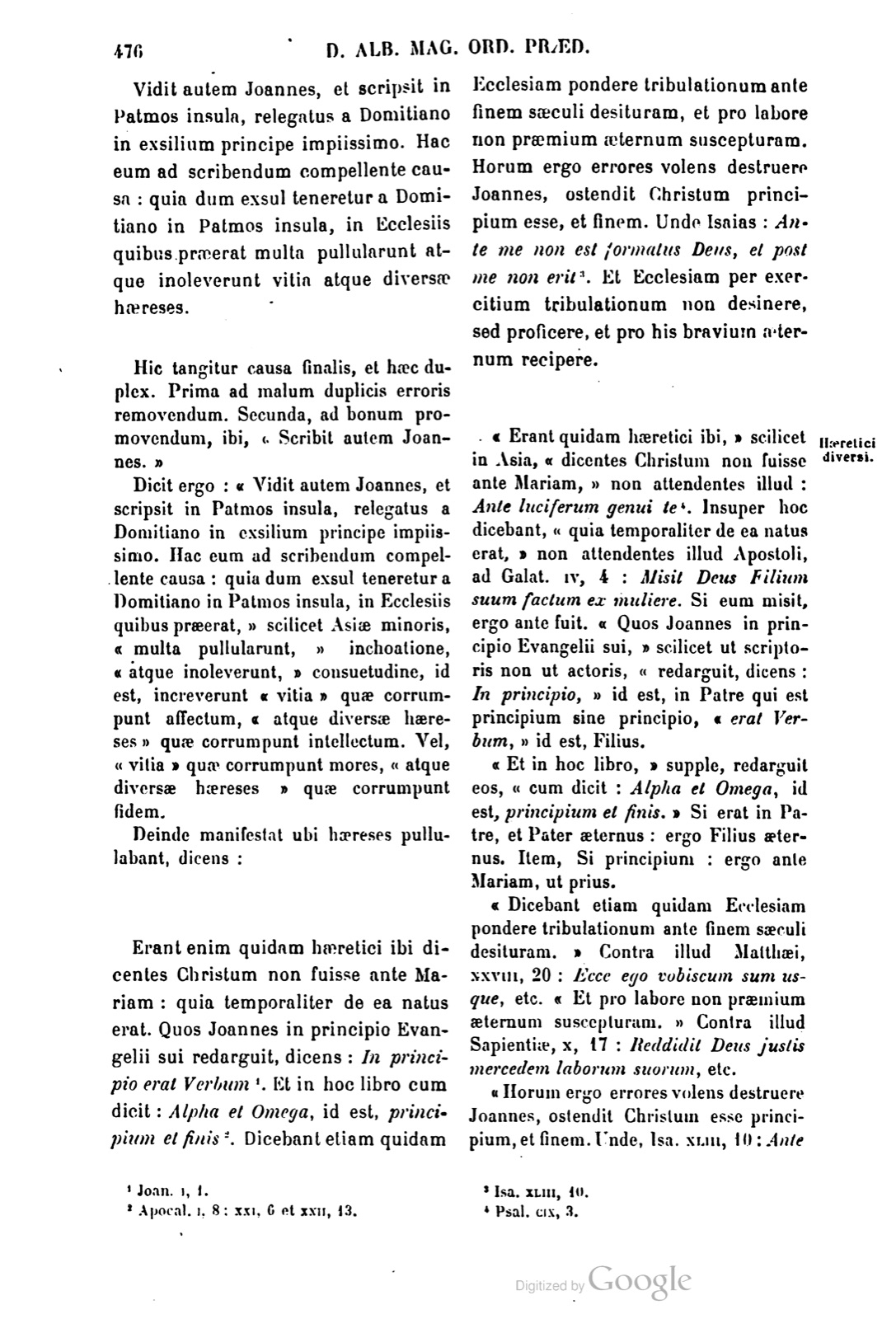
me non est formatus Deus, et post me non erit. Quasi diceret: Ego sum et sine principio et sine fine. "Et Ecclesiam per exercitium tribulationum non desinere." Infra, XII, 14: Datae sunt mulieri alae duae, etc. "Sed proficere, et pro his aeternum bravium recipere." Infra, XXI et XXII, passim, quando scilicet Ecclesia introducetur in thalamum sponsi.
Scribit autem Joannes septem Ecclesiis Asiae, et earum septem Episcopis, de praedictis instruens, et in eis per eas totam generalem Ecclesiam docens.
Duplex Asia.
Hic tangitur secunda causa finalis, scilicet, Ecclesiae instructio. Unde dicit: "Scribit autem Joannes septem Ecclesiis Asiae," scilicet minoris, cujus metropolis erat Ephesus: non majoris, quae est tertia pars mundi. Ipse enim praeerat septem Ecclesiis illius Asiae. "Et earum septem Episcopis, de praedictis instruens, et in eis per eas," id est, Ecclesias Asiae, "totam Ecclesiam generalem docens."
Est itaque materia Joannis in hoc opere, status specialiter Asianae Ecclesiae, necnon et totius, videlicet quae in praesenti patiatur, et in futuro receptura sit.
"Est itaque materia." Supra tetigit in generali causas hujus operis. Hic tangit quasi in speciali, quasi recapitulando quae materia, quae intentio, quis modus agendi.
Dicit ergo: "Est itaque materia Joannis in hoc opere, status specialiter Asianae Ecclesiae, necnon et totius Ecclesiae, videlicet quae in praesenti," scilicet saeculo, "patiatur, et in futuro receptura sit."
Intentio vero ejus est monere ad patientiam: quae servanda est, tum quia brevis labor, tum quia praemium magnum.
"Intentio vero ejus est monere ad patientiam quae servanda est: tum quia brevis labor est." Sapient. IV, 3: In paucis vexati. "Tum quia praemium magnum." Ubi supra, In multis bene disponentur.
Modus tractandi talis est: primo praemittit Prologum, et salutationem, ubi reddit auditores benignos et attentos: quo praemisso accedit ad narrationem. Ante narrationem vero ostendit Christum esse ab aeterno sine principio, et sine fine, inducens ipsum loquentem: Ego sum Alpha et Omega, id est, principium et finis 18. Postea accedens ad narrationem, distinguit septem visiones: quibus terminatis iste liber consummatur.
no God was formed before me, and after me there will not be. As if he were saying: I am both without beginning and without end. "And that the Church does not cease through the exercise of tribulations." Below, XII, 14: Two wings were given to the woman, etc. "But that it advances, and receives for these things an eternal prize." Below, XXI and XXII throughout, namely when the Church will be introduced into the bridegroom's chamber.
But John writes to the seven Churches of Asia and to their seven Bishops, instructing them concerning the aforesaid things, and in them, through them, teaching the whole general Church.
Twofold Asia.
Here the second final cause is touched on, namely the instruction of the Church. Hence he says: "But John writes to the seven Churches of Asia," namely of Asia Minor, whose metropolis was Ephesus; not of greater Asia, which is the third part of the world. For he himself presided over the seven Churches of that Asia. "And to their seven Bishops, instructing them concerning the aforesaid things, and in them through them," that is, through the Churches of Asia, "teaching the whole general Church."
Therefore the matter of John in this work is especially the state of the Asian Church, and also of the whole Church, namely what it suffers in the present and what it is going to receive in the future.
"Therefore the matter is." Above he touched in general on the causes of this work. Here he touches on them as if in particular, as if recapitulating what the matter is, what the intention is, and what the mode of proceeding is.
Therefore he says: "Therefore the matter of John in this work is especially the state of the Asian Church, and also of the whole Church, namely what it suffers in the present," that is, in the present age, "and what it is going to receive in the future."
But its intention is to admonish to patience, which must be kept, both because the labor is brief and because the reward is great.
"But its intention is to admonish to patience, which must be kept: both because the labor is brief." Wisdom IV, 3: Troubled in few things. "And because the reward is great." In the same place above: In many things they will be well disposed.
The mode of treating is such: first he sets before us the Prologue and salutation, where he renders the hearers kindly disposed and attentive; once this has been set before them, he approaches the narration. But before the narration he shows that Christ is from eternity, without beginning and without end, introducing him speaking: I am Alpha and Omega, that is, the beginning and the end 18. Afterward, approaching the narration, he distinguishes seven visions; when these are finished, this book is completed.
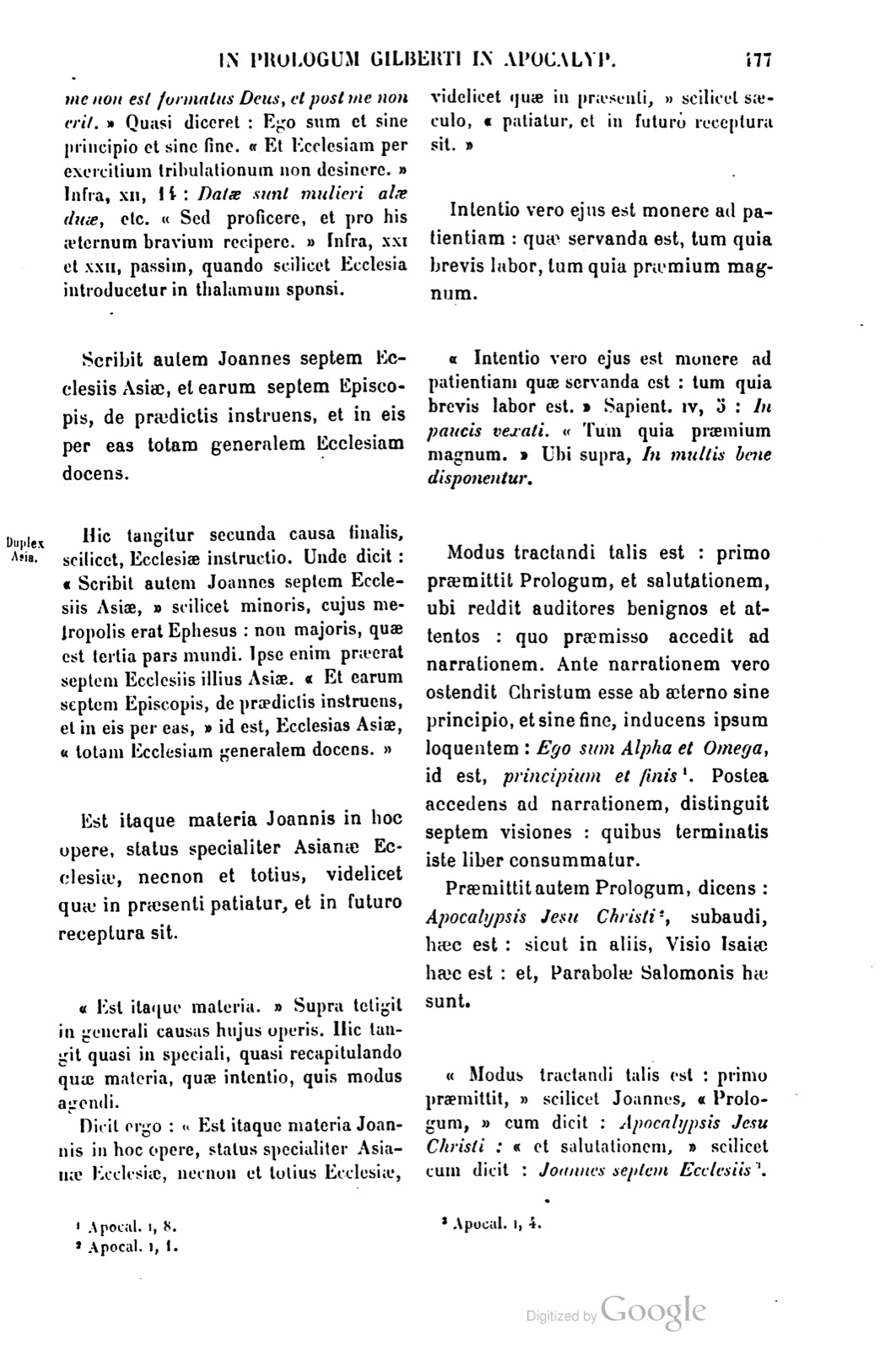
Praemittit autem Prologum, dicens: Apocalypsis Jesu Christi 19; subaudi, haec est: sicut in aliis, Visio Isaiae haec est: et, Parabolae Salomonis hae sunt.
"Modus tractandi talis est: primo praemittit," scilicet Joannes, "Prologum," cum dicit: Apocalypsis Jesu Christi: "et salutationem," scilicet cum dicit: Joannes septem Ecclesiis 20.
Hic opponitur: Salutatio est de ipso Prologo: ergo male dicit Prologum, et salutationem. Respondeo. Haec conjunctio, et, quandoque regitur copulative: ut, Socrates et Plato currunt: quandoque expositive, ut, Proverb. XXXI, 30: Fallax gratia, et vana est pulchritudo. Quandoque unitive, et hoc dupliciter: vel quia unit duo respectu tertii, ut cum dicitur: Anima rationalis et caro unus est homo. Vel, quia designat unum esse de unitate alterius, et sic sumitur hic.
"Ubi reddit auditores benignos" interius, "et attentos" exterius. Vel, "benignos" in affectu, "et attentos" in intellectu. "Quo praemisso, accedit ad narrationem," primo capitulo, v. 9: Ego Joannes, frater vester.
"Ante narrationem vero ostendit Christum esse ab aeterno sine principio, et sine fine, inducens ipsum loquentem, et dicentem: Ego sum Alpha et Omega, id est, principium et finis. Postea accedens ad narrationem distinguit septem visiones," scilicet secundum septem Ecclesias quibus scribit. "Quibus terminatis iste liber consummatur," id est, terminatur.
"Praemittit autem Prologum, dicens: Apocalypsis Jesu Christi; subaudi, haec est: sicut in aliis, Visio Isaiae haec est: et, Parabolae Salomonis hae sunt."
But he sets the Prologue before us, saying: The Apocalypse of Jesus Christ 19; understand, this is it, as in other places: This is the Vision of Isaiah; and, These are the Parables of Solomon.
"The mode of treating is such: first he sets before us," namely John does, "the Prologue," when he says: The Apocalypse of Jesus Christ; "and the salutation," namely when he says: John to the seven Churches 20.
Here an objection is raised: The salutation belongs to the Prologue itself; therefore he badly says, Prologue and salutation. I respond. This conjunction, and, is sometimes governed copulatively, as, Socrates and Plato run; sometimes expositively, as, Proverbs XXXI, 30: Grace is deceitful, and beauty is vain; sometimes unitively, and this in two ways: either because it unites two things with respect to a third, as when it is said, A rational soul and flesh are one man; or because it designates that one thing belongs to the unity of another, and so it is taken here.
"Where he renders the hearers kindly disposed" inwardly, "and attentive" outwardly. Or, "kindly disposed" in affection, "and attentive" in understanding. "Once this has been set before them, he approaches the narration," in the first chapter, verse 9: I John, your brother.
"But before the narration he shows that Christ is from eternity without beginning and without end, introducing him as speaking and saying: I am Alpha and Omega, that is, the beginning and the end. Afterward, approaching the narration, he distinguishes seven visions," namely according to the seven Churches to which he writes. "When these are finished this book is completed," that is, ended.
"But he sets the Prologue before us, saying: The Apocalypse of Jesus Christ; understand, this is it, as in other places: This is the Vision of Isaiah; and, These are the Parables of Solomon."

Notes
- II Timothy III, 12. (II ad Timoth. III, 12.) ↩
- Ecclesiasticus II, 1. (Eccli. II, 1.) ↩
- Matthew XXVIII, 20. (Matth. XXVIII, 20.) ↩
- Luke XII, 32. (Luc. XII, 32.) ↩
- The Vulgate has, Job VII, 1: Warfare is the life of man upon the earth. (Vulgata habet, Job, VII, 1: Militia est vita hominis super terram.) ↩
- Compare Matthew XXIV, 24. (Cf. Matth. XXIV, 24.) ↩
- Compare Apocalypse XII and XXII throughout. (Cf. Apocal. XII et XXII passim.) ↩
- Matthew XVIII, 16. (Matth. XVIII, 16.) ↩
- Daniel V, 5. (Daniel. V, 5.) ↩
- III Kings II, 11. (III Regum, II, 11.) ↩
- Exodus III, 2. (Exod. III, 2.) ↩
- Genesis XLI, 5 and 6. (Genes. XLI, 5 et 6.) ↩
- Exodus III, 2. (Exod. III, 2.) ↩
- Genesis XLI, 1 and following. (Genes. XLI, 1 et seq.) ↩
- John I, 1. (Joan. I, 1.) ↩
- Apocalypse I, 8; XXI, 6 and XXII, 13. (Apocal. I, 8; XXI, 6 et XXII, 13.) ↩
- Psalm CIX, 3. (Psal. CIX, 3.) ↩
- Apocalypse I, 8. (Apocal. I, 8.) ↩
- Apocalypse I, 1. (Apocal. I, 1.) ↩
- Apocalypse I, 4. (Apocal. I, 4.) ↩
If a page does not appear, its photograph has not been uploaded yet.