Works › Commentary on the Apocalypse of Blessed John
Volume 38 · pp. 479–500
The Apocalypse of Blessed John the Apostle. First Vision. Chapter I. Commentary on Chapter I of the Apocalypse
A marker with ≈ is an approximate page boundary, placed by measure of the text; the page photographs remain the authority. In the paired views, clicking a page marker brings that page into view.
Apocalypsis B. Joannis Apostoli. Visio Prima. Caput I.
Joannes in Patmos insula relegatus jubetur scribere quae viderit septem Asiae ecclesiis, per septem candelabra designatis, quae vidit in circuitu Filii hominis; modum describens quo hic ipsi demonstratus sit.
1. Apocalypsis Jesu Christi, quam dedit illi Deus palam facere servis suis, quae oportet fieri cito, et significavit, mittens per Angelum suum servo suo Joanni, 2. Qui testimonium perhibuit verbo Dei, et testimonium Jesu Christi, quaecumque vidit. 3. Beatus qui legit et audit verba prophetiae hujus, et servat ea quae in ea scripta sunt: tempus enim prope est. 4. Joannes septem ecclesiis quae sunt in Asia. Gratia vobis et pax ab eo qui est, et qui erat, et qui venturus est 1: et a septem spiritibus qui in conspectu throni ejus sunt: 5. Et a Jesu Christo, qui est testis fidelis, primogenitus mortuorum 2, et princeps regum terrae: qui dilexit nos, et lavit nos a peccatis nostris in sanguine suo 3. 6. Et fecit nos regnum et sacerdotes Deo et Patri suo: ipsi gloria et imperium in saecula saeculorum. Amen. 7. Ecce venit cum nubibus: et videbit eum omnis oculus, et qui eum pupugerunt. Et plangent se super eum omnes tribus terrae 4. Etiam. Amen. 8. Ego sum Alpha et Omega, principium et finis, dicit Dominus Deus, qui est, et qui erat, et qui venturus est, Omnipotens 5. 9. Ego Joannes, frater vester, et particeps in tribulatione, et regno, et patientia in Christo Jesu, fui in insula, quae appellatur Patmos, propter verbum Dei et testimonium Jesu. 10. Fui in spiritu in dominica die, et audivi post me vocem magnam tamquam tubae. 11. Dicentis: Quod vides, scribe in libro, et mitte septem ecclesiis quae sunt in Asia, Epheso, et Smyrnae, et Pergamo, et Thyatirae, et Sardis, et Philadelphiae, et Laodiciae. 12. Et conversus sum, ut viderem vocem quae loquebatur mecum: et conversus vidi septem candelabra aurea, 13. Et in medio septem candelabrorum aureorum similem Filio hominis, vestitum podere, et praecinctum ad mamillas zona aurea: 14. Caput autem ejus et capilli erant candidi tamquam lana alba, et tamquam nix, et oculi ejus tamquam flamma ignis: 15. Et pedes ejus similes aurichalco, sicut in camino ardenti: et vox illius tamquam vox aquarum multarum: 16. Et habebat in dextera sua stellas septem, et de ore ejus gladius utraque parte acutus exibat: et facies ejus sicut sol lucet in virtute sua. 17. Et cum vidissem eum, cecidi ad pedes ejus tamquam mortuus: et posuit dexteram suam super me, dicens: Noli timere: ego sum primus et novissimus 6, 18. Et vivus, et fui mortuus, et ecce sum vivens in saecula saeculorum, et habeo claves mortis, et inferni. 19. Scribe ergo quae vidisti, et quae sunt, et quae oportet fieri post haec. 20. Sacramentum septem stellarum quas vidisti in dextera mea, et septem candelabra aurea: septem stellae, angeli sunt septem ecclesiarum: et candelabra septem, septem ecclesiae sunt.
The Apocalypse of Blessed John the Apostle. First Vision. Chapter I.
John, having been banished on the island of Patmos, is ordered to write the things which he has seen to the seven churches of Asia, designated by the seven lampstands which he saw around the Son of Man, describing the manner in which this one was shown to him.
1. The Apocalypse of Jesus Christ, which God gave to him to make plain to his servants the things which must happen quickly, and he signified it, sending through his Angel to his servant John, 2. Who bore testimony to the word of God and the testimony of Jesus Christ, whatever things he saw. 3. Blessed is he who reads and hears the words of this prophecy, and keeps the things that are written in it; for the time is near. 4. John to the seven churches which are in Asia. Grace to you and peace from him who is, and who was, and who is to come 1, and from the seven spirits who are in the sight of his throne: 5. And from Jesus Christ, who is the faithful witness, the firstborn of the dead 2, and the prince of the kings of the earth, who loved us and washed us from our sins in his blood 3. 6. And he made us a kingdom and priests to God and his Father: to him be glory and empire forever and ever. Amen. 7. Behold, he comes with clouds, and every eye will see him, and those who pierced him. And all the tribes of the earth will lament themselves over him 4. Even so. Amen. 8. I am Alpha and Omega, the beginning and the end, says the Lord God, who is, and who was, and who is to come, the Almighty 5. 9. I John, your brother and sharer in tribulation, and in the kingdom, and in patience in Christ Jesus, was on the island which is called Patmos, on account of the word of God and the testimony of Jesus. 10. I was in spirit on the Lord's day, and I heard behind me a great voice like a trumpet, 11. Saying: What you see, write in a book, and send it to the seven churches which are in Asia, to Ephesus, and Smyrna, and Pergamum, and Thyatira, and Sardis, and Philadelphia, and Laodicea. 12. And I turned, so that I might see the voice which was speaking with me; and having turned I saw seven golden lampstands, 13. And in the midst of the seven golden lampstands one like the Son of Man, clothed with a poderis, and girded at the breasts with a golden belt. 14. But his head and hair were white like white wool, and like snow, and his eyes were like a flame of fire: 15. And his feet were like aurichalcum, as in a burning furnace, and his voice was like the voice of many waters: 16. And he had in his right hand seven stars, and from his mouth a sword sharp on both sides was coming forth, and his face was as the sun shines in its strength. 17. And when I had seen him, I fell at his feet as though dead; and he placed his right hand upon me, saying: Fear not: I am the first and the last 6, 18. And living, and I was dead, and behold, I am living forever and ever, and I have the keys of death and of hell. 19. Therefore write the things which you have seen, and the things which are, and the things which must happen after these things. 20. The sacrament of the seven stars which you have seen in my right hand, and the seven golden lampstands: the seven stars are the angels of the seven churches, and the seven lampstands are the seven churches.
In Caput I Apocalypseos Enarratio.
"Apocalypsis Jesu Christi, quam dedit illi Deus palam facere servis suis, quae oportet fieri cito, et significavit, mittens per Angelum suum servo suo Joanni, Qui testimonium perhibuit verbo Dei, et testimonium Jesu Christi, quaecumque vidit."
Iste liber dividitur in tres partes: in prooemium, et tractatum qui incipit ibi, v. 9: "Ego Joannes frater vester:" et conclusionem quae incipit ibi, XXI, 5: "Et dixit mihi: Haec verba fidelissima sunt, etc." Vel, in exordium, et narrationem, et consummationem.
In prima parte tanguntur duo. Primo, ponitur prooemium: secundo, salutatio, ibi, v. 4: "Joannes septem Ecclesiis." In prima duo: primo, de quo sit praesens intentio, ibi, v. 1: "Apocalypsis Jesu Christi:" secundo, ipsius revelationis commendatio, ibidem: "Quam dedit illi Deus."
Et commendatur primo, ab auctoritate, cum dicit: "Quam dedit illi Deus." Secundo, a necessitate, cum dicit: "Quae oportet fieri cito." Tertio, ab utilitate, cum dicit, v. 3: "Beatus qui legit, etc."
Commendatur autem ab auctoritate quadruplici, scilicet, mittentis, cum dicitur: "Jesu Christi:" dantis, cum dicit: "Quam dedit illi Deus:" deferentis, cum dicit: "Mittens per Angelum:" recipientis, cum dicitur: "Servo suo Joanni."
Commentary on Chapter I of the Apocalypse.
"The Apocalypse of Jesus Christ, which God gave to him to make plain to his servants the things which must happen quickly, and he signified it, sending through his Angel to his servant John, Who bore testimony to the word of God and the testimony of Jesus Christ, whatever things he saw."
This book is divided into three parts: into the proem, and the treatise which begins there, verse 9: "I John your brother," and the conclusion which begins there, XXI, 5: "And he said to me: These words are most faithful, etc." Or, into exordium, narration, and consummation.
In the first part two things are touched on. First, the proem is set down; second, the salutation, there, verse 4: "John to the seven Churches." In the first there are two things: first, concerning what the present intention is, there, verse 1: "The Apocalypse of Jesus Christ;" second, the commendation of the revelation itself, in the same place: "Which God gave to him."
And it is commended first from authority, when he says: "Which God gave to him." Second, from necessity, when he says: "Which must happen quickly." Third, from usefulness, when he says, verse 3: "Blessed is he who reads, etc."
But it is commended from fourfold authority, namely of the one sending, when it is said: "of Jesus Christ;" of the one giving, when he says: "which God gave to him;" of the one bearing it, when he says: "sending through the Angel;" of the one receiving it, when it is said: "to his servant John."
Apocalypsis.
Dicit ergo: "Apocalypsis," id est, revelatio. Nota: Apo graece, idem est quod de latine: et kalypsis graece, tectio latine. Unde Apocalypsis, idem est quod detectio, vel revelatio.
"Jesu Christi," id est, quam Trinitas revelavit Jesu Christo secundum humanitatem. Vel, "Jesu Christi" id est, quam Jesus Christus revelavit Angelo, et Angelus Joanni. Et in hoc vitat Joannes arrogantiam: quia non suam, sed Jesu Christi dicit esse revelationem. Item, reddit auditores attentos et benignos.
"Quam dedit Deus," Glossa: Pater, "palam facere," id est, ut palam faceret, non absconderet, "servis suis," id est, humilibus et operariis. In servo enim notantur duo: opus, et humilitas. Matth. XI, 25: Abscondisti haec a sapientibus et prudentibus, et revelasti ea parvulis. Psal. CXVIII, 130: Intellectum dat parvulis. Et dicit: "Servis suis," id est, servientibus ex amore, non ex timore. Joan. XV, 15: Jam non dicam vos servos... Vos autem dixi amicos. Item, "Servis suis," non canibus et porcis. Matth. VII, 6: Nolite dare sanctum canibus, neque mittatis margaritas vestras ante porcos: ne forte conculcent eas pedibus suis, etc.
"Quae oportet fieri cito." Glossa: quia inevitabile est quin fiat. Act. XIV, 21: Per multas tribulationes oportet nos intrare in regnum Dei. Item, Glossa dicit: Et utile est ut fiat.
Tribulationum utilitates.
Utilis autem est tribulatio: quia mentem a peccato sanat. Unde Gregorius de Beato Benedicto: "Vulnere corporis sanavit vulnus mentis." Item, quia amorem Dei demonstrat. Eccli. XXX, 1: Qui diligit filium suum, assiduat ei flagella. Item, intellectum illuminat. Isa. XXVII, 19: Sola vexatio intellectum dabit auditui. Item, charitatem augmentat. Psal. IV, 2: In tribulatione dilatasti mihi. Item, virtutem consummat. II ad Corinth. XII, 9: Virtus in infirmitate perficitur. Item, facit festinare ad praemia. Psal. XV, 4: Multiplicatae sunt infirmitates eorum, postea acceleraverunt. Item, acquirit regna caelestia. Matth. V, 10: Beati qui persecutionem patiuntur propter justitiam, quoniam ipsorum est regnum caelorum.
Apocalypse.
Therefore he says: "Apocalypse," that is, revelation. Note: Apo in Greek is the same as de in Latin; and kalypsis in Greek is covering in Latin. Hence Apocalypse is the same as uncovering, or revelation.
"Of Jesus Christ," that is, which the Trinity revealed to Jesus Christ according to his humanity. Or, "of Jesus Christ," that is, which Jesus Christ revealed to the Angel, and the Angel to John. And in this John avoids arrogance, because he says that the revelation is not his own, but Jesus Christ's. Likewise, he renders the hearers attentive and kindly disposed.
"Which God gave," the Gloss says: the Father, "to make plain," that is, that he might make it plain, not hide it, "to his servants," that is, to the humble and to workers. For two things are noted in a servant: work and humility. Matthew XI, 25: You have hidden these things from the wise and prudent, and have revealed them to little ones. Psalm CXVIII, 130: It gives understanding to little ones. And he says, "to his servants," that is, to those serving from love, not from fear. John XV, 15: Now I will not call you servants... But I have called you friends. Likewise, "to his servants," not to dogs and swine. Matthew VII, 6: Do not give what is holy to dogs, nor cast your pearls before swine, lest perhaps they trample them with their feet, etc.
"The things which must happen quickly." The Gloss says: because it is inevitable that it happen. Acts XIV, 21: Through many tribulations we must enter into the kingdom of God. Likewise, the Gloss says: And it is useful that it happen.
Uses of tribulations.
But tribulation is useful because it heals the mind from sin. Hence Gregory says concerning Blessed Benedict: "By the wound of the body he healed the wound of the mind." Likewise, because it demonstrates the love of God. Ecclesiasticus XXX, 1: He who loves his son makes frequent the lashes for him. Likewise, it illuminates the understanding. Isaiah XXVII, 19: Vexation alone will give understanding to the hearing. Likewise, it increases charity. Psalm IV, 2: In tribulation you have enlarged me. Likewise, it completes virtue. II Corinthians XII, 9: Virtue is perfected in weakness. Likewise, it makes one hasten to rewards. Psalm XV, 4: Their infirmities were multiplied; afterward they hastened. Likewise, it acquires the heavenly kingdoms. Matthew V, 10: Blessed are those who suffer persecution for justice, because theirs is the kingdom of heaven.
"Cito." Haymo: In praesenti tempore: quia, ut dicit Gregorius: "Breve est, quidquid fine clauditur." Deuter. XXXII, 35: Juxta est dies perditionis, et adesse festinant tempora. Et nota, quod per ista duo, "oportet, et cito," animat Sanctos ad patientiam, et tribulationem voluntariam: quia tribulationes sunt finiendae cito, et praemia cito reddenda. I Petri, I, 6: In quo exsultabitis, modicum nunc si oportet contristari in variis tentationibus.
"Et significavit," scilicet Christus, vel Deus Pater Filio, et Filius Joanni. "Significavit," id est, per signa praecepit ostendi. Vel, "Significavit," id est, sigillavit secundum Haymonem. Signum enim dicitur hic sigillum. Sic accipitur, Daniel. XII, 4: Tu autem, Daniel, claude sermones, et signa librum.
"Mittens," scilicet Deus Pater, "per Angelum suum," id est, Christum qui est magni consilii Angelus, secundum Septuaginta 7. Vel, "Mittens," scilicet Christus, "per Angelum suum," verum secundum naturam, et etiam "suum" propter officii exsecutionem. Unde dicit Haymo, quod iste Angelus in persona Christi apparuit Joanni.
"Servo suo." Ecce ejus humilitas. "Joanni." Ecce ejus bonitas vel gratiositas: quia Joannes interpretatur, in quo est gratia. Luc. XVIII, 14: Qui se humiliat, exaltabitur. Nota: Christus virgo, per Angelum virginem, Joanni virgini mittit.
"Qui testimonium perhibuit verbo Dei, etc." "Qui," scilicet, Joannes "testimonium perhibuit Verbo Dei," id est, Filio Dei: de ejus divinitate perhibuit testimonium. Joan. I, 1: In principio erat Verbum. De ejus humanitate, infra, eodem, v. 14: Et Verbum caro factum est.
Et per hoc quod dicit: "Verbo Dei," intelligitur Christi divinitas. Per hoc quod sequitur: "Et testimonium Jesu Christi," notatur ejus humanitas. Quasi diceret: Non solum de divinitate, sed etiam de humanitate ejus testimonium perhibuit. Unde et, supple, perhibuit "testimonium Jesu Christi," id est, Jesu Christo incarnato: in his "quaecumque vidit," vel oculis mentis ut Deum esse et fuisse semper cum Patre: vel oculis carnis ut passum, et caetera hujusmodi. Joan. XIX, 35: Et qui vidit, testimonium perhibuit.
"Quickly." Haymo says: In the present time, because, as Gregory says, "Whatever is enclosed by an end is brief." Deuteronomy XXXII, 35: The day of destruction is near, and the times hasten to be present. And note that by these two, "must" and "quickly," he animates the Saints to patience and voluntary tribulation, because tribulations are to be ended quickly and rewards are to be rendered quickly. I Peter I, 6: In which you will exult, now for a little while, if it is necessary to be saddened in various temptations.
"And he signified," namely Christ, or God the Father to the Son, and the Son to John. "He signified," that is, he commanded it to be shown through signs. Or, "He signified," that is, he sealed it according to Haymo. For sign here is called seal. Thus it is taken in Daniel XII, 4: But you, Daniel, close the words, and seal the book.
"Sending," namely God the Father, "through his Angel," that is, Christ, who is the Angel of great counsel, according to the Septuagint 7. Or, "Sending," namely Christ, "through his Angel," a true one according to nature, and also "his" because of the execution of office. Hence Haymo says that this Angel appeared to John in the person of Christ.
"To his servant." Behold his humility. "To John." Behold his goodness or graciousness, because John is interpreted, in whom there is grace. Luke XVIII, 14: He who humbles himself will be exalted. Note: Christ the virgin, through the virgin Angel, sends to John the virgin.
"Who bore testimony to the word of God, etc." "Who," namely John, "bore testimony to the Word of God," that is, to the Son of God; he bore testimony concerning his divinity. John I, 1: In the beginning was the Word. Concerning his humanity, below, in the same chapter, verse 14: And the Word was made flesh.
And through the fact that he says, "to the Word of God," the divinity of Christ is understood. Through what follows, "and the testimony of Jesus Christ," his humanity is marked. As if he were saying: He bore testimony not only concerning his divinity, but also concerning his humanity. Hence also, supply, he bore "the testimony of Jesus Christ," that is, to Jesus Christ incarnate, in these things "whatever he saw," either with the eyes of the mind, as that he is God and always has been with the Father; or with the eyes of the flesh, as that he suffered, and the other things of this sort. John XIX, 35: And he who saw bore testimony.
"Beatus qui legit et audit verba prophetiae hujus, et servat ea quae in ea scripta sunt: tempus enim prope est."
Hic commendat opus suum ab utilitate. Et dividitur in duas partes. In prima ostendit, quod sua documenta magnam utilitatem praestant. Secundo, quare audienda sunt et legenda, subdit causam, ibi, "Tempus enim prope est."
Dicit ergo ita: Haec est revelatio quam dedit mihi Christus. "Beatus" ergo. Vel sic ita: Revelavit quae oportet fieri cito. "Beatus" ergo, scilicet, beatitudine spei, et tandem beatitudine rei, "qui legit," scilicet aliis narrando, et eos docendo ut sapientes. Eccli. XXIV, 31: Qui elucidant me, vitam aeternam habebunt. "Et qui audit," addiscendo ut simplices. Eccli. V, 13: Esto mansuetus ad audiendum verbum, Dei scilicet, ut intelligas. "Verba prophetiae hujus," quae sunt verba vitae et salutis. "Et servat ea." Quasi diceret: Beatus non est qui audit et legit, sed si servat ea quae in ea scripta sunt, opere adimplendo. Quia Apostolus, ad Roman. II, 13: Non auditores legis justi sunt apud Deum: sed factores legis justificabuntur. Vel, "Servat," corde retinendo. Luc. XI, 28: Beati qui audiunt verbum Dei, et custodiunt illud.
Vel sic: "Beatus qui legit," studendo, "et qui audit," obediendo, "et servat ea," credendo et continendo. Unde Glossa: "Servat ea qui fidem Christi et Ecclesiae non violat, et timet nuntiata, et quaerit promissa."
Et quare ista servanda sunt, subdit: "Tempus enim prope est," scilicet retributionis bonorum et observantium. Luc. XXI, 31: Scitote quoniam prope est regnum Dei. Item, tempus retributionis malorum negligentium et contemnentium. Ezechiel. XXX, 3: Appropinquat dies Domini, dies nubis: tempus Gentium erit. Jerem. XLVII, 16: Prope est interitus Moab ut veniat. Haymo: "Felix qui servat: quia observationis tempus non longas moras innectit, et retributionis dies quodammodo in januis consistit." Jacobi, V, 9: Ecce judex ante januam assistit.
"Blessed is he who reads and hears the words of this prophecy, and keeps the things which are written in it; for the time is near."
Here he commends his work from usefulness. And it is divided into two parts. In the first he shows that his teachings furnish great usefulness. Second, he adds the cause why they are to be heard and read, there, "For the time is near."
Therefore he says thus: This is the revelation which Christ gave to me. "Blessed" therefore. Or thus: He revealed the things which must happen quickly. "Blessed" therefore, namely with the beatitude of hope, and at last with the beatitude of reality, "he who reads," namely by narrating to others and teaching them as wise persons. Ecclesiasticus XXIV, 31: Those who explain me will have eternal life. "And he who hears," by learning as simple persons. Ecclesiasticus V, 13: Be meek for hearing the word, namely of God, so that you may understand. "The words of this prophecy," which are words of life and salvation. "And keeps them." As if he were saying: Blessed is not the one who hears and reads, unless he keeps the things which are written in it by fulfilling them in work. Because the Apostle says, Romans II, 13: The hearers of the law are not just before God; but the doers of the law will be justified. Or, "keeps," by retaining in the heart. Luke XI, 28: Blessed are those who hear the word of God and keep it.
Or thus: "Blessed is he who reads," by studying, "and who hears," by obeying, "and keeps them," by believing and containing. Hence the Gloss says: "He keeps them who does not violate the faith of Christ and of the Church, and fears the things announced, and seeks the things promised."
And why those things are to be kept, he adds: "For the time is near," namely of the retribution of the good and of those observing. Luke XXI, 31: Know that the kingdom of God is near. Likewise, the time of retribution of the wicked who neglect and despise. Ezekiel XXX, 3: The day of the Lord approaches, a day of cloud; it will be the time of the Gentiles. Jeremiah XLVII, 16: The destruction of Moab is near, so that it may come. Haymo says: "Happy is he who keeps, because the time of observance does not weave long delays, and the day of retribution in a certain way stands at the doors." James V, 9: Behold, the judge stands before the door.
Moraliter: "Apocalypsis" interpretatur revelatio, hoc est, sacrae Scripturae cognitio quae debet esse "Jesu Christi," id est, peti in nomine Jesu Christi. Joan. XVI, 23 et 24: Si quid petieritis Patrem in nomine meo, dabit vobis. Usque modo non petistis quidquam in nomine meo. Petite, et accipietis, etc.
Quomodo sacra Scriptura debet peti?
"Quam dedit illi," non vendidit, sed gratis dedit, non pro meritis, non subtilitate ingenii. Matth. X, 8: Gratis accepistis, gratis date.
"Deus" Pater, a quo est omne bonum. Jacobi, I, 17: Omne datum optimum et omne donum perfectum, etc. Et ad quid? "Palam facere," id est, aliis aperire, non per invidiam abscondere. Sapient. VII, 13: Sine fictione didici, et sine invidia communico.
Et quid? "Quae oportet fieri cito," scilicet praemia bonorum, et supplicia malorum: illa ut appetantur, haec ut fugiantur.
"Et significavit," id est, sub sigillo suo dedit: quia non communicat alii. "Mittens per Angelum suum," id est, Praedicatorem, Doctorem, Praelatum qui dicitur angelus, Malach. II, 7: Angelus enim Domini exercituum est.
Et cui, subdit: "Servo suo," id est, ei qui servat Dei mandata: "Joanni," id est, ei qui mundus est a culpa: quia Joannes interpretatur in quo est gratia Dei.
"Qui testimonium perhibuit verbo Dei," id est, Filio, corde credendo, et ore confitendo. Ad Roman. X, 10: Corde creditur ad justitiam: ore autem confessio fit ad salutem. "Et testimonium Jesu Christi" scilicet ejus opera imitando.
Sacrae Scripturae utilitates.
"Beatus qui legit," docendo, "et audit," addiscendo, "et qui servat," in corde retinendo: et hoc ut peccatum vitetur. Psal. CXVIII, 11: In corde meo abscondi eloquia tua, ut non peccem tibi, etc. Item, ut a laqueis tentationum tueatur. Psal. XXXVI, 31: Lex Dei ejus in corde ipsius, etc. Et Glossa: "Lex Dei custodit a laqueis." Item, ut diabolus excludatur. Joan. III, 20: Qui male agit, odit lucem. Male agens est diabolus, lex est lux. Psal. CXVIII, 105: Lucerna pedibus meis verbum tuum. Item, ut auditoribus postea effundatur, exemplo Joseph, qui aperuit universa horrea Aegypti, et vendebat Aegyptiis: nam et illos fames, etc 8.
"Joannes septem Ecclesiis quae sunt in Asia. Gratia vobis et pax ab eo qui est, et qui erat, et qui venturus est: et a septem spiritibus qui in conspectu throni ejus sunt."
"Joannes septem Ecclesiis." Supra commendavit suam revelationem, hic ponit salutationem. Et dicuntur duo. Primo, salutatis optat bonum. Secundo, describit multipliciter Christum, ibi, v. 5: "Et a Jesu Christo."
In prima parte dicuntur quatuor: primo, persona salutans: "Joannes." Secundo, personae salutatae: "Septem Ecclesiis." Tertio, bonum quod optatur: "Gratia vobis." Quarto, a quo hoc bonum eis optatur: "Ab eo qui est."
Dicit ergo: "Joannes." Continua: Glossa: "Deus dedit Christo, Christus Angelo, Angelus Joanni."
Quid per septem Ecclesias significetur?
"Joannes septem Ecclesiis quae sunt in Asia," scilicet minori specialiter. Vel, "Septem Ecclesiis," id est, universis generaliter quae per septem Ecclesias significantur, propter septiformem gratiam Spiritus sancti quo replentur; supple, scribit hoc quod sequitur, vel mandat: "Gratia vobis," id est, venia gratis data, "et pax," id est, reconciliatio ad Deum per Christum facta. Vel, "Gratia vobis," id est, informatio virtutum, "et pax," id est, tranquillitas animorum. Vel, "Gratia vobis" sustinendi tribulationes in praesenti, "et pax" aeternae beatitudinis in futuro. Vel, "Gratia vobis" in operando bona, "et pax," scilicet in declinando mala, supple, detur.
Morally: "Apocalypse" is interpreted revelation; this is the knowledge of sacred Scripture which ought to be "of Jesus Christ," that is, sought in the name of Jesus Christ. John XVI, 23 and 24: If you ask the Father anything in my name, he will give it to you. Until now you have not asked anything in my name. Ask, and you will receive, etc.
How sacred Scripture ought to be sought.
"Which he gave to him," he did not sell, but gave freely, not for merits, not because of subtlety of talent. Matthew X, 8: Freely you have received; freely give.
"God" the Father, from whom is every good. James I, 17: Every best gift and every perfect gift, etc. And for what? "To make plain," that is, to open to others, not to hide through envy. Wisdom VII, 13: I learned without fiction, and I communicate without envy.
And what? "The things which must happen quickly," namely the rewards of the good and the punishments of the wicked: the former so that they may be sought, the latter so that they may be fled.
"And he signified," that is, he gave under his seal, because he does not communicate it to another. "Sending through his Angel," that is, through a Preacher, Doctor, or Prelate who is called an angel, Malachi II, 7: For he is the Angel of the Lord of hosts.
And to whom, he adds: "To his servant," that is, to him who keeps God's commandments; "to John," that is, to him who is clean from fault, because John is interpreted, in whom there is the grace of God.
"Who bore testimony to the word of God," that is, to the Son, by believing with the heart and confessing with the mouth. Romans X, 10: With the heart one believes unto justice, but with the mouth confession is made unto salvation. "And the testimony of Jesus Christ," namely by imitating his works.
Uses of sacred Scripture.
"Blessed is he who reads," by teaching, "and hears," by learning, "and who keeps," by retaining in the heart; and this so that sin may be avoided. Psalm CXVIII, 11: In my heart I have hidden your words, so that I may not sin against you, etc. Likewise, so that he may be protected from the snares of temptations. Psalm XXXVI, 31: The law of his God is in his heart, etc. And the Gloss says: "The law of God guards from snares." Likewise, so that the devil may be excluded. John III, 20: He who acts badly hates the light. The one acting badly is the devil; the law is light. Psalm CXVIII, 105: Your word is a lamp to my feet. Likewise, so that afterward it may be poured out to hearers, by the example of Joseph, who opened all the granaries of Egypt and sold to the Egyptians; for famine had also come upon them, etc 8.
"John to the seven Churches which are in Asia. Grace to you and peace from him who is, and who was, and who is to come; and from the seven spirits who are in the sight of his throne."
"John to the seven Churches." Above he commended his revelation; here he sets down the salutation. And two things are said. First, he wishes good to those greeted. Second, he describes Christ in many ways, there, verse 5: "And from Jesus Christ."
In the first part four things are said: first, the person greeting: "John." Second, the persons greeted: "to the seven Churches." Third, the good that is wished: "Grace to you." Fourth, from whom this good is wished for them: "From him who is."
Therefore he says: "John." Continue: the Gloss says: "God gave to Christ, Christ to the Angel, the Angel to John."
What is signified through the seven Churches?
"John to the seven Churches which are in Asia," namely Asia Minor specially. Or, "to the seven Churches," that is, to all generally which are signified through the seven Churches, on account of the sevenfold grace of the Holy Spirit with which they are filled; supply, he writes or commands what follows: "Grace to you," that is, pardon freely given, "and peace," that is, reconciliation to God made through Christ. Or, "Grace to you," that is, the informing of virtues, "and peace," that is, tranquility of souls. Or, "Grace to you" for sustaining tribulations in the present, "and peace" of eternal beatitude in the future. Or, may "grace" be given to you in working good things, "and peace," namely in declining evil things.
Nota secundum Haymonem, quod praeponitur gratia paci: quia nullus ad reconciliationem pacis pervenire poterit, nisi hac gratia vivere praecesserit.
"Ab eo qui est," scilicet de Virgine natus temporaliter. "Et qui erat" scilicet ante diuturna tempora aeternaliter. Proverb. VIII, 23: Ab aeterno ordinata sum. "Et qui venturus est," scilicet, ad judicium finaliter. Habacuc, II, 3: Si moram fecerit, exspecta illum, quia veniens veniet, etc.
Vel, "Qui est" omnium conservator, "et qui erat" omnium Creator, "et qui venturus est" omnium remunerator. II ad Corinth. V, 10: Omnes nos manifestari oportet ante tribunal Christi.
Vel, "Qui est" scilicet, vere, et ex se. Exod. III, 14: Qui est misit me. "Et qui erat," quando mundus non erat, "et qui venturus est," judex vivorum et mortuorum. Primum, scilicet, "Qui est," dicitur contra Judaeos qui dicunt eum mortuum. Secundum, scilicet, "Qui erat," contra Arianos qui eum dicunt puram creaturam fuisse. Tertium, scilicet, "Qui venturus est," contra quosdam haereticos qui dicunt judicium jam factum: de quibus dicitur, II Petri, III, 4: Ubi est promissio, aut adventus ejus? ex quo enim patres nostri dormierunt, omnia sic perseverant ab initio creaturae. Et in primo notatur ejus divinitas. In secundo ejus aeternitas. In tertio ejus potestas.
Item, "Est" dicitur propter incommutabilem veritatem, "erat" propter potentiam omnia creantem, "venturus est," propter justitiam secundum opera judicantem.
"Et a septem spiritibus," id est, a Spiritu sancto unico in natura, et septemplici in donis, multiplici in effectibus. Sapient. VII, 22: Est enim in illa spiritus intelligentiae, sanctus, unicus, multiplex.
"Qui sunt in conspectu throni ejus," id est, in Christo, cujus humanitas est quasi sedes, et thronus divinitatis. Ad Hebr. I, 8: Thronus tuus, Deus, etc. Isa. XI, 2: Requiescet super eum Spiritus Domini. Vel, thronus dicitur Ecclesia in qua Deus per gratiam sedet et quiescit. In conspectu hujus sunt septem Spiritus: quia divisionem septem donorum in suis fidelibus a Christo recipit. Unde, infra, V, 6: Vidi Agnum stantem tamquam occisum, habentem cornua septem, et oculos septem, qui sunt septem spiritus, etc.
Vel sic: "A septem spiritibus," id est, Angelis. Tob. XII, 15: Ego sum Raphael Angelus, unus ex septem qui adstamus ante Deum. Sed contra: Daniel. VII, 10: Millia millium, etc., non ergo septem. Responsio. "A septem spiritibus," id est, ab universis Angelis, qui in conspectu throni ejus sunt, id est, qui adstant ante sedem. Luc. I, 19: Ego sum Gabriel, qui adsto ante Deum.
"Et a Jesu Christo, qui est testis fidelis, primogenitus mortuorum, et princeps regum terrae."
Christi commendatio.
Supra posuit salutationem, hic ponit multiplicem Christi commendationem. Et primo, commendat eum quantum ad humanam naturam: secundo, quantum ad divinam, ibi, v. 8: "Ego sum Alpha, etc."
Note according to Haymo that grace is set before peace, because no one will be able to come to the reconciliation of peace unless living by this grace has preceded.
"From him who is," namely born temporally from the Virgin. "And who was," namely eternally before long ages. Proverbs VIII, 23: From eternity I was ordained. "And who is to come," namely finally to judgment. Habakkuk II, 3: If he delays, wait for him, because coming he will come, etc.
Or, "Who is," the conserver of all things, "and who was," the Creator of all things, "and who is to come," the rewarder of all things. II Corinthians V, 10: We must all be manifested before the tribunal of Christ.
Or, "Who is," namely truly and from himself. Exodus III, 14: He who is has sent me. "And who was," when the world was not, "and who is to come," the judge of the living and the dead. The first, namely "Who is," is said against the Jews who say that he is dead. The second, namely "Who was," against the Arians who say that he was a pure creature. The third, namely "Who is to come," against certain heretics who say that the judgment has already been made; concerning whom it is said, II Peter III, 4: Where is the promise or his coming? For since our fathers slept, all things so continue from the beginning of creation. And in the first his divinity is noted; in the second his eternity; in the third his power.
Likewise, "is" is said on account of incommutable truth, "was" on account of power creating all things, "is to come" on account of justice judging according to works.
"And from the seven spirits," that is, from the Holy Spirit, one in nature and sevenfold in gifts, manifold in effects. Wisdom VII, 22: For in her is the spirit of understanding, holy, one, manifold.
"Who are in the sight of his throne," that is, in Christ, whose humanity is as it were the seat and throne of divinity. Hebrews I, 8: Your throne, O God, etc. Isaiah XI, 2: The Spirit of the Lord will rest upon him. Or, the Church is called the throne in which God sits and rests through grace. In the sight of this throne are the seven Spirits, because it receives from Christ the division of the seven gifts in his faithful. Hence, below, V, 6: I saw a Lamb standing as though slain, having seven horns and seven eyes, which are the seven spirits, etc.
Or thus: "From the seven spirits," that is, from the Angels. Tobit XII, 15: I am Raphael the Angel, one of the seven who stand before God. But on the contrary: Daniel VII, 10: Thousands of thousands, etc., therefore not seven. Response. "From the seven spirits," that is, from all the Angels who are in the sight of his throne, that is, who stand before the seat. Luke I, 19: I am Gabriel, who stand before God.
"And from Jesus Christ, who is the faithful witness, the firstborn of the dead, and the prince of the kings of the earth."
Commendation of Christ.
Above he set down the salutation; here he sets down the manifold commendation of Christ. And first he commends him with regard to the human nature; second, with regard to the divine nature, there, verse 8: "I am Alpha, etc."
Quantum ad primum, commendat eum ab his quae fecit in adventu primo: secundo, ab his quae faciet in secundo, ibi, v. 7: "Ecce venit cum nubibus." Et in primo commendatur ejus misericordia, in secundo justitia.
In prima parte facit tria. Primo, commendat eum a multiplici statu quem in carne assumpta habuit: secundo, ab affectu multiplici quem nobis exhibuit, ibi, v. 5: "Qui dilexit nos:" tertio, pro omnibus his gloriam et imperium ei tribuit, ibi, v. 6: "Ipsi gloria, etc."
In prima, primo describit eum a statu Passionis: secundo, Resurrectionis, ibi, v. 5: "Primogenitus mortuorum:" tertio, judicii et retributionis, ibidem: "Et princeps regum."
Dicit ergo: "Et a Jesu Christo." Nota: Prius dixit de Spiritu sancto, hic vero subdit de Filio, cum tamen Spiritus sanctus procedat a Filio. Quia secundum Bedam, plura de Filio postea locuturus erat.
"Qui est testis fidelis," id est, martyr. Psal. LXXXVIII, 38: Et testis in caelo fidelis. Fidelis autem fuit testis Patris, quia fidele testimonium de ipso perhibuit. Isa. LV, 4: Ecce testem populis dedi eum. Item, testis suiipsius: quia veritatem quam docuit, operibus comprobavit. Joan. V, 36: Opera quae ego facio, testimonium perhibent de me. Item, testis noster in die judicii: quia tunc verum testimonium dabit de nobis. Jerem. XXIX, 23: Ego sum judex, et testis.
"Primogenitus mortuorum," id est primus ad immortalitatem resurgens, et dignitate, et causalitate, et tempore secundum Augustinum: quod est contra illos qui desperabant de resurrectione. I ad Corinth. XV, 20: Christus resurrexit a mortuis, primitiae dormientium. Et infra, XV, 51: Omnes quidem resurgemus.
"Et princeps regum terrae," id est, terrenarum potestatum secundum Glossam, potens eas removere: quod est contra illos qui dicunt, quod inferiora non curat. Job, XXII, 14: Nubes latibulum ejus, nec nostra considerat, et circa cardines caeli perambulat. Infra, XIX, 16: Rex regum, et Dominus dominantium. Fuit ergo testis fidelis in morte, primogenitus mortuorum in resurrectione, princeps regum terrae in judicii exsecutione.
"Qui dilexit nos, et lavit nos a peccatis nostris in sanguine suo, Et fecit nos regnum et sacerdotes Deo et Patri suo: ipsi gloria et imperium in saecula saeculorum. Amen."
Multiplex Christi effectus nobis exhibitus.
Hic describit Christum a multiplici effectu exhibito nobis. Et primo, causam istorum effectuum ponit, ibi, "Qui dilexit nos." Secundo, illos effectus subjungit, ibi, "Et lavit, etc." Et ibi tanguntur tres effectus. Primus, quia nos a peccatis purgavit: "Et lavit nos." Secundus, quod contra vitia fortes fecit, ibi, v. 6: "Et fecit nos regnum." Tertius, quod nos sanctificavit, ibi, "Et sacerdotes" fecit. Primus pertinet ad incipientes, secundus ad proficientes, tertius ad perfectos.
Dicit ergo: "Qui dilexit nos," id est, personam, non vitia. Ad Ephes. V, 25: Christus dilexit Ecclesiam, et seipsum tradidit pro ea. Item, dilexit charitate perpetua. Jerem. XXXI, 3: In charitate perpetua dilexi te.
"Dilexit nos," licet indignos, "et lavit nos," immundos, "a peccatis," animam inficientibus, "nostris," quia propria voluntate contraximus, "in sanguine suo," quem pro nobis omnibus effudit. I Petri, I, 18, 19 et seq.: Scientes quod non corruptibilibus auro vel argento redempti estis de vana vestra conversatione paternae traditionis, sed pretioso sanguine quasi agni immaculati Christi, et incontaminati, etc.
With regard to the first, he commends him from the things which he did in the first advent; second, from the things which he will do in the second, there, verse 7: "Behold, he comes with the clouds." And in the first his mercy is commended; in the second, justice.
In the first part he does three things. First, he commends him from the manifold state which he had in the flesh assumed; second, from the manifold affection which he displayed toward us, there, verse 5: "Who loved us;" third, for all these things he attributes glory and empire to him, there, verse 6: "To him be glory, etc."
In the first, first he describes him from the state of Passion; second, of Resurrection, there, verse 5: "Firstborn of the dead;" third, of judgment and retribution, in the same place: "And prince of kings."
Therefore he says: "And from Jesus Christ." Note: Before, he spoke of the Holy Spirit, but here he adds concerning the Son, although the Holy Spirit proceeds from the Son, because according to Bede he was afterward going to say more things about the Son.
"Who is the faithful witness," that is, martyr. Psalm LXXXVIII, 38: And a faithful witness in heaven. But he was the faithful witness of the Father, because he bore faithful testimony concerning him. Isaiah LV, 4: Behold, I have given him as witness to the peoples. Likewise, he is witness of himself, because he proved by works the truth which he taught. John V, 36: The works which I do bear testimony concerning me. Likewise, he is our witness on the day of judgment, because then he will give true testimony concerning us. Jeremiah XXIX, 23: I am judge and witness.
"Firstborn of the dead," that is, the first rising to immortality, both in dignity, and in causality, and in time, according to Augustine: which is against those who despaired concerning the resurrection. I Corinthians XV, 20: Christ has risen from the dead, the firstfruits of those sleeping. And below, XV, 51: We shall indeed all rise.
"And prince of the kings of the earth," that is, of earthly powers according to the Gloss, powerful to remove them, which is against those who say that he does not care for inferior things. Job XXII, 14: Clouds are his hiding-place, and he does not consider our things, and he walks around the hinges of heaven. Below, XIX, 16: King of kings and Lord of lords. Therefore he was a faithful witness in death, firstborn of the dead in resurrection, prince of the kings of the earth in the execution of judgment.
"Who loved us, and washed us from our sins in his blood, And made us a kingdom and priests to God and his Father: to him be glory and empire forever and ever. Amen."
The manifold effect of Christ displayed to us.
Here he describes Christ from the manifold effect displayed to us. And first he sets down the cause of these effects, there, "Who loved us." Second, he adds those effects, there, "And washed, etc." And there three effects are touched on. The first, because he cleansed us from sins: "And washed us." The second, that he made us strong against vices, there, verse 6: "And he made us a kingdom." The third, that he sanctified us, there, he made "priests." The first pertains to beginners, the second to those advancing, the third to the perfect.
Therefore he says: "Who loved us," that is, our person, not our vices. Ephesians V, 25: Christ loved the Church, and handed himself over for her. Likewise, he loved with perpetual charity. Jeremiah XXXI, 3: I have loved you with perpetual charity.
"He loved us," although unworthy, "and washed us," unclean, "from sins" infecting the soul, "our" sins, because we contracted them by our own will, "in his blood," which he poured out for all of us. I Peter I, 18, 19 and following: Knowing that you were not redeemed by corruptible gold or silver from your vain conduct of paternal tradition, but by the precious blood of Christ as of an immaculate and undefiled lamb, etc.
Sed quomodo in sanguine lavit? Responsio. In sanguine, id est, in fide sanguinis et passionis ejus. Unde, infra, VII, 14: Laverunt stolas suas... in sanguine Agni, id est, in fide passionis Christi.
"Et fecit nos regnum." Glossa, potentes vitiis resistere. Ad Roman. VI, 12: Non regnet peccatum in vestro mortali corpore. "Et sacerdotes," id est, nos Deo immolantes per carnis mortificationem. Vel, "Regnum et sacerdotes" id est, regale sacerdotium. I Petri, II, 9: Vos estis genus electum, etc. Et de regno, Luc. XVII, 21: Regnum Dei intra vos est. De sacerdotibus, Isa. LXI, 6: Vos autem sacerdotes Domini vocabimini. Exod. XIX, 6: Vos eritis mihi in regnum sacerdotale.
"Deo," non idolo, non mundo, sed Deo excelso qui est timendus, colendus, honorandus: "et Patri," qui est diligendus: et sic tenetur ly et expositive. Vel, "Deo," id est, sibi qui est Deus, "et Patri suo," id est, Deo qui est Pater suus: Deus per creationem ipsius hominis, et Pater per generationem ipsius Dei. Joan. XX, 17: Ascendo ad Patrem meum et Patrem vestrum, etc. Et sic ostenditur in Christo duplex natura: et tenetur ly et copulative.
"Ipsi gloria," scilicet ut pro tantis beneficiis a nobis laudetur, gloriosus annuntietur, et magnificetur. Psal. CXIII, 1: Non nobis, Domine, non nobis, sed nomini tuo da gloriam. "Et imperium," ut ei obediamus et obtemperemus, ut sic in aeternum vivamus. Ad Hebr. XII, 9: Non multo magis obtemperabimus Patri spirituum, et vivemus. "In saecula saeculorum," id est, consecutiva in aeternum. "Amen," id est, vere, vel ita sit. I ad Timoth. VI, 16: Cui honor, et imperium, etc. Amen.
Vel sic: "Ipsi gloria," id est, frequens fama cum laude quoad electos, "et imperium," quoad reprobos cruciando. Vel, "Gloria," in sua natura, "et imperium," in subjecta creatura. Vel, "Ipsi gloria" quia fecit nos sacerdotes, "et imperium," quia fecit nos reges, etc., ut prius.
"Ecce venit cum nubibus: et videbit eum omnis oculus, et qui eum pupugerunt: et plangent se super eum omnes tribus terrae. Etiam. Amen."
Supra descripsit Christum ab his quae fecit in primo adventu, hic describit eum ab his quae faciet in secundo adventu. Et dicuntur hic quinque. Primo, dicit ipsum venturum ad judicium. Secundo, ipsum ab omnibus videndum: "Et videbit." Tertio, ab his qui eum crucifixerunt: "Et qui eum pupugerunt." Quarto, dicit impios ex ejus separatione habere dolorem maximum: "Et plangent se, etc." Quinto, asserit hoc indubitanter verum: "Etiam. Amen."
Dicit ergo: "Ecce venit." Continua: Talia fecit Christus in primo adventu, et ideo glorificandus: et etiam quia veniet ad remunerandum. Unde: "Ecce." Quasi dicat: prope et in promptu est. "Venit." Isa. III, 13: Stat ad judicandum populos.
Quid per nubes intelligitur?
"Cum nubibus," scilicet materialibus ad litteram. Act. I, 11: Quemadmodum vidistis eum euntem in caelum, etc. Daniel. VII, 13: Adspiciebam in visione noctis, et ecce cum nubibus caeli quasi filius hominis veniebat.
Vel, "Cum nubibus," id est, cum sanctis Apostolis, et Praedicatoribus, qui sunt elevati a terrenis per paupertatem, praedicationibus sicut imbre corda rigant, miraculis vel bonis operibus coruscant, et alios illuminant. Unde, Isa. LX, 8: Qui sunt isti, qui ut nubes volant, et quasi columbae ad fenestras suas? Cum istis nubibus veniet Dominus ad judicium. Isa. III, 14: Dominus ad judicium veniet cum senibus populi sui.
But how did he wash in blood? Response. In blood, that is, in faith in his blood and passion. Hence below, VII, 14: They have washed their robes... in the blood of the Lamb, that is, in faith in the Passion of Christ.
"And he made us a kingdom." The Gloss says: powerful to resist vices. Romans VI, 12: Let not sin reign in your mortal body. "And priests," that is, those immolating ourselves to God through mortification of the flesh. Or, "a kingdom and priests," that is, a royal priesthood. I Peter II, 9: You are a chosen race, etc. And concerning the kingdom, Luke XVII, 21: The kingdom of God is within you. Concerning priests, Isaiah LXI, 6: But you will be called priests of the Lord. Exodus XIX, 6: You will be to me a priestly kingdom.
"To God," not to an idol, not to the world, but to the high God who is to be feared, worshiped, and honored; "and to the Father," who is to be loved; and thus the word and is taken expositively. Or, "to God," that is, to himself who is God, "and to his Father," that is, to God who is his Father: God through creation of the man himself, and Father through generation of God himself. John XX, 17: I ascend to my Father and your Father, etc. And thus a twofold nature is shown in Christ, and the word and is taken copulatively.
"To him be glory," namely that for such great benefits he may be praised by us, announced as glorious, and magnified. Psalm CXIII, 1: Not to us, Lord, not to us, but to your name give glory. "And empire," so that we may obey and submit to him, so that thus we may live forever. Hebrews XII, 9: Shall we not much more submit to the Father of spirits and live? "Forever and ever," that is, successive forever. "Amen," that is, truly, or so be it. I Timothy VI, 16: To whom be honor and empire, etc. Amen.
Or thus: "To him be glory," that is, frequent fame with praise with respect to the elect, "and empire," with respect to the reprobate by tormenting. Or, "Glory" in his own nature, "and empire" in subject creation. Or, "To him be glory" because he made us priests, "and empire" because he made us kings, etc., as before.
"Behold, he comes with the clouds; and every eye will see him, and those who pierced him; and all the tribes of the earth will lament themselves over him. Even so. Amen."
Above he described Christ from the things which he did in the first advent; here he describes him from the things which he will do in the second advent. And five things are said here. First, he says that he will come to judgment. Second, that he will be seen by all: "And every eye will see." Third, by those who crucified him: "And those who pierced him." Fourth, he says that the impious, from separation from him, will have the greatest sorrow: "And they will lament themselves, etc." Fifth, he asserts this to be indubitably true: "Even so. Amen."
Therefore he says: "Behold, he comes." Continue thus: Christ did such things in the first advent, and therefore he is to be glorified; and also because he will come to reward. Hence: "Behold." As if he were saying: it is near and ready. "He comes." Isaiah III, 13: He stands to judge the peoples.
What is understood by clouds?
"With the clouds," namely with material clouds literally. Acts I, 11: In the same way you have seen him going into heaven, etc. Daniel VII, 13: I was looking in a vision of the night, and behold, with the clouds of heaven one like the son of man was coming.
Or, "With the clouds," that is, with the holy Apostles and Preachers, who are raised from earthly things by poverty, water hearts by preachings as with rain, flash with miracles or good works, and illuminate others. Hence Isaiah LX, 8: Who are these who fly like clouds, and like doves to their windows? With these clouds the Lord will come to judgment. Isaiah III, 14: The Lord will come to judgment with the elders of his people.
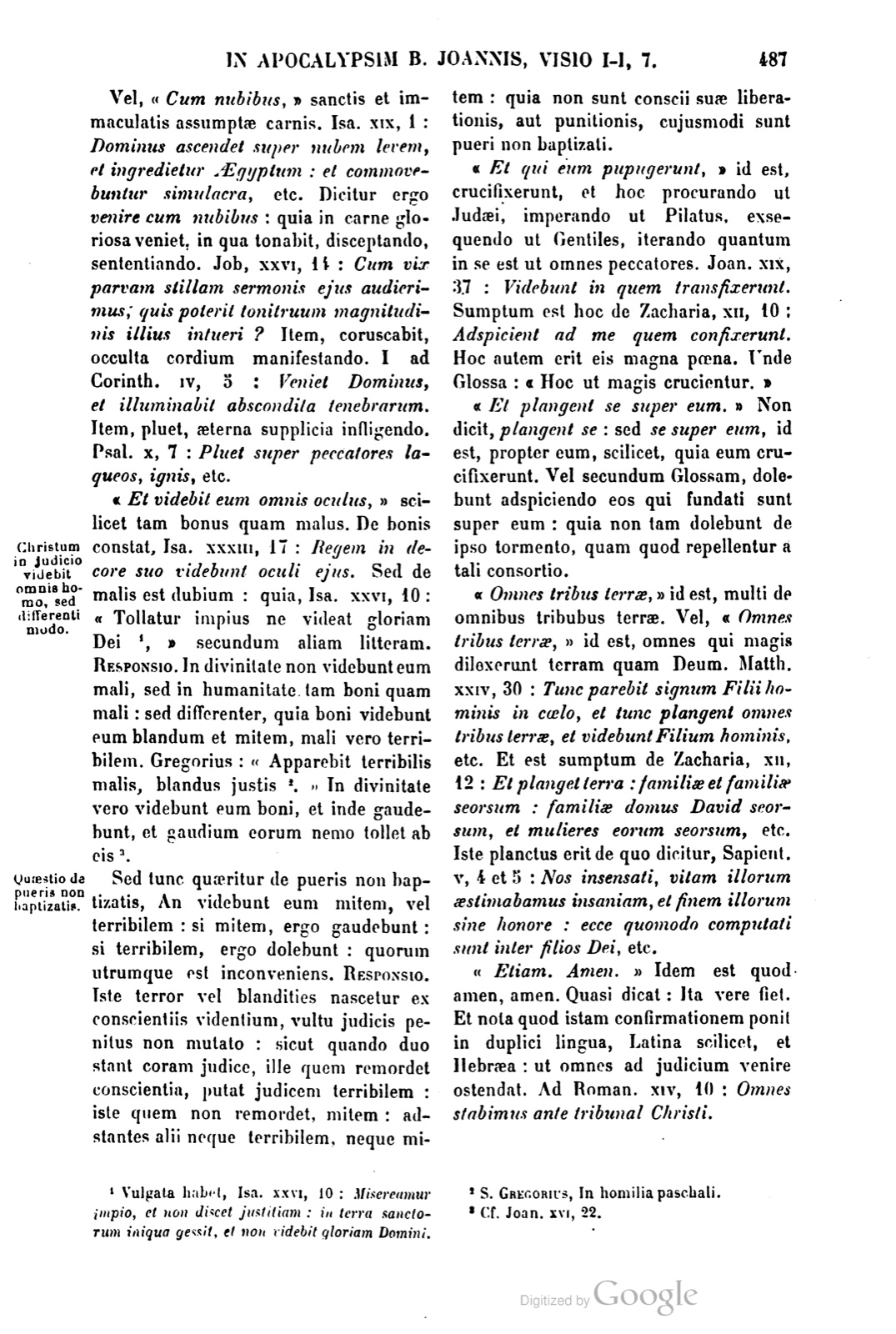
Vel, "Cum nubibus," sanctis et immaculatis assumptae carnis. Isa. XIX, 1: Dominus ascendet super nubem levem, et ingredietur Aegyptum: et commovebuntur simulacra, etc. Dicitur ergo venire cum nubibus: quia in carne gloriosa veniet, in qua tonabit, disceptando, sententiando. Job, XXVI, 14: Cum vix parvam stillam sermonis ejus audierimus, quis poterit tonitruum magnitudinis illius intueri? Item, coruscabit, occulta cordium manifestando. I ad Corinth. IV, 5: Veniet Dominus, et illuminabit abscondita tenebrarum. Item, pluet, aeterna supplicia infligendo. Psal. X, 7: Pluet super peccatores laqueos, ignis, etc.
Christum in Judicio videbit omnis homo sed differenter.
"Et videbit eum omnis oculus," scilicet tam bonus quam malus. De bonis constat, Isa. XXXIII, 17: Regem in decore suo videbunt oculi ejus. Sed de malis est dubium: quia, Isa. XXVI, 10: "Tollatur impius ne videat gloriam Dei 9," secundum aliam litteram. Responsio. In divinitate non videbunt eum mali, sed in humanitate tam boni quam mali: sed differenter, quia boni videbunt eum blandum et mitem, mali vero terribilem. Gregorius: "Apparebit terribilis malis, blandus justis 10." In divinitate vero videbunt eum boni, et inde gaudebunt, et gaudium eorum nemo tollet ab eis 11.
Quaestio de pueris non baptizatis.
Sed tunc quaeritur de pueris non baptizatis, An videbunt eum mitem, vel terribilem: si mitem, ergo gaudebunt: si terribilem, ergo dolebunt: quorum utrumque est inconveniens. Responsio. Iste terror vel blandities nascetur ex conscientiis videntium, vultu judicis penitus non mutato: sicut quando duo stant coram judice, ille quem remordet conscientia, putat judicem terribilem: iste quem non remordet, mitem: adstantes alii neque terribilem, neque mitem: quia non sunt conscii suae liberationis, aut punitionis, cujusmodi sunt pueri non baptizati.
"Et qui eum pupugerunt," id est, crucifixerunt, et hoc procurando ut Judaei, imperando ut Pilatus, exsequendo ut Gentiles, iterando quantum in se est ut omnes peccatores. Joan. XIX, 37: Videbunt in quem transfixerunt. Sumptum est hoc de Zacharia, XII, 10: Adspicient ad me quem confixerunt. Hoc autem erit eis magna poena. Unde Glossa: "Hoc ut magis crucientur."
"Et plangent se super eum." Non dicit, plangent se: sed se super eum, id est, propter eum, scilicet, quia eum crucifixerunt. Vel secundum Glossam, dolebunt adspiciendo eos qui fundati sunt super eum: quia non tam dolebunt de ipso tormento, quam quod repellentur a tali consortio.
"Omnes tribus terrae," id est, multi de omnibus tribubus terrae. Vel, "Omnes tribus terrae," id est, omnes qui magis dilexerunt terram quam Deum. Matth. XXIV, 30: Tunc parebit signum Filii hominis in caelo, et tunc plangent omnes tribus terrae, et videbunt Filium hominis, etc. Et est sumptum de Zacharia, XII, 12: Et planget terra: familiae et familiae seorsum: familiae domus David seorsum, et mulieres eorum seorsum, etc. Iste planctus erit de quo dicitur, Sapient. V, 4 et 5: Nos insensati, vitam illorum aestimabamus insaniam, et finem illorum sine honore: ecce quomodo computati sunt inter filios Dei, etc.
"Etiam. Amen." Idem est quod amen, amen. Quasi dicat: Ita vere fiet. Et nota quod istam confirmationem ponit in duplici lingua, Latina scilicet, et Hebraea: ut omnes ad judicium venire ostendat. Ad Roman. XIV, 10: Omnes stabimus ante tribunal Christi.
Or, "With the clouds," the holy and immaculate clouds of the assumed flesh. Isaiah XIX, 1: The Lord will ascend upon a light cloud, and will enter Egypt, and the idols will be moved, etc. Therefore he is said to come with clouds because he will come in glorious flesh, in which he will thunder by disputing and giving sentence. Job XXVI, 14: Since we have scarcely heard a little drop of his word, who will be able to look upon the thunder of his greatness? Likewise, he will flash, by manifesting the hidden things of hearts. I Corinthians IV, 5: The Lord will come and will illuminate the hidden things of darkness. Likewise, he will rain, by inflicting eternal punishments. Psalm X, 7: He will rain snares upon sinners, fire, etc.
Every man will see Christ in Judgment, but differently.
"And every eye will see him," namely both good and evil. Concerning the good it is established, Isaiah XXXIII, 17: His eyes will see the king in his beauty. But concerning the evil there is doubt, because Isaiah XXVI, 10 says: "Let the impious one be taken away lest he see the glory of God 9," according to another reading. Response. The evil will not see him in divinity, but both good and evil will see him in humanity, but differently, because the good will see him kindly and mild, but the evil as terrible. Gregory says: "He will appear terrible to the evil, kind to the just 10." But the good will see him in divinity, and from this they will rejoice, and no one will take their joy from them 11.
Question concerning unbaptized children.
But then one asks concerning unbaptized children whether they will see him mild or terrible: if mild, then they will rejoice; if terrible, then they will grieve; both of which are unfitting. Response. That terror or kindness will arise from the consciences of those seeing, with the face of the judge not changed at all: just as when two stand before a judge, the one whom conscience gnaws thinks the judge terrible; the one whom it does not gnaw thinks him mild; other bystanders think him neither terrible nor mild, because they are not conscious of their own liberation or punishment, of which sort are unbaptized children.
"And those who pierced him," that is, crucified him, and this by procuring it as the Jews did, by commanding it as Pilate did, by executing it as the Gentiles did, by repeating it, insofar as it lies in them, as all sinners do. John XIX, 37: They will see him whom they have transfixed. This is taken from Zechariah XII, 10: They will look upon me whom they have pierced. But this will be a great punishment for them. Hence the Gloss says: "This so that they may be tormented more."
"And they will lament themselves over him." He does not say, they will lament themselves, but themselves over him, that is, on account of him, namely because they crucified him. Or according to the Gloss, they will grieve by looking at those who have been founded upon him, because they will not grieve so much about the torment itself as because they will be repelled from such fellowship.
"All the tribes of the earth," that is, many from all the tribes of the earth. Or, "All the tribes of the earth," that is, all who loved the earth more than God. Matthew XXIV, 30: Then the sign of the Son of Man will appear in heaven, and then all the tribes of the earth will lament, and they will see the Son of Man, etc. And it is taken from Zechariah XII, 12: And the earth will lament: families and families separately, the families of the house of David separately, and their women separately, etc. That lamentation will be that concerning which Wisdom V, 4 and 5 says: We senseless ones esteemed their life madness, and their end without honor; behold how they have been counted among the sons of God, etc.
"Even so. Amen." This is the same as amen, amen. As if he were saying: Thus it will truly happen. And note that he sets this confirmation in a twofold language, namely Latin and Hebrew, so that he may show that all will come to judgment. Romans XIV, 10: We shall all stand before the tribunal of Christ.
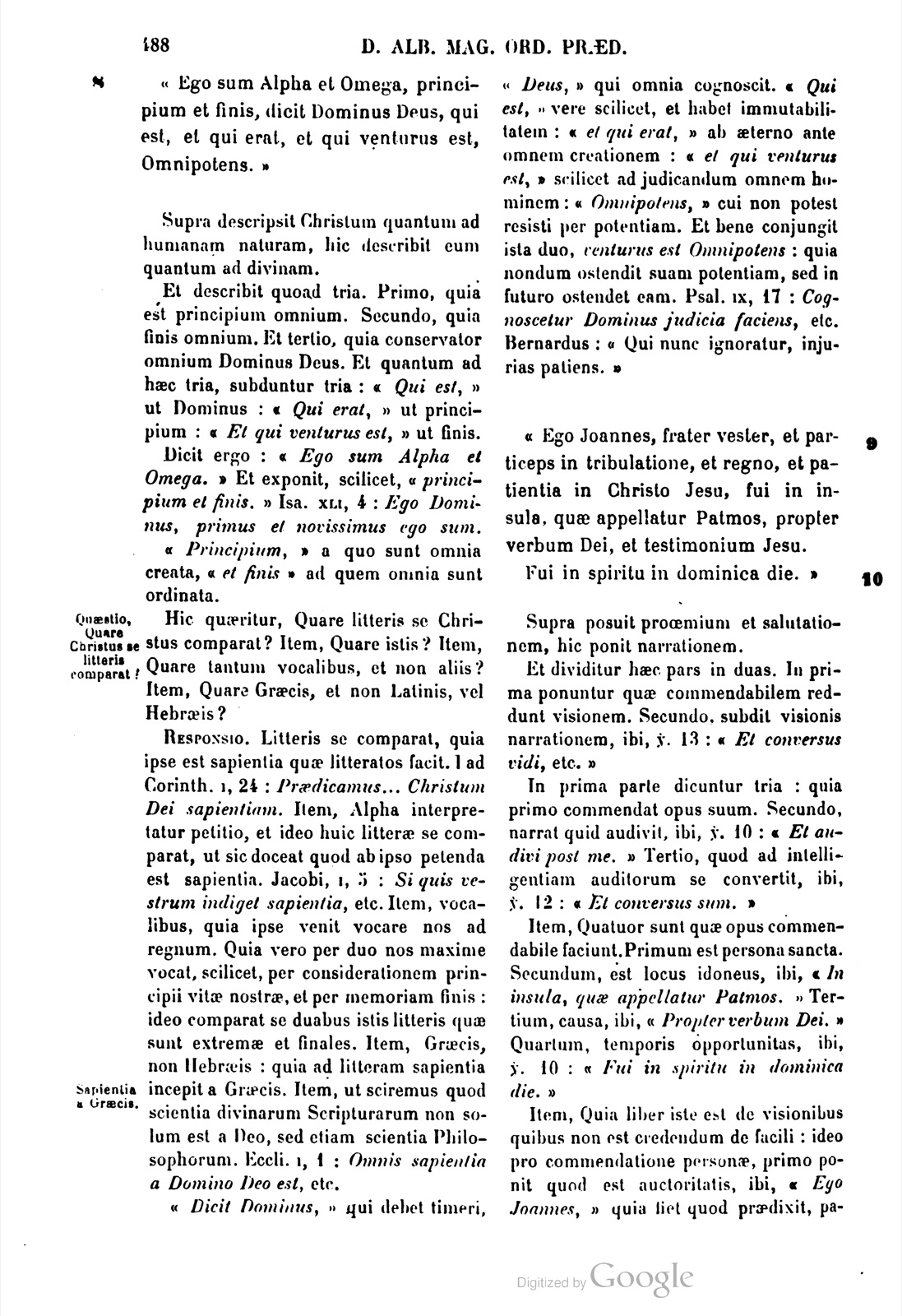
"Ego sum Alpha et Omega, principium et finis, dicit Dominus Deus, qui est, et qui erat, et qui venturus est, Omnipotens."
Supra descripsit Christum quantum ad humanam naturam, hic describit eum quantum ad divinam. Et describit quoad tria. Primo, quia est principium omnium. Secundo, quia finis omnium. Et tertio, quia conservator omnium Dominus Deus. Et quantum ad haec tria, subduntur tria: "Qui est," ut Dominus: "Qui erat," ut principium: "Et qui venturus est," ut finis.
Dicit ergo: "Ego sum Alpha et Omega." Et exponit, scilicet, "principium et finis." Isa. XLI, 4: Ego Dominus, primus et novissimus ego sum. "Principium," a quo sunt omnia creata, "et finis" ad quem omnia sunt ordinata.
Quaestio, Quare Christus se litteris comparat?
Hic quaeritur, Quare litteris se Christus comparat? Item, quare istis? Item, quare tantum vocalibus, et non aliis? Item, quare Graecis, et non Latinis, vel Hebraeis?
Responsio. Litteris se comparat, quia ipse est sapientia quae litteratos facit. I ad Corinth. I, 24: Praedicamus... Christum Dei sapientiam. Item, Alpha interpretatur petitio, et ideo huic litterae se comparat, ut sic doceat quod ab ipso petenda est sapientia. Jacobi, I, 5: Si quis vestrum indiget sapientia, etc. Item, vocalibus, quia ipse venit vocare nos ad regnum. Quia vero per duo nos maxime vocat, scilicet, per considerationem principii vitae nostrae, et per memoriam finis: ideo comparat se duabus istis litteris quae sunt extremae et finales. Item, Graecis, non Hebraeis: quia ad litteram sapientia incepit a Graecis. Item, ut sciremus quod scientia divinarum Scripturarum non solum est a Deo, sed etiam scientia Philosophorum. Eccli. I, 1: Omnis sapientia a Domino Deo est, etc.
Sapientia a Graecis.
"Dicit Dominus," qui debet timeri, "Deus," qui omnia cognoscit. "Qui est," vere scilicet, et habet immutabilitatem: "et qui erat," ab aeterno ante omnem creationem: "et qui venturus est," scilicet ad judicandum omnem hominem: "Omnipotens," cui non potest resisti per potentiam. Et bene conjungit ista duo, venturus est Omnipotens: quia nondum ostendit suam potentiam, sed in futuro ostendet eam. Psal. IX, 17: Cognoscetur Dominus judicia faciens, etc. Bernardus: "Qui nunc ignoratur, injurias patiens."
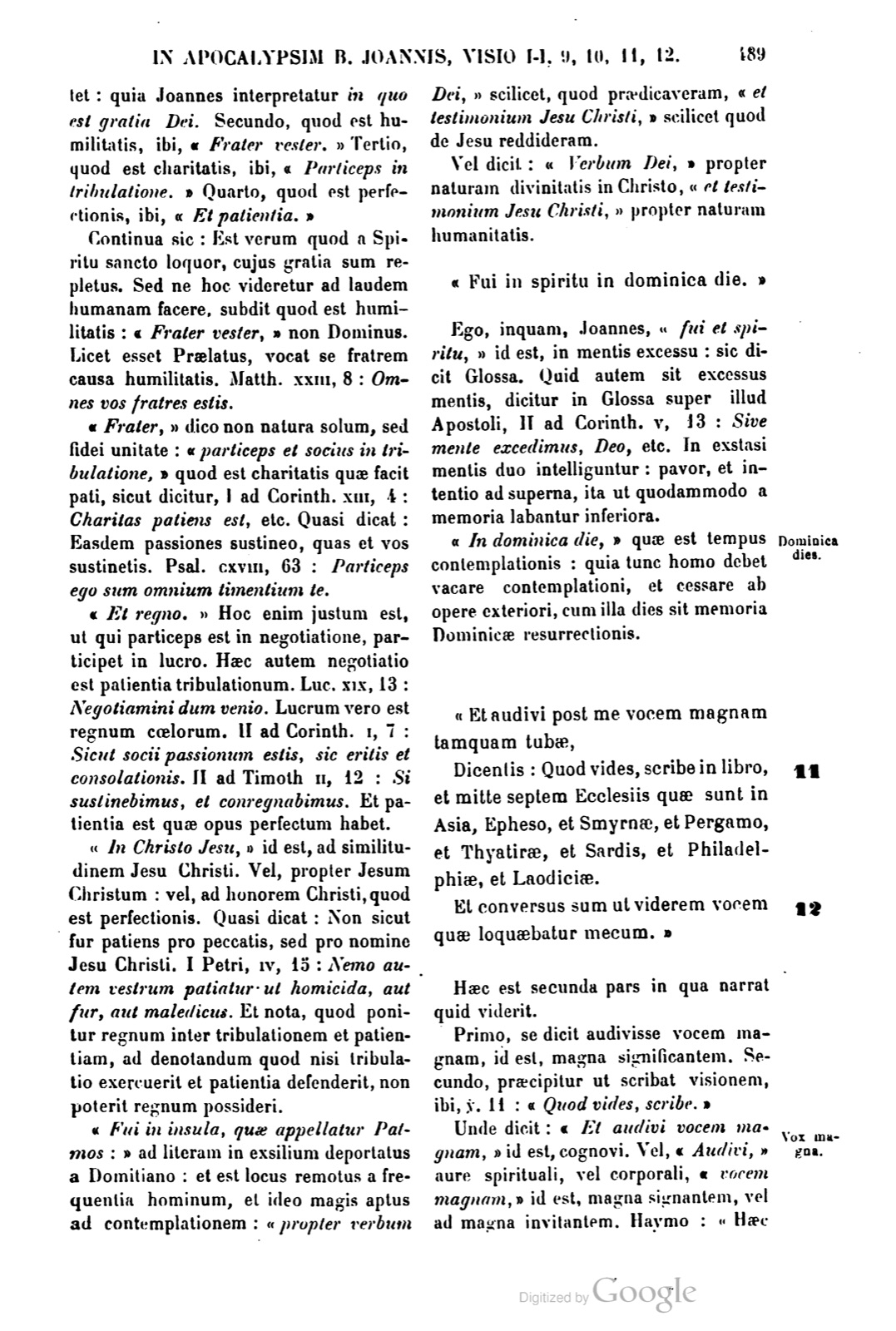
"Ego Joannes, frater vester, et particeps in tribulatione, et regno, et patientia in Christo Jesu, fui in insula, quae appellatur Patmos, propter verbum Dei, et testimonium Jesu. Fui in spiritu in dominica die."
Supra posuit prooemium et salutationem, hic ponit narrationem. Et dividitur haec pars in duas. In prima ponuntur quae commendabilem reddunt visionem. Secundo, subdit visionis narrationem, ibi, v. 13: "Et conversus vidi, etc."
In prima parte dicuntur tria: quia primo commendat opus suum. Secundo, narrat quid audivit, ibi, v. 10: "Et audivi post me." Tertio, quod ad intelligentiam auditorum se convertit, ibi, v. 12: "Et conversus sum."
Item, quatuor sunt quae opus commendabile faciunt. Primum est persona sancta. Secundum, est locus idoneus, ibi, "In insula, quae appellatur Patmos." Tertium, causa, ibi, "Propter verbum Dei." Quartum, temporis opportunitas, ibi, v. 10: "Fui in spiritu in dominica die."
Item, quia liber iste est de visionibus quibus non est credendum de facili: ideo pro commendatione personae, primo ponit quod est auctoritatis, ibi, "Ego Joannes," quia licet quod praedixit, pa-
"I am Alpha and Omega, the beginning and the end, says the Lord God, who is, and who was, and who is to come, the Almighty."
Above he described Christ with respect to the human nature; here he describes him with respect to the divine nature. And he describes him with respect to three things. First, because he is the beginning of all things. Second, because he is the end of all things. And third, because the Lord God is the conserver of all things. And with respect to these three, three things are added: "Who is," as Lord; "Who was," as beginning; "And who is to come," as end.
Therefore he says: "I am Alpha and Omega." And he explains, namely, "the beginning and the end." Isaiah XLI, 4: I, the Lord, am the first and the last. "Beginning," from whom all things have been created, "and end," to whom all things are ordered.
Question: Why does Christ compare himself to letters?
Here it is asked: Why does Christ compare himself to letters? Likewise, why to these? Likewise, why only to vowels, and not to other letters? Likewise, why to Greek letters, and not Latin or Hebrew?
Response. He compares himself to letters because he himself is the wisdom which makes men lettered. I Corinthians I, 24: We preach... Christ the wisdom of God. Likewise, Alpha is interpreted petition, and therefore he compares himself to this letter, so that he may thus teach that wisdom must be sought from him. James I, 5: If any of you lacks wisdom, etc. Likewise, to vowels, because he himself came to call us to the kingdom. But because he chiefly calls us through two things, namely through consideration of the beginning of our life and through memory of the end, therefore he compares himself to these two letters, which are extreme and final. Likewise, to Greek, not Hebrew letters, because literally wisdom began from the Greeks. Likewise, so that we might know that the knowledge of the divine Scriptures is not only from God, but also the knowledge of the Philosophers. Ecclesiasticus I, 1: All wisdom is from the Lord God, etc.
Wisdom from the Greeks.
"The Lord says," who ought to be feared; "God," who knows all things. "Who is," truly namely, and has immutability; "and who was," from eternity before every creation; "and who is to come," namely to judge every man; "Almighty," whom one cannot resist by power. And he rightly joins these two, he is to come, Almighty, because he has not yet shown his power, but in the future he will show it. Psalm IX, 17: The Lord will be known doing judgments, etc. Bernard says: "He who now is ignored, suffering injuries."
"I John, your brother and sharer in tribulation, and in the kingdom, and in patience in Christ Jesus, was on the island which is called Patmos, on account of the word of God and the testimony of Jesus. I was in spirit on the Lord's day."
Above he set down the proem and salutation; here he sets down the narration. And this part is divided into two. In the first are set down the things which render the vision commendable. Second, he adds the narration of the vision, there, verse 13: "And having turned I saw, etc."
In the first part three things are said, because first he commends his work. Second, he narrates what he heard, there, verse 10: "And I heard behind me." Third, that he turned himself to the understanding of his hearers, there, verse 12: "And I turned."
Likewise, there are four things which make the work commendable. The first is a holy person. The second is a suitable place, there, "On the island which is called Patmos." The third is the cause, there, "On account of the word of God." The fourth is the opportunity of time, there, verse 10: "I was in spirit on the Lord's day."
Likewise, because this book is about visions which are not easily to be believed, therefore for the commendation of the person, first he sets down what belongs to authority, there, "I John," because although what he foretold, is evi-
tet: quia Joannes interpretatur in quo est gratia Dei. Secundo, quod est humilitatis, ibi, "Frater vester." Tertio, quod est charitatis, ibi, "Particeps in tribulatione." Quarto, quod est perfectionis, ibi, "Et patientia."
Continua sic: Est verum quod a Spiritu sancto loquor, cujus gratia sum repletus. Sed ne hoc videretur ad laudem humanam facere, subdit quod est humilitatis: "Frater vester," non Dominus. Licet esset Praelatus, vocat se fratrem causa humilitatis. Matth. XXIII, 8: Omnes vos fratres estis.
"Frater," dico non natura solum, sed fidei unitate: "particeps et socius in tribulatione," quod est charitatis quae facit pati, sicut dicitur, I ad Corinth. XIII, 4: Charitas patiens est, etc. Quasi dicat: Easdem passiones sustineo, quas et vos sustinetis. Psal. CXVIII, 63: Particeps ego sum omnium timentium te.
"Et regno." Hoc enim justum est, ut qui particeps est in negotiatione, participet in lucro. Haec autem negotiatio est patientia tribulationum. Luc. XIX, 13: Negotiationemini dum venio. Lucrum vero est regnum caelorum. II ad Corinth. I, 7: Sicut socii passionum estis, sic eritis et consolationis. II ad Timoth. II, 12: Si sustinebimus, et conregnabimus. Et patientia est quae opus perfectum habet.
"In Christo Jesu," id est, ad similitudinem Jesu Christi. Vel, propter Jesum Christum: vel, ad honorem Christi, quod est perfectionis. Quasi dicat: Non sicut fur patiens pro peccatis, sed pro nomine Jesu Christi. I Petri, IV, 15: Nemo autem vestrum patiatur ut homicida, aut fur, aut maledicus. Et nota, quod ponitur regnum inter tribulationem et patientiam, ad denotandum quod nisi tribulatio exercuerit et patientia defenderit, non poterit regnum possideri.
"Fui in insula, quae appellatur Patmos:" ad litteram in exsilium deportatus a Domitiano: et est locus remotus a frequentia hominum, et ideo magis aptus ad contemplationem: "propter verbum Dei," scilicet, quod praedicaveram, "et testimonium Jesu Christi," scilicet quod de Jesu reddideram.
Vel dicit: "Verbum Dei," propter naturam divinitatis in Christo, "et testimonium Jesu Christi," propter naturam humanitatis.
"Fui in spiritu in dominica die."
Ego, inquam, Joannes, "fui et spiritu," id est, in mentis excessu: sic dicit Glossa. Quid autem sit excessus mentis, dicitur in Glossa super illud Apostoli, II ad Corinth. V, 13: Sive mente excedimus, Deo, etc. In exstasi mentis duo intelliguntur: pavor, et intentio ad superna, ita ut quodammodo a memoria labantur inferiora.
Dominica dies.
"In dominica die," quae est tempus contemplationis: quia tunc homo debet vacare contemplationi, et cessare ab opere exteriori, cum illa dies sit memoria Dominicae resurrectionis.
-tet: because John is interpreted, in whom there is the grace of God. Second, what belongs to humility, there, "your brother." Third, what belongs to charity, there, "sharer in tribulation." Fourth, what belongs to perfection, there, "and patience."
Continue thus: It is true that I speak from the Holy Spirit, with whose grace I am filled. But lest this seem to be done for human praise, he adds what belongs to humility: "your brother," not Lord. Although he was a Prelate, he calls himself a brother because of humility. Matthew XXIII, 8: You are all brothers.
I say "brother" not only by nature, but by unity of faith; "sharer and companion in tribulation," which belongs to charity, which makes one suffer, as is said, I Corinthians XIII, 4: Charity is patient, etc. As if he were saying: I endure the same sufferings which you also endure. Psalm CXVIII, 63: I am a sharer of all who fear you.
"And in the kingdom." For this is just, that one who is a sharer in the business should share in the profit. But this business is patience amid tribulations. Luke XIX, 13: Trade until I come. But the profit is the kingdom of heaven. II Corinthians I, 7: As you are companions of the sufferings, so you will also be of the consolation. II Timothy II, 12: If we endure, we shall also reign together. And patience is what has a perfect work.
"In Christ Jesus," that is, after the likeness of Jesus Christ. Or, on account of Jesus Christ; or, for the honor of Christ, which belongs to perfection. As if he were saying: Not like a thief suffering for sins, but for the name of Jesus Christ. I Peter IV, 15: Let none of you suffer as a homicide, or thief, or evildoer. And note that kingdom is placed between tribulation and patience, to denote that unless tribulation has exercised and patience has defended, the kingdom will not be able to be possessed.
"I was on the island which is called Patmos:" literally, carried away into exile by Domitian; and it is a place remote from the crowd of men, and therefore more suitable for contemplation; "on account of the word of God," namely, which I had preached, "and the testimony of Jesus Christ," namely which I had rendered concerning Jesus.
Or he says "the word of God" on account of the nature of divinity in Christ, and "the testimony of Jesus Christ" on account of the nature of humanity.
"I was in spirit on the Lord's day."
I, I say, John, "was in spirit," that is, in an excess of mind; thus says the Gloss. But what an excess of mind is, is said in the Gloss on that saying of the Apostle, II Corinthians V, 13: Whether we exceed in mind, it is to God, etc. In an ecstasy of mind two things are understood: fear, and intention toward higher things, so that lower things in a certain way slip from memory.
The Lord's day.
"On the Lord's day," which is a time of contemplation, because then a man ought to be free for contemplation and cease from exterior work, since that day is the memorial of the Lord's resurrection.
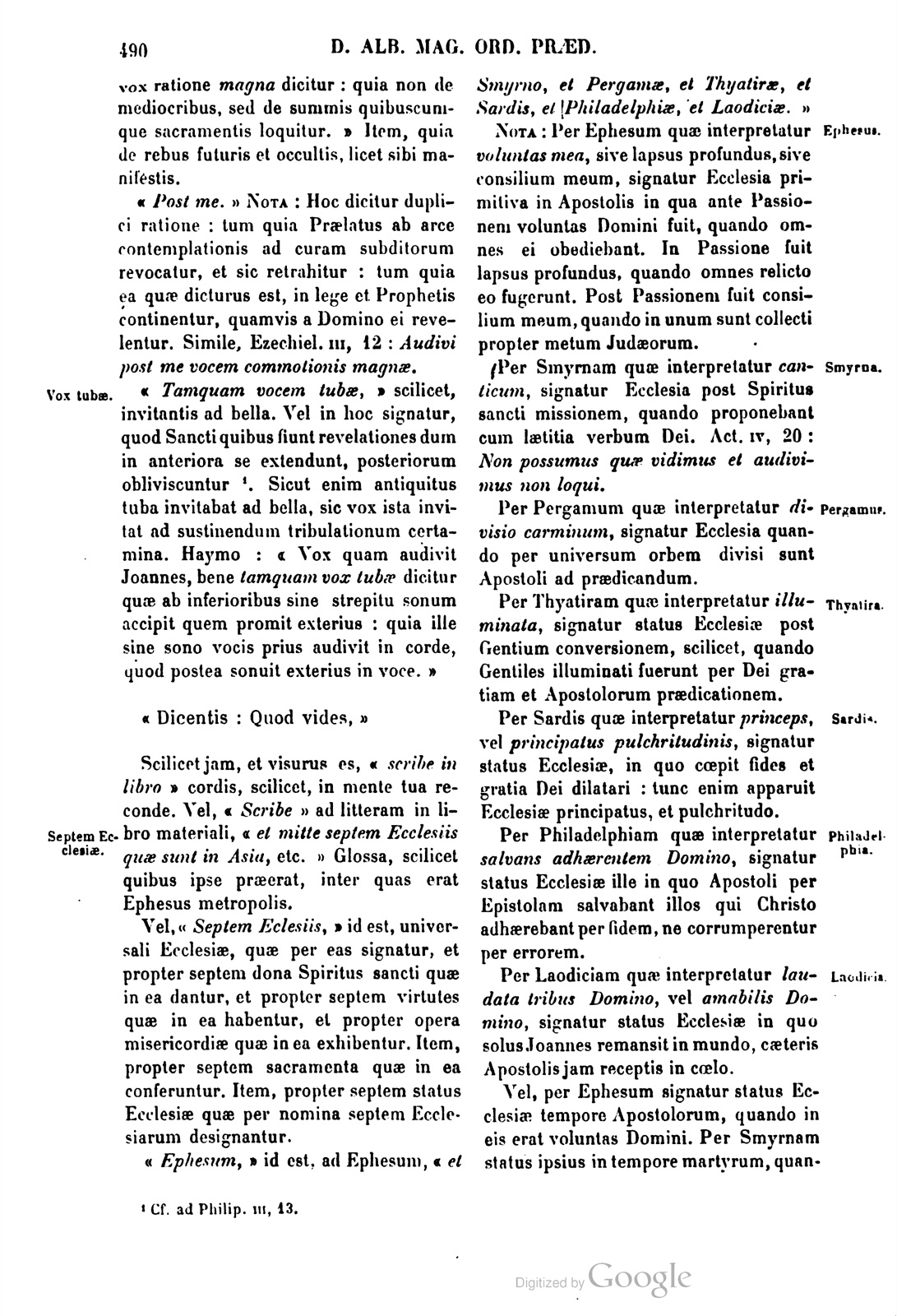
"Et audivi post me vocem magnam tamquam tubae, Dicentis: Quod vides, scribe in libro, et mitte septem Ecclesiis quae sunt in Asia, Epheso, et Smyrnae, et Pergamo, et Thyatirae, et Sardis, et Philadelphiae, et Laodiciae. Et conversus sum ut viderem vocem quae loquebatur mecum."
Haec est secunda pars in qua narrat quid viderit. Primo, se dicit audivisse vocem magnam, id est, magna significantem. Secundo, praecipitur ut scribat visionem, ibi, v. 11: "Quod vides, scribe."
Vox magna.
Unde dicit: "Et audivi vocem magnam," id est, cognovi. Vel, "Audivi," aure spirituali, vel corporali, "vocem magnam," id est, magna signantem, vel ad magna invitantem. Haymo: "Haec vox ratione magna dicitur: quia non de mediocribus, sed de summis quibuscumque sacramentis loquitur." Item, quia de rebus futuris et occultis, licet sibi manifestis.
"Post me." Nota: Hoc dicitur duplici ratione: tum quia Praelatus ab arce contemplationis ad curam subditorum revocatur, et sic retrahitur: tum quia ea quae dicturus est, in lege et Prophetis continentur, quamvis a Domino ei revelentur. Simile, Ezechiel. II, 12: Audivi post me vocem commotionis magnae.
Vox tubae.
"Tamquam vocem tubae," scilicet, invitantis ad bella. Vel in hoc signatur, quod Sancti quibus fiunt revelationes dum in anteriora se extendunt, posteriorum obliviscuntur 12. Sicut enim antiquitus tuba invitabat ad bella, sic vox ista invitat ad sustinendum tribulationum certamina. Haymo: "Vox quam audivit Joannes, bene tamquam vox tubae dicitur quae ab inferioribus sine strepitu sonum accipit quem promit exterius: quia ille sine sono vocis prius audivit in corde, quod postea sonuit exterius in voce."
"Dicentis: Quod vides," scilicet jam, et visurus es, "scribe in libro" cordis, scilicet, in mente tua reconde. Vel, "Scribe" ad litteram in libro materiali, "et mitte septem Ecclesiis quae sunt in Asia, etc." Glossa, scilicet quibus ipse praeerat, inter quas erat Ephesus metropolis.
Septem Ecclesiae.
Vel, "Septem Ecclesiis," id est, universali Ecclesiae, quae per eas signatur, et propter septem dona Spiritus sancti quae in ea dantur, et propter septem virtutes quae in ea habentur, et propter opera misericordiae quae in ea exhibentur. Item, propter septem sacramenta quae in ea conferuntur. Item, propter septem status Ecclesiae quae per nomina septem Ecclesiarum designantur.
"Ephesum," id est, ad Ephesum, "et Smyrno, et Pergamae, et Thyatirae, et Sardis, et Philadelphiae, et Laodiciae."
Ephesus.
Nota: Per Ephesum quae interpretatur voluntas mea, sive lapsus profundus, sive consilium meum, signatur Ecclesia primitiva in Apostolis in qua ante Passionem voluntas Domini fuit, quando omnes ei obediebant. In Passione fuit lapsus profundus, quando omnes relicto eo fugerunt. Post Passionem fuit consilium meum, quando in unum sunt collecti propter metum Judaeorum.
"And I heard behind me a great voice like a trumpet, Saying: What you see, write in a book, and send to the seven Churches which are in Asia, to Ephesus, and Smyrna, and Pergamum, and Thyatira, and Sardis, and Philadelphia, and Laodicea. And I turned that I might see the voice which was speaking with me."
This is the second part, in which he narrates what he saw. First, he says that he heard a great voice, that is, one signifying great things. Second, he is commanded to write the vision, there, verse 11: "What you see, write."
A great voice.
Hence he says: "And I heard a great voice," that is, I knew. Or, "I heard," with the spiritual or bodily ear, "a great voice," that is, one signifying great things, or inviting to great things. Haymo says: "This voice is called great by reason, because it speaks not about middling things, but about the highest sacraments whatsoever." Likewise, because it speaks about future and hidden things, although manifest to him.
"Behind me." Note: This is said for a twofold reason: both because a Prelate is recalled from the height of contemplation to the care of subjects, and thus is drawn back; and because the things which he is about to say are contained in the Law and the Prophets, although they are revealed to him by the Lord. A similar thing is in Ezekiel II, 12: I heard behind me the voice of a great commotion.
The voice of a trumpet.
"As the voice of a trumpet," namely, inviting to wars. Or in this it is signified that the Saints to whom revelations are made, while they stretch themselves toward the things before, forget the things behind 12. For as in old times a trumpet invited to wars, so this voice invites one to endure the contests of tribulations. Haymo says: "The voice which John heard is well called like the voice of a trumpet, which receives from lower things without noise the sound which it brings forth outwardly; because he first heard without sound of voice in the heart what afterward sounded outwardly in the voice."
"Saying: What you see," namely now, and will see, "write in a book" of the heart, that is, store it in your mind. Or, "Write" literally in a material book, "and send to the seven Churches which are in Asia, etc." The Gloss says, namely to those over which he presided, among which Ephesus was the metropolis.
The seven Churches.
Or, "to the seven Churches," that is, to the universal Church, which is signified through them, both because of the seven gifts of the Holy Spirit which are given in it, and because of the seven virtues which are held in it, and because of the works of mercy which are displayed in it. Likewise, because of the seven sacraments which are conferred in it. Likewise, because of the seven states of the Church which are designated through the names of the seven Churches.
"Ephesus," that is, to Ephesus, "and to Smyrna, and Pergamum, and Thyatira, and Sardis, and Philadelphia, and Laodicea."
Ephesus.
Note: Through Ephesus, which is interpreted my will, or a deep fall, or my counsel, the primitive Church in the Apostles is signified, in which before the Passion there was the will of the Lord, when all obeyed him. In the Passion there was a deep fall, when all, having left him, fled. After the Passion there was my counsel, when they were gathered into one because of fear of the Jews.
Smyrna.
Per Smyrnam quae interpretatur canticum, signatur Ecclesia post Spiritus sancti missionem, quando proponebant cum laetitia verbum Dei. Act. IV, 20: Non possumus quae vidimus et audivimus non loqui.
Pergamus.
Per Pergamum quae interpretatur divisio carminum, signatur Ecclesia quando per universum orbem divisi sunt Apostoli ad praedicandum.
Thyatira.
Per Thyatiram quae interpretatur illuminata, signatur status Ecclesiae post Gentium conversionem, scilicet, quando Gentiles illuminati fuerunt per Dei gratiam et Apostolorum praedicationem.
Sardis.
Per Sardis quae interpretatur princeps, vel principatus pulchritudinis, signatur status Ecclesiae, in quo coepit fides et gratia Dei dilatari: tunc enim apparuit Ecclesiae principatus, et pulchritudo.
Philadelphia.
Per Philadelphiam quae interpretatur salvans adhaerentem Domino, signatur status Ecclesiae ille in quo Apostoli per Epistolam salvabant illos qui Christo adhaerebant per fidem, ne corrumperentur per errorem.
Laodicia.
Per Laodiciam quae interpretatur laudata tribus Domino, vel amabilis Domino, signatur status Ecclesiae in quo solus Joannes remansit in mundo, caeteris Apostolis jam receptis in caelo.
Vel, per Ephesum signatur status Ecclesiae tempore Apostolorum, quando in eis erat voluntas Domini. Per Smyrnam status ipsius in tempore martyrum, quando cantantes et laetantes ibant ad supplicium. Per Pergamum status ipsius tempore haereticorum, quando divisi sunt multi a fide vera per errores eorum. Per Thyatiram signatur status ejus tempore Confessorum et Doctorum, quando illuminabant Ecclesiam lumine verborum, et exemplorum. Per Sardis signatur status ejus tempore sanctorum simplicium, quando temporales divitiae Ecclesiae datae sunt. Per Philadelphiam status modernorum qui seipsos carnaliter diligunt. Per Laodiciam status ipsius tempore Antichristi, in quo illi qui stabunt, erunt tribus amabilis Domino: quia erunt perfectissimi et robustissimi.
"Et conversus sum," supple, voce audita. Vel, "Conversus sum," id est, ad recogitandum de subditis me converti, "ut viderem vocem," id est, intelligerem. Visus enim pro omni sensu ponitur: quia oculus secundum Augustinum, habet in cognoscendo principatum.
"Quae loquebatur mecum."
Smyrna.
Through Smyrna, which is interpreted song, the Church after the sending of the Holy Spirit is signified, when they were setting forth the word of God with gladness. Acts IV, 20: We cannot fail to speak the things which we have seen and heard.
Pergamum.
Through Pergamum, which is interpreted division of songs, the Church is signified when the Apostles were divided through the whole world to preach.
Thyatira.
Through Thyatira, which is interpreted illuminated, the state of the Church after the conversion of the Gentiles is signified, namely when the Gentiles were illuminated through the grace of God and the preaching of the Apostles.
Sardis.
Through Sardis, which is interpreted prince, or principate of beauty, the state of the Church is signified in which faith and the grace of God began to be enlarged; for then the principate and beauty of the Church appeared.
Philadelphia.
Through Philadelphia, which is interpreted saving the one adhering to the Lord, that state of the Church is signified in which the Apostles through an Epistle were saving those who adhered to Christ through faith, lest they be corrupted through error.
Laodicea.
Through Laodicea, which is interpreted a tribe praised by the Lord, or lovable to the Lord, the state of the Church is signified in which John alone remained in the world, the other Apostles having already been received in heaven.
Or, through Ephesus the state of the Church in the time of the Apostles is signified, when the will of the Lord was in them. Through Smyrna, its state in the time of the martyrs, when singing and rejoicing they went to punishment. Through Pergamum, its state in the time of heretics, when many were divided from the true faith through their errors. Through Thyatira, its state in the time of Confessors and Doctors is signified, when they illuminated the Church by the light of words and examples. Through Sardis, its state in the time of the holy simple is signified, when temporal riches were given to the Church. Through Philadelphia, the state of modern persons who love themselves carnally. Through Laodicea, its state in the time of Antichrist, in which those who will stand will be a tribe lovable to the Lord, because they will be most perfect and most robust.
"And I turned," supply, after the voice had been heard. Or, "I turned," that is, I turned myself to thinking again about my subjects, "that I might see the voice," that is, understand it. For sight is placed for every sense, because the eye, according to Augustine, has principate in knowing.
"Which was speaking with me."
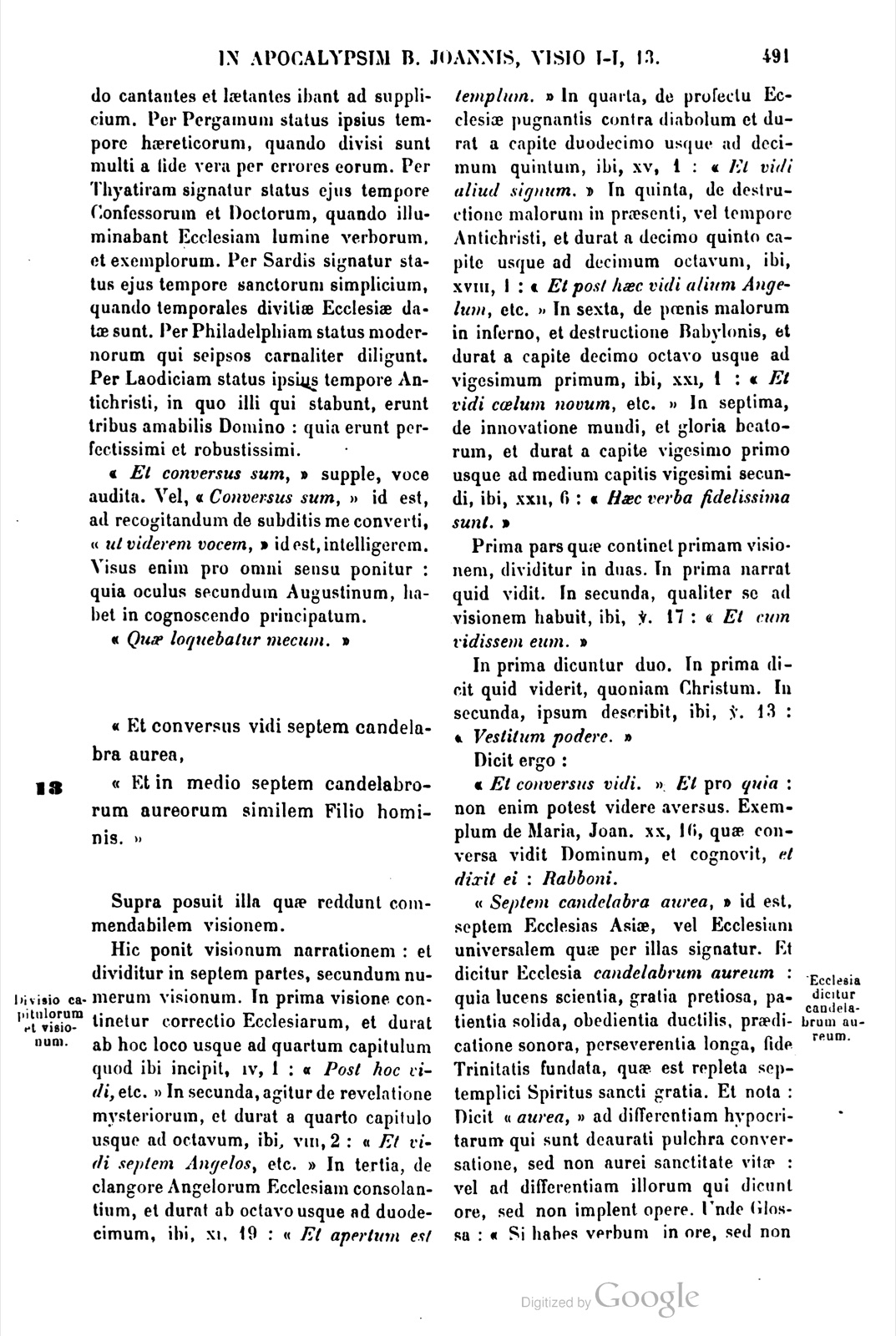
"Et conversus vidi septem candelabra aurea, Et in medio septem candelabrorum aureorum similem Filio hominis."
Supra posuit illa quae reddunt commendabilem visionem. Hic ponit visionum narrationem: et dividitur in septem partes, secundum numerum visionum. In prima visione continetur correctio Ecclesiarum, et durat ab hoc loco usque ad quartum capitulum quod ibi incipit, IV, 1: "Post hoc vidi, etc." In secunda, agitur de revelatione mysteriorum, et durat a quarto capitulo usque ad octavum, ibi, VIII, 2: "Et vidi septem Angelos, etc." In tertia, de clangore Angelorum Ecclesiam consolantium, et durat ab octavo usque ad duodecimum, ibi, XI, 19: "Et apertum est templum." In quarta, de profectu Ecclesiae pugnantis contra diabolum et durat a capite duodecimo usque ad decimum quintum, ibi, XV, 1: "Et vidi aliud signum." In quinta, de destructione malorum in praesenti, vel tempore Antichristi, et durat a decimo quinto capite usque ad decimum octavum, ibi, XVIII, 1: "Et post haec vidi alium Angelum, etc." In sexta, de poenis malorum in inferno, et destructione Babylonis, et durat a capite decimo octavo usque ad vigesimum primum, ibi, XXI, 1: "Et vidi caelum novum, etc." In septima, de innovatione mundi, et gloria beatorum, et durat a capite vigesimo primo usque ad medium capitis vigesimi secundi, ibi, XXI, 6: "Haec verba fidelissima sunt."
Prima pars quae continet primam visionem, dividitur in duas. In prima narrat quid vidit. In secunda, qualiter se ad visionem habuit, ibi, v. 17: "Et cum vidissem eum."
In prima dicuntur duo. In prima dicit quid viderit, quoniam Christum. In secunda, ipsum describit, ibi, v. 13: "Vestitum podere."
Dicit ergo: "Et conversus vidi." Et pro quia: non enim potest videre aversus. Exemplum de Maria, Joan. XX, 16, quae conversa vidit Dominum, et cognovit, et dixit ei: Rabboni.
Ecclesia dicitur candelabrum aureum.
"Septem candelabra aurea," id est, septem Ecclesias Asiae, vel Ecclesiam universalem quae per illas signatur. Et dicitur Ecclesia candelabrum aureum: quia lucens scientia, gratia pretiosa, patientia solida, obedientia ductilis, praedicatione sonora, perseverentia longa, fide Trinitatis fundata, quae est repleta septemplici Spiritus sancti gratia. Et nota: Dicit "aurea," ad differentiam hypocritarum qui sunt deaurati pulchra conversatione, sed non aurei sanctitate vitae: vel ad differentiam illorum qui dicunt ore, sed non implent opere. Unde Glossa: "Si habes verbum in ore, sed non in opere, candelabrum es, sed non aureum."
"Et in medio septem candelabrorum aureorum," id est, in medio Ecclesiae. Isa. XII, 6: Exsulta, et lauda, habitatio Sion, quia magnus in medio tui Sanctus Israel.
"Similem Filio hominis," id est, Angelum gerentem personam Christi, et apparentem in forma hominis. Vel, "Similem Filio hominis," Christum qui post resurrectionem fuit immortalis, et ideo non Filius hominis, sed ei similis appellatur: vel quia ignorantiam et peccatum non suscepit, sed in similitudine carnis peccati apparuit in natura et poena similis. Ad Roman. VIII, 3: Deus Filium suum misit in similitudinem carnis peccati.
"And having turned, I saw seven golden lampstands, And in the midst of the seven golden lampstands one like the Son of Man."
Above he set down those things which render the vision commendable. Here he sets down the narration of the visions, and it is divided into seven parts, according to the number of the visions. In the first vision the correction of the Churches is contained, and it lasts from this place up to the fourth chapter, which begins there, IV, 1: "After this I saw, etc." In the second, there is treatment of the revelation of mysteries, and it lasts from the fourth chapter up to the eighth, there, VIII, 2: "And I saw seven Angels, etc." In the third, concerning the sounding of the Angels consoling the Church, and it lasts from the eighth up to the twelfth, there, XI, 19: "And the temple was opened." In the fourth, concerning the progress of the Church fighting against the devil, and it lasts from the twelfth chapter up to the fifteenth, there, XV, 1: "And I saw another sign." In the fifth, concerning the destruction of the wicked in the present, or in the time of Antichrist, and it lasts from the fifteenth chapter up to the eighteenth, there, XVIII, 1: "And after these things I saw another Angel, etc." In the sixth, concerning the punishments of the wicked in hell, and the destruction of Babylon, and it lasts from the eighteenth chapter up to the twenty-first, there, XXI, 1: "And I saw a new heaven, etc." In the seventh, concerning the renewal of the world and the glory of the blessed, and it lasts from the twenty-first chapter up to the middle of the twenty-second chapter, there, XXI, 6: "These words are most faithful."
The first part, which contains the first vision, is divided into two. In the first he narrates what he saw. In the second, how he disposed himself toward the vision, there, verse 17: "And when I had seen him."
In the first two things are said. In the first he says what he saw, namely Christ. In the second, he describes him, there, verse 13: "clothed with a poderis."
Therefore he says: "And having turned, I saw." And this stands for because: for one cannot see while turned away. The example is of Mary, John XX, 16, who, having turned, saw the Lord and recognized him and said to him: Rabboni.
The Church is called a golden lampstand.
"Seven golden lampstands," that is, the seven Churches of Asia, or the universal Church which is signified through them. And the Church is called a golden lampstand because it is shining in knowledge, precious in grace, solid in patience, ductile in obedience, sonorous in preaching, long in perseverance, founded in faith in the Trinity, and filled with the sevenfold grace of the Holy Spirit. And note: he says "golden" to distinguish it from hypocrites, who are gilded by a beautiful manner of life, but are not golden by holiness of life; or to distinguish it from those who speak with the mouth but do not fulfill in work. Hence the Gloss says: "If you have the word in the mouth, but not in work, you are a lampstand, but not a golden one."
"And in the midst of the seven golden lampstands," that is, in the midst of the Church. Isaiah XII, 6: Exult and praise, dwelling of Sion, because great in your midst is the Holy One of Israel.
"One like the Son of Man," that is, an Angel bearing the person of Christ and appearing in the form of a man. Or, "like the Son of Man," Christ, who after the resurrection was immortal, and therefore he is not called Son of Man, but like him; or because he did not assume ignorance and sin, but appeared in the likeness of the flesh of sin, similar in nature and penalty. Romans VIII, 3: God sent his Son in the likeness of the flesh of sin.
"Vestitum podere, et praecinctum ad mamillas zona aurea: Caput autem ejus et capilli erant candidi tamquam lana alba et tamquam nix, et oculi ejus tamquam flamma ignis: Et pedes ejus similes aurichalco, sicut in camino ardenti: et vox illius tamquam vox aquarum multarum."
Hic incipit describere ipsum qui ei apparuit. Et describit ipsum in quatuor. Primo, ab habitu. Secundo, a forma, ibi, v. 14: "Caput autem ejus." Tertio, a potestate, ibi, v. 16: "Et habebat in dextera." Quarto, a gloria, ibidem, "Et facies ejus."
Poderis.
Dicit ergo: "Vestitum podere," est, talari veste secundum Haymonem, et dicitur a pous quod est pes, et haereo, haeres, quasi pedibus haerens. Haec erat vestis sacerdotalis, ut dicitur, Sapient. XVIII, 24: In veste poderis quam habebat, totus erat orbis terrarum, scilicet descriptus. Per istam intelligitur Christi humanitas, quae fuit vestis sacerdotalis: quia in hac se obtulit Deo Patri: per hanc enim humiliavit semetipsum factus obediens. Ad Ephes. V, 2: Tradidit semetipsum pro nobis oblationem et hostiam, etc. Vel, per hanc intelligitur Ecclesia generalis, quae est vestimentum Domini, ut dicit Pater ad Filium, Isa. XLIX, 18: Omnibus his velut ornamento vestieris. Haec durat usque ad pedes: quia usque in finem mundi durabunt fideles.
Zona aurea.
"Et praecinctum ad mamillas," in quo signat cogitationum cohibitionem, "zona aurea," quae signat charitatem. Vel, "Praecinctum ad mamillas," in quo signatur castitas, "zona aurea," in quo charitas et sapientia. Nota, quod in Veteri Testamento apparuit Dominus praecinctus ad renes. Daniel. X, 3: Ecce vir unus vestitus lineis, et renes ejus accincti. Hic autem ad mamillas ostenditur praecinctus, et primum signat cohibitionem luxuriae, secundum cohibitionem cogitationum quae procedunt a corde. Matth. XV, 19: De corde exeunt cogitationes malae, etc. Quia vero in Veteri Testamento damnabatur luxuriae opus, ideo Dominus apparuit Danieli renes accinctus. Quia vero in Novo Testamento cogitationes malae damnantur, ideo ad mamillas praecinctus ostenditur. Matth. V, 27, 28: Dictum est antiquis: Non moechaberis: ecce cohibitio luxuriae. Ego autem dico vobis: Quia omnis qui viderit mulierem, etc.: ecce cohibitio cogitationis malae.
"Caput autem ejus et capilli, etc."
Christus Ecclesiae est caput.
"Caput autem ejus," id est, Christus qui est caput intransitive. Ad Ephes. I, 22 et 23: Ipsum dedit caput supra omnem Ecclesiam, quae est corpus ipsius. Vel, "Caput ejus," id est, mens Christi, vel deitas, "et capilli erant," id est, sancti qui Christo immediate adhaerent per amorem, sicut capilli capiti immediate adhaerent. Ad Roman. VIII, 35: Quis nos separabit a charitate Christi? Item, quia quando separantur a Christo dolent, sicut quando capilli separantur a capite.
"Clothed with a poderis, and girded at the breasts with a golden belt; But his head and hair were white like white wool and like snow, and his eyes like a flame of fire; And his feet like aurichalcum, as in a burning furnace, and his voice like the voice of many waters."
Here he begins to describe the one who appeared to him. And he describes him in four ways. First, from clothing. Second, from form, there, verse 14: "But his head." Third, from power, there, verse 16: "And he had in his right hand." Fourth, from glory, in the same place, "And his face."
Poderis.
Therefore he says: "Clothed with a poderis," that is, with an ankle-length garment according to Haymo, and it is named from pous, which is foot, and haereo, haeres, as if clinging to the feet. This was the priestly garment, as is said, Wisdom XVIII, 24: On the garment of the poderis which he had, the whole world was, namely, described. Through this Christ's humanity is understood, which was the priestly garment, because in this he offered himself to God the Father; for through this he humbled himself, having become obedient. Ephesians V, 2: He handed himself over for us as an oblation and victim, etc. Or, through this the general Church is understood, which is the Lord's clothing, as the Father says to the Son, Isaiah XLIX, 18: With all these you will be clothed as with an ornament. This lasts down to the feet, because the faithful will last until the end of the world.
The golden belt.
"And girded at the breasts," in which he signifies the restraint of thoughts, "with a golden belt," which signifies charity. Or, "girded at the breasts," in which chastity is signified, "with a golden belt," in which charity and wisdom are signified. Note that in the Old Testament the Lord appeared girded at the loins. Daniel X, 3: Behold, one man clothed in linen, and his loins girded. But here he is shown girded at the breasts, and the first signifies the restraint of luxury, the second the restraint of thoughts which proceed from the heart. Matthew XV, 19: From the heart evil thoughts go forth, etc. But because in the Old Testament the work of luxury was condemned, therefore the Lord appeared to Daniel girded at the loins. But because in the New Testament evil thoughts are condemned, therefore he is shown girded at the breasts. Matthew V, 27, 28: It was said to those of old: You shall not commit adultery; behold the restraint of luxury. But I say to you: that everyone who shall look at a woman, etc.; behold the restraint of evil thought.
"But his head and hair, etc."
Christ is the head of the Church.
"But his head," that is, Christ, who is the head intransitively. Ephesians I, 22 and 23: He gave him as head over the whole Church, which is his body. Or, "his head," that is, the mind of Christ, or the deity, "and the hairs were," that is, the holy ones who immediately adhere to Christ through love, as hairs immediately adhere to the head. Romans VIII, 35: Who will separate us from the charity of Christ? Likewise, because when they are separated from Christ, they grieve, as when hairs are separated from the head.
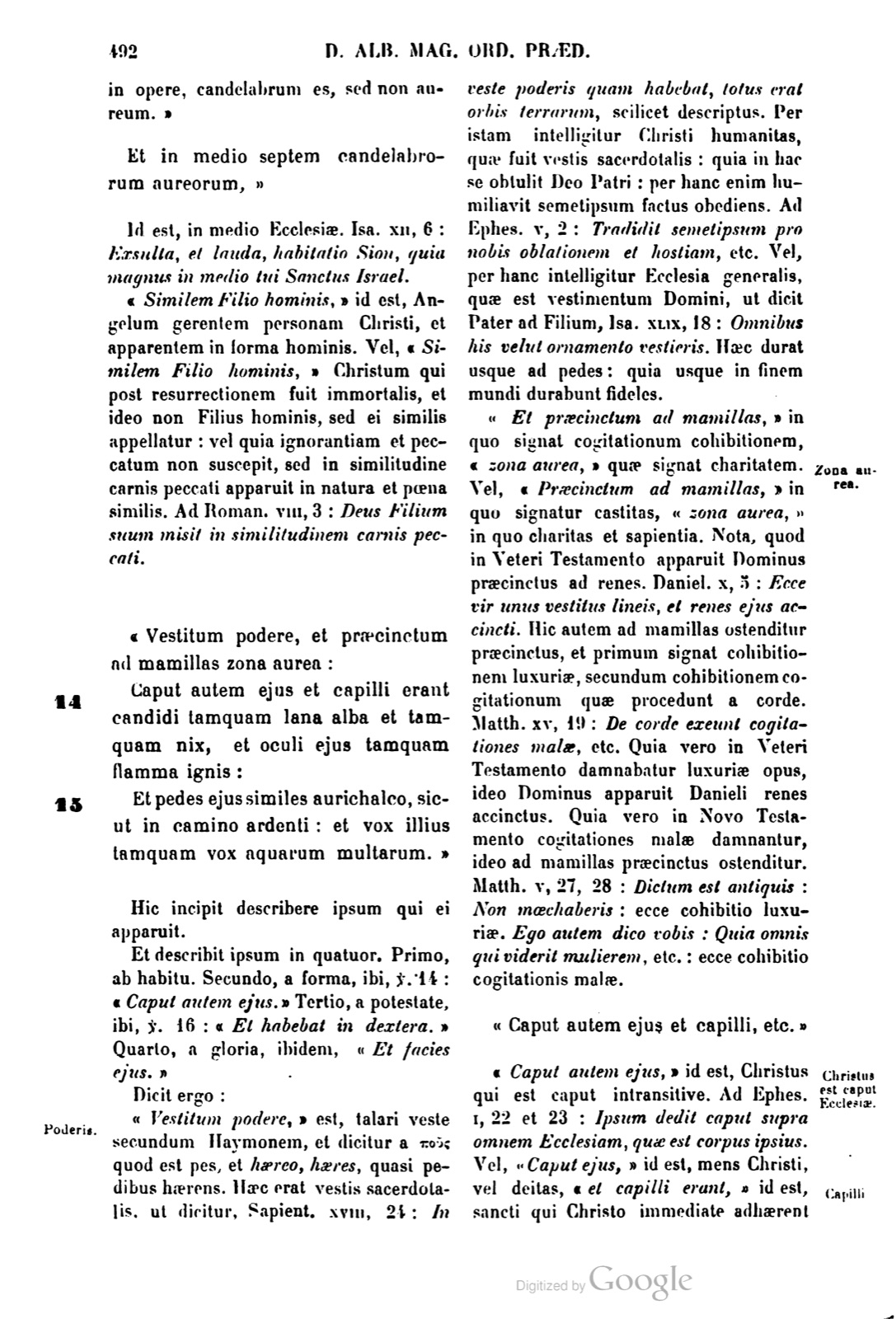
"Tamquam lana candidi," id est, ab omni peccato mundi. Nota: Lana mollis est, et alba et calida. Sunt ergo tamquam lana alba capilli molles: quoniam sunt albi per innocentiae candorem, molles per mansuetudinem, calidi per charitatem. Simile, Daniel. VII, 9: Capilli capitis ejus quasi lana munda.
"Et tamquam nix," id est, frigidi per castitatem.
Lana alba.
Vel sic: "Tamquam lana candida," quae est ad calefaciendum: "Et tamquam nix," quae est ad refrigerium. Conversatio Christi et Sanctorum aufert a nobis frigus desperationis, et refrigerat aestum praesumptionis.
Vel, "Tamquam lana alba." Glossa: "Sicut lana alba apta est ad suscipiendum quoscumque colores: sic Sancti ad tribulationes." "Et tamquam nix," propter gloriam Resurrectionis.
Oculi.
"Et oculi ejus," id est, septem dona Spiritus sancti, ut dicit Glossa. Zachar. III, 9: Super lapidem unum septem oculi sunt, id est, super Christum.
"Tamquam flamma ignis," quia illuminant, et incendunt: illuminant ad cognitionem, et accendunt ad amorem.
Vel sic: "Oculi ejus," id est, Apostoli et Praedicatores qui illuminant Ecclesias per doctrinam. Zachar. IV, 10: Isti oculi sunt, qui discurrunt in universum orbem. "Tamquam flamma ignis," quia incendium praebent amoris simul et lumen cognitionis. Luc. XII, 49: Ignem veni mittere in terram.
Vel sic: "Oculi ejus," id est, respectus Dei, "tamquam flamma ignis," id est, inflammantis et illuminantis, ut prius. Psal. XXXII, 16: Oculi Domini super justos.
Pedes.
"Et pedes ejus," id est, extremi fideles post quos non erunt alii, sicut pes est extrema pars corporis, "similes aurichalco," id est, habebunt charitatem fidei, et soliditatem patientiae in adversis: quae duo in aurichalco intelliguntur.
Aurichalcum.
Isidorus in libro Etymologiarum: "Aurichalcum dicitur ab auro, et chalkos graece quod est aes latine: et sic ex aere et igne multo ac medicaminibus perducitur ad aureum colorem. Vel, aurichalcum dicitur ab auro, et kakon quod est malum, quasi malum aurum: quia habet colorem aureum, non valorem."
"Sicut in camino ardenti," id est, in tribulatione vehementi. Matth. XXIV, 21: Erit tunc tribulatio magna, qualis non fuit ab initio mundi usque modo, neque fiet. Nam sicut aurichalcum in camino redditur purius et fortius, ita fideles ultimi ex tribulationibus reddentur puriores et fortiores. Nota: Secundum Haymonem, similes aurichalco dicuntur, et non auro: quia quamvis sint ejusdem meriti et virtutis sicut Sancti primitivi, non tamen ita lucebunt miraculis sicut illi primi, et ideo viliores reputabuntur.
"Et vox illius tamquam vox aquarum multarum."
"White like wool," that is, clean from every sin. Note: Wool is soft, white, and warm. Therefore the hairs are like white wool, soft, because they are white through the brightness of innocence, soft through meekness, warm through charity. A similar thing is in Daniel VII, 9: The hairs of his head were like clean wool.
"And like snow," that is, cold through chastity.
White wool.
Or thus: "like white wool," which is for warming; "and like snow," which is for refreshment. The manner of life of Christ and of the Saints takes away from us the cold of desperation and cools the heat of presumption.
Or, "like white wool." The Gloss says: "As white wool is suited to receive whatever colors, so the Saints are suited to tribulations." "And like snow," on account of the glory of the Resurrection.
Eyes.
"And his eyes," that is, the seven gifts of the Holy Spirit, as the Gloss says. Zechariah III, 9: Upon one stone are seven eyes, that is, upon Christ.
"Like a flame of fire," because they illuminate and set on fire: they illuminate unto knowledge, and kindle unto love.
Or thus: "his eyes," that is, the Apostles and Preachers who illuminate the Churches through doctrine. Zechariah IV, 10: These are the eyes which run through the whole world. "Like a flame of fire," because they furnish the fire of love and at the same time the light of knowledge. Luke XII, 49: I came to send fire upon the earth.
Or thus: "his eyes," that is, God's gaze, "like a flame of fire," that is, inflaming and illuminating, as before. Psalm XXXII, 16: The eyes of the Lord are upon the just.
Feet.
"And his feet," that is, the last faithful after whom there will be no others, as the foot is the extreme part of the body, "like aurichalcum," that is, they will have the charity of faith and the solidity of patience in adversities; these two things are understood in aurichalcum.
Aurichalcum.
Isidore says in the book of Etymologies: "Aurichalcum is named from gold, and chalkos in Greek, which is bronze in Latin; and thus from bronze and much fire and medicines it is brought to a golden color. Or, aurichalcum is named from gold and kakon, which is evil, as if evil gold, because it has golden color, not value."
"As in a burning furnace," that is, in vehement tribulation. Matthew XXIV, 21: Then there will be great tribulation, such as has not been from the beginning of the world until now, nor will be. For as aurichalcum in the furnace is rendered purer and stronger, so the last faithful will be rendered purer and stronger from tribulations. Note: According to Haymo, they are called like aurichalcum, and not gold, because although they are of the same merit and virtue as the primitive Saints, nevertheless they will not shine by miracles as those first ones did, and therefore they will be considered cheaper.
"And his voice like the voice of many waters."
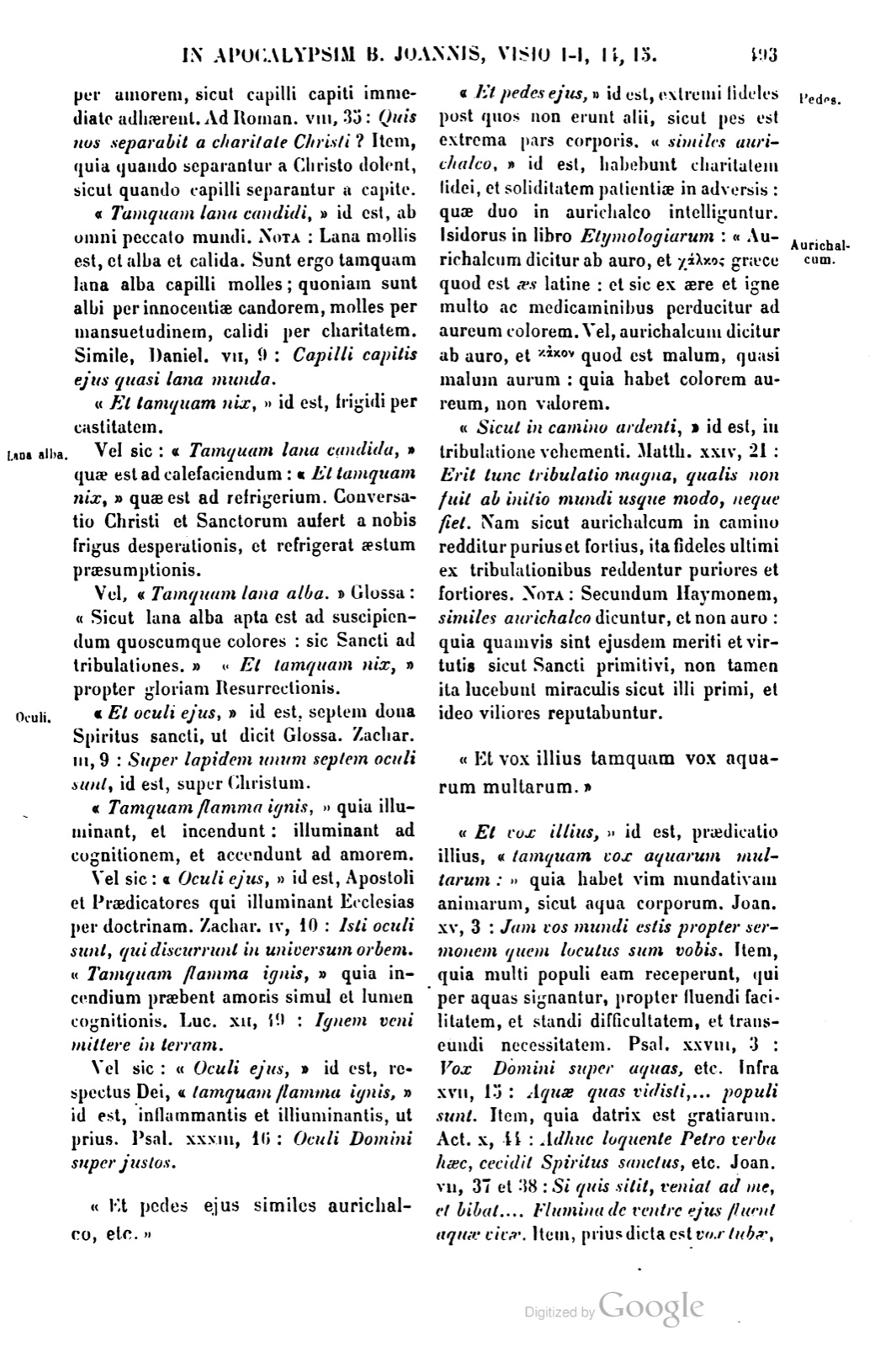
"Et vox illius," id est, praedicatio illius, "tamquam vox aquarum multarum:" quia habet vim mundativam animarum, sicut aqua corporum. Joan. XV, 3: Jam vos mundi estis propter sermonem quem locutus sum vobis. Item, quia multi populi eam receperunt, qui per aquas signantur, propter fluendi facilitatem, et standi difficultatem, et transeundi necessitatem. Psal. XXVIII, 3: Vox Domini super aquas, etc. Infra XVII, 15: Aquae quas vidisti, ... populi sunt. Item, quia datrix est gratiarum. Act. X, 44: Adhuc loquente Petro verba haec, cecidit Spiritus sanctus, etc. Joan. VII, 37 et 38: Si quis sitit, veniat ad me, et bibat.... Flumina de ventre ejus fluent aquae viva. Item, prius dicta est vox tuba, quia quandoque terret: hic vox aquae, quia quandoque mulcet.
"Et habebat in dextera sua stellas septem, et de ore ejus gladius utraque parte acutus exibat."
Hic describit Christum a potestate, et hoc duplici. Prima consistit in fidelium consolatione. Secunda, in adversariorum depressione, ibi, "Et de ore ejus."
Stella.
Dicit ergo: "Et habebat in dextera sua septem stellas," id est, septem Angelos, vel universos Praelatos qui debent lucere in mundo verbo et exemplo, sicut stellae in firmamento. Ad Philip. II, 15 et 16: Inter quos lucetis, sicut luminaria in mundo, verbum vitae continentes. Baruch, III, 34: Stellae dederunt lumen in custodiis suis, id est, Praelati in Ecclesiis.
Stellarum proprietates.
Item, minimi per humilitatem. Eccli. III, 20: Quanto magnus es, humilia te in omnibus. Item, maximi per potestatem in exstirpando culpam. Jerem. I, 10: Ecce constitui te super Gentes, etc. Item, ignei per charitatis fervorem, in alto siti per contemplationem, fixi in caelo, id est, in Christo per fidem, spem, et charitatem: coruscantes per boni operis ostensionem vel exempli, vel bonam conversationem: effectum habentes in terra per pauperum confortationem. Hi dicuntur esse in dextera Dei, id est, in aeterna beatitudine modo in spe, tandem in re, quando statuet Dominus oves a dextris, haedos autem a sinistris 13.
Vel sic: Sancti "in dextera" Dei esse dicuntur: quia bonos consolatur, et protegit in tribulationibus: vel quia eos replet septem donis spiritualibus quae in dextera signantur, sicut temporalia in sinistra. Proverb. III, 16: Longitudo dierum in dextera ejus, etc.
Vel, "Septem stellae" sunt septem dotes electorum, quas Christus dicitur habere in dextera, quia eas dat in futura vita quae per dexteram signatur.
"Et de ore ejus," id est, Christi, "gladius," id est, sententia judiciaria qua dividet malos a bonis, et dicet, Matth. XXV, 41: Discedite a me, maledicti, etc. Job, XIX, 29: Fugite a facie gladii, quoniam ultor iniquitatum gladius est.
Gladius Christi acutus.
"Utraque parte acutus," puniendo reprobos in anima, et in corpore: vel pro omissis, et commissis. Matth. XIII, 49 et 50: Exibunt Angeli, et separabunt malos de medio justorum, et mittent eos in caminum ignis, etc. Vel, quia dividet a visione Dei, et affliget in poena inferni.
"And his voice," that is, his preaching, "like the voice of many waters," because it has the power to cleanse souls, as water has the power to cleanse bodies. John XV, 3: Now you are clean because of the word which I have spoken to you. Likewise, because many peoples received it, who are signified through waters, on account of easiness of flowing, difficulty of standing, and necessity of passing over. Psalm XXVIII, 3: The voice of the Lord is over the waters, etc. Below, XVII, 15: The waters which you saw ... are peoples. Likewise, because it is the giver of graces. Acts X, 44: While Peter was still speaking these words, the Holy Spirit fell, etc. John VII, 37 and 38: If anyone thirsts, let him come to me and drink.... Rivers of living water will flow from his belly. Likewise, before it was called the voice of a trumpet, because sometimes it terrifies; here the voice of water, because sometimes it soothes.
"And he had in his right hand seven stars, and from his mouth came forth a sword sharp on both sides."
Here he describes Christ from power, and this in two ways. The first consists in the consolation of the faithful. The second consists in the depression of adversaries, there, "And from his mouth."
Star.
Therefore he says: "And he had in his right hand seven stars," that is, seven Angels, or all Prelates, who ought to shine in the world by word and example, as stars in the firmament. Philippians II, 15 and 16: Among whom you shine like lights in the world, holding the word of life. Baruch III, 34: The stars gave light in their watches, that is, Prelates in the Churches.
Properties of stars.
Likewise, smallest through humility. Ecclesiasticus III, 20: The greater you are, humble yourself in all things. Likewise, greatest through power in rooting out fault. Jeremiah I, 10: Behold, I have set you over the Nations, etc. Likewise, fiery through the fervor of charity, situated on high through contemplation, fixed in heaven, that is, in Christ through faith, hope, and charity; flashing through the display of good work or example, or good manner of life; having effect on earth through the comforting of the poor. These are said to be in the right hand of God, that is, in eternal beatitude now in hope, at last in reality, when the Lord will set the sheep at the right, but the goats at the left 13.
Or thus: the Saints are said to be "in the right hand" of God because he consoles and protects the good in tribulations; or because he fills them with the seven spiritual gifts which are signified in the right hand, as temporal things in the left. Proverbs III, 16: Length of days is in her right hand, etc.
Or, the "seven stars" are the seven dowries of the elect, which Christ is said to have in his right hand because he gives them in the future life, which is signified through the right hand.
"And from his mouth," that is, from Christ's mouth, "a sword," that is, the judicial sentence by which he will divide the wicked from the good and will say, Matthew XXV, 41: Depart from me, accursed ones, etc. Job XIX, 29: Flee from the face of the sword, because the sword is the avenger of iniquities.
Christ's sharp sword.
"Sharp on both sides," by punishing the reprobate in soul and in body; or for things omitted and committed. Matthew XIII, 49 and 50: The Angels will go out and separate the wicked from the midst of the just, and will send them into the furnace of fire, etc. Or, because he will divide them from the vision of God and afflict them in the punishment of hell.
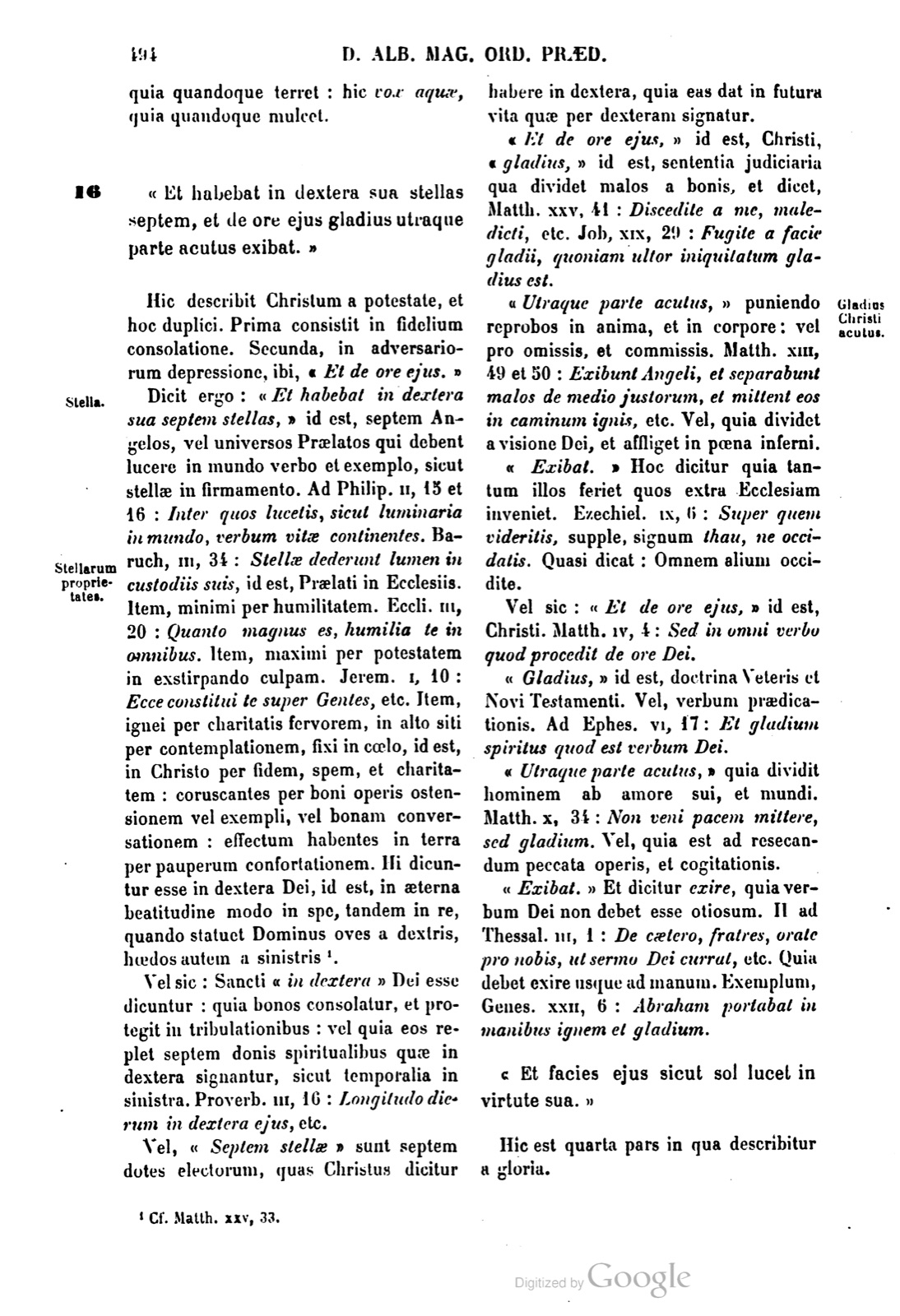
"Exibat." Hoc dicitur quia tantum illos feriet quos extra Ecclesiam inveniet. Ezechiel. IX, 6: Super quem videritis, supple, signum thau, ne occidatis. Quasi dicat: Omnem alium occidite.
Vel sic: "Et de ore ejus," id est, Christi. Matth. IV, 4: Sed in omni verbo quod procedit de ore Dei.
"Gladius," id est, doctrina Veteris et Novi Testamenti. Vel, verbum praedicationis. Ad Ephes. VI, 17: Et gladium spiritus quod est verbum Dei.
"Utraque parte acutus," quia dividit hominem ab amore sui, et mundi. Matth. X, 34: Non veni pacem mittere, sed gladium. Vel, quia est ad resecandum peccata operis, et cogitationis.
"Exibat." Et dicitur exire, quia verbum Dei non debet esse otiosum. II ad Thessal. III, 1: De caetero, fratres, orate pro nobis, ut sermo Dei currat, etc. Quia debet exire usque ad manum. Exemplum, Genes. XXII, 6: Abraham portabat in manibus ignem et gladium.
"Et facies ejus sicut sol lucet in virtute sua."
Hic est quarta pars in qua describitur a gloria.
Facies Christi dicitur sol.
Unde dicit: "Et facies ejus," id est, humanitas ejus in qua visibilis mundo apparuit, "sicut sol," id est, quia habuit ortum in nativitate, et occasum in morte, iterum ortum post occasum in sua Resurrectione. Eccle. I, 5: Oritur sol, scilicet in nativitate, et occidit, id est, in morte, et ad locum suum revertitur, id est, in Resurrectione.
"Lucet in virtute sua," id est, in meridiano tempore, et ubi non obumbrabitur nubium caligine, ita quod vix possit adspectus ejus claritatem ferre. Matth. XVII, 2: Resplenduit facies ejus sicut sol. Vel, "In virtute sua," scilicet in qua possibile est eum esse, quod erit post judicium, quando lux lunae erit sicut lux solis, et lux solis septempliciter 14. Ideo cum diceretur hic: "Et facies ejus sicut sol," additum est: "In virtute sua."
Vel sic: "Et facies ejus sicut sol," quia sine peccato natus fuit, et pastores illuminavit 15, et stella praevia magos perduxit 16, et lucens in processu vitae, quando miracula fecit. "In virtute sua," quando in Passione diabolum vicit, et Judaeos excaecavit, id est, excaecari permisit. Eccli. XLIII, 4: Tripliciter sol exurens montes, radios igneos exsufflans, scilicet, in sua nativitate, et refulgens radiis suis, scilicet in miraculorum operatione, obcaecat oculos, scilicet Judaeorum in sua Passione.
Vel sic: "Facies ejus," id est, omnes electi post resurrectionem, "sicut sol," scilicet propter naturae et gloriae similitudinem. Matth. XIII, 43: Tunc justi fulgebunt sicut sol.
"Lucet in virtute sua," id est, sicut Sol justitiae qui solus lucet virtute propria.
"It came forth." This is said because it will strike only those whom it finds outside the Church. Ezekiel IX, 6: Upon whom you see, supply, the sign tau, do not kill. As if he were saying: Kill every other one.
Or thus: "And from his mouth," that is, Christ's. Matthew IV, 4: But in every word that proceeds from the mouth of God.
"A sword," that is, the doctrine of the Old and New Testament. Or, the word of preaching. Ephesians VI, 17: And the sword of the spirit, which is the word of God.
"Sharp on both sides," because it divides a man from love of himself and of the world. Matthew X, 34: I did not come to send peace, but a sword. Or, because it is for cutting away sins of deed and of thought.
"It came forth." And it is said to come forth because the word of God ought not to be idle. II Thessalonians III, 1: For the rest, brothers, pray for us, that the word of God may run, etc. Because it ought to go forth as far as the hand. The example is Genesis XXII, 6: Abraham was carrying fire and a sword in his hands.
"And his face is as the sun shines in its strength."
This is the fourth part, in which he is described from glory.
The face of Christ is called the sun.
Hence he says: "And his face," that is, his humanity, in which he appeared visibly to the world, "as the sun," that is, because he had rising in his nativity, and setting in death, and again rising after setting in his Resurrection. Ecclesiastes I, 5: The sun rises, namely in the nativity, and sets, that is, in death, and returns to its place, that is, in the Resurrection.
"It shines in its strength," that is, in the midday time, and where it will not be overshadowed by the darkness of clouds, so that sight can scarcely bear its brightness. Matthew XVII, 2: His face shone like the sun. Or, "in its strength," namely in which it is possible for it to be, which will be after judgment, when the light of the moon will be as the light of the sun, and the light of the sun sevenfold 14. Therefore when it was said here: "And his face as the sun," there was added: "in its strength."
Or thus: "And his face as the sun," because he was born without sin, and illuminated the shepherds 15, and the star going before led the Magi 16, and he shone in the course of life when he performed miracles. "In its strength," when in the Passion he conquered the devil and blinded the Jews, that is, permitted them to be blinded. Ecclesiasticus XLIII, 4: The sun burning the mountains in three ways, breathing forth fiery rays, namely in his nativity, and shining with its rays, namely in the working of miracles, blinds the eyes, namely of the Jews in his Passion.
Or thus: "his face," that is, all the elect after the resurrection, "as the sun," namely because of likeness of nature and glory. Matthew XIII, 43: Then the just will shine like the sun.
"It shines in its strength," that is, like the Sun of justice, who alone shines by his own strength.
"Et cum vidissem eum, cecidi ad pedes ejus tamquam mortuus."
Supra posuit visionem, hic ponitur consequens ad eam. Et tanguntur quinque. Primo, Joannis casus. Secundo, consolatio ejus, ibidem, "Et posuit dexteram." Tertio, ut scribat quae vidit praecipitur, ibi, v. 19: "Scribe." Quarto, expositio visionis ibi, v. 20: "Sacramentum septem stellarum." Quinto, quid debeat scribere, et quibus Ecclesiis, ibi, II, 1: "Angelo Ephesi, etc."
Dicit ergo: "Et cum vidissem eum," id est, Christum tantum et talem, "cecidi ad pedes ejus," prae stupore et admiratione stupefactus, vel quasi non potens sustinere similitudinem humanitatis glorificatae. "Cecidi," per humilitatem, "ad pedes" paratus ad imitationem. Vel, "Cecidi ad pedes ejus," indignum me arbitrans et insufficientem ad intuendam ejus divinitatem, et me inclinavi ad intuendam ejus humanitatem. Et in casu notatur infirmitas humanae naturae, et humilitas Joannis.
Cadere ad pedes Christi.
In hoc quod dicit: "Ad pedes ejus," notatur desiderium imitationis, quasi paratus sum sequi. I Petri, II, 21: Christus passus est pro nobis, vobis relinquens exemplum.
"Tamquam mortuus." Quasi diceret: Non vere mortuus: in quo notatur mortificatio carnalis affectus. Unde, Haymo: "Electi et si moriuntur mundo, tamen imitantes vestigia Christi vivunt Deo." Ad Galat. II, 20: Vivo autem, jam non ego, etc.
Quaestio.
Sed quaeritur, Cum Apostolus illos qui carnem mortificant pro Christo, dicat mortuos, ad Coloss. III, 3: Mortui estis, et vita vestra, etc., quare non dicit hic, Cecidi mortuus, sed tamquam mortuus? Responsio. Quia etsi tales mundo moriuntur, et vitiis, vivunt tamen Deo. II ad Corinth. VI, 9: Quasi morientes, et ecce vivimus.
"Et posuit dexteram suam super me, dicens: Noli timere: ego sum primus et novissimus, Et vivus, et fui mortuus, et ecce sum vivens in saecula saeculorum, et habeo claves mortis et inferni."
Hic ponitur Joannis consolatio. Et haec duplex: verbo, et facto: contra duo quae praecesserant. Quia enim cecidit, ponit dexteram super eum ut erigat. Quia quasi mortuus fuit, verbo consolatur ne timeat, dicens: "Noli timere." Quasi dicat: Cecidi, etc.
"Et posuit dexteram suam super me." Glossa, id est, spiritum confortantem. Psal. CXVII, 16: Dextera Domini exaltavit me. Et dicit: "Super me," ad denotandum quod non poterat per se resurgere, sed per donum divinae gratiae.
"Dicens," per internam inspirationem, vel toti Ecclesiae per Praedicatores et Scripturam: "Noli timere." Glossa, pati pro me tribulationes. Matth. X, 28: Nolite timere eos qui occidunt corpus.
Et subdit duplicem causam. Una: quia ipse qui tantus erat, non timuit mori pro nobis. Alia: quia potens liberare a tentationibus cunctis, ibi, v. 18: "Et habeo claves."
"And when I had seen him, I fell at his feet as though dead."
Above he set down the vision; here what follows upon it is set down. And five things are touched on. First, John's fall. Second, his consolation, in the same place, "And he placed his right hand." Third, he is commanded to write the things which he saw, there, verse 19: "Write." Fourth, the explanation of the vision there, verse 20: "The sacrament of the seven stars." Fifth, what he ought to write, and to which Churches, there, II, 1: "To the Angel of Ephesus, etc."
Therefore he says: "And when I had seen him," that is, Christ so great and of such a sort, "I fell at his feet," stunned by stupor and admiration, or as if unable to sustain the likeness of glorified humanity. "I fell," through humility, "at the feet," ready for imitation. Or, "I fell at his feet," judging myself unworthy and insufficient to look upon his divinity, and I inclined myself to look upon his humanity. And in the fall is noted the weakness of human nature and the humility of John.
To fall at the feet of Christ.
In this, that he says "at his feet," the desire of imitation is noted, as if I am ready to follow. I Peter II, 21: Christ suffered for us, leaving you an example.
"As though dead." As if he were saying: Not truly dead; in this is noted the mortification of carnal affection. Hence Haymo says: "The elect, even if they die to the world, nevertheless, imitating the footsteps of Christ, live to God." Galatians II, 20: But I live, now not I, etc.
Question.
But it is asked: Since the Apostle calls those who mortify the flesh for Christ dead, at Colossians III, 3: You are dead, and your life, etc., why does he not say here, I fell dead, but as though dead? Response. Because although such persons die to the world and to vices, nevertheless they live to God. II Corinthians VI, 9: As though dying, and behold we live.
"And he placed his right hand upon me, saying: Fear not: I am the first and the last, And living, and I was dead, and behold, I am living forever and ever, and I have the keys of death and of hell."
Here John's consolation is set down. And this is twofold: by word and by deed, against the two things which had preceded. For because he fell, he places his right hand upon him so that he may raise him. Because he was as though dead, he consoles him by word lest he fear, saying: "Fear not." As if he were saying: I fell, etc.
"And he placed his right hand upon me." The Gloss says, that is, the comforting spirit. Psalm CXVII, 16: The right hand of the Lord has exalted me. And he says "upon me" to denote that he could not rise by himself, but through the gift of divine grace.
"Saying," through internal inspiration, or to the whole Church through Preachers and Scripture: "Fear not." The Gloss says, to suffer tribulations for me. Matthew X, 28: Do not fear those who kill the body.
And he adds a twofold cause. One: because he himself, who was so great, did not fear to die for us. The other: because he is powerful to free from all temptations, there, verse 18: "And I have the keys."
Christus primus dicitur et novissimus.
Dicit ergo: "Noli timere," quia, supple, "ego sum primus," id est, principium a quo omnia, et sic habeo potentiam liberandi: "et novissimus," id est, finis in quem tendunt omnia, et sic habeo potentiam remunerandi.
"Et vivus, et fui mortuus, etc."
Et sum "vivus," per Resurrectionem, "et fui mortuus," per altam Passionem.
Vel sic: "Ego sum primus," quia ante saecula natus sum de Deo Patre, "et novissimus," quia in fine temporum natus sum secundum carnem de Virgine Matre. Vel, "Primus" in regno Angelorum, "et novissimus," in regno hominum. Isa. LIII, 2 et 3: Desideravimus eum, despectum, et novissimum virorum.
Et sum "vivus," ante incarnationem in deitate. Deuter. XXXII, 40: Vivo ego in aeternum.
"Et fui mortuus," post incarnationem in humanitate.
"Et ecce sum vivens," post Resurrectionem tertia die, sed non iterum moriturus. Unde sequitur: "In saecula saeculorum," id est, semper. Ad Roman. VI, 9: Christus resurgens ex mortuis jam non moritur. Quasi dicat: Sicut non timui pro vobis mori, sic et vos non debetis timere pro me mori: quia similiter resurgetis victuri in saecula saeculorum. I Petri, IV, 1: Christo igitur passo in carne, et vos eadem cogitatione armamini.
Quaestio.
Quaeritur, Cum prius dicitur: "Sum vivus," quare dicitur postea: "Et ecce sum vivens:" cum hoc videatur superfluere? Responsio. Non est superfluitas: quia primo loquitur de vita quam habet ab aeterno secundum deitatem, postea loquitur de vita quam habet in tempore secundum humanitatem, et post resurrectionem.
Habet claves mortis.
"Et habeo claves mortis et inferni," id est, potestatem super diabolum, qui mors dicitur, tum quia fuit prima occasio mortis. Sapient. II, 24: Invidia diaboli mors introivit, etc. Tum quia semper mortem animarum sitit. Gregorius: "Nihil se fecisse aestimat, nisi cum animas sauciat." Tum quia semper est in morte inferni, et ideo sortitur nomen mortis. Infra, VI, 8: Nomen illi mors.
"Et inferni," id est, habeo potestatem super membra ejus, quae dicuntur infernus, quia ad poenam inferni sunt ventura. Quasi dicat: "Habeo claves," id est, potestatem aeternam et judiciariam super diabolum, ne nimis saeviat in tentando bonos: et super membra ejus, ne nimis persequantur eos. Vel sic: "Habeo claves mortis," ut amplius non dominetur vobis, cum surrexeritis: "et inferni," id est, super infernum ut vos non detineat, et diabolum et membra ejus quasi in carcere perpetuo ibi claudam.
Vel: "Habeo claves, etc." Quasi dicat: Si non vultis pro me pati, possum vos punire in poenis inferni, et aperire infernum vobis. Sapient. XVI, 13: Tu es, Domine, qui vitae et mortis habes potestatem.
Christ is called first and last.
Therefore he says: "Fear not," because, supply, "I am the first," that is, the beginning from whom are all things, and thus I have the power of freeing; "and the last," that is, the end into whom all things tend, and thus I have the power of rewarding.
"And living, and I was dead, etc."
And I am "living," through Resurrection, "and I was dead," through the deep Passion.
Or thus: "I am the first," because before the ages I was born from God the Father, "and the last," because at the end of times I was born according to the flesh from the Virgin Mother. Or, "first" in the kingdom of Angels, "and last" in the kingdom of men. Isaiah LIII, 2 and 3: We desired him, despised and the last of men.
And I am "living," before the incarnation in deity. Deuteronomy XXXII, 40: I live forever.
"And I was dead," after the incarnation in humanity.
"And behold, I am living," after the Resurrection on the third day, but not about to die again. Hence follows: "forever and ever," that is, always. Romans VI, 9: Christ rising from the dead now dies no more. As if he were saying: As I did not fear to die for you, so you also ought not to fear to die for me, because similarly you will rise again to live forever and ever. I Peter IV, 1: Therefore Christ having suffered in the flesh, arm yourselves also with the same thought.
Question.
It is asked: Since before it is said, "I am living," why afterward is it said, "And behold, I am living," since this seems to be superfluous? Response. There is no superfluity, because first he speaks of the life which he has from eternity according to deity; afterward he speaks of the life which he has in time according to humanity and after resurrection.
He has the keys of death.
"And I have the keys of death and of hell," that is, power over the devil, who is called death, both because he was the first occasion of death. Wisdom II, 24: Through the devil's envy death entered, etc. Also because he always thirsts for the death of souls. Gregory says: "He considers that he has done nothing unless he wounds souls." Also because he is always in the death of hell, and therefore he receives the name of death. Below, VI, 8: His name is death.
"And of hell," that is, I have power over his members, who are called hell because they are going to the punishment of hell. As if he were saying: "I have the keys," that is, eternal and judicial power over the devil, lest he rage too much in tempting the good; and over his members, lest they persecute them too much. Or thus: "I have the keys of death," so that it may no longer dominate you when you have risen; "and of hell," that is, over hell so that it may not detain you, and so that I may shut the devil and his members there as if in a perpetual prison.
Or: "I have the keys, etc." As if he were saying: If you do not wish to suffer for me, I can punish you in the penalties of hell, and open hell for you. Wisdom XVI, 13: You are the Lord who have power of life and death.
"Scribe ergo quae vidisti, et quae sunt, et quae oportet fieri post haec."
Hic praecipitur ut quae vidit, scribat. Quasi dicat: Malis possum infernum aperire: "scribe ergo quae vidisti," scilicet, Incarnationem, Passionem, et Resurrectionem meam, et caetera Ecclesiae sacramenta: "quae vidisti", id est, intellexisti.
Quaestio.
Sed cum supra dictum sit ut scriberet, quare hic iterum ad scribendum invitatur? Responsio. Secundum Haymonem, in repetitione verbi negligentia torporis a Praedicatorum studio removetur: ut quae saepius admonentur, sine tarditate impleantur.
"Et quae sunt," id est, praesentes tribulationes et consolationes fidelium, "et quae oportet fieri post haec," id est, ultimam persecutionem tempore Antichristi: et hoc debet nos animare ad sustinendum tribulationes in praesenti, quia id quod modo sustinemus, nihil est in comparatione eorum quae sustinebunt Sancti in novissimo tempore, Antichristo regnante.
"Sacramentum septem stellarum quas vidisti in dextera mea, et septem candelabra aurea: septem stellae, Angeli sunt septem Ecclesiarum: et candelabra septem, septem Ecclesiae sunt."
Hic tangitur visionis expositio. Continua: Quasi dicat: Scribe quod vidisti. Et quia posset dicere: Quid scribam? propter hoc subdit: "Sacramentum," id est, sanctum secretum, vel mysterium, ubi aliud videtur, et aliud intelligitur, "septem stellarum quas vidisti in dextera mea, et septem candelabra aurea," scilicet scribe, vel expone. Glossa, subaudi, docebo te. Quasi dicat: Sub his signis sensum latentem quaere, et expone.
Deinde exponit mysterium, dicens: "Septem stellae, Angeli sunt septem," id est, septem Praelati vel Episcopi septem Ecclesiarum, scilicet, Asiae, vel omnium generaliter: "et candelabra septem, septem Ecclesiae sunt," id est, per septem stellas signantur septem Praelati, et per septem candelabra septem Ecclesiae.
Allegoria utitur Scriptura propter multa.
Et nota, quod Angelus istam partem visionis exposuit allegorice, ut ostendat allegoriam similiter in sequentibus esse quaerendam. Quod autem quaedam exposuit, quaedam non, ideo fecit, ne si totus liber esset planus, vilesceret legentibus, et in taedium verteretur: et ut haberemus in quo sensum nostrum exercitaremus, et exercitando mereremur. Item, ut indignis mysterium Ecclesiae occultaretur. Tob. XII, 7: Sacramentum regis abscondere bonum est, etc. Item, quaedam exposuit, sicut dicit Haymo, quia si ex toto clausus esset, eum legere nos taederet. Item, ut confidentiam aeterna intelligendi nobis daret.
"Therefore write the things which you have seen, and the things which are, and the things which must happen after these things."
Here he is commanded to write the things which he saw. As if he were saying: I can open hell to the wicked; "therefore write the things which you have seen," namely, my Incarnation, Passion, and Resurrection, and the other sacraments of the Church; "which you have seen," that is, understood.
Question.
But since above it was said that he should write, why here again is he invited to write? Response. According to Haymo, in the repetition of the word, the negligence of sluggishness is removed from the zeal of Preachers, so that the things which are more often admonished may be fulfilled without delay.
"And the things which are," that is, the present tribulations and consolations of the faithful, "and the things which must happen after these things," that is, the last persecution in the time of Antichrist; and this ought to animate us to endure tribulations in the present, because that which we now endure is nothing in comparison with those things which the Saints will endure in the last time, when Antichrist reigns.
"The sacrament of the seven stars which you have seen in my right hand, and the seven golden lampstands: the seven stars are the Angels of the seven Churches; and the seven lampstands are the seven Churches."
Here the explanation of the vision is touched on. Continue: As if he were saying: Write what you saw. And because he could say, What shall I write? for this reason he adds: "The sacrament," that is, the holy secret, or mystery, where one thing is seen and another is understood, "of the seven stars which you have seen in my right hand, and the seven golden lampstands," namely write it, or explain it. The Gloss says, understand, I will teach you. As if he were saying: Seek the sense lying hidden under these signs, and explain it.
Then he explains the mystery, saying: "The seven stars are the seven Angels," that is, the seven Prelates or Bishops of the seven Churches, namely of Asia, or of all Churches generally; "and the seven lampstands are the seven Churches," that is, through the seven stars seven Prelates are signified, and through the seven lampstands seven Churches.
Scripture uses allegory for many reasons.
And note that the Angel explained this part of the vision allegorically, to show that allegory is similarly to be sought in what follows. But the reason why he explained certain things and not certain others was so that, if the whole book were plain, it might become cheap to readers and be turned into weariness; and so that we might have something in which we could exercise our understanding, and by exercising it might merit. Likewise, so that the mystery of the Church might be hidden from the unworthy. Tobit XII, 7: It is good to hide the sacrament of the king, etc. Likewise, he explained certain things, as Haymo says, because if it were entirely closed, it would weary us to read it. Likewise, so that it might give us confidence for understanding eternal things.
"Et conversus vidi septem candelabra 17, etc."
Moraliter. Septem candelabra sunt septem opera quibus debet pollere Praelatus.
Praelati conditiones.
Primum est lumen fidei, ut sit paratus ad satisfaciendum omni poscenti rationem de ea quae in eo est fide et spe 18. Et hoc est respectu Dei. Respectu autem proximi debet habere tria. Primum est lumen verbi, ut lucide doceat. Item, boni operis, ne reprehensibilis appareat: quia turpe est Doctori, cum culpa redarguit ipsum. Item, exterioris conversationis, ne aliquem offendat. Augustinus: "In omnibus motibus vestris nihil fiat quod cujusquam oculos offendat, etc. 19." Item, respectu sui triplex lumen debet habere. Primum est lumen quotidianae circumspectionis, ne in conscientia aliquid immundum inveniat. Item, lumen beneficiorum Dei, ut memorando gratias referat. Item, lumen caelestis patriae in desiderio, ne torpescat. Haec autem candelabra dicuntur esse aurea, ut ex radice charitatis procedant omnia: quae comparatur auro propter valorem, colorem, pretiositatem.
In medio horum debet esse Praelatus qui debet esse Filio hominis similis in ministerio humilitatis, sicut in potestate terribilis. Gregorius: "Summus locus tunc bene regitur, cum is qui praeest, non personis sed vitiis dominatur." Item, in amore paupertatis sustinendae tribulationis, ut tandem sit similis in gloria immortalitatis. Ad Roman. VI, 5: Si complantati facti sumus similitudini mortis ejus, etc. Hic debet esse in medio septem candelabrorum aureorum, id est, septem virtutum quibus promittitur beatitudo, Matth. V, 3: Beati pauperes spiritu, etc.
"Vestitum podere," ubi notatur perseverantia quae sola coronabitur. Matth. XXIV, 13: Qui perseveraverit usque in finem, etc.
"Praecinctum ad mamillas zona aurea," id est, castitate mentis et corporis.
"Caput autem ejus," id est, intentio pura quae debet esse principium in omnibus operibus, sicut caput in omnibus membris. Cantic. V, 11: Caput ejus aurum optimum.
"Capilli ejus" sunt cogitationes quae adhaerent menti, quae sunt "candidae tamquam lana," quando homo se praeparat ad omnes tribulationes sustinendas, sicut lana est apta ad suscipiendum omnes colores. Vel, "Capilli" sunt sancti martyres adhaerentes Christo capiti. Cantic. IV, 1: Capilli tui sicut greges caprarum quae ascenderunt de monte Galaad. Qui sunt sicut "lana alba," quia, infra, VII, 14: Laverunt stolas suas, et dealbaverunt eas in sanguine Agni.
"Oculi ejus," id est, Praelati, "tamquam flamma ignis," per fervorem charitatis.
"Et pedes ejus similes aurichalco," id est, sancti ultimi temporis minus valent iis qui fuerunt tempore primitivo. Sicut enim aes est minus ponderosum, minus pretiosum auro: sic Sancti ultimi Apostolis minus valent: et tamen sicut de aere plura vasa facta sunt in templo quam de auro, sic isti respectu illorum abundant in numero.
"Sicut in camino ardenti." Quod dicit, quia videntur esse inflammati charitate, et non sunt. Vel ly sicut, est expressivum veritatis: unde puriores exibunt sicut tres pueri 20.
"Et vox illius," id est, Christi, "tamquam vox aquarum multarum." Haec vox fuit Joannes Baptista. Joan. I, 23: Ego vox clamantis in deserto. Qui ad litteram baptizavit in aqua, Joan. III, 23: Erat et Joannes baptizans in Annon juxta Salim, quia aquae multae erant illic. Psal. XXVIII, 3: Vox Domini super aquas.
"And having turned, I saw seven lampstands 17, etc."
Morally. The seven lampstands are seven works in which a Prelate ought to be strong.
Conditions of a Prelate.
The first is the light of faith, so that he may be ready to make satisfaction to everyone asking for a reason concerning the faith and hope which are in him 18. And this is with respect to God. But with respect to neighbor he ought to have three things. The first is the light of the word, so that he may teach clearly. Likewise, the light of good work, lest he appear blameworthy, because it is disgraceful for a Doctor when fault refutes him. Likewise, the light of exterior conduct, lest he offend anyone. Augustine says: "In all your movements let nothing be done which offends anyone's eyes, etc. 19." Likewise, with respect to himself he ought to have a threefold light. The first is the light of daily circumspection, lest he find anything unclean in conscience. Likewise, the light of God's benefits, so that by remembering he may give thanks. Likewise, the light of the heavenly homeland in desire, lest he grow sluggish. But these lampstands are said to be golden so that all things may proceed from the root of charity, which is compared to gold because of value, color, and preciousness.
In the midst of these the Prelate ought to be, who ought to be like the Son of Man in the ministry of humility, as he is terrible in power. Gregory says: "A high place is then ruled well, when the one who presides rules not over persons but over vices." Likewise, in love of poverty and of tribulation to be endured, so that at last he may be like him in the glory of immortality. Romans VI, 5: If we have been planted together in the likeness of his death, etc. He ought to be in the midst of the seven golden lampstands, that is, the seven virtues to which beatitude is promised, Matthew V, 3: Blessed are the poor in spirit, etc.
"Clothed with a poderis," where perseverance is noted, which alone will be crowned. Matthew XXIV, 13: He who will have persevered to the end, etc.
"Girded at the breasts with a golden belt," that is, with chastity of mind and body.
"But his head," that is, pure intention, which ought to be the beginning in all works, as the head is in all the members. Song of Songs V, 11: His head is the best gold.
"His hairs" are thoughts which adhere to the mind, which are "white like wool" when a man prepares himself to sustain all tribulations, as wool is suited to receive all colors. Or, the "hairs" are the holy martyrs adhering to Christ the head. Song of Songs IV, 1: Your hair is like flocks of goats which have ascended from mount Galaad. These are like "white wool," because, below, VII, 14: They have washed their robes and whitened them in the blood of the Lamb.
"His eyes," that is, Prelates, "like a flame of fire," through the fervor of charity.
"And his feet like aurichalcum," that is, the saints of the last time are worth less than those who were in the primitive time. For as bronze is less weighty, less precious than gold, so the last Saints are worth less than the Apostles; and nevertheless, as more vessels were made of bronze in the temple than of gold, so these abound in number with respect to them.
"As in a burning furnace." He says this because they seem to be inflamed by charity and are not. Or the word as is expressive of truth; hence they will come forth purer, like the three boys 20.
"And his voice," that is, Christ's, "like the voice of many waters." This voice was John the Baptist. John I, 23: I am the voice of one crying in the desert. He literally baptized in water, John III, 23: And John was baptizing in Aenon near Salim, because there were many waters there. Psalm XXVIII, 3: The voice of the Lord is over the waters.
Religiosi dicuntur stellae.
"Et habebat in dextera sua septem stellas," id est, universos religiosos, qui dicuntur stellae propter motum continuum: quia continuo debent moveri de virtute in virtutem. Psal. LXXXIII, 8: Ibunt de virtute in virtutem, etc. Bernardus: "In via Dei non progredi, regredi est." Item, propter modicam apparitionem, et magnam existentiam. Job, XI, 17: Cum te consumptum putaveris, orieris ut lucifer. Item, propter ordinis dispositionem. Judicum, V, 20: Stellae manentes in cursu et ordine suo. Item, propter obedientiae promptitudinem. Baruch, V, 34, 35: Stellae dederunt lumen in custodiis suis... Vocatae sunt, et dixerunt: Adsumus. Item, quia stellae laudant Creatorem suum, non verbis, sed motibus, id est, operibus. Job, XXXVII, 7: Ubi eras, cum me laudarent astra matutina? Et sic religiosi laudant Deum in Matutinis, et in horis aliis. Item, quia sicut stellae diffamantur a Philosophis qui dicunt: Ille natus est sub Venere, et ideo est luxuriosus: sub Marte, et ideo bellicosus, etc. Non tamen desistunt a suo cursu: sic nec religiosi si diffamentur a mundanis, non tamen desistunt a suo proposito. Ad Philip. II, 15: Inter quos lucetis sicut luminaria in mundo. Item, sicut stellae lucent de nocte, sic isti debent inter peccatores lucere. Item, stellae istae licet sint in dextera Dei, Eccli. L, 6: Quasi stella matutina in medio nebulae: tamen debent timere ne cadant in peccatis: quia Psalmista dicit, Psal. XC, 7: Cadent a latere tuo mille, et decem millia a dextris tuis: ad te autem, etc.
DUBIA
Circa capitulum istud sunt dubitabilia.
Dub. 1.
Primo, Super illud: "Quam dedit illi Deus 21." Glossa: "Secundum hominem accepit eam a Patre et Verbo sibi conjuncto in Spiritu sancto: ergo ly Deus, supponit pro tota Trinitate." Contra: Alia Glossa: "Quam dedit illi Deus" Pater, tamquam nihil debens: ergo ly Deus, supponit pro Patre.
Responsio. Homo assumptus accepit a tota Trinitate: tamen secundum rationem auctoritatis attribuitur Patri, ut dicit Glossa, et per hoc non removentur Filius, et Spiritus sanctus. Unde ut notetur residere auctoritas apud Patrem, attribuitur Patri quod est commune toti Trinitati. Sic accipitur illud Matthaei, XI, 27: Omnia mihi tradita sunt a Patre meo.
Dub. 2.
Secundo quaeritur, Secundum quam naturam dedit illi? Non secundum divinam, quia omnia scivit ab aeterno sicut Pater: ergo secundum humanam. Contra: Richardus de S. Victore: "Scio, quod anima Christi ab hora conceptionis suae tam sapientiae quam scientiae plenitudinem accepit: ergo postea ei revelatio fieri non potuit."
Responsio. Christi anima omnium habuit scientiam quae Deus fecit, facit, et facturus est: sed non ita limpide cognovit sicut Deus. Unde Augustinus super illud Psalmi CXXXVIII, 6: Mirabilis facta est scientia tua ex me. "Homo assumptus divinae substantiae non potest aequari in scientia: et ideo quantum ad hoc potuit ei fieri revelatio." Item, Cum haberet omnium scientiam non per naturam, sed per gratiam: non est inconveniens ei fieri revelationem.
Religious are called stars.
"And he had in his right hand seven stars," that is, all religious, who are called stars on account of continual motion, because they ought continually to be moved from virtue into virtue. Psalm LXXXIII, 8: They will go from virtue into virtue, etc. Bernard says: "On the way of God, not to advance is to go backward." Likewise, on account of slight appearance and great existence. Job XI, 17: When you think yourself consumed, you will arise like the morning star. Likewise, on account of the disposition of order. Judges V, 20: The stars remaining in their course and order. Likewise, on account of the promptness of obedience. Baruch V, 34, 35: The stars gave light in their watches ... they were called, and said: We are here. Likewise, because the stars praise their Creator, not with words, but with movements, that is, works. Job XXXVII, 7: Where were you when the morning stars praised me? And thus religious praise God in Matins and in the other hours. Likewise, because just as stars are defamed by Philosophers who say: That one was born under Venus, and therefore he is lustful; under Mars, and therefore warlike, etc. Yet they do not desist from their course; so neither do religious, if they are defamed by worldly persons, nevertheless desist from their purpose. Philippians II, 15: Among whom you shine like lights in the world. Likewise, as stars shine at night, so these ought to shine among sinners. Likewise, although those stars are in the right hand of God, Ecclesiasticus L, 6: Like the morning star in the midst of a cloud; nevertheless they ought to fear lest they fall in sins, because the Psalmist says, Psalm XC, 7: A thousand will fall at your side, and ten thousand at your right hand; but to you, etc.
DUBIA
There are doubtful questions concerning this chapter.
Dub. 1.
First, On this: "Which God gave to him 21." The Gloss says: "According to man he received it from the Father and from the Word joined to him in the Holy Spirit; therefore the word God supposes for the whole Trinity." On the contrary: Another Gloss says: "Which God gave to him," the Father, as owing nothing; therefore the word God supposes for the Father.
Response. The assumed man received from the whole Trinity; nevertheless according to the account of authority it is attributed to the Father, as the Gloss says, and through this the Son and the Holy Spirit are not removed. Hence, so that authority may be noted to reside with the Father, that which is common to the whole Trinity is attributed to the Father. That saying of Matthew XI, 27 is taken thus: All things have been handed over to me by my Father.
Dub. 2.
Second, it is asked: According to which nature did he give it to him? Not according to the divine, because he knew all things from eternity, as the Father did; therefore according to the human. On the contrary: Richard of St. Victor says: "I know that the soul of Christ from the hour of its conception received the fullness both of wisdom and of knowledge; therefore afterward revelation could not be made to him."
Response. The soul of Christ had knowledge of all things which God made, makes, and will make, but it did not know as clearly as God. Hence Augustine, on that saying of Psalm CXXXVIII, 6: Your knowledge has been made wonderful from me: "The assumed man cannot be equaled in knowledge to the divine substance; and therefore with respect to this, revelation could be made to him." Likewise, since he had knowledge of all things not through nature but through grace, it is not unfitting for revelation to be made to him.
Dub. 3.
Tertio, Quaeritur de hoc quod dicit: "Palam facere 22." Contra: Haec revelatio facta est sub figuris, et occultata, unde non est palam facta. Item, super illud: "Et signavit 23." Glossa, id est, sub sigillo dedit, ne locus sit furibus pervertendi, etc.
Responsio. Joanni palam facta est: quia veritatem rerum mentis intuitu conspexit, Deo revelante, et etiam figuras vidit quarum significationem aliis in parte revelavit et non omnino, sicut dicit Glossa: et hoc ne furibus esset locus pervertendi, et ne vilesceret prophetia.
Dub. 4.
Quarto, Super illo verbo: Quae oportet fieri cito 24, quaeritur, Cum iste liber non solum futura, sed etiam praesentia et praeterita narrat, quare hic sola futura dicit Christum revelare servis suis?
Responsio. Quia praesentia visu, praeterita auditu facile cognosci possunt: futura autem non nisi per revelationem, et ideo magis dicit de futuris quam de aliis.
Dub. 5.
Quinto, Super illo verbo: Et signavit mittens 25. Contra: Infra, XXII, 10: Ne signaveris verba prophetiae libri hujus.
Responsio. Dicendo, signavit, docuit infidelibus claudi. Dicendo autem: Ne signaveris, docuit fidelibus aperiri exercitio spirituali: propter quod dicitur, Daniel. XII, 9: Vade, Daniel, quia clausi sunt signatique sermones usque ad tempus praefinitum. Et subdit, v. 10: Neque intelligent omnes impii. Porro docti intelligent.
Dub. 6.
Sexto, Super illo verbo: Et testimonium Jesu Christi, quaecumque vidit 26. Contra: Cum hoc opus scriptum sit ante Evangelium (ut dicit Hieronymus 27) quomodo se dicit testimonium perhibuisse Jesu Christo?
Responsio. Etsi nondum perhibuerat scribendo, tamen perhibuerat praedicando: et sicut praedicavit, ita scripsit postea in Evangelio.
Dub. 7.
Septimo, Super illo verbo: "Quaecumque vidit." Contra: Multa quidem et alia signa fecit Jesus 28.
Responsio. Scribens testimonium Jesu Christi, non scripsit omnia quae viderat simpliciter, sed quae vidit posteris amplius profectura, et sic hic loquitur.
Dub. 8.
Octavo, Super illo verbo: Joannes septem Ecclesiis quae sunt in Asia 29, quaeritur, Quare hic ponit nomen suum, et non in principio sui Evangelii?
Responsio. Propter tria. Primo, ut daretur auctoritas suo operi, qua Evangelium non indigebat: quia jam praedicatum erat, et a Domino auctoritatem habebat. Secundo, quia hujus operis et auctor et scriptor erat, Evangelii solum scriptor. Tertio, ne alterius esse opus crederetur: quia hunc librum in exsilio scripsit, et ideo posset credi alterius de facili: Evangelium vero inter fratres scripsit jam ab exsilio revocatus: et ideo hic nomen suum apposuit, et non in principio Evangelii.
Dub. 9.
Nono, quaeritur super illo verbo: "Et a septem spiritibus, etc. 30." Cum tota Trinitas quiescat in Ecclesia sicut in throno, quare solus Spiritus sanctus in conspectu hujus throni esse dicitur?
Responsio. Quia remissio peccatorum Spiritui sancto attribuitur. Unde dicit Dominus, Joan. XX, 22 et 23: Accipite Spiritum sanctum: quorum remiseritis peccata, etc.
Dub. 10.
Decimo quaeritur, Quare personam
Dub. 3.
Third, it is asked about this which he says: "to make plain 22." On the contrary: This revelation was made under figures and hidden, whence it was not made plain. Likewise, on that phrase: "And he sealed 23." The Gloss says, that is, he gave it under a seal, lest there be a place for thieves to pervert it, etc.
Response. It was made plain to John, because he beheld the truth of the things by the gaze of the mind, God revealing it, and he also saw figures whose signification he revealed to others in part and not entirely, as the Gloss says; and this so that there might not be a place for thieves to pervert it, and lest the prophecy become cheap.
Dub. 4.
Fourth, On that phrase: The things which must happen quickly 24, it is asked: Since this book narrates not only future things, but also present and past things, why here does he say that Christ reveals only future things to his servants?
Response. Because present things can be known easily by sight, and past things by hearing, but future things only by revelation; and therefore he speaks more of future things than of others.
Dub. 5.
Fifth, On that phrase: And he sealed, sending 25. On the contrary: Below, XXII, 10: Do not seal the words of the prophecy of this book.
Response. By saying, he sealed, he taught that it is closed to unbelievers. But by saying, Do not seal, he taught that it is opened to believers by spiritual exercise; on account of which it is said, Daniel XII, 9: Go, Daniel, because the words are closed and sealed until the predetermined time. And he adds, verse 10: Nor will all the impious understand. But the learned will understand.
Dub. 6.
Sixth, On that phrase: And the testimony of Jesus Christ, whatever things he saw 26. On the contrary: Since this work was written before the Gospel, as Jerome says 27, how does he say that he bore testimony to Jesus Christ?
Response. Although he had not yet borne testimony by writing, nevertheless he had borne testimony by preaching; and as he preached, so afterward he wrote in the Gospel.
Dub. 7.
Seventh, On that phrase: "Whatever things he saw." On the contrary: Jesus indeed did many other signs 28.
Response. Writing the testimony of Jesus Christ, he did not write all things which he had seen absolutely, but those things which he saw as going to profit posterity more fully, and thus he speaks here.
Dub. 8.
Eighth, On that phrase: John to the seven Churches which are in Asia 29, it is asked: Why here does he set down his name, and not at the beginning of his Gospel?
Response. For three reasons. First, so that authority might be given to his work, which the Gospel did not need, because it had already been preached and had authority from the Lord. Second, because he was both the author and writer of this work, but only the writer of the Gospel. Third, lest it be believed to be the work of another, because he wrote this book in exile, and therefore it could easily be believed to be another's; but he wrote the Gospel among the brothers, having already been recalled from exile; and therefore here he added his name, and not at the beginning of the Gospel.
Dub. 9.
Ninth, it is asked on that phrase: "And from the seven spirits, etc. 30." Since the whole Trinity rests in the Church as on a throne, why is only the Holy Spirit said to be in the sight of this throne?
Response. Because the remission of sins is attributed to the Holy Spirit. Hence the Lord says, John XX, 22 and 23: Receive the Holy Spirit; whose sins you shall remit, etc.
Dub. 10.
Tenth, it is asked: Why the person
Notes
- Exodus III, 14. (Exod. III, 14.) ↩
- I Corinthians XV, 20; Colossians I, 18. (I ad Corinth. XV, 20; ad Coloss. I, 18.) ↩
- Hebrews IX, 14; I Peter I, 19; I John I, 7. (Ad Hebr. IX, 14; I Petri, I, 19; I Joannis, I, 7.) ↩
- Isaiah III, 13; Matthew XXIV, 30; Jude, verse 14. (Isa. III, 13; Matth. XXIV, 30; Judae, v. 14.) ↩
- Isaiah XLI, 4, XLIV, 6 and XLVIII, 12; below, XXI, 6 and XXII, 13. (Isa. XLI, 4, XLIV, 6 et XLVIII, 12; Infra, XXI, 6 et XXII, 13.) ↩
- Isaiah XLI, 4 and XLIV, 6 and XLVIII, 12; below, XXII, 13. (Isa. XLI, 4 et XLIV, 6 et XLVIII, 12; Infra, XXII, 13.) ↩
- Isaiah IX, 6. (Isa. IX, 6.) ↩
- Genesis XLI, 56. (Genes. XLI, 56.) ↩
- The Vulgate has, Isaiah XXVI, 10: Let us have mercy on the impious one, and he will not learn justice; in the land of the saints he has done wicked things, and he will not see the glory of the Lord. (Vulgata habet, Isa. XXVI, 10: Misereamur impio, et non discet justitiam: in terra sanctorum iniqua gessit, et non videbit gloriam Domini.) ↩
- St. Gregory, In the Paschal Homily. (S. Gregorius, In homilia paschali.) ↩
- Compare John XVI, 22. (Cf. Joan. XVI, 22.) ↩
- Compare Philippians III, 13. (Cf. ad Philip. III, 13.) ↩
- Compare Matthew XXV, 33. (Cf. Matth. XXV, 33.) ↩
- Compare Isaiah XXX, 26. (Cf. Isa. XXX, 26.) ↩
- Luke II, 9. (Luc. II, 9.) ↩
- Matthew II, 9. (Matth. II, 9.) ↩
- Compare above, verse 12 and following. There is also another moral exposition after the literal one. (Cf. Supra, v. 12 et seq. Est et alia expositio moralis post litteralem.) ↩
- Compare I Peter III, 15. (Cf. I Petri, III, 15.) ↩
- St. Augustine, In the Rule. (S. Augustinus, In regula.) ↩
- Daniel III, 94. (Daniel, III, 94.) ↩
- Above, verse 1. (Supra, v. 1.) ↩
- Above, verse 1. (Supra, v. 1.) ↩
- Above, in the same place, the Vulgate has, he signified. (Supra, ibidem, Vulgata habet, significavit.) ↩
- Above, verse 1. (Supra, v. 1.) ↩
- The Vulgate has, he signified. (Vulgata habet, significavit.) ↩
- Above, verse 2. (Supra, v. 2.) ↩
- As he says in the Prologue on the Gospel of John (note of the Lyons editor). (Ut dicit in Prologo super Evangelium Joannis (Nota ed. Lugd.).) ↩
- John XX, 30. (Joan. XX, 30.) ↩
- Above, verse 4. (Supra, v. 4.) ↩
- In the same place. (Ibidem.) ↩
If a page does not appear, its photograph has not been uploaded yet.