Works › Commentary on the Apocalypse of Blessed John
Volume 38 · pp. 465–469
Clear Exposition on the Apocalypse of Blessed John the Apostle. Prologue.
A marker with ≈ is an approximate page boundary, placed by measure of the text; the page photographs remain the authority. In the paired views, clicking a page marker brings that page into view.
D. Alberti Magni, Ratisbonensis Episcopi, Ordinis Praedicatorum; In Apocalypsim B. Joannis Apostoli, Luculenta Expositio. Prologus.
Confiteor tibi, Pater, Domine caeli et terrae, quia abscondisti haec a sapientibus et prudentibus, et revelasti ea parvulis 1. Quamvis ista verba secundum sensum litteralem sunt Christi loquentis ad suum Patrem, tamen secundum sensum allegoricum possunt esse verba Joannis Apostoli loquentis ad totam Trinitatem, et referentis gratias propter revelationem multiplicem sibi factam. Et commendat Trinitatem Joannes in his verbis quoad tria. Primo, quoad bonitatem quae intelligitur in nomine Patris: "Confiteor tibi, Pater." Joan. XVI, 27: Ipse Pater amat vos, quia vos me amastis. Secundo, quoad ejus potentiam, cum dicit, "Domine caeli et terrae." II Machab. XV, 4: Est Dominus vivus ipse in caelo potens, qui jussit agi septimam diem, scilicet diem sabbatorum. Psal. XXIII, 8: Dominus fortis et potens, Dominus potens in proelio. Tertio, quoad sapientiam, cum dicit: "Quoniam abscondisti haec a sapientibus, etc." Abscondere enim scientiam et revelare pertinet ad sapientiam. De primo, Proverb. X, 14: Sapientes abscondunt scientiam. De secundo, Daniel. II, 28: Est Deus in caelo revelans mysteria. Deus autem dicitur a theasthai, quod est considerare, quod pertinet ad sapientiam.
Vel, in nomine Patris intelligitur persona Patris: "Tibi, Pater." In Domino, persona Filii: "Domine caeli, etc." Ad Philip. II, 11: Dominus Jesus Christus in gloria est Dei Patris. In revelatione, persona Spiritus, scilicet "revelasti ea parvulis." I ad Corinth. II, 10: Nobis autem revelavit Deus per Spiritum suum.
Dicit ergo: "Confiteor tibi, Pater." Confiteor, inquam, laudem et gratias tibi de beneficiis referendo. Daniel. II, 23: Tibi, Deus patrum nostrorum, confiteor, teque laudo, quia sapientiam et fortitudinem dedisti mihi: sapientiam ad cognoscendum caelestia, et fortitudinem ad tolerandum adversa. Item, Confiteor, veniam pro peccatis postulando, exemplo illius de quo, Genes. XLI, 9: Tunc demum reminiscens pincernarum magister, ait: Confiteor peccatum meum, etc. I Joannis, I, 8: Si dixerimus quoniam peccatum non habemus, ipsi nos seducimus. Item, Confiteor, fidem sanctae Trinitatis recognoscendo. Matth. XI, 25: Confiteor, etc. Ad Roman. X, 10: Corde creditur ad justitiam, ore autem confessio fit ad salutem.
"Pater," qui omnia creasti per potentiam. Genes. I, 1: In principio creavit Deus caelum, etc. Deuter. XXXII, 6: Numquid non ipse est pater tuus, qui possedit te, et fecit, et creavit te? Pater, qui omnia gubernas per providentiam. Sapient. XIV, 3: Tua autem, Pater, providentia gubernat. Pater, qui hominem redemisti per tuam misericordiam. Isa. LXIII, 16: Tu, Domine, pater noster, redemptor noster, a saeculo nomen tuum. Pater, qui eumdem glorificasti per tuam justitiam. Isa. IX, 6: Vocabitur nomen ejus, Admirabilis, Consiliarius, Deus, fortis, Pater futuri saeculi, Princeps pacis.
Of D. Albert the Great, Bishop of Regensburg, of the Order of Preachers; A Clear Exposition on the Apocalypse of Blessed John the Apostle. Prologue.
I confess to you, Father, Lord of heaven and earth, because you have hidden these things from the wise and prudent, and have revealed them to little ones 1. Although according to the literal sense these words are Christ's, speaking to his Father, nevertheless according to the allegorical sense they can be the words of John the Apostle speaking to the whole Trinity, and giving thanks on account of the manifold revelation made to him. And in these words John commends the Trinity with regard to three things. First, with regard to the goodness which is understood in the name of Father: "I confess to you, Father." John XVI, 27: The Father himself loves you, because you have loved me. Second, with regard to his power, when he says, "Lord of heaven and earth." II Maccabees XV, 4: The Lord himself is living in heaven, mighty, who commanded the seventh day to be kept, namely the day of sabbaths. Psalm XXIII, 8: The Lord strong and mighty, the Lord mighty in battle. Third, with regard to wisdom, when he says: "Because you have hidden these things from the wise, etc." For to hide knowledge and to reveal it belongs to wisdom. Concerning the first, Proverbs X, 14: The wise hide knowledge. Concerning the second, Daniel II, 28: There is a God in heaven revealing mysteries. But God is said from theasthai, which is to consider, which belongs to wisdom.
Or, in the name of Father the person of the Father is understood: "To you, Father." In Lord, the person of the Son: "Lord of heaven, etc." To the Philippians II, 11: The Lord Jesus Christ is in the glory of God the Father. In revelation, the person of the Spirit, namely "you have revealed them to little ones." I Corinthians II, 10: But God has revealed to us through his Spirit.
Therefore he says: "I confess to you, Father." I confess, I say, by referring praise and thanks to you for benefits. Daniel II, 23: To you, God of our fathers, I confess, and I praise you, because you have given wisdom and strength to me: wisdom for knowing heavenly things, and strength for tolerating adversities. Likewise, I confess, by asking pardon for sins, by the example of that one concerning whom, Genesis XLI, 9: Then at last the chief of the cupbearers, remembering, said: I confess my sin, etc. I John I, 8: If we say that we have no sin, we deceive ourselves. Likewise, I confess, by acknowledging the faith of the holy Trinity. Matthew XI, 25: I confess, etc. To the Romans X, 10: With the heart one believes unto justice, but with the mouth confession is made unto salvation.
"Father," who created all things by power. Genesis I, 1: In the beginning God created heaven, etc. Deuteronomy XXXII, 6: Is not he himself your father, who possessed you, and made you, and created you? Father, who governs all things by providence. Wisdom XIV, 3: But your providence, Father, governs. Father, who redeemed man through your mercy. Isaiah LXIII, 16: You, Lord, are our father, our redeemer; from eternity is your name. Father, who glorified the same one through your justice. Isaiah IX, 6: His name shall be called Wonderful, Counselor, God, strong, Father of the future age, Prince of peace.
"Domine caeli et terrae," id est, spiritualis et corporalis creaturae. Domine, inquam, cujus dominium est universale. Judith, IX, 17: Deus caelorum, creator aquarum, et Deus totius creaturae, exaudi me, etc. Domine, cujus nomen admirabile. Psal. VIII, 2: Domine, Dominus noster, quam admirabile est nomen tuum! Judicum, XIII, 18: Cur quaeris nomen meum, quod est mirabile? Domine, qui das in praesenti virtutem bene operandi viatoribus. Psal. XXIX, 8: Domine, in voluntate tua praestitisti decori meo virtutem. Domine, qui dabis in futuro laetitiam gloriae contemplantibus. Psal. XX, 2: Domine, in virtute tua laetabitur rex, et super salutare tuum exsultabit vehementer.
"Quia abscondisti." Tu qui abscondisti dulcedinem caelestis gloriae Deum timentibus, ut illam habeant. Psal. XXX, 20: Quam magna multitudo dulcedinis tuae, Domine, quam abscondisti timentibus te! Item, tuam faciem desiderabilem damnatis et daemonibus, ne illam videant. Isa. LXIV, 7: Abscondisti faciem tuam a nobis, et allisisti nos in manu iniquitatis nostrae. Item, sacramenta caelestia mundi sapientibus, ne intelligant. Matth. XI, 25: Abscondisti haec a sapientibus et prudentibus, etc.
"Abscondisti haec a sapientibus et prudentibus." Haec enim revelantur dignis hominibus, et absconduntur indignis et peccatoribus. Tob. XII, 7: Sacramentum regis abscondere bonum est, scilicet indignis: opera autem Dei revelare et confiteri honorificum est, scilicet dignis. Talibus autem, hoc est, sapientibus sapientia mundi, vel prudentibus prudentia carnis, vel diaboli, praedicta non revelantur. Tum quia sapientia mundi est stultitia apud Deum. I ad Corinth. III, 19: Sapientia hujus mundi stultitia est apud Deum. Tum quia prudentia carnis mortifera. Ad Roman. VIII, 6: Prudentia carnis mors est. Item, Deo inimica. Ibidem, v. 7: Sapientia carnis inimica est Deo. Item, sapientia diaboli vana et deceptoria. De his tribus simul, Jacobi, III, 15: Non est enim ista sapientia desursum descendens, sed terrena, quoad sapientiam mundi, animalis, quoad prudentiam carnis, et diabolica, quoad sapientiam diaboli. Terrena consistit in appetitu divitiarum, animalis in appetitu et usu deliciarum, diabolica in appetitu bonorum. Talibus autem etiam Deus occultat sua secreta, ne panis filiorum mittatur canibus. Matth. XV, 26: Non est bonum sumere panem filiorum, et mittere canibus. Item, ne sancta ante porcos spargantur. Matth. VII, 6: Nolite dare sanctum canibus, neque mittatis margaritas vestras ante porcos.
"Lord of heaven and earth," that is, of the spiritual and bodily creature. Lord, I say, whose dominion is universal. Judith IX, 17: God of the heavens, creator of the waters, and God of every creature, hear me, etc. Lord, whose name is wonderful. Psalm VIII, 2: Lord, our Lord, how wonderful is your name! Judges XIII, 18: Why do you ask my name, which is wonderful? Lord, who in the present gives to wayfarers the virtue of working well. Psalm XXIX, 8: Lord, in your will you have furnished strength to my beauty. Lord, who in the future will give the joy of glory to those contemplating. Psalm XX, 2: Lord, in your strength the king will rejoice, and over your salvation he will exult exceedingly.
"Because you have hidden." You who have hidden the sweetness of heavenly glory for those fearing God, so that they may have it. Psalm XXX, 20: How great is the multitude of your sweetness, Lord, which you have hidden for those fearing you! Likewise, you have hidden your desirable face from the damned and demons, lest they see it. Isaiah LXIV, 7: You have hidden your face from us, and have dashed us in the hand of our iniquity. Likewise, you have hidden the heavenly sacraments from the wise of the world, lest they understand. Matthew XI, 25: You have hidden these things from the wise and prudent, etc.
"You have hidden these things from the wise and prudent." For these things are revealed to worthy men, and are hidden from the unworthy and from sinners. Tobit XII, 7: To hide the king's sacrament is good, namely from the unworthy; but to reveal and confess the works of God is honorable, namely to the worthy. To such, however, that is, to those wise with the wisdom of the world, or prudent with the prudence of the flesh, or of the devil, the aforesaid things are not revealed. Both because the wisdom of the world is foolishness with God. I Corinthians III, 19: The wisdom of this world is foolishness with God. And because the prudence of the flesh is deadly. Romans VIII, 6: The prudence of the flesh is death. Likewise, it is hostile to God. In the same place, verse 7: The wisdom of the flesh is hostile to God. Likewise, the wisdom of the devil is vain and deceptive. Concerning these three together, James III, 15: For that is not wisdom descending from above, but earthly, with regard to the wisdom of the world, animal, with regard to the prudence of the flesh, and diabolical, with regard to the wisdom of the devil. The earthly consists in the appetite for riches, the animal in the appetite and use of delicacies, the diabolical in the appetite for goods. From such people also God hides his secrets, lest the bread of the children be cast to dogs. Matthew XV, 26: It is not good to take the bread of the children and cast it to dogs. Likewise, lest holy things be scattered before swine. Matthew VII, 6: Do not give what is holy to dogs, nor cast your pearls before swine.
"Sed revelasti ea parvulis," id est, humilibus.
Nota: Multi sunt quibus fit revelatio. Mundum contemnentibus. Psal. XXVIII, 9: Vox Domini praeparantis cervos, et revelabit condensa. Cervi transiliunt lutosa, et signant contemnentes terrena, quibus Deus revelat condensa, id est, occulta et secreta mysteria. Item, devote obedientibus. Matth. XVI, 17: Beatus es, Simon Bar Jona: quia caro et sanguis non revelavit tibi, etc. Simon obediens interpretatur. Item, carnem macerantibus. Daniel. II, 19: Danieli mysterium per visionem nocte revelatum est, scilicet, propter jejunium et magnam abstinentiam. Item, humiliter se habentibus. Matth. XI, 25: Revelasti ea parvulis, id est, humilibus. Hi parvuli specialiter fuerunt homo Christus, caelestis Angelus, Joannes Apostolus, et Ecclesia. De primo, Isa. IX, 6: Parvulus natus est nobis, et filius datus est nobis. Isa. XI, 6: Puer parvulus minabit eos. De secundo, Proverb. XXI, 11: Mulctato pestilente, id est, diabolo, sapientior erit parvulus, id est, Angelus in caelo. De tertio, I Regum, XVI, 11: Adhuc reliquus est parvulus, et pascit oves, id est, Ecclesiam, Joannes scilicet. Istis, dico, parvulis est facta revelatio. Psal. CXVIII, 130: Intellectum dat parvulis. Alibi, XVIII, 8: Sapientiam praestans parvulis. Sed differenter eis facta est: quia tota Trinitas revelavit Christo homini, Christus Angelo, Angelus Joanni, Joannes septem Ecclesiis 2: ut sic lex divinitatis impleatur, quae reducit infima ad summa per media, ut dicit Dionysius. Quae autem sunt illa quae fuerunt Joanni revelata, patent in textus sui prosecutione.
Tamen ad praesens notandum, quod sicut homo habet triplicem statum suae aetatis, infantiae scilicet, virilitatis, et senectutis: sic Ecclesia in principio fuit quasi in statu infantiae, postea in statu aetatis robustae, in fine erit in statu quasi senectutis et debilitatis magnae. Primus status describitur a Luca in Actibus, secundus in Epistolis Pauli et canonicis omnibus, tertius a Joanne in Apocalypsi, prout est ei a Domino revelatus. In illo autem statu erunt persecutiones mirabiles Sanctorum, in adventu Antichristi, blasphemiae nominis Christi: et tandem malorum supplicium sequitur, et bonorum gaudium: illud pertinet ad Dei justitiam, hoc vero ad ejus misericordiam.
Dicuntur autem illa futura ultimo tempore, profunda, abscondita, et mystica: sed profunda propter rei subtilitatem et arduitatem, abscondita propter intellectus humani imbecillitatem, mystica propter figurarum velationem. Profunda sunt Sanctorum merita, et malorum peccata in ultimo tempore: haec tamen Dominus Joanni revelavit. Job, XI, 22: Qui revelat profunda de tenebris, et producit in lucem umbram mortis, id est, peccata. Hoc dicit quoad malorum demerita. Psal. XVII, 16: Revelata sunt fundamenta orbis terrarum. Hoc dicit quoad bonorum merita. Abscondita dicuntur persecutio Antichristi qua Ecclesiam persequetur et ejus blasphemia, quae Deus Joanni revelat. Daniel. II, 22: Ipse revelat profunda et abscondita, et novit in tenebris constituta, et lux cum eo est: revelavit, dico, Joanni in sua contemplatione: sed revelabit omnibus in fine mundi aperta visione. II ad Thessal. II, 3: Nisi venerit discessio primum, et revelatus fuerit homo peccati, filius perditionis. Et ibidem, v. 6: Et nunc quid detineat scitis, ut reveletur in suo tempore. Mystica appellantur Sanctorum praemia, et malorum supplicia, et Dei sacramenta. Haec etiam revelata sunt Joanni. Daniel. II, 28: Est Deus in caelo revelans mysteria, qui indicabit tibi, rex, quae ventura sunt in novissimis temporibus. Et, ibidem, v. 29: Qui revelat mysteria ostendit tibi quae ventura sunt. Et, ibidem, v. 47: Vere Deus vester Deus deorum est, et Dominus regum, et revelans mysteria, quoniam tu potuisti aperire hoc sacramentum. Sic ergo patet quis revelavit, et cui, et quae revelavit: et sic etiam jam patet quae sit intentio Joannis in Apocalypsi.
"But you have revealed them to little ones," that is, to the humble.
Note: There are many to whom revelation is made. To those contemning the world. Psalm XXVIII, 9: The voice of the Lord preparing stags, and he will reveal the thickets. Stags leap over muddy places, and signify those contemning earthly things, to whom God reveals thickets, that is, hidden and secret mysteries. Likewise, to those devoutly obeying. Matthew XVI, 17: Blessed are you, Simon Bar-Jona: because flesh and blood has not revealed it to you, etc. Simon is interpreted obedient. Likewise, to those chastening the flesh. Daniel II, 19: The mystery was revealed to Daniel by a vision in the night, namely, on account of fasting and great abstinence. Likewise, to those bearing themselves humbly. Matthew XI, 25: You have revealed them to little ones, that is, to the humble. These little ones especially were the man Christ, the heavenly Angel, John the Apostle, and the Church. Concerning the first, Isaiah IX, 6: A little child has been born to us, and a son has been given to us. Isaiah XI, 6: A little boy will lead them. Concerning the second, Proverbs XXI, 11: When the pestilent one, that is, the devil, has been punished, the little one will be wiser, that is, the Angel in heaven. Concerning the third, I Kings XVI, 11: There still remains a little one, and he feeds the sheep, that is, the Church, namely John. To these, I say, little ones the revelation was made. Psalm CXVIII, 130: It gives understanding to little ones. Elsewhere, XVIII, 8: Furnishing wisdom to little ones. But it was made to them differently: because the whole Trinity revealed to Christ as man, Christ to the Angel, the Angel to John, John to the seven Churches 2: so that in this way the law of divinity might be fulfilled, which leads back the lowest things to the highest through middle things, as Dionysius says. But what those things are which were revealed to John is evident in the pursuit of his text.
Nevertheless for the present it must be noted that, just as man has a threefold state of his age, namely of infancy, of manhood, and of old age, so the Church in the beginning was as it were in the state of infancy, afterward in the state of robust age, and at the end will be in a state as it were of old age and of great debility. The first state is described by Luke in Acts, the second in the Epistles of Paul and in all the canonical epistles, the third by John in the Apocalypse, as it was revealed to him by the Lord. In that state there will be marvelous persecutions of the Saints, in the coming of Antichrist, blasphemies of the name of Christ; and at last the punishment of the wicked follows, and the joy of the good: the former pertains to God's justice, but the latter to his mercy.
Moreover those future things at the last time are called profound, hidden, and mystical: profound, because of the subtlety and difficulty of the matter; hidden, because of the weakness of human understanding; mystical, because of the veiling of figures. The merits of the Saints and the sins of the wicked in the last time are profound; nevertheless the Lord revealed these to John. Job XI, 22: He reveals profound things from the darkness, and brings the shadow of death into light, that is, sins. He says this with regard to the demerits of the wicked. Psalm XVII, 16: The foundations of the world have been revealed. He says this with regard to the merits of the good. The persecution of Antichrist by which he will persecute the Church, and his blasphemy, are called hidden things, which God reveals to John. Daniel II, 22: He himself reveals profound and hidden things, and knows things established in darkness, and light is with him: he revealed, I say, to John in his contemplation; but he will reveal to all at the end of the world in open vision. II Thessalonians II, 3: Unless the revolt first comes, and the man of sin, the son of perdition, has been revealed. And in the same place, verse 6: And now you know what holds him back, so that he may be revealed in his own time. The rewards of the Saints, and the punishments of the wicked, and the sacraments of God are called mystical. These also were revealed to John. Daniel II, 28: There is a God in heaven revealing mysteries, who will show you, O king, what things are to come in the last times. And, in the same place, verse 29: He who reveals mysteries has shown you what things are to come. And, in the same place, verse 47: Truly your God is God of gods, and Lord of kings, and one revealing mysteries, since you were able to open this sacrament. Thus, therefore, it is evident who revealed, and to whom, and what things he revealed; and thus also it is now evident what John's intention is in the Apocalypse.
Restat videre de causis hujus operis, scilicet, quae sunt? Item, quis titulus? Item, cui parti Philosophiae supponatur?
Ad primum dicendum, quod causa efficiens movens et non mota fuit tota Trinitas Christo homini revelans: et haec tangitur, cum dicitur: "Pater." Causa movens et mota fuit homo Christus, et Angelus, et Joannes: et haec tangitur cum dicitur: "Domine caeli et terrae." In Domino intelligitur Christus, in caelo Angelus, in terra Joannes Apostolus. Causa exsequens, Joannes Apostolus, quae tangitur ibi: "Confiteor tibi." Causa materialis sunt sacramenta caelestia, quae tangitur ibi: "Haec et ea," id est, secreta caelestia. Causa formalis vel modus agendi consistit in absconsione et revelatione, quae tangitur ibi: "Abscondisti." Causa finalis, cum dicitur: "Sapientibus et prudentibus, et parvulis:" quia haec Apocalypsis scripta est, ut mali terreantur qui sunt sapientes mundi, et boni consolentur qui sunt humiles et parvuli: ut illi puniantur, et isti praemientur. Titulus talis est: Apocalypsis Jesu Christi, quam dedit illi Deus, etc. mittens per Angelum suum servo suo Joanni 3.
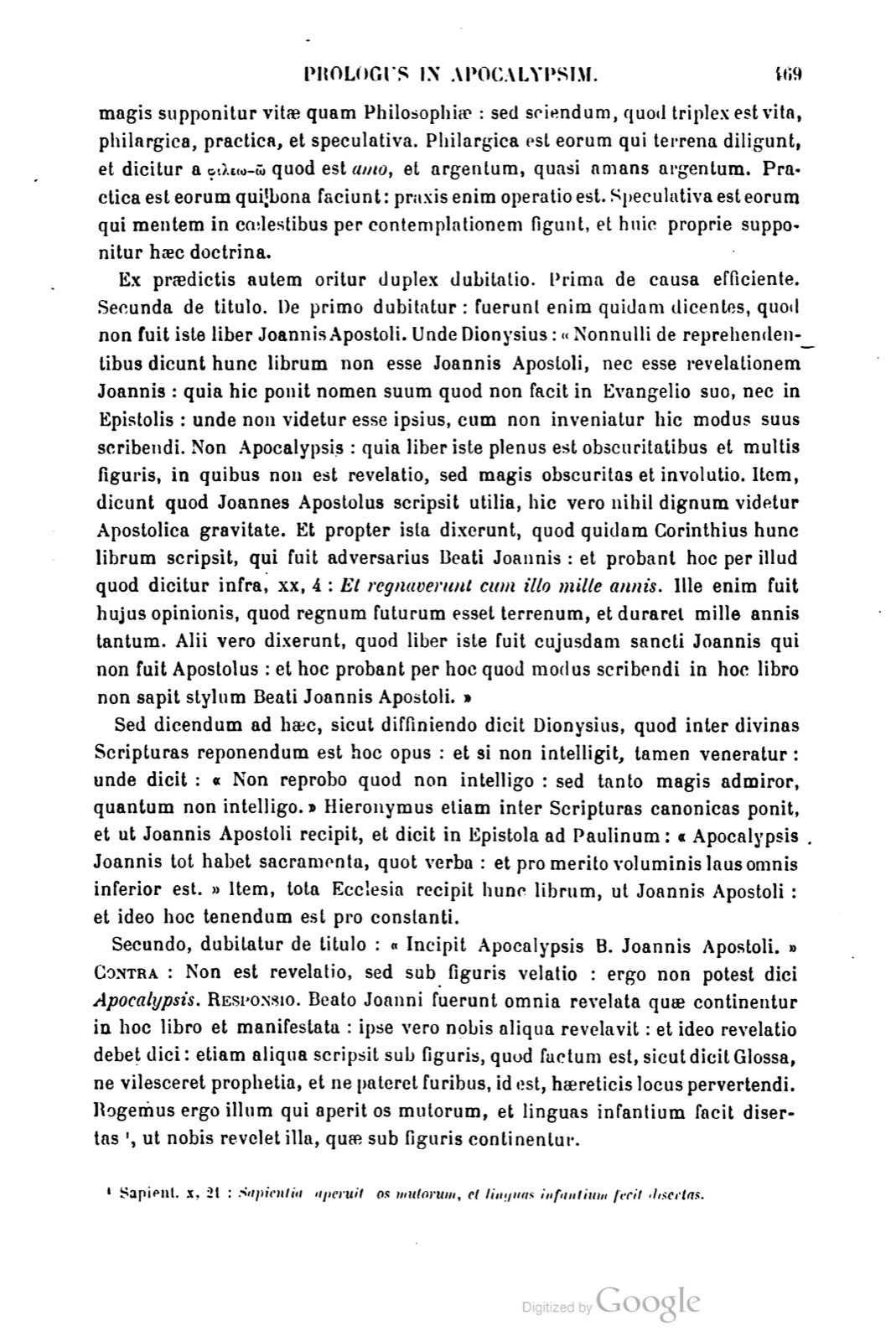
Ad id quod quaeritur, Cui parti Philosophiae supponatur? Dicendum, quod magis supponitur vitae quam Philosophiae: sed sciendum, quod triplex est vita, philargica, practica, et speculativa. Philargica est eorum qui terrena diligunt, et dicitur a phileo, quod est amo, et argentum, quasi amans argentum. Practica est eorum qui bona faciunt: praxis enim operatio est. Speculativa est eorum qui mentem in caelestibus per contemplationem figunt, et huic proprie supponitur haec doctrina.
It remains to see about the causes of this work, namely, what they are. Likewise, what is the title? Likewise, to what part of Philosophy is it subordinated?
To the first it must be said that the efficient cause moving and not moved was the whole Trinity revealing to Christ as man; and this is touched upon when it is said: "Father." The cause moving and moved was the man Christ, and the Angel, and John; and this is touched upon when it is said: "Lord of heaven and earth." In Lord Christ is understood; in heaven, the Angel; in earth, John the Apostle. The executing cause is John the Apostle, which is touched upon there: "I confess to you." The material cause is the heavenly sacraments, which is touched upon there: "These and those," that is, heavenly secrets. The formal cause, or the manner of proceeding, consists in hiding and revelation, which is touched upon there: "You have hidden." The final cause is when it is said: "To the wise and prudent, and to little ones," because this Apocalypse was written so that the wicked, who are the wise of the world, may be terrified, and the good, who are humble and little, may be consoled: so that the former may be punished, and the latter rewarded. The title is such: The Apocalypse of Jesus Christ, which God gave to him, etc., sending through his Angel to his servant John 3.
To that which is asked, To what part of Philosophy is it subordinated? it must be said that it is subordinated more to life than to Philosophy. But it must be known that life is threefold: money-loving, practical, and speculative. The money-loving life is that of those who love earthly things, and is said from phileo, which is I love, and silver, as if loving silver. The practical life is that of those who do good things; for praxis is operation. The speculative life is that of those who fix the mind on heavenly things through contemplation, and this doctrine is properly subordinated to this life.
Ex praedictis autem oritur duplex dubitatio. Prima de causa efficiente. Secunda de titulo. De primo dubitatur: fuerunt enim quidam dicentes, quod non fuit iste liber Joannis Apostoli. Unde Dionysius: "Nonnulli de reprehendentibus dicunt hunc librum non esse Joannis Apostoli, nec esse revelationem Joannis: quia hic ponit nomen suum quod non facit in Evangelio suo, nec in Epistolis: unde non videtur esse ipsius, cum non inveniatur hic modus suus scribendi. Non Apocalypsis: quia liber iste plenus est obscuritatibus et multis figuris, in quibus non est revelatio, sed magis obscuritas et involutio. Item, dicunt quod Joannes Apostolus scripsit utilia, hic vero nihil dignum videtur Apostolica gravitate. Et propter ista dixerunt, quod quidam Corinthius hunc librum scripsit, qui fuit adversarius Beati Joannis: et probant hoc per illud quod dicitur infra, XX, 4: Et regnaverunt cum illo mille annis. Ille enim fuit hujus opinionis, quod regnum futurum esset terrenum, et duraret mille annis tantum. Alii vero dixerunt, quod liber iste fuit cujusdam sancti Joannis qui non fuit Apostolus: et hoc probant per hoc quod modus scribendi in hoc libro non sapit stylum Beati Joannis Apostoli."
Sed dicendum ad haec, sicut diffiniendo dicit Dionysius, quod inter divinas Scripturas reponendum est hoc opus: et si non intelligit, tamen veneratur: unde dicit: "Non reprobo quod non intelligo: sed tanto magis admiror, quantum non intelligo." Hieronymus etiam inter Scripturas canonicas ponit, et ut Joannis Apostoli recipit, et dicit in Epistola ad Paulinum: "Apocalypsis Joannis tot habet sacramenta, quot verba: et pro merito voluminis laus omnis inferior est." Item, tota Ecclesia recipit hunc librum, ut Joannis Apostoli: et ideo hoc tenendum est pro constanti.
Secundo, dubitatur de titulo: "Incipit Apocalypsis B. Joannis Apostoli." Contra: Non est revelatio, sed sub figuris velatio: ergo non potest dici Apocalypsis. Responsio. Beato Joanni fuerunt omnia revelata quae continentur in hoc libro et manifestata: ipse vero nobis aliqua revelavit: et ideo revelatio debet dici: etiam aliqua scripsit sub figuris, quod factum est, sicut dicit Glossa, ne vilesceret prophetia, et ne pateret furibus, id est, haereticis locus pervertendi. Rogemus ergo illum qui aperit os mutorum, et linguas infantium facit disertas 4, ut nobis revelet illa, quae sub figuris continentur.
But from the aforesaid there arises a twofold doubt. The first is about the efficient cause. The second is about the title. Concerning the first it is doubted: for there were certain persons saying that this book was not by John the Apostle. Hence Dionysius says: "Some of those who criticize say that this book is not by John the Apostle, nor is it the revelation of John: because here he sets down his name, which he does not do in his Gospel, nor in the Epistles; hence it does not seem to be his, since this manner of writing is not found here to be his. It is not Apocalypse: because that book is full of obscurities and many figures, in which there is not revelation, but rather obscurity and envelopment. Likewise, they say that John the Apostle wrote useful things, but here nothing worthy of apostolic gravity seems to be present. And on account of these things they said that a certain Corinthian wrote this book, who was an adversary of Blessed John; and they prove this through that which is said below, XX, 4: And they reigned with him for a thousand years. For that man was of this opinion, that the future kingdom would be earthly, and would last only a thousand years. But others said that this book was by a certain holy John who was not an Apostle; and they prove this by this, that the manner of writing in this book does not savor of the style of Blessed John the Apostle."
But to these things it must be said, as Dionysius says by defining, that this work must be placed among the divine Scriptures; and if he does not understand it, nevertheless he venerates it; hence he says: "I do not reject what I do not understand; but I wonder at it the more, the more I do not understand it." Jerome also places it among the canonical Scriptures, receives it as of John the Apostle, and says in the Epistle to Paulinus: "The Apocalypse of John has as many sacraments as words; and for the merit of the volume every praise is lower than it." Likewise, the whole Church receives this book as of John the Apostle; and therefore this must be held as established.
Second, there is doubt about the title: "Here begins the Apocalypse of Blessed John the Apostle." On the contrary: it is not a revelation, but a veiling under figures; therefore it cannot be called Apocalypse. Response. To Blessed John all things that are contained in this book were revealed and manifested; but he revealed some things to us; and therefore it ought to be called revelation. He also wrote some things under figures, which was done, as the Gloss says, lest prophecy become cheap, and lest a place for perverting it lie open to thieves, that is, to heretics. Therefore let us ask him who opens the mouth of the mute and makes the tongues of infants eloquent 4, that he reveal to us those things which are contained under figures.
If a page does not appear, its photograph has not been uploaded yet.