Works › The Paradise of the Soul
Volume 37 · ≈ pp. 511–512
Chapter XLII. On Perseverance.
A marker with ≈ is an approximate page boundary, placed by measure of the text; the page photographs remain the authority. In the paired views, clicking a page marker brings that page into view.
Caput XLII.
De Perseverantia.
A. Perseverantia vera est in bonis operibus frequens exercitatio, continuum studium ad perfectionem, spiritualium gratiarum et virtutum diligentissima usque ad mortem observatio. Ad hanc invitat nos Dominus in Apocalypsi: Esto fidelis usque ad mortem, et dabo tibi coronam vitae 1. Hanc habuit Job, cum dixit: Donec deficiam, non recedam ab innocentia mea 2. Et Tobias, qui corpora mortuorum occultabat in domo sua, et mediis noctibus sepelivit: licet cum rex propter hoc spoliari jusserit et occidi 3.
B. Ad amorem perseverantiae inducere nos debet maxima utilitas ex ea proveniens. Nam ex ea omne opus bonum, et omnis virtus coronabitur, et tota salus nostra in ea consistit: secundum illud Domini nostri Jesu Christi: Qui perseveraverit usque ad finem, hic salvus erit 4. Sine qua nulla virtus vel opus remunerabile est. Sine qua omnis perfectio in nihilum redigitur. Quid enim profuit Apostolo et traditori Judae, quod ipsum Dominus de mundo elegerat? Quid profuit diuturnitas familiaritatis Jesu Christi? Quid sancta praedicatio quam saepe ab ipso audierat? Quid exempla, virtutes, et miracula, quae ab ipso viderat? Quid societas Apostolorum? Quid gratia ei collata ad praedicandum, et ad miracula faciendum? Nam ei cum aliis Apostolis dixit: Euntes praedicate, dicentes: Quia appropinquavit regnum coelorum. Infirmos curate, mortuos suscitate, leprosos mundate, daemones ejicite 5.
Chapter XLII.
On Perseverance.
A. True perseverance is frequent exercise in good works, continual zeal toward perfection, and most diligent observance of spiritual graces and virtues until death. The Lord invites us to this in the Apocalypse: Be faithful until death, and I will give you the crown of life 1. Job had this when he said: Until I fail, I will not withdraw from my innocence 2. And Tobias, who hid the bodies of the dead in his house and buried them in the middle of the nights, although because of this the king ordered him to be despoiled and killed 3.
B. The greatest usefulness arising from it ought to induce us to love of perseverance. For from it every good work and every virtue will be crowned, and our whole salvation consists in it, according to that saying of our Lord Jesus Christ: He who perseveres until the end will be saved 4. Without it no virtue or work is rewardable. Without it every perfection is reduced to nothing. For what did it profit the Apostle and traitor Judas that the Lord had chosen him from the world? What did the long duration of familiarity with Jesus Christ profit? What did the holy preaching that he had often heard from him profit? What did the examples, virtues, and miracles that he had seen from him profit? What did the fellowship of the Apostles profit? What did the grace conferred on him for preaching and for doing miracles profit? For to him with the other Apostles he said: Going, preach, saying: The kingdom of heaven has drawn near. Heal the sick, raise the dead, cleanse lepers, cast out demons 5.
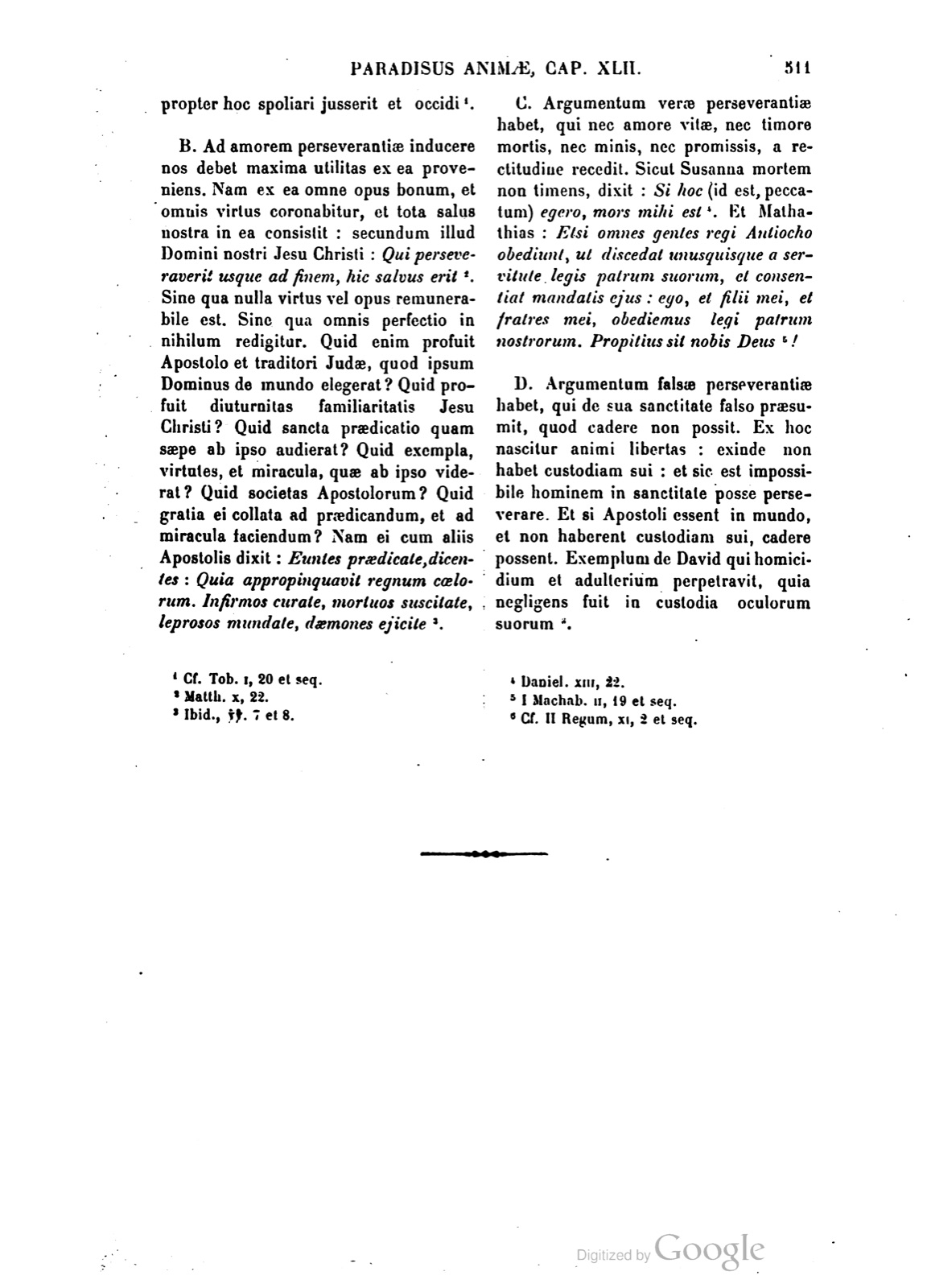
C. Argumentum verae perseverantiae habet, qui nec amore vitae, nec timore mortis, nec minis, nec promissis, a rectitudine recedit. Sicut Susanna mortem non timens, dixit: Si hoc, id est, peccatum, egero, mors mihi est 6. Et Mathathias: Etsi omnes gentes regi Antiocho obediunt, ut discedat unusquisque a servitute legis patrum suorum, et consentiat mandatis ejus: ego, et filii mei, et fratres mei, obediemus legi patrum nostrorum. Propitius sit nobis Deus 7!
D. Argumentum falsae perseverantiae habet, qui de sua sanctitate falso praesumit, quod cadere non possit. Ex hoc nascitur animi libertas: exinde non habet custodiam sui: et sic est impossibile hominem in sanctitate posse perseverare. Et si Apostoli essent in mundo, et non haberent custodiam sui, cadere possent. Exemplum de David qui homicidium et adulterium perpetravit, quia negligens fuit in custodia oculorum suorum 8.
C. He has the proof of true perseverance who withdraws from rectitude neither by love of life, nor by fear of death, nor by threats, nor by promises. Thus Susanna, not fearing death, said: If I do this, that is, sin, it is death for me 6. And Mattathias said: Even if all nations obey King Antiochus, so that each may depart from the service of the law of his fathers and consent to his commands, I and my sons and my brothers will obey the law of our fathers. May God be propitious to us 7!
D. He has the proof of false perseverance who falsely presumes concerning his holiness that he cannot fall. From this liberty of spirit is born; from there he has no guarding of himself; and thus it is impossible for a human being to be able to persevere in holiness. And if the Apostles were in the world and did not have guarding of themselves, they could fall. The example is David, who perpetrated homicide and adultery because he was negligent in guarding his eyes 8.
Notes
- Apocalypse 2:10. (Apocal. II, 10.) ↩
- Job 27:3. (Job XXVII, 3.) ↩
- Compare Tobit 1:20 and following. (Cf. Tob. I, 20 et seq.) ↩
- Matthew 10:22. (Matth. X, 22.) ↩
- The same, verses 7 and 8. (Ibid., v. 7 et 8.) ↩
- Daniel 13:22. (Daniel XIII, 22.) ↩
- 1 Maccabees 2:19 and following. (I Machab. II, 19 et seq.) ↩
- Compare 2 Kings 11:2 and following. (Cf. II Regum, XI, 2 et seq.) ↩
If a page does not appear, its photograph has not been uploaded yet.