Works › The Paradise of the Soul
Volume 37 · ≈ p. 512
Epilogue
A marker with ≈ is an approximate page boundary, placed by measure of the text; the page photographs remain the authority. In the paired views, clicking a page marker brings that page into view.
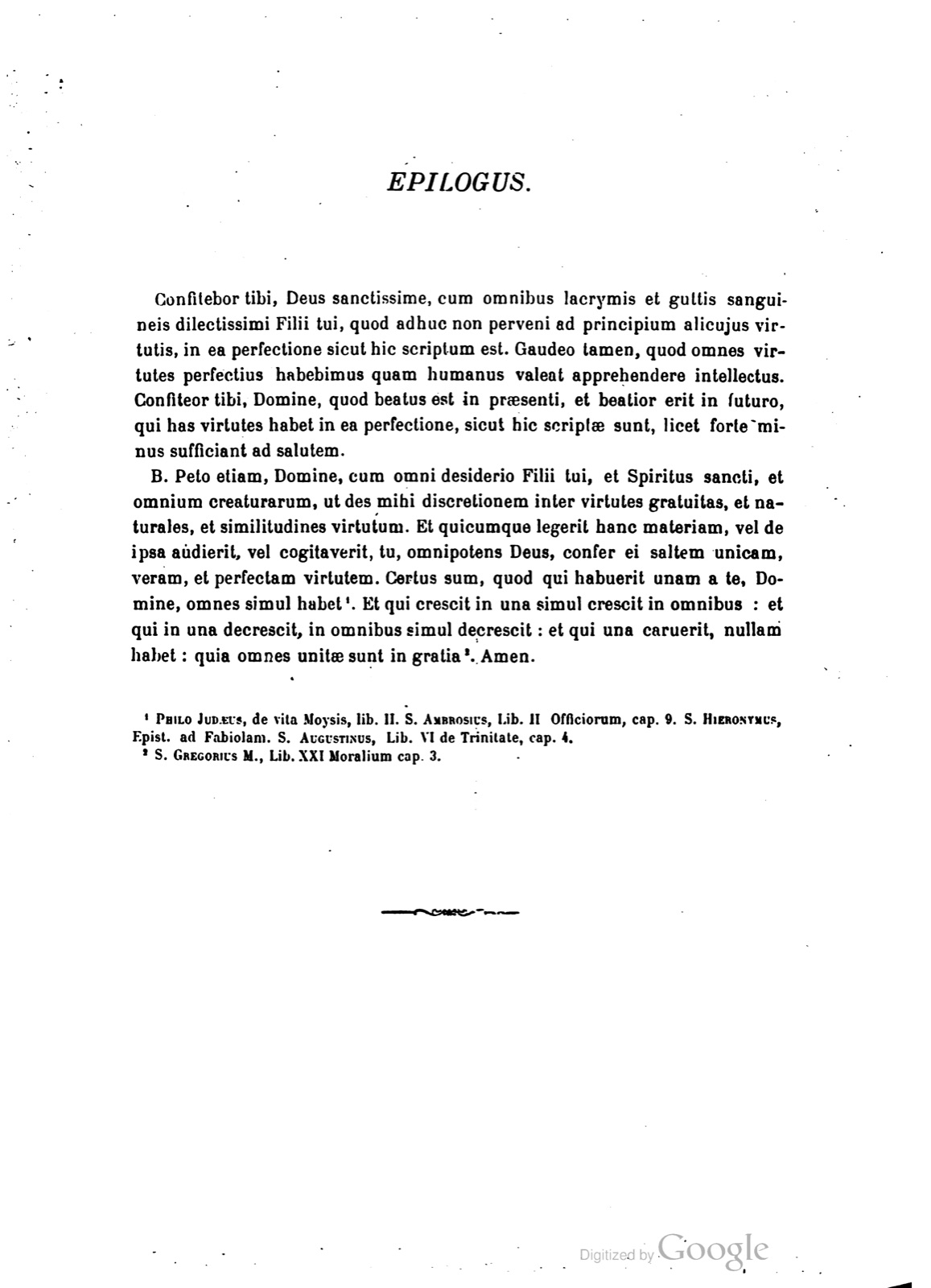
Epilogus.
A. Confitebor tibi, Deus sanctissime, cum omnibus lacrymis et guttis sanguineis dilectissimi Filii tui, quod adhuc non perveni ad principium alicujus virtutis, in ea perfectione sicut hic scriptum est. Gaudeo tamen, quod omnes virtutes perfectius habebimus quam humanus valeat apprehendere intellectus. Confiteor tibi, Domine, quod beatus est in praesenti, et beatior erit in futuro, qui has virtutes habet in ea perfectione, sicut hic scriptae sunt, licet forte minus sufficiant ad salutem.
B. Peto etiam, Domine, cum omni desiderio Filii tui, et Spiritus sancti, et omnium creaturarum, ut des mihi discretionem inter virtutes gratuitas, et naturales, et similitudines virtutum. Et quicumque legerit hanc materiam, vel de ipsa audierit, vel cogitaverit, tu, omnipotens Deus, confer ei saltem unicam, veram, et perfectam virtutem. Certus sum, quod qui habuerit unam a te, Domine, omnes simul habet 1. Et qui crescit in una simul crescit in omnibus: et qui in una decrescit, in omnibus simul decrescit: et qui una caruerit, nullam habet: quia omnes unitae sunt in gratia 2. Amen.
Epilogue.
A. I confess to you, most holy God, with all the tears and bloody drops of your most beloved Son, that I have not yet arrived at the beginning of any virtue in that perfection as it is written here. Nevertheless I rejoice that we will have all virtues more perfectly than human understanding is able to apprehend. I confess to you, Lord, that he is blessed in the present and will be more blessed in the future who has these virtues in that perfection as they are written here, although perhaps they suffice for salvation in a lesser degree.
B. I also ask, Lord, with every desire of your Son, and of the Holy Spirit, and of all creatures, that you give me discretion between gratuitous and natural virtues and likenesses of virtues. And whoever reads this material, or hears of it, or thinks about it, may you, almighty God, confer on him at least one single, true, and perfect virtue. I am certain that whoever has one from you, Lord, has all at the same time 1. And whoever grows in one grows in all at the same time; and whoever decreases in one decreases in all at the same time; and whoever lacks one has none, because all are united in grace 2. Amen.
Notes
- Philo Judaeus, On the Life of Moses, Book 2. St. Ambrose, On Duties, Book 2, chapter 9. St. Jerome, Letter to Fabiola. St. Augustine, On the Trinity, Book 6, chapter 4. (Philo Judaeus, de vita Moysis, lib. II. S. Ambrosius, Lib. II Officiorum, cap. 9. S. Hieronymus, Epist. ad Fabiolam. S. Augustinus, Lib. VI de Trinitate, cap. 4.) ↩
- St. Gregory the Great, Moralia, Book 21, chapter 3. (S. Gregorius M., Lib. XXI Moralium cap. 3.) ↩
If a page does not appear, its photograph has not been uploaded yet.