Works › The Paradise of the Soul
Volume 37 · ≈ pp. 508–509
Chapter XL. On Confession.
A marker with ≈ is an approximate page boundary, placed by measure of the text; the page photographs remain the authority. In the paired views, clicking a page marker brings that page into view.
Caput XL.
De Confessione.
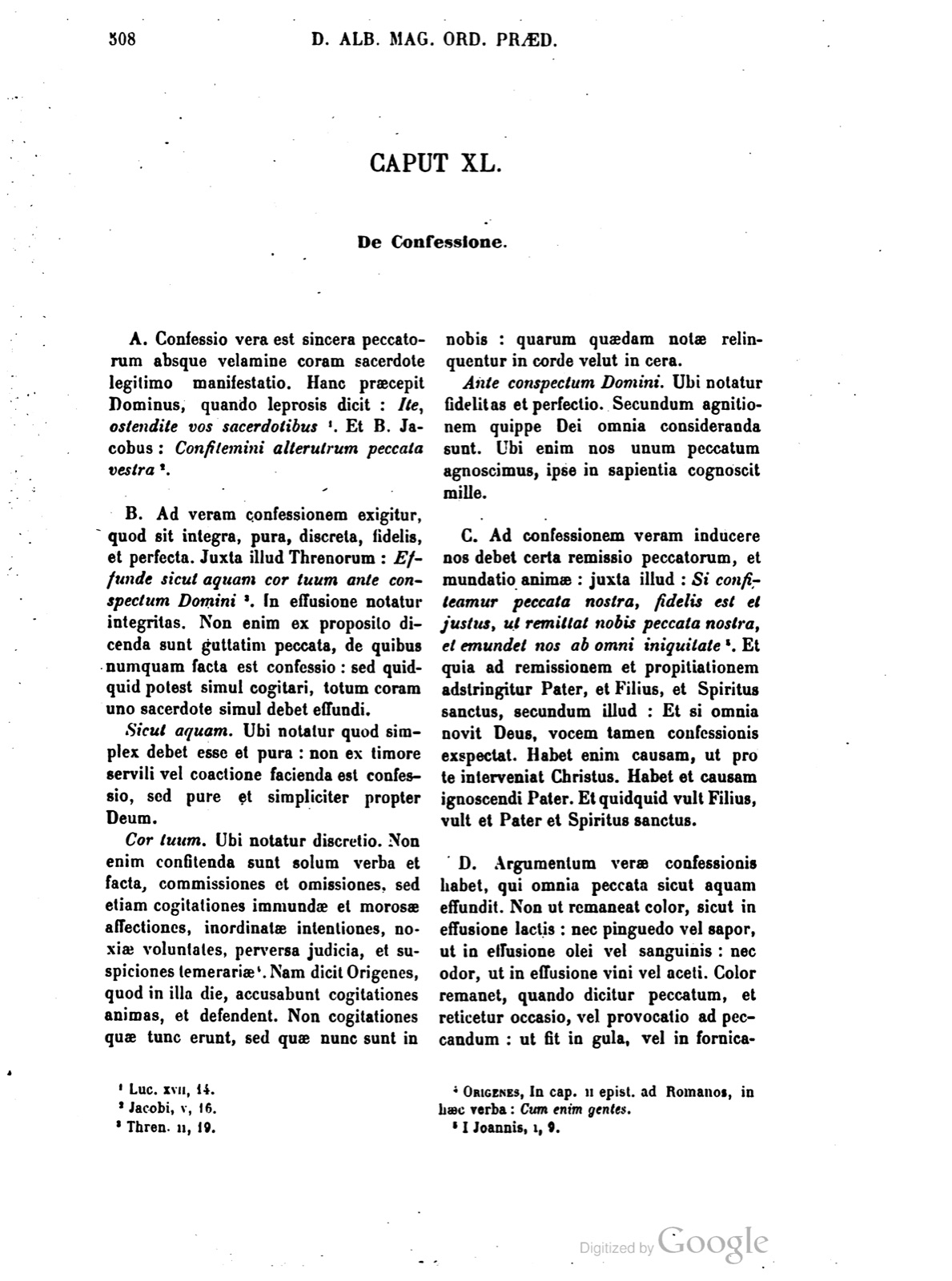
A. Confessio vera est sincera peccatorum absque velamine coram sacerdote legitimo manifestatio. Hanc praecepit Dominus, quando leprosis dicit: Ite, ostendite vos sacerdotibus 1. Et B. Jacobus: Confitemini alterutrum peccata vestra 2.
B. Ad veram confessionem exigitur, quod sit integra, pura, discreta, fidelis, et perfecta. Juxta illud Threnorum: Effunde sicut aquam cor tuum ante conspectum Domini 3. In effusione notatur integritas. Non enim ex proposito dicenda sunt guttatim peccata, de quibus numquam facta est confessio: sed quidquid potest simul cogitari, totum coram uno sacerdote simul debet effundi.
Sicut aquam. Ubi notatur quod simplex debet esse et pura: non ex timore servili vel coactione facienda est confessio, sed pure et simpliciter propter Deum.
Cor tuum. Ubi notatur discretio. Non enim confitenda sunt solum verba et facta, commissiones et omissiones, sed etiam cogitationes immundae et morosae affectiones, inordinatae intentiones, noxiae voluntates, perversa judicia, et suspiciones temerariae. Nam dicit Origenes, quod in illa die, accusabunt cogitationes animas, et defendent. Non cogitationes quae tunc erunt, sed quae nunc sunt in nobis: quarum quaedam notae relinquentur in corde velut in cera 4.
Ante conspectum Domini. Ubi notatur fidelitas et perfectio. Secundum agnitionem quippe Dei omnia consideranda sunt. Ubi enim nos unum peccatum agnoscimus, ipse in sapientia cognoscit mille.
C. Ad confessionem veram inducere nos debet certa remissio peccatorum, et mundatio animae: juxta illud: Si confiteamur peccata nostra, fidelis est et justus, ut remittat nobis peccata nostra, et emundet nos ab omni iniquitate 5. Et quia ad remissionem et propitiationem adstringitur Pater, et Filius, et Spiritus sanctus, secundum illud: Et si omnia novit Deus, vocem tamen confessionis exspectat. Habet enim causam, ut pro te interveniat Christus. Habet et causam ignoscendi Pater. Et quidquid vult Filius, vult et Pater et Spiritus sanctus.
Chapter XL.
On Confession.
A. True confession is the sincere manifestation of sins without covering before a legitimate priest. The Lord commanded this when he says to the lepers: Go, show yourselves to the priests 1. And blessed James says: Confess your sins to one another 2.
B. For true confession it is required that it be whole, pure, discreet, faithful, and perfect, according to that saying of Lamentations: Pour out your heart like water before the sight of the Lord 3. In pouring out, integrity is marked. For sins about which confession has never been made are not to be said by drops on purpose, but whatever can be thought together ought all at once to be poured out together before one priest.
Like water. There it is marked that it ought to be simple and pure: confession is not to be made from servile fear or compulsion, but purely and simply because of God.
Your heart. There discretion is marked. For not only words and deeds, commissions and omissions, are to be confessed, but also unclean thoughts and lingering affections, disordered intentions, harmful wills, perverse judgments, and rash suspicions. For Origen says that on that day thoughts will accuse souls and will defend them; not thoughts that will then exist, but those that are now in us, certain marks of which will be left in the heart as in wax 4.
Before the sight of the Lord. There faithfulness and perfection are marked. Indeed all things must be considered according to the knowledge of God. For where we recognize one sin, he in wisdom knows a thousand.
C. Certain remission of sins and cleansing of the soul ought to induce us to true confession, according to that saying: If we confess our sins, he is faithful and just, so that he may remit our sins for us and cleanse us from every iniquity 5. And because the Father, Son, and Holy Spirit are bound to remission and propitiation, according to that saying: And although God knows all things, nevertheless he awaits the voice of confession. For Christ has a cause to intercede for you. And the Father has a cause for forgiving. And whatever the Son wills, the Father and Holy Spirit also will.
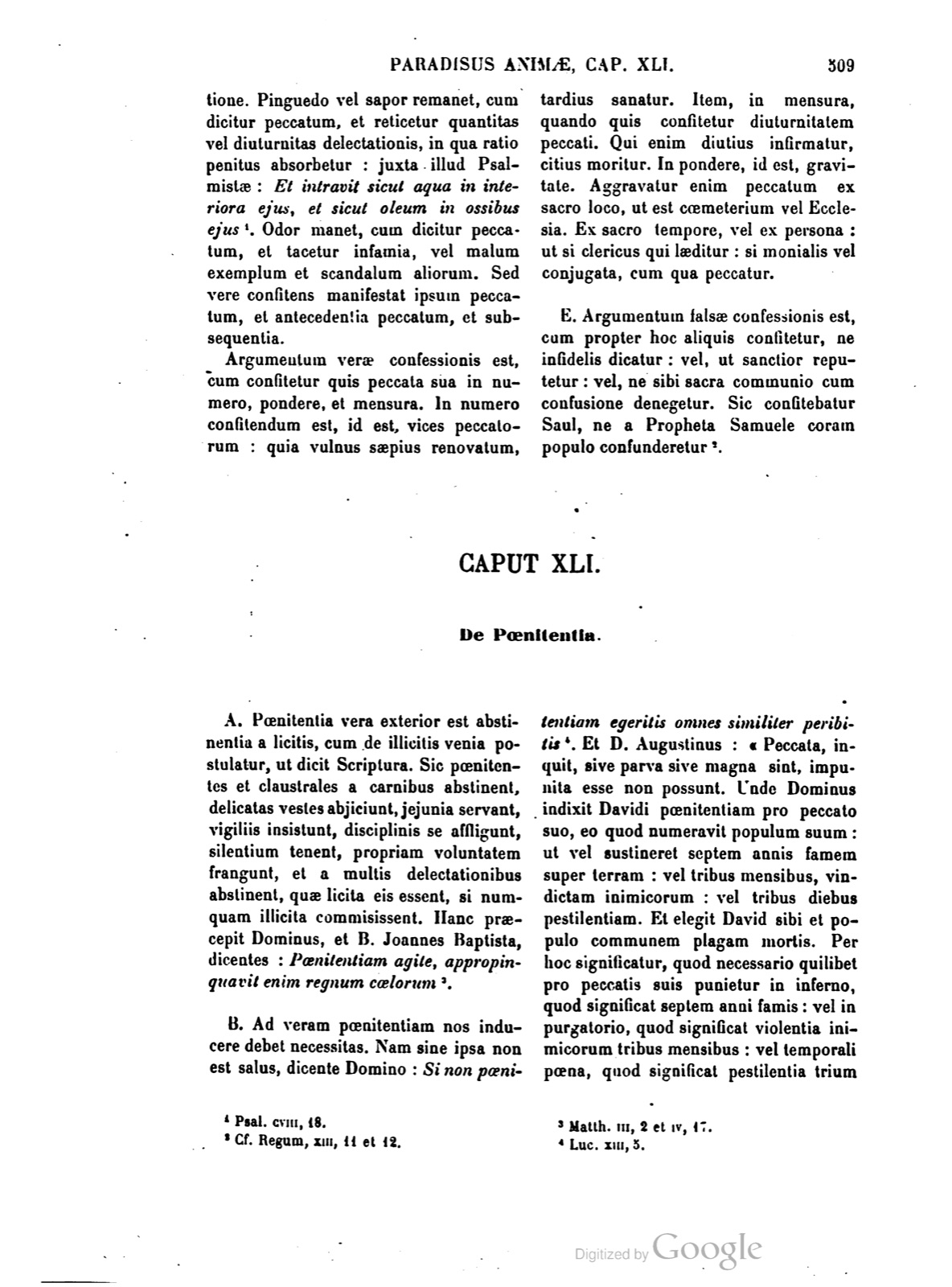
D. Argumentum verae confessionis habet, qui omnia peccata sicut aquam effundit. Non ut remaneat color, sicut in effusione lactis: nec pinguedo vel sapor, ut in effusione olei vel sanguinis: nec odor, ut in effusione vini vel aceti. Color remanet, quando dicitur peccatum, et reticetur occasio, vel provocatio ad peccandum: ut fit in gula, vel in fornicatione. Pinguedo vel sapor remanet, cum dicitur peccatum, et reticetur quantitas vel diuturnitas delectationis, in qua ratio penitus absorbetur: juxta illud Psalmistae: Et intravit sicut aqua in interiora ejus, et sicut oleum in ossibus ejus 6. Odor manet, cum dicitur peccatum, et tacetur infamia, vel malum exemplum et scandalum aliorum. Sed vere confitens manifestat ipsum peccatum, et antecedentia peccatum, et subsequentia.
Argumentum verae confessionis est, cum confitetur quis peccata sua in numero, pondere, et mensura. In numero confitendum est, id est, vices peccatorum: quia vulnus saepius renovatum, tardius sanatur. Item, in mensura, quando quis confitetur diuturnitatem peccati. Qui enim diutius infirmatur, citius moritur. In pondere, id est, gravitate. Aggravatur enim peccatum ex sacro loco, ut est coemeterium vel Ecclesia. Ex sacro tempore, vel ex persona: ut si clericus qui laeditur: si monialis vel conjugata, cum qua peccatur.
E. Argumentum falsae confessionis est, cum propter hoc aliquis confitetur, ne infidelis dicatur: vel, ut sanctior reputetur: vel, ne sibi sacra communio cum confusione denegetur. Sic confitebatur Saul, ne a Propheta Samuele coram populo confunderetur 7.
D. He has the proof of true confession who pours out all sins like water: not so that color remains, as in the pouring out of milk; nor fatness or taste, as in the pouring out of oil or blood; nor smell, as in the pouring out of wine or vinegar. Color remains when the sin is said and the occasion or provocation to sinning is kept silent, as happens in gluttony or fornication. Fatness or taste remains when the sin is said and the quantity or length of delight, in which reason is wholly absorbed, is kept silent, according to that saying of the Psalmist: And it entered like water into his inward parts, and like oil into his bones 6. Smell remains when the sin is said and infamy, or evil example and scandal of others, is kept silent. But one truly confessing manifests the sin itself, and the things preceding the sin, and the things following it.
The proof of true confession is when someone confesses his sins in number, weight, and measure. It must be confessed in number, that is, the times of sins, because a wound renewed more often is healed more slowly. Likewise in measure, when someone confesses the length of the sin; for one who is sick longer dies more quickly. In weight, that is, in gravity. For sin is aggravated by a sacred place, such as a cemetery or church; by a sacred time; or by a person, as if the one harmed is a cleric, or if she with whom sin is committed is a nun or married woman.
E. The proof of false confession is when someone confesses for this reason, lest he be called unfaithful; or so that he may be reckoned holier; or lest holy communion be denied to him with confusion. Saul confessed in this way, lest he be confounded by the Prophet Samuel before the people 7.
Notes
- Luke 17:14. (Luc. XVII, 14.) ↩
- James 5:16. (Jacobi V, 16.) ↩
- Lamentations 2:19. (Thren. II, 19.) ↩
- Origen, On chapter 2 of the Epistle to the Romans, on these words: For when the gentiles. (Origenes, In cap. II epist. ad Romanos, in haec verba: Cum enim gentes.) ↩
- 1 John 1:9. (I Joannis I, 9.) ↩
- Psalm 108:18. (Psal. CVIII, 18.) ↩
- Compare 1 Kings 15:11 and 12. (Cf. I Regum, XV, 11 et 12.) ↩
If a page does not appear, its photograph has not been uploaded yet.