Works › The Paradise of the Soul
Volume 37 · ≈ pp. 506–508
Chapter XXXIX. On Contrition.
A marker with ≈ is an approximate page boundary, placed by measure of the text; the page photographs remain the authority. In the paired views, clicking a page marker brings that page into view.
Caput XXXIX.
De Contritione.
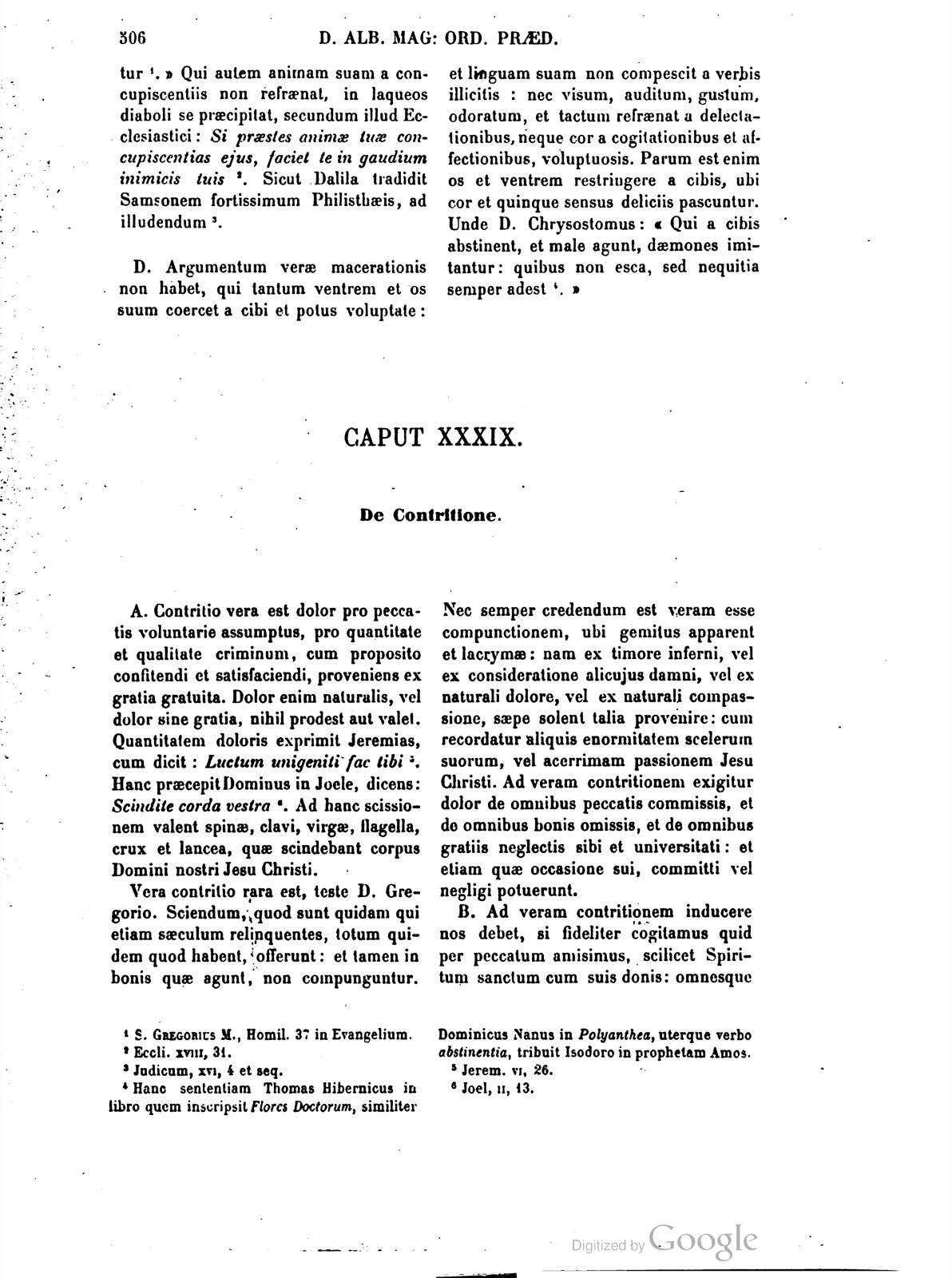
A. Contritio vera est dolor pro peccatis voluntarie assumptus, pro quantitate et qualitate criminum, cum proposito confitendi et satisfaciendi, proveniens ex gratia gratuita. Dolor enim naturalis, vel dolor sine gratia, nihil prodest aut valet. Quantitatem doloris exprimit Jeremias, cum dicit: Luctum unigeniti fac tibi 9. Hanc praecepit Dominus in Joele, dicens: Scindite corda vestra 10. Ad hanc scissionem valent spinae, clavi, virgae, flagella, crux et lancea, quae scindebant corpus Domini nostri Jesu Christi.
Vera contritio rara est, teste D. Gregorio. Sciendum, quod sunt quidam qui etiam saeculum relinquentes, totum quidem quod habent, offerunt: et tamen in bonis quae agunt, non compunguntur. Nec semper credendum est veram esse compunctionem, ubi gemitus apparent et lacrymae: nam ex timore inferni, vel ex consideratione alicujus damni, vel ex naturali dolore, vel ex naturali compassione, saepe solent talia provenire: cum recordatur aliquis enormitatem scelerum suorum, vel acerrimam passionem Jesu Christi. Ad veram contritionem exigitur dolor de omnibus peccatis commissis, et de omnibus bonis omissis, et de omnibus gratiis neglectis sibi et universitati: et etiam quae occasione sui, committi vel negligi potuerunt.
B. Ad veram contritionem inducere nos debet, si fideliter cogitamus quid per peccatum amisimus, scilicet Spiritum sanctum cum suis donis: omnesque
Chapter XXXIX.
On Contrition.
A. True contrition is sorrow for sins voluntarily assumed, according to the quantity and quality of crimes, with a purpose of confessing and making satisfaction, coming from gratuitous grace. For natural sorrow, or sorrow without grace, profits or avails nothing. Jeremiah expresses the quantity of sorrow when he says: Make mourning for yourself as for an only-begotten 9. The Lord commanded this in Joel, saying: Rend your hearts 10. Thorns, nails, rods, scourges, the cross, and the lance, which were rending the body of our Lord Jesus Christ, avail for this rending.
True contrition is rare, as St. Gregory testifies. It must be known that there are some who, even leaving the age, indeed offer all that they have, and yet in the goods that they do they are not pierced with compunction. Nor must it always be believed that compunction is true where groans and tears appear, for such things often are accustomed to come from fear of hell, or from consideration of some loss, or from natural sorrow, or from natural compassion, when someone recalls the enormity of his crimes or the most bitter passion of Jesus Christ. For true contrition sorrow is required concerning all sins committed, and concerning all good things omitted, and concerning all graces neglected toward oneself and the whole community, and also concerning those things which on one's occasion could have been committed or neglected.
B. This ought to induce us to true contrition, if we faithfully think what we have lost through sin, namely the Holy Spirit with his gifts, and all
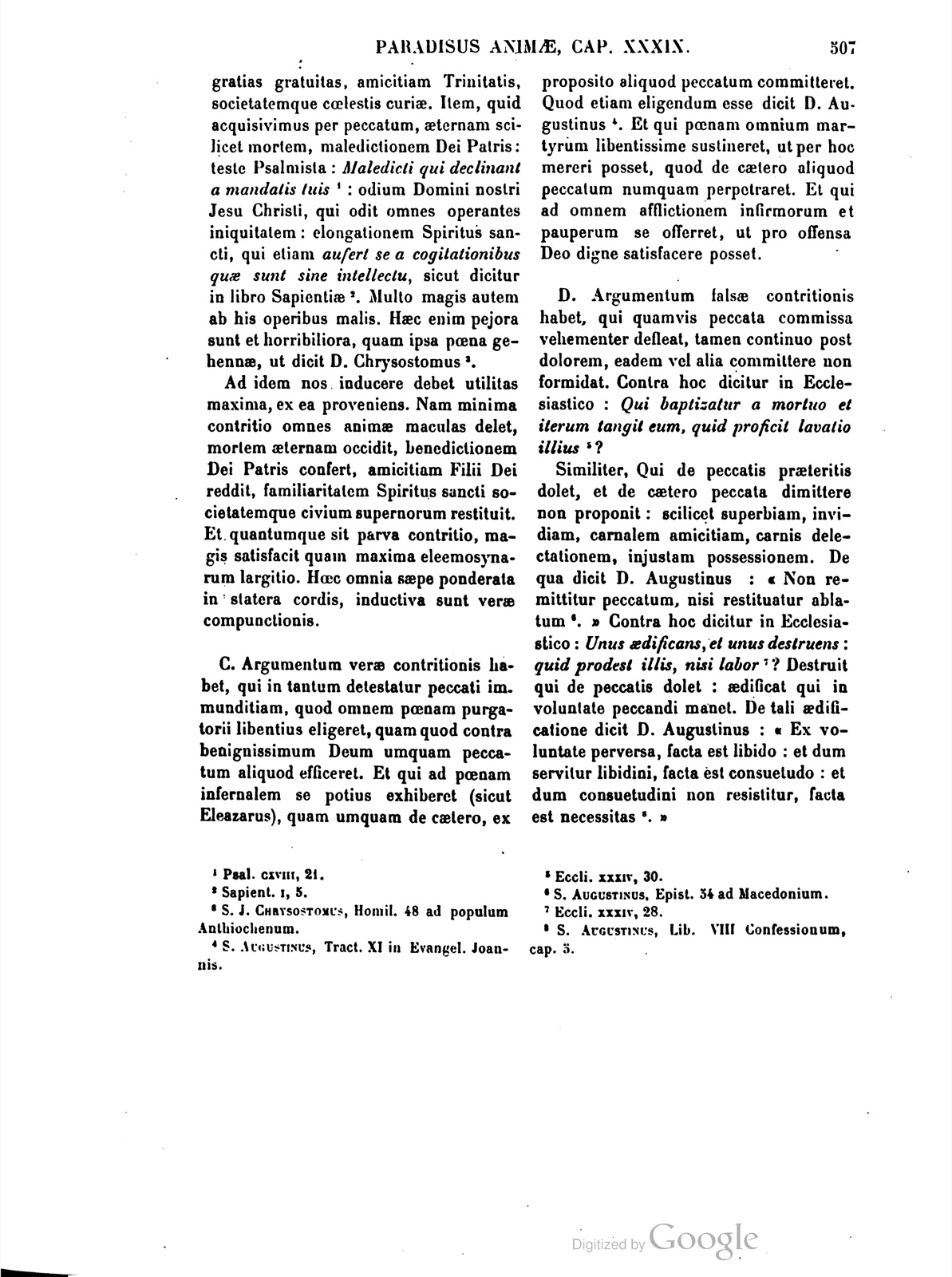
B. Ad veram contritionem inducere nos debet, si fideliter cogitamus quid per peccatum amisimus, scilicet Spiritum sanctum cum suis donis: omnesque gratias gratuitas, amicitiam Trinitatis, societatemque coelestis curiae. Item, quid acquisivimus per peccatum, aeternam scilicet mortem, maledictionem Dei Patris: teste Psalmista: Maledicti qui declinant a mandatis tuis 11: odium Domini nostri Jesu Christi, qui odit omnes operantes iniquitatem: elongationem Spiritus sancti, qui etiam aufert se a cogitationibus quae sunt sine intellectu, sicut dicitur in libro Sapientiae 12. Multo magis autem ab his operibus malis. Haec enim pejora sunt et horribiliora, quam ipsa poena gehennae, ut dicit D. Chrysostomus 13.
Ad idem nos inducere debet utilitas maxima, ex ea proveniens. Nam minima contritio omnes animae maculas delet, mortem aeternam occidit, benedictionem Dei Patris confert, amicitiam Filii Dei reddit, familiaritatem Spiritus sancti societatemque civium supernorum restituit. Et quantumque sit parva contritio, magis satisfacit quam maxima eleemosynarum largitio. Haec omnia saepe ponderata in statera cordis, inductiva sunt verae compunctionis.
C. Argumentum verae contritionis habet, qui in tantum detestatur peccati immunditiam, quod omnem poenam purgatorii libentius eligeret, quam quod contra benignissimum Deum umquam peccatum aliquod efficeret. Et qui ad poenam infernalem se potius exhiberet, sicut Eleazarus, quam umquam de caetero, ex proposito aliquod peccatum committeret. Quod etiam eligendum esse dicit D. Augustinus 14. Et qui poenam omnium martyrum libentissime sustineret, ut per hoc mereri posset, quod de caetero aliquod peccatum numquam perpetraret. Et qui ad omnem afflictionem infirmorum et pauperum se offerret, ut pro offensa Deo digne satisfacere posset.
B. This ought to induce us to true contrition, if we faithfully think what we have lost through sin, namely the Holy Spirit with his gifts, and all gratuitous graces, the friendship of the Trinity, and the fellowship of the heavenly court. Likewise, what we have acquired through sin, namely eternal death, the curse of God the Father; the Psalmist testifies: Cursed are those who turn aside from your commandments 11; the hatred of our Lord Jesus Christ, who hates all workers of iniquity; distancing from the Holy Spirit, who even takes himself away from thoughts that are without understanding, as is said in the book of Wisdom 12, and much more from these evil works. For these things are worse and more horrible than the very punishment of hell, as St. Chrysostom says 13.
The greatest usefulness arising from it ought to induce us to the same. For the least contrition wipes away all stains of the soul, kills eternal death, confers the blessing of God the Father, returns the friendship of the Son of God, and restores familiarity with the Holy Spirit and the fellowship of the citizens above. And however small contrition may be, it satisfies more than the greatest giving of alms. All these things, often weighed in the scales of the heart, are inducements of true compunction.
C. He has the proof of true contrition who detests the uncleanness of sin so much that he would more gladly choose every punishment of purgatory than ever bring about any sin against the most benign God. And who would rather present himself to infernal punishment, like Eleazarus, than ever thereafter commit any sin by intention. St. Augustine says that this too is to be chosen 14. And who would most gladly endure the punishment of all martyrs, so that through this he could merit never thereafter to perpetrate any sin. And who would offer himself to every affliction of the sick and poor, so that he could worthily satisfy God for offense.
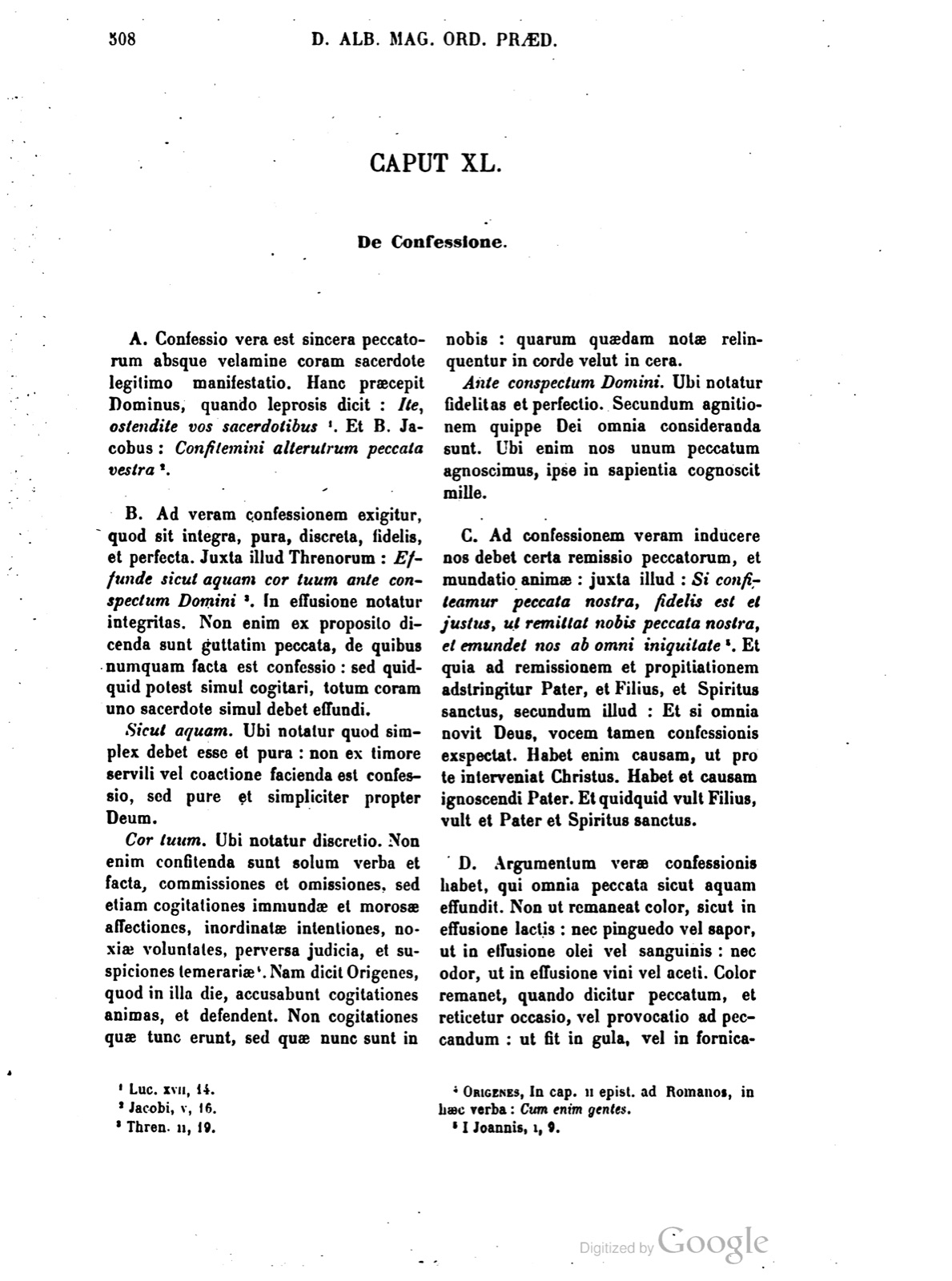
D. Argumentum falsae contritionis habet, qui quamvis peccata commissa vehementer defleat, tamen continuo post dolorem, eadem vel alia committere non formidat. Contra hoc dicitur in Ecclesiastico: Qui baptizatur a mortuo et iterum tangit eum, quid proficit lavatio illius 15?
Similiter, Qui de peccatis praeteritis dolet, et de caetero peccata dimittere non proponit: scilicet superbiam, invidiam, carnalem amicitiam, carnis delectationem, injustam possessionem. De qua dicit D. Augustinus: "Non remittitur peccatum, nisi restituatur ablatum 16." Contra hoc dicitur in Ecclesiastico: Unus aedificans, et unus destruens: quid prodest illis, nisi labor 17? Destruit qui de peccatis dolet: aedificat qui in voluntate peccandi manet. De tali aedificatione dicit D. Augustinus: "Ex voluntate perversa, facta est libido: et dum servitur libidini, facta est consuetudo: et dum consuetudini non resistitur, facta est necessitas 18."
D. He has the proof of false contrition who, although he vehemently weeps over committed sins, nevertheless immediately after the sorrow does not fear to commit the same or other sins. Against this it is said in Ecclesiasticus: He who is baptized by a dead man and again touches him, what does his washing profit 15?
Similarly, he who grieves over past sins and does not intend to dismiss sins thereafter, namely pride, envy, carnal friendship, delight of the flesh, unjust possession. Concerning this St. Augustine says: "The sin is not remitted unless what was taken away is restored 16." Against this it is said in Ecclesiasticus: One building and one destroying: what profits them, except labor 17? He destroys who grieves over sins; he builds who remains in the will of sinning. Concerning such building St. Augustine says: "From a perverse will, lust was made; and while lust is served, custom was made; and while custom is not resisted, necessity was made 18."
Notes
- Ecclesiasticus 20:7. (Eccli. XX, 7.) ↩
- Proverbs 18:13. (Proverb. XVIII, 13.) ↩
- Ecclesiasticus 32:10. (Eccli. XXXII, 10.) ↩
- Proverbs 17:28. (Proverb. XVII, 28.) ↩
- Isaiah 2:10. (Isa. II, 10.) ↩
- Compare Exodus 34:28 and following. (Cf. Exod. XXXIV, 28 et seq.) ↩
- Luke 22:41. (Luc. XXII, 41.) ↩
- Luke 19:2. (Luc. XIX, 2.) ↩
- Jeremiah 6:26. (Jerem. VI, 26.) ↩
- Joel 2:13. (Joel II, 13.) ↩
- Psalm 118:21. (Psal. CXVIII, 21.) ↩
- Wisdom 1:5. (Sapient. I, 5.) ↩
- St. John Chrysostom, Homily 48 to the people of Antioch. (S. J. Chrysostomus, Homil. 48 ad populum Antiochenum.) ↩
- St. Augustine, Tractate 11 on the Gospel of John. (S. Augustinus, Tract. XI in Evangel. Joannis.) ↩
- Ecclesiasticus 34:30. (Eccli. XXXIV, 30.) ↩
- St. Augustine, Letter 54 to Macedonius. (S. Augustinus, Epist. 54 ad Macedonium.) ↩
- Ecclesiasticus 34:28. (Eccli. XXXIV, 28.) ↩
- St. Augustine, Confessions, Book 8, chapter 3. (S. Augustinus, Lib. VIII Confessionum, cap. 3.) ↩
If a page does not appear, its photograph has not been uploaded yet.