Works › The Paradise of the Soul
Volume 37 · ≈ pp. 498–500
Chapter XXXIV. On Discretion.
A marker with ≈ is an approximate page boundary, placed by measure of the text; the page photographs remain the authority. In the paired views, clicking a page marker brings that page into view.
Caput XXXIV.
De Discretione.
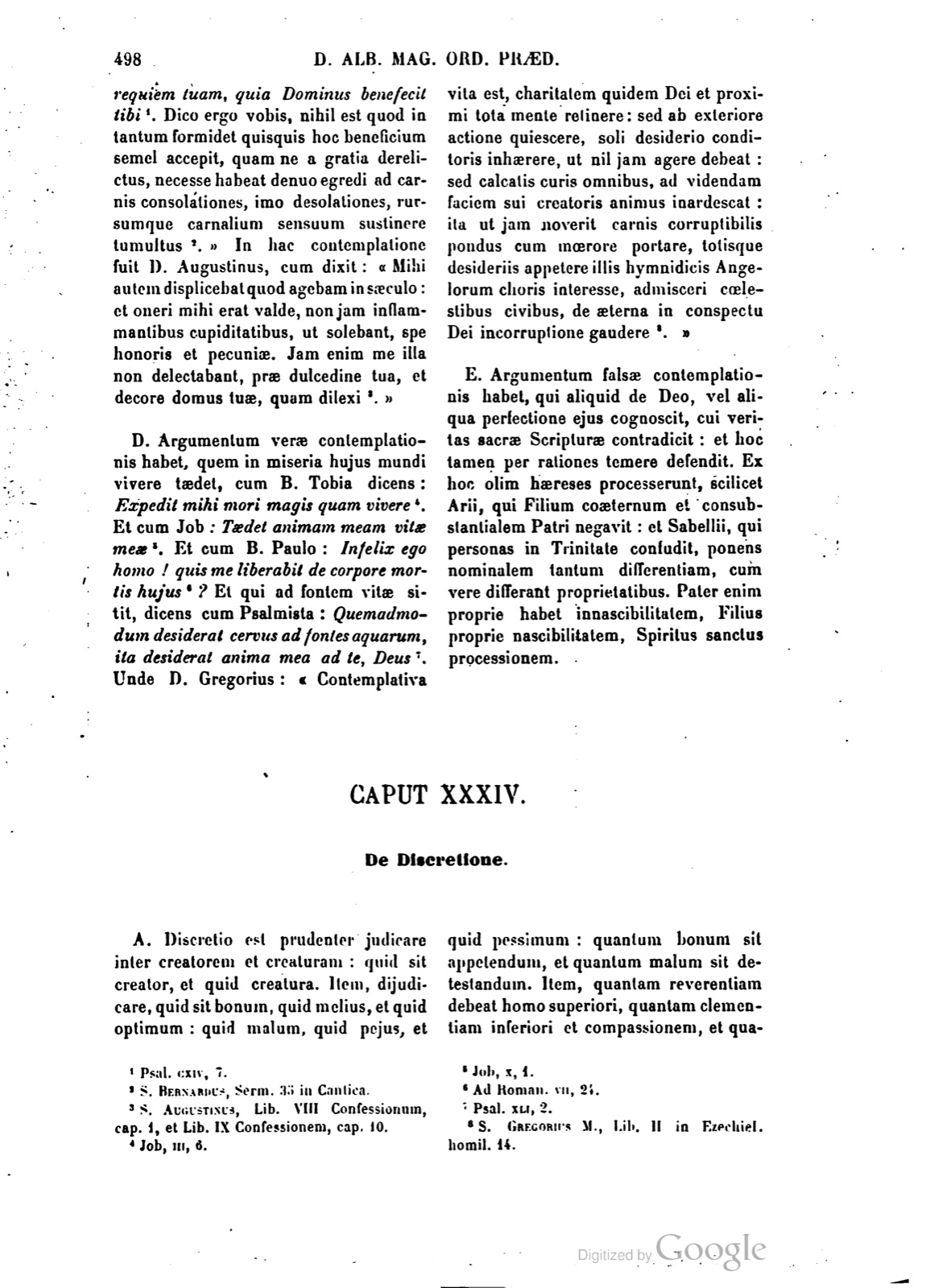
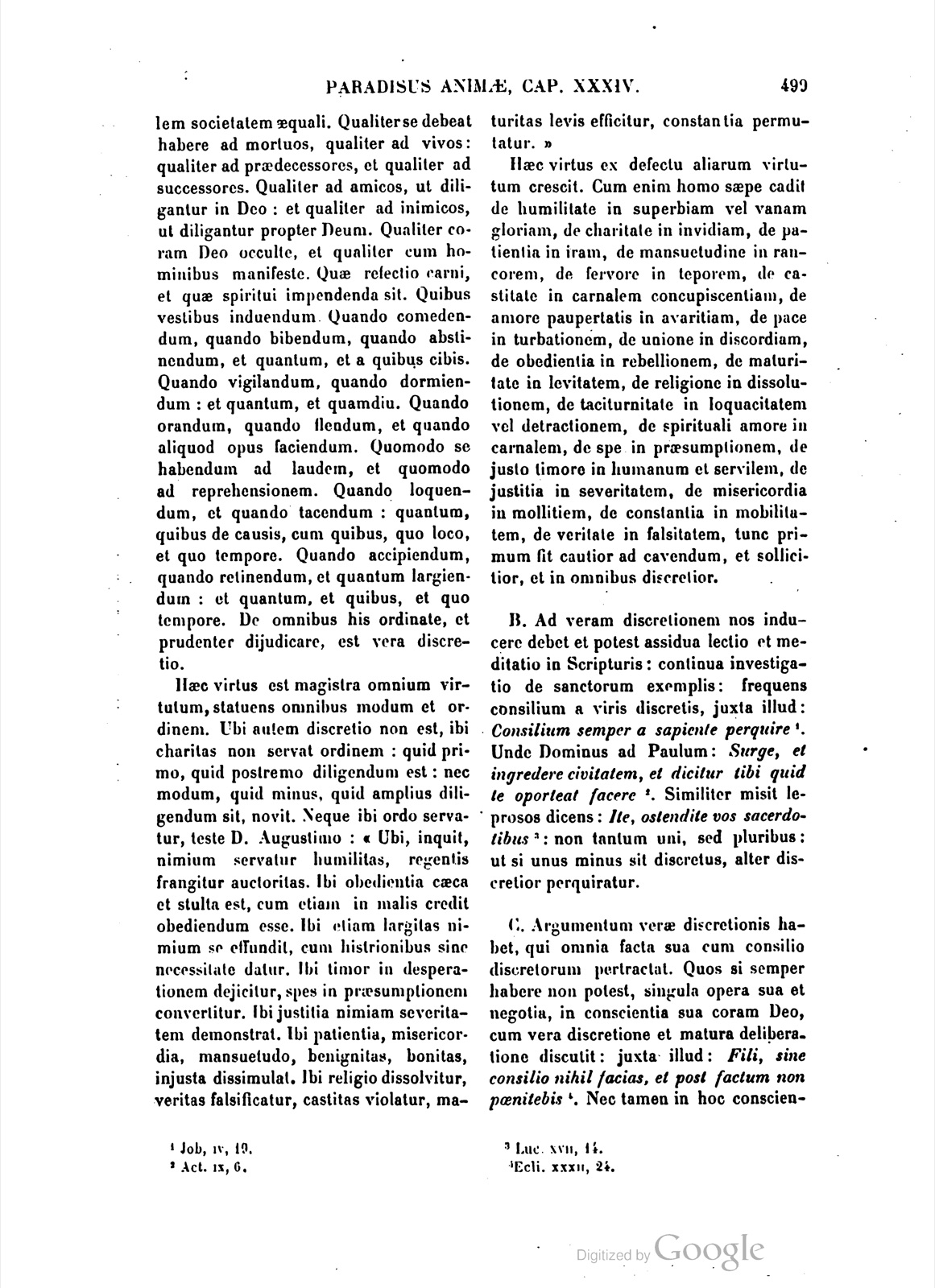
A. Discretio est prudenter judicare inter creatorem et creaturam: quid sit creator, et quid creatura. Item, dijudicare, quid sit bonum, quid melius, et quid optimum: quid malum, quid pejus, et quid pessimum: quantum bonum sit appetendum, et quantum malum sit detestandum. Item, quantam reverentiam debeat homo superiori, quantam clementiam inferiori et compassionem, et qualem societatem aequali. Qualiter se debeat habere ad mortuos, qualiter ad vivos: qualiter ad praedecessores, et qualiter ad successores. Qualiter ad amicos, ut diligantur in Deo: et qualiter ad inimicos, ut diligantur propter Deum. Qualiter coram Deo occulte, et qualiter cum hominibus manifeste. Quae refectio carni, et quae spiritui impendenda sit. Quibus vestibus induendum. Quando comedendum, quando bibendum, quando abstinendum, et quantum, et a quibus cibis. Quando vigilandum, quando dormiendum: et quantum, et quamdiu. Quando orandum, quando flendum, et quando aliquod opus faciendum. Quomodo se habendum ad laudem, et quomodo ad reprehensionem. Quando loquendum, et quando tacendum: quantum, quibus de causis, cum quibus, quo loco, et quo tempore. Quando accipiendum, quando retinendum, et quantum largiendum: et quantum, et quibus, et quo tempore. De omnibus his ordinate, et prudenter dijudicare, est vera discretio.
Haec virtus est magistra omnium virtutum, statuens omnibus modum et ordinem. Ubi autem discretio non est, ibi charitas non servat ordinem: quid primo, quid postremo diligendum est: nec modum, quid minus, quid amplius diligendum sit, novit. Neque ibi ordo servatur, teste D. Augustino: "Ubi, inquit, nimium servatur humilitas, regentis frangitur auctoritas. Ibi obedientia caeca et stulta est, cum etiam in malis credit obediendum esse. Ibi etiam largitas nimium se effundit, cum histrionibus sine necessitate datur. Ibi timor in desperationem dejicitur, spes in praesumptionem convertitur. Ibi justitia nimiam severitatem demonstrat. Ibi patientia, misericordia, mansuetudo, benignitas, bonitas, injusta dissimulat. Ibi religio dissolvitur, veritas falsificatur, castitas violatur, maturitas levis efficitur, constantia permutatur 1."
Chapter XXXIV.
On Discretion.
A. Discretion is prudently to judge between creator and creature: what the creator is and what the creature is. Likewise, to judge what is good, what is better, and what is best; what is evil, what is worse, and what is worst; how much the good is to be desired and how much the evil is to be detested. Likewise, how much reverence a human being owes to a superior, how much clemency and compassion to an inferior, and what sort of fellowship to an equal. How he ought to have himself toward the dead, how toward the living; how toward predecessors and how toward successors. How toward friends, that they may be loved in God, and how toward enemies, that they may be loved because of God. How secretly before God and how openly with human beings. What refreshment must be expended on the flesh and what on the spirit. With what garments one must be clothed. When one must eat, when drink, when abstain, and how much, and from what foods. When one must watch, when sleep, how much and how long. When one must pray, when weep, and when do some work. How one must behave toward praise and how toward rebuke. When to speak and when to be silent: how much, for what reasons, with whom, in what place, and at what time. When to receive, when to retain, and how much to give generously; and how much, to whom, and at what time. To judge about all these things in an ordered and prudent way is true discretion.
This virtue is the mistress of all virtues, setting measure and order for all. But where discretion is not, there charity does not keep order, what is to be loved first and what last; nor does it know measure, what is to be loved less and what more. Nor is order kept there, as St. Augustine testifies: "Where," he says, "humility is kept excessively, the authority of the ruler is broken. There obedience is blind and foolish when it is believed that one must obey even in evils. There also largesse pours itself out excessively when it is given to actors without necessity. There fear is cast down into despair, hope is turned into presumption. There justice shows excessive severity. There patience, mercy, meekness, benignity, goodness, dissemble unjust things. There religion is dissolved, truth is falsified, chastity is violated, maturity is made light, constancy is changed 1."
Haec virtus ex defectu aliarum virtutum crescit. Cum enim homo saepe cadit de humilitate in superbiam vel vanam gloriam, de charitate in invidiam, de patientia in iram, de mansuetudine in rancorem, de fervore in teporem, de castitate in carnalem concupiscentiam, de amore paupertatis in avaritiam, de pace in turbationem, de unione in discordiam, de obedientia in rebellionem, de maturitate in levitatem, de religione in dissolutionem, de taciturnitate in loquacitatem vel detractionem, de spirituali amore in carnalem, de spe in praesumptionem, de justo timore in humanum et servilem, de justitia in severitatem, de misericordia in mollitiem, de constantia in mobilitatem, de veritate in falsitatem, tunc primum fit cautior ad cavendum, et sollicitior, et in omnibus discretior.
B. Ad veram discretionem nos inducere debet et potest assidua lectio et meditatio in Scripturis: continua investigatio de sanctorum exemplis: frequens consilium a viris discretis, juxta illud: Consilium semper a sapiente perquire 4. Unde Dominus ad Paulum: Surge, et ingredere civitatem, et dicitur tibi quid te oporteat facere 2. Similiter misit leprosos dicens: Ite, ostendite vos sacerdotibus 3: non tantum uni, sed pluribus: ut si unus minus sit discretus, alter discretior perquiratur.
This virtue grows from the defect of other virtues. For when a human being often falls from humility into pride or vain glory, from charity into envy, from patience into anger, from meekness into rancor, from fervor into tepidity, from chastity into carnal concupiscence, from love of poverty into avarice, from peace into disturbance, from union into discord, from obedience into rebellion, from maturity into levity, from religion into dissolution, from silence into loquacity or detraction, from spiritual love into carnal love, from hope into presumption, from just fear into human and servile fear, from justice into severity, from mercy into softness, from constancy into mobility, from truth into falsity, then for the first time he becomes more cautious in avoiding, more solicitous, and more discreet in all things.
B. Constant reading and meditation in the Scriptures can and ought to induce us to true discretion, continual investigation concerning the examples of the saints, frequent counsel from discreet men, according to that saying: Always seek counsel from a wise man 4. Hence the Lord said to Paul: Rise and enter the city, and it will be told you what you must do 2. Similarly he sent the lepers, saying: Go, show yourselves to the priests 3, not only to one, but to many, so that if one is less discreet, another more discreet may be sought.
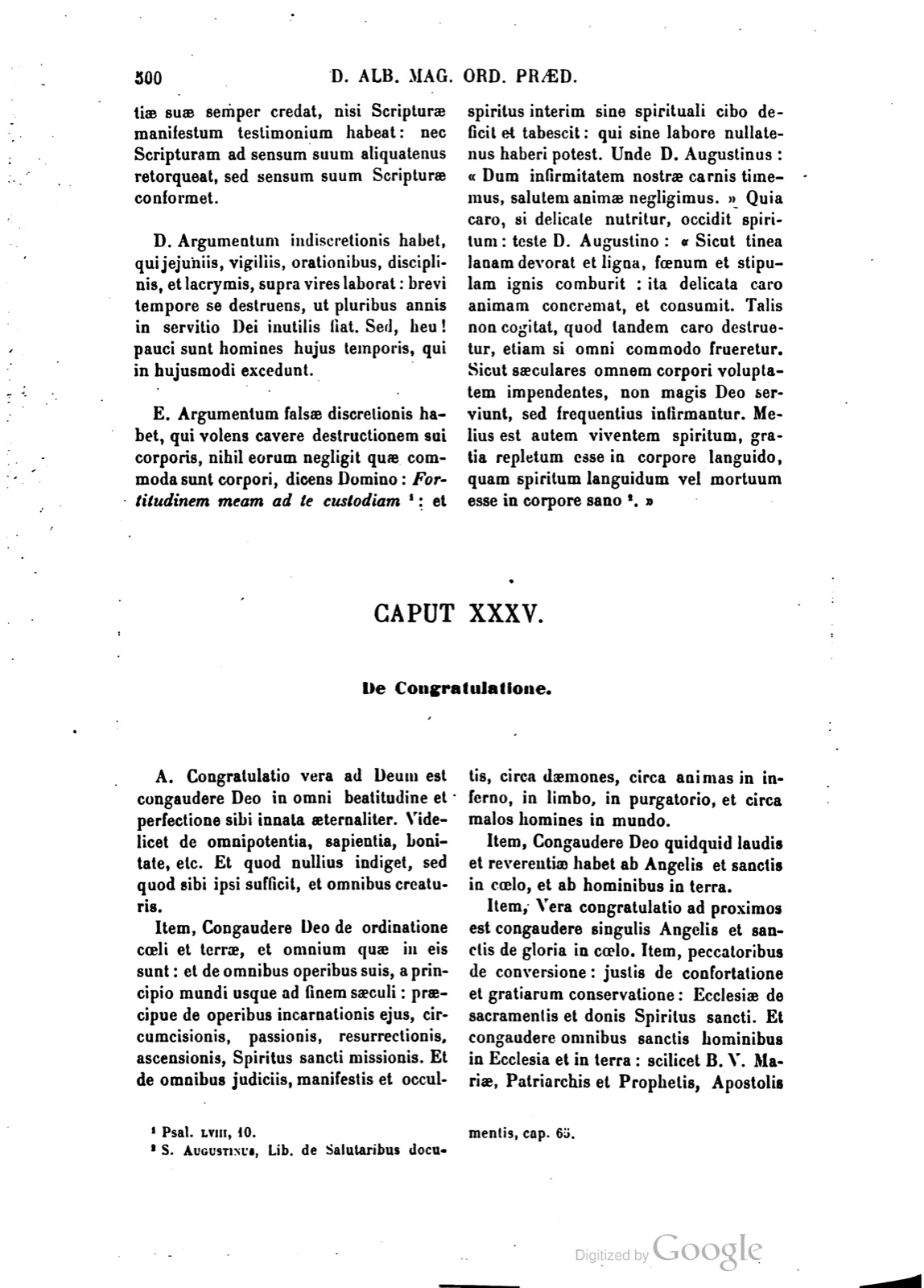
C. Argumentum verae discretionis habet, qui omnia facta sua cum consilio discretorum pertractat. Quos si semper habere non potest, singula opera sua et negotia, in conscientia sua coram Deo, cum vera discretione et matura deliberatione discutit: juxta illud: Fili, sine consilio nihil facias, et post factum non poenitebis 4. Nec tamen in hoc conscientiae suae semper credat, nisi Scripturae manifestum testimonium habeat: nec Scripturam ad sensum suum aliquatenus retorqueat, sed sensum suum Scripturae conformet.
D. Argumentum indiscretionis habet, qui jejuniis, vigiliis, orationibus, disciplinis, et lacrymis, supra vires laborat: brevi tempore se destruens, ut pluribus annis in servitio Dei inutilis fiat. Sed, heu! non pauci sunt homines hujus temporis, qui in hujusmodi excedunt.
E. Argumentum falsae discretionis habet, qui volens cavere destructionem sui corporis, nihil eorum negligit quae commoda sunt corpori, dicens Domino: Fortitudinem meam ad te custodiam 5: et spiritus interim sine spirituali cibo deficit et tabescit: qui sine labore nullatenus haberi potest. Unde D. Augustinus: "Dum infirmitatem nostrae carnis timemus, salutem animae negligimus." Quia caro, si delicate nutritur, occidit spiritum: teste D. Augustino: "Sicut tinea lanam devorat et ligna, foenum et stipulam ignis comburit: ita delicata caro animam concremat, et consumit. Talis non cogitat, quod tandem caro destruetur, etiam si omni commodo frueretur. Sicut saeculares omnem corpori voluptatem impendentes, non magis Deo serviunt, sed frequentius infirmantur. Melius est autem viventem spiritum, gratia repletum esse in corpore languido, quam spiritum languidum vel mortuum esse in corpore sano 6."
C. He has the proof of true discretion who considers all his deeds with the counsel of discreet persons. If he cannot always have them, he discusses each of his works and affairs in his conscience before God, with true discretion and mature deliberation, according to that saying: Son, do nothing without counsel, and after the deed you will not repent 4. Yet in this he should not always believe his own conscience unless he has manifest testimony of Scripture; nor should he in any way twist Scripture back to his own sense, but should conform his sense to Scripture.
D. He has the proof of indiscretion who labors above his strength with fasts, vigils, prayers, disciplines, and tears, destroying himself in a short time so that for many years he becomes useless in the service of God. But alas, there are not a few human beings of this time who exceed in things of this sort.
E. He has the proof of false discretion who, wishing to guard against the destruction of his body, neglects none of those things which are advantageous to the body, saying to the Lord: I will keep my strength for you 5; and meanwhile the spirit, without spiritual food, fails and wastes away, which cannot be had at all without labor. Hence St. Augustine says: "While we fear the infirmity of our flesh, we neglect the salvation of the soul." Because the flesh, if it is delicately nourished, kills the spirit, as St. Augustine testifies: "As a moth devours wool, and fire consumes wood, hay, and straw, so delicate flesh burns up and consumes the soul. Such a person does not think that finally the flesh will be destroyed, even if it enjoyed every convenience. Just as secular persons who expend every pleasure upon the body do not serve God more, but are more frequently made sick. But it is better that a living spirit, filled with grace, be in a languid body, than that a languid or dead spirit be in a healthy body 6."
If a page does not appear, its photograph has not been uploaded yet.