Works › The Paradise of the Soul
Volume 37 · ≈ pp. 495–496
Chapter XXXII. On Solitude.
A marker with ≈ is an approximate page boundary, placed by measure of the text; the page photographs remain the authority. In the paired views, clicking a page marker brings that page into view.
Caput XXXII.
De Solitudine.
A. Solitudo vera est abstrahere mentem a sollicitudine et occupatione actionum exteriorum, ab omni delectatione creaturarum: omnes affectiones, voluntates, et intentiones unanimiter, in quantum potest, dirigere in Deum, ut fiat unus spiritus cum eo. Ad hoc adhortatur Isaias, dicens: Ingredere in petram, et abscondere in fossa humo 1. Ingredere in petram, id est, in divinitatem Christi: abscondere in fossa humo, id est, in vulneribus Christi. Qui in hac petra est, solus est: qui extra hanc petram est, in multitudine est. In hac solitudine mentis tanta gratia et illuminatio mentis percipitur, ut percipiens sit gravis aliis ad videndum. Sicut Moyses solus manens in monte cum Deo quadraginta diebus et noctibus, tantum illuminatus fuit, ut lux in vultu erumperet, et de claritate vultus, quasi radii solis procederent, quos filii Israel non potuerunt intueri, donec faciem suam velaret 2.
B. Ad amorem solitudinis nos inducere debet exemplum sanctissimum Domini nostri Jesu Christi, qui licet ex nullius consortio umquam impediri potuit a spirituali negotio, saepe tamen declinavit a turba, propter amorem solitudinis. Et quandoque cum amplius non potuit, a charissimis Apostolis suis ad orandum secessit, quantum jactus est lapidis, ut scribit Lucas 3: per hoc innuens, quod etiam viri sancti in multitudine familiariter Deo vacare non possunt: aut modicam, aut nullam gratiam efficacem inter homines consequuntur. Hinc est, quod Zachaeus Dominum Jesum in turba videre non poterat 4: sed postmodum vidit ipsum, et vocem Salvatoris audivit, quando solus arborem ascendit.
Chapter XXXII.
On Solitude.
A. True solitude is to withdraw the mind from solicitude and occupation with exterior actions, from every delight in creatures, and unanimously to direct all affections, wills, and intentions, as much as it can, into God, so that it may become one spirit with him. Isaiah exhorts to this, saying: Enter into the rock, and hide in the pit of the ground 1. Enter into the rock, that is, into the divinity of Christ; hide in the pit of the ground, that is, in the wounds of Christ. He who is in this rock is alone; he who is outside this rock is in the multitude. In this solitude of mind so much grace and illumination of mind is perceived that the one perceiving it is burdensome for others to look upon. Thus Moses, remaining alone on the mountain with God for forty days and nights, was so greatly illumined that light broke out on his face, and from the brightness of his face there proceeded as it were rays of the sun, which the children of Israel could not gaze upon until he veiled his face 2.
B. The most holy example of our Lord Jesus Christ ought to induce us to love of solitude. Although he could never be impeded from spiritual business by the company of anyone, nevertheless he often withdrew from the crowd because of love of solitude. And sometimes, when he could not do more, he withdrew from his dearest Apostles to pray, as far as the throw of a stone, as Luke writes 3, indicating through this that even holy men cannot familiarly be at leisure for God in a multitude, or they obtain slight or no effective grace among human beings. Hence Zacchaeus could not see the Lord Jesus in the crowd 4, but afterward he saw him and heard the voice of the Savior when he alone climbed the tree.
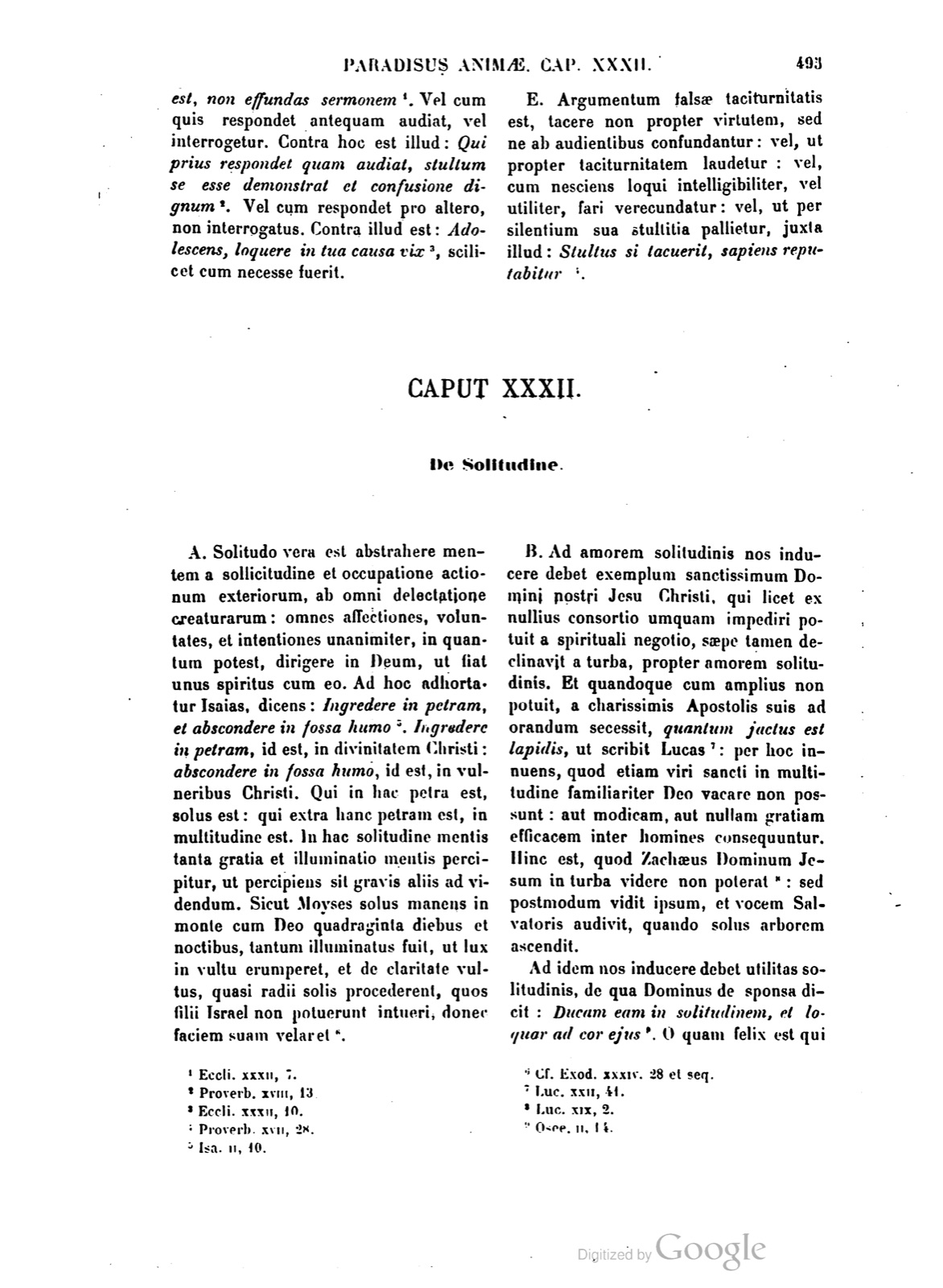
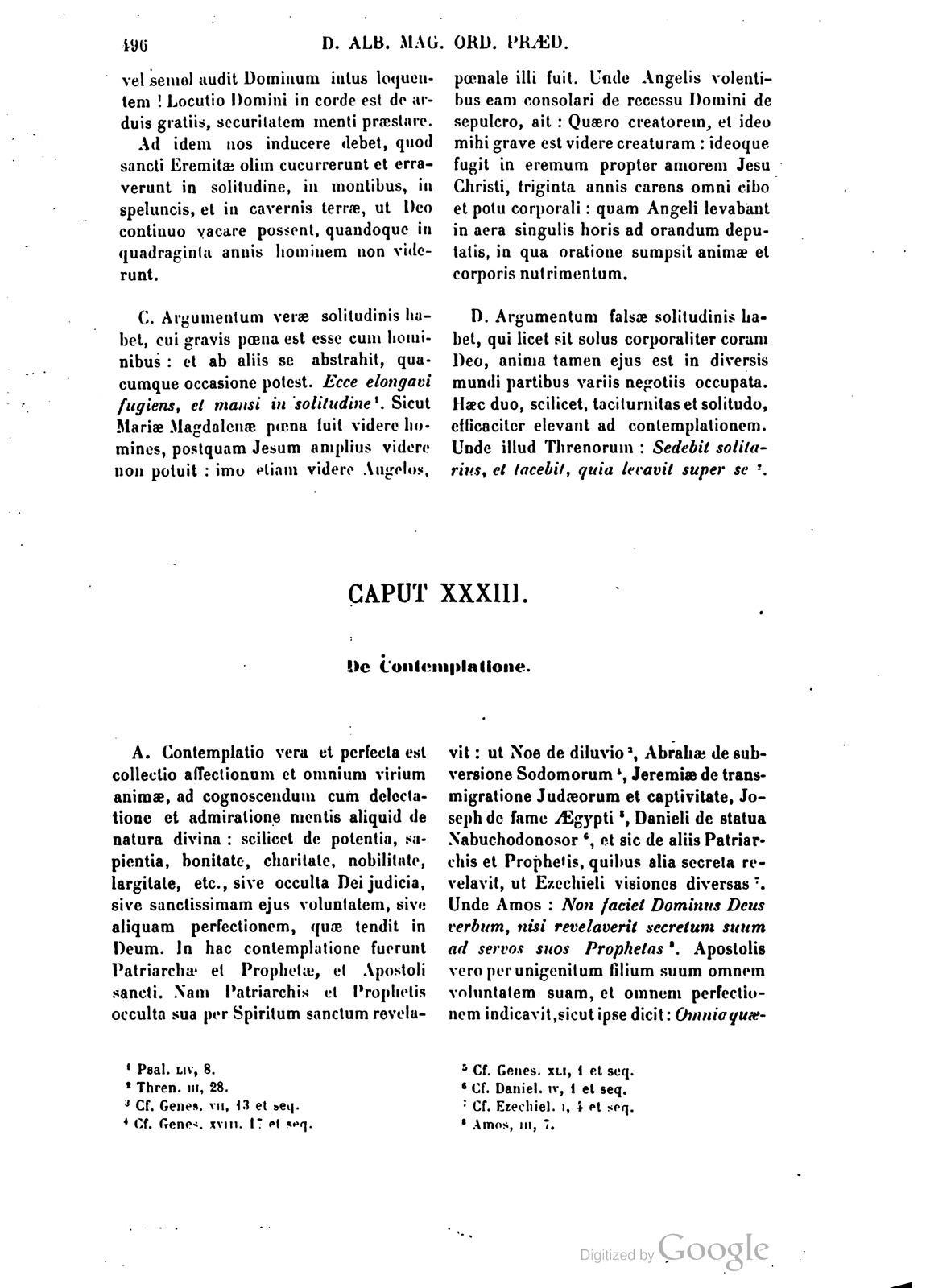
Ad idem nos inducere debet utilitas solitudinis, de qua Dominus de sponsa dicit: Ducam eam in solitudinem, et loquar ad cor ejus 5. O quam felix est qui vel semel audit Dominum intus loquentem! Locutio Domini in corde est de arduis gratiis, securitatem menti praestare.
Ad idem nos inducere debet, quod sancti Eremitae olim cucurrerunt et erraverunt in solitudine, in montibus, in speluncis, et in cavernis terrae, ut Deo continuo vacare possent; quandoque in quadraginta annis hominem non viderunt.
C. Argumentum verae solitudinis habet, cui gravis poena est esse cum hominibus: et ab aliis se abstrahit, quacumque occasione potest. Ecce elongavi fugiens, et mansi in solitudine 6. Sicut Mariae Magdalenae poena fuit videre homines, postquam Jesum amplius videre non potuit: imo etiam videre Angelos, poenale illi fuit. Unde Angelis volentibus eam consolari de recessu Domini de sepulcro, ait: Quaero creatorem, et ideo mihi grave est videre creaturam: ideoque fugit in eremum propter amorem Jesu Christi, triginta annis carens omni cibo et potu corporali: quam Angeli levabant in aera singulis horis ad orandum deputatis, in qua oratione sumpsit animae et corporis nutrimentum.
D. Argumentum falsae solitudinis habet, qui licet sit solus corporaliter coram Deo, anima tamen ejus est in diversis mundi partibus variis negotiis occupata. Haec duo, scilicet taciturnitas et solitudo, efficaciter elevant ad contemplationem. Unde illud Threnorum: Sedebit solitarius, et tacebit, quia levavit super se 7.
The usefulness of solitude ought to induce us to the same, concerning which the Lord says of the bride: I will lead her into solitude, and I will speak to her heart 5. O how happy is one who even once hears the Lord speaking within! The speech of the Lord in the heart is to furnish security to the mind concerning lofty graces.
This also ought to induce us, that the holy hermits once ran and wandered in solitude, on mountains, in caves, and in caverns of the earth, so that they might be continuously at leisure for God; sometimes for forty years they saw no human being.
C. He has the proof of true solitude for whom it is a grave punishment to be with human beings, and who withdraws himself from others by whatever occasion he can. Behold, I have gone far away fleeing, and I have remained in solitude 6. Thus it was a punishment for Mary Magdalene to see human beings after she could see Jesus no more; indeed even to see angels was penal for her. Hence, when the angels wished to console her about the Lord's departure from the sepulcher, she said: I seek the creator, and therefore it is grievous to me to see a creature. Therefore she fled into the wilderness because of love for Jesus Christ, lacking every bodily food and drink for thirty years; angels lifted her into the air at each hour appointed for prayer, in which prayer she took nourishment of soul and body.
D. He has the proof of false solitude who, although he is bodily alone before God, nevertheless his soul is occupied with various businesses in diverse parts of the world. These two, namely silence and solitude, effectively lift up to contemplation. Hence that saying of Lamentations: He will sit solitary and will be silent, because he has lifted upon himself 7.
If a page does not appear, its photograph has not been uploaded yet.