Works › The Paradise of the Soul
Volume 37 · ≈ pp. 493–495
Chapter XXXI. On Silence.
A marker with ≈ is an approximate page boundary, placed by measure of the text; the page photographs remain the authority. In the paired views, clicking a page marker brings that page into view.
Caput XXXI.
De Taciturnitate.
A. Taciturnitas vera et perfecta est, non solum moderari linguam a verbis illicitis, ut sunt detractiones, mendacia, perjuria, impudica, levia, iracunda, nociva, maledica, otiosa, et similia, sed etiam ab utilibus et licitis, juxta illud: Obmutui, et humiliatus sum, et silui a bonis 24, scilicet annuntiandis. Dicit Glossa: "Ille non cadit ad illicita, qui se caute restringit a licitis 25." Non solum autem per verba inutilia et nociva, sed etiam per verba utilia gratia spiritualis effunditur, cum in loquendo modus non observatur. Rara est haec virtus, moderatio linguae, teste Jacobo: Omnis natura bestiarum, et volucrum, et serpentium, et caeterarum, domantur et domita sunt a natura humana: linguam autem nullus hominum domare potest; inquietum malum, plena veneno mortifero 26. Glossa: "Lingua pravorum, bestiis ferocitate, volucribus levitate, serpentibus virulentia praecellit." Sunt enim bestiales, qui exacuerunt ut gladium linguas suas 27. Sunt volucres, qui posuerunt in coelum os suum 28, et quorum os locutum est vanitatem 29. Sunt serpentes, de quibus dicitur: Venenum aspidum sub labiis eorum 30.
B. Ad amorem taciturnitatis inducere nos debet sanctissimum exemplum Domini nostri Jesu Christi, qui taciturnitatem commendans, de impositione criminum interrogatus, se noluit excusare, nec per responsionem mortem suam voluit differre.
Ad idem inducere nos debet exemplum cujusdam eremitae, de quo legitur, quod tribus annis lapidem in ore gestarit, ut disceret silentium servare 31. Citius enim addisceret aliquis loqui, quam tacere, juxta illud sapientis: "Qui scit loqui, discat et tacere."
Chapter XXXI.
On Silence.
A. True and perfect silence is not only to moderate the tongue from illicit words, such as detractions, lies, perjuries, immodest, light, angry, harmful, evil-speaking, idle words and similar things, but also from useful and lawful words, according to that saying: I was mute and humbled, and I kept silence from good things 24, namely from announcing them. The Gloss says: "He does not fall into illicit things who cautiously restrains himself from lawful things 25." Spiritual grace is poured out not only through useless and harmful words, but also through useful words, when measure is not observed in speaking. This virtue, moderation of the tongue, is rare, as James testifies: Every nature of beasts and birds and serpents and the rest are tamed and have been tamed by human nature; but no human being can tame the tongue, an unquiet evil, full of deadly poison 26. The Gloss says: "The tongue of the wicked surpasses beasts in ferocity, birds in levity, and serpents in venom." For they are bestial, who sharpened their tongues like a sword 27. They are birds, who set their mouth in heaven 28, and whose mouth spoke vanity 29. They are serpents, of whom it is said: The poison of asps is under their lips 30.
B. The most holy example of our Lord Jesus Christ ought to induce us to love of silence. In commending silence, when interrogated about the imposition of crimes, he would not excuse himself, nor did he wish to delay his death by a response.
The example of a certain hermit ought to induce us to the same; about him it is read that he carried a stone in his mouth for three years so that he might learn to keep silence 31. For someone would learn to speak more quickly than to keep silence, according to that saying of the wise man: "Let him who knows how to speak learn also to be silent."
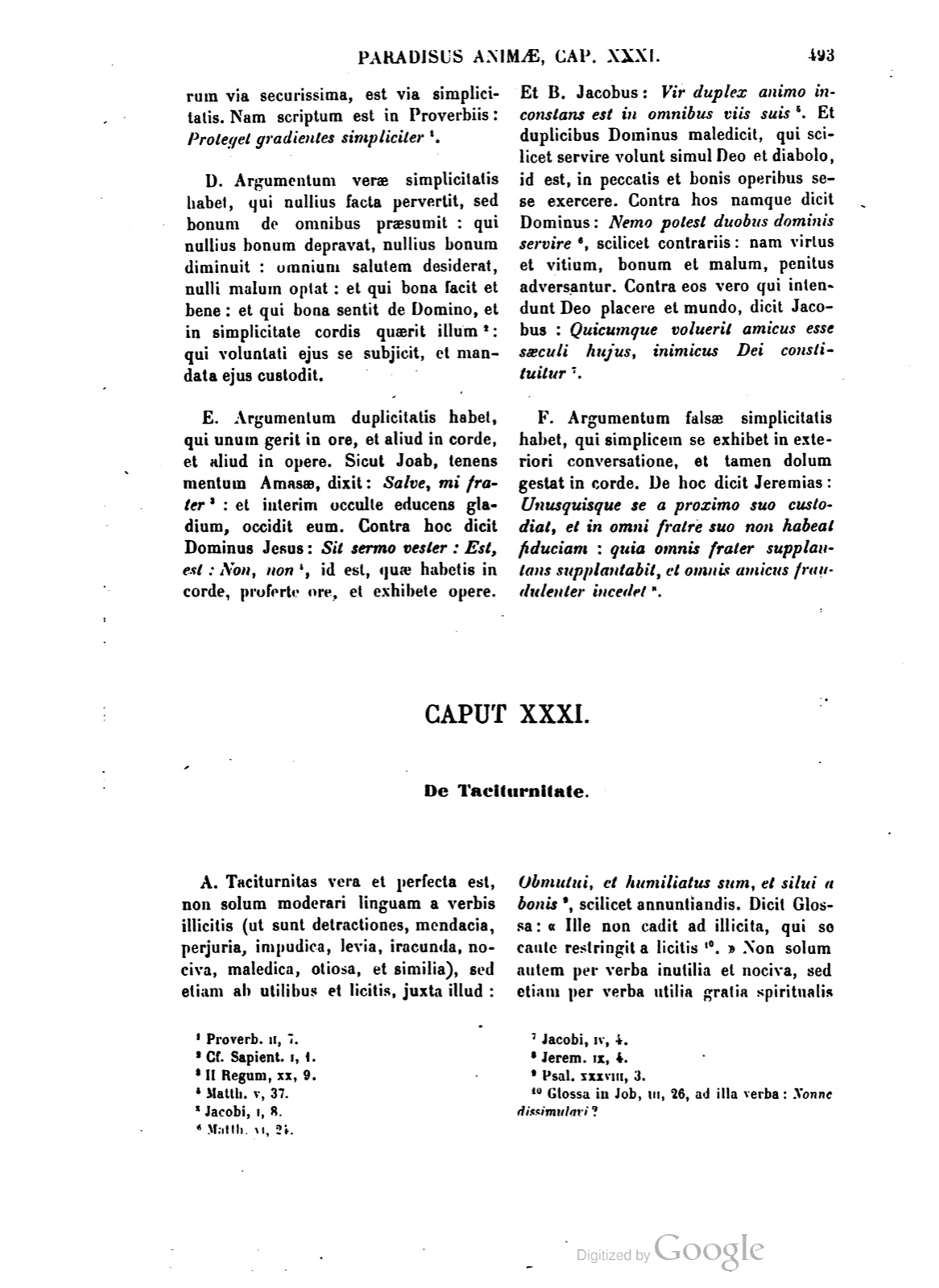
Ad idem inducere nos debet utilitas ex ea proveniens. Nam silentium cor distractum componit, conscientiae serenitatem inducit, et ad recipiendam gratiam divinam habilem mentem facit. Ubi autem non est taciturnitas, ibi homo de facili ab adversario superatur, juxta illud: Sicut urbs patens et absque murorum ambitu, ita vir qui non potest in loquendo cohibere spiritum suum 32. Ubi enim non est moderatio linguae, ibi numquam erit perfectio, juxta illud: Si quis in verbo non offendit, hic perfectus est vir 33, et non alius, dicit Glossa. Ubi est custodia linguae, ibi est beatitudo, secundum illud: Beatus vir qui non est lapsus verbo ex ore suo 15. Et: Qui custodit os suum et linguam suam, custodit ab angustiis animam suam 16.
C. Argumentum verae taciturnitatis habet, qui cum libere, et licite, et sine offensa, loqui potest, et cujus verba recipientur cum magno desiderio: et tamen nullo modo, aut raro inducitur ad loquendum, recogitans illud D. Gregorii: "Si sanctus Propheta Ezechiel missus ad loquendum fuerat, et septem diebus sedens maerensque tacebat; pensandum nobis est, quanta culpa sit ei non tacere, quem nulla necessitas cogit loqui 17." Et illud verbum Evangelicum: Dico autem vobis, quoniam omne verbum otiosum quod locuti fuerint homines, reddent rationem de eo in die judicii 18.
The usefulness arising from it ought to induce us to the same. For silence composes the distracted heart, brings in serenity of conscience, and makes the mind fit for receiving divine grace. But where there is no silence, there the human being is easily overcome by the adversary, according to that saying: Like a city lying open and without the circuit of walls, so is a man who cannot restrain his spirit in speaking 32. For where there is no moderation of the tongue, there will never be perfection, according to that saying: If anyone does not offend in word, this one is a perfect man 33, and no other, says the Gloss. Where there is guarding of the tongue, there is blessedness, according to that saying: Blessed is the man who has not slipped by a word from his mouth 15. And: He who guards his mouth and his tongue guards his soul from distresses 16.
C. He has the proof of true silence who, when he can speak freely, lawfully, and without offense, and when his words will be received with great desire, nevertheless is in no way, or rarely, induced to speak, considering that saying of St. Gregory: "If the holy Prophet Ezekiel had been sent to speak, and sat mourning and was silent for seven days, we must consider how great a fault it is for him not to be silent whom no necessity compels to speak 17." And that evangelical word: But I say to you, that every idle word which human beings have spoken, they will render an account of it on the day of judgment 18.
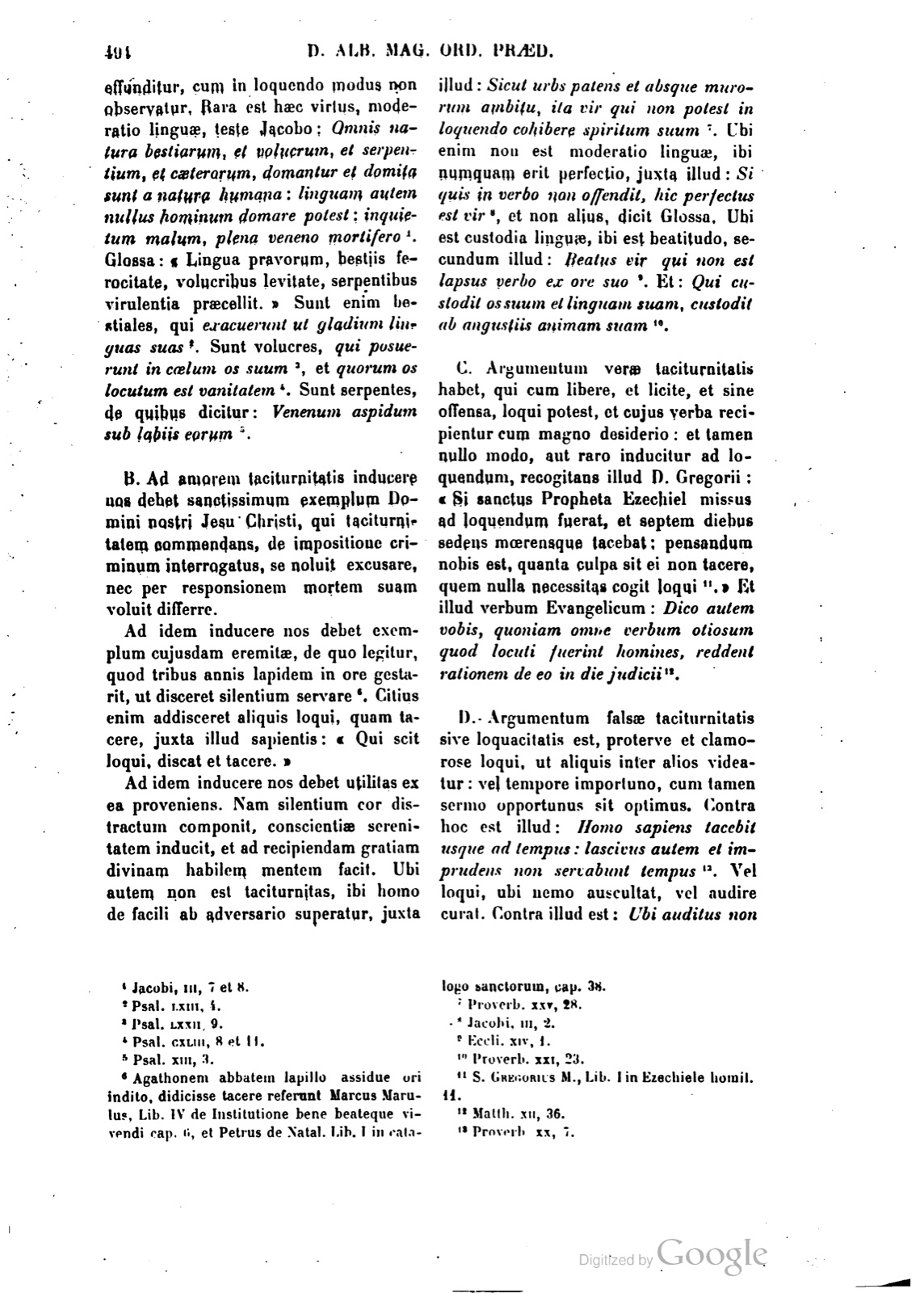
D. Argumentum falsae taciturnitatis sive loquacitatis est, proterve et clamorose loqui, ut aliquis inter alios videatur: vel tempore importuno, cum tamen sermo opportunus sit optimus. Contra hoc est illud: Homo sapiens tacebit usque ad tempus: lascivus autem et imprudens non servabunt tempus 19. Vel loqui, ubi nemo auscultat, vel audire curat. Contra illud est: Ubi auditus non
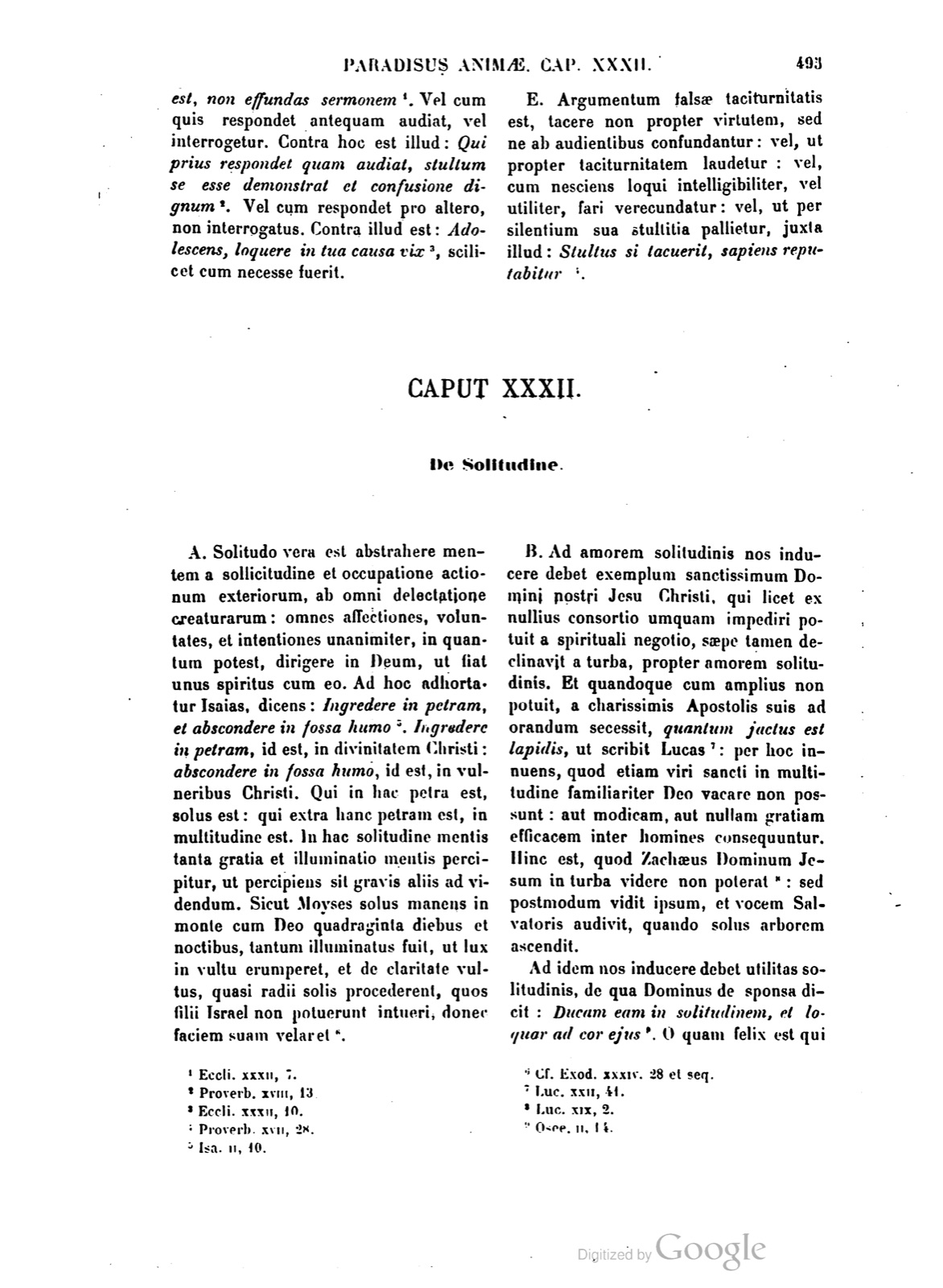
D. Argumentum falsae taciturnitatis sive loquacitatis est, proterve et clamorose loqui, ut aliquis inter alios videatur: vel tempore importuno, cum tamen sermo opportunus sit optimus. Contra hoc est illud: Homo sapiens tacebit usque ad tempus: lascivus autem et imprudens non servabunt tempus 20. Vel loqui, ubi nemo auscultat, vel audire curat. Contra illud est: Ubi auditus non est, non effundas sermonem 20. Vel cum quis respondet antequam audiat, vel interrogetur. Contra hoc est illud: Qui prius respondet quam audiat, stultum se esse demonstrat et confusione dignum 21. Vel cum respondet pro altero, non interrogatus. Contra illud est: Adolescens, loquere in tua causa vix 22, scilicet cum necesse fuerit.
E. Argumentum falsae taciturnitatis est, tacere non propter virtutem, sed ne ab audientibus confundantur: vel, ut propter taciturnitatem laudetur: vel, cum nesciens loqui intelligibiliter, vel utiliter, fari verecundatur: vel, ut per silentium sua stultitia pallietur, juxta illud: Stultus si tacuerit, sapiens reputabitur 23.
D. The proof of false silence or loquacity is to speak insolently and loudly, so that someone may be seen among others; or to speak at an unsuitable time, although timely speech is best. Against this is that saying: A wise man will be silent until the time; but the wanton and imprudent will not observe the time 19. Or to speak where no one listens or cares to hear. Against that is: Where there is no hearing
D. The proof of false silence or loquacity is to speak insolently and loudly, so that someone may be seen among others; or to speak at an unsuitable time, although timely speech is best. Against this is that saying: A wise man will be silent until the time; but the wanton and imprudent will not observe the time 20. Or to speak where no one listens or cares to hear. Against that is: Where there is no hearing, do not pour out speech 20. Or when someone answers before he hears or is questioned. Against this is that saying: He who answers before he hears shows himself to be foolish and worthy of confusion 21. Or when he answers for another, not having been questioned. Against that is: Young man, speak scarcely in your own cause 22, namely when it is necessary.
E. The proof of false silence is to be silent not because of virtue, but lest they be confounded by the hearers; or so that one may be praised because of silence; or when, not knowing how to speak intelligibly or usefully, he is ashamed to speak; or so that by silence his foolishness may be covered over, according to that saying: If a fool is silent, he will be reckoned wise 23.
Notes
- Isaiah 61:10. (Isa. LXI, 10.) ↩
- Psalm 77:39. (Psal. LXXVII, 39.) ↩
- Matthew 5:5. (Matth. V, 5.) ↩
- Ecclesiastes 7:3. (Eccle. VII, 3.) ↩
- Psalm 37:3. (Psal. XXXVII, 3.) ↩
- Gloss on Job 1:26, at those words: Did I not dissemble? (Glossa in Job I, 26, ad illa verba: Nonne dissimulavi?) ↩
- James 3:7 and 8. (Jacobi III, 7 et 8.) ↩
- Psalm 63:4. (Psal. LXIII, 4.) ↩
- Psalm 72:9. (Psal. LXXII, 9.) ↩
- Psalm 143:8 and 11. (Psal. CXLIII, 8 et 11.) ↩
- Psalm 11:3. (Psal. XI, 3.) ↩
- Marcus Marulus, Book 4 On the Institution of Living Well and Blessedly, chapter 6, and Peter de Natalibus, Book 1 in the catalogue of saints, chapter 38, report that Abbot Agatho learned to be silent by continually putting a little stone in his mouth. (Agathonem abbatem lapillo assidue ori indito, didicisse tacere referunt Marcus Marulus, Lib. IV de Institutione bene beateque vivendi cap. 6, et Petrus de Natal. Lib. I in catalogo sanctorum, cap. 38.) ↩
- Proverbs 25:28. (Proverb. XXV, 28.) ↩
- James 3:2. (Jacobi III, 2.) ↩
- Ecclesiasticus 14:1. (Eccli. XIV, 1.) ↩
- Proverbs 21:23. (Proverb. XXI, 23.) ↩
- St. Gregory the Great, Book 1 on Ezekiel, homily 11. (S. Gregorius M., Lib. I in Ezechiele homil. 11.) ↩
- Matthew 12:36. (Matth. XII, 36.) ↩
- Proverbs 20:7. (Proverb. XX, 7.) ↩
- Ecclesiasticus 20:7. (Eccli. XX, 7.) ↩
- Proverbs 18:13. (Proverb. XVIII, 13.) ↩
- Ecclesiasticus 32:10. (Eccli. XXXII, 10.) ↩
- Proverbs 17:28. (Proverb. XVII, 28.) ↩
- The same, verse 13. (Ibid., v. 13.) ↩
- Galatians 5:19 and following. (Ad Galat. V, 19 et seq.) ↩
- John 12:25. (Joan. XII, 25.) ↩
- Luke 14:26. (Luc. XIV, 26.) ↩
- St. Gregory the Great, Homily 37 on the Gospel. (S. Gregorius M., Homil. 37 in Evangelium.) ↩
- Ecclesiasticus 18:31. (Eccli. XVIII, 31.) ↩
- Judges 16:4 and following. (Judicum XVI, 4 et seq.) ↩
- Thomas Hibernicus, in the book he entitled Flowers of the Doctors, and similarly Dominicus Nanus in the Polyanthea, both under the word abstinence, attribute this sentence to Isidore on the prophet Amos. (Hanc sententiam Thomas Hibernicus in libro quem inscripsit Flores Doctorum, similiter Dominicus Nanus in Polyanthea, uterque verbo abstinentia, tribuit Isidoro in prophetam Amos.) ↩
- Jeremiah 6:26. (Jerem. VI, 26.) ↩
- Joel 2:13. (Joel II, 13.) ↩
If a page does not appear, its photograph has not been uploaded yet.