Works › The Paradise of the Soul
Volume 37 · ≈ pp. 492–493
Chapter XXX. On Simplicity.
A marker with ≈ is an approximate page boundary, placed by measure of the text; the page photographs remain the authority. In the paired views, clicking a page marker brings that page into view.
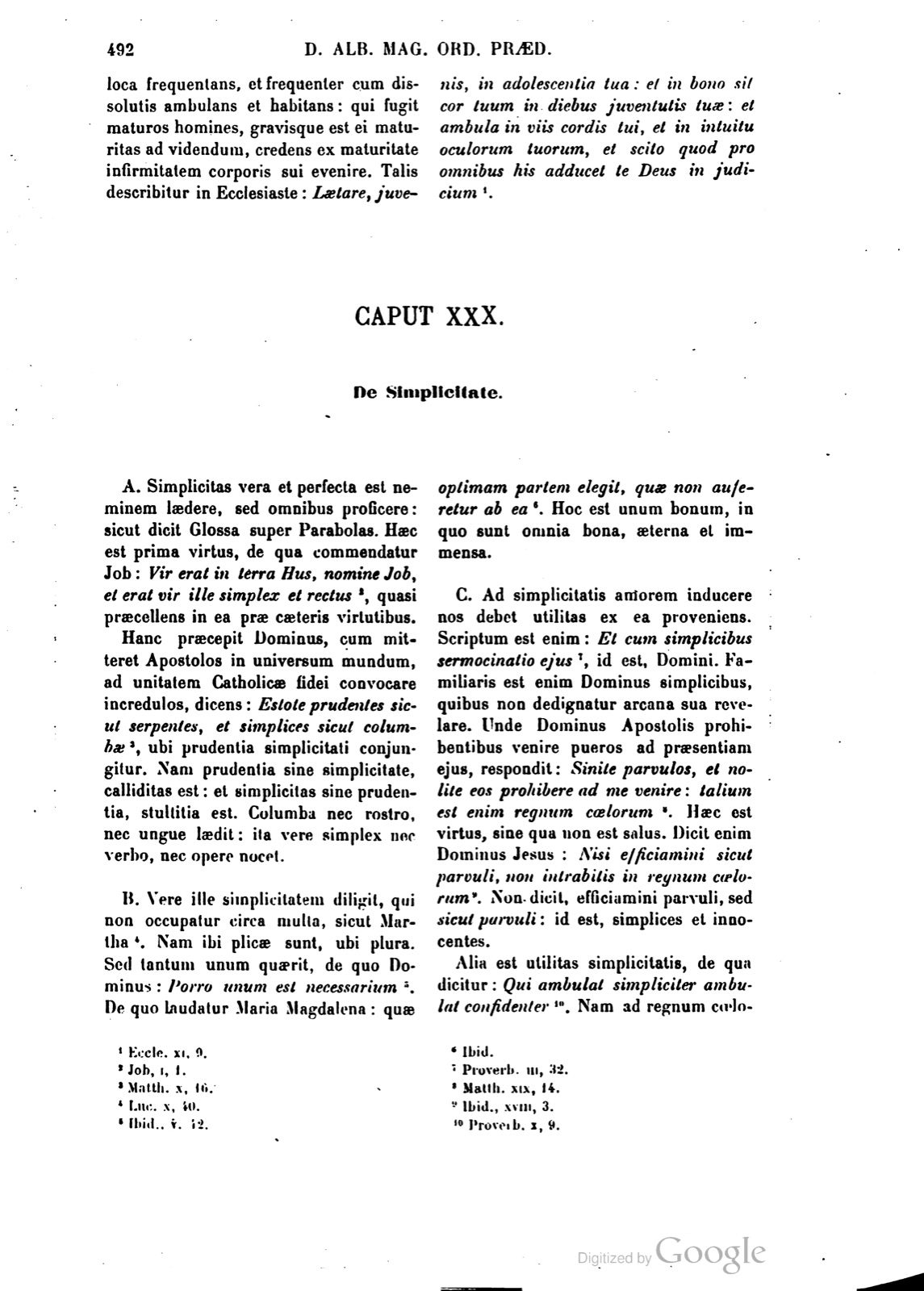
Caput XXX.
De Simplicitate.
A. Simplicitas vera et perfecta est neminem laedere, sed omnibus proficere: sicut dicit Glossa super Parabolas. Haec est prima virtus, de qua commendatur Job: Vir erat in terra Hus, nomine Job, et erat vir ille simplex et rectus 1, quasi praecellens in ea prae caeteris virtutibus.
Hanc praecepit Dominus, cum mitteret Apostolos in universum mundum, ad unitatem Catholicae fidei convocare incredulos, dicens: Estote prudentes sicut serpentes, et simplices sicut columbae 2, ubi prudentia simplicitati conjungitur. Nam prudentia sine simplicitate, calliditas est: et simplicitas sine prudentia, stultitia est. Columba nec rostro, nec ungue laedit: ita vere simplex nec verbo, nec opere nocet.
B. Vere ille simplicitatem diligit, qui non occupatur circa multa, sicut Martha 3. Nam ibi plicae sunt, ubi plura. Sed tantum unum quaerit, de quo Dominus: Porro unum est necessarium 4. De quo laudatur Maria Magdalena: quae optimam partem elegit, quae non auferetur ab ea 5. Hoc est unum bonum, in quo sunt omnia bona, aeterna et immensa.
C. Ad simplicitatis amorem inducere nos debet utilitas ex ea proveniens. Scriptum est enim: Et cum simplicibus sermocinatio ejus 6, id est, Domini. Familiaris est enim Dominus simplicibus, quibus non dedignatur arcana sua revelare. Unde Dominus Apostolis prohibentibus venire pueros ad praesentiam ejus, respondit: Sinite parvulos, et nolite eos prohibere ad me venire: talium est enim regnum coelorum 7. Haec est virtus, sine qua non est salus. Dicit enim Dominus Jesus: Nisi efficiamini sicut parvuli, non intrabitis in regnum coelorum 8. Non dicit, efficiamini parvuli, sed sicut parvuli: id est, simplices et innocentes.
Alia est utilitas simplicitatis, de qua dicitur: Qui ambulat simpliciter ambulat confidenter 9. Nam ad regnum coelorum via securissima, est via simplicitatis. Nam scriptum est in Proverbiis: Proteget gradientes simpliciter 10.
Chapter XXX.
On Simplicity.
A. True and perfect simplicity is to harm no one, but to benefit all, as the Gloss says on the Parables. This is the first virtue for which Job is commended: There was a man in the land of Hus, named Job, and that man was simple and upright 1, as if excelling in it before the other virtues.
The Lord commanded this when he sent the Apostles into the whole world to call unbelievers together to the unity of the Catholic faith, saying: Be prudent as serpents and simple as doves 2, where prudence is joined to simplicity. For prudence without simplicity is cunning, and simplicity without prudence is foolishness. A dove harms neither with beak nor with claw; so the truly simple person harms neither by word nor by deed.
B. He truly loves simplicity who is not occupied about many things, like Martha 3. For folds are where there are many things. But he seeks only the one thing, concerning which the Lord says: But one thing is necessary 4. Concerning this Mary Magdalene is praised, because she chose the best part, which will not be taken away from her 5. This is the one good in which are all good things, eternal and immeasurable.
C. The usefulness arising from simplicity ought to induce us to love of simplicity. For it is written: And with the simple is his conversation 6, that is, the Lord's. For the Lord is familiar with the simple, to whom he does not disdain to reveal his secrets. Hence, when the Apostles were forbidding children to come to his presence, the Lord answered: Permit the little ones, and do not forbid them to come to me; for of such is the kingdom of heaven 7. This is the virtue without which there is no salvation. For the Lord Jesus says: Unless you become like little ones, you will not enter into the kingdom of heaven 8. He does not say, become little ones, but like little ones, that is, simple and innocent.
Another usefulness of simplicity is that of which it is said: He who walks simply walks confidently 9. For the safest way to the kingdom of heaven is the way of simplicity. For it is written in Proverbs: He will protect those walking simply 10.
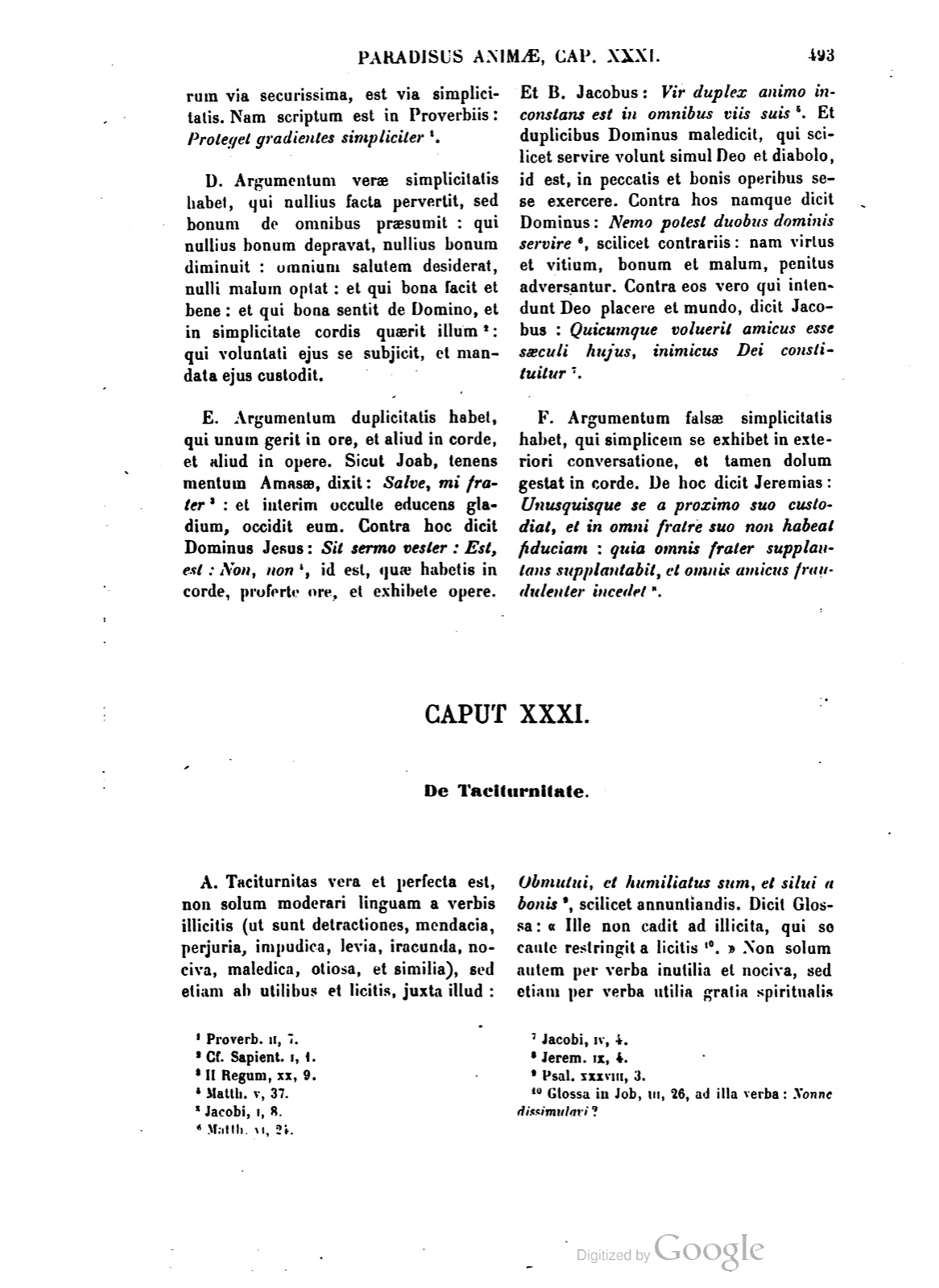
D. Argumentum verae simplicitatis habet, qui nullius facta pervertit, sed bonum de omnibus praesumit: qui nullius bonum depravat, nullius bonum diminuit: omnium salutem desiderat, nulli malum optat: et qui bona facit et bene: et qui bona sentit de Domino, et in simplicitate cordis quaerit illum 11: qui voluntati ejus se subjicit, et mandata ejus custodit.
E. Argumentum duplicitatis habet, qui unum gerit in ore, et aliud in corde, et aliud in opere. Sicut Joab, tenens mentum Amase, dixit: Salve, mi frater: et interim occulte educens gladium, occidit eum 12. Contra hoc dicit Dominus Jesus: Sit sermo vester: Est, est: Non, non 13, id est, quae habetis in corde, proferte ore, et exhibete opere. Et B. Jacobus: Vir duplex animo inconstans est in omnibus viis suis 14. Et duplicibus Dominus maledicit, qui scilicet servire volunt simul Deo et diabolo, id est, in peccatis et bonis operibus sese exercere. Contra hos namque dicit Dominus: Nemo potest duobus dominis servire 15, scilicet contrariis: nam virtus et vitium, bonum et malum, penitus adversantur. Contra eos vero qui intendunt Deo placere et mundo, dicit Jacobus: Quicumque voluerit amicus esse saeculi hujus, inimicus Dei constituitur 16.
F. Argumentum falsae simplicitatis habet, qui simplicem se exhibet in exteriori conversatione, et tamen dolum gestat in corde. De hoc dicit Jeremias: Unusquisque se a proximo suo custodiat, et in omni fratre suo non habeat fiduciam: quia omnis frater supplantans supplantabit, et omnis amicus fraudulenter incedet 17.
D. He has the proof of true simplicity who distorts the deeds of no one, but presumes good of all; who depraves the good of no one, lessens the good of no one; who desires the salvation of all, wishes evil to no one; and who does good things and does them well; and who thinks good things about the Lord and seeks him in simplicity of heart 11; who subjects himself to his will and keeps his commandments.
E. He has the proof of duplicity who carries one thing in his mouth, another in his heart, and another in his work. Thus Joab, holding Amasa's chin, said: Hail, my brother, and meanwhile secretly drawing out a sword, killed him 12. Against this the Lord Jesus says: Let your speech be: Yes, yes; no, no 13, that is, what you have in your heart, bring forth by mouth and exhibit in deed. And blessed James says: A man double in soul is inconstant in all his ways 14. And the Lord curses the double, namely those who wish to serve God and the devil at the same time, that is, to exercise themselves in sins and good works. Against these the Lord says: No one can serve two masters 15, namely contrary masters; for virtue and vice, good and evil, are wholly opposed. But against those who intend to please God and the world, James says: Whoever wishes to be a friend of this world is made an enemy of God 16.
F. He has the proof of false simplicity who shows himself simple in exterior conduct and nevertheless bears deceit in the heart. Concerning this Jeremiah says: Let each one guard himself from his neighbor, and let him not have confidence in any brother, because every brother in supplanting will supplant, and every friend will walk fraudulently 17.
Notes
- Job 1:1. (Job I, 1.) ↩
- Matthew 10:16. (Matth. X, 16.) ↩
- Luke 10:40. (Luc. X, 40.) ↩
- The same, verse 42. (Ibid., v. 42.) ↩
- The same. (Ibid.) ↩
- Proverbs 3:32. (Proverb. III, 32.) ↩
- Matthew 19:14. (Matth. XIX, 14.) ↩
- Matthew 18:3. (Matth. XVIII, 3.) ↩
- Proverbs 10:9. (Proverb. X, 9.) ↩
- Proverbs 2:7. (Proverb. II, 7.) ↩
- Compare Wisdom 1:1. (Cf. Sapient. I, 1.) ↩
- 2 Kings 20:9. (II Regum XX, 9.) ↩
- Matthew 5:37. (Matth. V, 37.) ↩
- James 1:8. (Jacobi I, 8.) ↩
- Matthew 6:24. (Matth. VI, 24.) ↩
- James 4:4. (Jacobi IV, 4.) ↩
- Jeremiah 9:4. (Jerem. IX, 4.) ↩
If a page does not appear, its photograph has not been uploaded yet.