Works › The Paradise of the Soul
Volume 37 · ≈ pp. 489–491
Chapter XXVIII. On Religion.
A marker with ≈ is an approximate page boundary, placed by measure of the text; the page photographs remain the authority. In the paired views, clicking a page marker brings that page into view.
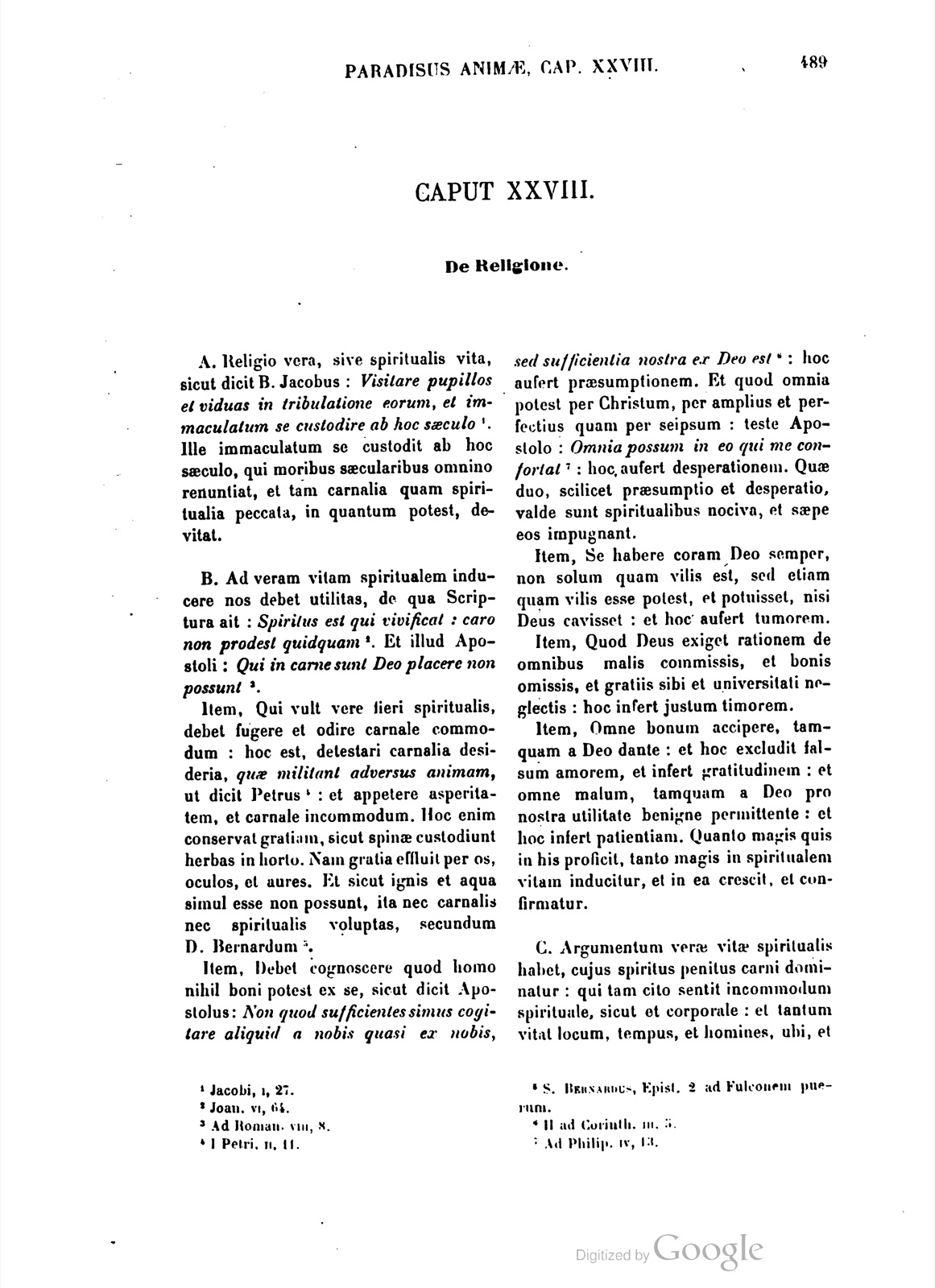
Caput XXVIII.
De Religione.
A. Religio vera, sive spiritualis vita, sicut dicit B. Jacobus: Visitare pupillos et viduas in tribulatione eorum, et immaculatum se custodire ab hoc saeculo 1. Ille immaculatum se custodit ab hoc saeculo, qui moribus saecularibus omnino renuntiat, et tam carnalia quam spiritualia peccata, in quantum potest, devitat.
B. Ad veram vitam spiritualem inducere nos debet utilitas, de qua Scriptura ait: Spiritus est qui vivificat: caro non prodest quidquam 2. Et illud Apostoli: Qui in carne sunt Deo placere non possunt 3.
Item, Qui vult vere fieri spiritualis, debet fugere et odire carnale commodum: hoc est, detestari carnalia desideria, quae militant adversus animam, ut dicit Petrus 4: et appetere asperitatem, et carnale incommodum. Hoc enim conservat gratiam, sicut spinae custodiunt herbas in horto. Nam gratia effluit per os, oculos, et aures. Et sicut ignis et aqua simul esse non possunt, ita nec carnalis nec spiritualis voluptas, secundum D. Bernardum 5.
Item, Debet cognoscere quod homo nihil boni potest ex se, sicut dicit Apostolus: Non quod sufficientes simus cogitare aliquid a nobis quasi ex nobis, sed sufficientia nostra ex Deo est 6: hoc aufert praesumptionem. Et quod omnia potest per Christum, per amplius et perfectius quam per seipsum: teste Apostolo: Omnia possum in eo qui me confortat 7: hoc aufert desperationem. Quae duo, scilicet praesumptio et desperatio, valde sunt spiritualibus nociva, et saepe eos impugnant.
Item, Se habere coram Deo semper, non solum quam vilis est, sed etiam quam vilis esse potest, et potuisset, nisi Deus cavisset: et hoc aufert tumorem.
Chapter XXVIII.
On Religion.
A. True religion, or spiritual life, is, as blessed James says: To visit orphans and widows in their tribulation, and to keep oneself unstained from this world 1. He keeps himself unstained from this world who entirely renounces secular manners, and avoids, as much as he can, both carnal and spiritual sins.
B. The usefulness about which Scripture says, The Spirit is what gives life; the flesh profits nothing 2, ought to induce us to true spiritual life. And that saying of the Apostle: Those who are in the flesh cannot please God 3.
Likewise, he who wishes truly to become spiritual must flee and hate bodily advantage; that is, he must detest carnal desires, which war against the soul, as Peter says 4, and must desire roughness and bodily inconvenience. For this preserves grace, as thorns guard herbs in a garden. For grace flows out through the mouth, eyes, and ears. And as fire and water cannot exist together at the same time, so neither can carnal pleasure and spiritual pleasure, according to St. Bernard 5.
Likewise, he must know that a human being can do nothing good from himself, as the Apostle says: Not that we are sufficient to think anything from ourselves as from ourselves, but our sufficiency is from God 6. This removes presumption. And that he can do all things through Christ, in a greater and more perfect way than through himself, as the Apostle testifies: I can do all things in him who strengthens me 7. This removes despair. These two, namely presumption and despair, are very harmful to spiritual persons and often attack them.
Likewise, he must always hold himself before God, not only considering how vile he is, but also how vile he can be and could have been, unless God had guarded him. And this removes swelling pride.
Item, Quod Deus exiget rationem de omnibus malis commissis, et bonis omissis, et gratiis sibi et universitati neglectis: hoc infert justum timorem.
Item, Omne bonum accipere, tamquam a Deo dante: et hoc excludit falsum amorem, et infert gratitudinem: et omne malum, tamquam a Deo pro nostra utilitate benigne permittente: et hoc infert patientiam. Quanto magis quis in his proficit, tanto magis in spiritualem vitam inducitur, et in ea crescit, et confirmatur.
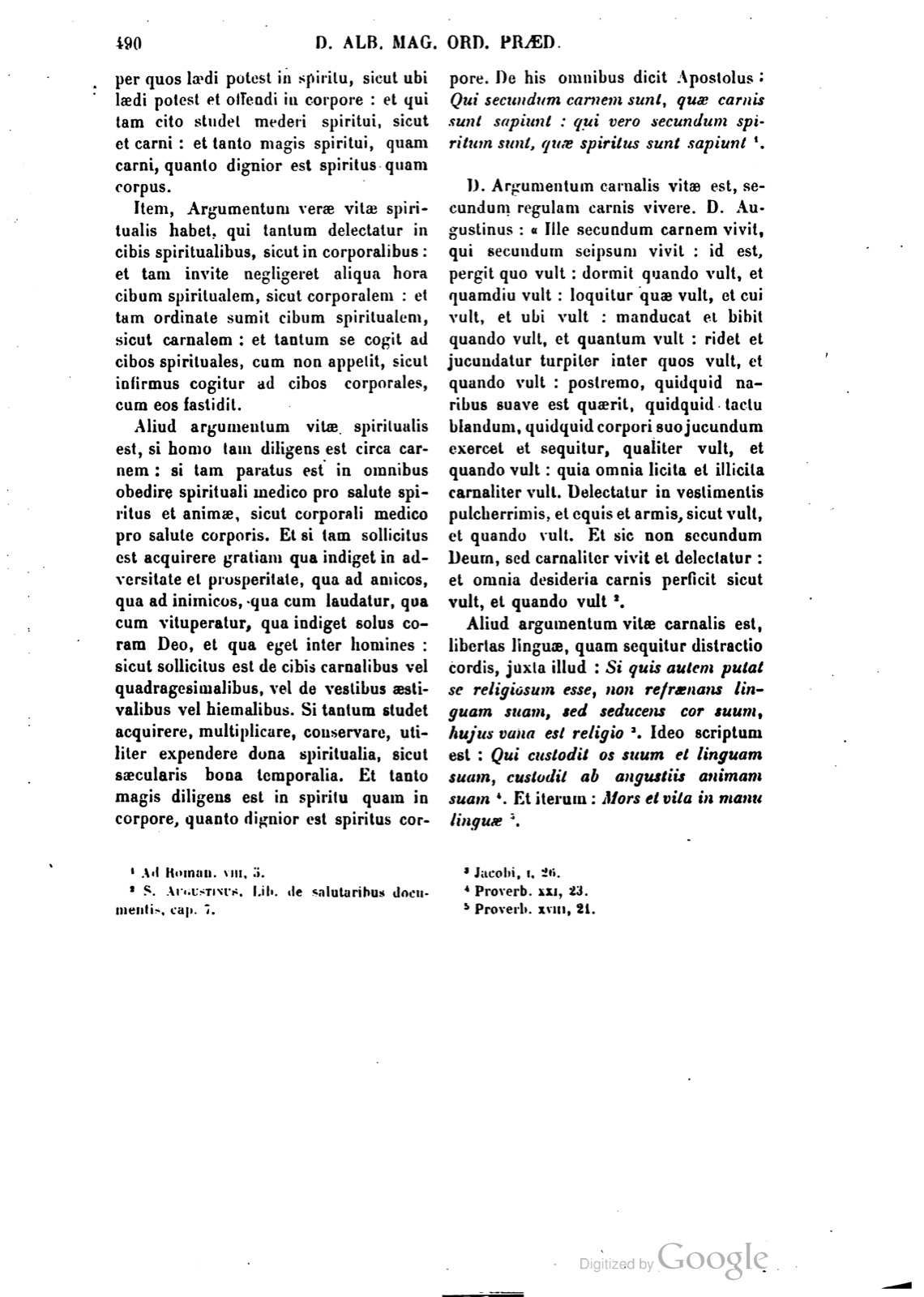
C. Argumentum verae vitae spiritualis habet, cujus spiritus penitus carni dominatur: qui tam cito sentit incommodum spirituale, sicut et corporale: et tantum vitat locum, tempus, et homines, ubi, et per quos laedi potest in spiritu, sicut ubi laedi potest et offendi in corpore: et qui tam cito studet mederi spiritui, sicut et carni: et tanto magis spiritui, quam carni, quanto dignior est spiritus quam corpus.
Item, Argumentum verae vitae spiritualis habet, qui tantum delectatur in cibis spiritualibus, sicut in corporalibus: et tam invite negligeret aliqua hora cibum spiritualem, sicut corporalem: et tam ordinate sumit cibum spiritualem, sicut carnalem: et tantum se cogit ad cibos spirituales, cum non appetit, sicut infirmus cogitur ad cibos corporales, cum eos fastidit.
Aliud argumentum vitae spiritualis est, si homo tam diligens est circa carnem: si tam paratus est in omnibus obedire spirituali medico pro salute spiritus et animae, sicut corporali medico pro salute corporis. Et si tam sollicitus est acquirere gratiam qua indiget in adversitate et prosperitate, qua ad amicos, qua ad inimicos, qua cum laudatur, qua cum vituperatur, qua indiget solus coram Deo, et qua eget inter homines: sicut sollicitus est de cibis carnalibus vel quadragesimalibus, vel de vestibus aestivalibus vel hiemalibus. Si tantum studet acquirere, multiplicare, conservare, utiliter expendere dona spiritualia, sicut saecularis bona temporalia. Et tanto magis diligens est in spiritu quam in corpore, quanto dignior est spiritus corpore. De his omnibus dicit Apostolus: Qui secundum carnem sunt, quae carnis sunt sapiunt: qui vero secundum spiritum sunt, quae spiritus sunt sapiunt 8.
Likewise, that God will require an account of all evils committed, and of good things omitted, and of graces neglected both toward himself and toward the whole community. This introduces just fear.
Likewise, he must receive every good as from God giving it, and this excludes false love and introduces gratitude; and every evil as from God benignly permitting it for our usefulness, and this introduces patience. The more someone advances in these things, the more he is brought into spiritual life, and grows and is confirmed in it.
C. He has the proof of true spiritual life whose spirit entirely dominates the flesh; who feels spiritual inconvenience as quickly as bodily inconvenience; and who avoids the place, time, and persons where and through whom he can be harmed in spirit, just as he avoids where he can be harmed and offended in body; and who as quickly strives to heal the spirit as the flesh, and the spirit more than the flesh by so much as the spirit is more worthy than the body.
Likewise, he has the proof of true spiritual life who delights as much in spiritual foods as in bodily foods; and who would neglect spiritual food at any hour as unwillingly as bodily food; and who receives spiritual food as orderly as carnal food; and who compels himself to spiritual foods, when he does not desire them, as a sick man is compelled to bodily foods when he loathes them.
Another proof of spiritual life exists if a human being is as diligent concerning the flesh; if he is as ready in all things to obey a spiritual physician for the health of spirit and soul as a bodily physician for the health of the body. And if he is as solicitous to acquire the grace which he needs in adversity and prosperity, toward friends, toward enemies, when he is praised, when he is reviled, which he needs alone before God and which he needs among human beings, as he is solicitous about carnal or Lenten foods, or about summer or winter garments. If he is as eager to acquire, multiply, preserve, and usefully expend spiritual gifts as a secular person is with temporal goods. And he is more diligent in spirit than in body by so much as the spirit is more worthy than the body. Concerning all these things the Apostle says: Those who are according to the flesh savor the things that are of the flesh; but those who are according to the spirit savor the things that are of the spirit 8.
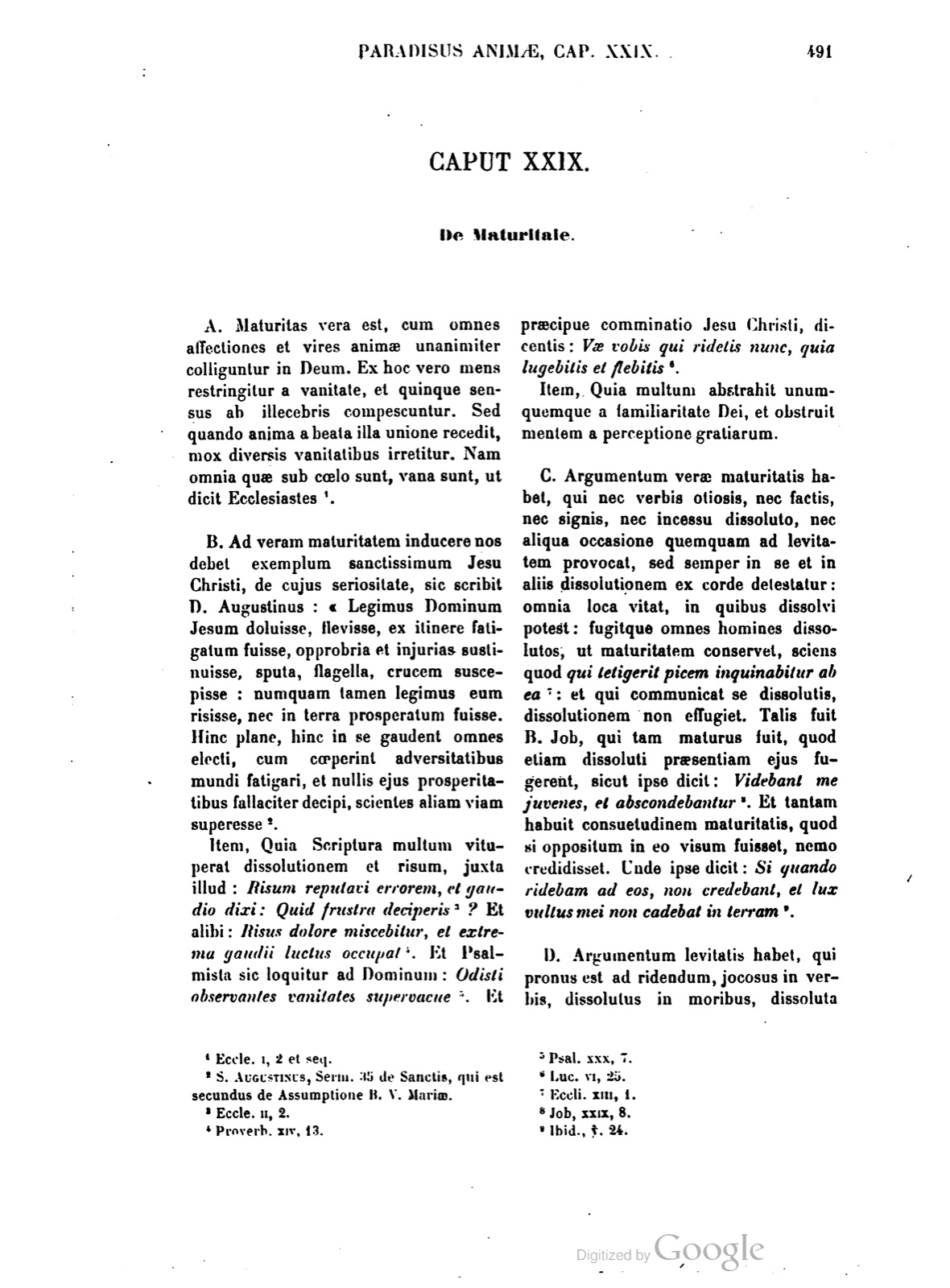
D. Argumentum carnalis vitae est, secundum regulam carnis vivere. D. Augustinus: "Ille secundum carnem vivit, qui secundum seipsum vivit: id est, pergit quo vult: dormit quando vult, et quamdiu vult: loquitur quae vult, et cui vult, et ubi vult: manducat et bibit quando vult, et quantum vult: ridet et jucundatur turpiter inter quos vult, et quando vult: postremo, quidquid naribus suave est quaerit, quidquid tactu blandum, quidquid corpori suo jucundum exercet et sequitur, qualiter vult, et quando vult: quia omnia licita et illicita carnaliter vult. Delectatur in vestimentis pulcherrimis, et equis et armis, sicut vult, et quando vult. Et sic non secundum Deum, sed carnaliter vivit et delectatur: et omnia desideria carnis perficit sicut vult, et quando vult 9."
Aliud argumentum vitae carnalis est, libertas linguae, quam sequitur distractio cordis, juxta illud: Si quis autem putat se religiosum esse, non refraenans linguam suam, sed seducens cor suum, hujus vana est religio 10. Ideo scriptum est: Qui custodit os suum et linguam suam, custodit ab angustiis animam suam 11. Et iterum: Mors et vita in manu linguae 12.
D. The proof of carnal life is to live according to the rule of the flesh. St. Augustine says: "He lives according to the flesh who lives according to himself: that is, he goes where he wishes; he sleeps when he wishes and as long as he wishes; he speaks the things he wishes, to whom he wishes, and where he wishes; he eats and drinks when he wishes and as much as he wishes; he laughs and is shamefully merry among whom he wishes and when he wishes; finally, whatever is pleasant to the nostrils he seeks, whatever is soothing to touch, whatever is pleasing to his body he practices and follows, how he wishes and when he wishes, because he wills all lawful and unlawful things carnally. He delights in very beautiful garments, and horses and arms, as he wishes and when he wishes. And thus he does not live according to God, but carnally lives and delights, and he fulfills all the desires of the flesh as he wishes and when he wishes 9."
Another proof of carnal life is freedom of the tongue, which is followed by distraction of the heart, according to that saying: But if anyone thinks himself to be religious, not restraining his tongue, but deceiving his own heart, this one's religion is vain 10. Therefore it is written: He who guards his mouth and his tongue guards his soul from distresses 11. And again: Death and life are in the hand of the tongue 12.
Notes
- James 1:27. (Jacobi I, 27.) ↩
- John 6:64. (Joan. VI, 64.) ↩
- Romans 8:8. (Ad Roman. VIII, 8.) ↩
- 1 Peter 2:11. (I Petri II, 11.) ↩
- St. Bernard, Letter 2 to the boy Fulco. (S. Bernardus, Epist. 2 ad Fulconem puerum.) ↩
- 2 Corinthians 3:5. (II ad Corinth. III, 5.) ↩
- Philippians 4:13. (Ad Philip. IV, 13.) ↩
- Romans 8:5. (Ad Roman. VIII, 5.) ↩
- St. Augustine, Book on Saving Teachings, chapter 7. (S. Augustinus, Lib. de salutaribus documentis, cap. 7.) ↩
- James 1:26. (Jacobi I, 26.) ↩
- Proverbs 21:23. (Proverb. XXI, 23.) ↩
- Proverbs 18:21. (Proverb. XVIII, 21.) ↩
If a page does not appear, its photograph has not been uploaded yet.