Works › The Paradise of the Soul
Volume 37 · ≈ pp. 487–489
Chapter XXVII. On Freedom.
A marker with ≈ is an approximate page boundary, placed by measure of the text; the page photographs remain the authority. In the paired views, clicking a page marker brings that page into view.
Caput XXVII.
De Libertate.
A. Libertas vera est, non esse ligatum vinculis peccatorum quae vere ligant, juxta illud: Iniquitates suae capiunt impium, et funibus peccatorum suorum constringitur 1. Et vere faciunt servum, juxta illud: Omnis qui facit peccatum, servus est peccati 2. Peccare enim non libertas, nec pars libertatis, ut dicit Anselmus: sed est pessima species servitutis. Ab hac specie servitutis nemo liberatur, nisi solius Filii Dei auxilio, ipso teste: Si vos filius liberaverit, vere liberi eritis 3.
B. Veram libertatem habet, qui non est captus appetitu rerum temporalium, nec laude, vel favore hominum, nec propria placentia, vel displicentia aliena, nec amicitia carnali, vel timore servili, nec delectatione gaudii transitorii.
C. Ad amorem verae libertatis inducere nos debet divinae ordinationis consideratio, quae vult hominem esse liberum. In cujus signum dedit homini liberum arbitrium: in hoc maxime ipsum sibi assimilans, quod a nemine cogi potest, sicut nec Deus ab aliquo cogi potest. Illud liberum arbitrium Deus homini contulit, dicens in Ecclesiastico: Deus ab initio constituit hominem, et reliquit illum in manu consilii sui 4. Et paulo post: Apposuit tibi aquam et ignem, ad quod volueris porrige manum tuam. Ante hominem vita et mors, bonum et malum: quod placuerit ei dabitur illi 5.
Chapter XXVII.
On Freedom.
A. True freedom is not to be bound by the chains of sins, which truly bind, according to that saying: His own iniquities seize the wicked, and he is bound by the ropes of his sins 1. And they truly make a slave, according to that saying: Everyone who commits sin is the slave of sin 2. For to sin is not freedom, nor a part of freedom, as Anselm says; rather it is the worst species of servitude. No one is freed from this species of servitude except by the help of the Son of God alone, as he himself testifies: If the Son frees you, you will truly be free 3.
B. He has true freedom who is not captured by desire for temporal things, nor by praise or favor of human beings, nor by his own pleasing of himself or another's displeasure, nor by carnal friendship, nor by servile fear, nor by delight in transitory joy.
C. Consideration of the divine ordering ought to induce us to love of true freedom, for it wills the human being to be free. As a sign of this, God gave free choice to the human being, assimilating him to himself most of all in this: that he can be compelled by no one, just as God too can be compelled by no one. God bestowed that free choice on the human being, saying in Ecclesiasticus: God from the beginning established the human being, and left him in the hand of his own counsel 4. And a little later: He has placed before you water and fire; stretch out your hand to whichever you wish. Before the human being are life and death, good and evil; what has pleased him will be given to him 5.
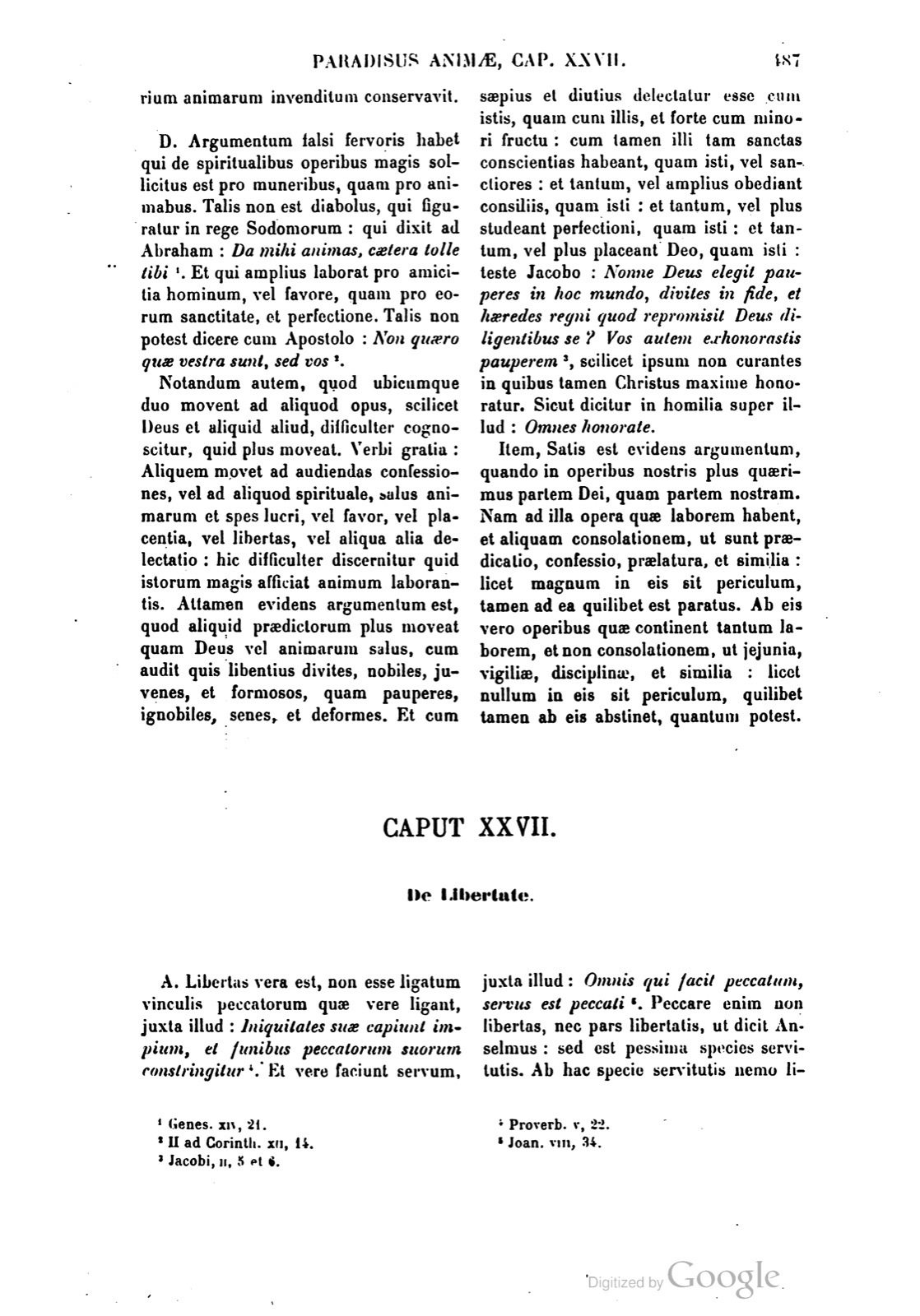
Ad veram libertatem indubitanter inducitur, qui praeceptorum divinorum, et consiliorum, et votorum suorum inviolabili observantia se ligat: qui mentem suam et sensus suos a voluptatibus refraenat: qui membra sua nullis illicitis occupat: qui obedientiae jugum ex corde amat: qui toto nisu, qualiter Deo suo placeat, elaborat. Quanto amplius quis praedictis innititur, tanto citius veram libertatem consequitur, et in ea fortius radicatur. Qui vero in hoc mundo libere voluntatem suam in omnibus, et in quantum potest exsequitur, variis diaboli laqueis irretitur: et cum liberior esse videtur, tunc in servitute et captivitate diaboli fortius et certius detinetur.
D. Argumentum verae libertatis habet, qui nihil eorum desiderat quae a familiaritate Dei mentem alienant vel elongant: sicut est praelatio, circa exteriora frequens occupatio, de commodo carnis nimia sollicitudo, mentis dissolutio, ad diversa negotia distractio, alienae vitae et conscientiae temeraria discussio, propriorum defectuum excusatio sive minoratio, defectuum proximorum manifestatio vel aggravatio.
Aliud argumentum libertatis est securitas mentis de remissione totius culpae et poenae, quae ex fervore cordis provenit: qui quandoque cremat in corde, sicut ignis in fornace, et hominem ante frigidum et pallidum, in oratione facit calidum et rufum: qui fervor omnem maculam et poenam consumit, sicut ignis rubiginem ferri exurit.
One is brought without doubt to true freedom who binds himself by inviolable observance of the divine precepts and counsels and his vows; who restrains his mind and his senses from pleasures; who occupies his members in no illicit things; who loves from the heart the yoke of obedience; who labors with his whole effort how he may please his God. The more one leans upon the aforesaid things, the more quickly he obtains true freedom, and the more strongly he is rooted in it. But he who in this world freely carries out his own will in all things and as much as he can, is entangled by various snares of the devil; and when he seems to be more free, then he is held more strongly and more certainly in the servitude and captivity of the devil.
D. He has the proof of true freedom who desires none of those things which alienate or distance the mind from familiarity with God, such as prelacy, frequent occupation about exterior things, excessive solicitude about the advantage of the flesh, dissolution of mind, distraction into diverse business, rash examination of another's life and conscience, excuse or lessening of one's own defects, and manifestation or aggravation of the defects of neighbors.
Another proof of freedom is security of mind concerning the remission of the whole fault and punishment, which comes from fervor of heart. This sometimes burns in the heart like fire in a furnace, and in prayer makes a human being who was before cold and pale become warm and red. This fervor consumes every stain and punishment, just as fire burns out the rust of iron.
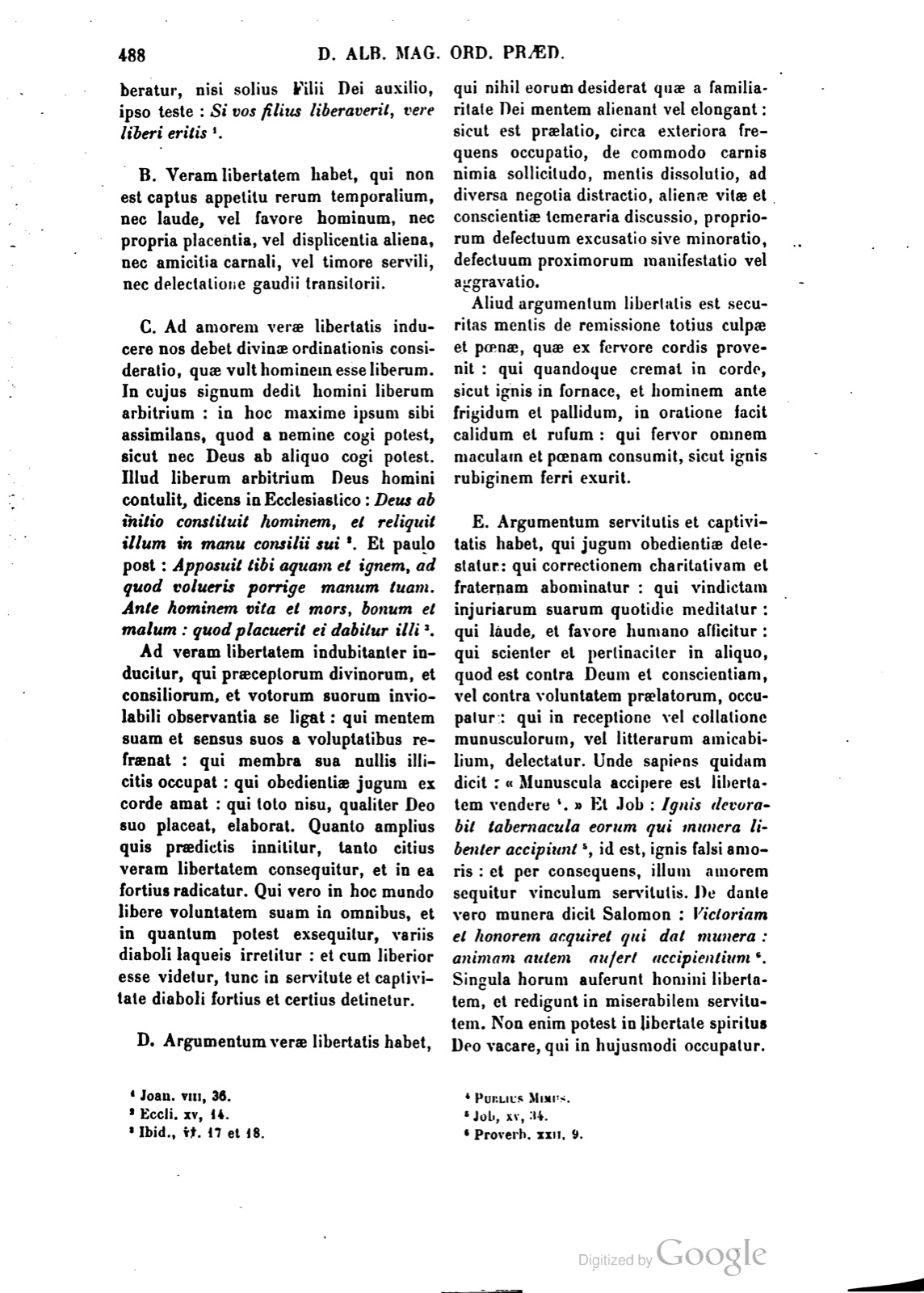
E. Argumentum servitutis et captivitatis habet, qui jugum obedientiae detestatur: qui correctionem charitativam et fraternam abominatur: qui vindictam injuriarum suarum quotidie meditatur: qui laude, et favore humano afficitur: qui scienter et pertinaciter in aliquo, quod est contra Deum et conscientiam, vel contra voluntatem praelatorum, occupatur: qui in receptione vel collatione munusculorum, vel litterarum amicabilium, delectatur. Unde sapiens quidam dicit: "Munuscula accipere est libertatem vendere 6." Et Job: Ignis devorabit tabernacula eorum qui munera libenter accipiunt 7, id est, ignis falsi amoris: et per consequens, illum amorem sequitur vinculum servitutis. De dante vero munera dicit Salomon: Victoriam et honorem acquiret qui dat munera: animam autem aufert accipientium 8. Singula horum auferunt homini libertatem, et redigunt in miserabilem servitutem. Non enim potest in libertate spiritus Deo vacare, qui in hujusmodi occupatur.
E. He has the proof of servitude and captivity who detests the yoke of obedience; who abominates charitable and fraternal correction; who daily meditates revenge for his injuries; who is affected by praise and human favor; who knowingly and pertinaciously is occupied in something which is against God and conscience, or against the will of prelates; who is delighted in the receiving or conferring of little gifts or friendly letters. Hence a certain wise man says: "To receive little gifts is to sell freedom 6." And Job says: Fire will devour the tents of those who willingly receive gifts 7, that is, the fire of false love; and consequently the bond of servitude follows that love. But concerning one who gives gifts Solomon says: He will acquire victory and honor who gives gifts; but he takes away the soul of the receivers 8. Each of these takes freedom away from a human being and reduces him to miserable servitude. For he cannot in freedom of spirit be at leisure for God who is occupied in things of this kind.
Notes
If a page does not appear, its photograph has not been uploaded yet.