Works › The Paradise of the Soul
Volume 37 · ≈ pp. 483–484
Chapter XXIV. On Sadness.
A marker with ≈ is an approximate page boundary, placed by measure of the text; the page photographs remain the authority. In the paired views, clicking a page marker brings that page into view.
Caput XXIV.
De Tristitia.
naturalis. Felix esset, qui dicere posset cum Isaia: Gaudens gaudebo in Domino, scilicet creatore, et exsultabit anima mea in Deo meo, scilicet redemptore, quia induit me vestimentis salutis 1, etc.
A. Tristitia vera est dolor cordis pro omnibus injuriis, quas patiens Deus innocenter sustinuit a suis creaturis a principio mundi, et usque in finem sustinebit tam a spiritualibus quam a saecularibus hominibus. Iste dolor innumerabiles lacrymas sanguineas elicere debet ab oculis singulorum Deum amantium.
Alia pars verae tristitiae est, quod frequenter homo in tentationibus sine repugnantia superatur. Quando enim aliquid videt, vel audit, tam in volatilibus quam in reptilibus, quod spectat ad impudicitiam: statim mens impudicis cogitationibus, vel voluptatibus, vel affectionibus sordidatur. Quando vero percipit anima ex quinque sensibus, quod movere potest ad vanam gloriam, invidiam, iram, rancorem, detractionem, avaritiam, levitatem, vel carnalem amicitiam, vel aliquod peccatum: statim sine pugna dejicitur in aliquod praedictorum, dubius si umquam a tali peccato resurgat. Et si auxilio Dei resurgit, incertus est, si umquam recuperet gratiam quam habebat, et tantam quantam ante habuit. Homo enim per se cadere potest, per se autem numquam resurgere potest: Et recordatus est, scilicet Deus, quia caro sunt, spiritus vadens et non rediens 2.
Alia pars verae tristitiae est, quod multiplex gratia effluens a fonte divinae pietatis ad nihil redigitur, eo quod non revertitur ad suum principium, unde fluxit, cum multiplici foenore, secundum ordinationem Dei. Hoc omnes creaturae digne deflere non possent.
B. Ad veram tristitiam inducere nos debet sanctissimum vitae Jesu Christi exemplum, cujus anima tristis fuit a principio vitae suae usque ad mortem. Qui etiam tristes beatos esse confitetur, dicens: Beati qui lugent, quoniam ipsi consolabuntur 3. Quia non nisi per tristitiam gaudia inveniri valent, dicit quaedam Glossa super canonicam Jacobi.
Chapter XXIV.
On Sadness.
natural. Happy would he be who could say with Isaiah: Rejoicing I shall rejoice in the Lord, namely the creator, and my soul will exult in my God, namely the redeemer, because he has clothed me with garments of salvation 1, etc.
A. True sadness is sorrow of heart for all injuries which God, suffering, has innocently endured from his creatures from the beginning of the world, and will endure until the end, both from spiritual persons and from secular persons. This sorrow ought to draw innumerable bloody tears from the eyes of each one who loves God.
Another part of true sadness is that frequently a human being is overcome in temptations without resistance. For when he sees or hears anything, both among flying creatures and among creeping things, which looks toward immodesty, immediately the mind is befouled with immodest thoughts, or pleasures, or affections. But when the soul perceives from the five senses what can move toward vain glory, envy, anger, rancor, detraction, avarice, levity, or carnal friendship, or some sin, immediately without battle it is cast down into one of the aforesaid things, doubtful whether it will ever rise again from such a sin. And if by the help of God it rises again, it is uncertain whether it will ever recover the grace which it had, and as much as it had before. For a human being can fall by himself, but by himself he can never rise again: And he remembered, namely God, that they are flesh, a spirit going and not returning 2.
Another part of true sadness is that manifold grace flowing out from the fountain of divine piety is reduced to nothing, because it does not return to its principle, whence it flowed, with manifold interest, according to the ordering of God. All creatures could not worthily weep over this.
B. The most holy example of the life of Jesus Christ ought to induce us to true sadness, for his soul was sad from the beginning of his life until death. He also confesses those who are sad to be blessed, saying: Blessed are those who mourn, for they themselves will be consoled 3. Because joys can be found only through sadness, as a certain Gloss says on the canonical epistle of James.
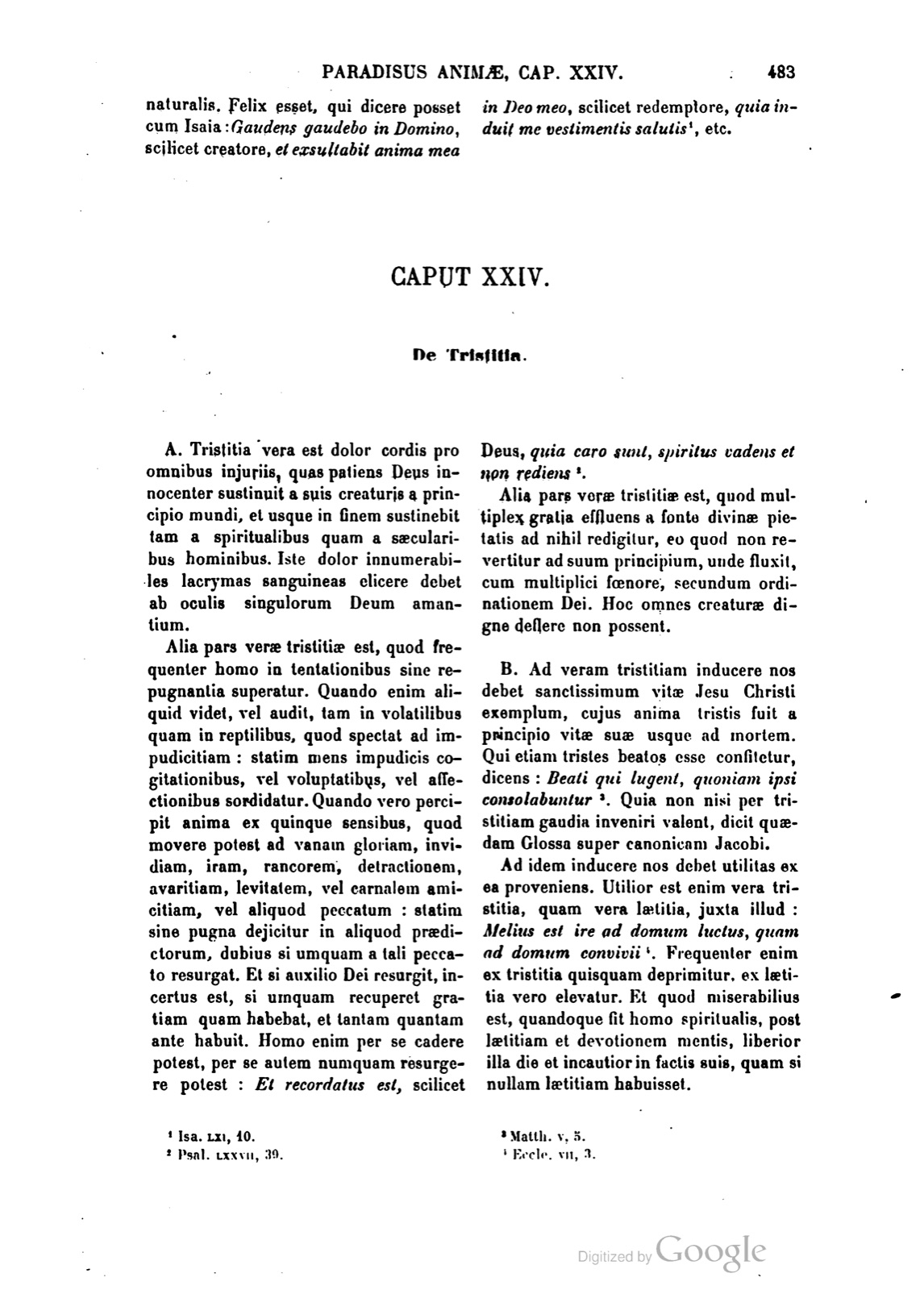
Ad idem inducere nos debet utilitas ex ea proveniens. Utilior est enim vera tristitia, quam vera laetitia, juxta illud: Melius est ire ad domum luctus, quam ad domum convivii 4. Frequenter enim ex tristitia quisquam deprimitur, ex laetitia vero elevatur. Et quod miserabilius est, quandoque fit homo spiritualis, post laetitiam et devotionem mentis, liberior illa die et incautior in factis suis, quam si nullam laetitiam habuisset.
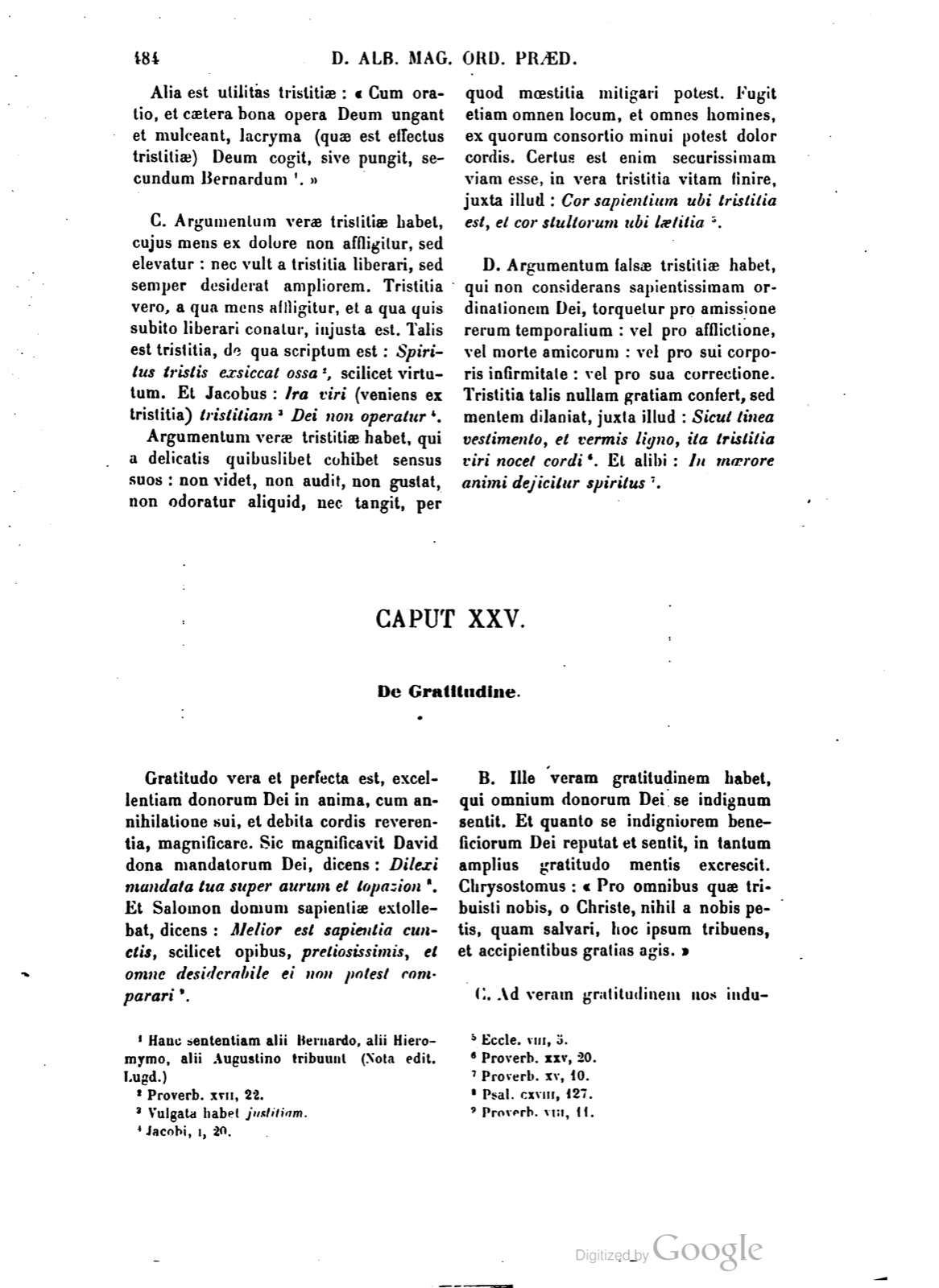
Alia est utilitas tristitiae: "Cum oratio, et caetera bona opera Deum ungant et mulceant, lacryma, quae est effectus tristitiae, Deum cogit, sive pungit, secundum Bernardum 5."
C. Argumentum verae tristitiae habet, cujus mens ex dolore non affligitur, sed elevatur: nec vult a tristitia liberari, sed semper desiderat ampliorem. Tristitia vero, a qua mens affligitur, et a qua quis subito liberari conatur, injusta est. Talis est tristitia, de qua scriptum est: Spiritus tristis exsiccat ossa 6, scilicet virtutum. Et Jacobus: Ira viri, veniens ex tristitia, tristitiam Dei 7 non operatur 8.
Argumentum verae tristitiae habet, qui a delicatis quibuslibet cohibet sensus suos: non videt, non audit, non gustat, non odoratur aliquid, nec tangit, per quod maestitia mitigari potest. Fugit etiam omnem locum, et omnes homines, ex quorum consortio minui potest dolor cordis. Certus est enim securissimam viam esse, in vera tristitia vitam finire, juxta illud: Cor sapientium ubi tristitia est, et cor stultorum ubi laetitia 9.
D. Argumentum falsae tristitiae habet, qui non considerans sapientissimam ordinationem Dei, torquetur pro amissione rerum temporalium: vel pro afflictione, vel morte amicorum: vel pro sui corporis infirmitate: vel pro sua correctione. Tristitia talis nullam gratiam confert, sed mentem dilaniat, juxta illud: Sicut tinea vestimento, et vermis ligno, ita tristitia viri nocet cordi 10. Et alibi: In maerore animi dejicitur spiritus 11.
The usefulness arising from it ought to induce us to the same. For true sadness is more useful than true gladness, according to that saying: It is better to go to the house of mourning than to the house of feasting 4. For frequently someone is pressed downward by sadness, but is lifted up by gladness. And what is more pitiable, sometimes a spiritual human being, after gladness and devotion of mind, becomes on that day more free and less cautious in his deeds than if he had had no gladness.
There is another usefulness of sadness: "Since prayer and the other good works anoint and soothe God, a tear, which is the effect of sadness, compels God, or pierces him, according to Bernard 5."
C. He has the proof of true sadness whose mind is not afflicted by sorrow, but is lifted up; nor does he wish to be freed from sadness, but always desires greater sadness. But sadness by which the mind is afflicted, and from which someone suddenly strives to be freed, is unjust. Such is the sadness about which it is written: A sad spirit dries up the bones 6, namely of virtues. And James says: The anger of a man, coming from sadness, does not work the sadness of God 7 8.
He has the proof of true sadness who restrains his senses from every delicate thing: he does not see, does not hear, does not taste, does not smell, and does not touch anything by which sadness can be mitigated. He also flees every place and all persons from whose company the sorrow of the heart can be lessened. For he is certain that it is the safest way to finish life in true sadness, according to that saying: The heart of the wise is where sadness is, and the heart of fools where gladness is 9.
D. He has the proof of false sadness who, not considering the most wise ordering of God, is tormented over the loss of temporal things, or over the affliction or death of friends, or over the infirmity of his own body, or over his correction. Such sadness confers no grace, but tears the mind apart, according to that saying: As a moth harms a garment and a worm harms wood, so the sadness of a man harms the heart 10. And elsewhere: In the sorrow of the soul the spirit is cast down 11.
Notes
- Isaiah 61:10. (Isa. LXI, 10.) ↩
- Psalm 77:39. (Psal. LXXVII, 39.) ↩
- Matthew 5:5. (Matth. V, 5.) ↩
- Ecclesiastes 7:3. (Eccle. VII, 3.) ↩
- Some attribute this sentence to Bernard, others to Jerome, others to Augustine (note of the Lyon editor). (Hanc sententiam alii Bernardo, alii Hieronymo, alii Augustino tribuunt (Nota edit. Lugd.).) ↩
- Proverbs 17:22. (Proverb. XVII, 22.) ↩
- The Vulgate has "justice." (Vulgata habet justitiam.) ↩
- James 1:20. (Jacobi I, 20.) ↩
- Ecclesiastes 7:5. (Eccle. VII, 5.) ↩
- Proverbs 25:20. (Proverb. XXV, 20.) ↩
- Proverbs 15:10. (Proverb. XV, 10.) ↩
If a page does not appear, its photograph has not been uploaded yet.