Works › The Paradise of the Soul
Volume 37 · ≈ pp. 481–482
Chapter XXIII. On Joy.
A marker with ≈ is an approximate page boundary, placed by measure of the text; the page photographs remain the authority. In the paired views, clicking a page marker brings that page into view.
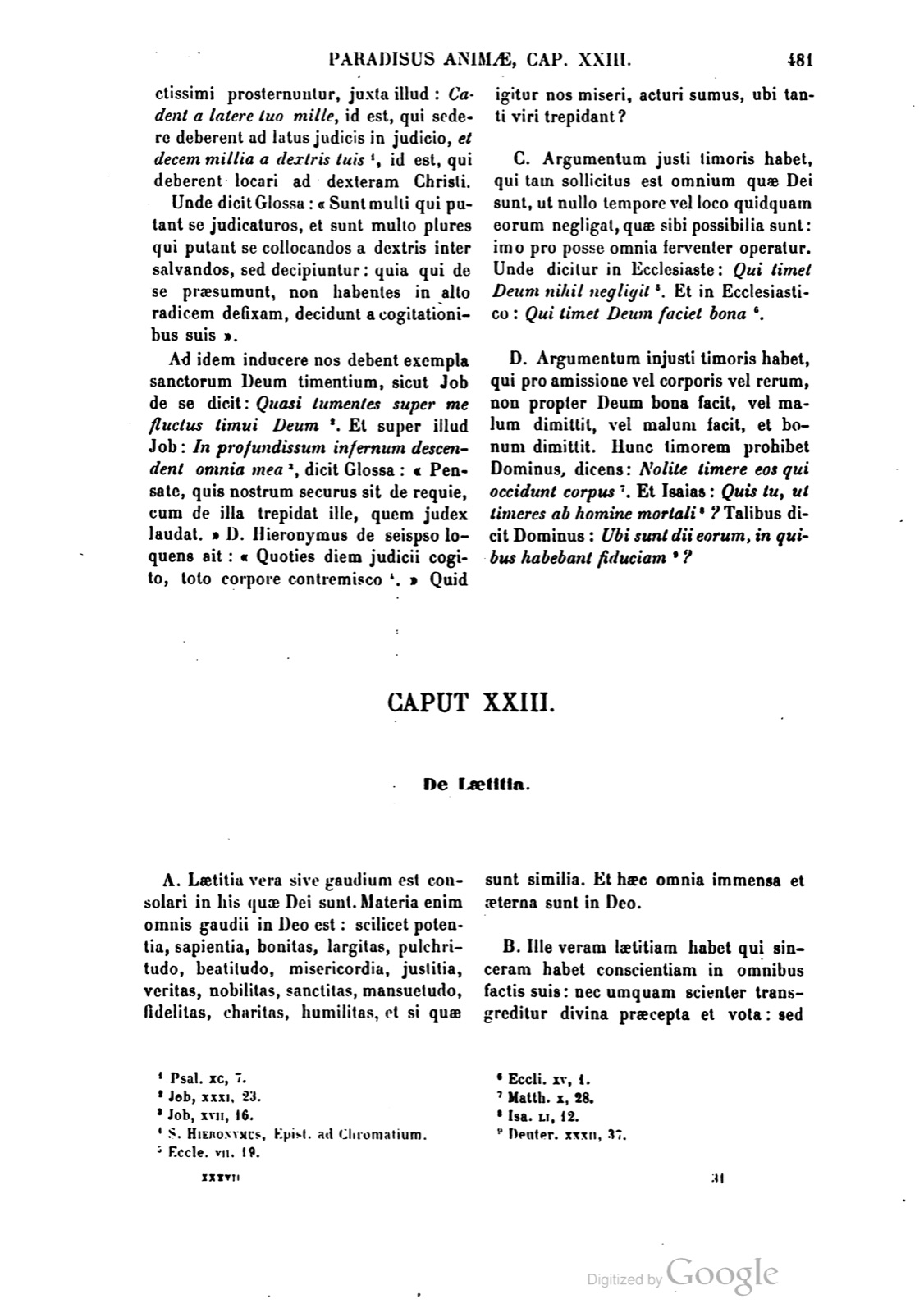
Caput XXIII.
De Laetitia.
A. Laetitia vera sive gaudium est consolari in his quae Dei sunt. Materia enim omnis gaudii in Deo est: scilicet potentia, sapientia, bonitas, largitas, pulchritudo, beatitudo, misericordia, justitia, veritas, nobilitas, sanctitas, mansuetudo, fidelitas, charitas, humilitas, et si quae sunt similia. Et haec omnia immensa et aeterna sunt in Deo.
B. Ille veram laetitiam habet qui sinceram habet conscientiam in omnibus factis suis: nec umquam scienter transgreditur divina praecepta et vota: sed semper intendit proficere, et exemplis Jesu Christi, et divinis moribus se conformare. De hac conscientia gaudebat et gloriabatur Apostolus, dicens: Gloria nostra haec est, testimonium conscientiae nostrae, quod in simplicitate cordis et sinceritate Dei, et non in sapientia carnali, sed in gratia Dei, conversati sumus in hoc mundo, abundantius autem ad vos 1.
C. Ad veram laetitiam inducere nos debet, quod super omnia bonus Deus inter omnes creaturas solam creaturam humanam in tantum sibi univit, ut vere dicatur Deus esse homo, et homo esse Deus. Et quidquid Deus habet per naturam, habet homo per gratiam: Nusquam enim Angelos apprehendit, sed semen Abrahae apprehendit, ut dicit Apostolus 2. Chrysostomus: « Nonne magnum est et mirabile carnem nostram sursum sedere, et ab angelis et archangelis adorari? »
Aliud inductivum est, quod Deus nos certificavit de aeterna beatitudine, promissis legis et prophetarum munita et juramento, juxta illud: Jusjurandum quod juravit ad Abraham patrem nostrum, daturum se nobis 3. Per privilegia quatuor Evangelistarum: per testimonium Apostolorum: per pignus Spiritus sancti in baptismo, qui est pignus haereditatis nostrae: per arrham, id est, praegustationem in devotione et dulcedine Dei: per obsidem, qui est Christus, unigenitus Dei Filius. Ad hoc duplex gaudium hortatur nos Apostolus, dicens: Gaudete in Domino semper, videlicet propter divinam unionem: iterum dico, gaudete, nempe propter aeternae beatitudinis certitudinem.
Chapter XXIII.
On Joy.
A. True joy or gladness is to be consoled in those things that are God's. For the matter of all joy is in God: namely power, wisdom, goodness, largesse, beauty, blessedness, mercy, justice, truth, nobility, holiness, meekness, faithfulness, charity, humility, and any similar things. And all these are immense and eternal in God.
B. He has true joy who has a sincere conscience in all his deeds and never knowingly transgresses divine precepts and vows, but always intends to advance and to conform himself to the examples of Jesus Christ and the divine manners. The Apostle rejoiced and gloried in this conscience, saying: This is our glory, the testimony of our conscience, that in simplicity of heart and sincerity of God, and not in carnal wisdom but in the grace of God, we have conducted ourselves in this world, and more abundantly toward you 1.
C. This ought to induce us to true joy, that God, good above all things, among all creatures united to himself the human creature alone to such an extent that God is truly said to be man, and man to be God. And whatever God has by nature, man has by grace: For he nowhere takes hold of angels, but he takes hold of the seed of Abraham, as the Apostle says 2. Chrysostom says: "Is it not great and marvelous that our flesh sits above and is adored by angels and archangels?"
Another inducement is that God has made us certain of eternal blessedness, fortified by promises of the law and prophets and by oath, according to that: The oath that he swore to Abraham our father, that he would give himself to us 3. By the privileges of the four Evangelists, by the testimony of the Apostles, by the pledge of the Holy Spirit in baptism, who is the pledge of our inheritance, by the earnest-money, that is, foretaste in devotion and sweetness of God, by the hostage, who is Christ, the only-begotten Son of God. To this twofold joy the Apostle exhorts us, saying: Rejoice in the Lord always, namely because of the divine union; again I say, rejoice, namely because of the certainty of eternal blessedness.
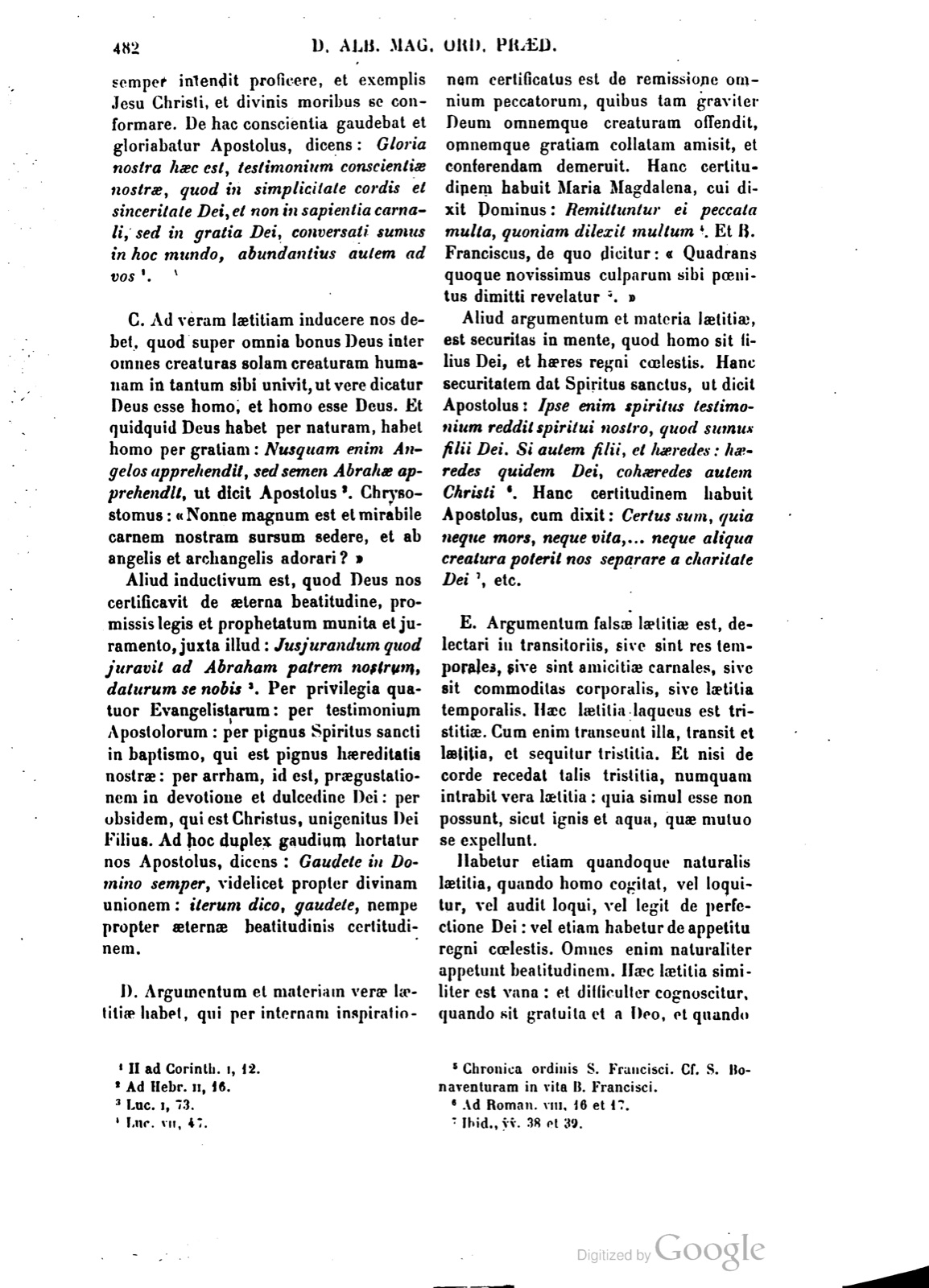
D. Argumentum et materiam verae laetitiae habet, qui per internam inspirationem certificatus est de remissione omnium peccatorum, quibus tam graviter Deum omnemque creaturam offendit, omnemque gratiam collatam amisit, et conferendam demeruit. Hanc certitudinem habuit Maria Magdalena, cui dixit Dominus: Remittuntur ei peccata multa, quoniam dilexit multum 4. Et B. Franciscus, de quo dicitur: « Quadrans quoque novissimus culparum sibi penitus dimitti revelatur 5. »
Aliud argumentum et materia laetitiae, est securitas in mente, quod homo sit filius Dei, et haeres regni coelestis. Hanc securitatem dat Spiritus sanctus, ut dicit Apostolus: Ipse enim spiritus testimonium reddit spiritui nostro, quod sumus filii Dei. Si autem filii, et haeredes: haeredes quidem Dei, cohaeredes autem Christi 6. Hanc certitudinem habuit Apostolus, cum dixit: Certus sum, quia neque mors, neque vita,... neque aliqua creatura poterit nos separare a charitate Dei 7, etc.
E. Argumentum falsae laetitiae est, delectari in transitoriis, sive sint res temporales, sive sint amicitiae carnales, sive sit commoditas corporalis, sive laetitia temporalis. Haec laetitia laqueus est tristitiae. Cum enim transeunt illa, transit et laetitia, et sequitur tristitia. Et nisi de corde recedat talis tristitia, numquam intrabit vera laetitia: quia simul esse non possunt, sicut ignis et aqua, quae mutuo se expellunt.
Habetur etiam quandoque naturalis laetitia, quando homo cogitat, vel loquitur, vel audit loqui, vel legit de perfectione Dei: vel etiam habetur de appetitu regni coelestis. Omnes enim naturaliter appetunt beatitudinem. Haec laetitia similiter est vana: et difficulter cognoscitur, quando sit gratuita et a Deo, et quando
D. He has the proof and matter of true joy who through internal inspiration has been made certain of the remission of all sins by which he so gravely offended God and every creature, lost every grace conferred, and demerited grace to be conferred. Mary Magdalene had this certainty, to whom the Lord said: Many sins are forgiven her, because she has loved much 4. And blessed Francis, concerning whom it is said: "It is revealed to him that the very last farthing of faults is wholly forgiven him 5."
Another proof and matter of joy is security in the mind that the human being is a son of God and heir of the heavenly kingdom. The Holy Spirit gives this security, as the Apostle says: For the Spirit himself gives testimony to our spirit that we are sons of God. But if sons, also heirs: heirs indeed of God, and coheirs of Christ 6. The Apostle had this certainty when he said: I am certain that neither death nor life... nor any creature will be able to separate us from the charity of God 7, etc.
E. The proof of false joy is to delight in transitory things, whether they are temporal goods, carnal friendships, bodily convenience, or temporal gladness. This joy is a snare of sadness. For when those things pass, joy also passes and sadness follows. And unless such sadness withdraws from the heart, true joy will never enter, because they cannot exist together, like fire and water, which mutually expel each other.
Natural joy is also sometimes had when a human being thinks, speaks, hears speech, or reads about the perfection of God, or when it is had from appetite for the heavenly kingdom. For all naturally desire blessedness. This joy likewise is vain, and it is difficult to know when it is gratuitous and from God, and when
Notes
- 2 Corinthians 1:12. (II ad Corinth. I, 12.) ↩
- Hebrews 2:16. (Ad Hebr. II, 16.) ↩
- Luke 1:73. (Luc. I, 73.) ↩
- Luke 7:47. (Luc. VII, 47.) ↩
- Chronicle of the Order of St. Francis. Compare St. Bonaventure in the life of blessed Francis. (Chronica ordinis S. Francisci. Cf. S. Bonaventuram in vita B. Francisci.) ↩
- Romans 8:16 and 17. (Ad Roman. VIII, 16 et 17.) ↩
- The same, verses 38 and 39. (Ibid., v. 38 et 39.) ↩
If a page does not appear, its photograph has not been uploaded yet.