Works › The Paradise of the Soul
Volume 37 · ≈ pp. 479–481
Chapter XXII. On Fear.
A marker with ≈ is an approximate page boundary, placed by measure of the text; the page photographs remain the authority. In the paired views, clicking a page marker brings that page into view.
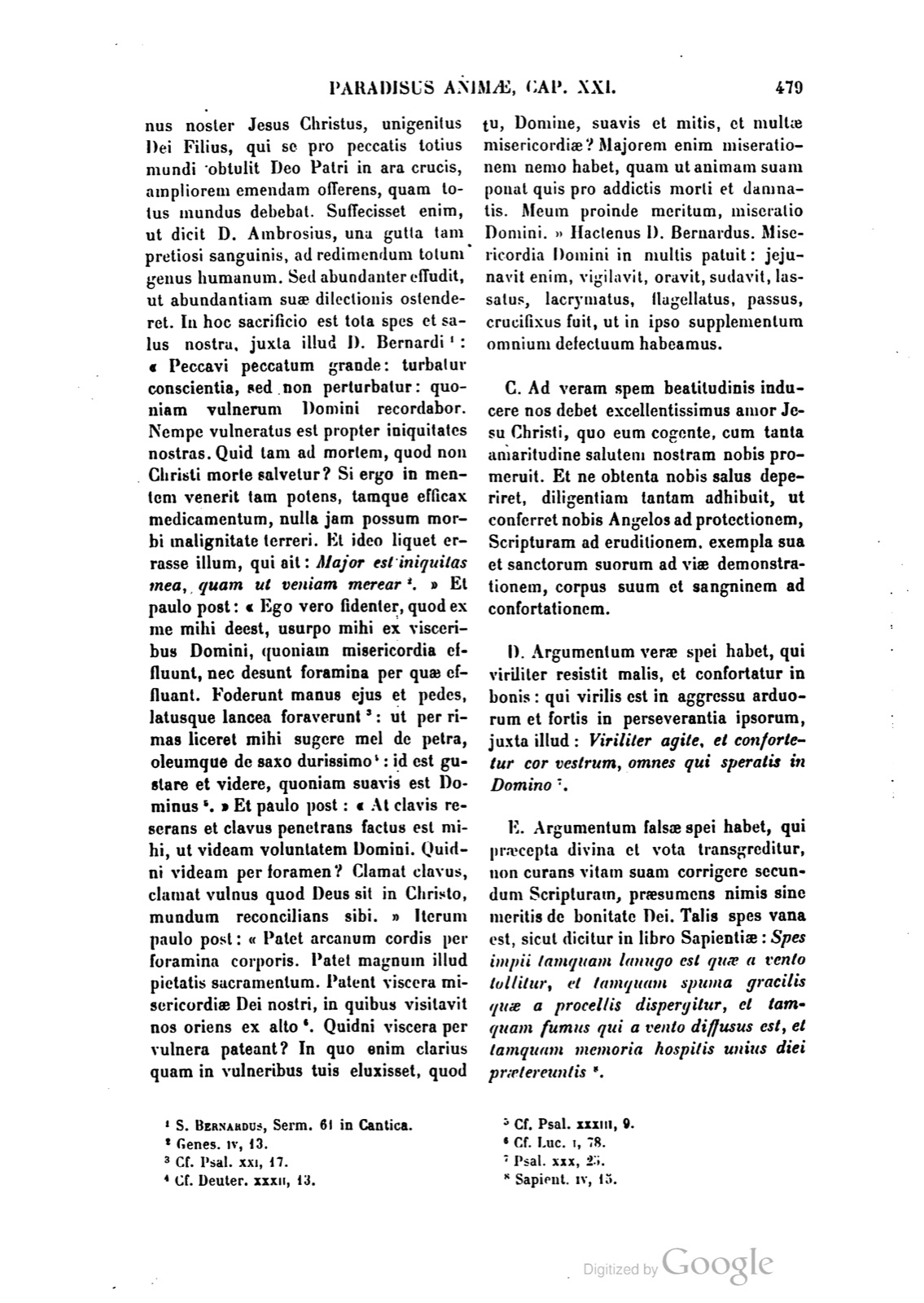
Caput XXII.
De Timore.
A. Timor justus est fide et moribus divinorum diligens custodia praeceptorum. Item, justus timor est anxietas cordis, retrahens hominem ab illicito usu membrorum, sensuumque exteriorum, et affectionum interiorum: ne anima vel a Deo penitus separetur, vel a familiaritate ipsius aliquantulum elongetur. Cavens etiam ne mens vel in cibo, vel in potu, vel in somno, vel in aliqua creatura minimam delectationem quaerat, et sic a fervore tepescat. Hanc anxietatem habet sponsa ad sponsum charissimum: ne in aliquo motu, incessu, verbo vel facto ipsum offendat, quo ingratitudinem ejus incurrat. Item, ne minus grata sit per culpam aliquam, etiam minimam. Justus timor cogit non solum a peccatis gravibus, imo etiam a venialibus abstinere. Nam ex consuetudine venialium securitas mentis et familiaritas Dei amittitur, et gratia multiformis negligitur.
B. Ad justum timorem nos inducere debet multiplex ejus utilitas. Est enim initium sapientiae, teste Psalmista: Initium sapientiae timor Domini 1. Et initium justitiae, juxta illud: Qui sine timore est, non poterit justificari 2. Item, est signaculum et conclusio omnium virtutum et gratiarum, juxta illud: Timor Dei super omnia se superponit 3. Ubi non est timor Domini, omnis gratia subito dispergitur, et conscientia pervertitur, juxta illud: Si non in timore Domini tenueris te instanter, cito subvertetur domus tua 4.
Chapter XXII.
On Fear.
A. Just fear is the diligent guarding, by faith and morals, of the divine precepts. Likewise, just fear is anxiety of heart drawing a human being back from illicit use of the members, the exterior senses, and interior affections, lest the soul be either wholly separated from God or be drawn somewhat away from his familiarity. It also guards lest the mind seek even the least delight in food, drink, sleep, or any creature, and thus grow tepid from fervor. The bride has this anxiety toward the dearest bridegroom: lest in any movement, gait, word, or deed she offend him, whereby she incur his displeasure. Likewise, lest through some fault, even the least, she be less pleasing. Just fear compels one to abstain not only from grave sins but also from venial ones. For by habit of venial sins security of mind and familiarity with God are lost, and manifold grace is neglected.
B. Its manifold usefulness ought to induce us to just fear. For it is the beginning of wisdom, as the Psalmist testifies: The beginning of wisdom is fear of the Lord 1. And the beginning of justice, according to that: He who is without fear will not be able to be justified 2. Likewise, it is the seal and conclusion of all virtues and graces, according to that: The fear of God sets itself over all things 3. Where there is no fear of the Lord, all grace is suddenly scattered and conscience is perverted, according to that: If you do not hold yourself instantly in the fear of the Lord, your house will quickly be overturned 4.
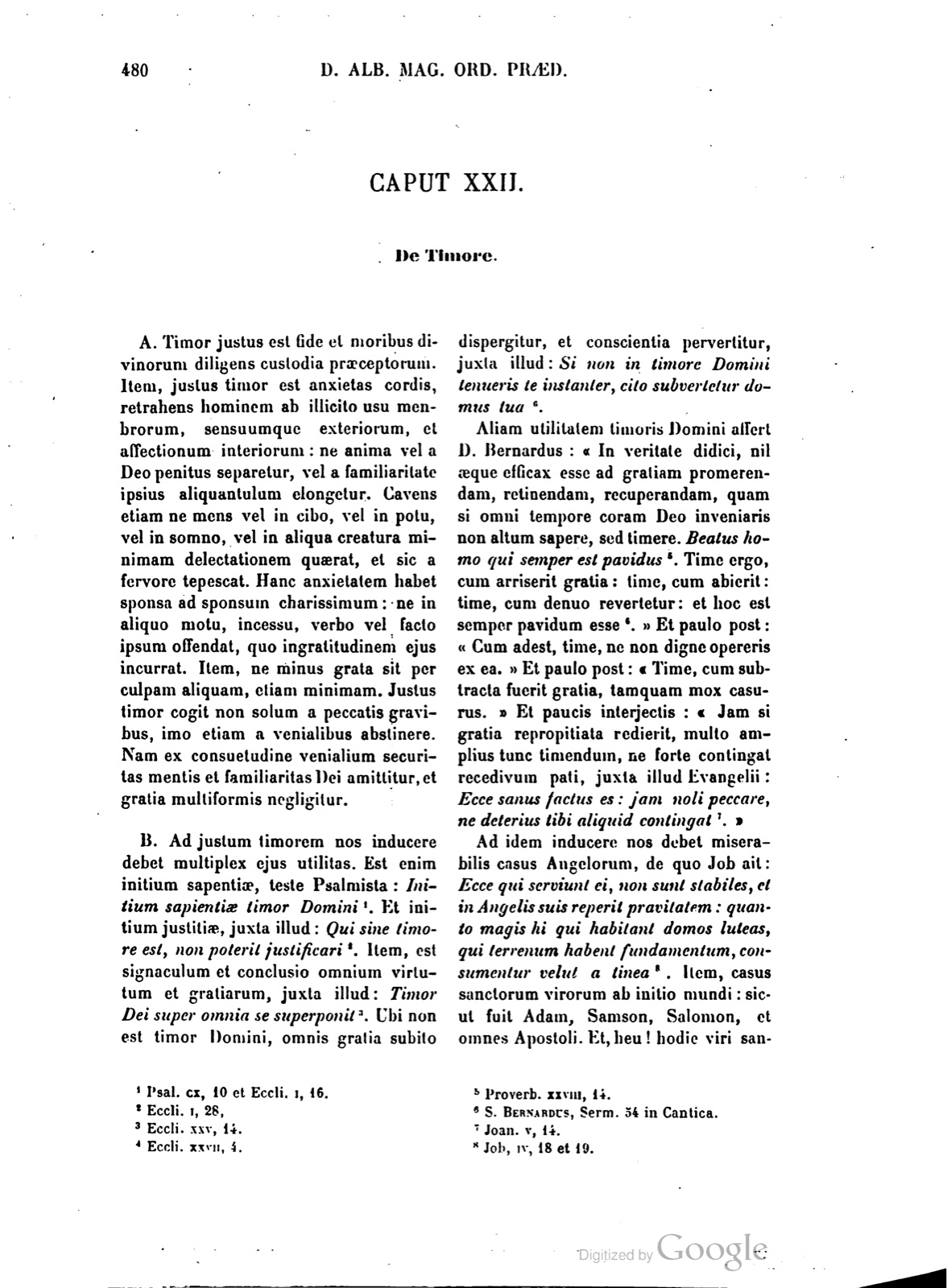
Aliam utilitatem timoris Domini affert D. Bernardus: « In veritate didici, nil aeque efficax esse ad gratiam promerendam, retinendam, recuperandam, quam si omni tempore coram Deo inveniaris non altum sapere, sed timere. Beatus homo qui semper est pavidus 5. Time ergo, cum arriserit gratia: time, cum abierit: time, cum denuo revertetur: et hoc est semper pavidum esse 6. » Et paulo post: « Cum adest, time, ne non digne opereris ex ea. » Et paulo post: « Time, cum subtracta fuerit gratia, tamquam mox casurus. » Et paucis interjectis: « Jam si gratia repropitiata redierit, multo amplius tunc timendum, ne forte contingat recidivum pati, juxta illud Evangelii: Ecce sanus factus es: jam noli peccare, ne deterius tibi aliquid contingat 7. »
Ad idem inducere nos debet miserabilis casus Angelorum, de quo Job ait: Ecce qui serviunt ei, non sunt stabiles, et in Angelis suis reperit pravitatem: quanto magis hi qui habitant domos luteas, qui terrenum habent fundamentum, consumentur velut a tinea 8. Item, casus sanctorum virorum ab initio mundi: sicut fuit Adam, Samson, Salomon, et omnes Apostoli. Et, heu! hodie viri sanctissimi prosternuntur, juxta illud: Cadent a latere tuo mille, id est, qui sedere deberent ad latus judicis in judicio, et decem millia a dextris tuis 9, id est, qui deberent locari ad dexteram Christi.
Unde dicit Glossa: « Sunt multi qui putant se judicaturos, et sunt multo plures qui putant se collocandos a dextris inter salvandos, sed decipiuntur: quia qui de se praesumunt, non habentes in alto radicem defixam, decidunt a cogitationibus suis ». Ad idem inducere nos debent exempla sanctorum Deum timentium, sicut Job de se dicit: Quasi tumentes super me fluctus timui Deum 10. Et super illud Job: In profundissimum infernum descendent omnia mea 11, dicit Glossa: « Pensate, quis nostrum securus sit de requie, cum de illa trepidat ille, quem judex laudat. » D. Hieronymus de seipso loquens ait: « Quoties diem judicii cogito, toto corpore contremisco 12. » Quid igitur nos miseri, acturi sumus, ubi tanti viri trepidant?
D. Bernard brings forward another usefulness of the fear of the Lord: "In truth I have learned that nothing is equally effective for meriting, retaining, and recovering grace as if at every time before God you are found not to be high-minded, but to fear. Blessed is the man who is always fearful 5. Fear, therefore, when grace smiles upon you; fear when it goes away; fear when it returns again; and this is to be always fearful 6." And a little later: "When it is present, fear lest you not work worthily from it." And a little later: "Fear when grace has been withdrawn, as if you are soon about to fall." And after a few words inserted: "Now if grace, having been propitiated again, returns, then one must fear much more, lest perhaps it happen that one suffer a relapse, according to that of the Gospel: Behold, you have been made well; now do not sin, lest something worse happen to you 7."
The miserable fall of the angels ought to induce us to the same, concerning which Job says: Behold, those who serve him are not stable, and in his angels he found depravity; how much more those who dwell in houses of clay, who have an earthly foundation, will be consumed like a moth 8. Likewise, the fall of holy men from the beginning of the world, such as Adam, Samson, Solomon, and all the Apostles. And alas, today most holy men are prostrated, according to that: A thousand will fall at your side, that is, those who ought to sit at the side of the judge in judgment, and ten thousand at your right hand 9, that is, those who ought to be placed at the right hand of Christ.
Hence the Gloss says: "There are many who think that they will judge, and there are many more who think that they are to be placed at the right among those to be saved, but they are deceived, because those who presume concerning themselves, not having a root fixed on high, fall away from their thoughts." Examples of saints fearing God ought to induce us to the same, as Job says of himself: Like swelling waves over me, I feared God 10. And on that saying of Job, All my things will descend into the deepest hell 11, the Gloss says: "Consider which of us is secure concerning rest, when that man trembles about it whom the judge praises." D. Jerome, speaking of himself, says: "Whenever I think of the day of judgment, I tremble in my whole body 12." What then are we miserable ones going to do, where such great men tremble?
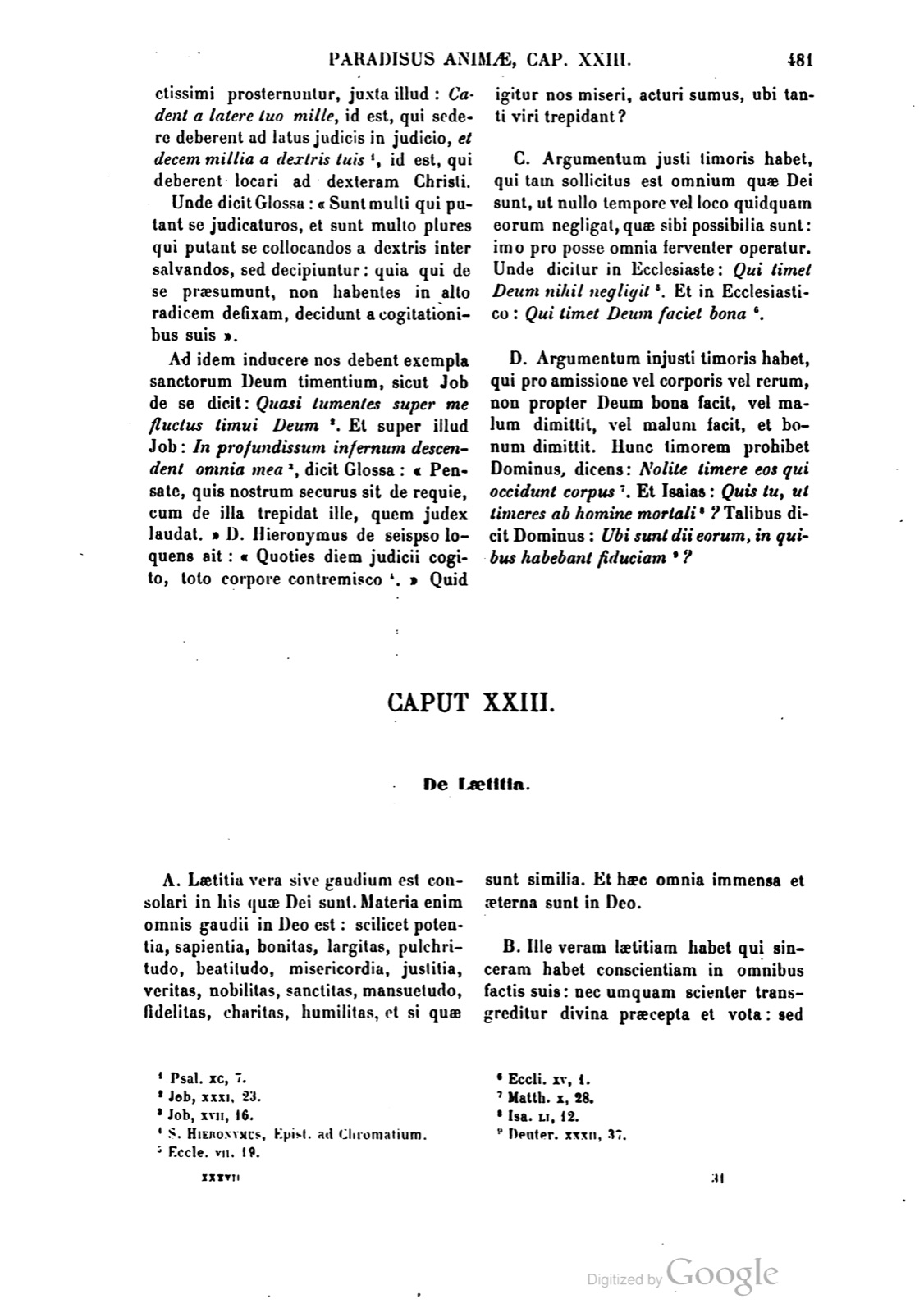
C. Argumentum justi timoris habet, qui tam sollicitus est omnium quae Dei sunt, ut nullo tempore vel loco quidquam eorum negligat, quae sibi possibilia sunt: imo pro posse omnia ferventer operatur. Unde dicitur in Ecclesiaste: Qui timet Deum nihil negligit 13. Et in Ecclesiastico: Qui timet Deum faciet bona 14.
D. Argumentum injusti timoris habet, qui pro amissione vel corporis vel rerum, non propter Deum bona facit, vel malum dimittit, vel malum facit, et bonum dimittit. Hunc timorem prohibet Dominus, dicens: Nolite timere eos qui occidunt corpus 15. Et Isaias: Quis tu, ut timeres ab homine mortali 16? Talibus dicit Dominus: Ubi sunt dii eorum, in quibus habebant fiduciam 17?
C. He has the proof of just fear who is so solicitous for all things that are God's that at no time or place does he neglect anything of them that is possible for him; indeed, as far as he can, he fervently works all things. Hence it is said in Ecclesiastes: He who fears God neglects nothing 13. And in Ecclesiasticus: He who fears God will do good things 14.
D. He has the proof of unjust fear who because of loss either of body or possessions, not for God's sake, does good things or omits evil, or does evil and omits good. The Lord prohibits this fear, saying: Do not fear those who kill the body 15. And Isaiah says: Who are you, that you should fear mortal man 16? To such persons the Lord says: Where are their gods, in whom they had confidence 17?
Notes
- Psalm 110:10 and Ecclesiasticus 1:16. (Psal. CX, 10 et Eccli. I, 16.) ↩
- Ecclesiasticus 1:28. (Eccli. I, 28.) ↩
- Ecclesiasticus 25:14. (Eccli. XXV, 14.) ↩
- Ecclesiasticus 27:4. (Eccli. XXVII, 4.) ↩
- Proverbs 28:14. (Proverb. XXVIII, 14.) ↩
- St. Bernard, Sermon 54 on the Song of Songs. (S. Bernardus, Serm. 54 in Cantica.) ↩
- John 5:14. (Joan. V, 14.) ↩
- Job 5:18 and 19. (Job, V, 18 et 19.) ↩
- Psalm 90:7. (Psal. XC, 7.) ↩
- Job 31:23. (Job, XXXI, 23.) ↩
- Job 17:16. (Job, XVII, 16.) ↩
- St. Jerome, Letter to Chromatius. (S. Hieronymus, Epist. ad Chromatium.) ↩
- Ecclesiastes 7:19. (Eccle. VII, 19.) ↩
- Ecclesiasticus 15:1. (Eccli. XV, 1.) ↩
- Matthew 10:28. (Matth. X, 28.) ↩
- Isaiah 51:12. (Isa. LI, 12.) ↩
- Deuteronomy 32:37. (Deuter. XXXII, 37.) ↩
If a page does not appear, its photograph has not been uploaded yet.