Works › The Paradise of the Soul
Volume 37 · ≈ pp. 478–479
Chapter XXI. On Hope.
A marker with ≈ is an approximate page boundary, placed by measure of the text; the page photographs remain the authority. In the paired views, clicking a page marker brings that page into view.
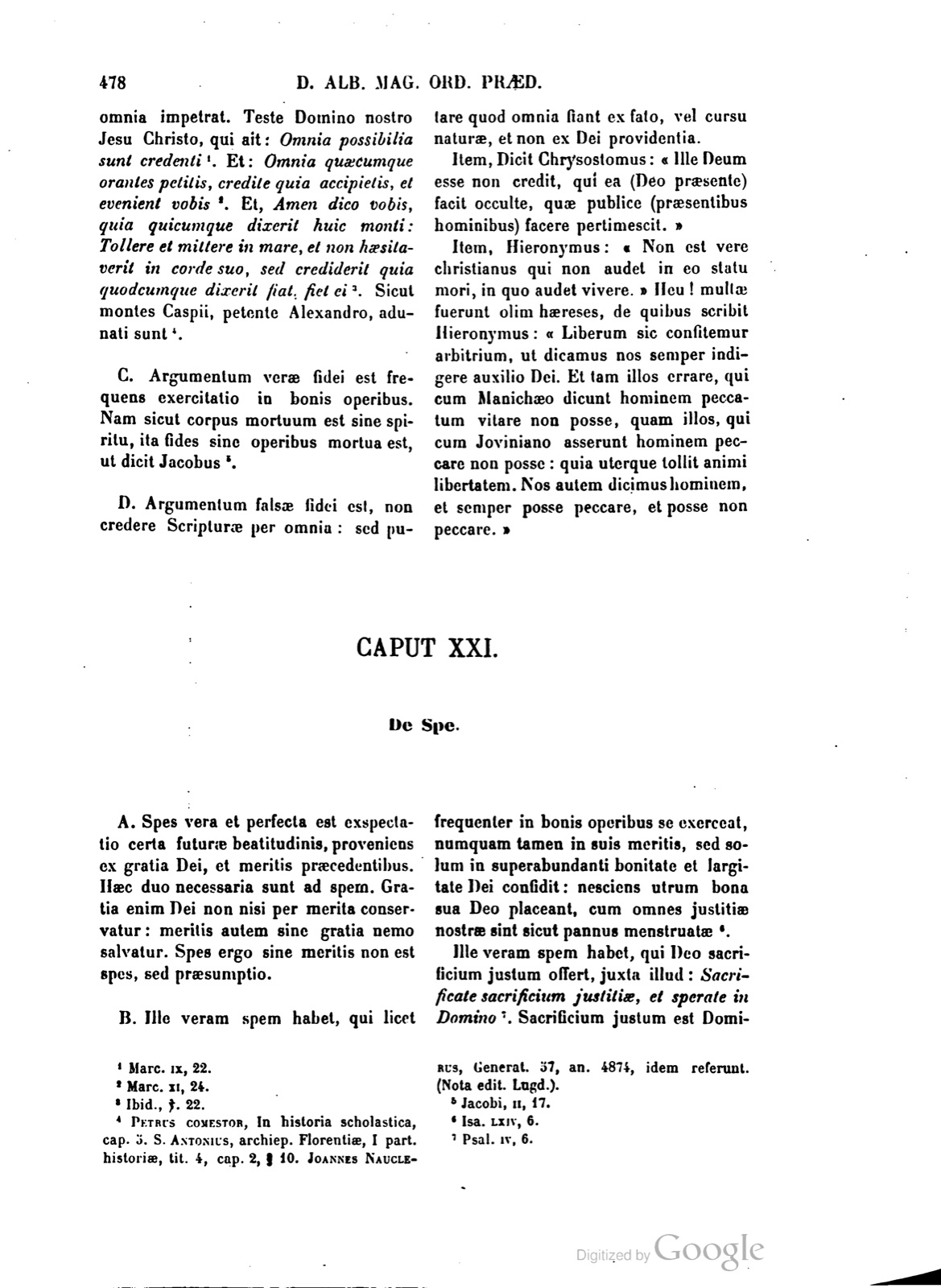
Caput XXI.
De Spe.
A. Spes vera et perfecta est exspectatio certa futurae beatitudinis, proveniens ex gratia Dei, et meritis praecedentibus. Haec duo necessaria sunt ad spem. Gratia enim Dei non nisi per merita conservatur: meritis autem sine gratia nemo salvatur. Spes ergo sine meritis non est spes, sed praesumptio.
B. Ille veram spem habet, qui licet frequenter in bonis operibus se exerceat, numquam tamen in suis meritis, sed solum in superabundanti bonitate et largitate Dei confidit: nesciens utrum bona sua Deo placeant, cum omnes justitiae nostrae sint sicut pannus menstruatae 1. Ille veram spem habet, qui Deo sacrificium justum offert, juxta illud: Sacrificate sacrificium justitiae, et sperate in Domino 2. Sacrificium justum est Dominus noster Jesus Christus, unigenitus Dei Filius, qui se pro peccatis totius mundi obtulit Deo Patri in ara crucis, ampliorem emendam offerens, quam totus mundus debebat. Suffecisset enim, ut dicit D. Ambrosius, una gutta tam pretiosi sanguinis, ad redimendum totum genus humanum. Sed abundanter effudit, ut abundantiam suae dilectionis ostenderet. In hoc sacrificio est tota spes et salus nostra, juxta illud D. Bernardi 3: « Peccavi peccatum grande: turbatur conscientia, sed non perturbatur: quoniam vulnerum Domini recordabor. Nempe vulneratus est propter iniquitates nostras. Quid tam ad mortem, quod non Christi morte salvetur? Si ergo in mentem venerit tam potens, tamque efficax medicamentum, nulla jam possum morbi malignitate terreri. Et ideo liquet errasse illum, qui ait: Major est iniquitas mea, quam ut veniam merear 4. »
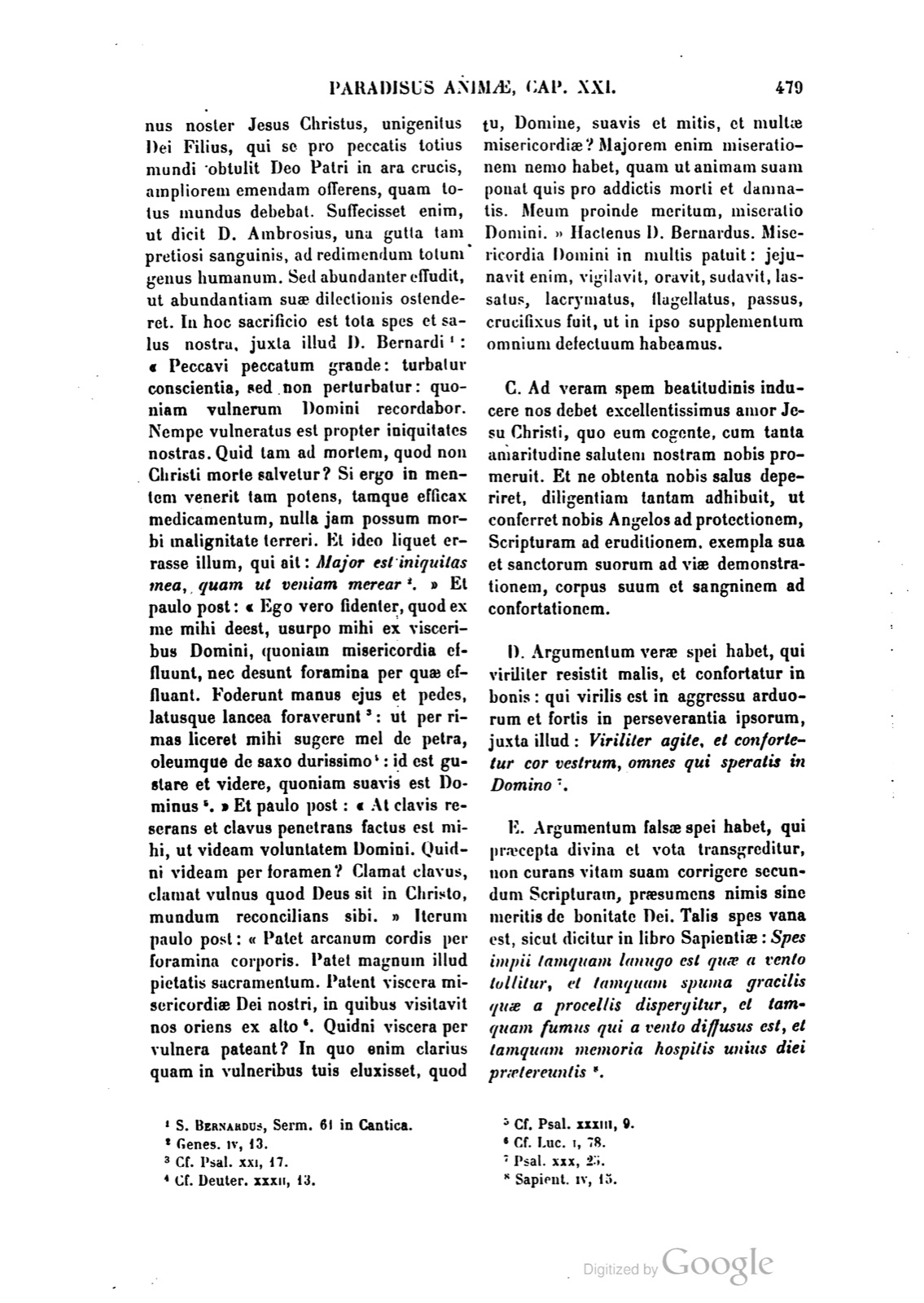
Et paulo post: « Ego vero fidenter, quod ex me mihi deest, usurpo mihi ex visceribus Domini, quoniam misericordia effluunt, nec desunt foramina per quae effluant. Foderunt manus ejus et pedes 5, latusque lancea foraverunt: ut per rimas liceret mihi sugere mel de petra, oleumque de saxo durissimo 6: id est gustare et videre, quoniam suavis est Dominus 7. » Et paulo post: « At clavis reserans et clavus penetrans factus est mihi, ut videam voluntatem Domini. Quidni videam per foramen? Clamat clavus, clamat vulnus quod Deus sit in Christo, mundum reconcilians sibi. » Iterum paulo post: « Patet arcanum cordis per foramina corporis. Patet magnum illud pietatis sacramentum. Patent viscera misericordiae Dei nostri, in quibus visitavit nos oriens ex alto 8. Quidni viscera per vulnera pateant? In quo enim clarius quam in vulneribus tuis eluxisset, quod tu, Domine, suavis et mitis, et multae misericordiae? Majorem enim miserationem nemo habet, quam ut animam suam ponat quis pro addictis morti et damnatis. Meum proinde meritum, miseratio Domini. » Hactenus D. Bernardus. Misericordia Domini in multis patuit: jejunavit enim, vigilavit, oravit, sudavit, lassatus, lacrymatus, flagellatus, passus, crucifixus fuit, ut in ipso supplementum omnium defectuum habeamus.
Chapter XXI.
On Hope.
A. True and perfect hope is the certain expectation of future blessedness, coming from the grace of God and preceding merits. These two are necessary for hope. For the grace of God is preserved only through merits; but without grace no one is saved by merits. Therefore hope without merits is not hope, but presumption.
B. He has true hope who, although he frequently exercises himself in good works, nevertheless never trusts in his own merits, but only in the superabundant goodness and generosity of God, not knowing whether his good works please God, since all our justices are like the cloth of a menstruating woman 1. He has true hope who offers a just sacrifice to God, according to that: Sacrifice the sacrifice of justice and hope in the Lord 2. The just sacrifice is our Lord Jesus Christ, the only-begotten Son of God, who offered himself for the sins of the whole world to God the Father on the altar of the cross, offering a fuller amends than the whole world owed. For, as D. Ambrose says, one drop of such precious blood would have sufficed to redeem the whole human race. But he poured it out abundantly to show the abundance of his love. In this sacrifice is our whole hope and salvation, according to that saying of D. Bernard 3: "I have sinned a great sin; conscience is disturbed, but not thrown into confusion, because I will remember the wounds of the Lord. Indeed he was wounded because of our iniquities. What is so unto death that it is not saved by the death of Christ? If therefore so powerful and so effective a medicine comes into mind, I can no longer be terrified by any malignity of disease. And therefore it is clear that he erred who said: My iniquity is greater than that I may merit pardon 4."
And a little later: "But I confidently usurp for myself from the inward parts of the Lord what is lacking to me from myself, because mercies flow forth, nor are there lacking openings through which they may flow. They dug his hands and feet 5, and pierced his side with a lance, so that through the cracks it might be permitted me to suck honey from the rock and oil from the hardest stone 6, that is, to taste and see that the Lord is sweet 7." And a little later: "But the key opening and the nail penetrating have been made for me, that I may see the will of the Lord. Why should I not see through the opening? The nail cries out, the wound cries out, that God is in Christ reconciling the world to himself." Again a little later: "The secret of the heart lies open through the openings of the body. That great sacrament of piety lies open. The inward parts of the mercy of our God lie open, in which the rising sun from on high has visited us 8. Why should not inward parts lie open through wounds? For in what would it have shone forth more clearly than in your wounds that you, Lord, are sweet and mild and of much mercy? For no one has greater pity than that one lay down his soul for those condemned to death and damned. Therefore my merit is the Lord's pity." Thus far D. Bernard. The mercy of the Lord was evident in many things: for he fasted, watched, prayed, sweated, was wearied, wept, was scourged, suffered, and was crucified, so that in him we may have the supplement of all defects.
C. Ad veram spem beatitudinis inducere nos debet excellentissimus amor Jesu Christi, quo eum cogente, cum tanta amaritudine salutem nostram nobis promeruit. Et ne obtenta nobis salus deperiret, diligentiam tantam adhibuit, ut conferret nobis Angelos ad protectionem, Scripturam ad eruditionem, exempla sua et sanctorum suorum ad viae demonstrationem, corpus suum et sanguinem ad confortationem.
D. Argumentum verae spei habet, qui viriliter resistit malis, et confortatur in bonis: qui virilis est in aggressu arduorum et fortis in perseverantia ipsorum, juxta illud: Viriliter agite, et confortetur cor vestrum, omnes qui speratis in Domino 9.
E. Argumentum falsae spei habet, qui praecepta divina et vota transgreditur, non curans vitam suam corrigere secundum Scripturam, praesumens nimis sine meritis de bonitate Dei. Talis spes vana est, sicut dicitur in libro Sapientiae: Spes impii tamquam lanugo est quae a vento tollitur, et tamquam spuma gracilis quae a procellis dispergitur, et tamquam fumus qui a vento diffusus est, et tamquam memoria hospitis unius diei praetereuntis 10.
C. The most excellent love of Jesus Christ ought to induce us to true hope of blessedness; compelled by this love, with such great bitterness he merited our salvation for us. And lest the salvation obtained for us perish, he applied such diligence that he gave us angels for protection, Scripture for instruction, his own examples and those of his saints for showing the way, and his body and blood for strengthening.
D. He has the proof of true hope who manfully resists evils and is strengthened in goods; who is manly in undertaking arduous things and strong in persevering in them, according to that: Act manfully, and let your heart be strengthened, all you who hope in the Lord 9.
E. He has the proof of false hope who transgresses divine precepts and vows, not caring to correct his life according to Scripture, presuming too much without merits on the goodness of God. Such hope is vain, as it is said in the book of Wisdom: The hope of the wicked is like down that is taken up by the wind, and like thin foam that is scattered by storms, and like smoke that is diffused by the wind, and like the memory of a guest passing by for one day 10.
Notes
- Isaiah 64:6. (Isa. LXIV, 6.) ↩
- Psalm 4:6. (Psal. IV, 6.) ↩
- St. Bernard, Sermon 61 on the Song of Songs. (S. Bernardus, Serm. 61 in Cantica.) ↩
- Genesis 4:13. (Genes. IV, 13.) ↩
- Compare Psalm 21:17. (Cf. Psal. XXI, 17.) ↩
- Compare Deuteronomy 32:13. (Cf. Deuter. XXXII, 13.) ↩
- Compare Psalm 33:9. (Cf. Psal. XXXIII, 9.) ↩
- Compare Luke 1:78. (Cf. Luc. I, 78.) ↩
- Psalm 30:25. (Psal. XXX, 25.) ↩
- Wisdom 4:15. (Sapient. IV, 15.) ↩
If a page does not appear, its photograph has not been uploaded yet.