Works › The Paradise of the Soul
Volume 37 · ≈ pp. 477–478
Chapter XX. On Faith.
A marker with ≈ is an approximate page boundary, placed by measure of the text; the page photographs remain the authority. In the paired views, clicking a page marker brings that page into view.
Caput XX.
De Fide.
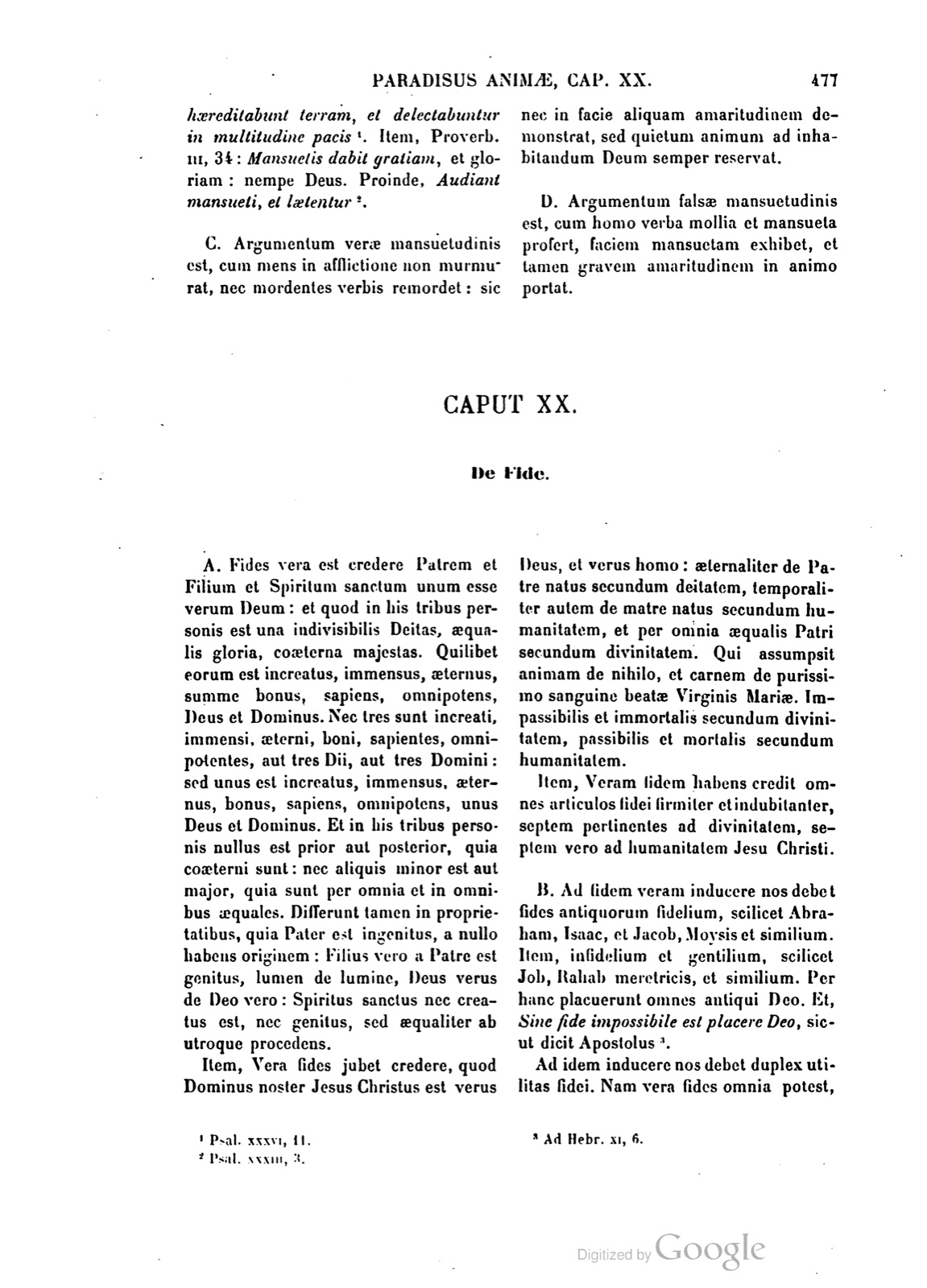
A. Fides vera est credere Patrem et Filium et Spiritum sanctum unum esse verum Deum: et quod in his tribus personis est una indivisibilis Deitas, aequalis gloria, coaeterna majestas. Quilibet eorum est increatus, immensus, aeternus, summe bonus, sapiens, omnipotens, Deus et Dominus. Nec tres sunt increati, immensi, aeterni, boni, sapientes, omnipotentes, aut tres Dii, aut tres Domini: sed unus est increatus, immensus, aeternus, bonus, sapiens, omnipotens, unus Deus et Dominus. Et in his tribus personis nullus est prior aut posterior, quia coaeterni sunt: nec aliquis minor est aut major, quia sunt per omnia et in omnibus aequales. Differunt tamen in proprietatibus, quia Pater est ingenitus, a nullo habens originem: Filius vero a Patre est genitus, lumen de lumine, Deus verus de Deo vero: Spiritus sanctus nec creatus est, nec genitus, sed aequaliter ab utroque procedens.
Item, Vera fides jubet credere, quod Dominus noster Jesus Christus est verus Deus, et verus homo: aeternaliter de Patre natus secundum deitatem, temporaliter autem de matre natus secundum humanitatem, et per omnia aequalis Patri secundum divinitatem. Qui assumpsit animam de nihilo, et carnem de purissimo sanguine beatae Virginis Mariae. Impassibilis et immortalis secundum divinitatem, passibilis et mortalis secundum humanitatem. Item, Veram fidem habens credit omnes articulos fidei firmiter et indubitanter, septem pertinentes ad divinitatem, septem vero ad humanitatem Jesu Christi.
B. Ad fidem veram inducere nos debet fides antiquorum fidelium, scilicet Abraham, Isaac, et Jacob, Moysis et similium. Item, infidelium et gentilium, scilicet Job, Rahab meretricis, et similium. Per hanc placuerunt omnes antiqui Deo. Et, Sine fide impossibile est placere Deo, sicut dicit Apostolus 1. Ad idem inducere nos debet duplex utilitas fidei. Nam vera fides omnia potest, omnia impetrat. Teste Domino nostro Jesu Christo, qui ait: Omnia possibilia sunt credenti 2. Et: Omnia quaecumque orantes petitis, credite quia accipietis, et evenient vobis 3. Et, Amen dico vobis, quia quicumque dixerit huic monti: Tollere et mittere in mare, et non haesitaverit in corde suo, sed crediderit quia quodcumque dixerit fiat, fiet ei 4. Sicut montes Caspii, petente Alexandro, adunati sunt 5.
Chapter XX.
On Faith.
A. True faith is to believe that the Father and the Son and the Holy Spirit are one true God, and that in these three persons there is one indivisible Godhead, equal glory, coeternal majesty. Each of them is uncreated, immeasurable, eternal, supremely good, wise, almighty, God and Lord. Nor are there three uncreated, immeasurable, eternal, good, wise, almighty ones, or three Gods, or three Lords; but one is uncreated, immeasurable, eternal, good, wise, almighty, one God and Lord. And in these three persons none is prior or posterior, because they are coeternal; nor is any lesser or greater, because they are through all things and in all things equal. Yet they differ in properties, because the Father is unbegotten, having origin from no one; but the Son is begotten from the Father, light from light, true God from true God; the Holy Spirit is neither created nor begotten, but proceeds equally from both.
Likewise, true faith commands one to believe that our Lord Jesus Christ is true God and true man: eternally born of the Father according to deity, but temporally born of the mother according to humanity, and in all things equal to the Father according to divinity. He assumed a soul from nothing and flesh from the most pure blood of the blessed Virgin Mary. He is impassible and immortal according to divinity, passible and mortal according to humanity. Likewise, one having true faith believes all the articles of faith firmly and undoubtingly, seven pertaining to the divinity and seven to the humanity of Jesus Christ.
B. The faith of the ancient faithful ought to induce us to true faith, namely Abraham, Isaac, Jacob, Moses, and similar persons. Likewise the faith of unbelievers and gentiles, namely Job, Rahab the prostitute, and similar persons. Through this all the ancients pleased God. And without faith it is impossible to please God, as the Apostle says 1. A twofold usefulness of faith ought to induce us to the same. For true faith can do all things and obtains all things, as our Lord Jesus Christ testifies, who says: All things are possible to one believing 2. And: Whatever things you ask praying, believe that you will receive, and they will come to you 3. And: Amen I say to you, whoever says to this mountain, Be lifted up and cast into the sea, and has not hesitated in his heart, but has believed that whatever he has said will happen, it will happen to him 4. Thus the Caspian mountains, at Alexander's request, were joined together 5.
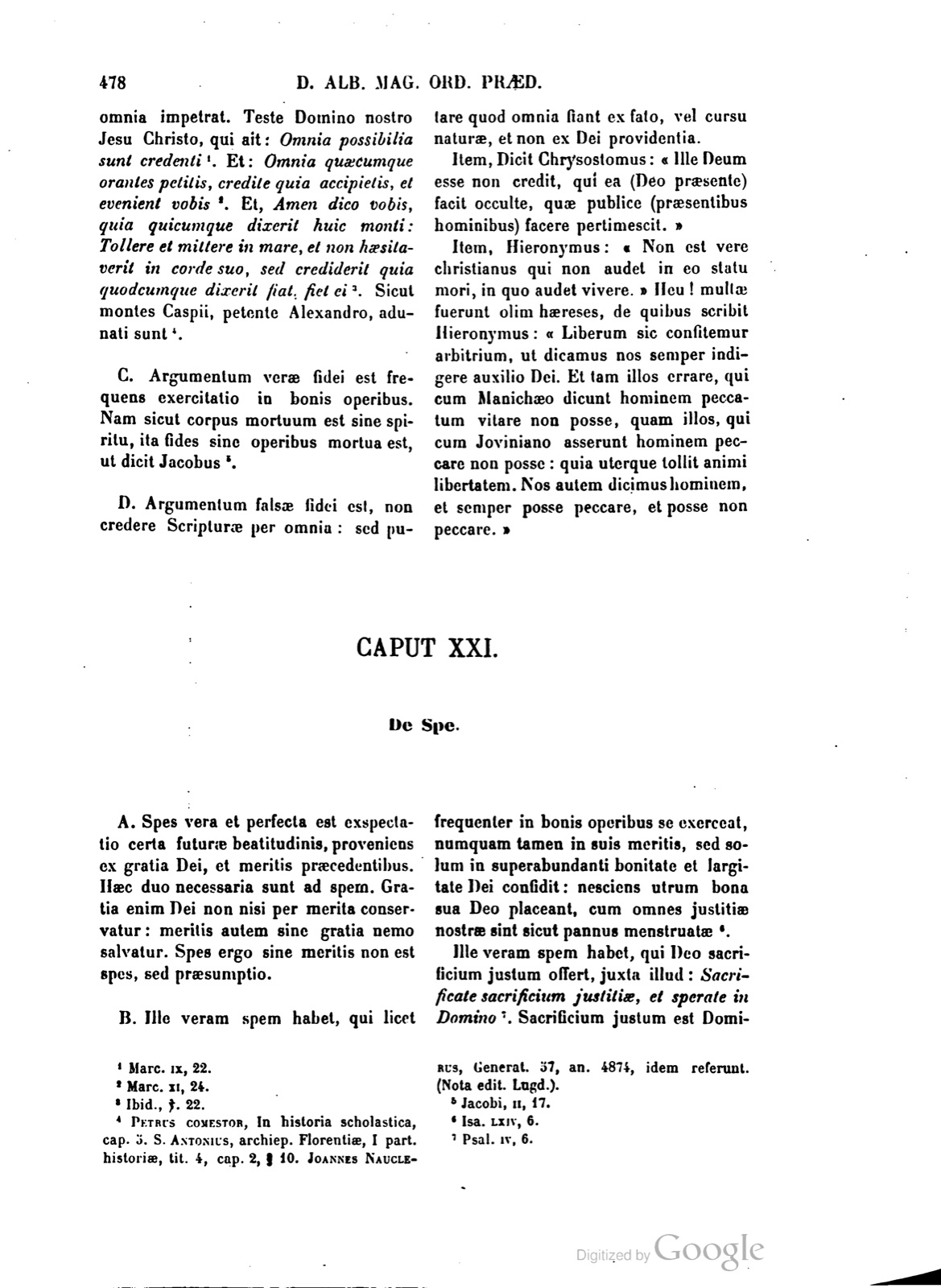
C. Argumentum verae fidei est frequens exercitatio in bonis operibus. Nam sicut corpus mortuum est sine spiritu, ita fides sine operibus mortua est, ut dicit Jacobus 6.
D. Argumentum falsae fidei est, non credere Scripturae per omnia: sed putare quod omnia fiant ex fato, vel cursu naturae, et non ex Dei providentia. Item, Dicit Chrysostomus: « Ille Deum esse non credit, qui ea Deo praesente facit occulte, quae publice praesentibus hominibus facere pertimescit. » Item, Hieronymus: « Non est vere christianus qui non audet in eo statu mori, in quo audet vivere. » Heu! multae fuerunt olim haereses, de quibus scribit Hieronymus: « Liberum sic confitemur arbitrium, ut dicamus nos semper indigere auxilio Dei. Et tam illos errare, qui cum Manichaeo dicunt hominem peccatum vitare non posse, quam illos, qui cum Joviniano asserunt hominem peccare non posse: quia uterque tollit animi libertatem. Nos autem dicimus hominem, et semper posse peccare, et posse non peccare. »
C. The proof of true faith is frequent exercise in good works. For just as the body without the spirit is dead, so faith without works is dead, as James says 6.
D. The proof of false faith is not to believe Scripture in all things, but to think that all things happen from fate or the course of nature, and not from God's providence. Likewise Chrysostom says: "He does not believe that God exists who, while God is present, does secretly those things that he fears to do publicly in the presence of human beings." Likewise Jerome says: "He is not truly Christian who does not dare to die in that state in which he dares to live." Alas, there were once many heresies, about which Jerome writes: "We confess free will in such a way that we say we always need the help of God. And both those err who with Mani say that a human being cannot avoid sin, and those who with Jovinian assert that a human being cannot sin, because each removes freedom of the soul. But we say that a human being can always sin and can not sin."
Notes
- Hebrews 11:6. (Ad Hebr. XI, 6.) ↩
- Mark 9:22. (Marc. IX, 22.) ↩
- Mark 11:24. (Marc. XI, 24.) ↩
- The same, verse 23. (Ibid., v. 23.) ↩
- Peter Comestor, in the Scholastic History, chapter 3. St. Antoninus and Johannes Nauclerus report the same. (Petrus Comestor, In historia scholastica, cap. 3. S. Antonius... Joannes Nauclerus... idem referunt.) ↩
- James 2:17. (Jacobi, II, 17.) ↩
If a page does not appear, its photograph has not been uploaded yet.