Works › The Paradise of the Soul
Volume 37 · ≈ pp. 476–477
Chapter XIX. On Meekness.
A marker with ≈ is an approximate page boundary, placed by measure of the text; the page photographs remain the authority. In the paired views, clicking a page marker brings that page into view.
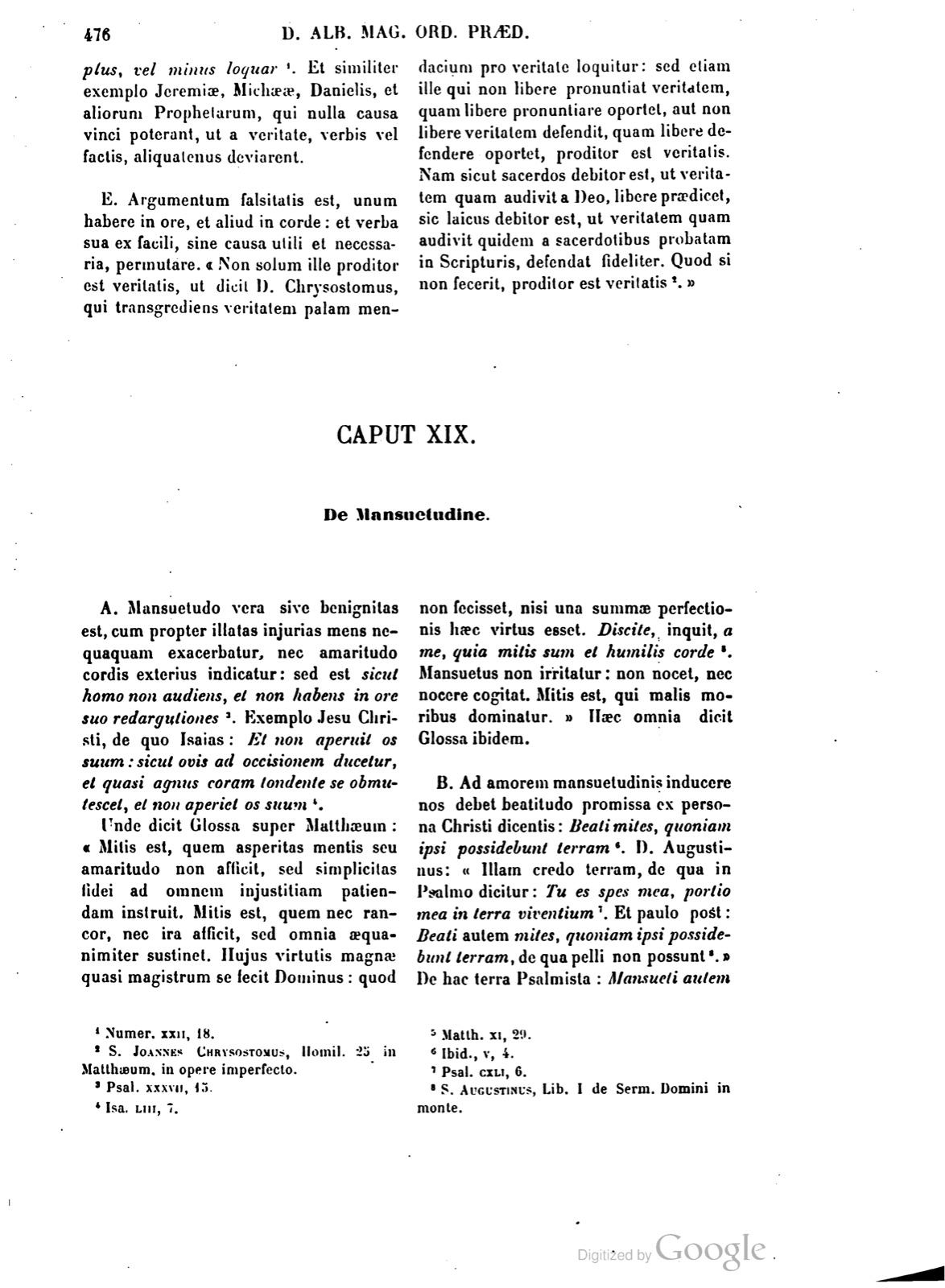
Caput XIX.
De Mansuetudine.
A. Mansuetudo vera sive benignitas est, cum propter illatas injurias mens nequaquam exacerbatur, nec amaritudo cordis exterius indicatur: sed est sicut homo non audiens, et non habens in ore suo redargutiones 1. Exemplo Jesu Christi, de quo Isaias: Et non aperuit os suum: sicut ovis ad occisionem ducetur, et quasi agnus coram tondente se obmutescet, et non aperiet os suum 2.
Unde dicit Glossa super Matthaeum: « Mitis est, quem asperitas mentis seu amaritudo non afficit, sed simplicitas fidei ad omnem injustitiam patiendam instruit. Mitis est, quem nec rancor, nec ira afficit, sed omnia aequanimiter sustinet. Hujus virtutis magnae quasi magistrum se fecit Dominus: quod non fecisset, nisi una summae perfectionis haec virtus esset. Discite, inquit, a me, quia mitis sum et humilis corde 3. Mansuetus non irritatur: non nocet, nec nocere cogitat. Mitis est, qui malis moribus dominatur. » Haec omnia dicit Glossa ibidem.
Chapter XIX.
On Meekness.
A. True meekness or kindness exists when, because of injuries brought upon one, the mind is in no way embittered, nor is bitterness of heart shown outwardly, but one is like a human being not hearing and not having rebukes in his mouth 1. After the example of Jesus Christ, of whom Isaiah says: And he did not open his mouth; like a sheep he will be led to slaughter, and like a lamb before the one shearing him he will be silent, and he will not open his mouth 2.
Hence the Gloss on Matthew says: "The meek person is one whom roughness of mind or bitterness does not affect, but whom simplicity of faith instructs for suffering every injustice. The meek person is one whom neither rancor nor anger affects, but who sustains all things with equanimity. The Lord made himself as it were master of this great virtue; he would not have done this unless this virtue were one of highest perfection. Learn from me, he says, because I am meek and humble of heart 3. The meek person is not irritated, does not harm, and does not think to harm. He is gentle who rules over evil morals." All these things the Gloss says in the same place.
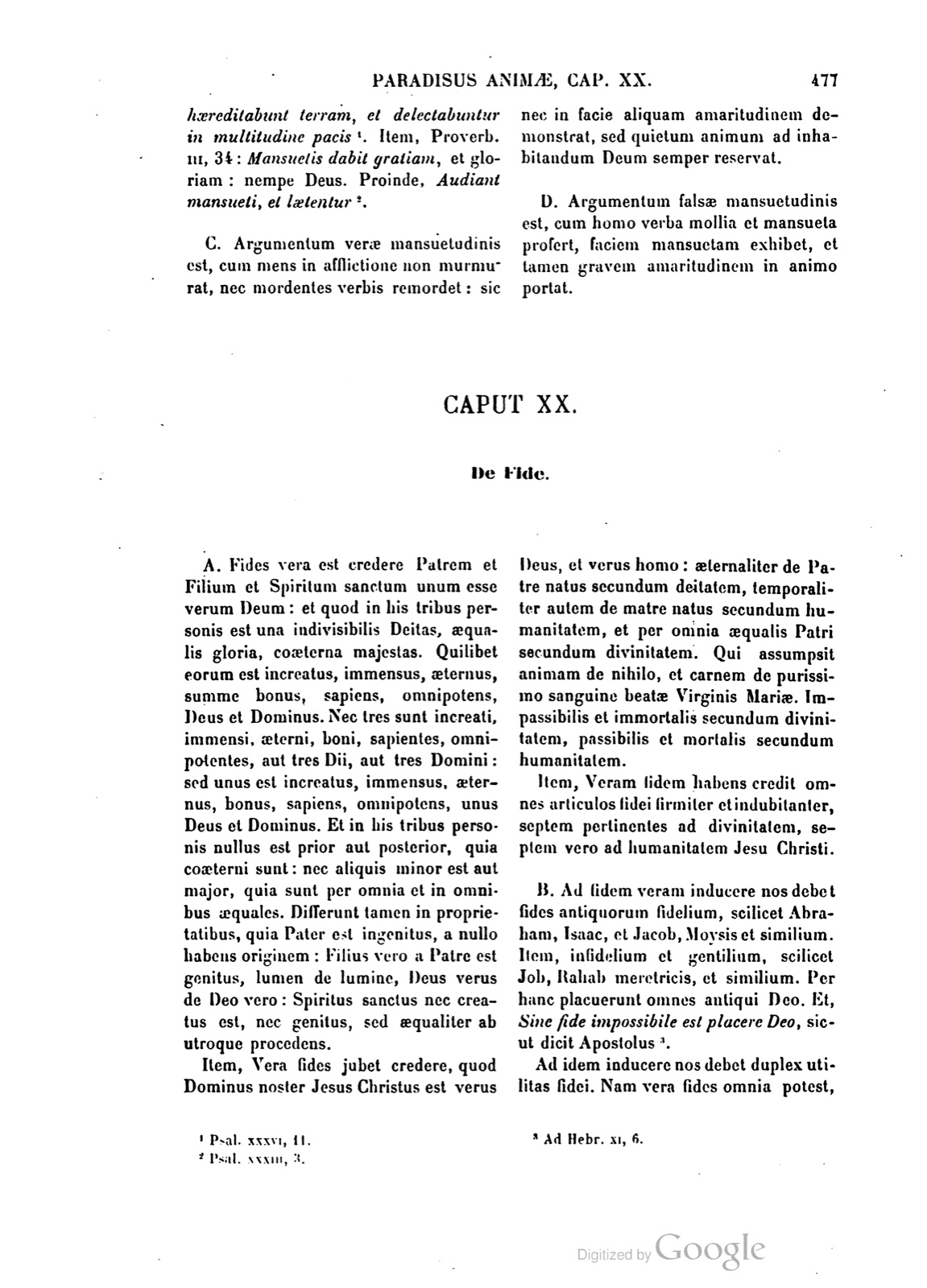
B. Ad amorem mansuetudinis inducere nos debet beatitudo promissa ex persona Christi dicentis: Beati mites, quoniam ipsi possidebunt terram 4. D. Augustinus: « Illam credo terram, de qua in Psalmo dicitur: Tu es spes mea, portio mea in terra viventium 5. Et paulo post: Beati autem mites, quoniam ipsi possidebunt terram, de qua pelli non possunt 6. » De hac terra Psalmista: Mansueti autem haereditabunt terram, et delectabuntur in multitudine pacis 7. Item, Proverb. III, 34: Mansuetis dabit gratiam, et gloriam: nempe Deus. Proinde, Audiant mansueti, et laetentur 8.
C. Argumentum verae mansuetudinis est, cum mens in afflictione non murmurat, nec mordentes verbis remordet: nec in facie aliquam amaritudinem demonstrat, sed quietum animum ad inhabitandum Deum semper reservat.
D. Argumentum falsae mansuetudinis est, cum homo verba mollia et mansueta profert, faciem mansuetam exhibet, et tamen gravem amaritudinem in animo portat.
B. The beatitude promised from the person of Christ saying, Blessed are the meek, for they will possess the earth 4, ought to induce us to love of meekness. D. Augustine says: "I believe that earth of which it is said in the Psalm: You are my hope, my portion in the land of the living 5." And a little later: "But blessed are the meek, for they will possess the earth from which they cannot be driven 6." Of this earth the Psalmist says: But the meek will inherit the earth and will delight in the multitude of peace 7. Likewise Proverbs 3:34 says: To the meek he will give grace and glory, namely God. Therefore, Let the meek hear and rejoice 8.
C. The proof of true meekness is when the mind in affliction does not murmur, nor bites back with words at those biting it, nor demonstrates any bitterness in the face, but always reserves a quiet soul for God to inhabit.
D. The proof of false meekness is when a human being utters soft and meek words, shows a meek face, and nevertheless carries grave bitterness in the soul.
Notes
- Psalm 37:15. (Psal. XXXVII, 15.) ↩
- Isaiah 53:7. (Isa. LIII, 7.) ↩
- Matthew 11:29. (Matth. XI, 29.) ↩
- Matthew 5:4. (Matth. V, 4.) ↩
- Psalm 141:6. (Psal. CXLI, 6.) ↩
- St. Augustine, On the Lord’s Sermon on the Mount, book 1. (S. Augustinus, Lib. I de Serm. Domini in monte.) ↩
- Psalm 36:11. (Psal. XXXVI, 11.) ↩
- Psalm 33:3. (Psal. XXXIII, 3.) ↩
If a page does not appear, its photograph has not been uploaded yet.