Works › The Paradise of the Soul
Volume 37 · ≈ pp. 475–476
Chapter XVIII. On Truth.
A marker with ≈ is an approximate page boundary, placed by measure of the text; the page photographs remain the authority. In the paired views, clicking a page marker brings that page into view.
Caput XVIII.
De Veritate.
A. Veritas justa est, quando vere concordant mens, lingua, et opera: ut quod sentit quis in corde, hoc profert ore, et perficit opere. Exemplo Apostoli invitantis: Imitatores mei estote, fratres, et observate eos, id est, imitamini eos, qui ita ambulant, sicut habetis formam nostram 1. Glossa: Id est, sicut ego credo, doceo et vivo.
B. Ille verax est, qui Deo et omnibus hominibus immutabiliter omnia vota servat: et omnia verba sua semel dicta opere complet, nisi ea quandoque salubri consilio mutet. Juxta illud Isidori: « In malis promissis rescinde fidem: et in turpi voto muta decretum 2. » Sic Dominus quandoque sententiam propriam permutavit, ut patet in Ezechia, et Ninivitis. Nam Ezechiam moriturum per Isaiam praedixit, et tamen quindecim annos ei post fletum adjecit 3. Et Ninivem infra quadraginta dies subvertendam per Jonam praedicavit, quam propter humiliationem regis et populi stare permisit 4.
C. Ad amorem veritatis inducere nos debet, quod Christus est veritas 5: et quia veritas semper in se amabilis est. Et licet aliquibus quandoque gravis sit veritas, et intolerabilis, non est hoc ex parte veritatis, sed ex parte pravae voluntatis eorum, quam libenter implerent, si veritatem contrariam non haberent. Castis et humilibus amabilis est veritas, quae commendat castitatem et humilitatem, et detestatur impudicitiam et superbiam: quia nimis contraria est impudicis et superbis qui se in oppositis firmaverunt. Item, Quia veritas omnia vincit, sicut probatum est in Esdra 6. Et quia veritas immutabilis est, sicut Dominus Jesus dicit: Facilius est coelum et terram praeterire, quam de lege unum apicem cadere 7. Et apud Matthaeum: Amen quippe dico vobis, donec transeat coelum et terra, iota unum aut unus apex non praeteribit a lege, donec omnia fiant 8.
Chapter XVIII.
On Truth.
A. Just truth exists when mind, tongue, and works truly agree: so that what someone feels in the heart, this he brings forth with the mouth and accomplishes in work. After the example of the Apostle inviting: Be imitators of me, brothers, and observe them, that is, imitate them, who walk thus, as you have our form 1. The Gloss says: that is, as I believe, teach, and live.
B. He is truthful who immutably keeps all vows to God and all human beings, and completes in work all his words once spoken, unless he sometimes changes them by salutary counsel. According to that of Isidore: "In evil promises break faith, and in a shameful vow change the decree 2." Thus the Lord sometimes changed his own sentence, as is clear in Hezekiah and the Ninevites. For he foretold through Isaiah that Hezekiah would die, and nevertheless after his weeping added fifteen years to him 3. And through Jonah he preached that Nineveh would be overthrown within forty days, but because of the humiliation of the king and people he allowed it to stand 4.
C. This ought to induce us to love of truth, that Christ is truth 5, and because truth is always lovable in itself. And although truth is sometimes heavy and intolerable to some, this is not on the part of truth but on the part of their depraved will, which they would gladly fulfill if they did not have contrary truth. Truth is lovable to the chaste and humble, because it commends chastity and humility and detests immodesty and pride, and because it is too contrary to the immodest and proud who have established themselves in the opposites. Likewise, because truth conquers all things, as was proved in Esdras 6. And because truth is immutable, as the Lord Jesus says: It is easier for heaven and earth to pass away than for one point of the law to fall 7. And in Matthew: Amen, indeed I say to you, until heaven and earth pass away, one iota or one point will not pass away from the law until all things are done 8.
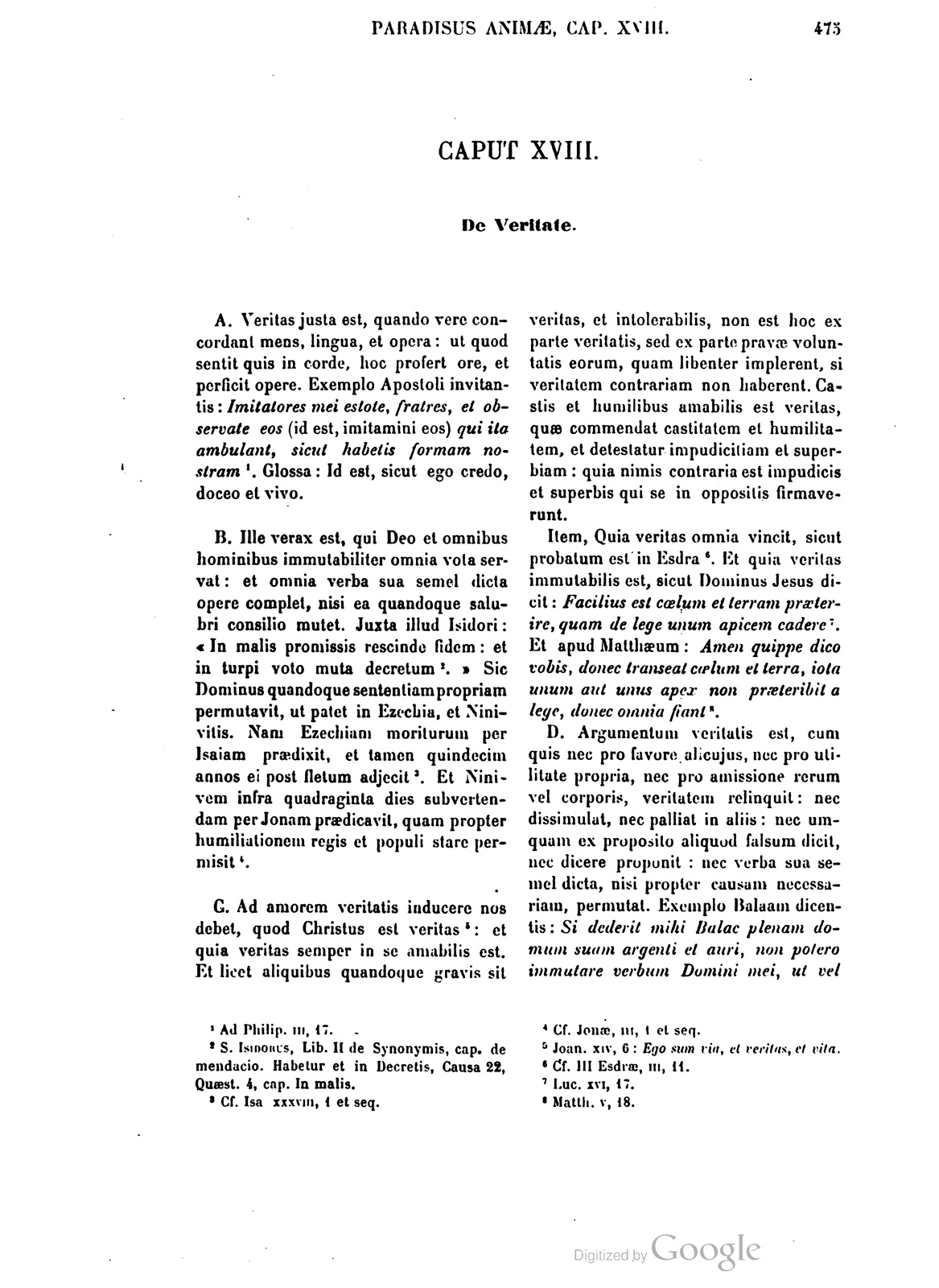
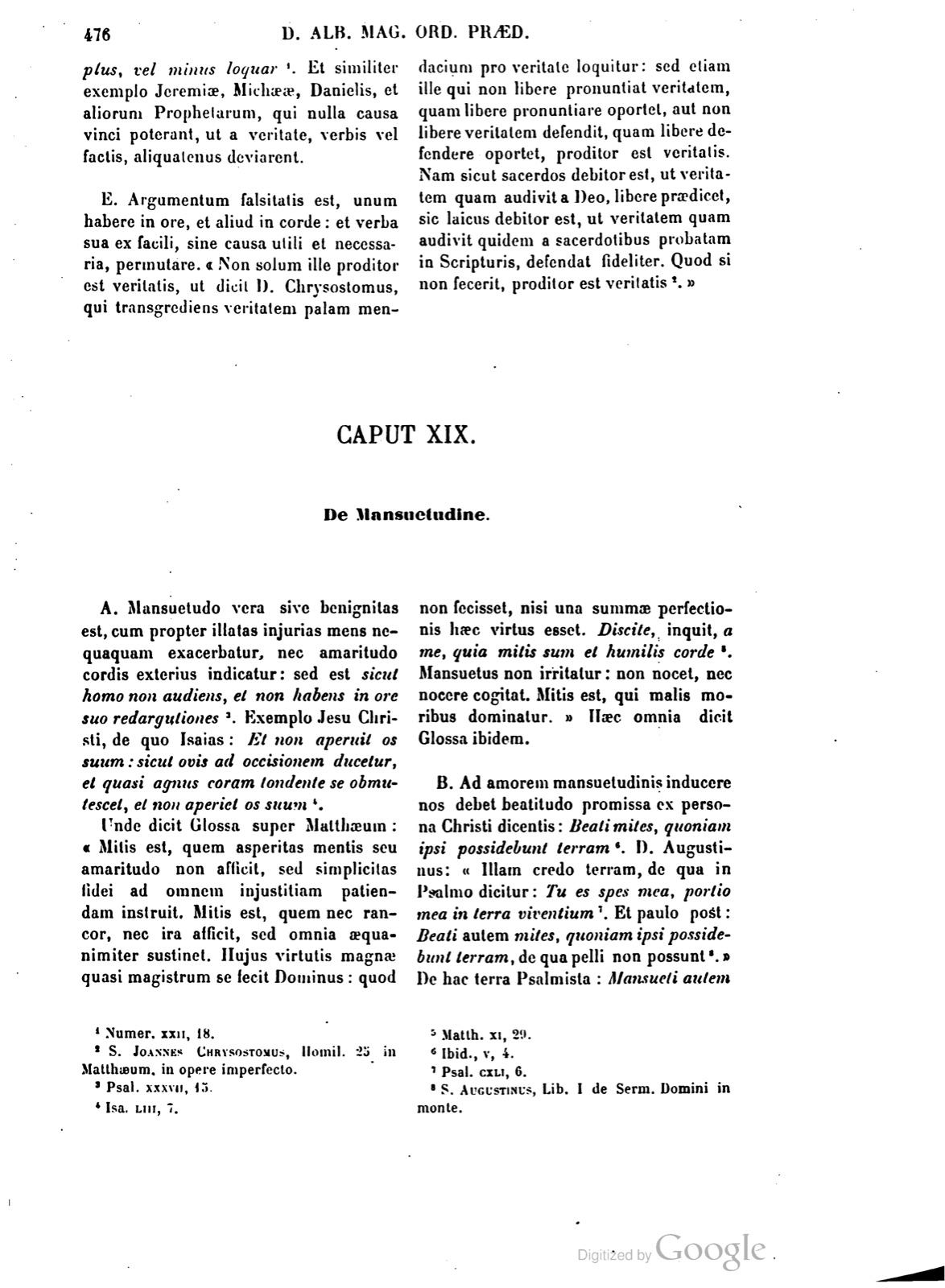
D. Argumentum veritatis est, cum quis nec pro favore alicujus, nec pro utilitate propria, nec pro amissione rerum vel corporis, veritatem relinquit: nec dissimulat, nec palliat in aliis: nec umquam ex proposito aliquod falsum dicit, nec dicere proponit: nec verba sua semel dicta, nisi propter causam necessariam, permutat. Exemplo Balaam dicentis: Si dederit mihi Balac plenam domum suam argenti et auri, non potero immutare verbum Domini mei, ut vel plus, vel minus loquar 9. Et similiter exemplo Jeremiae, Michaeae, Danielis, et aliorum Prophetarum, qui nulla causa vinci poterant, ut a veritate, verbis vel factis, aliquatenus deviarent.
E. Argumentum falsitatis est, unum habere in ore, et aliud in corde: et verba sua ex facili, sine causa utili et necessaria, permutare. « Non solum ille proditor est veritatis, ut dicit D. Chrysostomus, qui transgrediens veritatem palam mendacium pro veritate loquitur: sed etiam ille qui non libere pronuntiat veritatem, quam libere pronuntiare oportet, aut non libere veritatem defendit, quam libere defendere oportet, proditor est veritatis. Nam sicut sacerdos debitor est, ut veritatem quam audivit a Deo, libere praedicet, sic laicus debitor est, ut veritatem quam audivit quidem a sacerdotibus probatam in Scripturis, defendat fideliter. Quod si non fecerit, proditor est veritatis 10. »
D. The proof of truth is when someone abandons truth neither because of anyone's favor, nor because of his own usefulness, nor because of loss of possessions or body; and neither dissimulates nor cloaks it in others; nor ever deliberately says anything false, nor proposes to say it; nor changes his words once spoken except because of a necessary cause. After the example of Balaam saying: If Balak should give me his house full of silver and gold, I will not be able to change the word of my Lord, so that I speak either more or less 9. And similarly after the example of Jeremiah, Micaiah, Daniel, and the other prophets, who could be conquered by no cause so that in words or deeds they would deviate in any way from truth.
E. The proof of falsity is to have one thing in the mouth and another in the heart, and easily, without useful and necessary cause, to change one's words. "Not only is that man a betrayer of truth," as D. Chrysostom says, "who, transgressing truth, openly speaks a lie in place of truth; but also he who does not freely pronounce the truth that ought to be freely pronounced, or does not freely defend the truth that ought to be freely defended, is a betrayer of truth. For just as a priest is debtor to preach freely the truth that he has heard from God, so a layman is debtor faithfully to defend the truth that he has heard indeed from priests and that has been proved in the Scriptures. But if he does not do this, he is a betrayer of truth 10."
Notes
- Philippians 3:17. (Ad Philip. III, 17.) ↩
- St. Isidore, Synonyms, book 2, chapter on lying. It is also found in the Decrees, Cause 22, Question 4, chapter In malis. (S. Isidorus, Lib. II de Synonymis, cap. de mendacio. Habetur et in Decretis, Causa 22, Quaest. 4, cap. In malis.) ↩
- Compare Isaiah 38:1 and following. (Cf. Isa. XXXVIII, 1 et seq.) ↩
- Compare Jonah 1:1 and following. (Cf. Jonae, I, 1 et seq.) ↩
- John 14:6: I am the way, and the truth, and the life. (Joan. XIV, 6: Ego sum via, et veritas, et vita.) ↩
- Compare 3 Esdras 3:11. (Cf. III Esdrae, III, 11.) ↩
- Luke 16:17. (Luc. XVI, 17.) ↩
- Matthew 5:18. (Matth. V, 18.) ↩
- Numbers 22:18. (Numer. XXII, 18.) ↩
- St. John Chrysostom, Homily 25 on Matthew, in the imperfect work. (S. Joannes Chrysostomus, Homil. 25 in Matthaeum, in opere imperfecto.) ↩
If a page does not appear, its photograph has not been uploaded yet.