Works › The Paradise of the Soul
Volume 37 · ≈ pp. 473–475
Chapter XVII. On Largesse.
A marker with ≈ is an approximate page boundary, placed by measure of the text; the page photographs remain the authority. In the paired views, clicking a page marker brings that page into view.
Caput XVII.
De Largitate.
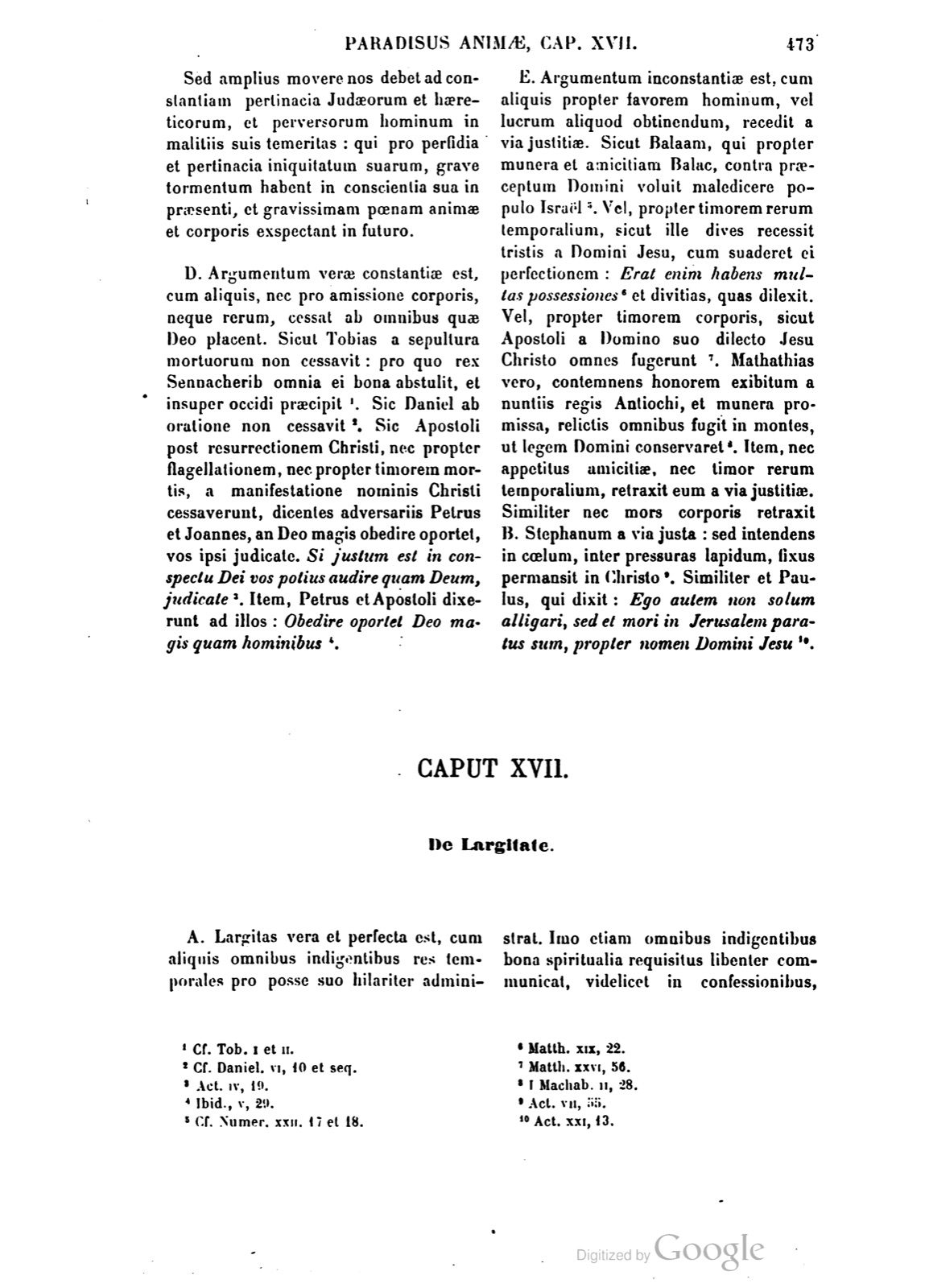
A. Largitas vera et perfecta est, cum aliquis omnibus indigentibus res temporales pro posse suo hilariter administrat. Imo etiam omnibus indigentibus bona spiritualia requisitus libenter communicat, videlicet in confessionibus, praedicationibus, consiliis et doctrinis. Nec solum desiderantibus hujusmodi paratus est: imo etiam non desiderantibus, et non curantibus doctrinam et praedicationem, secundum consilium Apostoli, opportune et importune participat 1: imo et invitis et ignorantibus, orationes, gemitus, ac fletus coram Deo communicat. Nec hoc sufficit, vere largo, nisi etiam se totum evisceret in studio, in meditationibus, et in sanctis operibus continue pro salute proximorum.
B. Ad hanc largitatem inducere nos debet appetitus conformitatis Dei, qui tam continue dat sua dona temporalia et spiritualia omnibus, etiam non petentibus, et super omnia haec carnem et sanguinem dilectissimi filii sui Jesu Christi. Nec sufficit ei dona sua dare simpliciter, nisi etiam seipsum sine mensura det in singulis donis. Commendat largitatem suam, quod nulli neget sua dona, quantumcumque sibi adversetur. Imo pluries in die et in nocte dona sua cuilibet elargitur, quantumcumque a quoquam offendatur. Approbat in hoc largitatem suam, quod quandocumque invenit opportunitatem aliquam in recipiente, statim ab effluxione spiritualium donorum nequaquam se potest continere. Licet ex sapientia divina praenoscat, quod recipiens illa dona in proximo debeat amittere, vel ea continuo deturpare, vel ipsum per eadem impugnare.
Chapter XVII.
On Largesse.
A. True and perfect largesse exists when someone cheerfully administers temporal goods to all in need as far as he can. Indeed, when asked, he gladly communicates spiritual goods also to all in need, namely in confessions, preachings, counsels, and teachings. Nor is he ready only for those desiring such things; indeed even to those not desiring and not caring for teaching and preaching, according to the counsel of the Apostle, he shares opportunely and importunely 1. Indeed, to those unwilling and ignorant he communicates prayers, groans, and tears before God. Nor does this suffice for the truly generous person unless he also pours out his whole self continually in study, meditations, and holy works for the salvation of neighbors.
B. Appetite for conformity to God ought to induce us to this largesse, because God so continually gives his temporal and spiritual gifts to all, even those not asking, and above all these things the flesh and blood of his most beloved Son Jesus Christ. Nor is it sufficient to him simply to give his gifts unless he also gives himself without measure in each gift. He commends his largesse in this, that he denies his gifts to no one, however much that person opposes him. Indeed many times by day and by night he generously grants his gifts to anyone, however much he is offended by anyone. He approves his largesse in this, that whenever he finds any opportunity in the receiver, immediately he cannot at all restrain himself from the outflow of spiritual gifts, although from divine wisdom he foreknows that the receiver is soon going to lose those gifts, or continually defile them, or attack him through the same.
Ad idem inducere nos debet, quod aliena sunt quae damus. Et proverbium est, quod latae corrigiae scindantur ex pellibus alienis. Unde D. Chrysostomus: « Opus est enim etiam de tuo non tam parcum esse: sed cum Domini tibi creditae sint facultates, cur tam tenax es 2? »
C. Argumentum verae largitatis est, cum aliquis dat sua indigentibus hilariter, sine meritis alicujus, gratis et sine spe recompensationis. Sic dedit Dominus Jesus et se et sua omnia: et hoc maximae perfectionis est. Nec sufficit vere largo sua dare, imo etiam pro salute proximorum, tempore necessitatis usque ad mortem exhibet semetipsum, sicut docet B. Joannes, dicens: In hoc cognovimus charitatem Dei, quoniam ille animam suam pro nobis posuit: et nos debemus pro fratribus animas ponere 3. Ad hoc tamen magis obligantur Praelati. Hanc largitatem habuit Apostolus, dicens: Ego autem libentissime impendam, et superimpendar ipse pro animabus vestris 4. Idem quoque ait alibi: Quotidie morior per vestram gloriam, fratres 5, id est, pericula mortis sustineo. Vere largus sine spe recompensationis dat Domino totum quod est, quod habet, et quod potest, ad aeternam divinae laudis augmentationem: singulis Angelis et sanctis ad perpetuam exsultationem, singulis peccatoribus ad conversionem, singulis justis et perfectis ad perfectionis conservationem et confirmationem, singulis purgandis ad poenarum mitigationem et abbreviationem.
This ought to induce us to the same, that the things we give belong to another. And there is a proverb that broad straps are cut from other people's hides. Hence D. Chrysostom says: "For there is need also not to be so sparing from your own; but since resources of the Lord have been entrusted to you, why are you so tenacious 2?"
C. The proof of true largesse is when someone gives his own goods to the needy cheerfully, without anyone's merits, freely and without hope of recompense. Thus the Lord Jesus gave both himself and all his goods, and this belongs to the highest perfection. Nor is it sufficient for the truly generous person to give his goods; indeed for the salvation of neighbors, in time of necessity, he presents himself even unto death, as blessed John teaches, saying: In this we have known the charity of God, because he laid down his soul for us, and we ought to lay down our souls for the brothers 3. Yet prelates are more bound to this. The Apostle had this largesse, saying: But I most gladly will spend and will be spent myself for your souls 4. The same also says elsewhere: Daily I die by your glory, brothers 5, that is, I sustain dangers of death. The truly generous person, without hope of recompense, gives to the Lord all that he is, has, and can do, for the eternal increase of divine praise; to each angel and saint for perpetual exultation; to each sinner for conversion; to each just and perfect person for the conservation and confirmation of perfection; to each one being purged for the mitigation and shortening of punishments.
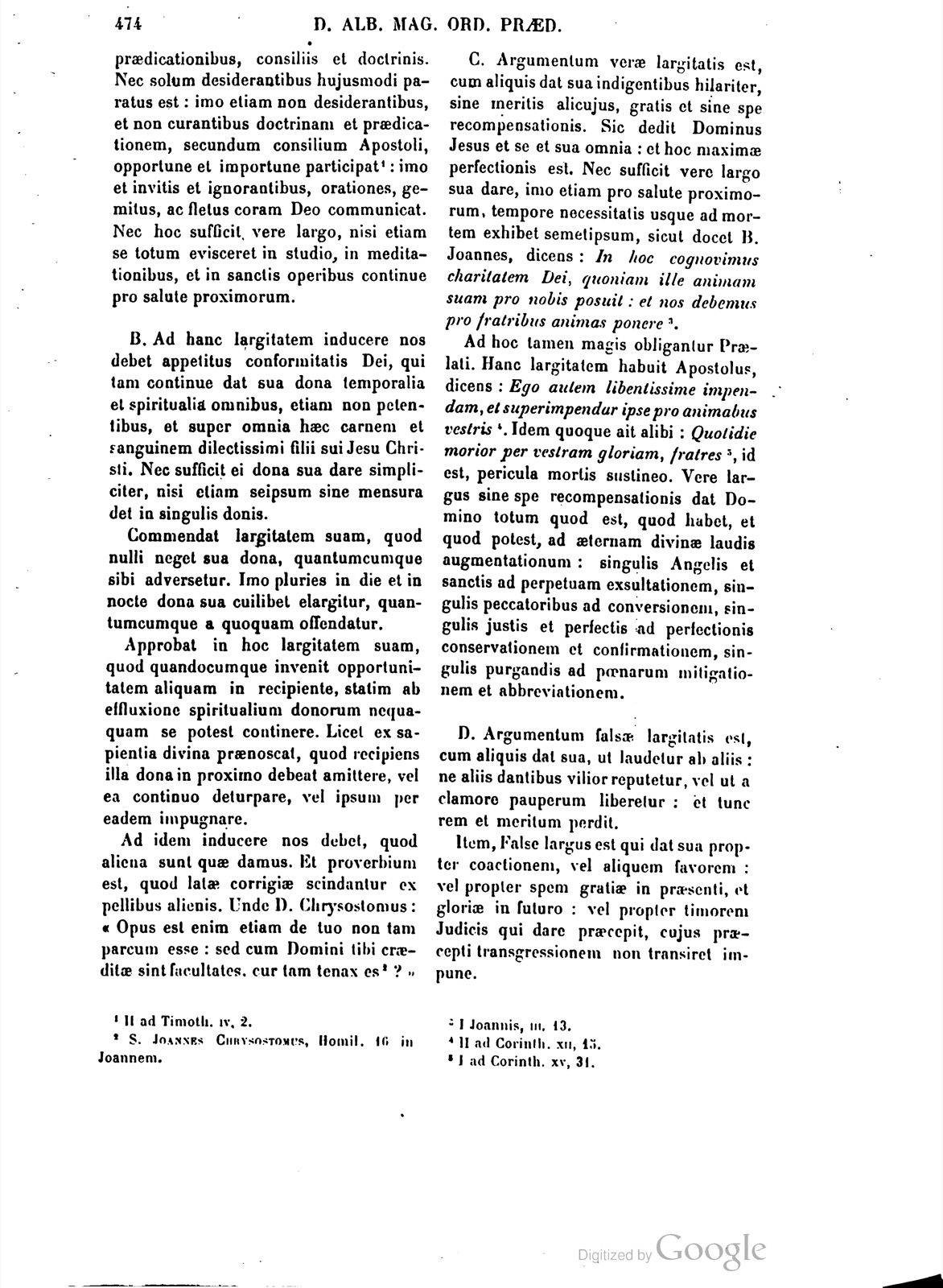
D. Argumentum falsae largitatis est, cum aliquis dat sua, ut laudetur ab aliis: vel ne aliis dantibus vilior reputetur, vel ut a clamore pauperum liberetur: et tunc rem et meritum perdit. Item, False largus est qui dat sua propter coactionem, vel aliquem favorem: vel propter spem gratiae in praesenti, et gloriae in futuro: vel propter timorem Judicis qui dare praecepit, cujus praecepti transgressionem non transiret impune.
D. The proof of false largesse is when someone gives his goods so that he may be praised by others, or lest, when others give, he be regarded as more vile, or so that he may be freed from the cry of the poor; then he loses both the thing and the merit. Likewise, he is falsely generous who gives his goods because of coercion, or some favor, or because of hope of grace in the present and glory in the future, or because of fear of the Judge who commanded giving, the transgression of whose command he would not pass through unpunished.
If a page does not appear, its photograph has not been uploaded yet.